Watch


The Angiotensin No. 2 formula
For a pressure that fell suddenly because half a litre of blood went out
This is a treatment for raising low BP and bringing it immediately to normal, made exactly on the basis of the facts of physiology. It is very good for those patients whose blood pressure has fallen because 500 ml or more of blood has flowed out of the body — from menstruation, or from a blow, or from the cutting of some limb.
By this treatment the blood pressure will rise at once. And it has one further quality that no tablet has: as the production of blood in the body increases over some days, so this treatment reverses itself. That is, the blood pressure will not rise more than is needed. How that happens is the whole of what follows.
The Renin–Angiotensin System, in plain words
Angiotensinogen, renin, ACE — and the three actions of angiotensin #2
The cascade, step by step
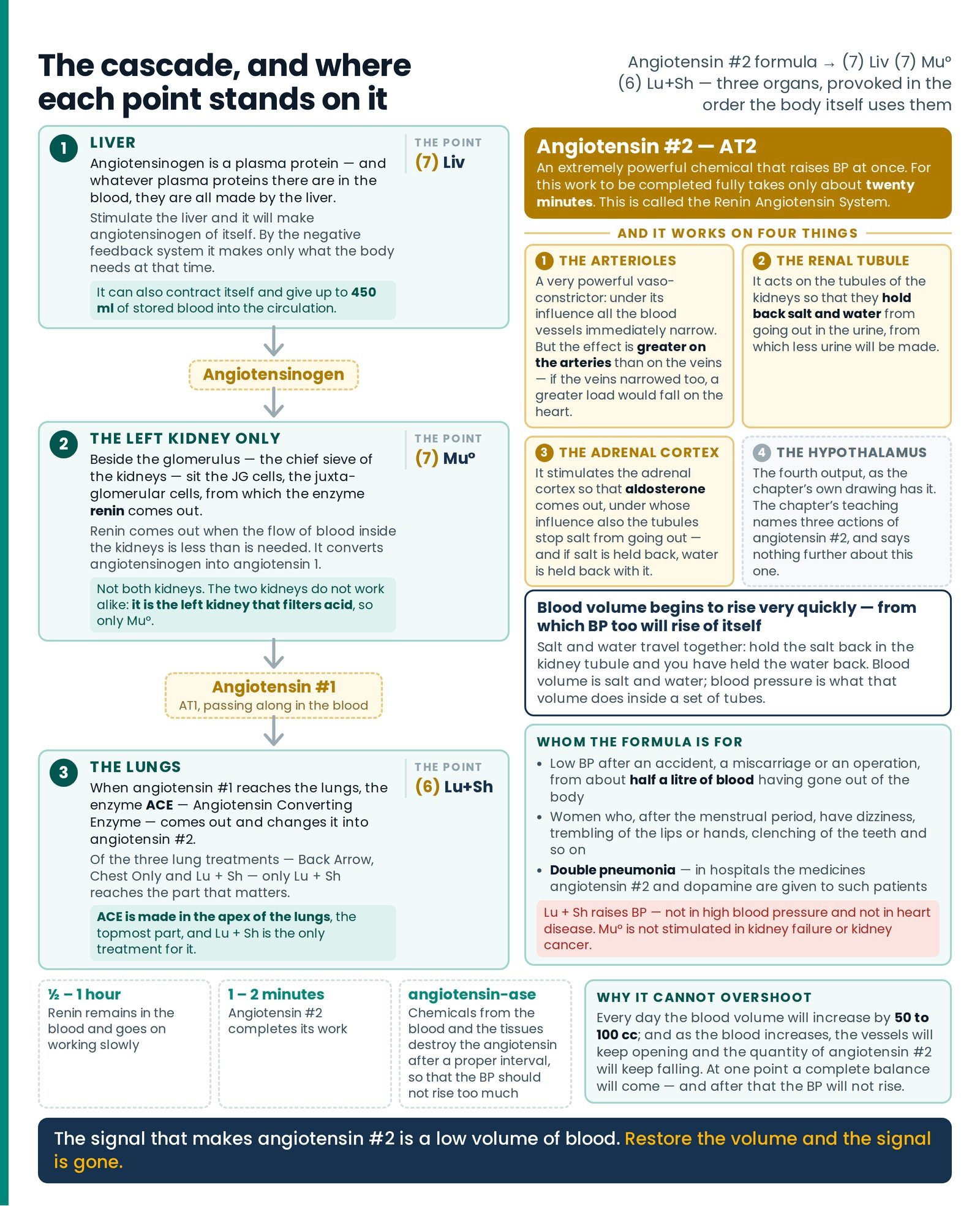
In the blood there is a plasma protein called angiotensinogen. When for some reason the BP in the body falls, the kidneys will not be able to filter the blood properly. From this there will be an accumulation in the blood of unwanted things like urea and creatinine, from which harm will come to the body.
So that this should not happen, near the glomerulus of the kidneys — the glomerulus being the chief sieve of the kidneys — there are cells called the JG cells, the juxta-glomerular cells, from which an enzyme called Renin comes out. This enzyme will come out when the flow of blood inside the kidneys is less than is needed. If there is angiotensinogen in the blood, renin will convert it into angiotensin 1 (AT1).
When angiotensin #1, passing along in the blood, reaches the lungs, then from the lungs an enzyme called ACE comes out — Angiotensin Converting Enzyme — which changes that angiotensin #1 into angiotensin #2.
Angiotensin #2, written in short as AT2, is an extremely powerful chemical that raises BP at once. It works in three ways, and the third of them is the one that gives this article its title.
The three actions of angiotensin #2
First — it is a very powerful vaso-constrictor: under its influence all the blood vessels immediately constrict, that is, narrow. But the remarkable thing is that it does not have the same effect on arteries and on veins. Its effect is greater on the arteries, from which the pressure inside them — the arterial pressure — rises. Against this raised pressure in the arteries the heart has to pump the blood; and if at the same time the vessels of the veins were also narrowed, a greater load would fall on the heart — so that this should not happen, AT2's effect on the veins is less.
Second — it acts on the tubules of the kidneys so that they hold back salt and water from going out in the urine, from which less urine will be made. If more urine were made, the volume of the blood would fall further, would it not?
Third — it stimulates the adrenal cortex, so that aldosterone will come out of it, under whose influence also the tubules of the kidney will stop salt from going out. But if salt is held back, water will be held back along with it. So salt and water will remain in the body.
That is: three different effects of this kind, because of which the blood volume begins to rise very quickly, from which BP too will rise of itself. For this work to be completed fully takes only about twenty minutes. This is called the Renin Angiotensin System.
There is a clock inside it, and the clock is the reason the system does not run away with itself.
Renin remains in the blood for half an hour to one hour and goes on working slowly, whereas angiotensin #2 completes its work within one or two minutes. And from the blood and the tissues several chemicals come out which are called angiotensin-ase, which destroy the angiotensin after a proper interval, so that the BP should not rise too much. A chemical whose name ends in -ase is an enzyme that breaks — that is, digests — something. Angiotensin-ase: the enzyme that digests angiotensin.
Where a blood pressure falls from, and what falling does
Haemorrhage, hypovolaemia — and the signs that say the system did not answer
Now let us see from what causes BP can fall. If low BP has come on suddenly, one main cause of it is blood suddenly flowing out of the body. This is called haemorrhage. Because of it, the blood volume — the quantity — falls all at once.
Ordinarily this can happen from the following causes:
when some deep injury has occurred;
or an accident has happened;
or, in women, when there has been very heavy bleeding during an abortion — a miscarriage — or in the menses;
some people can feel giddy even after donating blood. That too is from this same cause.
Note: if bleeding has occurred because of an accident, in the hospital report it is written as haemorrhage due to RTA — RTA meaning Road Traffic Accident.
What trouble is caused by BP falling
If the bleeding is suddenly so great that 35% of the body's blood — around one and three-quarter litres — goes out, then because of it, first the outflow of blood from the heart will be very much reduced, and afterwards the BP will keep falling. Then heart failure can also occur — that is, the heart may even stop altogether — which is called hypovolaemic shock. So that this should not happen, angiotensin #2 constricts the peripheral arteries more, so that the situation of heart failure should not arise.
[hypo = less; vol = volume; -aemia = in the blood. Hypovolaemia means the volume of blood becoming low.]
If around half a litre of blood goes out of the body, there is not so much danger. In some women this can happen after the menses — because of which, for two to three days after the menstrual period, or for somewhat longer, they feel giddy on doing any work at all. On being asked they will say that their bleeding in the menstrual cycle is very heavy. Because of this their blood volume and blood pressure fell suddenly for some days.
And then the sentence that turns a physiological account into a way of examining a woman standing in front of you.
A shortage of blood means a shortage of haemoglobin — the oxygen-carrier — in the body. When the woman is lying down, the blood she has is enough to supply the oxygen needed for the body's involuntary work — the work of the heart, the lungs and so on. But when she sets to work, she needs more oxygen, which she cannot get because of the shortage of haemoglobin. Because sufficient oxygen does not reach the brain, she feels giddy.
The other signs in such women are shivering, clenching of the teeth, speech stopping — that is, not even having the strength to speak — and falling temperature and pulse.
The sign that says the system is not doing its own work
So if, after blood has suddenly been lost, the above signs appear in someone, one meaning of it is that angiotensin #2 is not being formed in their body.
(The production of angiotensin number two increases when the pressure in the arteries, or the quantity of blood in them, suddenly falls. So where the pressure has fallen and the signs of the fall are there, the system that should have answered it has not answered.)
Liver, kidney and lung — how the formula was built
Four questions, four answers, and a formula: (7) Liv (7) Mu° (6) Lu+Sh
If we somehow make angiotensin #2 in the body, the BP will become normal. First we have to make angiotensinogen. Then the kidney and lungs will change it. So how is all this to be done?
Here comes the originality, and it is worth following one bullet at a time, because each answers a question a good student would have raised.
Four questions, four answers, and a formula
Where does angiotensinogen come from? It is written that angiotensinogen is a plasma protein. And whatever plasma proteins there are in the blood, they are all made by the liver. That is: if any plasma protein at all is to be made, we have only to stimulate the liver. It will make angiotensinogen of itself! And after that, the kidney and the lungs have to be stimulated. If we succeed in stimulating these three properly and in order, then we can solve this problem. Not only that — the lungs and the liver have one further quality, that some blood remains stored within them, which both of them can bring into the circulation when there is need. The liver can contract itself and give up to 450 ml of blood to the circulation.
But the liver makes a great many things — when we stimulate it, will it not make all of them? Answer — No, it is not so. In our body there is a negative feedback system, by which every organ of the body comes to know which thing or chemical the body needs at that time, and which it does not. So when we stimulate the liver, it will make only those things which the body needs at that time — among which one will be angiotensinogen. It will not make those things which are already present in the body in sufficient quantity.
Are we to stimulate both kidneys? Answer — No. We are not to stimulate both kidneys. Note that acidosis occurs because of a rise of acid in the body. And in this therapy it has been found that the two kidneys do not work alike. It is the left kidney that filters acid. That is, acidosis diseases come only when the left kidney is not working properly. So we have to stimulate only the left kidney, that is Mu°.
And which lung treatment? For stimulating the lungs there are three treatments — \°/, that is Back Arrow, Chest Only, and Lu + Sh. Which of the three? Answer — ACE is made in the apex of the lungs — that is, the topmost part — and to stimulate this part we have only one treatment: it is Lu + Sh.
Read the second of those four again, because it disposes of the objection most often raised against this whole therapy. The worry is: if you stimulate an organ, will you not get everything that organ makes, wanted or not? The answer offered is the negative feedback system — the body's own arrangement for knowing what it is short of. On that account a stimulation is not an order to manufacture; it is an invitation to a factory that already knows its own order book.
An everyday version: you do not tell the kitchen what to cook. You tell the kitchen the family is home. What comes out is what the family was short of.
Table 11 — Card: the Angiotensin No. 2 formula Supine 6 sec Left Both sides ▲ Take care
| Written | Angiotensin #2 formula → (7) Liv (7) Mu° (6) Lu+Sh |
|---|---|
| What it is for | To raise a suddenly-fallen blood pressure at once and bring it to normal, in the patient from whose body about half a litre of blood or more has gone out |
| Position | Supine throughout Supine |
| Step 1 — (7) Liv | Supine; the therapist's right sole on the patient's left arm above the elbow and the left sole on the left thigh, together — the Liv – 3 points pass given twice and then once more at the middle station, six applications and then a seventh. To make the liver produce angiotensinogen, and to bring as much as 450 ml of stored blood into the circulation 6 sec |
| Step 2 — (7) Mu° | Supine; the left kidney code, single station, hand contact high at the shoulder Left . To provoke the left kidney, so that by renin it makes angiotensin #1. Only the left — it is the left kidney that filters acid |
| Step 3 — (6) Lu+Sh | Supine, from the head end. Station 1: the flats of both palms, very light pressure, on both sides at the collar bone, the place below the shoulder bone — this is for rousing the lungs. Station 2: with the middle part of the palm or the sole, press a little firmly above the shoulder joint and release at once, so that the shoulder is pulled outward — this is for opening the muscles of the chest. These two together make (1) Lu + Sh; repeat them alternately six times. Ordinarily no pillow is needed; if the therapist's foot does not reach the ground, a thin pillow may be placed under the patient's forehead, so that pressure does not fall on the shoulder bone Both sides |
| Why the lung, and why this lung treatment | To provoke the lungs to make ACE, which will convert AT1 into AT2. ACE is made in the apex of the lungs, and Lu + Sh is the only treatment that reaches that part |
| What it inherits | Liv — not in liver cancer. Mu° — do not stimulate it in kidney failure or kidney cancer; those who have pain only at Liv° — do not give it to them. Lu + Sh — this raises BP, so do not give in high blood pressure and in heart disease ▲ Take care |
| Points taught in | Liv and Mu° — The Front of the Body I, "The Front of the Body — I"; Lu + Sh — The Front of the Body II, "The Front of the Body — II"; indications and bars — Each Point in Use |
Table 12 — The three points read against the cascade
| Step | Point | Organ | The step of the cascade it is aimed at |
|---|---|---|---|
| 1 | (7) Liv | Liver | Angiotensinogen — and 450 ml of stored blood into the circulation |
| 2 | (7) Mu° | Left kidney | Renin, which makes angiotensin #1 |
| 3 | (6) Lu+Sh | Lungs | ACE, which converts AT1 into AT2 |
It was seen that immediately after this treatment the shivering of those women stopped and the blood pressure began to rise. Since the formula is based on the facts of the physiology of angiotensin #2 production, its name was fixed as the Angiotensin #2 formula. (Figure 35.4)
Why it cannot overshoot
Restore the volume and you have removed the signal that makes the chemical
Here is the part that makes this formula unlike a drug, and it is worth saying to a patient in exactly these terms.
The self-cancelling arrangement
The quantity of blood is a fourteenth part of the whole body weight.
By this treatment the vessels are immediately constricted by the renin–angiotensin system, the flow of blood increases, and the BP begins to come right. Every day the blood volume will increase by 50 to 100 cc; and as the blood increases, the vessels will keep opening and the quantity of angiotensin #2 will keep falling.
And at one point a complete balance will come — the quantity of blood will be right, and just so the quantity of angiotensin #2 will also become normal, and after that the BP will not rise.
Is this an unbelievable thing? Can a thing said on the basis of experience not be true?
A thermostat is the analogy every household understands. You do not turn a thermostat off when the room is warm; the room being warm is the instruction that turns it off. The signal that makes angiotensin #2 is a low volume of blood. Restore the volume and you have removed the signal — and the treatment stops working because there is nothing left for it to answer.
Table 13 — Whom the Angiotensin No. 2 formula is for
| The patient | The instruction |
|---|---|
| Low BP after an accident, a miscarriage, or an operation, from about half a litre of blood having gone out of the body | Give the Angiotensin #2 formula |
| Women who, after the menstrual period, have dizziness, trembling of the lips or hands, clenching of the teeth and so on | Give the Angiotensin #2 formula |
| Double pneumonia | The formula is useful. In hospitals, to give relief to such patients, the medicines angiotensin #2 and dopamine are given. In a normal person, when there is a lack of oxygen, blood flow in the tissues increases; but perhaps in this illness the flow of blood cannot increase enough for the needs of the tissues to be met. This formula has been found excellent for those patients too — in pneumonia the flow of blood in the tissues is reduced, from which there will also be a deficiency of oxygen |
How the name Angiotensin #2 was arrived at, and what was seen at Salem
Reasoned first, named afterwards — with the doctor's disbelief kept in
The formula was reasoned out first and named afterwards, on what was seen. It is worth having the sequence in that order, because that order is itself the claim.
Where the interest began. In hospitals, for the treatment of double pneumonia, the medicines given are dopamine and angiotensin # 2. The two chemicals of this part of the article were not picked out of a physiology book. They were picked out of what was being put into patients who were very ill.
What was already in hand before the formula was built. That dopamine can be provoked with (20) Medulla had already been seen.
The dopamine reasoning, and the answer that came back from the hospitals
When the treatment called (20) Medulla is given, a considerable difference comes in the tremor of the hands of many Parkinson's patients. In the same way, if the quantity of Prolactin has risen in a woman, that same treatment lowers the Prolactin level in her body.
It is precisely from a deficiency of dopamine that Parkinson's disease arises, and another of dopamine's functions is to inhibit — that is, to hold back — prolactin. This treatment has an effect on both these things, and so it is said that the treatment of (20) Medulla produces dopamine in the body.
And then the line that is easy to read past. When several hospitals in Mumbai were telephoned and asked, the same answer came from everywhere: dopamine testing is not done in their laboratories!
That last line stands where it stands and is not tidied. It is not an excuse, and it is not offered as one. It is the plain account of why a claim about dopamine in this therapy has a telephone call behind it and not a report: the test was asked for, in Mumbai, from several hospitals, and the same answer came back from all of them — it is not done here. A student who is asked why did you not simply test it? may give that answer exactly as it is written, and add nothing to it.
What was then read, and then done. From the books it was learnt that angiotensin # 2 is formed by the working of the liver, the kidneys and the lungs. When these three organs were provoked in order, in this therapy's own way, a patient's low blood pressure rose and began to come right. After using it on various occasions it began to be felt that the treatment really does the work that angiotensin #2 does. On that, the name angiotensin #2 formula was fixed. The three organs, in that order, are the three steps of Table 11; the reading of this section is that the order came from the book and the name came from the patients.
And the use that grew out of it. When a child has double pneumonia and is given (20) Medulla and the Angiotensin #2 formula along with the other treatments, the child benefits considerably after only a few treatments. That is the same pairing the hospitals use in the same illness — dopamine and angiotensin #2 together — and it is the seed of the ADK sequence taught immediately below.
One further sentence belongs here, because it describes how a finding travels in this therapy rather than what any finding was: "And I do not hide this from my students — as soon as any good results are obtained, I tell all those who are in contact with me at once."
ADK — the sequence for the patient who once had pneumonia
Angiotensin, dopamine, kidney — and the illness the mother had
One line of enquiry led straight out of the Angiotensin formula and into a group of patients nobody had thought to connect.
ADK, and the way to remember it
For those who had pneumonia in childhood and came to us many years later, the following treatment has been found very beneficial:
I — the Angiotensin #2 formula II — (20) Medulla — for dopamine III — the Kidney clear treatment — because of pneumonia there is an effect on the kidney as well
(Remember the order — ADK. A means AT2; D means dopamine; K means kidney.)
One more reason for the use of Angiotensin #2 is that it increases the flow of blood inside the kidney.
Table 14 — Card: the ADK sequence Supine Seated Prone ▲ Take care
| Part | What is given | Detail | Why |
|---|---|---|---|
| I — A | The Angiotensin #2 formula | (7) Liv (7) Mu° (6) Lu+Sh — Table 11 Supine | Angiotensin II |
| II — D | (20) Medulla | Twenty applications, both sides of the neck below the ears, the patient seated Seated | For dopamine |
| III — K | The Kidney clear treatment | The grade chosen by the condition of the body on that day — Table 22 and Table 25 Supine Prone | Because of pneumonia there is an effect on the kidney as well |
| What it inherits | Lu + Sh — not in high blood pressure and not in heart disease. (20) Medulla — the contraindication card blocks it in heart disorders and in high blood pressure. Mu° — not in kidney failure or kidney cancer. Ch. Only — not in lung cancer ▲ Take care |
Where this sequence is used, and why, widens considerably from the child with pneumonia.
In mentally retarded children it is sometimes found that some of them had pneumonia in childhood. Giving these three treatments along with the other treatments makes a considerable difference — the parents of such children tell us so themselves.
Not only that. If a child comes to us for any problem at all, and we learn that the child earlier — or the mother during her pregnancy or a few days before it — had pneumonia, then when we give the child all three of the above treatments the benefit reaches him at once, even though he may have come to us for some entirely different illness.
Why a treatment is given to the child for an illness the mother had
Question — everything else was understood, but this was not: if the mother had pneumonia, why is this treatment to be given to the child?
Answer. For as long as the child is in the mother's belly, whatever deficiencies there are in the mother will be in the child as well. If the mother had pneumonia during the pregnancy, then whatever deficiency came from it — surely that same deficiency will have come in the child too?
The same reasoning was already used once, in the Chole treatment formula — Setting the Stomach, "Setting the Stomach". And you met its exact twin in the vitamin article, where a small child who cannot say whether a point hurts is investigated by checking the mother's pain points and treating the child for whatever she was short of in pregnancy.
An open question, left open
An increase in the quantity of AT2 helps to maintain the GFR — the flow of blood inside the kidneys — and to keep the excretion of waste things such as creatinine and urea normal.
That is: if we want to improve kidney function, can we give the angiotensin #2 formula for that too? If kidney patients do not have high BP, then this is to be tested: will it reduce creatinine or urea? — both of these are to be considered, are to be tested.
That is exactly how it stands, and this wiki leaves it standing. Note what the question already contains: a condition (if kidney patients do not have high BP), a measurement (creatinine or urea), and an honest verb (to be tested). It is not a claim. It is a proposal for work, and the work has not been done.
The Vasopressin formula
(2) Para, and nothing else — the shortest formula in the manual
The story at the head of this article is how it was found. Here is the formula, which is the shortest in the wiki.
The Vasopressin formula
Table 15 — Card: the Vasopressin formula Supine 6 sec Both sides ▲ Take care
| Written | Vasopressin formula → (2) Para |
|---|---|
| What it is for | Low BP of many years' standing — a pressure that always remains below normal, for example 100/70. Such people become tired very quickly from working |
| The whole formula | Two applications of the parathyroid point. That is all of it |
| Technique | The Para contact, elbow and shoulder places, four contacts equal one — elbow, shoulder, elbow, shoulder, six seconds at each. The Front of the Body II, "The Front of the Body — II" 6 sec |
| What was recorded | The blood pressure rose after one treatment. After one more treatment of (2) Para the next day, it became normal. On checking again after some days it was still normal; it had not come back down |
| What the chemical is | Vasopressin is a hormone which is made in the hypothalamus and is then stored in the posterior pituitary. It is a very powerful chemical, by whose effect all the blood vessels of the body contract and become narrow. By its effect the kidneys hold water and do not let it go out — that is, the blood volume increases, and from that the BP begins to rise |
| The other use | Diabetes insipidus — an illness in which ADH is not made in the body, on account of which the person drinks a very great deal of water, and very soon afterwards passes a very great deal of urine as well. But by the grace of Hari this illness is very rare |
| What it inherits | (2) Para — do not give to high blood pressure patients ▲ Take care |
| What (4) Para is instead | A different treatment at the same site: (4) Para raises the calcium in the blood by means of parathormone, PTH. See the box below |
Para at its two counts, and why the number is the whole instruction
(2) Para → vasopressin — to normalise a long-standing low blood pressure, and for diabetes insipidus, in which there is a deficiency of vasopressin.
(4) Para → parathormone (PTH) — to raise the calcium in the blood; given inside the 1,25 DCC formula to maintain the amount of calcium in the blood; for those who get cramps from calcium deficiency; and for women with excessive flow during menstruation.
Two applications and four applications, at one site, are two different treatments provoking two different glands — the posterior pituitary and the parathyroid. Read the number before you read the point. And carry (4) Para's own rule with it: those who have osteoporosis are not given (4) Para separately by itself; they must be given the full 1,25 DCC formula.
Since then this treatment has been tried on many patients for low BP. And on all of them the same kind of results have been found, from which it is proved that the inference was right — that from giving (2) Para, vasopressin is made.
The readings the name was given on
Beside the account of how the formula was found stands a set of figures, repeated on patient after patient. These are the measurements the name was actually offered on.
What was measured, and in what order
If a patient's blood pressure is 90/50, we give them the treatment called (2) Para twice, at an interval of one minute each — and it has been seen that within one hour their blood pressure rises to 100/60.
And after some days of treatment the blood pressure comes to 110/70 or even higher.
And that patient no longer gets the giddiness they had before — they feel very well. This has been proved on many such people.
So it is understood that this treatment produces or provokes vasopressin in the body, and for that reason the treatment was given the name Vasopressin treatment.
Take the measured record by itself, in the order it was taken:
Before treatment — 90/50. That is the patient this record is about: not a pressure that is a little soft, but one low enough to be making her giddy.
The treatment — (2) Para, given twice, at an interval of one minute each. Carry the interval with the count. The formula on the card is (2) Para; what was done to get these figures was that formula given twice, a minute apart, in a patient found at 90/50.
Within one hour — 100/60.
After some days of treatment — 110/70, or even higher.
And alongside the figures — the giddiness she had before no longer comes, and she says she feels very well.
Three things are worth saying about that list, and none of them is a complaint about it.
The first is that the figure moved inside an hour, which is short enough to be watched in the room, and long enough that anybody can check it. A therapist who wants to know whether this is true of the patient in front of him has only to take the reading, give the treatment, and take the reading again. This is the most easily checked claim in the article, and it costs nothing but a cuff and an hour.
The second is that both halves moved together — ten points on the upper figure and ten on the lower — which is what a change in the volume and the tone of the whole system looks like, rather than a change in one part of it.
The third is the last line, and it is the one a patient cares about. The giddiness stopped. A pressure that reads better on a machine while the patient still cannot cross a room has not answered anything; this record says the reading and the person moved in the same direction.
Which of the two, for which patient
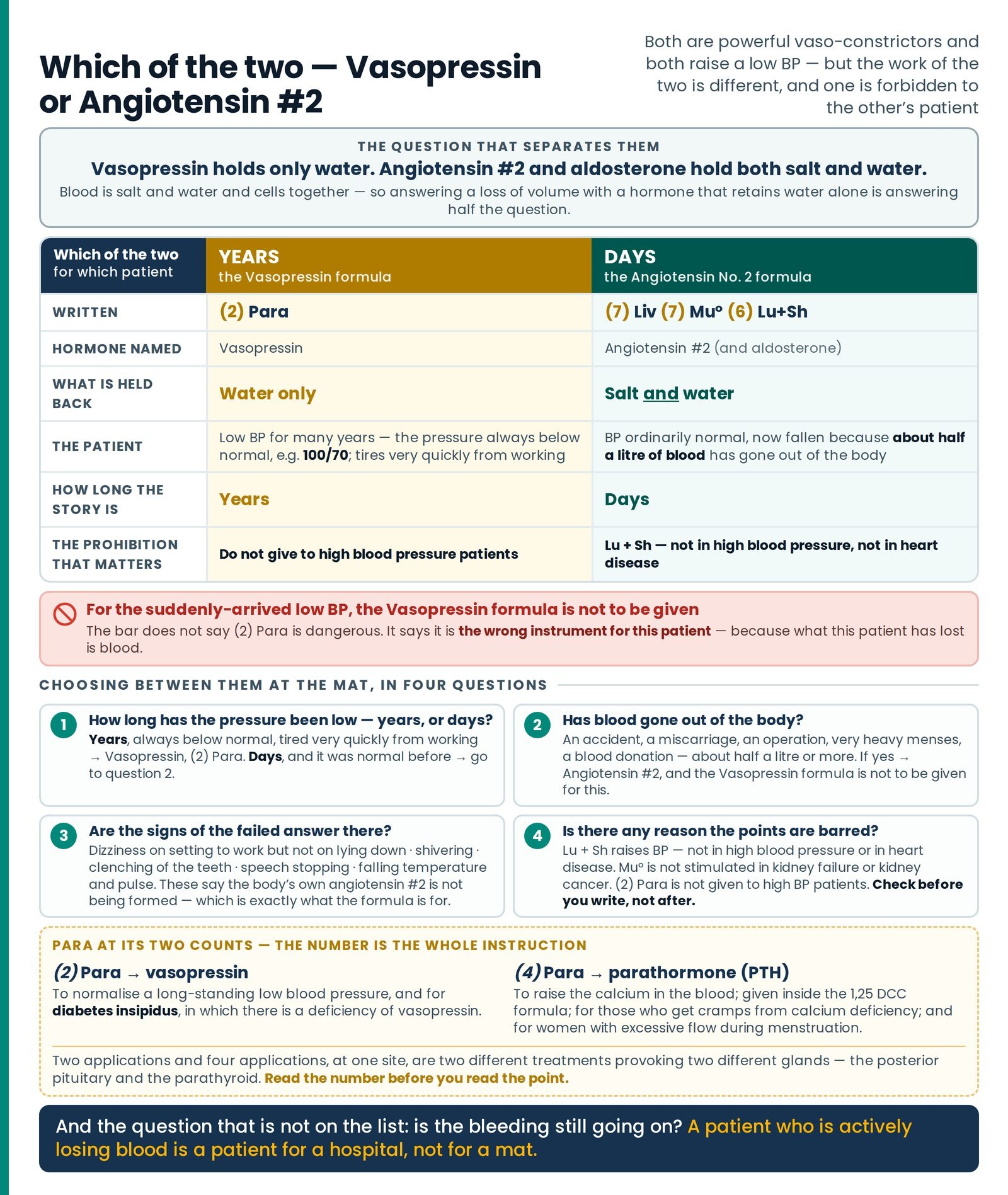
Vasopressin holds water only; angiotensin #2 holds salt and water
The question, and the answer that separates them
Question — the angiotensin #2 formula and vasopressin both raise the BP. So how will it be known which formula is to be used for which patient?
Answer. Angiotensin #2 and vasopressin are both powerful vaso-constrictors. Both raise the blood pressure, that is, they make a low BP normal. But the work of the two is different.
Vasopressin holds only water.
Angiotensin #2 and aldosterone — these hold both salt and water.
| Vasopressin formula | Angiotensin No. 2 formula | |
|---|---|---|
| Written | (2) Para | (7) Liv (7) Mu° (6) Lu+Sh |
| Hormone named | Vasopressin | Angiotensin #2 (and aldosterone) |
| What is held back | Water only | Salt and water |
| The patient | Low BP for many years — the pressure always below normal, e.g. 100/70; tires very quickly from working | BP ordinarily normal, now fallen because about half a litre of blood has gone out of the body |
| How long the story is | Years | Days |
| The prohibition that matters | Do not give to high blood pressure patients ▲ Take care | Lu + Sh — not in high blood pressure, not in heart disease ▲ Take care |
Where they came from
A bottle of multivitamin tablets, a question asked, and four treatments
Once Guruji, Kamlesh Didi, Shri Piyush Panchal ji and some other therapists were sitting and having some discussion about the formulas. Then Piyush ji asked Guruji why some such treatment should not be made from which everybody would get energy — that is, strength. At that very moment a bottle of multivitamin tablets came into his hand; and looking at it, the names Vitamin B₁₂, calcium and so forth were on it.
Until then, separate treatments were already being given to raise calcium, sodium and so on. After Piyush ji's question this thought came — why not join these together and make one treatment? From that thought came four treatments.
At present these are four separate treatments, which correct the deficiency of sugar, sodium, calcium and vitamin B₁₂ and so forth in the body. Often it is from the deficiency of these things that a person feels tired for no reason. So when the appropriate formula is given to remove their deficiency, the patient's tiredness goes away at once. Hence these are called Multivitamin formulas, because if there is weakness in the body, doctors often tell people to take multivitamin tablets.
The four Multivitamin formulae, and the rule that governs them
1.
(1) Pit (3) Gal (7) Liv (8) Lt. Parkhoo (2) Adr 2. (4) Pit (3) Gal (7) Liv (8) Lt Parkhoo (6) Adr 3. (4) Para (3) Gal (7) Liv (8) Lt. Parkhoo (6) Adr or (2) Adr 4. (2) Para (3) Gal (7) Liv (8) Lt. Parkhoo (2) Adr
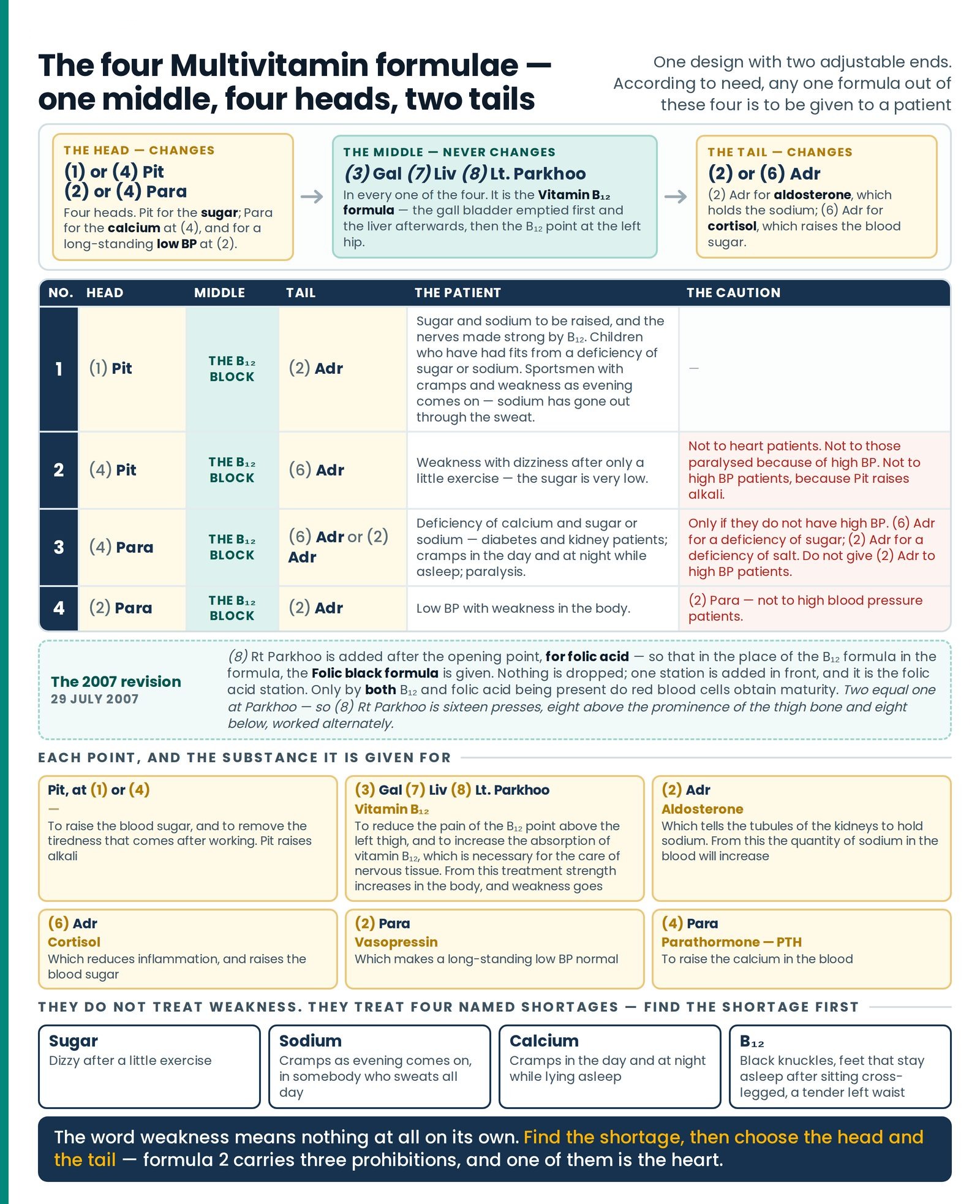
According to need, any one formula out of these four is to be given to a patient.
Look at the four lines together before you learn any of them separately, because they are one design with two adjustable ends. (Figure 35.6)
The middle three steps never change. (3) Gal (7) Liv (8) Lt. Parkhoo stands in every one of the four — and you already know it, whole, from the previous article: it is the Vitamin B₁₂ formula, the gall bladder emptied first and the liver afterwards, then the B₁₂ point at the left hip.
What changes is the head and the tail. The head is either Pit or Para, at one of two counts. The tail is Adr, at one of two counts. Four heads, two tails, and the whole clinical decision lives in those two brackets.
Table 17 — Each point of the Multivitamin formulae, and the substance it is given for
| Point and count | Substance named | What it is there for |
|---|---|---|
| Pit, at (1) or (4) | — | To raise the blood sugar, and to remove the tiredness that comes after working. Pit raises alkali |
| (3) Gal (7) Liv (8) Lt. Parkhoo | Vitamin B₁₂ | To reduce the pain of the B₁₂ point above the left thigh, and to increase the absorption of vitamin B₁₂, which is necessary for the care of nervous tissue. From this treatment strength increases in the body, and weakness goes |
| (2) Adr | Aldosterone | Which tells the tubules of the kidneys to hold sodium. From this the quantity of sodium in the blood will increase |
| (6) Adr | Cortisol | Which reduces inflammation, and raises the blood sugar |
| (2) Para | Vasopressin | Which makes a long-standing low BP normal |
| (4) Para | Parathormone — PTH | To raise the calcium in the blood |
That table is the whole grammar of the family. Four substances — sugar, sodium, calcium, B₁₂ — and a point for each, with the B₁₂ block sitting permanently in the middle because it is the one every tired body is assumed to want.
Which formula for which patient
Four named shortages — sugar, sodium, calcium, B₁₂ — one formula each
Formula 1 — (1) Pit (3) Gal (7) Liv (8) Lt. Parkhoo (2) Adr
Use — to raise sugar and sodium, and to make the nerves strong by means of B₁₂.
Especially those children who have had fits from a deficiency of sugar or sodium.
Or sportsmen who say that as evening comes on they feel something like cramps and weakness. Weakness in the evening means that sodium has gone out through the sweat. They have a deficiency of sodium, so (2) Adr will benefit them, because with (2) Adr we provoke aldosterone, which will stop the salt from going out.
Formula 2 — (4) Pit (3) Gal (7) Liv (8) Lt Parkhoo (6) Adr
Use — those who feel weakness, and who get dizziness after only a little exercise. This means the quantity of sugar in their body is very low. For them this treatment is excellent.
Formula 3 — (4) Para (3) Gal (7) Liv (8) Lt. Parkhoo (6) Adr or (2) Adr
Those who have a deficiency of calcium and sugar or sodium may be given this — such as diabetes and kidney patients, or those who get cramps in the day and also at night while lying asleep.
Those who have paralysis may also be given it, if they do not have high BP.
To those who have a deficiency of sugar, give (6) Adr.
To those who have a deficiency of salt, give (2) Adr. To high BP patients, do not give (2) Adr. ▲ Take care
Formula 4 — (2) Para (3) Gal (7) Liv (8) Lt. Parkhoo (2) Adr
This is good for those who have low BP and weakness in the body.
Formula 4 is worth a second look, because it is the only place in the wiki where (2) Para appears inside a longer formula. The Vasopressin formula is two applications on its own; here those same two applications open a five-step sequence, and the reason is stated in the point table: (2) Para for vasopressin, which makes a long-standing low BP normal. The patient is the same patient — low pressure of long standing — with weakness in the body on top of it, and the weakness is what the other four steps are for.
| Formula | Head | Tail | The patient | The caution |
|---|---|---|---|---|
| 1 | (1) Pit | (2) Adr | Sugar and sodium to be raised, and the nerves made strong by B₁₂. Children who have had fits from a deficiency of sugar or sodium. Sportsmen with cramps and weakness as evening comes on — sodium has gone out through the sweat | — |
| 2 | (4) Pit | (6) Adr | Weakness with dizziness after only a little exercise — the sugar is very low | Not to heart patients. Not to those paralysed because of high BP. Not to high BP patients, because Pit raises alkali ▲ Take care |
| 3 | (4) Para | (6) Adr or (2) Adr | Deficiency of calcium and sugar or sodium — diabetes and kidney patients; cramps in the day and at night while asleep; paralysis | Only if they do not have high BP. (6) Adr for a deficiency of sugar; (2) Adr for a deficiency of salt. Do not give (2) Adr to high BP patients ▲ Take care |
| 4 | (2) Para | (2) Adr | Low BP with weakness in the body | (2) Para — not to high blood pressure patients ▲ Take care |
The inherited bars, once, for all four. Pit — not to diabetic patients, because it raises sugar; it raises alkali, so not to high blood pressure, cancer and fits patients; perhaps low blood pressure patients will benefit. Para — (4) Para is not given separately by itself to those who have osteoporosis; they must be given the full 1,25 DCC formula; (2) Para not to high blood pressure patients. Gal — not in leukaemia, blood cancer or other diseases arising from a raised white cell count; not in asthma; not to those passing little urine. Liv — not in liver cancer. Lt. Parkhoo — no prohibition is printed for this point. Adr — (2) Adr not to high blood pressure patients; (6) Adr reduces immunity, so not in septicaemia, AIDS, HIV or cancer, and reduces acid and raises alkali, so not in high blood pressure. ▲ Take care
The 2007 revision — the right hip comes in
(8) Rt Parkhoo added for folic acid: the middle becomes Folic Black
A thought that came at the time of writing this — 29.07.2007
It seems that from now on (8) Rt Parkhoo should also be added into the Multivitamin formula — for folic acid.
That is, in the place of the B₁₂ formula in the formula, the Folic black formula is to be given.
Table 19 — The four Multivitamin formulae as revised, 29 July 2007
| No. | Step 1 | Step 2 | Step 3 | Step 4 | Step 5 | Step 6 |
|---|---|---|---|---|---|---|
| 1 | (1) Pit | (8) Rt Parkhoo | (3) Gal | (7) Liv | (8) Lt. Parkhoo | (2) Adr |
| 2 | (4) Pit | (8) Rt Parkhoo | (3) Gal | (7) Liv | (8) Lt Parkhoo | (6) Adr |
| 3 | (4) Para | (8) Rt Parkhoo | (3) Gal | (7) Liv | (8) Lt. Parkhoo | (6) Adr or (2) Adr |
| 4 | (2) Para | (8) Rt Parkhoo | (3) Gal | (7) Liv | (8) Lt. Parkhoo | (2) Adr |
Notice what the revision actually does. The three B₁₂ steps in the middle are replaced, as a block, by the four steps of Pure Folic Black — (8) Rt Parkhoo (3) Gal (7) Liv (8) Lt. Parkhoo, the right hip and then the whole B₁₂ formula. Nothing is dropped; one station is added in front, and it is the folic acid station. The reason is the one the vitamin article makes its whole argument out of: only by both B₁₂ and folic acid being present do red blood cells obtain maturity. A family of formulas written for tiredness that had only half of that pair in it was going to be improved by having both.
Two equal one at Parkhoo — so (8) Rt Parkhoo is sixteen presses, eight above the prominence of the thigh bone and eight below, worked alternately; and the same for (8) Lt. Parkhoo. The technique, the side the patient lies on and the pillows between the knees are in On the Side, "On the Side".
This is one of the most consequential treatments in the wiki, and it is consequential twice over: once for what it does, and once because it is the gate a heart patient must pass through before another formula may be given at all.
The Angina treatment, or Athero treatment
I — (4) Medulla Clockwise, ↑ (Up Arrow) at T1/T2 + Raman trt + (10) Pan (2) Thrd
II — (1) Single point liver × 2 treatments
III — P. Heparin → (8) Pan (7) Liv (8) Ch. Only + Sulta Ulta (with the hand at 135°)
or, for those who have pain in Mu° and hard constipation, for them:
III — Mild ATF
IV — A. Heparin + Sulta Ulta (to be given with the hand placed up at 135°)
Main illnesses — heart disease; atherosclerosis; raised cholesterol; raised triglyceride; cardiac asthma; carpal tunnel syndrome or tarsal tunnel syndrome, and so on.
Table 20 — Card: the Angina / Athero treatment Seated Supine Side-lying Prone 6 sec ▲ Take care
| Written | I (4) Medulla Clockwise ↑ T1/T2 + Raman trt + (10) Pan (2) Thrd · II (1) Single point liver × 2 trts. · III P. Heparin + Sulta Ulta at 135° — or Mild ATF · IV A. Heparin + Sulta Ulta at 135° |
|---|---|
| What it is for | Heart disease · atherosclerosis · raised cholesterol · raised triglyceride · cardiac asthma · carpal tunnel syndrome or tarsal tunnel syndrome, and so on |
| What selects the alternative part III | Pain in Mu° and hard constipation → Mild ATF in place of P. Heparin |
| Sulta Ulta, exactly | Supine. Ordinarily the arm at 90°; for those who have angina or heart disease, keep both arms extended — not parallel to the shoulders but a little upward, at 135°, or as far up as they will go. Powder from elbow to fingers. The soft part of the sole only: six times elbow → wrist with light pressure, then six times wrist → fingertips with a little more pressure, palm up (sulta); then all of it again palm down (ulta). It is not necessary to give both sides at the same time. Give the left side first and the right afterwards. With sulta the pain of the front of the chest goes out; with ulta the pain of the part of the back behind that same place goes out Left Right |
| Why (2) Thrd and not (4) Thrd | In angina — that is, in heart patients — to reduce cholesterol, (2) Thrd is given in place of (4) Thrd. And the reason (4) Thrd is withheld: (4) Thrd raises metabolism, and when the metabolism increases too much there can also be trouble — therefore (4) Thrd is not given to heart patients ▲ Take care |
| What it inherits | Pan — raises alkali, therefore not in fits, convulsions or seizures; never to schizophrenia patients. Liv — not in liver cancer. Ch. Only — not in lung cancer. acid — not if there are loose motions, or if there is no pain at Mu°. For the heart patient the contraindication card blocks (10) Medulla, (20) Medulla, (30) Medulla, Lu + Sh, Swt, Katka, Loveleen, Thymus and (4) Thrd ▲ Take care |
| Points and formulas taught in | Medulla — Seated I — Brain, Medulla, Neck, "Seated — I"; Raman and Neck Clockwise — Seated I — Brain, Medulla, Neck; the arrows — Face Down, "Face Down"; Pan, Liv — The Front of the Body I; Thrd, Ch. Only, Sulta Ulta — The Front of the Body II; P. Heparin and A. Heparin — The River — Heparin, "The River"; Mild ATF — Correcting the Two Kingdoms |
The rule that makes this a gate
The Angina treatment only, two to four days, before Vater may be touched
There is a second thing in that rule worth naming out loud, because students miss it. The graded Medulla series carries its own heart rule, and it is a substitution and not a refusal. (10) Medulla is not withheld from a heart patient; (10) Left Medulla is named as the half that may be given — and side is part of the identity of a point, not a detail of technique. That instruction belongs to (10) and travels with every formula containing (10) Medulla; it does not automatically attach to the other members of the graded series, each of which carries its own rules.
Why the upper back, when the trouble is the heart
A student's first question about part I is always the same: why does a treatment for angina begin at the neck and the T1/T2 beads?
Because that is where the heart reports. The nerves that carry sensation from the heart run with the sympathetic supply and enter the spinal cord at the upper thoracic segments, where they arrive at the same cells that carry sensation from the chest wall and the inner arm. That convergence is the reason a heart complains in the chest, the jaw and the left arm rather than in the heart — the plainest example of referred pain in the whole of physiology.
So a treatment that addresses the upper thoracic segments for a cardiac complaint is working on the segment the heart itself uses to speak. And Sulta Ulta — six passes down the arm palm up for the front of the chest, six palm down for the back behind it — is working the territory that shares those cells.
How the formula came to have a tail
A formula that reaches the acid–alkali machinery must put something back
In this therapy we use the WD point to provoke the reproductive organs. To provoke the organs below the navel we give the New Genes formula; and if there is severe pain there, then in it, in place of Chest Only we give Thymus Chest. We use this in problems of the uterus or the prostate gland.
The reasoning, exactly as it runs
In just the same way, to provoke the kidneys we use the Liv° – Mu° point.
From the experience of the Pure 1,25 DCC treatment, Guruji thought that provoking Liv° – Mu° alone could cause trouble to some patients. So, to make the acid–alkali balance, he began to give Ch. Only and ↑|↓ (Round Arrow) along with it —
— from which it was seen that patients get wonderful results.
That short passage is the reason of this article had to come first, and it is also the clearest demonstration anywhere of what the balance pair is for. A formula that provokes the two kidneys is a formula that reaches straight into the body's acid–alkali machinery — the left kidney filters acid, as you were told in the Angiotensin section — and a formula like that cannot be allowed to end where it stops. Something has to be put back.
You have met the same lesson from the other side. Pure 1,25 DCC has no balance pair, and both Pure formulas of the vitamin article carry a warning in the same words for exactly that reason. A formula that ends without a balance is a formula that leaves the patient somewhere.