- How it is given
- On the Side
- What it is used for
- Each Point in Use
Watch


From On the Side
Lt. Parkhoo — लेफ्ट परखू
Lay the patient as above, but on the right side, and press and release with pressure, alternately, at both points of the left hip.
Doing once above and once below is called (1) Lt Parkhoo. That is, the count is: two equals one.
| Patient's position | Lying on the right side, otherwise exactly as for Rt. Parkhoo — chest turned inward, knees very close to the chest; one or two pillows between both knees; a pillow under the head Side-lying Right ▲ Take care |
|---|---|
| Where the hands or feet are placed | Both points of the left hip — one above and one below — worked alternately, with pressure Left |
| Duration and repetitions | Once above and once below is called (1) Lt Parkhoo — two equals one |
| What it is for | Not separately stated at the point |
The hip that is worked is the upper one, and that decides which side the patient lies on: for Rt. Parkhoo the right hip must face the ceiling, so the patient lies on the left. The side they lie on is the side you are not treating. (Figure 20.3)
The pillow between the knees is not preparation for this point. It is part of the technique. Everything Parkhoo aims at depends on the hip staying where you put it, and the moment the upper knee falls below waist level the pelvis rolls forward and carries both stations away from your hand. The pillows go in as the knees come up, and are checked again after the first press. (Figure 20.4)
The knees come to the chest for a stated purpose — *so that it is easy to give the treatment at the edge of the femur bone*. Drawing them up rolls the pelvis and swings the top of the thigh bone outward until its knuckle stands up under the skin, and the two stations sit at that edge. On a patient whose knees have quietly straightened, the same presses land on a hip rolled back flat, and the edge is no longer where it was.
Parkhoo and the count that doubles — two equals one
At Parkhoo the written number is not the number of presses. One press above plus one press below, worked alternately, make one of what the card asks for. So (1) Rt Parkhoo is two presses and (8) Rt Parkhoo is sixteen — eight above, eight below, alternating.
The same convention governs Medulla, Ku, Armpit and Adr, and belongs to a family: two equal one, three equal one, four equals one. Learn the family, not the individual points.
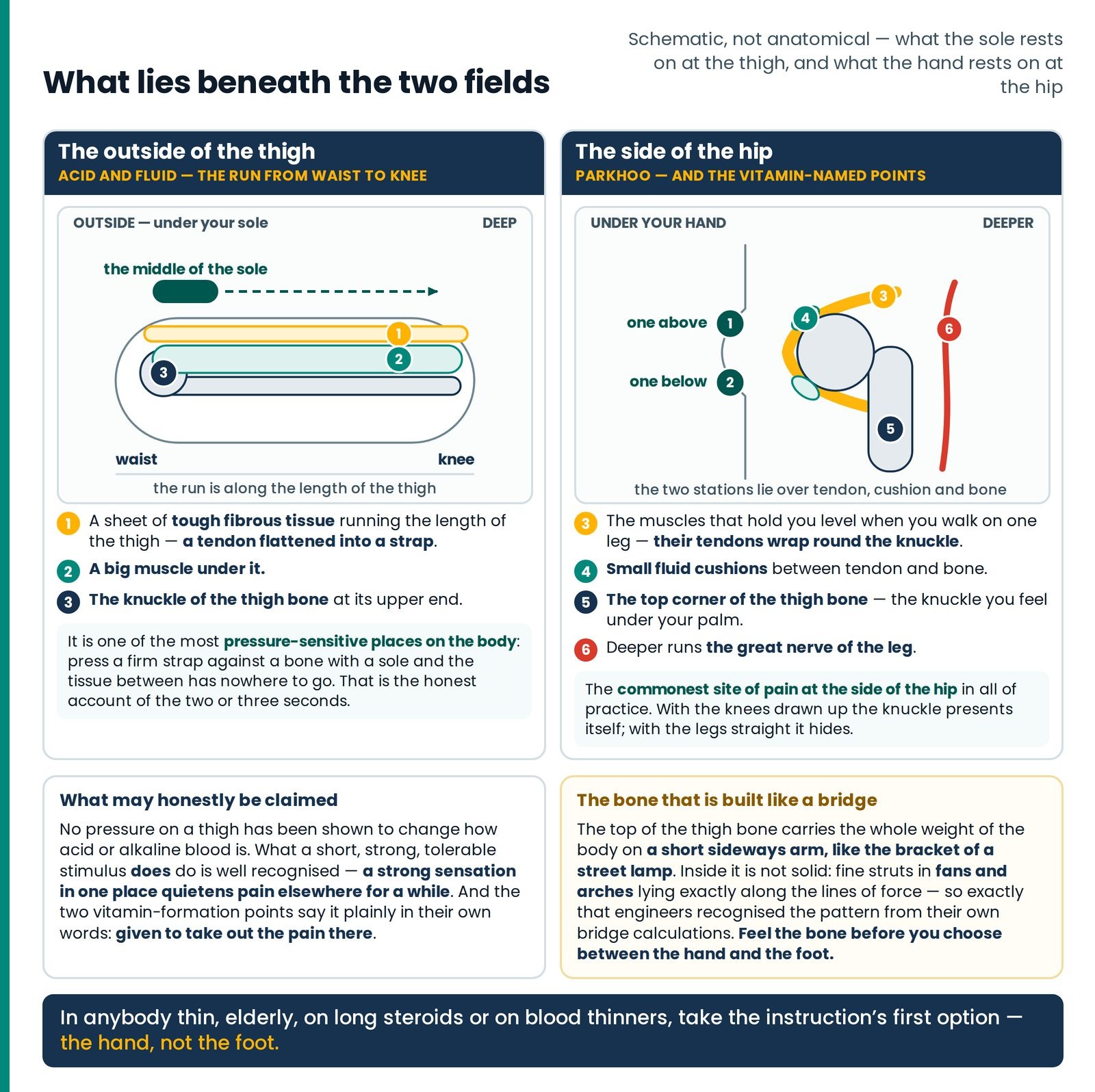
What lies beneath. Put a hand on the side of your own hip, stand on the other leg, and a knuckle of bone stands out under the palm — the top corner of the thigh bone. It anchors the muscles that hold you level when you walk on one leg; their tendons wrap round it, with small fluid cushions between tendon and bone, and deeper runs the great nerve of the leg. So the two stations lie over tendon, cushion and bone — the commonest site of pain at the side of the hip in all of practice. With the knees drawn up the knuckle presents itself; with the legs straight it hides. And in anybody thin, elderly, on long steroids or on blood thinners, take the instruction's first option — the hand, not the foot.
Also explained in
- What this article hands to the next On the Side
(Figure 20.6) Plate — Setting up for Rt. Parkhoo: the pillows between the knees · PLATE — AND THE PROMPT TO REDRAW IT Caption: The group's signature arrangement.
- The edge of the thigh bone — Parkhoo, right and left On the Side
Doing it once above and once below is called (1) Rt Parkhoo.
- Fluid or Alkali — फ्लूइड या ऐल्कली On the Side
She was set up for Rt. Parkhoo, and the setting up is where the first session went wrong: on a floor mat with one thin pillow between her knees, her upper knee sank below waist level within a minute, and the therapist wo
- Questions students ask On the Side
If (1) Rt Parkhoo is two presses, what is (6) Rt Parkhoo? Twelve — six above and six below, alternating.
- The hip pair — the vitamin points Each Point in Use
PARKHOO and RT. PARKHOO Point and variant What it is used for When it must not be used Notes Lt.
- The Folic acid and Pure Folic acid formulas Vitamin and Gene Formulas
➢ So why should it not be that if a treatment like Lt Parkhoo is done on the right side of the waist, folic acid would be made from it? That treatment was given the name Rt. Parkhoo.
- The 2007 revision — the right hip comes in Water and Salt
8) Rt Parkhoo added for folic acid: the middle becomes Folic Black It seems that from now on (8) Rt Parkhoo should also be added into the Multivitamin formula — for folic acid.
- Where this leads Vitamin and Gene Formulas
Pure Folic acid adds (8) Rt Parkhoo.
- Mild Genes Vitamin and Gene Formulas
Pure Folic Black formula → (8) Rt Parkhoo (3) Gal (7) Liv (8) Lt.
- Generation six — OLD UDF Clearing the Ash
Table 11 — Card: OLD UDF Seated Side-lying Prone Supine 6 sec Written, parts I–V I (15) Medulla · II (2) Rt Parkhoo (2) Lt Parkhoo · III (8) Rt Parkhoo (8) Lt Parkhoo · IV (½) Ku – 20 secs × 4 treatments · V
- The two treatments written for diabetics Clearing the Ash
Table 8 — Card: the eight-stage treatment for diabetics and for poor digestion Seated Side-lying Prone Supine 6 sec Written, stages I–IV I (3) Necklace · II (3) Raman Trt · III (2) Rt. Parkhoo (2) Lt.
- Reading OLD UDF point by point Clearing the Ash
Parts II and III — (2) then (8) Rt. Parkhoo and Lt.
- The general UDF formula Clearing the Ash
able 16 — Card: the general UDF formula Seated Side-lying Prone Supine 6 sec Written I (15) Medulla · II (2) Rt Parkhoo (2) Lt Parkhoo · III (½) Ku – 20 secs × 4 treatments · IV (10) Medulla (1) Gas Only – 6
- The stomach-setting formula Clearing the Ash
Table 17 — Card: the stomach-setting formula Seated Side-lying Prone Supine 6 sec Written I (15) Medulla · II (2) Rt Parkhoo (2) Lt Parkhoo · III (8) Rt Parkhoo (8) Lt Parkhoo · IV (½) Ku – 20 secs × 2 treat