- Part of
- Bones, joints and muscles
Watch


From The Low Back
Two treatments that serve the low back and the knee together
Cupped palms down the calf, then a heel at each toe joint — seated or bent
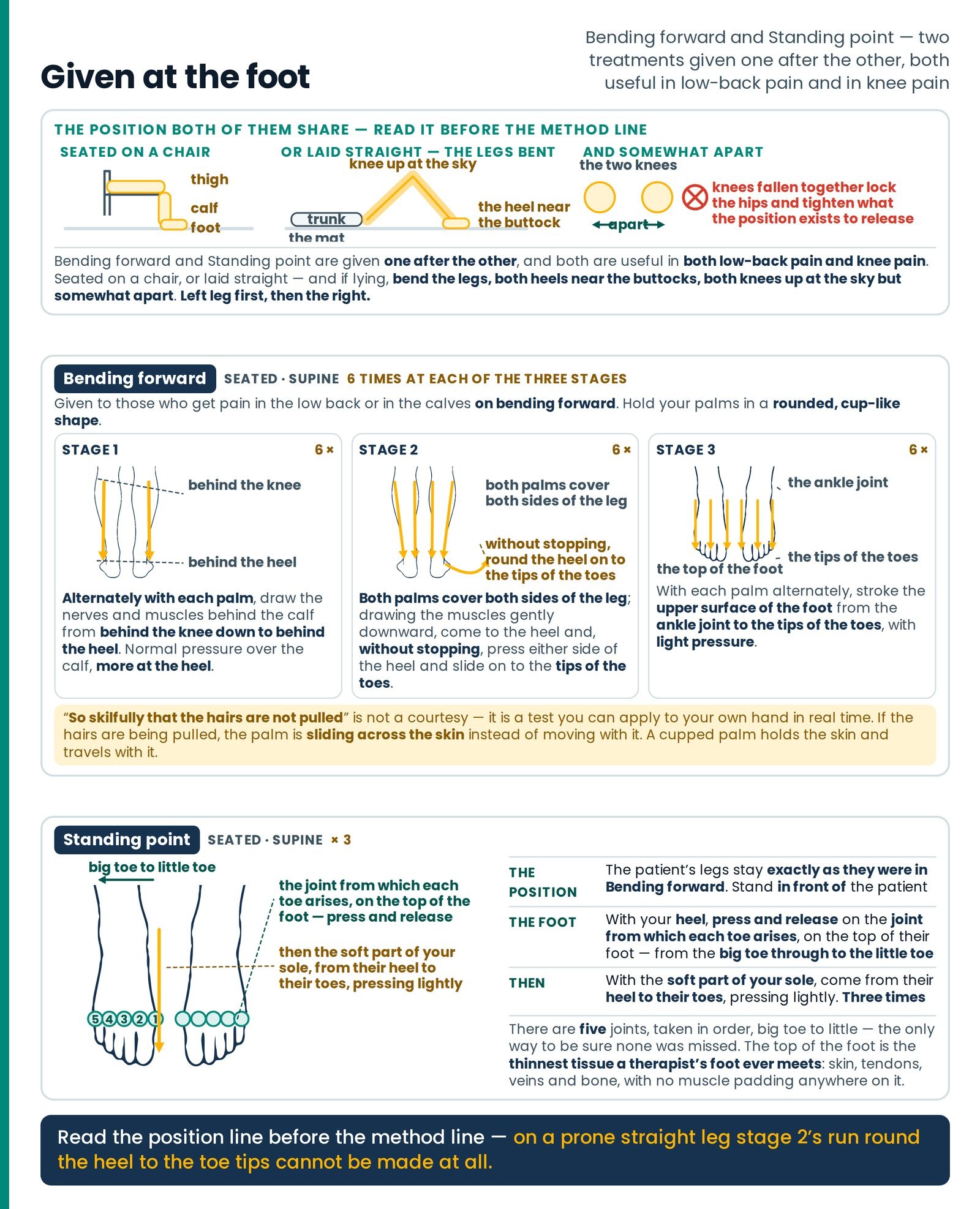
The shared setup
Both of the treatments below are useful in both low-back pain and knee pain. They are given one after the other.
They can be given with the patient seated on a chair, or laid straight. If given lying down, tell the patient to bend the legs and place both heels near their buttocks, with both knees pointing up at the sky but somewhat apart from each other.
That position does quiet work before a hand arrives. Hip and knee bent with the feet planted flattens the hollow of the low back, opens the gaps the nerves leave by, and releases the deep muscle running from the low back to the thigh, which has been under tension in every prone treatment so far — and it leaves the back of the calf slack, which is the tissue the first treatment is about to handle. Knees "somewhat apart" is written and is not a comfort note: knees fallen together lock the hips and tighten exactly what the position exists to release.
From Each Point in Use
The low back, the sacrum and the tail bone
Bone that can break and nerves that matter — the bars bite hardest
The largest physical family, and the one where the prohibitions bite hardest, because the hand here is over bone that can break and nerves that matter. Nothing in this family is given over the knee joint itself; The Low Back, "The Low Back", carries that rule with the points it governs, and it governs all of these.
Table 15 — The low back, the sacrum and the tail bone
| Point | What it is used for | When it must not be used | Notes |
|---|---|---|---|
| L5–S1 ghisai Prone | Good for sciatica, and for all pains of the back — especially for lumbar spondylosis or spondylitis. It works in three ways: 1. bringing the vertebrae of the back from L1 to S1 into their correct place; 2. relaxing the muscles of both sides of the buttocks; 3. pulling upward and setting right the muscles and nerves on both sides of the vertebrae that have descended | — | The three ways are the three stages of the technique. |
| (6) L3, 4, 5 Prone | Given to relax both kinds of back muscles from L1 to S1. Ordinarily (6) L3, 4, 5 are given | But if there is a fracture in any bone between L1 and S1, it is not to be given ▲ Take care | The plainest landmark and the plainest bar in the article. |
| L4 fracture Prone | Given if the L4 vertebra — the mankā — breaks or slips. With this treatment, the nerves of the L4 vertebra, which go to the inner side of the calves of both legs, are pulled — by which slowly that vertebra or disc comes back to its correct place | — | Inner side of the calves. This is the treatment for a fracture, where L3, 4, 5 is the treatment withheld because of one. |
| L5 fracture Prone | Given if the L5 vertebra or mankā breaks or slips. With this treatment, the nerves of the L5 vertebra, which go to the outer side of the calves of both legs, are pulled — by which slowly that vertebra or disc comes back to its correct place | — | Outer side of the calves. Inner for L4, outer for L5, and that single word is the whole difference |
| JJ⁺¹ Prone | For pain in the middle part of the back, and for slip disc between L1, L2, L3 | Those who have pain in the knee should not be given JJ⁺¹, because they are to be given the Pradip treatment, in which we pull the muscles in the opposite direction. They can be given JJ⁺² ▲ Take care | A bar that also names what may be given instead. |
| JJ⁺² Prone | For knee pain, low back pain, and slip disc between L4, L5, S1 | But if someone has knee pain together with pain in the soles of the feet, then they are to be given BOF treatment, and JJ⁺² is not to be given that day, because the two work in opposite directions. After the sole pain has gone, JJ⁺² can be given ▲ Take care | Not a permanent bar but a same-day one, with the condition for lifting it stated. |
| (2) S4 – S5 Prone | In it, to stimulate the sacral nerves, we pull the muscles on both sides of the S3–S5 vertebrae from above downward. This relaxes and opens the sphincters of the urinary bladder, of the uterus, and of the anus. This is given to increase urine, by which high blood pressure will also come down. If motions come less, or if the flow in the menses is less, it is also useful for increasing them | It is not to be given to those who pass too much urine ▲ Take care | The point that is given with Gas 'I' where the constipation is severe. |
| Triangle for piles Prone | This strengthens the muscles of the pelvis, and tightens the sphincters of the urinary bladder, of the uterus, of the anal opening and so on. Therefore it is useful in piles; fistula; anal fissure; and prolapse of the rectum — the rectum coming out through the anus. Give it for those children who pass urine in the bed | Do not give it to those who pass little urine ▲ Take care | Read this row against S4–S5 above: one opens the sphincters, the other tightens them. |
| Tail bone pain Prone | Given to remove the pain from an injury at the last end of the bone of the spine — that is, the tail bone. This pain often happens when someone slips on the stairs, or sits down with a thud, and the tail bone is injured | — |
Two sphincter treatments that face opposite ways
(2) S4 – S5 relaxes and opens the sphincters of the bladder, the uterus and the anus. It is given to increase urine, and it is not given to those who pass too much urine.
Triangle for piles tightens those same sphincters. It is given for piles, fistula, fissure and prolapse of the rectum, and for the child who wets the bed — and it is not given to those who pass little urine.
Two points, one region, opposite actions, opposite bars — and the two bars between them cover the whole range of a patient's water. Learn them as a pair and you will never give the wrong one: ask how much urine is coming before you touch the sacrum. ▲ Take care
Also explained in
- Palpating the pair, and the first visit The Two Kingdoms
You are not asking does the low back hurt, but which of two identical places hurts more.
- The back pain chart The Navel Speaks First
Left Right Table 4 — The back pain chart, label by label Label on the chart Where the arrow lands What lies at that level Cervical pain Nape, base of the neck, midline The seven neck bones and the long muscles either
- The heading this group carries The Low Back
ome treatments for the low back — not the whole answer to one कमर की समस्याओं को ठीक करने के कुछ उपचार Some treatments to correct problems of the low back.
- L5–S1 GHISAI — three stages, three different counts The Low Back
The article's opening treatment drawn as three separate actions on the same prone low back, each with its own tool, direction and count — and the one direction protected by its own warning.
- Two bodies, read as this article teaches The Two Kingdoms
At the low back, prone, right side first then left, confirmed in reverse: Mu° L +++ HP · Liv° R −.
- Changing position in the middle of a formula Placing the Patient
Shubhangi Deshmukh · 46 · primary school teacher · Ahmednagar · came with a low back that "catches" on standing, and eight months of loose motions alternating with constipation What she said.
- The pillows Before You Touch Anyone
And the pillow must not come under the patient's waist, or they may get back pain during or after the treatment — it arches the low back and holds it arched for the entire session.
- The master list — every treatment point, by the position the patient is placed in The Shorthand
Code Full name / Hindi Where it is taught in this wiki Adr Adrenal Face Down Swt Sweat Face Down Back Arrow Back Arrow, or Blood supply to lungs Face Down H arrow — Face Down On the spine — Face Down Beside the spine — Face Down Round arrow —
- (6) L3,4,5 — the plainest landmark in the wiki The Low Back
Patient's position Prone, 1½ pillows under the chest; therapist taking the full support of the chairs, body weight on the palms Prone Where the feet are placed The soft inner part of the sole, starting from above the L3
- How to say it When the Hand Must Stop
His standing foot is flat on the floor; the working foot rests on the low back with the broad soft part of the sole, flat and spread, positioned over the lumbar region.
- The back that gets better, and the back that leaves the room today The Low Back
ost backs mend; a handful must be sent, and the difference is not the pain Every article since From Findings to a Plan has promised this section, and here it is, at the place in the wiki where it is most needed — because the low back
- What else the Kidney Clear treatments are used for Water and Salt
Sumitra Rane · 44 · tailor · Sangli · came with patches on both elbows and a low back that "never lets go" What she said.
- The caution about pills Treating Women
Farida Sheikh · 29 · primary school teacher · Bhiwandi · came in the fifth month with vomiting that had not stopped, pain across the low back, and "no strength at all" What she came with.
- The findings that were established for the back, and belong to every patient When the Hand Must Stop
ix findings from The Low Back, listed where a therapist looks for them The Low Back set these out for the low back, because the low back is where the commonest complaint in a clinic and the most dangerous one arrive wearing