TF reversed, Rt. Chest early, and the Triangle for control of urine
Three small, specific adjustments belong to children and are easily lost among the formulas that carry them.
TF, reversed. The toe-finger work is ordinarily begun at the big toe of the left foot and worked to the little toe, then the right side in the same way. If children have ordinary loose motions, give the order reversed — start from the little toe of the right foot and work to the big toe, then do the left side in the same way — and it will give immediate benefit. Everything else about TF is unchanged: at every joint of the toes, as many times as the number written, counting as you go, rubbing the three sides so that the nerves under the skin are roused, but not so hard that a wound is made there.
Rt. Chest only, early. It controls the tendency of sudden sneezing, usually accompanied by a running nose, especially in children — provided it is given within the first few sneezes. The condition is part of the indication; given late it is a different situation.
Triangle for piles, for control of urine. Besides piles, anal fissure, fistula and prolapse of the rectum, it is beneficial for control of urine in children and in the elderly — one treatment answering the same complaint at both ends of a life. For an ordinary person three times is enough. Its own bar travels with it: not to those who pass little urine.
Now the adjustment that is unique to children and has nothing to do with pressure at all. There is a period of life in which certain treatments are withheld not because the body cannot bear them but because they would end something that is still happening — and a therapist who does not know this list can, with a correct and well-given treatment, cost a child two inches of adult height.
Key teaching
The teenage years — the block, exactly as it stands
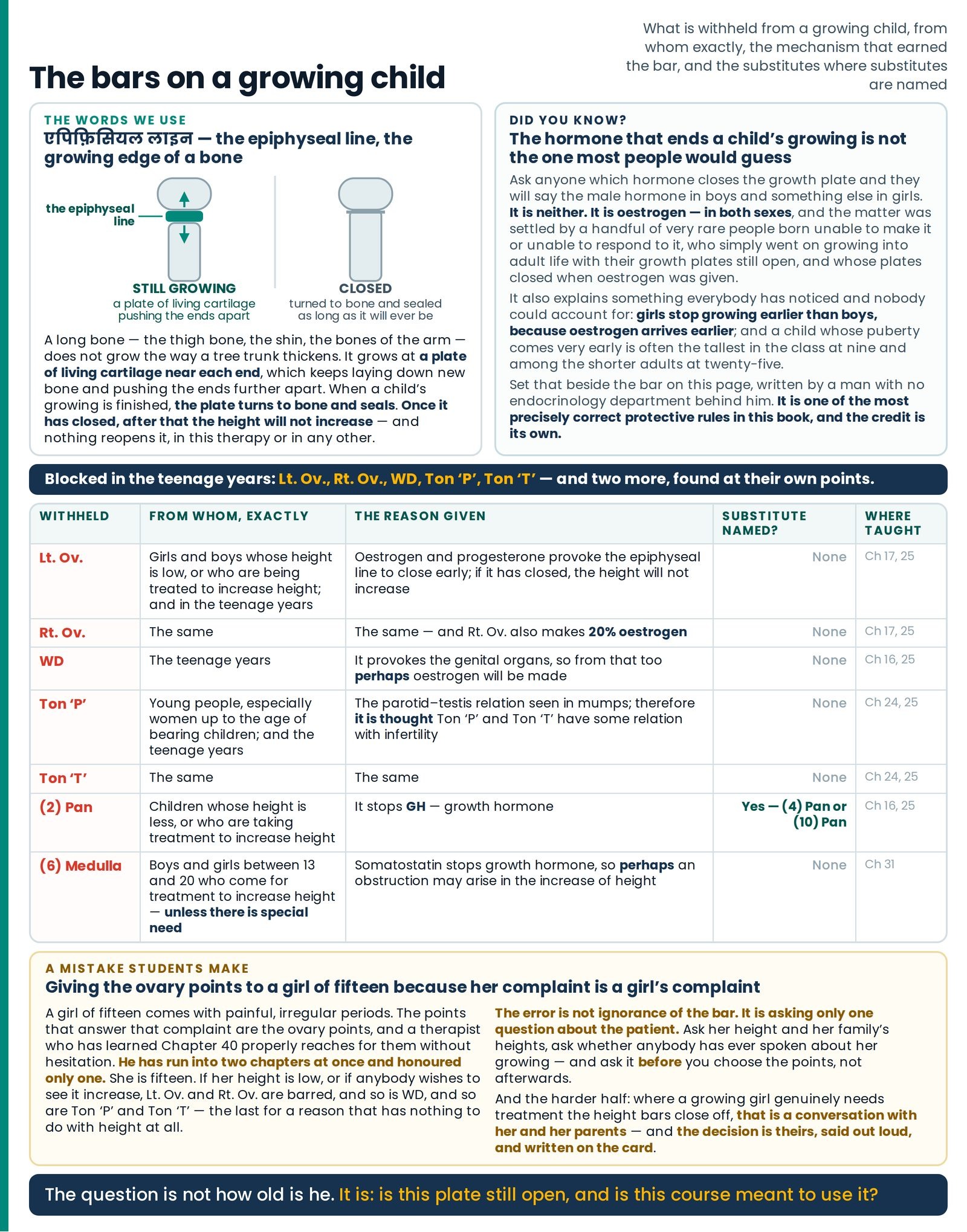
Lt. Ov. and Rt. Ov. — oestrogen and progesterone provoke the epiphyseal line to close early. If it has closed, after that the height will not increase. Therefore those whose height is low are not to be given Lt. Ov. and Rt. Ov. And separately, at the points' own entries: Rt. Ov. also makes 20% oestrogen, so the same bar attaches to it.
WD — is not given because it provokes the genital organs, so from that too perhaps oestrogen will be made. The perhaps is the material's own and stays where it is.
Ton 'P' and Ton 'T' — the parotid glands at the side of the cheek have some kind of relation with the testes. Because when in the disease called mumps — kanphūl — the parotid glands swell, during that disease in some boys the testes disappear, after which they are not able to become fathers. Therefore it is thought that Ton 'P' and Ton 'T' have some relation with infertility. So to those young people — especially to women, up to the age of bearing children — Ton 'P' and Ton 'T' are not given.
Two more bars belong to the same family and are found at their own points rather than in that block. Both are stated with their mechanism, and both name a substitute, which is the mark of a rule that has been thought through rather than merely feared. (Figure 41.6)
Key teaching
(2) Pan, and what is given instead
(2) Pan stops GH — that is, growth hormone. Therefore do not give (2) Pan to children whose height is less, or who are taking treatment from us to increase height.
And the other side of the same coin, at (4) Pan: it corrects weakness arising from lack of sugar, by means of glucagon — glucagon will give nourishment to the cells, so it may be given in small children to increase appetite and height. Its own bar rides with it: those who have diabetes — giving (4) Pan will raise the blood sugar, so do not give them (4) Pan.
The hypothalamus makes a hormone called somatostatin, which is an inhibitory hormone. Somatostatin stops growth hormone — so it is inferred that perhaps by this treatment an obstruction may arise in the increase of children's height.
Key teaching
(6) Medulla between thirteen and twenty
Therefore we do not give (6) Medulla to boys and girls between 13 and 20 years of age who come to us for treatment to increase height, unless there is a special need for it.
The perhaps and the unless there is a special need both stand. This is a bar with a door in it, and the door is opened by a therapist who can say what the special need is.
One instruction about children is so specific, and so easily missed among the formulas, that it is set apart here and given its own heading. It belongs to the New Gal family, and it is not a rule about pressure or position at all. It is a rule about what you ask the mother.
Key teaching
The child of a mother whose blood pressure rose in pregnancy
If some child comes to you for a long course of treatment, and on enquiry you learn that during pregnancy his mother's BP had gone up — whether they are children of dull intellect, or have come for some other illness — they are first to be given only this treatment for ten to fifteen days, and there will be considerable benefit. Afterwards other suitable treatments may be given.
The bars on a growing child. Every point withheld from a growing child with the mechanism that earned the bar and the substitutes where substitutes are named; the growing edge of a bone open and closed; and the mistake of treating a girl of fifteen as a woman only.
The treatment is the New Gal formula, and the same instruction is stated a second time in its list of uses, with two more conditions of the mother's pregnancy added:
This same treatment is to be given to those children whose mother, during pregnancy, had high BP, or any skin disease, or itching.
Take the instruction apart, because every clause in it is load-bearing.
"A long course of treatment." This is for the child who is going to be with you for months — the child with cerebral palsy, the child of dull intellect, the child with autism, the child with a developmental condition — and not for the child brought in on Tuesday with loose motions.
"On enquiry." The mother will not volunteer it. Seven years have passed; she does not connect her blood pressure in the eighth month with the child in front of you; and nobody has ever asked her. You ask.During this pregnancy, did your BP go up at any time? Did you have any skin trouble, or itching? Three questions, thirty seconds, at the first visit, of every child who comes for a long course.
"Whether they are children of dull intellect, or have come for some other illness." The instruction is not restricted to one diagnosis. The mother's pregnancy is the indication, not the child's disease.
"First to be given only this treatment for ten to fifteen days."Only, and first, and a stated number of days. It is a course that goes before the course — ten to fifteen days of New Gal and nothing else — and then the plan you would otherwise have written. A therapist who gives New Gal alongside six other things on day one has not followed the instruction.
And the best order, where the ampulla is to be opened too:first the ampulla of Vater is to be opened; afterwards the gall bladder is to be stimulated — so, in order: I. Vater formula. II. New Gal treatment formula.
The instruction has a history, and the history teaches the method better than the rule does.
Two further instructions about such children sit beside that one and must be given with their hedges intact, because the hedges are printed.
Chole, after a pregnancy with high blood pressure.If a pregnant woman's blood pressure rises during pregnancy, and after the birth it is found that the child is mentally slow, then giving that child the Chole treatment and other treatments brings considerable improvement in its digestive power within three months — this is a matter of experience. Note precisely what is claimed: considerable improvement in its digestive power, within three months. Not more than that, and the experience label stays on.
(10) Pan, in the same situation — with the question marks the material printed. At the entry for (10) Pan there stands: if the mother of a CP — cerebral palsy — child had high BP during pregnancy, giving that child (10) Pan will benefit ??? The three question marks are the material's own and are not to be tidied away. In the same entry, and equally marked: a child who is very hyper may become even more hyper on being given (10) Pan ??? Both statements are given as open questions, and a therapist who gives (10) Pan to a hyperactive child should know that the material itself has flagged a possible opposite effect.
Old age is not a disease and this wiki does not treat it as one. But two observations about age change what a therapist expects to find, and both are worth holding.
Key teaching
What changes with age, and the exception that is stated with it
Up to the age of 30–35 years most people have pain at Mu°, and they frequently get the diseases of acidosis. With increasing age the diseases of alkali begin to come.
But remember that it will not always be so. And the stated exception is a children's one: a chief cause of diseases such as fits and CP — cerebral palsy — in children is an increase of alkali.
A second finding of the same kind, from the teaching on undigested food: sometimes an older person, because of poor water consumption, shows pain at Mu° and yet has UDF — meaning the stomach's secretion of hydrochloric acid is poor. Never decide that a patient cannot have UDF because his flank finding was on the left. Ask everybody.
So the expectation shifts with age and the examination does not. You look for the same things in the same order, in a man of eighty as in a man of thirty, and you let the findings choose — which is the first rule of the whole wiki and is not suspended for grey hair.
What is different in an old body is everything in the adjustment table: the tool, the turns, the pillow, the frequency, and the honest recognition that the twenty-three and a half hours outside your session are harder for this patient than for most. The daily rules of Between Two Sessions bite harder here and are worth going over again with the son or daughter rather than with the patient: the side-turn on getting up matters more in a thin, old spine; the thirty seconds sitting on the edge of the bed matters more when the reflexes that hold the blood pressure up are slower; the slippers matter more when a cold floor is also a slippery one; and cold-water bathing is the one rule where age is a genuine reason to go carefully rather than boldly.
And Food as Medicine's kitchen matters more too, for a reason a therapist can find in four seconds and nobody else asks about. A patient who has quietly stopped eating anything that needs chewing — who lives on tea and soft rice, and has been doing so for a year — has told you something about her nutrition as surely as any report would. Ask how many teeth she chews on. It is not an undignified question if you ask it plainly.
This article's sheet is not addressed to the patient. It is addressed to the parent, the son or daughter, or the carer — the person who will actually carry it out, and who is very often the one who has not been spoken to at all.
Two rules a visit, as always.
Table 3 — What to tell the parent, the son or daughter, the carer — and why
Who, and when
What to do
Why
A parent, on the first day
Sit where he can see you, and hold his hand. Do not hold him down.
A child who is held down learns that this room is a place where things are done to him. A child whose mother is in his sight sits still on his own by the third visit.
If he cries, tell me at once — do not wait for me to notice.
Ordinarily this does not hurt. If a child cries, something about how my hand is laid needs changing, and I would rather change it in five seconds than lose a month.
A parent of a newborn
He does not have to be made to look clean on the first day. A light clean with warm water, wrapped in a soft blanket, given rest — and given to his mother.
The fluid he has lain in protects his skin from germs outside. It is not washed off; it is cleaned away slowly, slowly, over about seven days.
Keep him warm and covered, and against his mother's skin.
A newborn loses heat very fast, and a cold baby feeds badly and does badly. This is the one part of the first hour that is urgent.
Always lift him with both hands — never with one, even for a second.
From lifting a child with one hand he can get indigestion, or constipation, or loose motions. The organs in a small belly are packed with no spare room, and a sideways drag presses on vessels and nerves too fine to take it.
His mother's milk is the best food he has. Feed until it stops of itself.
It is said plainly, and nothing replaces it. Her half of this — her water, her calcium, opening his hand at the feed — she has been given separately.
A parent, when the teeth are coming
Fever or loose motions can come at this time. Give half milk and half sago water.
From this the diarrhoea will stop, and harm reaches the body from diarrhoea.
The fever may stay for two days, and that is not a bad thing.
The fever is telling you the liver needs a few days' rest. It is the diarrhoea we are stopping, not the fever.
But come the same day if he has blood in the stool, will not stop vomiting, passes no urine for many hours, has sunken eyes or skin that stays pinched, goes quiet or floppy, or is under three months old with any fever at all.
Some things are counted in hours, and I cannot look inside. We will go on treating either way.
A parent of a child on a long course
Tell me about the pregnancy — did your BP go up? Was there any skin trouble, or itching, even before it?
There is a treatment given first, for ten to fifteen days and by itself, to children whose mother had those things, and it works best when it comes first.
Do not stop any medicine he is on, especially for fits, and do not stop his speech or physio.
We use no medicine, and we never tell anybody to stop theirs. That is a matter for the doctor who prescribed it.
A parent of a growing child or teenager
Tell me if anybody is hoping his height will increase — and how tall the family is.
Certain treatments would make the growing ends of the bones close early, and once they have closed the height will not increase. I need to know before I choose, not afterwards.
A son or daughter, of an older parent
Let him get onto the mat by himself if he can. Help only when help is needed.
How he gets down and up tells me more about what his body will take than anything else I will see today.
Tell me the truth about the falls. How many, when, and what he was doing.
A fall is the most useful single fact you can give me, and families hide it out of kindness.
Tell me if any doctor has ever said his bones are thin, or if he has been on steroid tablets for a long time.
If so, he is treated with the hand only, always — and some treatments are not given at all. That rule does not depend on how well he looks.
Tell me afterwards how he was that evening — stiff, sore, or well — because he will not tell me himself.
Old people who are being helped very often will not complain. You are my instrument for that.
A carer, every day
Rolling onto the side to lie down and to get up. Never up with a jerk. Thirty seconds sitting on the edge of the bed before the feet go down.
Getting up with a jerk churns the fluid in the ears that keeps balance, and the body's own machinery for holding the blood pressure up is slower with age.
Small mouthfuls, unhurried, and never fed lying flat. And tell me how many teeth he chews on.
Somebody who has quietly given up everything that needs chewing has been living on tea and soft rice for a year, and that changes what I do.
If he is in bed most of the day, move him and move his limbs.
Blood has a pump; lymph has none — it moves when the body moves. That is why the bed-bound collect troubles the rest of us do not.
Read next
Each Point in Use Each Point in Use — the Triangle, Rt. Chest only and (4) Pan at their own entries
The Medulla Family The Medulla Family — (6) Medulla, and the door in its bar
Setting the Stomach Setting the Stomach — New Gal whole, in all five parts, and Chole
Ton 'P' → not to those who want children A person who is well and wants to stay well; a small child; after a fever has come Viral VTF (Mild) Auto-immune disorder → do not give An old disease such as cancer Viral (1) Lymp
Adjust the number of places along a limb for a small child, a tall patient, and a therapist who is a child themselves — and know which of those numbers is labelled a matter of experience.
The strength of it is what decides whether it helps or harms, and this is one place where "more" is the wrong instinct: a drink made too strong with salt or sugar pulls water out of the body into the bowel and makes the
Blood in the stool at any age; black tarry stool; fever with abdominal pain; severe or localised pain with a hard, guarding belly; a small child or a frail elder going dry; weight coming off; a change in bowel habit last
If the patient is a small child, ask the mother one question: when the child vomits after drinking milk, does milk come out as milk, or as curd — दही? If milk comes out as milk, it means that hydrochloric acid is not bei
A CASE FROM PRACTICE The child whose heel would not come down Name not recorded · a small child · brought by his mother · came with the outer part of the foot turned inward from birth — talipes, that is club foot What th
And you met its exact twin in the vitamin article, where a small child who cannot say whether a point hurts is investigated by checking the mother's pain points and treating the child for whatever she was short of in pre
The instruction Where it is taught Milk for a woman whose menstrual bleeding is heavy — the quantity, the temperature, and the khārak soaked overnight Treating Women, "Treating Women" — which owns it whole The caution on pil
Ready to begin?
Send COURSE for course details, or your name, age and health issue for a consultation.