The Hand That Heals — What Neurotherapy Is
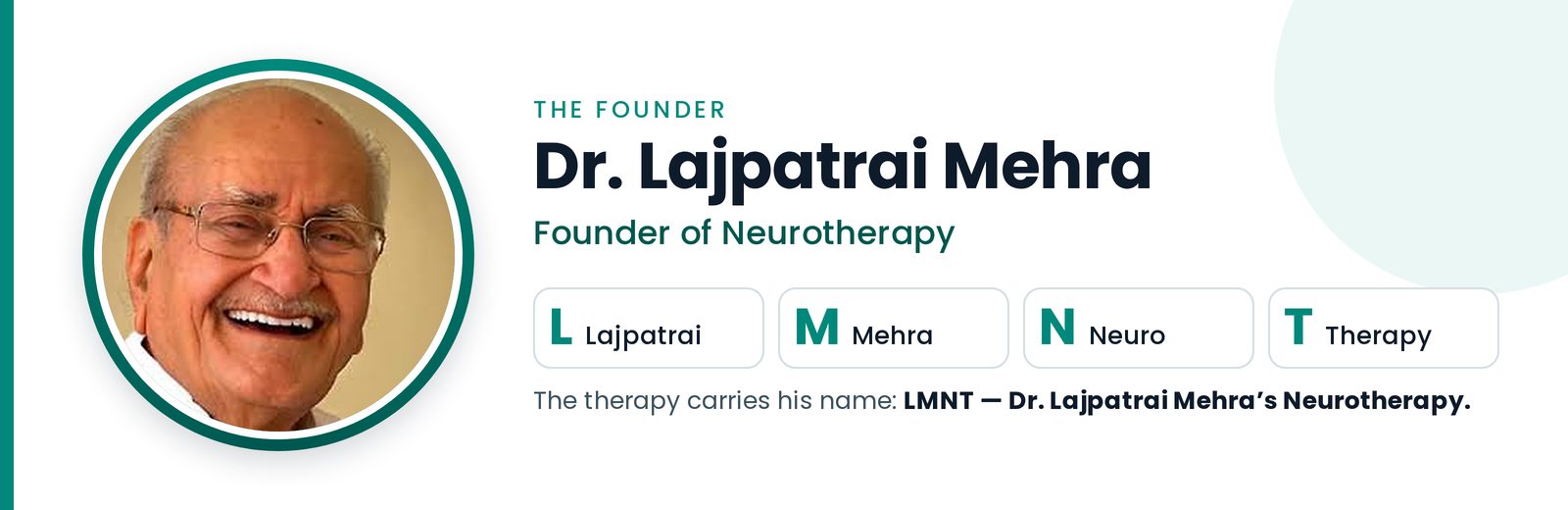
The rest of that life — the partition, the refugee train, the ten people he supported at sixteen, the clinic, the ashram, the women he trained for nothing — is told in The Man Who Would Not Accept 'Incurable', "The Man Who Would Not Accept 'Incurable'". This article is about the thing he made. (Figure 1.1)
Watch


The whole therapy in one sentence
The definition, and the nine phrases in it that carry weight
What Neurotherapy is
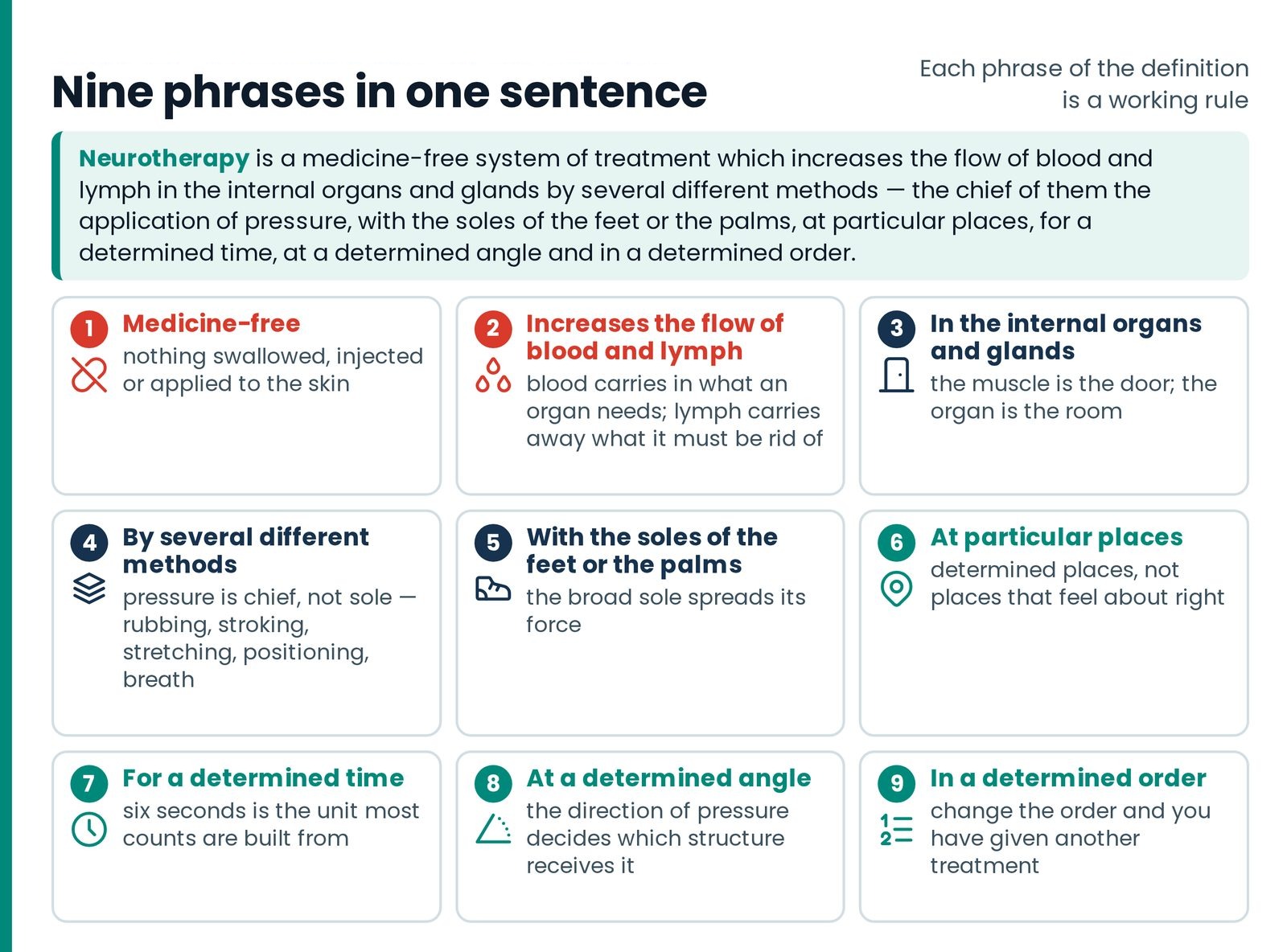
Neurotherapy is a medicine-free system of treatment which increases the flow of blood and lymph in the internal organs and glands by several different methods — the chief of them being the application of pressure, with the soles of the feet or with the palms, at particular places on the body, for a determined time, at a determined angle, and in a determined order.
From this the organs' manner of working improves and they begin to function smoothly again; and in this way the very root, the fundamental cause of the disease, is put to an end.
No medicine of any kind, and no instrument of any kind, is used.
Say it again in the words a patient would use. Some organ inside you is not getting the blood it needs. An organ starved of blood works badly, does not make its chemicals properly, and everything downstream begins to go wrong. We press certain places, with our feet or our hands, in a certain order and for a certain count, so that the blood goes back where it belongs. Then the organ repairs itself. We repair nothing; we only give it back what it was short of.
Nine phrases in that sentence carry weight. (Figure 1.2)
Medicine-free. Nothing swallowed, injected or applied to the skin. Not a modest detail: it decides the cost of the therapy, its availability in a village with no chemist, and the fact that it can be taught to a patient's own daughter to give at home.
Increases the flow of blood and lymph. Blood carries in what an organ needs; lymph carries away what it must be rid of. Blood is driven by a pump you own. Lymph has no pump at all: it moves when you move — which is why the bed-bound and the sedentary have more troubles than people busy all day. That is drainage, not a moral observation.
In the internal organs and glands. Not in the muscle you are touching. The muscle is the door; the organ is the room.
By several different methods. Pressure is chief, not sole. There is rubbing — ghisāī — and stroking, stretching, positioning, and treatments using the patient's own breath.
With the soles of the feet or with the palms. The foot is the tool of an adult treatment, for two reasons you will feel in your own hands within a week: a hand cannot hold a firm steady pressure for long without shaking and wearing out the therapist's joints; and the sole is broad, and a broad tool spreads its force.
At particular places. Determined places, not places that feel about right — the business of and .
For a determined time. The count is part of the treatment as the minutes are part of a recipe, and six seconds 6 sec is the unit most counts are built from.
At a determined angle. The direction in which pressure travels into the body decides which structure receives it: two feet on the same square inch of thigh at two different angles are two different treatments.
In a determined order. Students take longest to believe this one. Change the order and you have given another treatment, whose effects you have not been taught.
It is not derived from anything else
Not acupressure, not borrowed — and the one folk root it openly owns
At first glance the technique looks like acupressure. It is not. Nor is it based on any other therapy in existence, past or present — with one exception, stated openly rather than hidden: certain fundamental principles crept in of themselves, from a lifetime's exposure to India's traditional folk therapies. The navel-setting of the Punjab is the plainest of them, and a boy cured by it at eleven did not begin with an empty mind. That is a more interesting statement than a claim of pure originality: every therapy has parents, and this one names its parent and shows how far it walked from home.
Why an organ stops working
Pain as the report of an interrupted supply, and why the belly comes first
The body is a chemical factory, and a good one: it makes, from its own raw materials, every chemical it needs to keep itself well. Then why does anybody fall ill? Because the factory's working gets disturbed, and the causes are not mysterious. Most are things we do to ourselves: no control over āhāra-vihāra, which means what we eat and how we live; rising and sitting badly; polluted air; mental tension; work beyond our capacity; poor nourishment; fear; anger. Under any of these the organs and glands work slowly or wrongly, make less of their chemicals or make them at the wrong time, the body's balances — acid and alkali first among them — are spoiled, and from the shortage of one thing or another disease arrives.
So how do you find which organ has slowed, in a body that will only tell you it has a headache? Here the therapy uses one plain fact everybody has already proved on themselves.
Pain is the sign of interrupted blood supply
Whenever the blood supply to any organ or part is interrupted, it shows itself as pain or numbness in that part.
And read backwards, which is the useful half: if the pain in a part is relieved, it means the blood supply to that part has been restored.
This is as true of an organ deep in the abdomen as of a shoulder. An organ deprived of adequate blood for long enough will arrive at a diseased state — and it was working perfectly well before. There is no reason why it should not work perfectly well again once the supply is put back.
You have run this experiment a thousand times. Sit slouched at a desk for two hours and a dull ache begins somewhere. Nobody injured you; the ache reports that some tissue is not getting enough blood in the position you chose. So you shift, and the ache goes, because the blood went back.
Now carry it inward. Many things in an ordinary day pull blood away from the organs of digestion — eating in a hurry and running for a bus, sitting badly for twenty years, sleeping too little, living in fear of something. And blood that is over here is not over there: a deficiency in one region must be accompanied by an excess somewhere else, because barring an accident or an operation the quantity of blood in a body is a fixed volume being shared out. If it is only being shared out, then any technique that can move some of it from a place of excess to a place of shortage ought to work. That is the engine of the therapy; everything else is the map of where to push, and in what order.
There is a second half to the mechanism, and it decides why so much time is spent on the belly.
The chemistry of illness, and where the raw material comes from
All diseases arise because the body's internal balance is disturbed — either in the state of the internal environment (the acidity or alkalinity of the fluids, the blood pressure, the sugar, the temperature) or in the levels of hormones, enzymes and antibodies. Treatment restores that balance by stimulating the organs to work normally again, so that they produce the required chemicals in the required quantity at the required time.
Underneath it sits the observation on which the whole system was built:
All glands and organs can produce their own chemicals in the correct quantity and at the correct time only when the raw materials for them are available from the end products of digestion.
That is: the correct performance of every gland and organ depends wholly on the correct functioning of the digestive system, including the accessory organs of digestion.
Guruji sums it up in a line worth learning by heart: if the abdomen, the kidneys and the lungs are working properly, it is next to impossible that a healthy person will fall ill.
Think of one kitchen supplying a hundred households. If the kitchen is sound, every house eats. If it runs at half strength, no house is destroyed — but every one is a little short, and the weakest shows it first. That is why a slowed digestion does not produce one disease; it produces whichever disease that body is disposed to.
Two examples, both used at the mat every week. The thyroid builds its hormones on an amino acid that comes from the digestion of protein in the intestine; if digestion is not right the material is short, the gland's output falls, and the pituitary shouts louder — which is the raised TSH on the patient's laboratory slip. The bones: calcium is absorbed in the intestine, and if the intestine is not working you may swallow it by the fistful and it will pass through you, which is why thin bones do not thicken on tablets alone.
The disease has a name; the body has an organ
Why the treatment follows the organ, not the name on the card
In allopathy the names of diseases are attached to the symptoms themselves. When several symptoms are seen together, and the same cluster turns up in other people, the cluster is given a name — so that one word brings several symptoms to mind at once and choosing a medicine becomes easy. That is what a disease name is for. It is useful shorthand, and it is not a thing inside the patient.
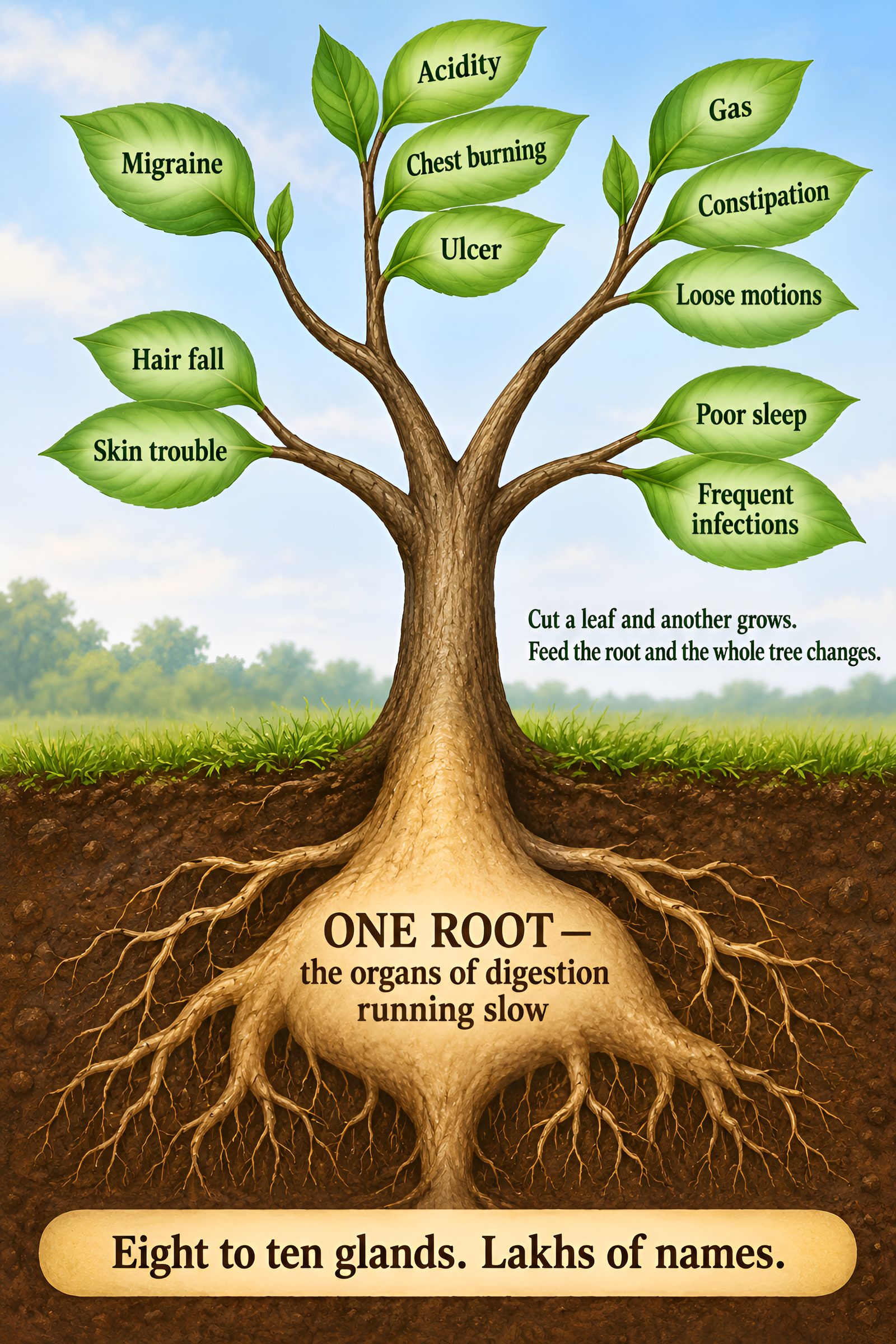
Watch what happens when the shorthand is mistaken for the thing. Suppose food is not being digested properly in one man's stomach. Monday, a headache. Wednesday, gas. Friday, loose motions. Next week, burning in the chest. Take those to four counters and you get four names — migraine, flatulence, diarrhoea, acidity — and four tablets. But although the symptoms differ, the root cause of all of them is one and the same, the food is not being digested. Correct that one thing and not only these four but others that had not yet appeared are corrected with them. It looks like four diseases. It is one fault in one place, showing four faces.
The treatment is not for the disease
The treatment is not directed at a disease. It is directed at restoring the glands and organs to their normal functioning.
Three consequences follow, and each is a working rule:
1. The treatment for the same disease may differ from person to person, because two people given the same name are not in the same condition.
2. The treatment for the same disease in the same person may differ from day to day — because as treatment begins to work the glands change, and Thursday's body is not Monday's. Neurotherapy treats according to the condition of the body.
3. The same treatment may be needed by different people with different diseases, who happen to share the same pain points.
All lakhs of disease names notwithstanding, every one arises from a few among eight to ten glands not working in the proper way. That root appears in different people as different symptoms — and in one person as different symptoms on different days — but on paying attention you will find it is the same root.
This is why the student who asks "what is the treatment for asthma?" has asked a question the therapy cannot answer in that form. For many diseases one and the same formula serves and every patient given it gets well; equally, several people with one disease may need different treatments. This is exactly how it should be, and this itself is the secret of the therapy's success. (Figure 1.3)
The observation on which the diagnosis rests
Any disease, whatever its individual symptoms, is generally accompanied by pain or hardness around the navel and the hip, at one or more of eighteen specific points.
The pain is found with the tips of the fingers, by a gentle inward pressure at pre-determined places. Very often it is a pain the patient does not know she has until it is found.
Removal or reduction of one or more of those pains produces an immediate sense of well-being, which the patient herself confirms.
Note the word hardness: you are feeling not only for a wince but for a place where the tissue has lost its give.
Because the therapy addresses itself to the pains in and around the navel, it follows that even for the same person the plan must change after a few days, according to that person's pain points on that day. One further rule of the same family is asked about constantly, because it looks like magic and is nothing of the sort.
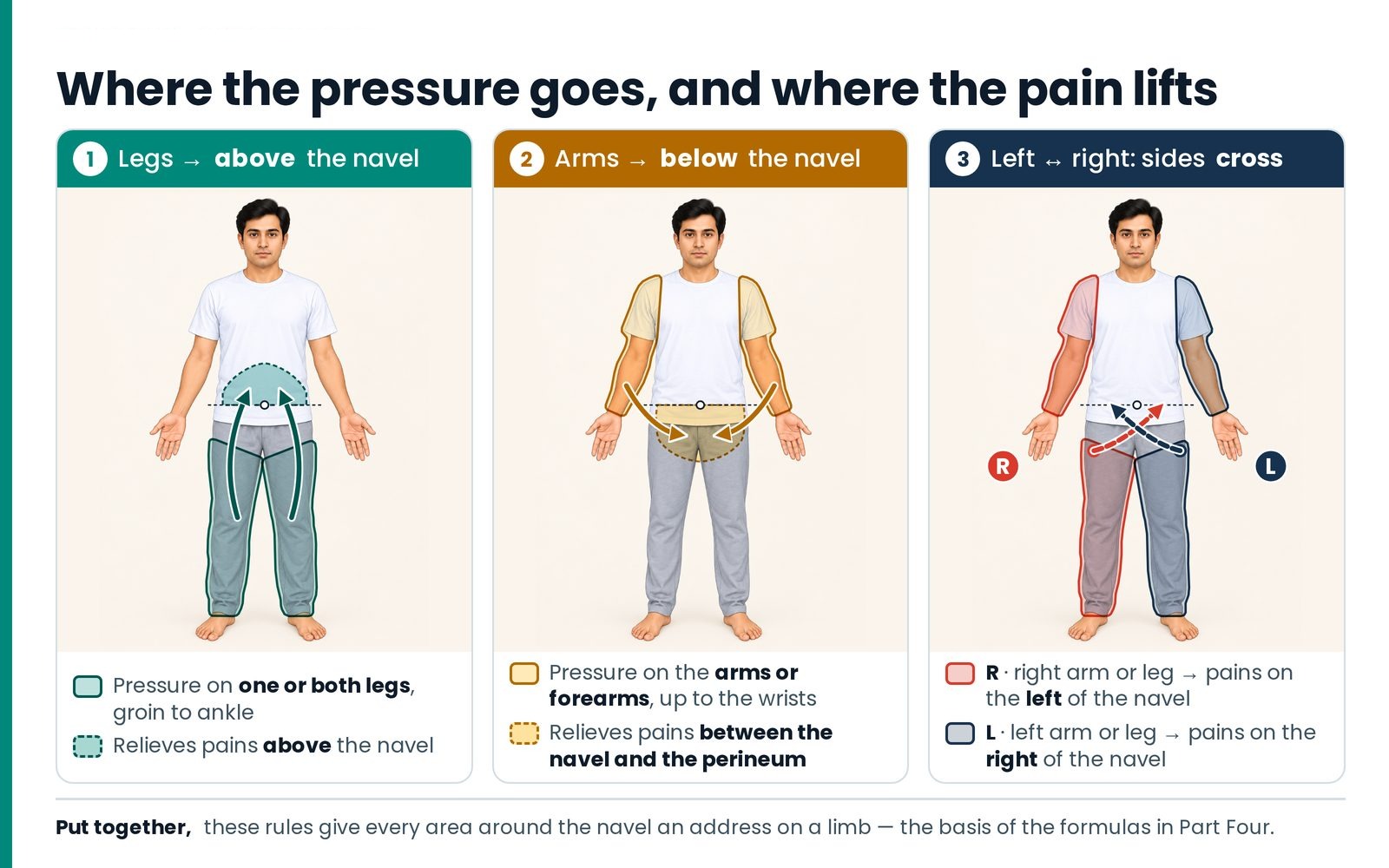
Where the pressure goes, and where the pain lifts
Pressure on one or both legs, between the groin and the ankle, relieves pains above the navel. Pressure on the arms or forearms, up to the wrists, relieves pains between the navel and the perineum. Pressure on the left arm or leg Left relieves pains on the right of the navel; on the right arm or leg Right , pains on the left.
From these four correspondences any chosen area around the navel can be reached — which is how the formulas of are built. (Figure 1.4)
The root, and the symptom
Correcting the cause instead of silencing the warning
Root cause, not symptom
Neurotherapy does not treat only the symptom. It improves the working of the glands, from which the disease is cured — and along with it the likelihood of another disease coming is also ended.
Small ailments — fevers, colds, coughs, indigestion, constipation, stomach ache — come in order to give us warning.
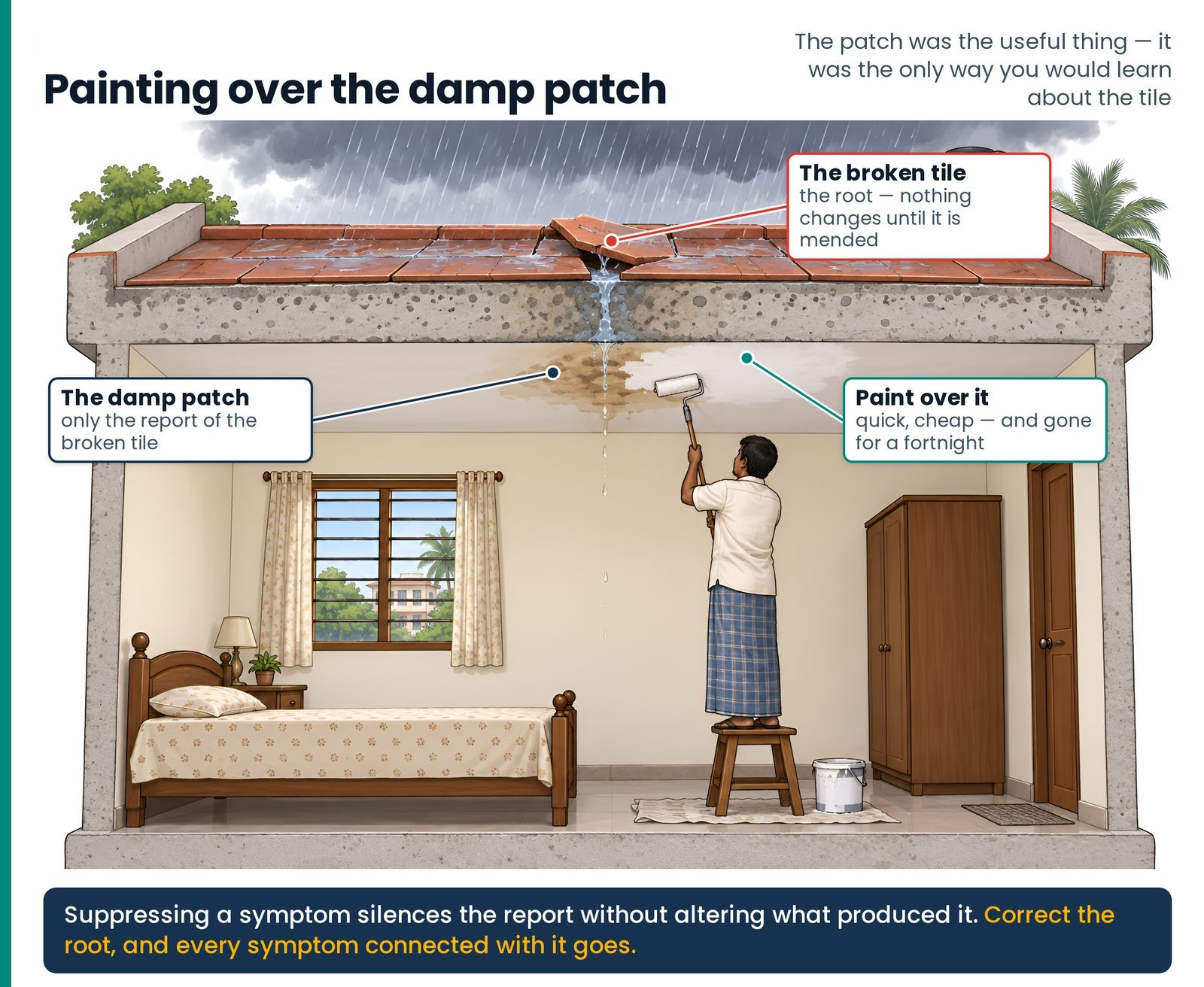
When such a thing is treated so that the symptom alone is suppressed, the warning is silenced and the bigger disease goes on growing in the body, unannounced.
So when such symptoms appear, treat at once, without delay: considerable relief will be obtained within three or four days. But for a complete cure, at least one treatment a week for a month or two means the trouble does not come again.
A damp patch appears on a bedroom ceiling. You can paint over it — quick, cheap, effective for a fortnight. Nobody who has owned a house believes the paint fixed anything; everybody knows there is a tile off the roof. And notice that the patch was the useful thing: it was the only way you were going to learn about the tile. Say that fairly at the mat, though — relief is a mercy and often urgent. The claim is only that relief is not the same act as correction. (Figure 1.5)
The other side of the coin: when the root really is corrected, not only that disease but all the symptoms connected with that root cause go away, and should not return. The patient will tell you about the ones you did not treat. She came about her knees; in the fourth week she mentions that her hair has stopped falling and she no longer needs the antacid, and thinks these coincidences. They were rows of one account.
Two honest qualifications, both the therapy's own. About living: one main cause of disease is wrong thinking, and not following the ordinary rules of diet, sleep and exercise. Some conditions are so bound up with tension that a person well for months finds the symptoms return with a little of it; such a person needs, besides treatment, to change the way of life and the direction of the thoughts.
What patients notice first comes long before that. Within a day or two the small effects begin: hunger improves, sleep improves, energy rises, weakness reduces, the body feels light, life becomes enjoyable. Even where the disease is slow to go, those changes matter in themselves, because a body in that state is far less likely to acquire the next disease. Say this at the start: it is true, it is modest, and it stops a patient measuring week one against a cure.
"Is this not just acupressure?"
How the therapy differs from acupressure, massage and reflexology — and why it does not hurt
You will be asked this in your first month and in your fortieth year. It is an intelligent question — somebody is pressing places on a body and saying something elsewhere will change — so learn the answer, and give it without irritation.
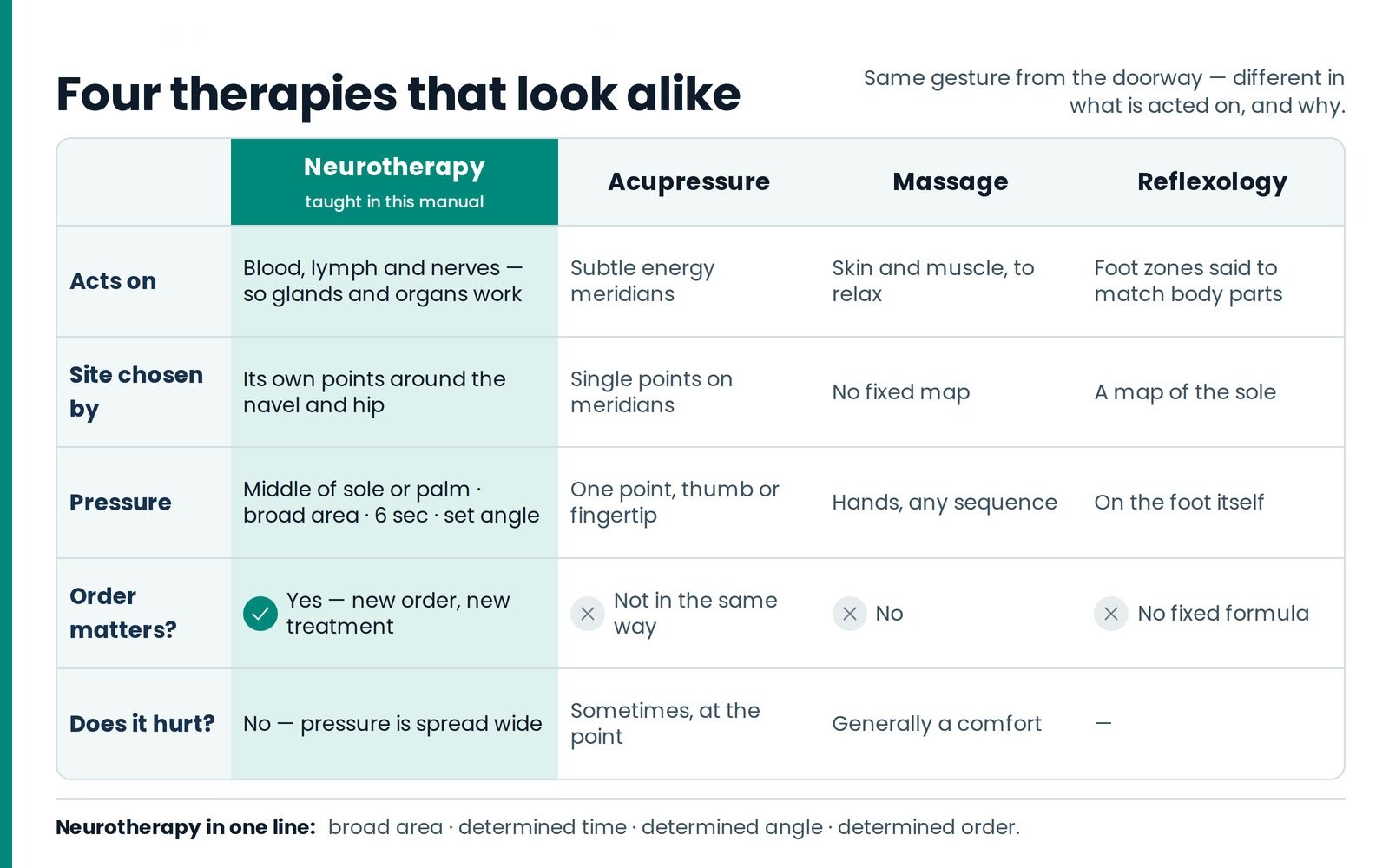
How Neurotherapy differs from acupressure
No. This is a therapy with no relation to acupressure, and none to any other therapy.
The difference is not in the gesture. It is in what is being acted upon, and why.
In Neurotherapy, working on the basis of the elements of physiology, we improve the functions of the glands by stimulating the body's circulation of blood and lymph, and the nervous system.
In acupressure, what is stimulated or improved are the subtle energy meridians beneath the skin.
Those are two different accounts of what a body is. One can be argued about in the language of blood vessels, nerves and glands; the other cannot, and does not try to be.
Three further things belong to Neurotherapy alone, and are the personal discovery of one man's sixty years of tapasyā: its own diagnosis points; the giving of pressure for six seconds 6 sec ; and the sequence in which the organs are to be stimulated.
Why it does not hurt
In acupressure, pressure is given on one point, where there is sometimes a chance of feeling a little pain.
In Neurotherapy it is given over a large area.
That is the whole of it, and it is not a matter of opinion. Pressure is force shared out over the surface it lands on: spread the same push over twenty times the area and you have a twentieth of the sting.
The therapist is trained to apply pressure with the soft part between the soles, so that even a child of six or eight feels no distress. And the angle is adjustable: if a patient does feel pain she must say so, and the therapist changes the angle or the manner of placing the foot — the effect of the treatment is not reduced by this. ▲ Take care
Two more comparisons are worth keeping ready. Massage works on muscle and skin, mainly for relaxation and local softening, and is a good thing in its place; but it has no fixed point map, no second-count, no order that must be kept, and no aim at a particular organ. A massage may run ten minutes or forty in whatever sequence suits the hands and is still a massage — whereas change the order of a formula here and it is no longer that formula. That is the difference between a comfort and a prescription. Reflexology also has a map, but a map of the feet, its logic being that zones of the sole correspond to parts of the body; this map is anchored on the abdomen and hip, its points named for the organ behind them. And in reflexology the foot is what is treated; here it is very often what does the treating.
Say it without scoring points off anybody: "They work with energy channels; we work with blood, lymph and nerves. They press one point; we press a broad area, which is why this won't hurt you." (Figure 1.6)
The same complaint is not the same treatment
Where the patient lives and what he eats help decide the plan
Where the patient lives, and what he eats, help decide the treatment
Even the locale and the diet followed by the people of an area play a part in deciding the treatment to be given.
The therapy's own example: a treatment for knee pain that suits a patient in Ludhiana may not suit a patient in Chennai, because of the difference in the diet of the people of those two places.
This is the same rule as before, arriving from another direction. The treatment is chosen for the condition of this body — and a body is partly made of what the household around it eats.
Which is why one instruction — keep away from sour things — lands differently in a Punjabi kitchen and in a Tamil one. The instruction has not changed; its weight has. A therapist who does not know what the household actually cooks is prescribing in the dark.
A composite of many such patients makes the point. Balwinder Singh, 61, a retired transport contractor of Ludhiana, came with four years of knee pain and had been told the cartilage was finished. His X-ray changed almost nothing — such wear is found in plenty of knees that do not hurt — while his borderline uric acid and sugar, and his account of hard, infrequent stools, changed a great deal. Digestive work first, joint work second, sour things stopped, water raised: by the tenth week he was rising from a chair unaided and walking to the gurudwara.
Then he moved to his son's house in Chennai, carried his treatment card to a centre there, and within a month was going backwards with nothing in the plan changed. That was the trouble: nothing had changed, and everything else had. Tamarind in the kuzhambu most days, curd after every meal, rice where there had been wheat — the restriction that had cost him a lemon in Ludhiana was now broken three times a day, because in that kitchen tamarind is not a "sour thing", it is simply how food tastes. The new therapist re-examined him from the beginning instead of continuing a plan made for another life; the findings were not the same, and neither was the plan. Within six weeks he was where he had been.
A treatment card records what was right for a patient in a place, at a time. It is a history, not an instruction — and a parhez must be translated into the household's actual kitchen before it means anything.
Who may receive this treatment
From one day old to a hundred years — the hand, the foot and the two chairs
From one day old to a hundred years
Every person, from a one-day-old infant up to the age of a hundred years, can take this treatment.
To very small children, and to old and weak persons, treatment is given with the hands.
To persons of greater build, it is given with the feet.
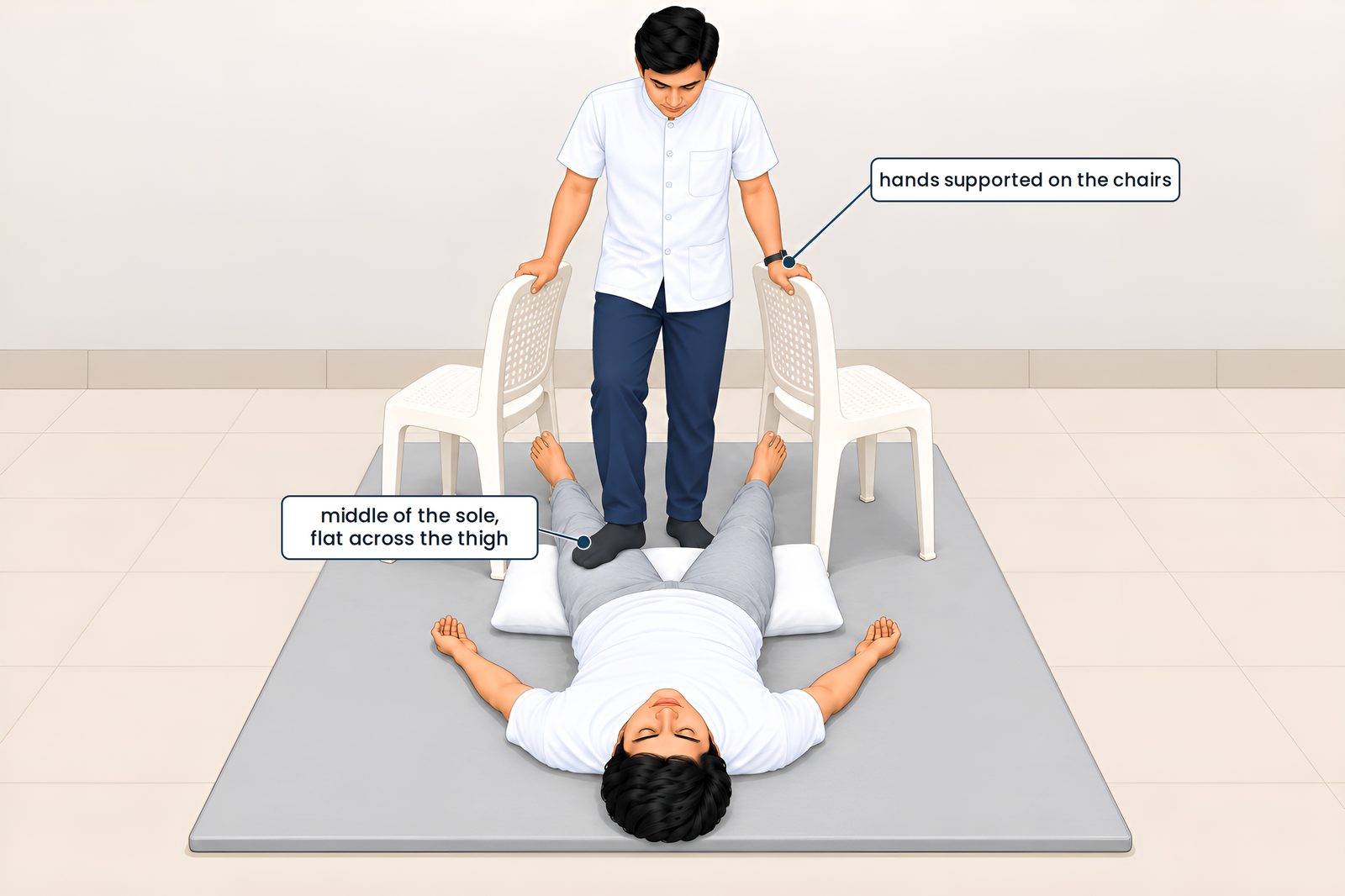
The therapist stands between two chairs, taking the support of the chairs on both sides, and gives pressure in a particular manner with the feet on the patient's hands, feet, thighs and so on — by which the patient suffers no discomfort of any kind.
The two chairs are not furniture; they are the instrument by which the dose is controlled. Because the therapist's weight rides on his arms, what reaches the patient is exactly as much of him as he chooses to let down, and he can take it back in an instant. (Figure 1.7)
Some treatments are close cousins of particular postures — the effect of the Gas I treatment resembles vajrāsana, that of Ku resembles vīrāsana — and each is taught in the atlas.
The shape of a session
What happens from the door to the door, and the reason for each rule
Patients want to know what will happen to them. Tell them, in this order, before they lie down. (Figure 1.8)
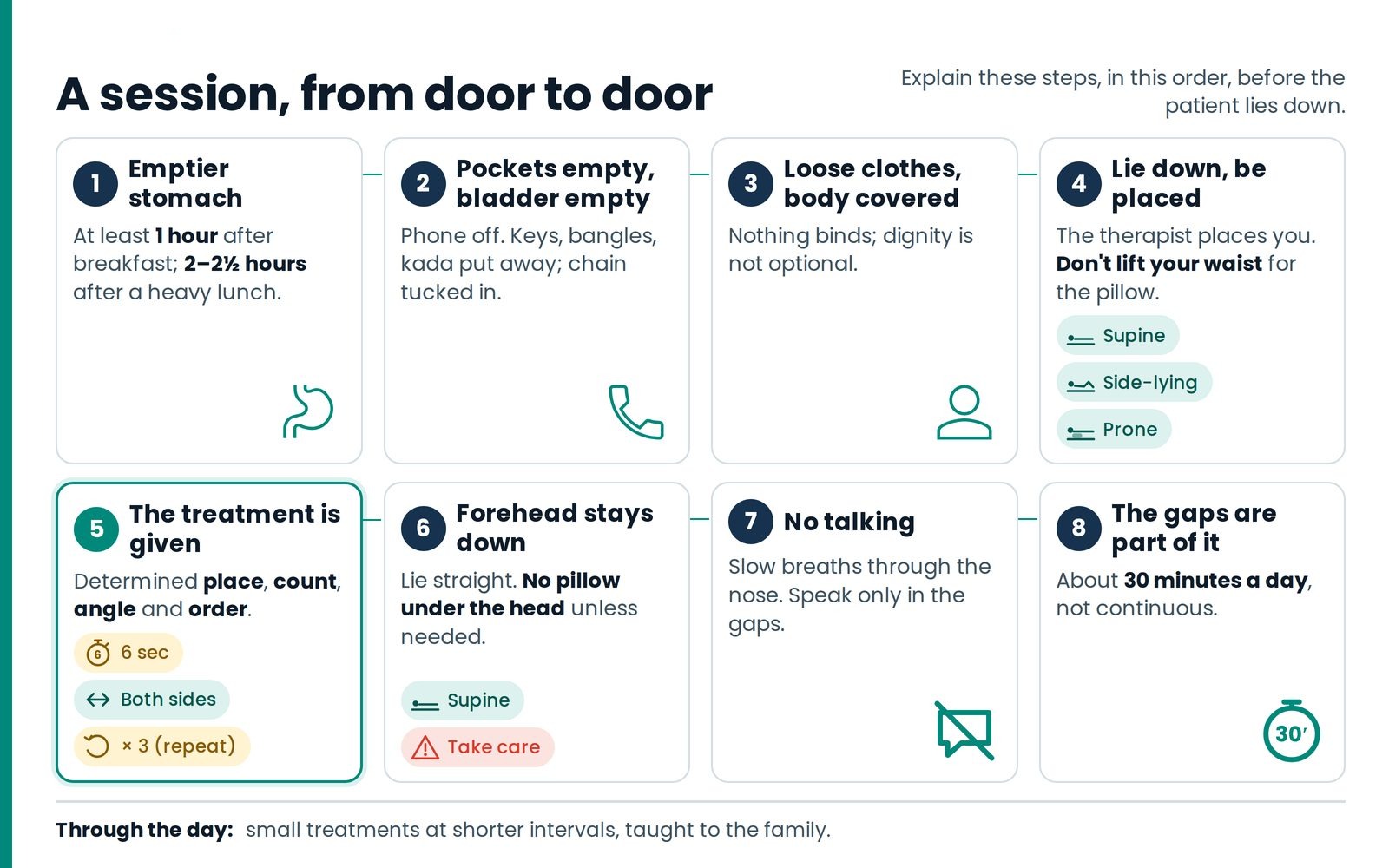
Where needed, small treatments at shorter intervals may be given through the day — and these are taught to the household, so relief comes more quickly.
Two of those steps carry reasons worth giving out loud, because a patient who knows the reason keeps the rule. The emptier stomach: the patient must lie straight, turn onto the side, lie face down, and so on by turns, and with heaviness in the stomach that is difficult. The breathing: long and unhurried through the nose, so the exchange of oxygen and carbon dioxide goes on properly in every cell. The more relaxed you remain, the more benefit you take — muscle braced against you is muscle you are working through rather than with.
What the therapy is used for
The range of complaints, and where it stands on the ones called incurable
Read the list as a therapist reads it — not as a menu of cures but as the range of complaints in which substantial relief has been brought. It is illustrative and by no means exhaustive. (Figure 1.9)
Three further kinds of result are recorded: measured values move — blood pressure, blood sugar, serum cholesterol and uric acid normalise, and T₃ and T₄ improve with a corresponding reduction of TSH; gall stones and kidney stones have been relieved by treatment alone in great numbers, without surgery; and there is substantial improvement in the quality of life of children with mental retardation, Down syndrome, ADD and ADHD, dyslexia, ataxia, fits, autism and muscular dystrophy.
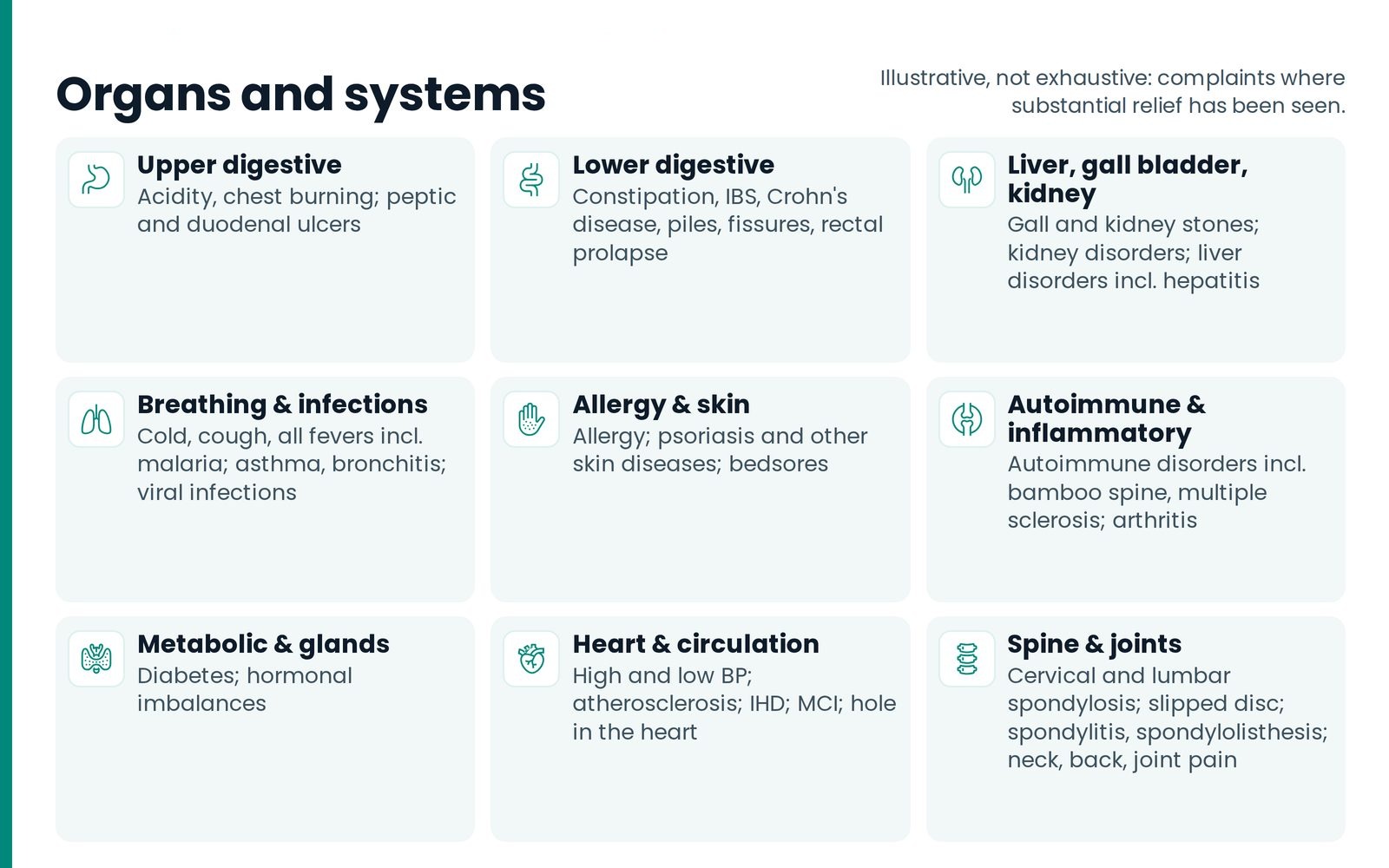
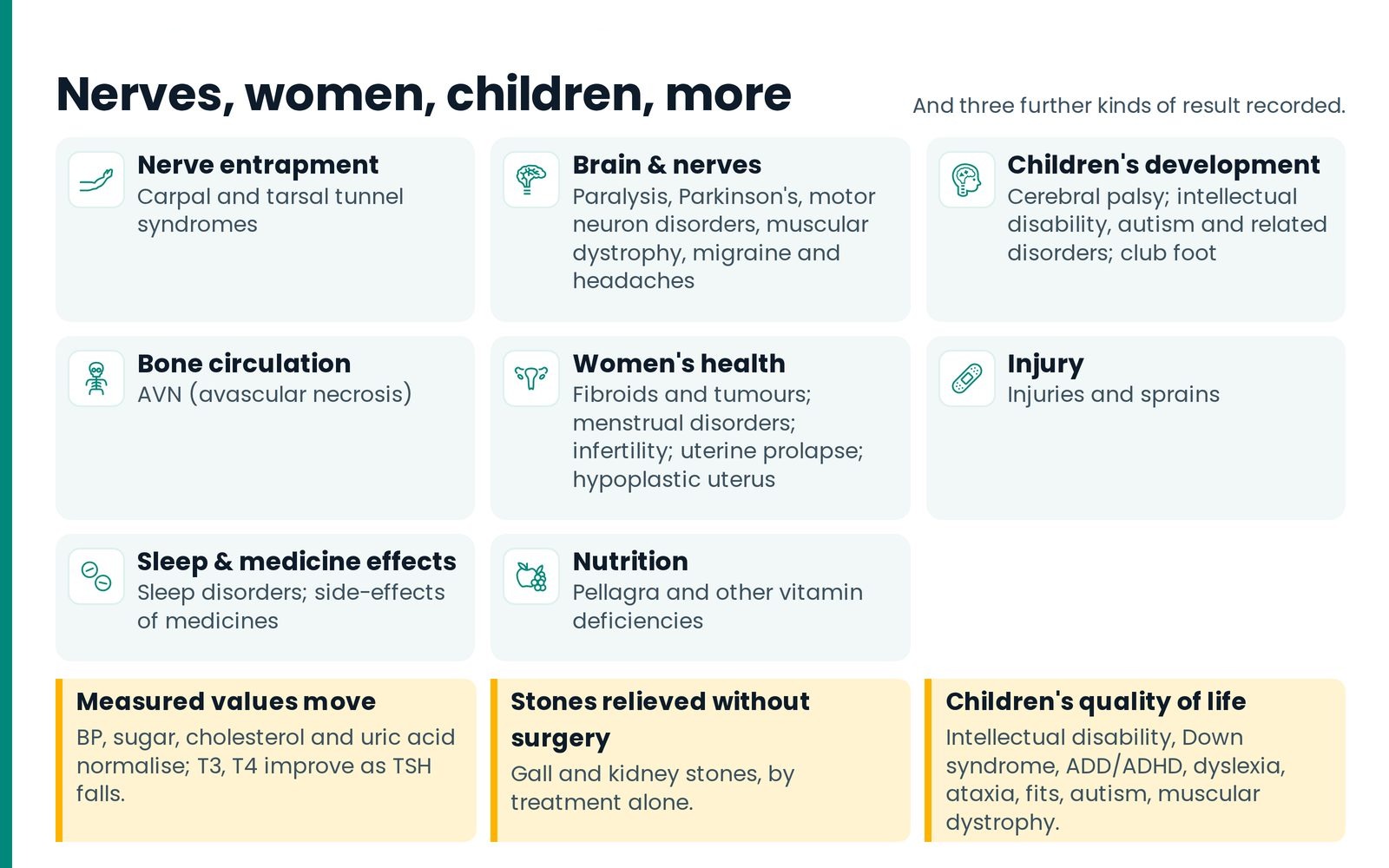
Since the treatment is done keeping the root cause in mind, relief is generally obtained in all common diseases.
But of the following diseases or symptoms it is said that there can be no treatment — CP (cerebral palsy), epilepsy (fits), hepatitis, thalassaemias, sickle cell anaemia, aplastic anaemia, MD and DMD, MND, MS, kidney failure, polio, and so on.
The conditions commonly called incurable
The truth is that in these diseases too, many patients have obtained quite good results by this treatment — even in HIV.
And Guruji's most important contribution is this: in the lives of children afflicted with congenital conditions such as intellectual disability, ADHD, dyslexia and autism, this therapy has brought considerable improvement — so their parents themselves say.
Give that to a family exactly as it stands, and notice what it does not say. It does not say these conditions are cured. It says the door is not shut, and that in the children the people best placed to judge — the parents who live with them — report considerable improvement. That is hope without a sale.
Two last observations belong to this list, because they prevent serious errors. Infectious disorders and inflammatory ones are treated in opposite ways — the treatment named Thymus, given at the breastbone, raises immunity and benefits infections; the treatment named ADR, given at the back between the sixth and twelfth thoracic vertebrae, reduces inflammation — and the two are not interchangeable: give either in the other's condition and the situation is aggravated.
The man, and his own estimate of his knowledge
A founder who says there is a long way to go
He has no formal education in modern medicine, and says so himself without embarrassment. His schooling ended at the tenth class; the certificate awarded him for his service in the refugee camps he declined to keep, because he had not sat the examination, and four years later he sat it and passed it.
What he did instead was read. Apart from the hours spent with patients, he has spent his waking life on the study of physiology — the same standard textbook read through many times over. From that reading, and from an experience of patients running into lakhs, he took the findings of physiology and looked at them from an angle with no place for medicines at all. Ask him about that knowledge and he smiles and says this:
He is not being modest for the room. He calls the therapy he built over seventy years a thing at the toddler stage, and means it — which is why old versions of formulas are still printed beside their successors: a man who thinks he has finished does not keep revising. Asked why his name is in no book of records, he answers: "My work is its own reward. In the time I would spend daily maintaining written records to justify such a claim, I can bring relief to another quarter million people."
Students find the humility charming. Find it instructive instead: a founder who says there is a long way to go expects you to keep your eyes open and record what you see.
The case that taught a whole method
The morning pain and the closed window
Why it was given away
Free treatment, free teaching, and a centre in one village in six
This therapy was not sold. Guruji's habit from the beginning was to share whatever he found, at once and free of charge, with anybody who kept in touch with him — unlike those who keep their findings secret in order to charge for them. He treated free for four decades before ever charging a nominal fee.
His stated goal is simple to say and enormous to do: that at least one Indian village in six should have a Neurotherapy centre, so the sick can be treated without medicines — and, in his lifetime, at least ten thousand centres. To that end: free health camps in needy villages; help for villagers at low cost, without side-effects, irrespective of caste, creed, colour and religion; the training of interested people in India and abroad; a centre for research into the cures obtained; and a generation who can use this therapy for their own families and for the welfare of society.
It went further than free treatment, into something rarer. Among the patients were many who could see no way ahead; such people were not only treated free and made well but taught the therapy free, and taught to earn from it. Many were widowed and orphaned women, for whom society would perhaps have done nothing at all, and who today live self-reliant and with pride, supporting their families and running their own centres. And where a patient comes from far and needs months of treatment, the family members are taught, so they may go home and treat that patient themselves.
At the ashram the giving of learning is free, and the lodging is free; from students a nominal amount is taken monthly for food, much less than it costs, and the teachers who keep the place running do so without charge.
That line is written up at the ashram, and it is not decoration. By which one can stand on one's own feet is the argument for free tuition, free lodging, and for teaching a widow a trade rather than giving her alms — and a fair description of what this therapy tries to do to an organ: not to supply it from outside for ever, but to put it back in a condition where it can do its own work again.
Questions students ask
1. I am nineteen and just starting. If the treatment differs for every person and every day, how will I ever learn it? Plenty is fixed — the points, the counts, the angles, the order within each formula, the cautions. What is not fixed is which formula this patient needs today, and that is decided by examination, not memory. A cook may know fifty dishes exactly; which to make depends on who is at the table.
2. I am a retired schoolteacher, sixty-eight, learning this for my family. Am I too old to press with my feet? You may not need to. Pressure is given with the hands for the very small and the old and weak, and the result does not depend on the therapist's age, weight or size: if the place and order are right, an eight-year-old and a woman of sixty get the same result. Do not substitute effort for accuracy.
3. I have no science at all. When you say a gland is "running slow", what is happening? A gland is a small factory making one or two chemicals the rest of the body relies on. Running slow means making less than it should, or at the wrong time — usually because it is short of blood or of raw material. Nothing is broken; it has been under-supplied, and behaves as any workshop does when the deliveries stop.
4. I am a physician. What precisely is being claimed — an observation or a mechanism? Both, and they deserve separate pockets. The observation: tenderness or hardness at particular sites around the navel and hip accompanies disease irrespective of its name, the findings change from day to day, and treating them is followed by improvement, across a very large clinical experience. The proposed mechanism: blood, lymph and nerve supply to specific organs is redistributed and gland function normalised. State the first without leaning on the second.
5. I practise in a village. No laboratory, no reports. Can I work? Yes — this needs less equipment than anything else in medicine: your hands, a mat, two chairs, a quiet room and a careful history. What you must have instead of a laboratory is a referral list you know by heart. Knowing when to send someone elsewhere is a clinical skill, not a confession of poverty. See also → When the Hand Must Stop, "When the Hand Must Stop".
- 6. My patients bring thick files of reports. Am I meant to read them? Read them, then say out loud which changes what you will do. Most will not. This therapy has its own methods of diagnosis and keeps coordination with what modern investigation shows — a blood test, an X-ray picture. Coordination, not obedience.
- 7. My mother has been ill eleven years. If I learn only enough to treat her, is that dishonourable? It is what this therapy was built for: families are taught precisely so a patient can be treated at home rather than living near a centre for months. For many patients that is the only form in which this knowledge ever reaches them.
- 8. Why do we spend days on the stomach when the patient came about her shoulder? Because every gland takes its raw materials from the end products of digestion, and a shoulder is repaired out of the same stores as everything else. Say so on day one, or by day four she will think you have forgotten her shoulder.
- 9. A patient felt worse for two days after her first session. Did I do harm? Ask whether your place, angle and order were right — then whether she felt pain during the session and said nothing. If she did, pain afterwards or a feeling of weakness is exactly what to expect, which is why you ask during the session and not only after.
- 10. Is it wrong to tell a patient this is scientific? Not if you say what is meant by it. What is claimed is reproducibility: if the treatments are properly understood, then however many times anyone applies them, on the same person or on different people, the same kind of results follow. That is a claim about a method — not a claim that everything about the body has been settled.
Questions patients ask
1. "My doctor says all my tests are normal. So why do I feel like this?" Then that is good news and worth having: the things those tests look for have been ruled out. A normal test does not mean nothing is wrong with you — it means nothing that this test measures is wrong with you. A great deal of what troubles people is organs working sluggishly rather than organs being damaged, and a blood report is not built to show that. What I can tell you is what I find with my hands.
2. "Is this scientific?" It works this way: pressure at particular places, for particular counts, in a particular order, to improve the circulation of blood and lymph and the working of the nerves, so that your own glands do their job. If two therapists give the same treatment properly, the same kind of result follows — that is what we mean by calling it scientific. I will tell you what I am doing and why, and you can judge the results.
- 3. "Why are you pressing my thigh when my problem is my stomach?" Because that is how this works. Pressure on the legs, between groin and ankle, relieves pains above the navel; pressure on the arms relieves pains below it; and the left side relieves the right, and the other way about — as you would tighten a nut at one end of a machine to stop a rattle at the other.
4. "Will it hurt? You are pressing with your foot." No, and that is the particular feature of this therapy. In some systems the pressure goes onto one small point, and there it can sting. Here it is spread over a broad area with the soft part of the sole, and I carry my own weight on these two chairs — only as much comes down as the treatment needs. If anything is uncomfortable, tell me at once and I will change the angle; the treatment loses nothing by it.
- 5. "Should I stop my tablets?" No, and I am not going to ask you to. We use no medicines here and we do not tell anybody to stop theirs. Keep taking exactly what your doctor gave you. If a day comes when your complaint has gone completely, go to him and say: "I have no pain at all now — must I still take the same quantity?" That decision is his and not mine.
6. "My son has cerebral palsy. Everyone says nothing can be done. Can you cure him?" I will not promise you a cure, and be careful of anyone who does. What I can tell you honestly is that this is one of the conditions where the door is not shut: many children have got quite good results, and the parents — who see them every day and are not easily fooled — report real improvement in how their children eat, sleep, move and manage themselves. We would work alongside whatever else he receives, never instead of it. Come for a few weeks and judge with your own eyes.
Words used here
| Hindi | English | Neurotherapy code / usage |
|---|---|---|
| नाभि / नाभी (nābhi) | Navel; also the hub of a wheel | The centre of the body; the point from which the front pain points are located |
| दबाव / प्रेशर (dabāv / preśar) | Pressure | The chief method; the standard unit of hold is six seconds 6 sec |
| रक्त संचार (rakta sañcār) | Blood circulation | What the therapy restores, together with lymph and nerve |
| आहार-विहार (āhāra-vihāra) | Diet and daily conduct | Half the prescription; Between Two Sessions · Food as Medicine |
| परहेज़ (parhez) | Abstinence, dietary restriction | What the patient keeps away from during a course of treatment |
| कब्ज़ (kabz) | Constipation | Const — a front pain point around the navel |
| पेट (peṭ) | Belly | Stomach, abdomen and digestion together |
| ग्रंथि (granthi) | Gland | Covers endocrine glands and lymph nodes alike |
| खिसकना (khisaknā) | To slip, to be displaced | Of the navel — the folk term behind navel setting |
| घिसाई (ghisāī) | Rubbing, abrading | A sliding application rather than a still press |
| मूल कारण / लक्षण | Root cause / symptom | The first is treated; the second is only its report |
| — | LMNT | Dr. Lajpatrai Mehra's Neurotherapy — the formal name, used since 2003 |
| — | UDF | Undigested food seen in the stool; taught in The Fire and the Ash |