Watch


Whom the Kidney Clear formula is for — the two-key rule
A complaint from one list and a finding from the other — never one alone
The conjunctive indication
The Kidney clear treatment is to be given to those who have low back pain, left kidney stone, ringworm (dād), itch (khāj), allergy, psoriasis, or any other dry skin disease — and who have any one of the following:
those who have a normal or hard motion, or constipation;
those who have equal pain in Liv° – Mu°, or more pain in Mu° and less in Liv°;
those women whose menses come for four days or more;
those who have other signs of acidosis, such as pain in the left ring finger, and so on;
and those whose BP remains normal, or sometimes becomes low.
This formula especially gives benefit to those children who have micro head or micro-cephalus — that is, a child whose head is smaller than other children's in comparison with the body.
Note — if there is pain along with the stone, then in place of Ch. Only and ↑|↓, give Th + Ch.
Two things about that indication are worth learning as craft, not just as content.
First, it is conjunctive. A complaint from the first group and at least one item from the second. That is a two-key rule, and it is far more disciplined than a list of diseases. A patient with psoriasis does not thereby get Kidney Clear; a patient with psoriasis and a hard motion, or and more pain at Mu° than at Liv°, does.
Second, look at what the second group is made of. It is almost entirely findings, not complaints: the relative tenderness of two named points, the duration of the menstrual period, one specific finger, the blood pressure. You are being told to examine before you choose — and exactly what to examine.
Table 23 — Whom the Kidney Clear formula is for
| The instruction | ||
|---|---|---|
| The presenting complaint — any one of: low back pain · left kidney stone · ringworm (dād) · itch (khāj) · allergy · psoriasis · any other dry skin disease | Give the Kidney clear formula — and any one of the findings below must also be present | |
| Normal or hard motion, or constipation | one of the qualifying findings | |
| Equal pain in Liv° – Mu°, or more pain in Mu° and less in Liv° | one of the qualifying findings | |
| Women whose menses come for four days or more | one of the qualifying findings | |
| Other signs of acidosis — such as pain in the left ring finger | one of the qualifying findings | |
| BP remains normal, or sometimes becomes low | one of the qualifying findings | |
| Micro head / micro-cephalus in children | This formula especially gives benefit | |
| Pain along with the stone | In place of Ch. Only and ↑\ | ↓, give Th + Ch ▲ Take care |
The Ulta Kidney Clear formula
Both pairs turned round, because the body's own direction has turned round
Why there is a second kind
But not everyone has the same symptoms every day.
When the body deteriorates, then some people show loose motions or other symptoms of alkali increasing. So, from sixty years of experience, the finding is that the order of the above formula is to be changed according to the patient's condition, in this manner —
I · (1) Mu° · (1) Liv° · (5) ↑\ · ↓ · (2) Ch. Only
II · (3) Mu° · (3) Liv° · (10) ↑\ · ↓ · (4) Ch. Only
III · (5) Mu° · (5) Liv° · (15) ↑\ · ↓ · (6) Ch. Only
IV · (7) Mu° · (7) Liv° · (20) ↑\ · ↓ · (8) Ch. Only
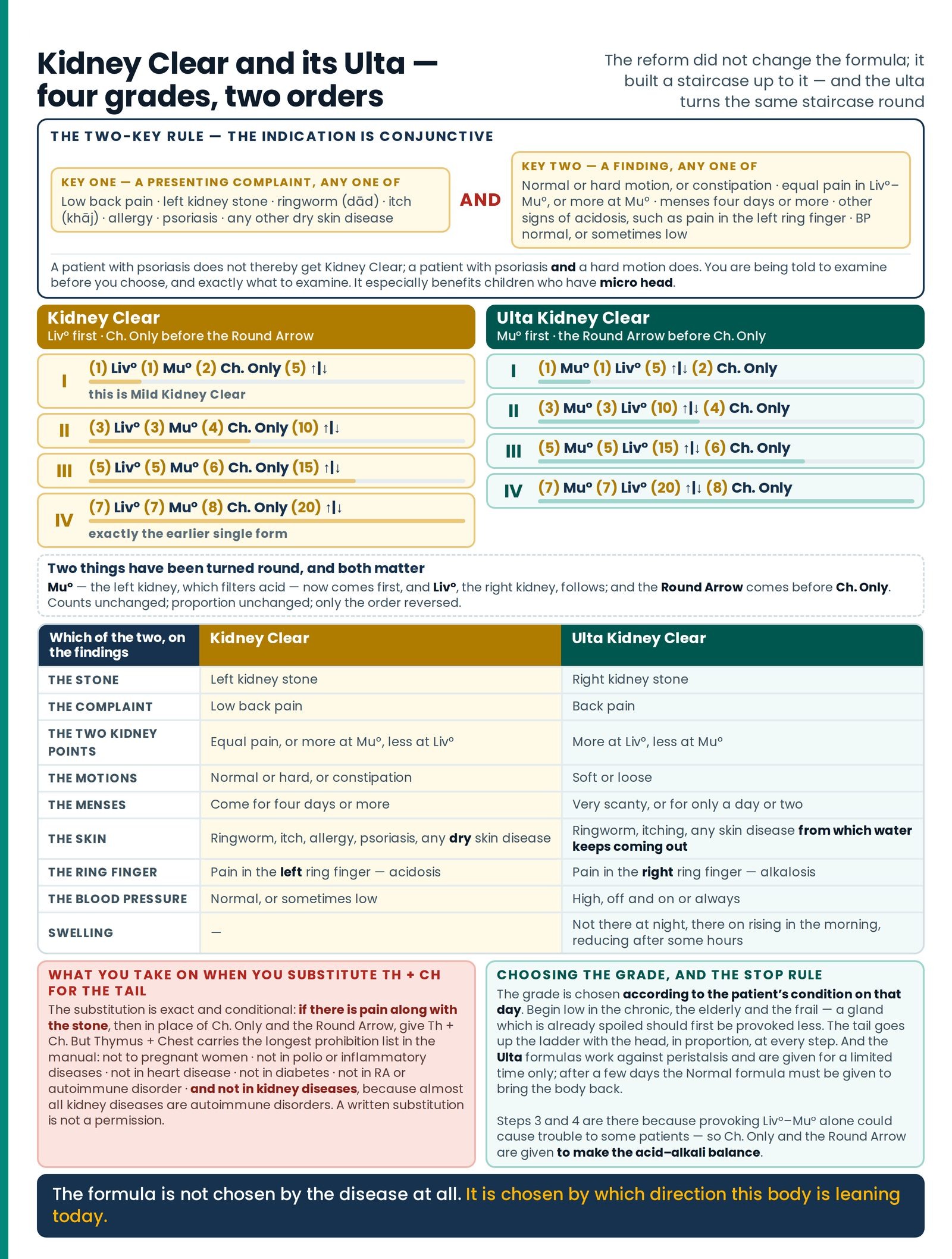
Two things have been turned round, and both matter. (Figure 35.7)
The kidneys have swapped places. Mu° — the left kidney, which filters acid — now comes first, and Liv°, the right kidney, follows. And the balance pair has swapped too. The Round Arrow comes first and Ch. Only afterwards.
That is precisely the ulta operation you met once already, in Ulta 1,25 DCC — Mu° is to be given first and Liv° afterwards; and (20) ↑|↓ is to be given first and (8) Ch. Only afterwards. One operation, performed on two different formulas, for the same reason: the patient's own direction has turned round, so the order that addresses it turns round with it. Counts unchanged; proportion unchanged; only the order reversed.
| Grade | Kidney Clear | Ulta Kidney Clear | ||
|---|---|---|---|---|
| I | (1) Liv° (1) Mu° (2) Ch. Only (5) ↑\ | ↓ | (1) Mu° (1) Liv° (5) ↑\ | ↓ (2) Ch. Only |
| II | (3) Liv° (3) Mu° (4) Ch. Only (10) ↑\ | ↓ | (3) Mu° (3) Liv° (10) ↑\ | ↓ (4) Ch. Only |
| III | (5) Liv° (5) Mu° (6) Ch. Only (15) ↑\ | ↓ | (5) Mu° (5) Liv° (15) ↑\ | ↓ (6) Ch. Only |
| IV | (7) Liv° (7) Mu° (8) Ch. Only (20) ↑\ | ↓ | (7) Mu° (7) Liv° (20) ↑\ | ↓ (8) Ch. Only |
Table 25 — Card: the Ulta Kidney Clear formula Supine Prone 6 sec Left Right ▲ Take care
| Written | Ulta Kidney clear formula → (n) Mu° (n) Liv° (n) ↑\ | ↓ (n) Ch. Only — at grade I, II, III or IV |
|---|---|---|
| The presenting complaint | Back pain · right kidney stone — and any one of the findings below | |
| The qualifying findings | More pain in Liv° and less pain in Mu° · soft or loose motions · women whose menstrual flow is very scanty, or comes for only a day or two · those in whose body swelling comes which is not there at night, is there on rising in the morning, and reduces after some hours · those who have ringworm, itching, or any other skin disease from which water keeps coming out · other symptoms of alkalosis, such as pain in the right ring finger and the like · those who have high BP, either off and on or always | |
| Positions, in order | Supine for the two kidney codes and — after the Round Arrow — for Ch. Only. The patient is turned prone for the arrow between them Supine Prone | |
| The substitution | If someone has pain along with the stone, then in place of the Round Arrow and Ch. Only, give Th + Ch — with everything the box above says about what that brings with it ▲ Take care | |
| The stop rule | The Ulta formulas work against peristalsis and are given for a limited time only; after a few days the Normal formula must be given to bring the body back — rule four of sequence, How a Formula Is Built ▲ Take care | |
| What it inherits | As Table 22 — Liv° and Mu° not stimulated in kidney failure or kidney cancer; Ch. Only not in lung cancer; in chronic illness all the arrows only as far as (L1–L5) ▲ Take care |
Table 26 — Which of the two, on the findings
| Finding | Kidney Clear | Ulta Kidney Clear |
|---|---|---|
| The stone | Left kidney stone | Right kidney stone |
| The complaint | Low back pain | Back pain |
| The two kidney points | Equal pain, or more at Mu°, less at Liv° | More at Liv°, less at Mu° |
| The motions | Normal or hard, or constipation | Soft or loose |
| The menses | Come for four days or more | Very scanty, or for only a day or two |
| The skin | Ringworm, itch, allergy, psoriasis, any dry skin disease | Ringworm, itching, any skin disease from which water keeps coming out |
| The ring finger | Pain in the left ring finger — acidosis | Pain in the right ring finger — alkalosis |
| The blood pressure | Normal, or sometimes low | High, off and on or always |
| Swelling | — | Swelling not there at night, there on rising in the morning, reducing after some hours |
Read that table down rather than across and something becomes obvious: it is the two kingdoms, on one page, in nine rows. Dry skin against weeping skin. Hard stool against loose. Left ring finger against right. Low pressure against high. The formula is not chosen by the disease at all. It is chosen by which direction this body is leaning today — which is why one patient can need the plain form one month and the ulta form the next, and why the material says exactly that: not everyone has the same symptoms every day.
What else the Kidney Clear treatments are used for
Pneumonia, CP children, swelling — and one question left open
Pneumonia, the kidneys, and a question left open
In the disease called pneumonia, a bad effect falls upon the kidneys.
For that too, the appropriate Kidney clear treatment is to be given according to the condition of the body. This treatment is also to be given to those who have come to us for some other illness and, on asking, we learn that they had pneumonia at some time in childhood.
This treatment will also give benefit to those children who have loose motions three or four times a day — as is found in some CP children.
And one thing more, which is written as a question and stays one. One function of dopamine is to increase the blood flow in the kidneys. So for problems of the kidneys, will (20) Medulla also be beneficial? Further research is to be done on this.
That last paragraph is the whole of the K in ADK, arrived at from the other end — and the open question in it is the same open question as the one attached to the Angiotensin formula a a little earlier. Two independent lines of reasoning have both arrived at this is to be tested, and neither has been tested. That is where the material stands and this wiki leaves it standing.
Two further observations belong here, both from practice rather than from theory.
The son of Shri Anil Bhalerao ji of Pune had pimples — that is, acne — and allergy, and along with it Gal +++. Shri Bhalerao gave the New Gal formula on the first day, and on the second day the New Gal formula together with the Kidney clear treatment. The next morning all the pimples came out. The face was so clean that it was beyond belief.
And a second observation of Bhalerao ji's: if there is swelling in the body — whether it be because of the heart or because the kidneys are not working properly — then giving that patient (10) Pan × 3 treatments often brings benefit. If full benefit is not obtained from that, then afterwards the appropriate Kidney clear treatment can be given.
The Anil Sharma treatment
A gate before the formula, and a rotation that pays back what Adr takes
Not every formula in this wiki was made by Guruji, and this one says so on its face.
The Anil Sharma treatment
If there is no pain in Mu°, it is not to be given.
(5) Pan (3) Gal (5) Liv (7) Mu° (3) acid (3) WD (3) Pit (6) Adr
This treatment was made by Guruji's very old student Shri Anil Sharma ji, who nowadays does neurotherapy practice in London. This formula is a very good treatment for reducing acid.
Since giving Adr will make the Thymus hypo — that is, it will work less — therefore, so that the body's immunity does not fall, after every 4 treatments, in one treatment give (4) Thymus + Chest in the place of (6) Adr.
Main illnesses — those who have joint pain because of acid (give only if there is considerable pain in Mu°); gout, that is gathiyā, where uric acid is raised; Bamboo spine; cervical or lumbar spondylitis.
Table 27 — Card: the Anil Sharma treatment Supine Side-lying Prone 6 sec Left ▲ Take care
| Written | Anil Sharma treatment → (5) Pan (3) Gal (5) Liv (7) Mu° (3) acid (3) WD (3) Pit (6) Adr |
|---|---|
| The gate | If there is no pain in Mu°, it is not to be given ▲ Take care |
| Positions, in order | Supine for steps 1–4 and 6–7 Supine → side-lying for the acid point Side-lying → prone for Adr Prone |
| Step 1 — (5) Pan | Supine; both thighs together, soft mid-sole on the upper third of each Both sides |
| Step 2 — (3) Gal | The therapist's right sole down the patient's left thigh, hip crease → knee Left |
| Step 3 — (5) Liv | Supine; right of the navel, ring 2 — the Liv – 3 points contact |
| Step 4 — (7) Mu° | The left kidney code, single station, hand contact high at the shoulder Left . This is the step the gate is about |
| Step 5 — (3) acid | The Acid point, side-lying Side-lying — On the Side, "On the Side" |
| Step 6 — (3) WD | Supine; the WD station, opposite Pan across the navel — The Front of the Body I |
| Step 7 — (3) Pit | The pituitary contact, elbow and shoulder places, four equal one — The Front of the Body II |
| Step 8 — (6) Adr | Prone; fingers gathered, both palms very close together at the T6 bead Prone |
| The rotation that protects immunity | After every 4 treatments, in one treatment give (4) Thymus + Chest in the place of (6) Adr — because giving Adr will make the Thymus hypo, and the body's immunity must not be allowed to fall ▲ Take care |
| What it is for | Joint pain because of acid — give only if there is considerable pain in Mu° · gout (gathiyā), uric acid raised · Bamboo spine · cervical or lumbar spondylitis. Some therapists of Punjab have the experience that this treatment also stops leucorrhoea — the going of white water — in women |
| What it inherits | Pan — raises alkali, so not in fits, convulsions or seizures; never to schizophrenia patients. Gal — not in leukaemia, blood cancer or other diseases from a raised white cell count; not in asthma; not to those passing little urine. Liv — not in liver cancer. Mu° — not stimulated in kidney failure or kidney cancer. acid — not if there are loose motions, or if there is no pain at Mu°. WD — this stimulates the genital organs, so perhaps it will also stimulate oestrogen; therefore do not give in cancer. Pit — not to diabetic patients, because it raises sugar; it raises alkali, so not to high blood pressure, cancer and fits patients. Adr — reduces immunity, so not in septicaemia, AIDS, HIV or cancer; reduces acid and raises alkali, so not in high blood pressure. On the rotation days, Th + Ch carries its own full list — not in pregnancy, polio, inflammatory disease, heart disease, diabetes, RA, autoimmune disorder or kidney disease ▲ Take care |
| Points taught in | Pan, Gal, Liv, Mu°, WD — The Front of the Body I; acid — On the Side; Pit — The Front of the Body II; Adr — Face Down; Th + Ch — The Front of the Body II |
Three things in that card repay study, and they are all about discipline rather than content.
One — the gate is written before the formula, not after it. If there is no pain in Mu°, it is not to be given. You have met that shape once before, at the head of ATF: no Mu°⁺⁺⁺, no acid treatment. Both formulas exist to reduce acid; both refuse to be given to a body that has not first demonstrated it has any.
Two — the rotation is an answer to a cost, and the cost is named. Adr is in this formula eight times out of nine visits, doing the work it is there to do; and eight visits out of nine the thymus is being pushed down as a consequence. So one visit in five the tail changes, and the thymus is given back what it has been losing. That is a planned repair of a known side-effect, written into the schedule instead of waited for.
Three — the rotation is not free either. The day you give (4) Thymus + Chest is the day the thymus bars apply, and there are eight of them. A patient who is diabetic, or has rheumatoid arthritis, or is pregnant, or has a kidney disease cannot have the rotation day — and that is a fact about that patient, to be written on the card, not a fact about the formula.
The Oxygen-Hormonal treatment
Twelve parts, taught to a mother and a father rather than given by a therapist
This is the longest single treatment in the wiki — twelve numbered parts — and it is also the one most often taught to a family rather than given by a therapist.
The Oxygen-hormonal treatment
I — (2) \°/ Back Arrow (1) ↑o↑ H Arrow (3) Organ clearance (5) On the spine, Round Arrow, Beside the spine II — (1) Liv° (1) Mu° III — (2) Ch. Only IV — (3) Folded legs (6) TF (3) NNS V — (3) Raman × 1 treatment VI — (2) Folic VII — (2) Thia VIII — (2) B₁₂ IX — (2) Nia X — (10) Medulla + Fast Gas : Gas 'I' : Gal : Spl : Liv : Mu XI — (1) Pit (1) Thrd (1) Adr (½) Ku – 20 secs — to make the hormones XII — Ajay Normal — (8) Pan (1) Gal (2) Liv – 3 points (1) Gas 'I' – 6 points
Table 28 — Card: the Oxygen-Hormonal treatment, part by part Prone Supine Side-lying Seated 6 sec ▲ Take care
| Part | What is given | How |
|---|---|---|
| I | (2) Back Arrow \°/ | Prone. With the soft part of the sole, from the middle of the back toward the shoulder, and from the shoulder to the middle part of the upper arm, light rubbing. First the left side, then the right. Its other name is Blood supply to lungs Prone Left Right |
| I | (1) H Arrow ↑o↑ | Between both shoulders, on both sides of the C7 bone, rub from below upward. The count is three equal one |
| I | (3) Organ clearance | Prone or seated; the palm on the back, fingers pointing toward the side of the body, thumb toward the head. First rub lightly over and around the spinal column from above downward and then, without lifting the hand, from below upward; then from right to left and from left to right. Begin from behind the neck and descend at very small intervals. Three times at every place |
| I | (5) On the spine, Round Arrow, Beside the spine | The three spinal strokes, five each. On the spine: the edge of the big thumb, neck → L5, then below L5 upward to T1. Round Arrow: down the right side of the beads to L5, up the left, the pressure on the side of the beads. Beside the spine: first and middle fingers on both sides of the column, pressed downward and inward, neck → L5, then without lifting the hand L5 → C7 |
| II | (1) Liv° (1) Mu° | Supine. The two kidney codes at their lowest count Supine |
| III | (2) Ch. Only | Supine. Six rubs a side — three rubs count as one — left first, chest up to the shoulders, nothing counted on the return Left Right |
| IV | (3) Folded legs | Supine. Both heels close to the buttocks; the patient's thumbs closed inside the palms, fists made, placed beside the navel, closed palm facing downward. Holding the legs in the middle and lifting, fold them from the knees towards the chest; after a few moments, when the patient is breathing out, press the fists downward and inward into the abdomen with their thighs; lift again after a few moments. The time for which it is kept pressed down should be only as long as the patient is comfortable ▲ Take care |
| IV | (6) TF — Toe Fingers | At the feet; the therapist seated facing the soles. At every joint of the toes, rub the three sides six times, counting as you go, so that the nerves under the skin are roused — but not so hard that a wound is made there. If nothing is written, start from the big toe of the left foot to the little toe, then the right side |
| IV | (3) NNS — New Nabhi Set | Pressing with the thumb at each joint of the toes in order, bend the toe downward toward the sole and stay six seconds; three times on each toe. Big toe of the left foot to the little toe, then the right. If the patient has pain, a pillow may be given under the foot — placed so that the heel stays outside the pillow |
| V | (3) Raman × 1 treatment | Seated. Both hands over the shoulders from behind, first fingers close to the neck, palms close to one another; lift the muscles of the back upward from both sides, hold six seconds, release slowly — three times; then the patient breathes in and out comfortably five or six times Seated 6 sec |
| VI–IX | (2) Folic (2) Thia (2) B₁₂ (2) Nia | The four vitamin-formation stations, side-lying, chest normal and knees straight with the body — not near the chest, a pillow between both thighs. Folic: on the left side, the right hip, pressure toward the knees. Thia: left side, right hip, toward the head. B₁₂: on the right side, the left hip, toward the knees, releasing immediately. Nia: right side, left hip, toward the head, releasing immediately Side-lying |
| X | (10) Medulla + the Fast run | Seated for the Medulla; then the Fast treatment, Gas : Gas 'I' : Gal : Spl : Liv : Mu, in which no six-second hold is counted — do not stay more than one or two seconds at any point Seated Supine |
| XI | (1) Pit (1) Thrd (1) Adr (½) Ku – 20 secs | To make the hormones. (½) Ku – 20 secs: the patient laid so that both heels face each other; the therapist sits between the feet and, with the middle part of the sole at normal pressure, presses the last end of the spinal column, holds twenty seconds, and releases comfortably. (½) Ku – 20 secs is for neutrophils, which will fight infection Prone |
| XII | Ajay Normal | (8) Pan (1) Gal (2) Liv – 3 points (1) Gas 'I' – 6 points. Given in place of part XI for the first month or so — see the method below. Setting the Stomach Supine |
Main illnesses — abdomen disorder · M.S. (multiple sclerosis) · back pain · mental retardation · neuropathy · myopathy · M.N.D. (motor neuron disorder).
And this same treatment has also been found very useful for:
Low count of platelets — as happens in the illness called ITP, idiopathic thrombocytopenic purpura
Any genetic illness
S.L.E., scleroderma, or any other auto-immune disorder
Table 29 — The arrow glyphs used in this treatment
| The glyph, described | Code | Full name | |
|---|---|---|---|
| A small circle flanked by inward-leaning oblique strokes | \°/ | Back Arrow, also Blood supply to lungs | |
| Two upward arrows with a small circle between them | ↑o↑ | H Arrow | |
| A ring-topped stem with a downward arrowhead | — | On the spine | |
| An upward arrow, a ring-topped stem, and a downward arrow | ↑\ | ↓ | Round Arrow |
| A double-headed arrow, a ring-topped stem, and a second double-headed arrow | — | Beside the spine | |
| A plain ring-topped stem with no arrowhead | — | Up Arrow | |
| A double-headed horizontal arrow | ←→ | Stretch |
The month that the hormones wait
Until the abdomen is completely all right, the hormones are not to be provoked
That instruction is the whole philosophy of this therapy compressed into one schedule. Every gland takes its raw materials from the end products of digestion. So a treatment whose last part is to make the hormones is a treatment that cannot work until the supply line is open — and rather than hope, the treatment withholds its own most important part for a month and puts a digestive formula in its place.
A householder's version: you do not send the tailor an order for six shirts until the cloth has arrived in the shop. Sending it earlier does not get the shirts sooner. It gets you a tailor with nothing to work with and an order he cannot fill.
Table 30 — The three-month schedule for M.N.D. and myopathy
| Period | Component I | Component II | How often |
|---|---|---|---|
| Month 1 | Oxygen-hormonal treatment | — | Daily, at least once a day |
| From month 2 | Oxygen-hormonal treatment | (15) Medulla | × 6 treatments |
| From month 3 | Oxygen-hormonal treatment | (15) Medulla | × 12 treatments |
The rest between rounds of a Medulla line is one and a half minutes — Table 8, How a Formula Is Built. Twelve rounds is therefore not merely twice six; it is a considerably longer sitting, and a family taught to give it must be told so.
The Oxygen formula
Ten steps that open the chest, work the whole spine, and open it again
The Oxygen formula
(8) Ch. Only (6) ←→ (6) \°/ (3) ↑o↑ (20) On the spine · Beside the spine · Round Arrow + (6) \°/ (3) ↑o↑ (6) ←→
Every step of this one carries its own stated reason, and the reasons read like a single argument about breathing.
Table 31 — Card: the Oxygen formula, with the purpose of every step Supine Prone 6 sec ▲ Take care
| Step | What is given | Why it is there |
|---|---|---|
| 1 | (8) Ch. Only Supine | To clean the lungs |
| 2 | (6) ←→ — Stretch | Opens the muscles of the neck so that one can breathe well |
| 3 | (6) \°/ — Back Arrow Prone | To increase the supply of blood to the lungs |
| 4 | (3) ↑o↑ — H Arrow Prone | So that through the nerves of T1/T2 the message reaches the nerves of the brain properly |
| 5 | (20) On the spine Prone | To set right the circulation of blood in the whole body |
| 6 | (20) Beside the spine Prone | To set right the circulation of blood in the whole body |
| 7 | (20) Round Arrow Prone | To set right the circulation of blood in the whole body |
| 8 | (6) \°/ — Back Arrow | As given above — repeated |
| 9 | (3) ↑o↑ — H Arrow | As given above — repeated |
| 10 | (6) ←→ — Stretch | As given above — repeated |
| What it is for | To increase the quantity of oxygen in the tissues and cells of the body | |
| The dose limit | In chronic illnesses, all the arrows are to be given only as far as (L1–L5) ▲ Take care | |
| What it inherits | Ch. Only — not in lung cancer ▲ Take care | |
| Points taught in | Ch. Only and Stretch — The Front of the Body II; the arrows and the spinal strokes — Face Down, "Face Down" |
Notice the shape: three, then twenty, then the same three again, in reverse. The formula opens the chest and the neck, does its long work on the whole spine, and then opens the chest and neck a second time on the way out. It is one of the very few formulas in the wiki that closes by repeating its own opening, and a therapist who leaves off the last three steps because they look like a duplication has given a different treatment.
Why this treatment has become so useful, and what happens in the gut
It has been seen that in today's times this treatment is very good.
The reason is this:
The lungs become clean and the flow of blood in them increases, from which every gland of the body gets blood filled with more oxygen, from which their capacity to do their work increases — and whatever work they were not doing before, or whatever enzyme or hormone or chemical they were not making, they begin to make.
The second thing is that in the intestines there are villi, which, if they do not get plentiful oxygen, become as if half-dead, and their capacity to work falls, from which they reduce or stop the absorbing of all the nutrients — the nourishing elements. As soon as they get blood filled with oxygen, they begin to work fully and correctly, from which every organ of the body gains great benefit, and the chemicals and so on which were not being made before begin to be made.
Read those two paragraphs together and you have the reason this article contains an oxygen treatment at all. Every other formula here asks an organ to make something — angiotensinogen, renin, ACE, vasopressin, aldosterone, PTH, cortisol. This one does not ask for a substance. It asks for the condition under which any of them can be made, and then gets out of the way.
The villi are the part patients understand at once. The lining of the intestine is not smooth; it is a carpet, and each thread of the carpet is a little finger with a blood vessel and a lymph channel inside it. A carpet starved of oxygen is a carpet that stops picking things up. Everything this wiki says about digestion supplying the glands runs through those threads, and they need air like anything else.
And there is a reason the villi are the part of the gut that shows it first. The cells at their tips sit at the far end of a very long supply line, on the last of the blood in the vessel, and they are replaced every few days — so the tip of a villus is the first part of the gut to suffer a shortage of air and the first to recover from one. A therapy that treats the lungs in order to reach the intestine is not making a poetic connection. It is following a blood supply.
How this formula got its name, and when
Named on reasoning, without a test — measured four years later, by accident
Here the therapy says something about itself that a tidier account would have left out, and it is left in. Read it exactly as it stands.
The name, and the moment it was given
Some years ago, around the year 2000, I made a treatment after giving which I felt that the quantity of oxygen in the body would increase. At that time, without doing any test at all, I named that treatment the Oxygen Formula.
Without doing any test at all. The formula was built by reasoning — the ten steps of Table 31, each with its own stated purpose, every one of them about breathing, blood supply to the lungs, or circulation — and then it was named for a substance that had not been measured in a single person. The name came first. The measurement came four years later, and came by accident.
The therapy neither apologises for that nor hides it. It prints the admission in the same passage as the evidence that followed, and leaves a reader to weigh the two together. A student should do the same, and should be able to say both halves out loud without embarrassment: the formula was named on reasoning, before any test; this is what was measured afterwards.
The readings at Lilavati Hospital, Mumbai, 2004
This is a matter of the year 2004, and the setting is not a treatment room. At Lilavati Hospital in Mumbai there was a patient in a critical stage — that is, a serious condition — whom his relatives called Guruji to come and see. Nothing about the case was chosen; the patient, the hospital and the measuring were all somebody else's.
The figure that was being watched was the hospital's own. The doctors said that the quantity of oxygen inside his cells, which should be 90, was 82.
What followed is the whole record, and it is a sequence rather than a result:
At the start — 82, against a figure that should be 90.
The Oxygen formula was given twice. Two hours later a test was done: it had come to 84.
The same treatment was given twice again. On testing, it had reached 86–87.
All of this happened within a single day — and without any other medicine.
Then the treatment was stopped. For some reason the hospital people had it stopped. The patient was taken to the ICU and treated with medicines, and his oxygen quantity came to 90.
A test done three hours after that showed the oxygen quantity had fallen again. And here is the line the whole record was kept for: this time it fell only to 87 — not to 82.
That last figure is the evidence being offered, and it is worth being clear about why. The rise from 82 to 86–87 could be argued about, because a patient in a serious condition is being given many things and is changing hour by hour. The fall afterwards is harder to argue about, because it is the same patient, off the treatment, falling back to his own floor — and his floor had moved. He had started the day at 82 and he came back down to 87. That is the whole of the claim: so why should we not say that the quantity of oxygen in the body can be increased by our Oxygen treatment?
Two things in the account are left exactly as they are, and this wiki does not tidy either of them. The first: "If we had been given a little more time, the quantity of oxygen would have come up to 90 with our treatment." That is a statement of what was believed would have happened, not of what was seen, and it is written as such. The second: "From this it was proved that the formula I had made by reasoning turned out, by Hari's grace, to be correct." The gratitude is part of how the record speaks, and it is kept.
What a therapist should take from it is narrower than the passage and firmer. Where a reading is being taken by somebody else, on somebody else's instrument, for somebody else's reasons — write down every number and the clock time beside it. Four readings in one day, taken by a hospital, are worth more than any number of impressions, and they are worth more precisely because nobody in this therapy took them.
The principle behind all of it is stated once, at the close of the run of examples it belongs to, and it is put as a question rather than as a conclusion: on talking with the patients, from the feedback — that is, the message — received from them, it is understood that these treatments have the very same effect as those chemicals have. That is the whole of why Oxygen and Vasopressin stand in this article with chemicals' names on them, and why Angiotensin #2 does. The statement is signed and dated 24.11.2005, and it is taught whole, with what it does and does not claim, in How a Formula Is Built, "How a Formula Is Built".
The (½) Ku timings that belong to this article
Forty seconds for the pineal; sixty and eighty, where research is continuing
(½) Ku appeared twice in the pages above — once inside the Oxygen-Hormonal treatment at twenty seconds, and once inside the Vater formula at forty. The whole timing family is scattered across four articles of this wiki by the chemical each timing is for, and this is where three of them are taught.
(½) Ku — the manoeuvre, once
There are two kinds of Ku.
One is (½) Ku, in front of which is written how many seconds the treatment is to be given — (½) Ku – 6 secs, (½) Ku – 20 secs, and so on. Lay the patient so that both their heels face each other. Sit between their feet, and with the middle part of your sole, with normal pressure, press on the last end of their spinal column; hold it pressed for as many seconds as is written, and then release comfortably. Prone
The half is not half a count. It is the name of the manoeuvre. One press, held, released — Table 13, How a Formula Is Built.
There is another kind, called Ku, or the old Kundali. In that the time is six seconds and the count is two equal one: if (4) Ku is written, press for six seconds and release, and do this eight times without stopping.
(½) Ku – 40 secs, 60 secs and 80 secs
(½) Ku – 40 secs — once, for forty seconds. To stimulate the pineal gland — for melatonin. To correct disorders of the brain, speech or CSF — such as MND (motor neuron disorder) and MS (multiple sclerosis). Excellent for cerebral atrophy.
(½) Ku – 60 secs and (½) Ku – 80 secs — once, for sixty or eighty seconds. These also stimulate the pineal gland. Research on them is continuing.
All three appear among the treatments used to reduce alkalosis, alongside the UDF treatment, ALTF, the Right Raman treatment, Right Chest Only and Right Vitamin formation — and in some people alkali is also reduced by Th + Ch.
That last sentence of the second paragraph stands exactly as it is. Research on them is continuing is not a hedge inserted by this wiki; it is what is written, and it tells you precisely how much is known: that sixty and eighty seconds reach the same gland as forty, and that what the extra seconds buy has not yet been settled. A therapist who uses them should say so, and should write down what he sees.
Table 32 — The whole (½) Ku timing family, and where each is taught
| Timing | What it is for | Taught in |
|---|---|---|
| (½) Ku – 3 secs | — | Cranial Nerve and Brain Formulas, "The Twelve Messengers" |
| (½) Ku – 6 secs | For mast cells, which assist in producing heparin. The recommended opening of every heparin formula | The River — Heparin, "The River" |
| (½) Ku – 13 secs | For eosinophils | Cranial Nerve and Brain Formulas, "The Twelve Messengers" |
| (½) Ku – 20 secs | For neutrophils, which will fight infection. To raise WBC, RBC, monocytes and so on. To correct infection or inflammation in the intestines of those who have had UDF for many years | Clearing the Ash, "Clearing the Ash" — and it is part XI of the Oxygen-Hormonal treatment above |
| (½) Ku – 40 secs | The pineal gland — for melatonin. Disorders of the brain, speech or CSF — MND, MS. Excellent for cerebral atrophy | This article — and it is step 3 of the Vater formula, Setting the Stomach |
| (½) Ku – 60 secs / 80 secs | These also stimulate the pineal gland. Research on them is continuing | This article |
Table 33 — The two kinds of Ku, and where each prohibition is written
| (4) Ku — the old Kundali | (½) Ku – N secs | |
|---|---|---|
| The count | Two equal one — (4) Ku is eight applications of six seconds | One press, held for the number of seconds written |
| What it is for | To reduce alkali; to reduce spasticity and stiffness in the joints. If pain remains at Mu° after Ku, give Round Arrow as required until the Mu° pain clears | By the timing — the table above |
| The printed prohibitions | Do not give Ku to women during menstruation. Do not give it to those with low blood pressure ▲ Take care | The contraindication card names Ku (old version) among the points blocked in low blood pressure |
Read that last row exactly as it is set out and do not let it collapse. The prohibitions are printed against (4) Ku, the old Kundali, and the contraindication card of When the Hand Must Stop names Ku (old version) for low blood pressure. This wiki states where each is written and does not extend it, and does not withdraw it either.