The patient now comes off the chair and goes down onto their side, and something changes in the way the atlas is written: the positioning of this group is written out in more detail than several of its treatments are — the plainest way of saying get this right first.
The reason is mechanical, not kind. A body on its side is a stack of moving parts: the pelvis rolls forward or back, the upper leg drops across the lower one or stays level, the shoulder opens away from the mat or closes toward it. Move any one and the tissue under your foot rises, drops, tightens or slackens — and the point you meant to give is not the point you gave. So this article teaches the pillows before it teaches a single point.
Watch


The position is the treatment
Three rules written before a single point — the pillows come first
The four positions, the two-chair method by which the therapist's weight is carried, and the general form of side-lying are taught in Placing the Patient, "Placing the Patient", and are not repeated.
Rule one — the pillow under the head, in every one of these treatments
In all the treatments given lying on the side, give a pillow under the head as well, so that the neck rests comfortably on it. Especially for those who have neck pain or cervical spondylosis, this precaution is compulsory. ▲ Take care
Lie on a floor on your side without one and the reason appears in ten seconds: the head sags, and everything from ear to shoulder is held in a sideways bend by the muscles of your own neck for as long as you stay down. A young neck absorbs that and complains later. A neck already stiff and narrowed does not absorb it at all — which is why the rule names cervical spondylosis and calls the pillow compulsory there.
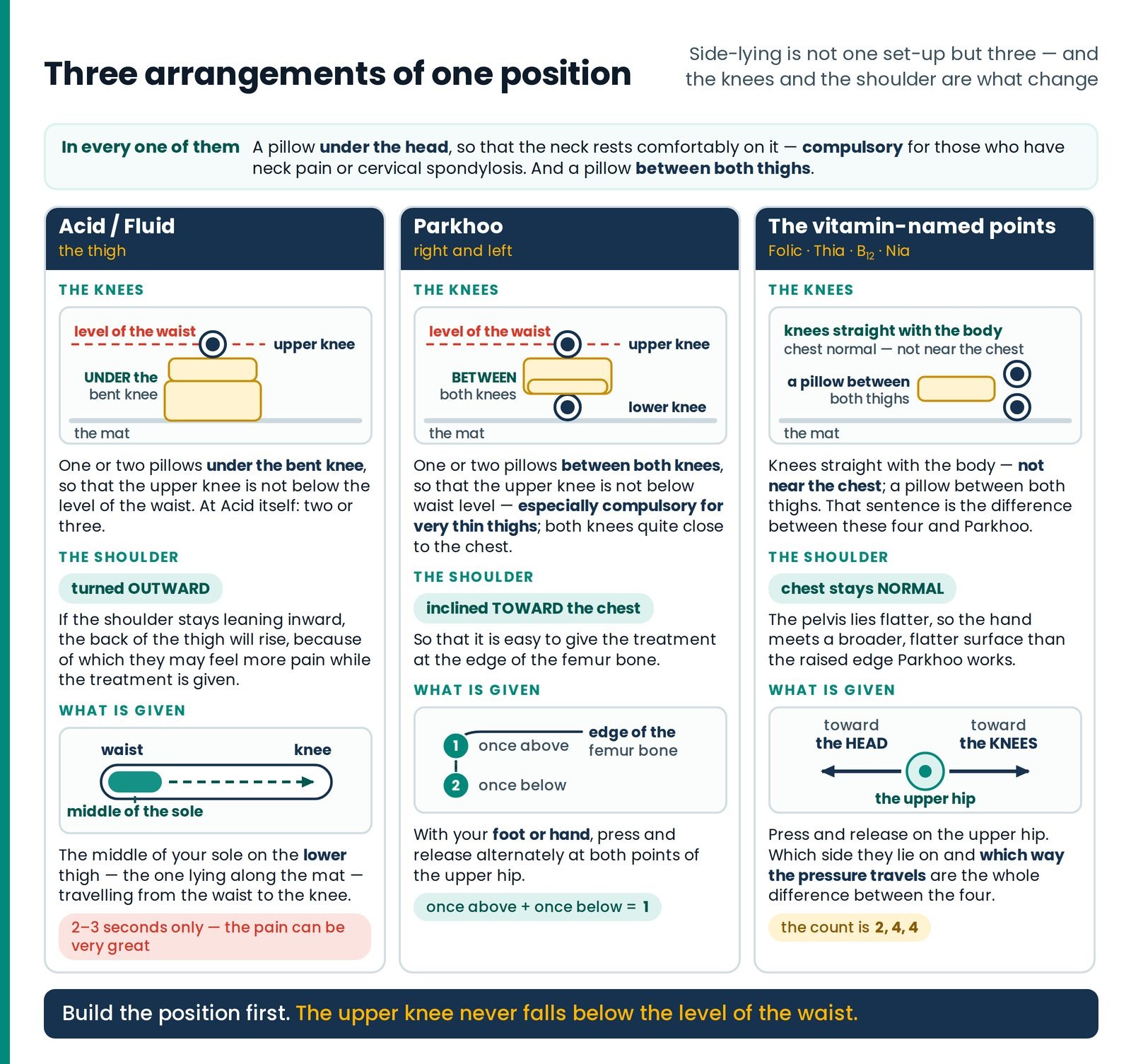
When giving the Acid or Fluid point, place one or two pillows under the bent knee, so that their upper knee is not below the level of the waist.
Besides this, their shoulder should stay turned outward.
Rule two — the knee and the shoulder for Acid and Fluid
If the shoulder stays leaning inward, the back of the thigh will rise, because of which they may feel more pain while the treatment is given.
When giving the Parkhoo point, place one or two pillows between both knees, so that their upper knee is not below the level of the waist.
Rule three — the knees and the shoulder for Parkhoo
This is especially compulsory for those whose thighs are very thin. ▲ Take care
But during the treatment their shoulder should stay well inclined toward the chest, and both knees should be quite close to the chest, so that it is easy to give the treatment at the edge of the femur bone.
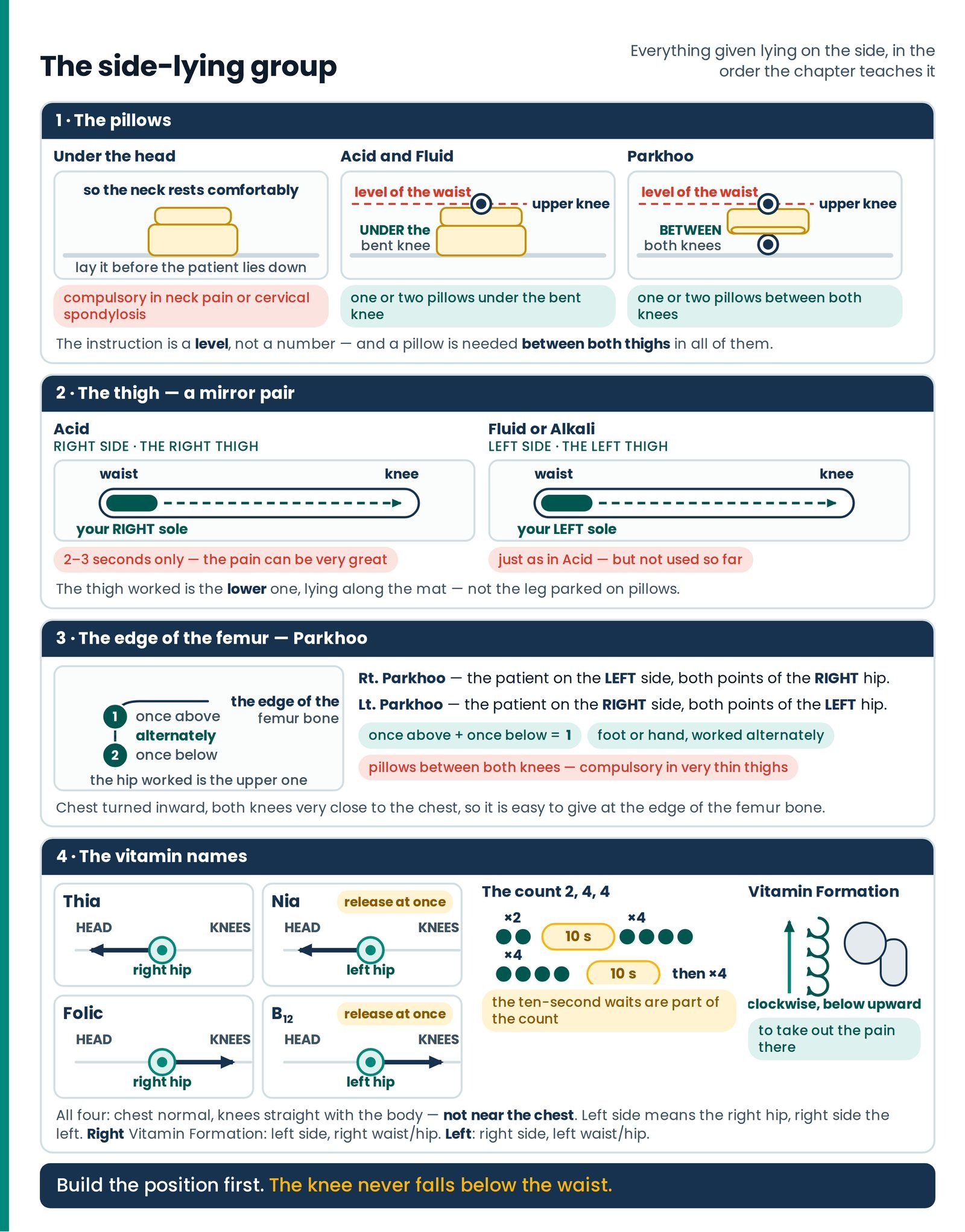
The pillows go in different places, and the difference is the point. For Acid and Fluid they go under the bent upper knee, so the upper leg is parked out of the way and the sole has the lower thigh clear from waist to knee. For Parkhoo they go between both knees, filling the gap so the upper leg cannot fall across the lower one. One arrangement clears a thigh; the other supports a pelvis. (Figure 20.1)
Both are measured the same way, and not by counting pillows. The instruction in each is a level — the upper knee is not below the level of the waist. On a broad-hipped woman with one firm pillow that is one; on a thin man with soft ones it is two, and at Acid itself the instruction says two or three. Build to the level, then write the number on the card.
And the rule names whom it is compulsory for. On a very thin thigh nothing lies between the knee bones to hold the upper leg up; the moment you begin, the knee drops, the pelvis rolls after it, and the edge of the thigh bone goes with it.
One further rule stands under the whole group, printed at the foot of its pages: in all these treatments a pillow is needed between both thighs.
The thigh — Acid
The lower thigh, waist to knee, and only two or three seconds
Acid — एसिड
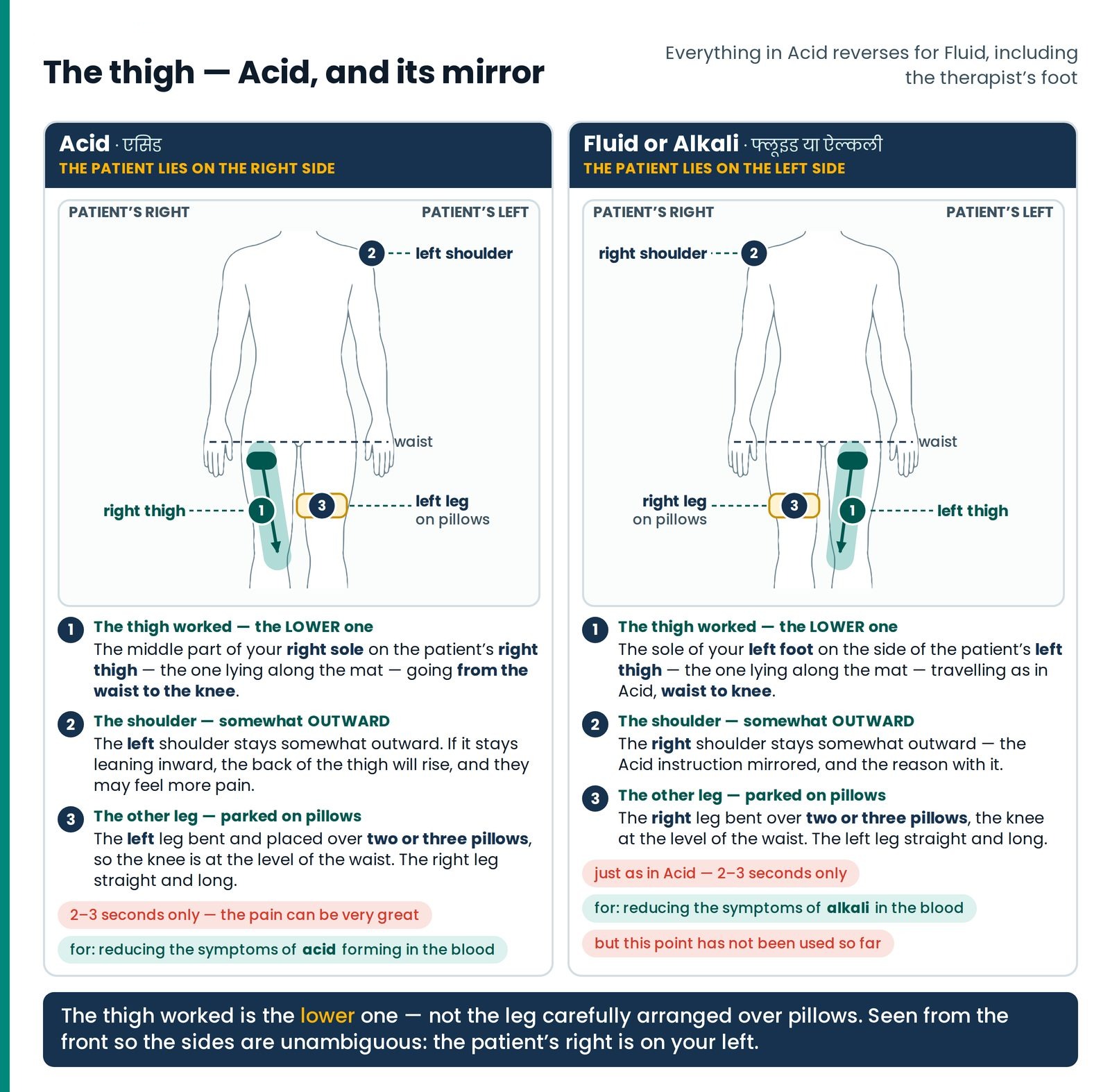
Lay the patient on the right side, in such a way that their left shoulder stays somewhat outward. Tell them to keep the right leg straight and long, and to bend the left leg and place it over two or three pillows, so that the knee is at the level of the waist.
Now, with the middle part of your right sole, pressing on their right thigh, go from the waist to the knee — but give the pressure for only 2–3 seconds, because the pain can be very great.
This reduces the symptoms of acid forming in the blood.
| Patient's position | Lying on the right side, the left shoulder somewhat outward; the right leg straight and long; the left leg bent and placed over two or three pillows, the knee at the level of the waist; a pillow under the head Side-lying Right |
|---|---|
| Where the feet are placed | The middle part of the therapist's right sole on the patient's right thigh — the lower one, lying along the mat — travelling from the waist to the knee |
| Duration and repetitions | The pressure only 2–3 seconds — the therapy's own limit, given for a stated reason ▲ Take care |
| What it is for | Reducing the symptoms of acid forming in the blood |
The thigh that is worked is the one underneath — which catches students out, because the leg carefully arranged over pillows is the other one. The upper leg is parked out of the way; the lower leg is kept straight and long so the sole has an uninterrupted run from waist to knee. The count here is seconds, not repetitions, and shorter than the therapy's usual six. (Figure 20.2)
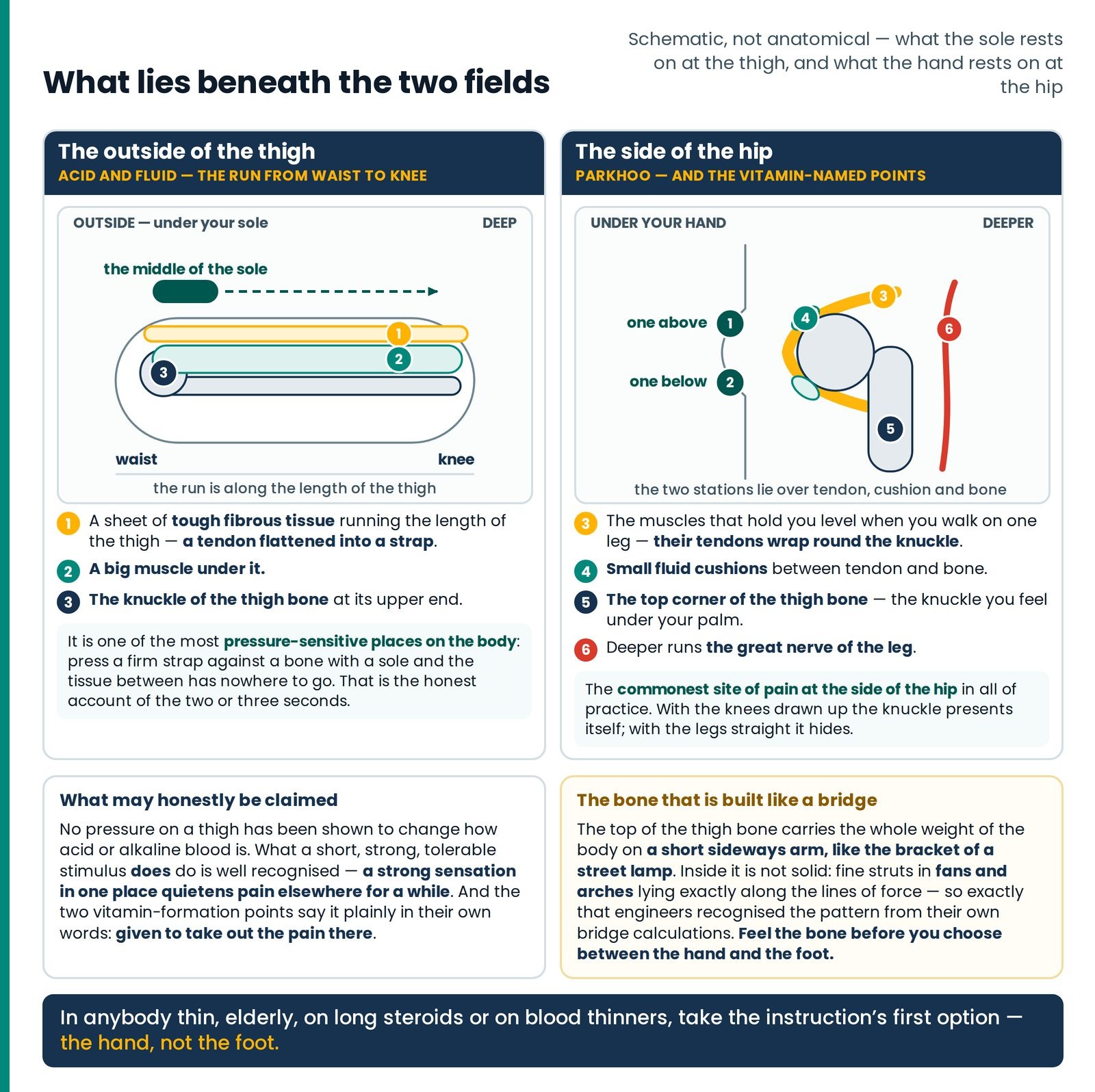
What lies beneath. Run your hand down the outside of your own thigh and you will feel a broad firm band — a sheet of tough fibrous tissue running the length of the thigh, a tendon flattened into a strap, with a big muscle under it and the knuckle of the thigh bone at its upper end. It is one of the most pressure-sensitive places on the body: press a firm strap against a bone with a sole and the tissue between has nowhere to go. That is the honest account of the two or three seconds. No pressure on a thigh has been shown to change how acid or alkaline blood is; what a short, strong, tolerable stimulus does do is well recognised — a strong sensation in one place quietens pain elsewhere for a while.
The edge of the thigh bone — Parkhoo, right and left
Two stations at the upper hip, and a count in which two equal one
Two points, one on each side, and they are the reason the knees come up to the chest at all.
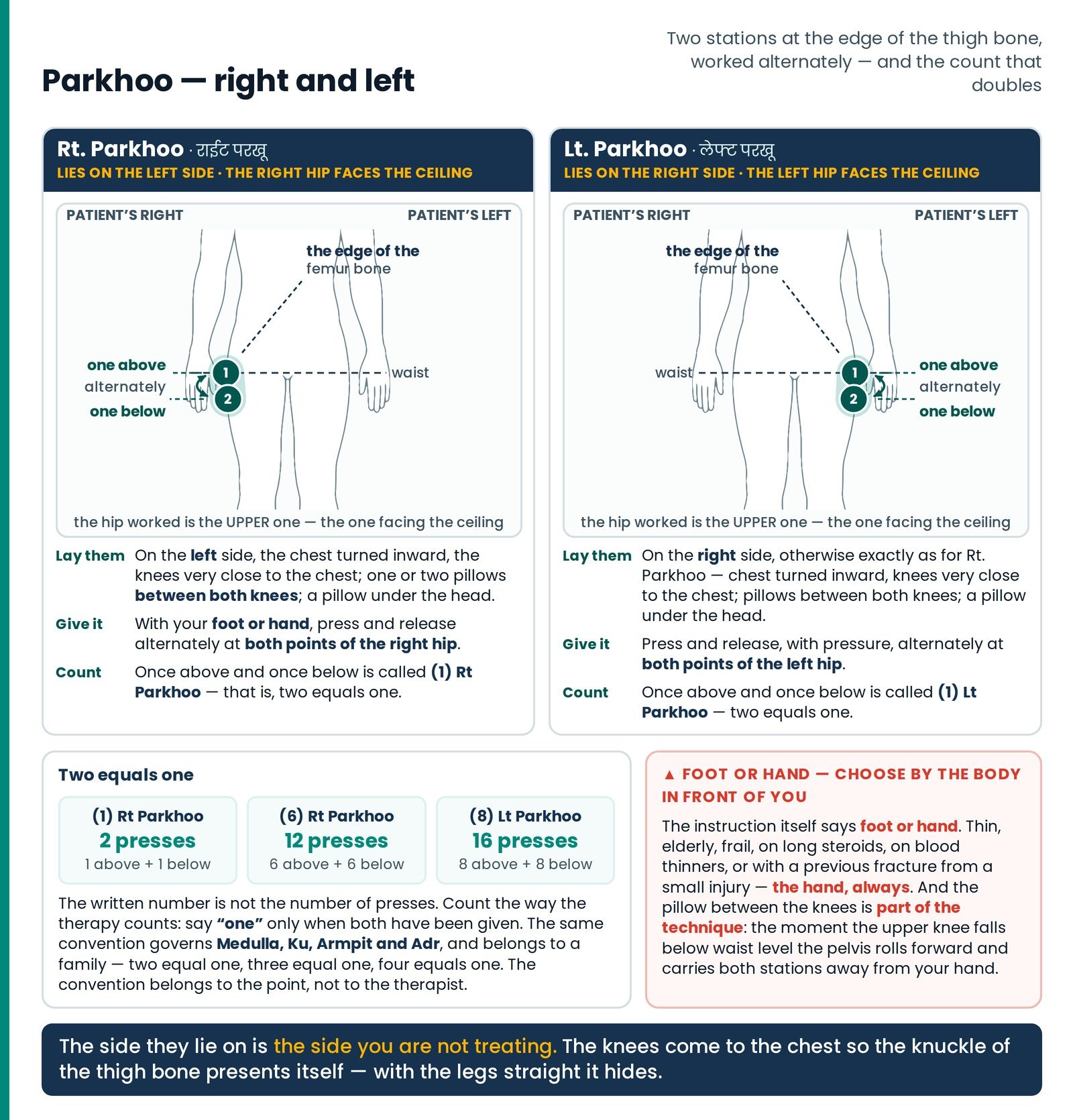
Lay the patient on the left side in such a way that the chest is turned inward and the knees are very close to the chest.
With your foot or hand, press and release alternately at both points of their right hip.
Doing it once above and once below is called (1) Rt Parkhoo. That is, the count is: two equals one.
| Patient's position | Lying on the left side, the chest turned inward, the knees very close to the chest; one or two pillows between both knees so the upper knee is not below waist level — especially compulsory in very thin thighs; a pillow under the head Side-lying Left ▲ Take care |
|---|---|
| Where the hands or feet are placed | The foot or hand at both points of the right hip — one above and one below — worked alternately Right |
| Duration and repetitions | Once above and once below is called (1) Rt Parkhoo — that is, the count is: two equals one |
| What it is for | Not separately stated at the point |
Rt. Parkhoo — राईट परखू
Lt. Parkhoo — लेफ्ट परखू
Lay the patient as above, but on the right side, and press and release with pressure, alternately, at both points of the left hip.
Doing once above and once below is called (1) Lt Parkhoo. That is, the count is: two equals one.
| Patient's position | Lying on the right side, otherwise exactly as for Rt. Parkhoo — chest turned inward, knees very close to the chest; one or two pillows between both knees; a pillow under the head Side-lying Right ▲ Take care |
|---|---|
| Where the hands or feet are placed | Both points of the left hip — one above and one below — worked alternately, with pressure Left |
| Duration and repetitions | Once above and once below is called (1) Lt Parkhoo — two equals one |
| What it is for | Not separately stated at the point |
The hip that is worked is the upper one, and that decides which side the patient lies on: for Rt. Parkhoo the right hip must face the ceiling, so the patient lies on the left. The side they lie on is the side you are not treating. (Figure 20.3)
The pillow between the knees is not preparation for this point. It is part of the technique. Everything Parkhoo aims at depends on the hip staying where you put it, and the moment the upper knee falls below waist level the pelvis rolls forward and carries both stations away from your hand. The pillows go in as the knees come up, and are checked again after the first press. (Figure 20.4)
The knees come to the chest for a stated purpose — *so that it is easy to give the treatment at the edge of the femur bone*. Drawing them up rolls the pelvis and swings the top of the thigh bone outward until its knuckle stands up under the skin, and the two stations sit at that edge. On a patient whose knees have quietly straightened, the same presses land on a hip rolled back flat, and the edge is no longer where it was.
Parkhoo and the count that doubles — two equals one
At Parkhoo the written number is not the number of presses. One press above plus one press below, worked alternately, make one of what the card asks for. So (1) Rt Parkhoo is two presses and (8) Rt Parkhoo is sixteen — eight above, eight below, alternating.
The same convention governs Medulla, Ku, Armpit and Adr, and belongs to a family: two equal one, three equal one, four equals one. Learn the family, not the individual points.
What lies beneath. Put a hand on the side of your own hip, stand on the other leg, and a knuckle of bone stands out under the palm — the top corner of the thigh bone. It anchors the muscles that hold you level when you walk on one leg; their tendons wrap round it, with small fluid cushions between tendon and bone, and deeper runs the great nerve of the leg. So the two stations lie over tendon, cushion and bone — the commonest site of pain at the side of the hip in all of practice. With the knees drawn up the knuckle presents itself; with the legs straight it hides. And in anybody thin, elderly, on long steroids or on blood thinners, take the instruction's first option — the hand, not the foot.
The four points named for vitamins
One arrangement, two differences, and the unusual count 2, 4, 4
Four points now follow that share one arrangement of the body, differ from each other in exactly two things, and are delivered on one unusual count.
The arrangement. All four are given side-lying with the chest normal and the knees straight with the body — not near the chest. That sentence is the difference between these four and Parkhoo, and it is stated afresh at each of them: Parkhoo curls the patient up, these lay them out long. A pillow is still needed between both thighs.
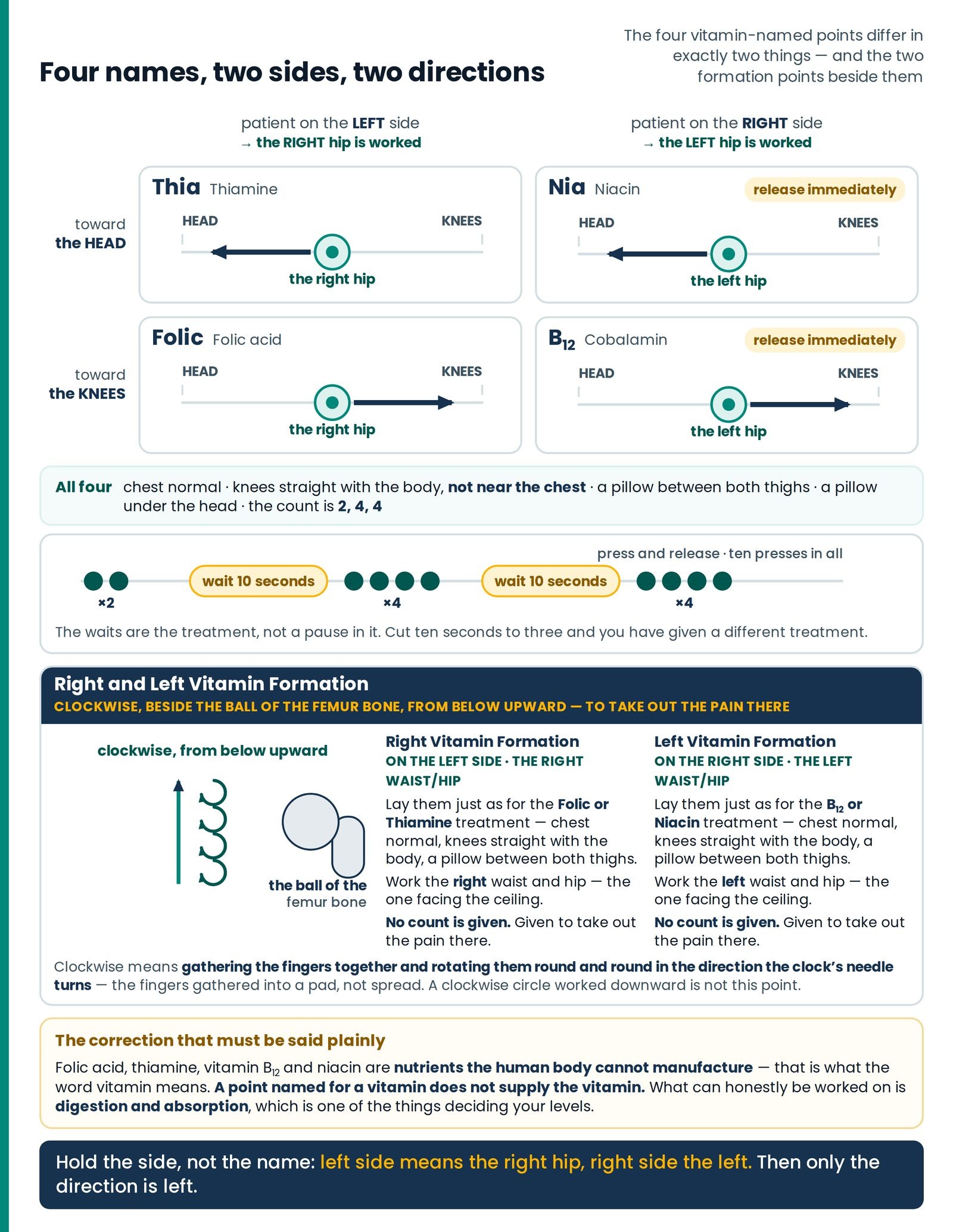
The two differences. Which side the patient lies on, deciding which hip faces the ceiling; and which direction the pressure travels. Two sides by two directions gives four named points — Folic, left side and right hip toward the knees; Thia, left side and right hip toward the head; B₁₂, right side and left hip toward the knees; Nia, right side and left hip toward the head — and nothing else separates them. (Figure 20.5)
Folic — फोलिक एसिड · folic acid
Lay the patient on the left side and press and release on the right hip, in the direction of the knees.
The difference between the Parkhoo treatment and this, in the laying down, is that the chest stays normal and the knees stay straight with the body — not near the chest.
| Patient's position | Lying on the left side; chest normal; knees straight with the body — not near the chest; a pillow between both thighs; a pillow under the head Side-lying Left |
|---|---|
| Where the hands are placed | On the right hip — the upper one — pressing and releasing in the direction of the knees Right |
| Duration and repetitions | The count for these four is 2, 4, 4 — taught in full at Nia below |
| What it is for | Named for folic acid; no separate indication is stated at the point |
Thia = Thiamine
Lay the patient just as for Folic, on the left side, and press and release on the right hip in the direction of the head.
The difference between the Parkhoo treatment and this, in the laying down, is that the chest stays normal and the knees stay straight with the body — not near the chest.
| Patient's position | Lying on the left side, exactly as for Folic; chest normal; knees straight with the body; a pillow between both thighs Side-lying Left |
|---|---|
| Where the hands are placed | On the right hip, pressing and releasing in the direction of the head Right |
| Duration and repetitions | 2, 4, 4 |
| What it is for | Named for thiamine; no separate indication is stated at the point |
In all these treatments a pillow is needed between both thighs.
B₁₂
Lay the patient on the right side and press on the left hip in the direction of the knees, and release immediately.
The difference between the Parkhoo treatment and this, in the laying down, is that the chest stays normal and the knees stay straight with the body — not near the chest.
| Patient's position | Lying on the right side; chest normal; knees straight with the body — not near the chest; a pillow between both thighs; a pillow under the head Side-lying Right |
|---|---|
| Where the hands are placed | On the left hip — the upper one — pressing in the direction of the knees, and releasing immediately Left |
| Duration and repetitions | 2, 4, 4 |
| What it is for | Named for vitamin B₁₂; no separate indication is stated at the point |
Nia = Niacin
Lay the patient just as for B₁₂ above, on the right side, and press on the left hip in the direction of the head, and release immediately.
The number of these four is 2, 4, 4. That is: press and release twice; then, after ten seconds, press and release four times; then, after ten seconds again, press and release four times.
| Patient's position | Lying on the right side, exactly as for B₁₂; chest normal; knees straight with the body; a pillow between both thighs Side-lying Right |
|---|---|
| Where the hands are placed | On the left hip, pressing in the direction of the head, and releasing immediately Left |
| Duration and repetitions | 2, 4, 4 — press and release twice; after ten seconds, press and release four times; after ten seconds again, press and release four times. This count governs all four of these points |
| What it is for | Named for niacin; no separate indication is stated at the point |
In all these treatments a pillow is needed between both thighs.
The count 2, 4, 4, and the ten seconds that are part of it
Press and release twice. Wait ten seconds. Press and release four times. Wait ten seconds again. Press and release four times.
Ten presses in all, in three sets of two, four and four, with two waits of ten seconds built into the middle of them.
The waits are the treatment, not a pause in it. Pressure squeezes blood out of a place and release lets it flood back, and the flood is the point of the press. Cut ten seconds to three because the hall is busy and you have given a different treatment.
Two of the four release immediately, and two do not say so. At B₁₂ and Nia the instruction is press … and release immediately; at Folic and Thia, press and release. Give each as it stands: nothing is held at B₁₂ and Nia.
What lies beneath — and one correction that must be said plainly. Under the hand in all four is the Parkhoo field. With the knees straight the pelvis lies flatter, so the hand meets a broader, flatter surface than the raised edge Parkhoo works, and "toward the head" and "toward the knees" are directions of drag across it — and the direction tissue is dragged in genuinely does change what the cells inside it experience.
The correction is this. Folic acid, thiamine, vitamin B₁₂ and niacin are nutrients the human body cannot manufacture. That is not an opinion about these points; it is what the word vitamin means. If a patient is short of B₁₂, they need B₁₂.
And yet a real claim sits beside that one. Whether a person absorbs and holds on to these nutrients is a different question from whether they can build them — a question about the stomach, the gut and the liver, where this therapy does most of its work. B₁₂ has a long journey with several places to fail: freed from food by stomach acid, bound to a carrier made by the stomach's own lining, taken up near the end of the small bowel. So the defensible sentence — to a patient, and on a card — is: "this work is aimed at digestion and absorption, which is one of the things that decides your vitamin levels." Testable, and it costs nothing to check.
Right and Left Vitamin Formation
Clockwise beside the knuckle, from below upward — for the pain there
Two more points, given in the same laid-out positions as the four above but worked quite differently — and carrying, unusually for this group, an indication of their own.
Right Vitamin Formation
Lay them just as for the Folic or Thiamine treatment, and doing clockwise beside the ball of the femur bone of the thigh, go from below upward.
For Right vitamin formation, lay the patient on the left side and do it on the right waist/hip. This is given to take out the pain there.
Clockwise means: gathering the fingers together and rotating them round and round in the direction the clock's needle turns.
Left Vitamin Formation
Lay them just as for the B₁₂ or Niacin treatment, and doing clockwise beside the ball of the femur bone of the thigh, go from below upward.
For Left vitamin formation, lay the patient on the right side and do it on the left waist/hip. This is given to take out the pain there.
Table 1 — Right and Left Vitamin Formation
| Right Vitamin Formation | Left Vitamin Formation | |
|---|---|---|
| Patient's position | Lying on the left side, just as for the Folic or Thiamine treatment; a pillow between both thighs Side-lying Left | Lying on the right side, just as for the B₁₂ or Niacin treatment; a pillow between both thighs Side-lying Right |
| Where the hands are placed | Beside the ball of the femur bone of the thigh, on the right waist/hip, working clockwise, going from below upward Right | Beside the ball of the femur bone of the thigh, on the left waist/hip, working clockwise, going from below upward Left |
| Duration and repetitions | Clockwise rotation worked upward; no count is given | |
| What it is for | To take out the pain there |
Three things are named separately in each, and all three are the instruction. The side the patient lies on. The hip worked — right for Right Vitamin Formation, left for Left — always the one facing the ceiling. And the direction, twofold: the fingers rotate clockwise, and the circling travels from below upward. A clockwise circle worked downward is not this point.
Clockwise is defined for you — gathering the fingers together and rotating them round and round in the direction the clock's needle turns. The fingers are gathered into a pad, not spread, and the skin moves with the pad rather than being slid over.
"Beside the ball of the femur bone" means beside it, not on it. The ball sits deep in the hip joint under thick muscle; no finger reaches it and none is asked to. What the fingers circle over is the field beside the knuckle you can feel at the side of the hip.
Which is why these two say what they say. This is given to take out the pain there — a local, honest indication, more modest than the name.
The mirror of Acid — Fluid or Alkali
Everything in Acid reversed, including the therapist's own foot
Fluid or Alkali — फ्लूइड या ऐल्कली
In this, do just as in Acid, but lay the patient on the left side, and give it with the sole of your left foot on the side of their left thigh.
This reduces the symptoms of alkali in the blood. But this point has not been used so far.
| Patient's position | Lying on the left side — otherwise exactly as in Acid: the right shoulder somewhat outward, the left leg straight and long, the right leg bent over two or three pillows with the knee at the level of the waist; a pillow under the head; a pillow between both thighs Side-lying Left |
|---|---|
| Where the feet are placed | The sole of the therapist's left foot on the side of the patient's left thigh — the lower one — travelling as in Acid, from the waist to the knee |
| Duration and repetitions | Just as in Acid — the pressure only 2–3 seconds, because the pain can be very great ▲ Take care |
| What it is for | Reducing the symptoms of alkali in the blood. But this point has not been used so far |
In all these treatments a pillow is needed between both thighs.
Fluid and Alkali are two names for one point, and both are met on cards. Its symbol is the Acid stroke mirrored left to right — the mirror is the instruction.
Everything in Acid reverses, including the therapist's foot. Patient on the left; the left thigh; your left sole; the right shoulder turned outward. Mirror the Acid picture rather than memorising a second list, and check what students reliably get wrong in mirrors: the thigh worked is again the lower one, not the one parked on pillows. The pressure limit travels with the technique — just as in Acid carries the two or three seconds and the reason for them.
The sentence at the end of this point, and why it is left standing
"But this point has not been used so far."
A therapy confident on every other page pauses here to record that one of its own points has never actually been given. That sentence is taught, not tidied away. It does not mean the point is forbidden or useless; it means the honest thing — the experience behind this one is not the experience behind Acid. Keep the habit in your own notes: mark what you have done a hundred times and what you have done once.
What lies beneath. Anatomically this is the Acid point on the other leg. The right for acid, left for alkali arrangement belongs to the therapy's own scheme of sidedness, taught with the two kidneys and the two columns of symptoms in The Two Kingdoms, "The Two Kingdoms"; the formulas using Fluid are in Correcting the Two Kingdoms. What is treated is the picture the therapy groups under that name — the swelling, the thin frequent stools, the watery nose, the pale urine.
What this article hands to the next
The patient turns onto the front, where a rule again comes first
That completes the treatments given lying on the side. The atlas turns the patient over once more, onto the front, where a new group begins with a positioning rule written before any point — again a compulsory one, concerning pillows under the chest and how the chin is to rest. That group holds Adr, Swt, the arrow family, Ku and the work along the spine.
Two layers are deliberately left out here. What each point is used for, and when it must not be used, is gathered in Each Point in Use, "Each Point in Use"; every formula they appear in belongs to — Correcting the Two Kingdoms, "Correcting the Two Kingdoms", and Vitamin and Gene Formulas, "The Missing Links". (Figure 20.6)
Questions students ask
- 1. Why is the pillow under the head compulsory here when the supine rules forbid one? Because the reason is different. On the back, a pillow pushes the chin onto the chest; on the side, no pillow leaves the head hanging sideways all session. The aim in both is a straight neck. See also → Placing the Patient, "Placing the Patient".
- 2. How many pillows exactly? One or two for the group, two or three at Acid. Neither counts pillows — both reach one level: the upper knee is not below the level of the waist. Build to the level, then write what got you there.
- 3. My patient is comfortable curled inward. Must I really turn the shoulder out for Acid? Yes, and the instruction tells you the price: the back of the thigh will rise, because of which they may feel more pain.
- 4. Parkhoo says foot or hand. How do I choose? By the body in front of you. Thin, elderly, frail, on long steroids, on blood thinners, or with a fracture from a small injury — the hand, always. See also → The Child, the Elder and the Frail, "The Child, the Elder and the Frail".
- 5. If (1) Rt Parkhoo is two presses, what is (6) Rt Parkhoo? Twelve — six above and six below, alternating.
- 6. I keep mixing up Folic and B₁₂. Hold the side, not the name: left side means the right hip, right side the left. Then only the direction is left.
- 7. May I shorten the ten seconds if I am in a hurry? No. They are part of the count, exactly as the six seconds are part of a six-second hold. See also → Six Seconds, "Six Seconds".
- 8. If these points cannot make vitamins, why are they in the therapy at all? Because they are real techniques over a real field of tissue, and one of them says plainly what it does — to take out the pain there. A name that overpromises is corrected, not discarded. See also → Vitamin and Gene Formulas, "The Missing Links".
Questions patients ask
- 1. "My blood report is normal. So why are you saying I have acid?" Your report is normal, and I am not telling you otherwise. The word acid here describes a pattern I can see — hard stools, dry cough, burning urine, a headache at the temples — not a number in your blood. Your body defends that number very hard.
- 2. "That one hurt much more than everything else. Is that normal?" Yes, and it is why I warned you first. That point is given for two or three seconds only, for exactly this reason. If it is worse than that, say so and I will stop and check how you are lying.
- 3. "Will this point give me B₁₂, so I can stop the injections?" No, and please do not stop them. Your body cannot make B₁₂ — nobody's can; the injections put it in. What this work aims at is your digestion, which is one of the things deciding how much you take in from food.
- 4. "Why so many pillows? I am not a baby." Because your knee has to stay level with your waist while I work, and your neck straight for twenty minutes. The pillows hold you there so your own muscles need not.
- 5. "My hip has hurt a year and the X-ray was fine. Does that mean nothing is wrong?" It means the bone and the joint are fine, which is good news. Pain at the side of the hip most often comes from the tendons and cushions just outside the joint, and those do not show on an ordinary X-ray — exactly where these points are worked.
Words used here
| Hindi | English | Neurotherapy code / usage |
|---|---|---|
| करवट में लिटाकर | Laid on the side | Always a named side; pillow under the head in every treatment Side-lying |
| तकिया | Pillow | Under the bent knee for Acid/Fluid; between both knees for Parkhoo; between both thighs in all |
| एसिड | Acid | Right side, right thigh, right sole, waist to knee, 2–3 seconds only |
| फ्लूइड / ऐल्कली | Fluid / alkali | The mirror of Acid: left side, left sole on the left thigh; not used so far |
| राईट परखू | Right Parkhoo | Rt. Parkhoo — left side, both points of the right hip, once above + once below = one |
| लेफ्ट परखू | Left Parkhoo | Lt. Parkhoo — right side, both points of the left hip, two equals one |
| फोलिक एसिड | Folic acid | Folic — left side, right hip, toward the knees; 2, 4, 4 |
| — | Thiamine · cobalamin · niacin | Thia — left side, right hip, toward the head. B₁₂ — right side, left hip, toward the knees. Nia — right side, left hip, toward the head. B₁₂ and Nia release immediately; all 2, 4, 4 |
| — | Vitamin formation | Clockwise beside the ball of the femur bone, from below upward — to take out the pain there |
| सर्वाइकल स्पॉन्डिलोसिस | Cervical spondylosis | Where the head pillow stops being a precaution and becomes compulsory |