The Shorthand — Codes, Symbols and How to Read a Formula
A therapist who can read three-quarters of a card is not three-quarters of a therapist. He is a therapist who will give the wrong treatment while believing he is following instructions. This article is the key to the thirty articles that come after it. Every point, every formula, every card and every line chalked on a board in a village camp is written in the language set out here.
Watch


Why a therapy needs a language of its own
Short, exact and kind: what crosses the gap between planner and hands
A therapy given by one person to one patient in one room needs no notation: the therapist remembers, because he was there.
This therapy is not given that way. It is given in camps where a hundred people are treated in a morning; taught to a patient's daughter so a village with no centre can be served; written on a card that comes out of a bag eleven months later in another state. Between the person who decides the treatment and the hands that give it there is very often a gap, and something must cross it without losing a count.
Why the codes exist
Any growing science must have a vocabulary of its own, by which its practitioners can communicate with each other.
For uniformity, it is necessary to standardise an easily understandable code for the various techniques practised in the therapy.
A code is not there to make the work look learned. It is there so that what one therapist meant is what another therapist does.
A second reason is quieter and just as deliberate: some codes are chosen so that a patient reading her own card is not frightened by it — the kidneys are never written as kidneys but as Liv° and Mu°.
The three tiers — point, formula, treatment
A point is a word, a formula a sentence, a treatment the paragraph
Three words are used constantly from here to the end of the wiki, and students confuse them for months. The difference is best made unmistakable by size.
The three types of name in use
1. Treatment point.
The code name given to a type of technique, given typically to relieve pain in a particular area. Examples: Pan, Gal, L5-S1 ghisai.
2. Formula. A particular sequence of treatment points which together addresses a specific symptom. Example: the Acid treatment formula. (Trt. is the abbreviation for treatment.)
3. Treatment. A set of formulae, given to treat a particular disease or condition.
Read the first slowly. A treatment point is the code name of a technique — not of a place, not of an organ. Pan names what you do; it does not claim your foot is on the pancreas. L5-S1 ghisai names a rubbing action at a level of the spine, and names no organ at all.
Pan on its own instructs nobody, exactly as the word salt on its own cooks nothing. (8) Pan (3) Gal (3) Spl (7) Liv (5) Mu is a sentence — subject, order and stop. The treatment is the paragraph written for one named person over eight weeks, in which that sentence is spoken on some days and not on others: the point is a word, the formula a sentence, the treatment the paragraph.
Why a treatment is a set of formulae and not one
When a set of symptoms heralding a disease appears, it means that a number of organs are functioning less than normal.
Cure is then obtained by a sequence of formulae, each of which corrects a group of organs, until finally the root cause is eliminated. Such a sequence of formulae is called the "treatment" for that disease.
And because different individuals have differing degrees of malfunction of their internal organs, we may have different sets of treatments for the same disease also.
That is why a treatment cannot be looked up. A formula can be: change it and you have made a different formula. A treatment is assembled for the person in front of you from what your hands found this morning.
The four ways a formula gets its name
a. Formulae which correct a specific condition of the body — the Acid treatment formula, which corrects acidosis; the Genes treatment formula, for genetic disorders; the Black treatments, for pigmentation (black colour in the body).
b. Formulae which correct the function of certain organs — the Vater treatment; the Medulla treatments.
c. Formulae which produce effects akin to those produced by certain chemicals — Heparin; 1,25 DCC; B₁₂.
d. Formulae and treatments with proper names. Where senior students or patients have helped in the research that produced a formula, the treatment bears the proper name of the person concerned, as a mark of respect — the "Maunish formula", the "Raman treatment", the "Anil Shama formula".
A student who knows the four families can often guess what an unfamiliar formula is for before turning to its page — and will never make the one dangerous mistake in the list.
Chemical points and physical points
Chemical counts are doses; physical counts may rise by one or two
Before you choose a point you must know which of two kinds it is, because the two obey different rules — and the rule that differs is the one about the count, which decides the dose.
The two kinds of treatment point
LMNT's treatment points are of two kinds.
One kind rouses the working of the various glands. These we call chemical points. Guruji obtained, through sixty years of tapasyā and experience, that many among these show different effects when given in different numbers — from which we understand that they make different chemicals. So while giving them, take care that the pressure is exactly 6 seconds and is given exactly as many times as is written; let there be no mistake in the count. Otherwise either the effect we want will not occur, or, in some rare cases, the opposite effect may occur. The wiki's own examples are (2) Pan against (4) Pan, and (6) Gas 'I' against (9) Gas 'I'.
The second kind are those given to relax the muscles. These we call physical points. These too have a usual count, fixed from experience. But if it is ever needed, in order to give the patient more comfort, one may give them one or two times more than that count.
At a chemical point the number written on the card is a dose and belongs to whoever wrote it: Pan, Gal, Liv, Mu, Adr, Ku, Acid, B₁₂ and their fellows are given exactly as written, at exactly six seconds. At a physical point — Sulta Ulta, Stretch, BAFA, Necklace, Back of Knees — the number is a guideline, and you may go one or two above it for the patient's comfort: one or two, not five, and never downward as a shortcut.
Why does this matter when you are choosing, and not only when you are giving?
Which of the two actually heals
The therapy tackles pain elsewhere in the body in two ways:
a. The chemical points — in which the chemistry of the internal environment of the body is altered, by suitably stimulating the internal organs.
b. The physical points — the muscle-relaxing techniques (MRT), to relieve the spasticity or tension of the muscles, tendons and so on, of two approaches: techniques based on dermatome charts, and techniques meant to physically relax the tendons and ligaments.
Then the honest sentence: the MRTs, while offering a psychological comfort, hasten the time required to bring normalcy. Alone, they would immediately bring a quick reduction in pain, no doubt. But the effect would wear off within a few hours, or, at best, a few days — because the root problem, the tendency of the internal organs to malfunction, has not been removed.
The real healer is the chemical process only. And in many cases, if the diagnosis and treatment schedule have been correctly given, this alone suffices to bring a lasting and permanent cure, even without resorting to MRTs.
Read that as a rule for building plans. The physical points shorten the road, but a plan made only of them expires by the weekend. A student's cards fill with physical points because they produce a visible result in the room; a senior therapist's are mostly chemical, with two or three physical points where comfort needs them.
The master list — every treatment point, by the position the patient is placed in
Some 126 manoeuvres, arranged as a route through four positions
This is the index you will turn to more often than any other page. It is arranged not by organ and not by ailment, but by the position the patient is put into — supine, seated, side-lying, prone — with three further groups for the physical points of back pain, knee pain and everything else. (Figure 14.1)
That is not filing convenience. Turning a patient costs time and comfort, and in the frail costs more; so a formula is performed as a route through the four positions, gathering all that one position yields before the patient is moved.
Around a hundred and twenty-six manoeuvres are listed — some named anatomically, some biochemically, some functionally, some for the shape traced on the back, a handful for the patients in whose case they were found.
Table 3 — Points given with the patient supine · पीठ के बल लिटाकर Supine
Chemical from Pan down to Thyroid; physical from Loveleen to Vocal.
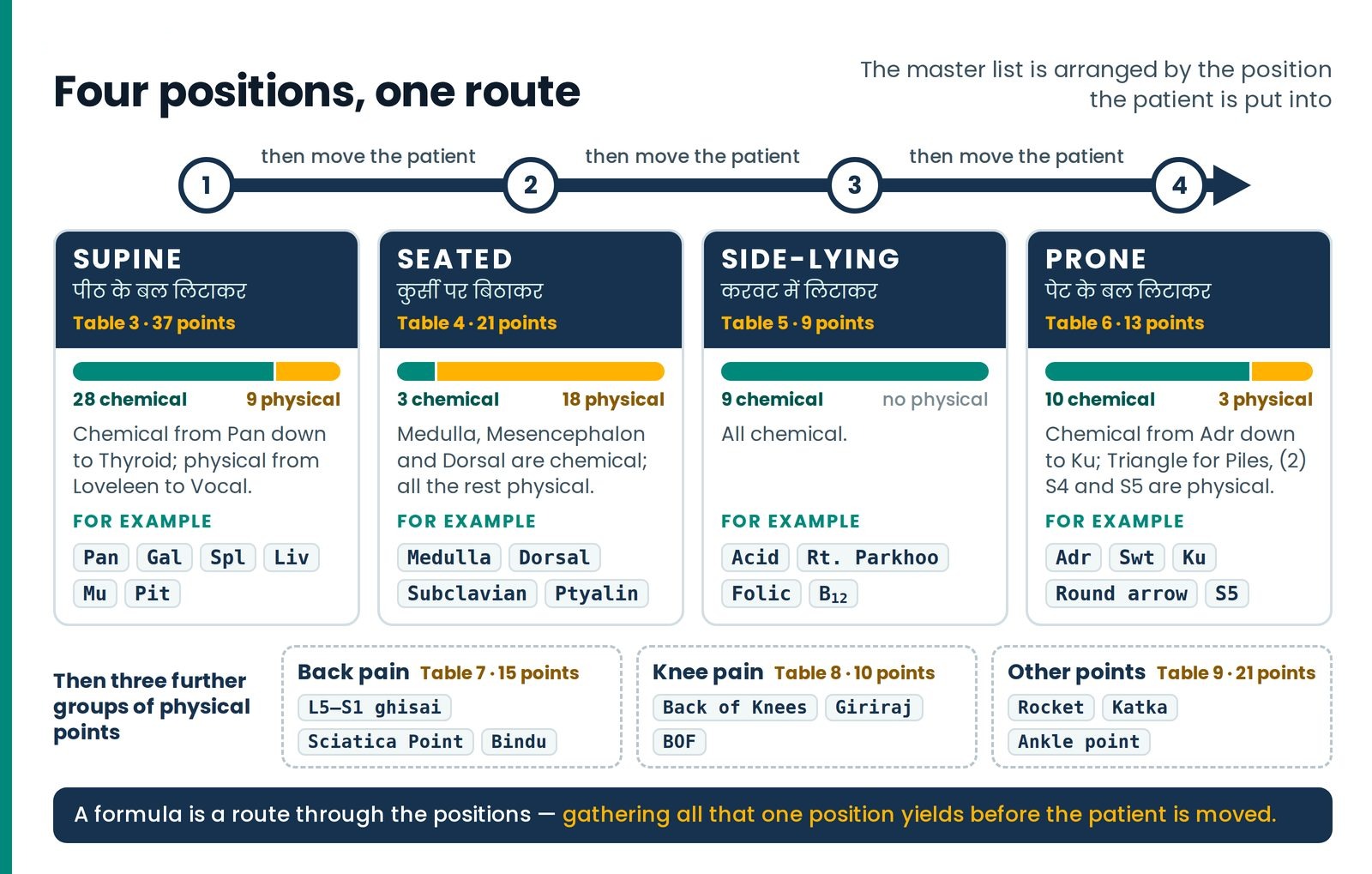
Table 4 — Points given seated on a chair · कुर्सी पर बिठाकर Seated
Medulla, Mesencephalon and Dorsal are chemical; all the rest physical.
Table 5 — Points given side-lying · करवट में लिटाकर — all chemical Side-lying
| Code | Full name / Hindi | Where it is taught in this wiki |
|---|---|---|
| Acid | — | On the Side; formulas, Correcting the Two Kingdoms |
| Rt. Parkhoo | Right Parkhoo | On the Side |
| Lt. Parkhoo | Left Parkhoo | On the Side |
| Folic | Folic acid | On the Side · Vitamin and Gene Formulas |
| Thia | Thiamine (B₁) | On the Side |
| B₁₂ | Cobalamin | On the Side · Vitamin and Gene Formulas |
| Nia | Niacin (B₃) | On the Side |
| Right and left Vitamin formation | Vitamin formation, both sides | On the Side |
| Fluid or alkali | Fluid / alkali | On the Side; ALTF, Correcting the Two Kingdoms |
Table 6 — Points given prone · उलटे यानि पेट के बल लिटाकर Prone
Chemical from Adr down to Ku; Triangle for Piles, (2) S4 and S5 are physical.
| Code | Full name / Hindi | Where it is taught in this wiki |
|---|---|---|
| Adr | Adrenal | Face Down |
| Swt | Sweat | Face Down |
| Back Arrow | Back Arrow, or Blood supply to lungs | Face Down |
| H arrow | — | Face Down |
| On the spine | — | Face Down |
| Beside the spine | — | Face Down |
| Round arrow | — | Face Down |
| Three arrows | — | Face Down |
| Organ clearance | — | Face Down |
| Ku | Ku, the old Kundali | Face Down; (½) Ku, Clearing the Ash |
| Triangle for Piles | Triangle for Piles, or for bed-wetting | Face Down |
| (2) S4 | Fourth sacral segment, twice | Face Down |
| S5 | Fifth sacral segment | Face Down |
Table 7 — Miscellaneous physical points: back pain
| Code | Full name / Hindi | Where it is taught in this wiki |
|---|---|---|
| L5–S1 ghisai | Rubbing at the lumbosacral junction (घिसाई) | The Low Back |
| L 3,4,5 | Third, fourth and fifth lumbar levels | The Low Back |
| Fracture point (T, 123) | Fracture point, thoracic 1-2-3 | The Low Back |
| Blood Supply To Sides | Blood supply to the sides | The Low Back |
| ⅃⅃+1 | "JJ plus one" | The Low Back |
| ⅃⅃+2 | "JJ plus two" | The Low Back |
| L4 Fracture | Fourth lumbar fracture point | The Low Back |
| L5 Fracture | Fifth lumbar fracture point | The Low Back |
| Blood Supply to legs | Blood supply to the legs | The Low Back |
| Sciatica Point | — | The Low Back |
| Sciatica setting | Sciatica setting — also listed in Table 9 | The Low Back |
| Bending Forward | — | The Low Back |
| Standing Point | — | The Low Back |
| Pelvic | — | The Low Back |
| Bindu | बिंदु (bindu) — point, drop | The Low Back |
Table 8 — Miscellaneous physical points: knee pain
| Code | Full name / Hindi | Where it is taught in this wiki |
|---|---|---|
| Back of Knees | Back of the knees — the popliteal hollows | Knee, Leg, Foot |
| Cap free | Freeing the knee cap | Knee, Leg, Foot |
| Giriraj | (proper name) | Knee, Leg, Foot |
| Calf muscle ghisai | Rubbing the calf (घिसाई) | Knee, Leg, Foot |
| Pradeep | (proper name) | Knee, Leg, Foot |
| JJgroin | JJ at the groin | Knee, Leg, Foot |
| JJback | JJ at the back | Knee, Leg, Foot |
| BOF | Bottom of feet | Knee, Leg, Foot |
| BOF — ALL 4 SIDES | All four aspects of the sole — for sprain | Knee, Leg, Foot |
| Big Toe Gas | — | Knee, Leg, Foot |
Table 9 — Other points
| Code | Full name / Hindi | Where it is taught in this wiki |
|---|---|---|
| Lower Shoulder Blade pain | Lower scapular region | Uncommon Problems |
| Upper Shoulder Blade pain | Upper scapular region | Uncommon Problems |
| Down arrow | — | Uncommon Problems |
| Up Arrow | — | Uncommon Problems |
| Hydrocele | Hydrocele point | Uncommon Problems |
| Prolapse point | — | Uncommon Problems · Treating Women |
| T8 | Eighth thoracic level | Uncommon Problems |
| Rocket | — | Uncommon Problems |
| Gal-Spl ghisai | Gall bladder–spleen rubbing (घिसाई) | Uncommon Problems |
| Abdomen Setting | — | Uncommon Problems |
| Opposite point | — | Uncommon Problems |
| Superfast | — | Uncommon Problems |
| Sciatica Setting | Sciatica setting — also listed in Table 7 | The Low Back · Uncommon Problems |
| Katka | कटका (kaṭkā) | Uncommon Problems |
| Motor Neuron point | — | Uncommon Problems |
| Paralysis clockwise | — | Uncommon Problems |
| Shukla | (proper name) | Uncommon Problems |
| Vasanti | (proper name) | Uncommon Problems |
| Ton P & T | Ton 'P' and Ton 'T' | Uncommon Problems |
| Sangam points | संगम (saṅgam) — confluence points | Uncommon Problems |
| Ankle point | — | Uncommon Problems |
Every symbol, and how to say it in words
Forty-two glyphs, three conventions: arrow, ring and handedness
Treatment notes in this therapy are very often not written in letters at all. On a card in a busy camp, or chalked on a board before a class, a point appears as a glyph — a circle with a dot beside it, two arrows springing apart, a numbered chevron, a small face with dots along the jaw. A therapist who cannot read them cannot read a prescription.
There are forty-two. They cannot be typed, so each is described here in words beside its code and full name, with the original plates alongside. (Figure 14.2)
Table 10 — The written symbols and their names (first plate)
| Symbol (described) | Code | Full name | |
|---|---|---|---|
| A small circle flanked by inward-leaning strokes — \ ° / | Back Arrow | Back Arrow, or Blood supply to lungs | |
| Two upward arrows with a small circle between — ↑o↑ | H Arrow | — | |
| A short stem, small open ring at top, downward arrowhead below | On the spine | — | |
| A double-headed arrow, a ring-topped stem, a second double-headed arrow | Beside the spine | — | |
| An upward arrow, a plain bar, a downward arrow — ↑ \ | ↓ | Round Arrow | |
| An inverted triangle numbered 3 at the top edge, 3 at each upper corner, 2 mid-side, 1 at each lower point | Triangle for Piles | Triangle for Piles, or for bed-wetting | |
| A large open circle, a small filled dot at its upper right | Hammering | Hammering for speech | |
| Two dotted ellipses, arrows above and below, all pointing right | Bell's Palsy (Left) | — | |
| The same, arrows pointing left | Bell's Palsy (Right) | — | |
| A downward arrow with a small forked mark branching right | Tennis Elbow Left | — | |
| The same, the fork mirrored left | Tennis Elbow Right | — | |
| A small open ring on a plain stem, no arrowhead | Up Arrow | — | |
| A larger ring on a longer stem ending in a downward arrowhead | Down Arrow | — | |
| A front-facing head, dots along cheeks and jawline | Jaw points | — | |
| A front-facing head, many dots over cheek, jaw and mouth, a curved neck line | Teeth points | — | |
| Two dotted ellipses, arrows above and below pointing left | Facial point (Right) | — | |
| Two small ear outlines with dots and small arrows | Ear points | — | |
| The letters spelled out plainly | BAFA | Both Arms, Both Forearms | |
| Two curved arrows springing apart, left and right | Electrical Waves | — | |
| Two arrows pointing away from each other — ← → | Stretch | — | |
| A stepped stroke: a short vertical rising into a horizontal that ends in an upward tick | Acid | — | |
| The same stroke mirrored left-to-right | Alkali | Alkali, or Fluid | |
| A wide inverted triangle — a horizontal line, two arrow-headed limbs below | Blood supply to sides | — | |
| Three columns of downward arrows, each closed at the foot by a double-headed arrow | Bending forward | — | |
| Two downward arrows, each on a short horizontal foot | Standing point | — | |
| A vertical stroke with a small circle threaded through it, like φ | Back of Knees | — |
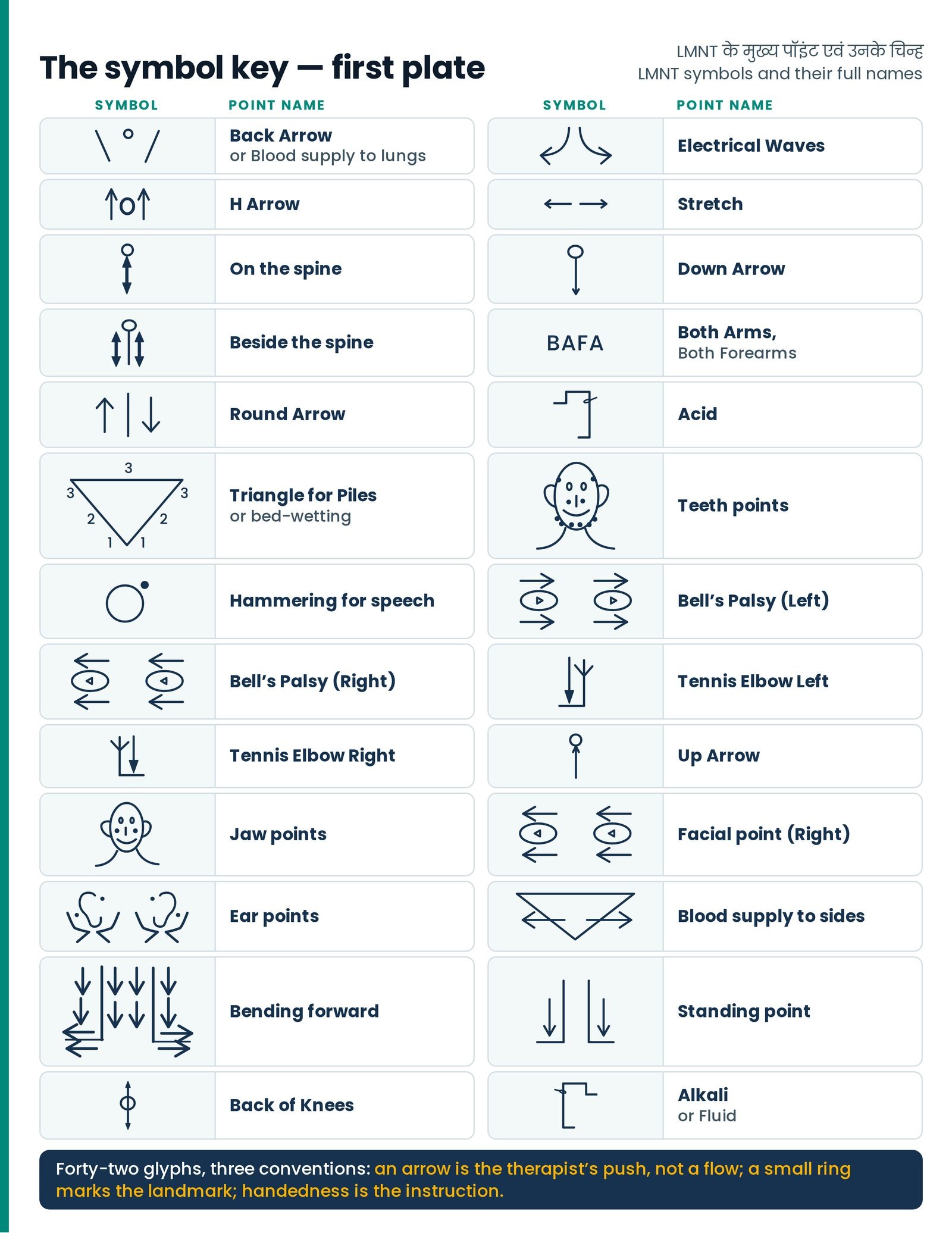
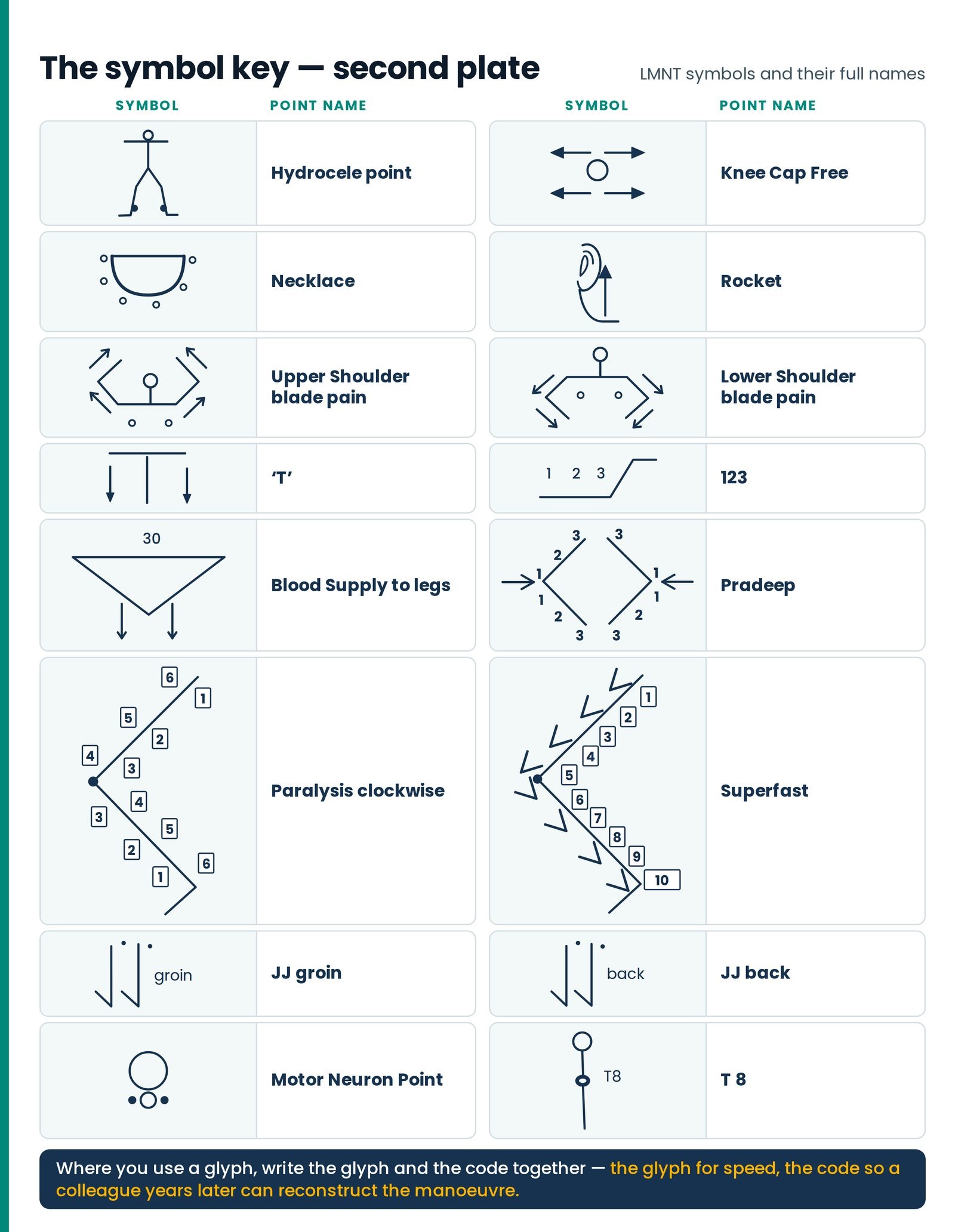
Table 11 — The written symbols and their names (second plate)
| Symbol (described) | Code | Full name | |
|---|---|---|---|
| A ring atop a line forking into two limbs, each ending in a dot, above a ground line | Hydrocele point | — | |
| Left and right arrows above, a circle between, the same below | Knee Cap Free | — | |
| A shallow semicircular bowl, small open circles around its rim | Necklace | — | |
| An ear outline with an upward arrow rising through it | Rocket | — | |
| An angular six-sided outline, arrows radiating upward and outward from the upper corners, a ringed stem at top centre, two rings at the base | Upper Shoulder blade pain | — | |
| The same outline, arrows radiating downward and outward, a ringed stem above, two rings within | Lower Shoulder blade pain | — | |
| A horizontal line, a downward arrow at each end, two short verticals between — ↓ \ | \ | ↓ | 'T' |
| The numerals 1 2 3 above a line stepping upward at its right end | 123 | — | |
| A wide inverted triangle marked 30, two downward arrows from its lower edge | Blood Supply to legs | — | |
| Two facing diamonds, arms numbered 1, 2, 3, an arrow entering from each side | Pradeep | — | |
| A zig-zag chevron, a dot at the vertex, numbered boxes along both limbs | Paralysis clockwise | — | |
| The same chevron with numbered boxes and arrowheads, last box 10 | Superfast | — | |
| Two "J" strokes with a dot above each, labelled groin | JJ groin | — | |
| The same, labelled back | JJ back | — | |
| A large circle above a filled dot, a small ring, a second dot | Motor Neuron Point | — | |
| A stem, filled circle at top, a small ring partway down, labelled T8 | T 8 | — |
Forty-two glyphs look like forty-two things to memorise. They are three conventions applied over and over. (Figure 14.3)
The three conventions that decode almost every glyph
1. An arrow shows the direction of your own push or drag — not a supposed flow inside the patient. An up-arrow and a down-arrow at the same site are two different manoeuvres: Up Arrow and Down Arrow are separate points with separate uses.
2. A small ring marks the landmark the stem is measured from — the same habit of mind as the ring above Liv° and Mu°, where the mark sits high because the contact goes high, near the shoulder.
3. Handedness is never decoration. Bell's Palsy (Left) and (Right) are mirror images, and so are Tennis Elbow Left and Right. The mirror is the whole instruction. And one pair worth pausing on: Acid and its mirror Alkali are one stroke drawn two ways — the central polarity of this therapy in a single glyph. Left Right
Reading a written formula aloud
Left to right, in the order performed — and the order is not negotiable
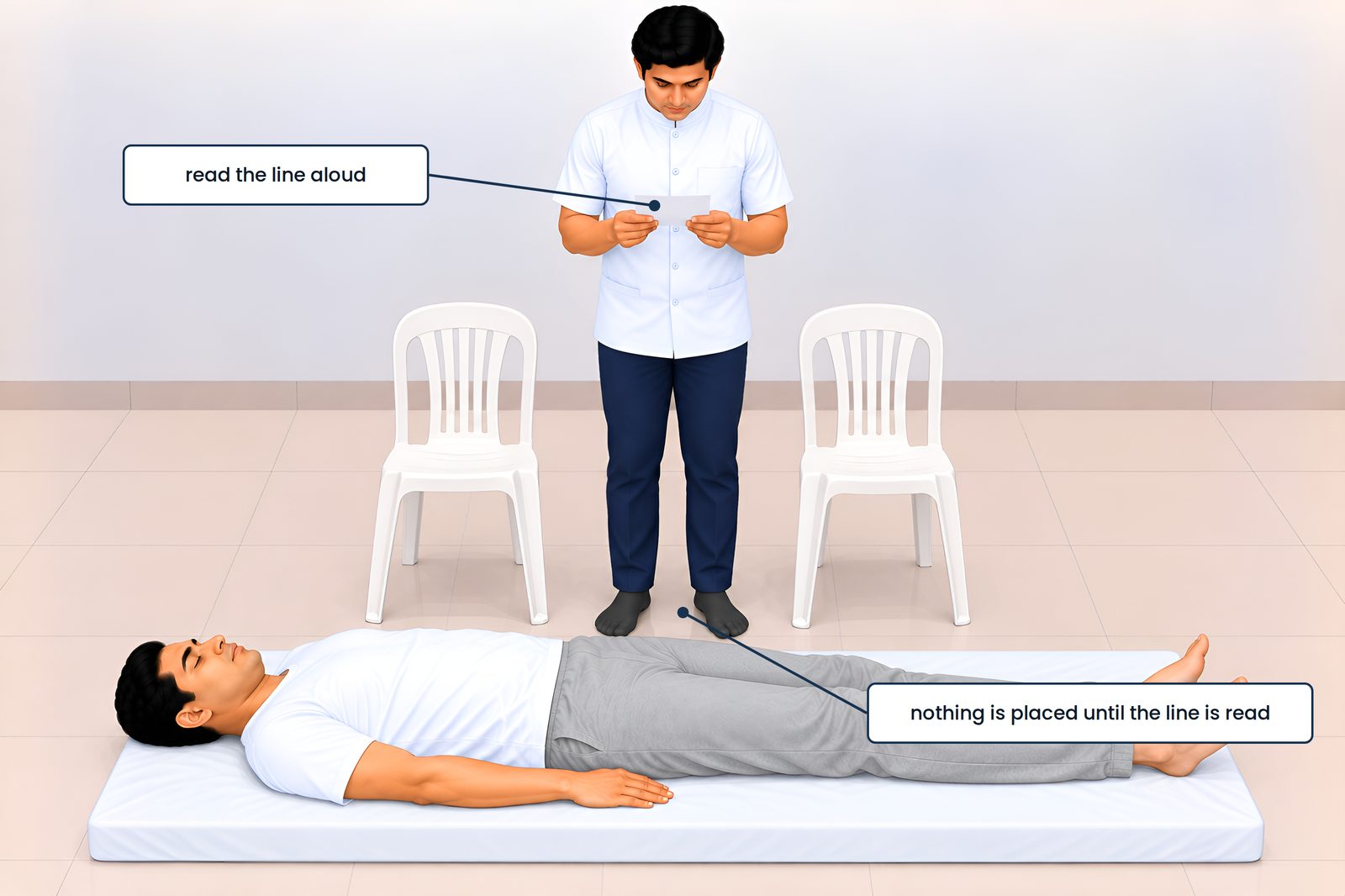
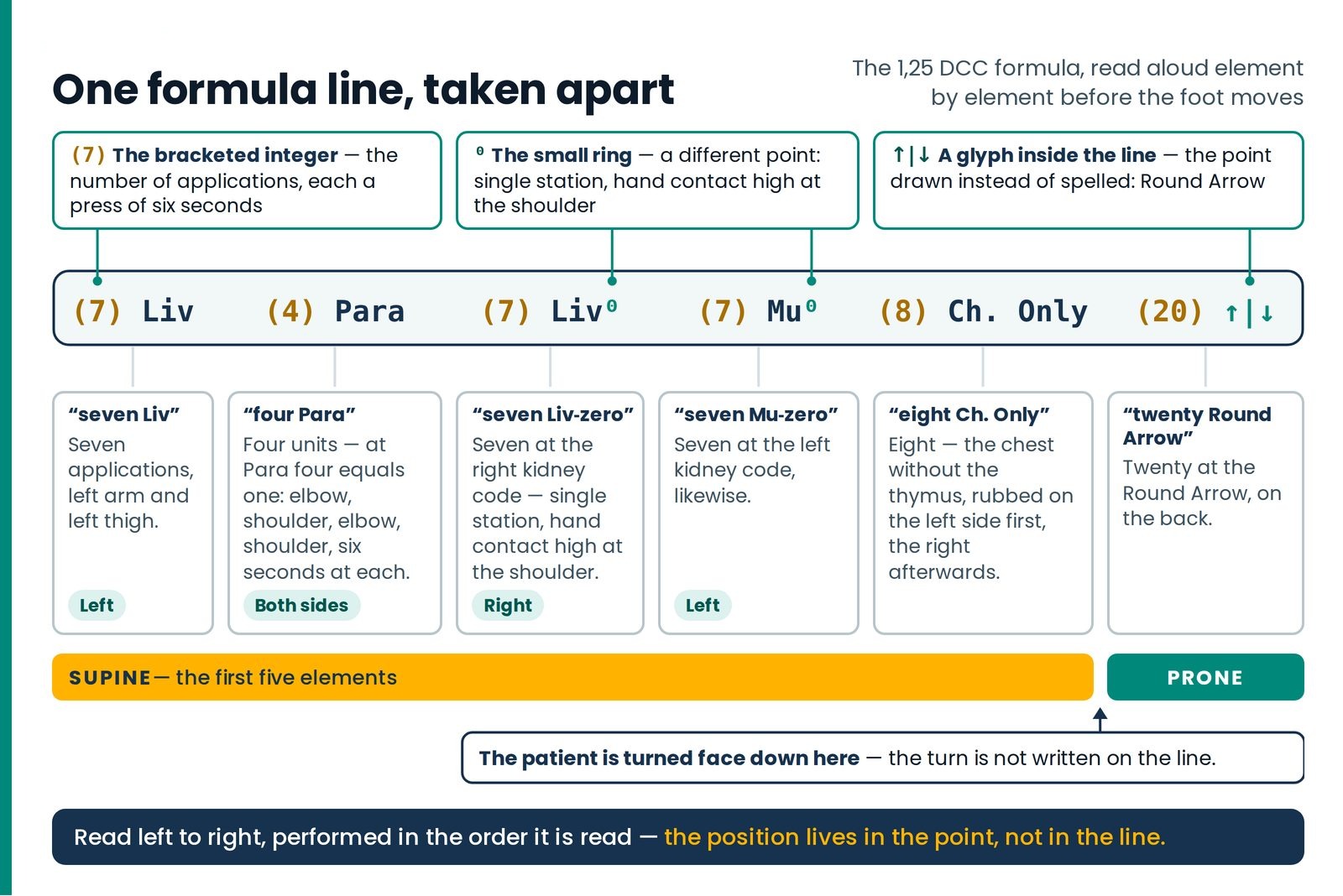
Everything above was vocabulary; this is grammar. A formula is read left to right and performed in the order it is read. (Figure 14.4) (Figure 14.5)
The rule that governs every formula in this wiki
a.
For the formulae to give the stipulated result, the most important thing to be remembered is that the timing of 6 seconds pressure at each pain point should be strictly followed, except when mentioned otherwise.
b. The sequence given in the formulae is to be followed exactly. A stimulation of the organs in a different sequence can sometimes produce opposite results.
Not a weaker result. Opposite.
First example — the commonest formula there is
Second example — a longer line, with a glyph inside it
Ch. Only reduces alkali — the symptoms of acid increase; Round Arrow reduces acid. Given together they hold the balance, and they are matched by their counts: to balance (20) ↑|↓ you need (8) Ch. Only, whereas (4) Ch. Only is balanced by (10) ↑|↓.
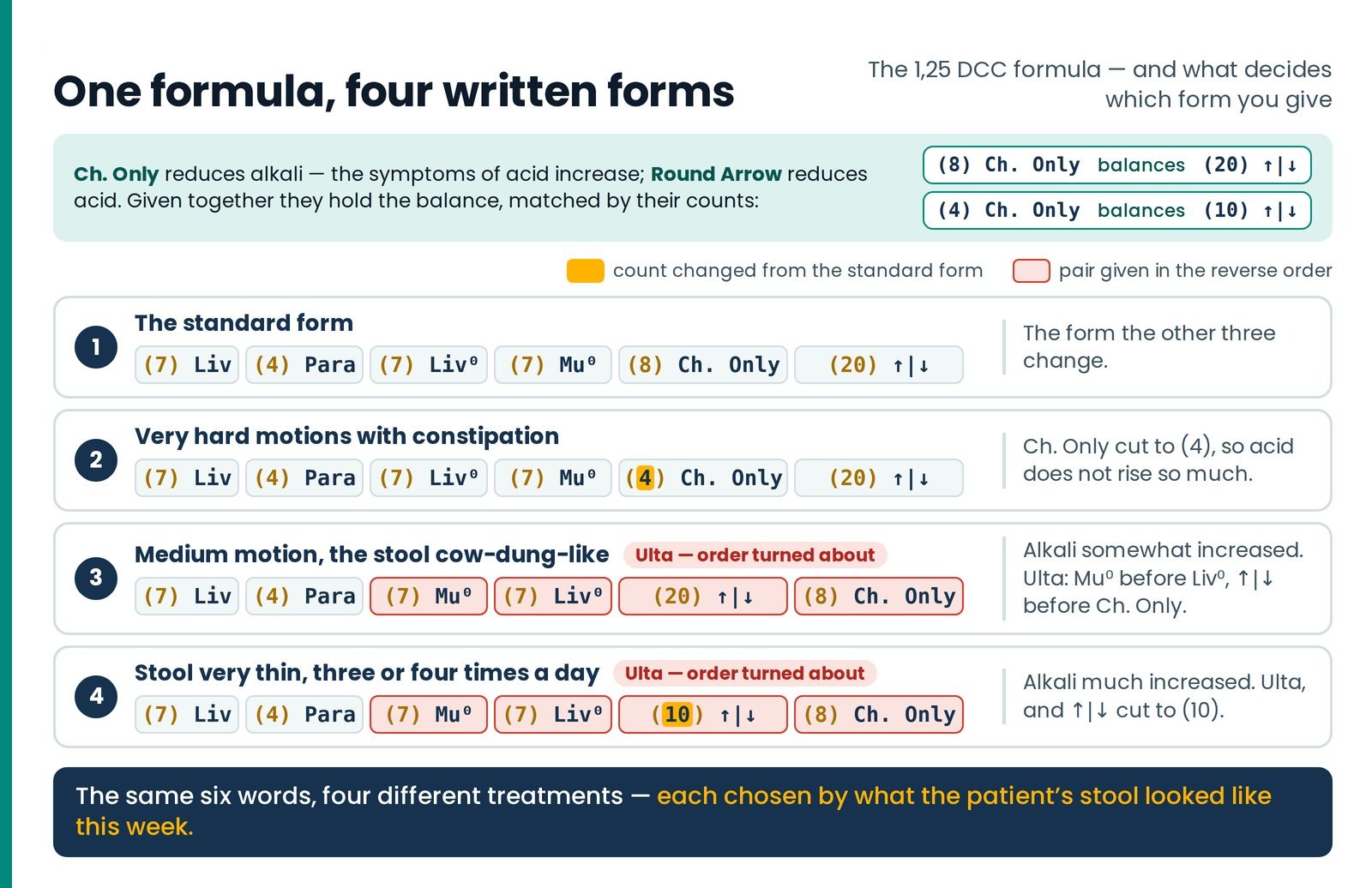
The same six words, four different treatments — each chosen by what the patient's stool looked like this week. (Figure 14.6)
Third example — seconds in place of counts, and where the gaps fall
Gaps fall in three places only: inside a point, between one application and the next; between rounds of a × N treatments line, a stated rest, most often one minute, not optional; and between formulas, where the patient is turned. A session for a common ailment runs about thirty minutes and is not continuous — the formula sets the gaps, and those minutes are when a patient may speak.
The notation conventions, gathered
Brackets, stations, rings, seconds, rounds, underlines, substitutions
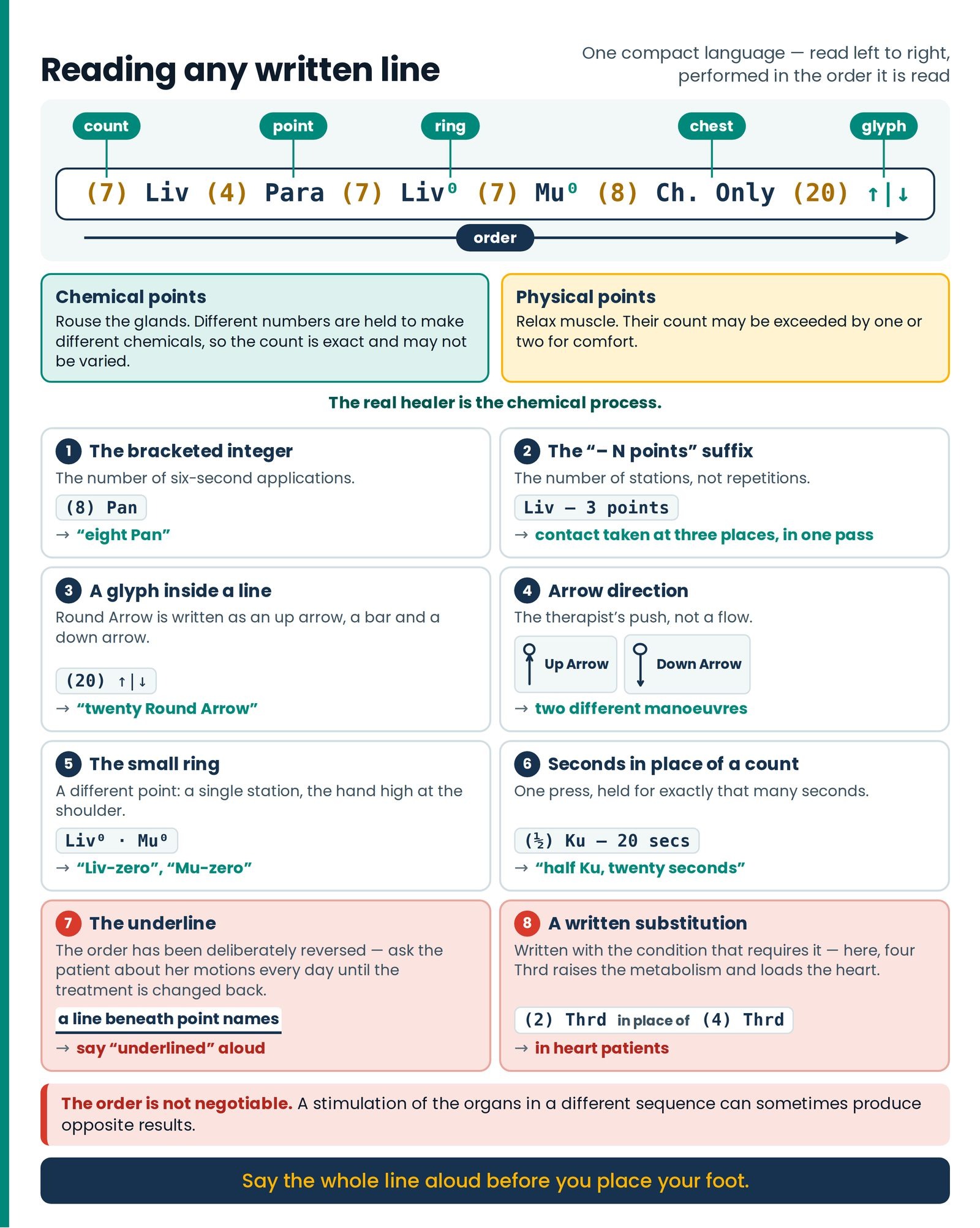
Everything a written line can contain is in the table below. Several of these you met in Six Seconds, "Six Seconds", where the count is taught as the dose; they are set out here in their written form, because a convention you can recite but cannot recognise on a card is no use at the mat. (Figure 14.8)
Table 13 — Every element you will meet in a written line
| Element | Written like this | How to say it | What it instructs | |
|---|---|---|---|---|
| The bracketed integer | (8) Pan | "eight Pan" | The number of applications — presses of six seconds, each released | |
| The "– N points" suffix | Liv – 3 points · (2) Liv – 3 points | "Liv, three points" | The number of stations, that is places, in one pass — not repetitions at one place. With a bracket in front, the whole pass is performed that many times | |
| The small ring | Liv⁰ · Mu⁰ | "Liv-zero" · "Mu-zero" | A different point: single station, hand contact high at the shoulder | |
| A glyph inside the line | (20) ↑\ | ↓ · (4) ↑o↑ | "twenty Round Arrow" · "four H arrow" | The point itself, drawn instead of spelled |
| Arrow direction and handedness | Up Arrow vs Down Arrow; Tennis Elbow Left / Right | as written | The direction of your push or drag; and which side — the mirrored glyph is the instruction Left Right | |
| Seconds in place of a count | (½) Ku – 20 secs | "half Ku, twenty seconds" | One press, held exactly that many seconds, then released | |
| Colons instead of brackets | Fast : Gas : Gas I : Gal : | "Fast: Gas, Gas I, Gal" | Elements in order where no six-second hold is being counted | |
| Rounds with rests | (2) Pan × 6 trts. | "two Pan, six treatments" | Two applications → rest → six rounds in all × 3 | |
| The underline | a line drawn beneath one or more point names | say "underlined" aloud when reading the card | The order has been deliberately reversed. Do not give the usual order out of habit | |
| The Ulta prefix | Ulta Normal · Ulta 1,25 DCC | "ulta Normal" | The named formula with its order turned about, for a stated purpose | |
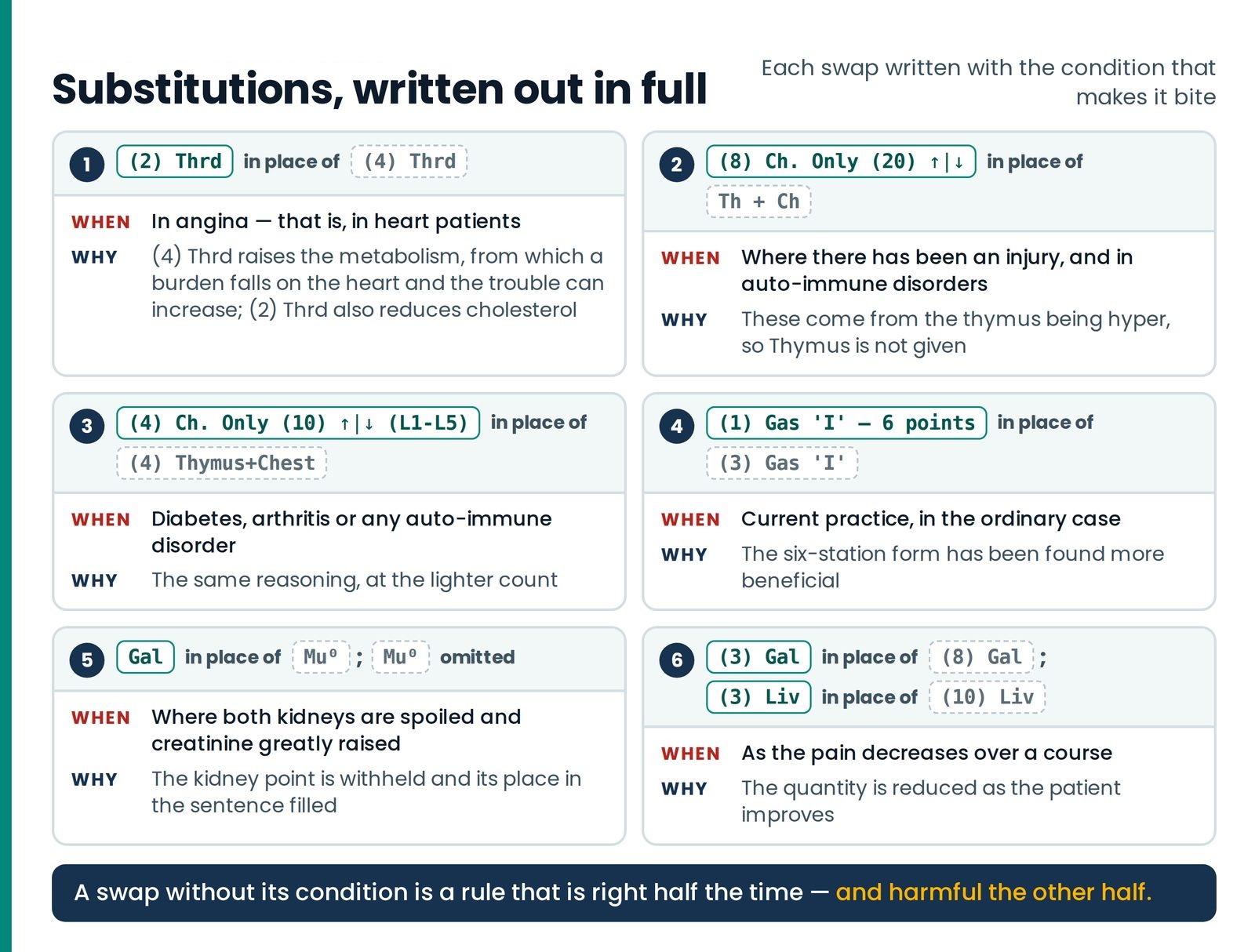
| A written substitution | (2) Thrd in place of (4) Thrd | read the whole clause aloud | One element swapped, with the condition that requires it | |
| A written omission | Spl absent, or noted "not given" | say the omission aloud | A point deliberately left out. The absence is the instruction | |
| Roman numerals, Trt. | I … II … · Acid trt. | "part one, part two"; "acid treatment" | Two formulas given as one treatment in that order, as in NAN and FAN; and the abbreviation for treatment |
The underline, and why it exists
In the Ulta Normal formula the usual order has been changed on purpose — Spl before Gal, Mu before Liv — and to give notice of that, a line is drawn beneath some of the points, so the therapist does not give the Normal order out of habit.
It does a second job. Seeing that line every day reminds the therapist to ask the patient every day about his motions — because as soon as the stool becomes firm, formed like a banana, the treatment must be changed, and for at least one day the Normal formula given to bring the body back. A reversed order is permitted only for a limited period, for a particular problem. One mark that says this is deliberate, ask her today, and this is temporary.
How a substitution is written
A substitution is written as a swap plus a condition. Both halves are the instruction: a swap without its condition is a rule that is right half the time and harmful the other half. (Figure 14.7)
Writing a prescription another therapist can follow
Seven steps to a card a stranger can act on a year later
Now turn the skill around: a therapist must also write, for a reader he will never meet.
Two cards, and what they taught
A card written for a family, and a line guessed at 900 km away
Questions students ask
- 1. I am twenty and just starting. Must I memorise all hundred and twenty-six codes before makes sense? No. Memorise the shape of the list: four positions, then back pain, knee pain, other. Then learn the twelve supine digestive codes properly — they appear in nearly every formula you will give. The rest arrive one at a time, attached to a patient.
- 2. A card says Liv where I am fairly sure Liv° was meant. May I correct it? No. You may ask. Telephone the therapist who wrote it, or leave that line out and write on the card why. A silent correction is a guess wearing the clothes of expertise, and if you are wrong nobody will ever find where the error entered.
- 3. I am a physician. What is a formula named "Heparin" claiming? That the sequence is held to produce effects akin to those of that chemical. Nothing is given. The honest sentence in a letter to you reads: "we applied a formula named after heparin." A therapist who writes that he gave your patient heparin has made a serious error of language.
- 4. If physical points wear off in a few days, why give them at all? Because they hasten the time required to bring normalcy. What they must not be is the whole plan.
- 5. Two lists contain Sciatica setting. Which is right? Both. One manoeuvre reached from two directions, and the group it stands in tells you what surrounds it.
- 6. I have no science at all. What does it mean that "different numbers make different chemicals"? Take it as an observation before a theory. Over sixty years it was found that pressing the same place twice and four times do not do the same thing — one stops an over-active thing, the other feeds a hungry one. Give the number written, exactly.
- 7. A senior therapist reads formulas silently and fast. Should I read aloud? He read them aloud for years first. Read every line aloud, quietly, until you catch yourself finishing it correctly before your eye reaches the end — and keep reading aloud on any card that is not yours, and on any day you are tired.
- 8. What is the commonest error in reading a card? Reading Liv – 3 points as "give Liv three times". That gives a third of the treatment, in one place instead of three, so none of the organs the pass was addressing has been reached. See also → Six Seconds, "Six Seconds".
Questions patients ask
- 1. "What is all this writing on my card? It looks like a code." It is a code, and I will read it to you if you like. Each short name is a place I press, and the number in front is how many times. We write it so that if you go to another centre in another city, the therapist there does exactly what I am doing.
- 2. "It says B₁₂ on my card. Are you giving me a vitamin injection?" No. Nothing is given to you here — no medicine, no injection, no instrument of any kind. That is the name of a sequence of pressures, named after an effect it is meant to help your body produce for itself. If a doctor asks, tell them exactly that.
- 3. "Why is one of the lines underlined?" Because for these few days I am giving part of the treatment in reverse order on purpose, and the underline stops me giving it the usual way out of habit. It also reminds me to ask you every day about your motions. As soon as they are properly formed, I change it back.
- 4. "Can you write it down so my daughter can do it at home?" Yes — that is one of the things this therapy is built for. I will write it in full, and then I will ask your daughter to read the whole card back to me aloud, twice, before you leave. Not to test her: if she can say it, she can do it.
- 5. "My report is normal. Then why is there so much written on my card?" Because a normal report and a well-working organ are not quite the same statement. A report tells you the things it measures are inside their ranges — genuinely good news, and worth having. What is on your card is what my hands found, and what I intend to do about it.
Words used here
| Hindi | English | Neurotherapy code / usage |
|---|---|---|
| केमिकल पॉइंट | Chemical point | Rouses a gland or organ; the count is exact |
| फिजिकल पॉइंट | Physical point | Relaxes muscle; the count may be exceeded by one or two |
| घिसाई (ghisāī) | Rubbing | L5–S1 ghisai, Calf muscle ghisai, Gal-Spl ghisai |
| उल्टा (ultā) | Reversed | Ulta Normal, Ulta 1,25 DCC — the order turned about |
| तपस्या (tapasyā) | Sustained effort over years | How the counts at the chemical points were arrived at |
| नाभि (nābhi) | Navel | ONS, NNS, CNNS — the Nabhi Sets |
| पीठ के बल लिटाकर | Laid on the back | The supine group Supine |
| कुर्सी पर बिठाकर | Seated on a chair | The seated group Seated |
| करवट में लिटाकर | Laid on the side | The side-lying group Side-lying |
| पेट के बल लिटाकर | Laid on the belly | The prone group Prone |
| — | MRT | Muscle-relaxing technique — the physical points |
| — | Liv⁰ · Mu⁰ | Right and left kidney codes; single station, hand high at the shoulder |
| — | BAFA · NAN · FAN | Both Arms Both Forearms · Normal + Ajay Normal · Fast + Ajay Normal |