Watch


Forty-two glyphs, three conventions: arrow, ring and handedness
Treatment notes in this therapy are very often not written in letters at all. On a card in a busy camp, or chalked on a board before a class, a point appears as a glyph — a circle with a dot beside it, two arrows springing apart, a numbered chevron, a small face with dots along the jaw. A therapist who cannot read them cannot read a prescription.
There are forty-two. They cannot be typed, so each is described here in words beside its code and full name, with the original plates alongside. (Figure 14.2)
Table 10 — The written symbols and their names (first plate)
| Symbol (described) | Code | Full name | |
|---|---|---|---|
| A small circle flanked by inward-leaning strokes — \ ° / | Back Arrow | Back Arrow, or Blood supply to lungs | |
| Two upward arrows with a small circle between — ↑o↑ | H Arrow | — | |
| A short stem, small open ring at top, downward arrowhead below | On the spine | — | |
| A double-headed arrow, a ring-topped stem, a second double-headed arrow | Beside the spine | — | |
| An upward arrow, a plain bar, a downward arrow — ↑ \ | ↓ | Round Arrow | |
| An inverted triangle numbered 3 at the top edge, 3 at each upper corner, 2 mid-side, 1 at each lower point | Triangle for Piles | Triangle for Piles, or for bed-wetting | |
| A large open circle, a small filled dot at its upper right | Hammering | Hammering for speech | |
| Two dotted ellipses, arrows above and below, all pointing right | Bell's Palsy (Left) | — | |
| The same, arrows pointing left | Bell's Palsy (Right) | — | |
| A downward arrow with a small forked mark branching right | Tennis Elbow Left | — | |
| The same, the fork mirrored left | Tennis Elbow Right | — | |
| A small open ring on a plain stem, no arrowhead | Up Arrow | — | |
| A larger ring on a longer stem ending in a downward arrowhead | Down Arrow | — | |
| A front-facing head, dots along cheeks and jawline | Jaw points | — | |
| A front-facing head, many dots over cheek, jaw and mouth, a curved neck line | Teeth points | — | |
| Two dotted ellipses, arrows above and below pointing left | Facial point (Right) | — | |
| Two small ear outlines with dots and small arrows | Ear points | — | |
| The letters spelled out plainly | BAFA | Both Arms, Both Forearms | |
| Two curved arrows springing apart, left and right | Electrical Waves | — | |
| Two arrows pointing away from each other — ← → | Stretch | — | |
| A stepped stroke: a short vertical rising into a horizontal that ends in an upward tick | Acid | — | |
| The same stroke mirrored left-to-right | Alkali | Alkali, or Fluid | |
| A wide inverted triangle — a horizontal line, two arrow-headed limbs below | Blood supply to sides | — | |
| Three columns of downward arrows, each closed at the foot by a double-headed arrow | Bending forward | — | |
| Two downward arrows, each on a short horizontal foot | Standing point | — | |
| A vertical stroke with a small circle threaded through it, like φ | Back of Knees | — |
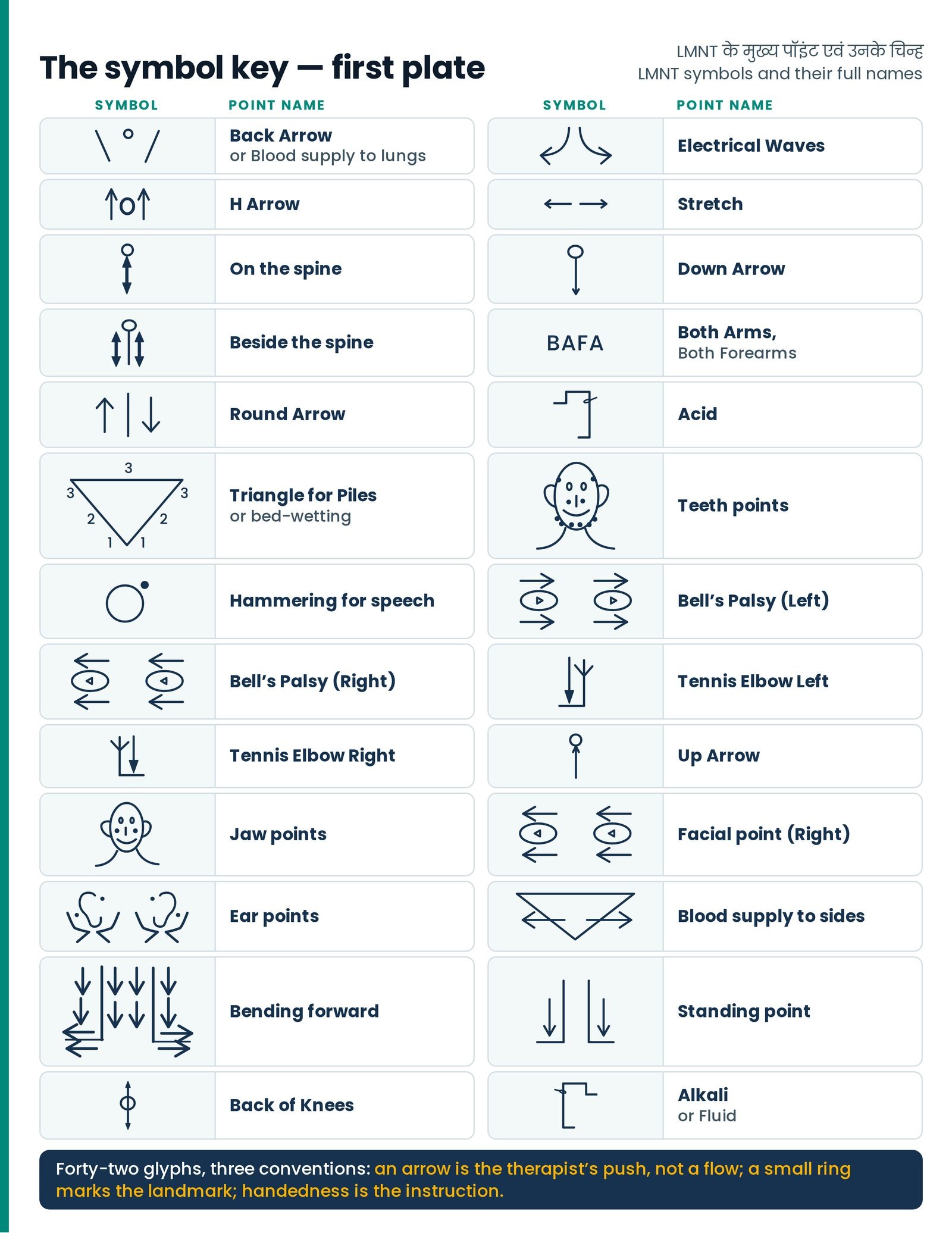
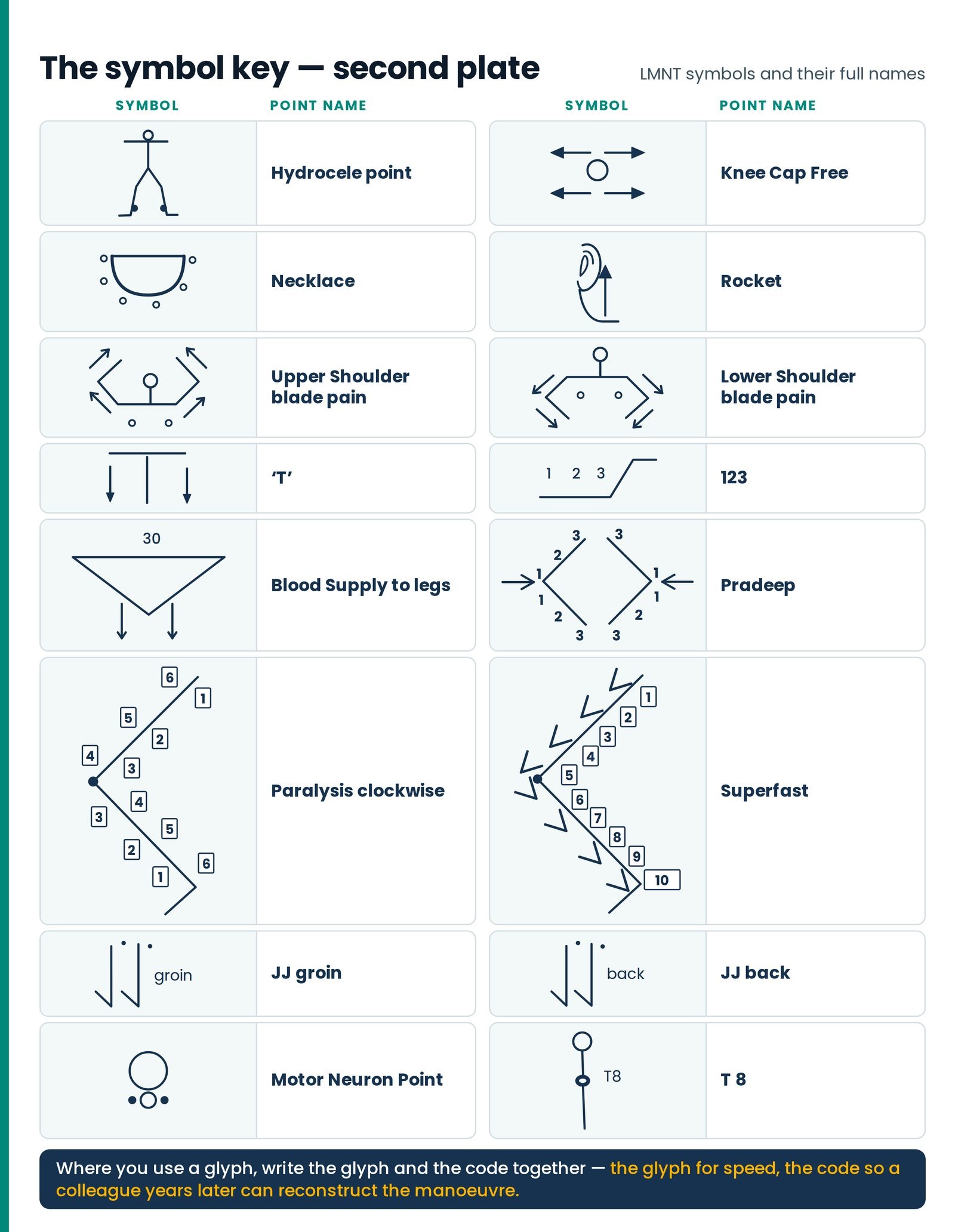
Table 11 — The written symbols and their names (second plate)
| Symbol (described) | Code | Full name | |
|---|---|---|---|
| A ring atop a line forking into two limbs, each ending in a dot, above a ground line | Hydrocele point | — | |
| Left and right arrows above, a circle between, the same below | Knee Cap Free | — | |
| A shallow semicircular bowl, small open circles around its rim | Necklace | — | |
| An ear outline with an upward arrow rising through it | Rocket | — | |
| An angular six-sided outline, arrows radiating upward and outward from the upper corners, a ringed stem at top centre, two rings at the base | Upper Shoulder blade pain | — | |
| The same outline, arrows radiating downward and outward, a ringed stem above, two rings within | Lower Shoulder blade pain | — | |
| A horizontal line, a downward arrow at each end, two short verticals between — ↓ \ | \ | ↓ | 'T' |
| The numerals 1 2 3 above a line stepping upward at its right end | 123 | — | |
| A wide inverted triangle marked 30, two downward arrows from its lower edge | Blood Supply to legs | — | |
| Two facing diamonds, arms numbered 1, 2, 3, an arrow entering from each side | Pradeep | — | |
| A zig-zag chevron, a dot at the vertex, numbered boxes along both limbs | Paralysis clockwise | — | |
| The same chevron with numbered boxes and arrowheads, last box 10 | Superfast | — | |
| Two "J" strokes with a dot above each, labelled groin | JJ groin | — | |
| The same, labelled back | JJ back | — | |
| A large circle above a filled dot, a small ring, a second dot | Motor Neuron Point | — | |
| A stem, filled circle at top, a small ring partway down, labelled T8 | T 8 | — |
Forty-two glyphs look like forty-two things to memorise. They are three conventions applied over and over. (Figure 14.3)
The three conventions that decode almost every glyph
1. An arrow shows the direction of your own push or drag — not a supposed flow inside the patient. An up-arrow and a down-arrow at the same site are two different manoeuvres: Up Arrow and Down Arrow are separate points with separate uses.
2. A small ring marks the landmark the stem is measured from — the same habit of mind as the ring above Liv° and Mu°, where the mark sits high because the contact goes high, near the shoulder.
3. Handedness is never decoration. Bell's Palsy (Left) and (Right) are mirror images, and so are Tennis Elbow Left and Right. The mirror is the whole instruction. And one pair worth pausing on: Acid and its mirror Alkali are one stroke drawn two ways — the central polarity of this therapy in a single glyph. Left Right