Watch


How this article divides from the ones on either side of it
Chapter 13 builds the plan, 42 stops the hand, 44 keeps the record
Everything you have learned so far happens inside one session, or inside one hour before it. From Findings to a Plan, "From Findings to a Plan", builds the first plan, takes the baseline and names the signs that a first approach has not worked by day ten. When the Hand Must Stop, "When the Hand Must Stop", tells you what must never be given to this patient at all, what may not meet in one session, and what ends a session on the spot. The Record That Shows the Truth, "The Record That Shows the Truth", is the card and the chart — the notation, the record, and the reading of your own results across hundreds of patients.
This article is the one in between, and it is about time. A course is not a session repeated. It has a shape: something that comes first, something that follows, a middle where nothing appears to be happening, a point at which it is changed, and an end. The decisions that decide whether a patient gets well are mostly made in the ten minutes after they have gone home — what to give tomorrow, whether to change anything, whether to say something honest about how long this is going to take.
A therapist who thinks in sessions gives good sessions and loses patients in the fourth week. A therapist who thinks in weeks keeps them.
The twenty-four hours, and your half hour
About thirty minutes a day is your share of the twenty-four hours
Begin with the arithmetic, because it settles the tone of everything else. For common ailments about thirty minutes a day is enough — and not continuously: according to the formula there may be gaps of a few minutes. That is your share. The other twenty-three and a half hours belong to the patient's kitchen, bed, work, water, window and worries, and they are also treating her, every day, in whatever direction they happen to point.
This is why a course is not a stack of sessions. Each session is a push in one direction; the days between are the current the boat is sitting in. A plan that ignores the current will be re-planned every week for ever.
Asked how many days treatment must be taken, the answer given is first of all that the same period does not apply to all. It depends on:
the person's body structure
which disease it is
What decides how long a course takes
how many organs it has affected
how many years it has been present
how far the parhez is kept
Five things, and look at which of them are in your hands. Not the first, not the second, not really the third or the fourth. The one variable a therapist can actually move is the last one — and it is moved by teaching, two rules at a time, in the patient's own kitchen and bedroom, not by pressing harder or oftener.
Everything the material says about time, in one place
Every stated duration, count and interval — and none of them rounded
Learn this table. Not because a patient will ask — although a patient will ask, on the first morning, before you have taken her pulse — but because an estimate given honestly on day one is the single cheapest thing you can do to stop a course collapsing in week four. A patient who was told two to four months in March does not panic in April. A patient who was told nothing decides for herself, and what she decides is always a few weeks.
Table 1 — Every duration, count and interval this therapy states
| The situation | What is stated |
|---|---|
| The first effects, in almost anyone | Within a day or two small and large effects begin to show — hunger and sleep begin to improve, energy increases, weakness reduces, the body feels light, life becomes enjoyable |
| The small warning ailments — fever, cold, cough, indigestion, constipation, stomach ache | Treat at once, without delay: considerable relief within three or four days — this is experience |
| The same small ailments, for a complete cure | At least one treatment a week for a month or two, so that the trouble does not come again |
| Ordinary ailments, whole course | An average of a week to ten days |
| Chronic ailments, whole course | About a year or more |
| Kept regularly, with the parhez kept too | Many diseases are cured in just two to four months |
| Old diseases | Many months |
| Congenital conditions | It may take some years |
| The undigested-food work | Until the stools become normal — between one week and ten days, or even more |
| The digestive block at the start of a course | The first ten days at a stretch, without break — as one centre practises it, only the undigested-food treatment, with the appropriate muscle-relaxation treatment in extreme cases |
| The residential start for an old disease | Admitted 20–25 days, treatment begun after a full investigation; quite a number of those days go simply in improving the digestive system first |
| An ordinary stay at a centre | In many centres one person takes treatment for about 15–20 days |
| Frequency, after the start | Daily for the first few weeks; then alternate days; then two days a week; then one day — reducing in this way |
| Treatment at home, by a taught relative | After some months at home, both come again for a few days for follow-up, so the new treatments can be taught |
| Menstruation | Four days — no treatment at all, with four stated exceptions |
| After a blow | The injury treatment until the serum dries — ten to fifteen days — and only then the heparin that heals the vessel |
| The Vater formula in a heart patient | The angina treatment only, first, for two to four days — given when the health improves a little |
| A child whose mother's blood pressure rose in pregnancy | Only that one treatment for ten to fifteen days first, whatever the child came about; afterwards other suitable treatments |
| The three gene formulas | Given on alternate days — one day on, one day off — the three in turn, with one normal treatment between each; in the case recorded, the factor began to rise within two or three months |
| Rheumatoid arthritis on the modified star formula | Formerly alternate days; nowadays, if there is need, even daily. When the finger pain has gone completely, twice or once a week may be enough |
| Those whose fats are not digested | The same treatment once or twice a week — and they will never get gall stones |
| Sour things, in the acidosis diseases | Not until the health is fully corrected; later, if there is need, they may be eaten. If the pain comes back, stop them completely for some months, until the body is fully corrected |
| The tablet taper, if a patient adopts it on his own responsibility | ¾ for three days, the saved quarters taken on the fourth; ½ for eight days, held a further four or eight if needed; ¼ for four, eight or twelve days; then ¼ on alternate days for two weeks; then ¼ twice weekly for some days; and the treatment is not stopped until the patient has been well for many days without medicine |
Nothing in that table is rounded and nothing in it has been reconciled with anything else in it. A week to ten days for ordinary ailments and at least one treatment a week for a month or two so the trouble does not come again are both stated, and they are not the same statement: one is how long the trouble takes to go, the other is how long you go on so that it does not return. Teach both. Where the material gives no number for a stage of a course, this wiki gives none either, and you should give none to a patient.
The order of correction, across days rather than within a session
Digestion first, whatever the disease; the plan comes on day eleven
Order within one session is How a Formula Is Built's — the five rules of sequence, the written rests, the four inseparable pairs.
The first of those is settled and is not restated here. The digestion is corrected first, whatever the disease, because the raw materials of every gland are made only from the end products of digestion; and one centre's practice of announcing at registration that the patient must come for the first ten days at a stretch, without break, giving only the undigested-food work in that time, is taught whole in From Findings to a Plan, "From Findings to a Plan". What belongs here is the sentence that follows it: afterwards, depending upon their ailments, a further treatment schedule will be prescribed. The ten days are the first stage of a course, not a preliminary to it. The course begins on day one, and the plan you write on day eleven is written out of what the first ten days produced — not out of what you guessed on day one.
The prerequisites, and the stopping condition attached to each
Every “first this, then that” carries the day on which it changes
Across the formulary there are a dozen places where one piece of work must be finished before another may begin. Students learn these as pairs and then forget the half that matters. Every "first this, then that" in this therapy carries a stopping condition, and the stopping condition is the instruction. First the injury treatment, then the heparin is not a sequence; the injury treatment until the serum dries, which takes ten to fifteen days, and only then the heparin is a sequence. Without the middle clause you do not know what day to change, so you change on the day you get bored. (Figure 43.1)

Why the washout is a course rule and not a fussiness
The reason given for putting one normal treatment between two powerful treatments is worth holding on to, because it explains a whole family of sequencing rules at once.
The chemicals produced by the treatment you gave yesterday are still in the body today. If a second, different treatment is laid straight on top of them, the two sets of chemicals mix together, and the results which were to come from the new treatment will not come in full, or will come in reverse.
The normal treatment brings back to its ordinary quantity whatever any previous treatment made more or less. After that, whatever new treatment is given has its full effect — and it has been seen that doing it this way brings very good results.
Read that as a general caution about course design, not only about genes. Two strong treatments run together without a pause are not twice as strong.
Down the rungs, as the body improves
Daily, alternate days, two days a week, one day — and four pauses
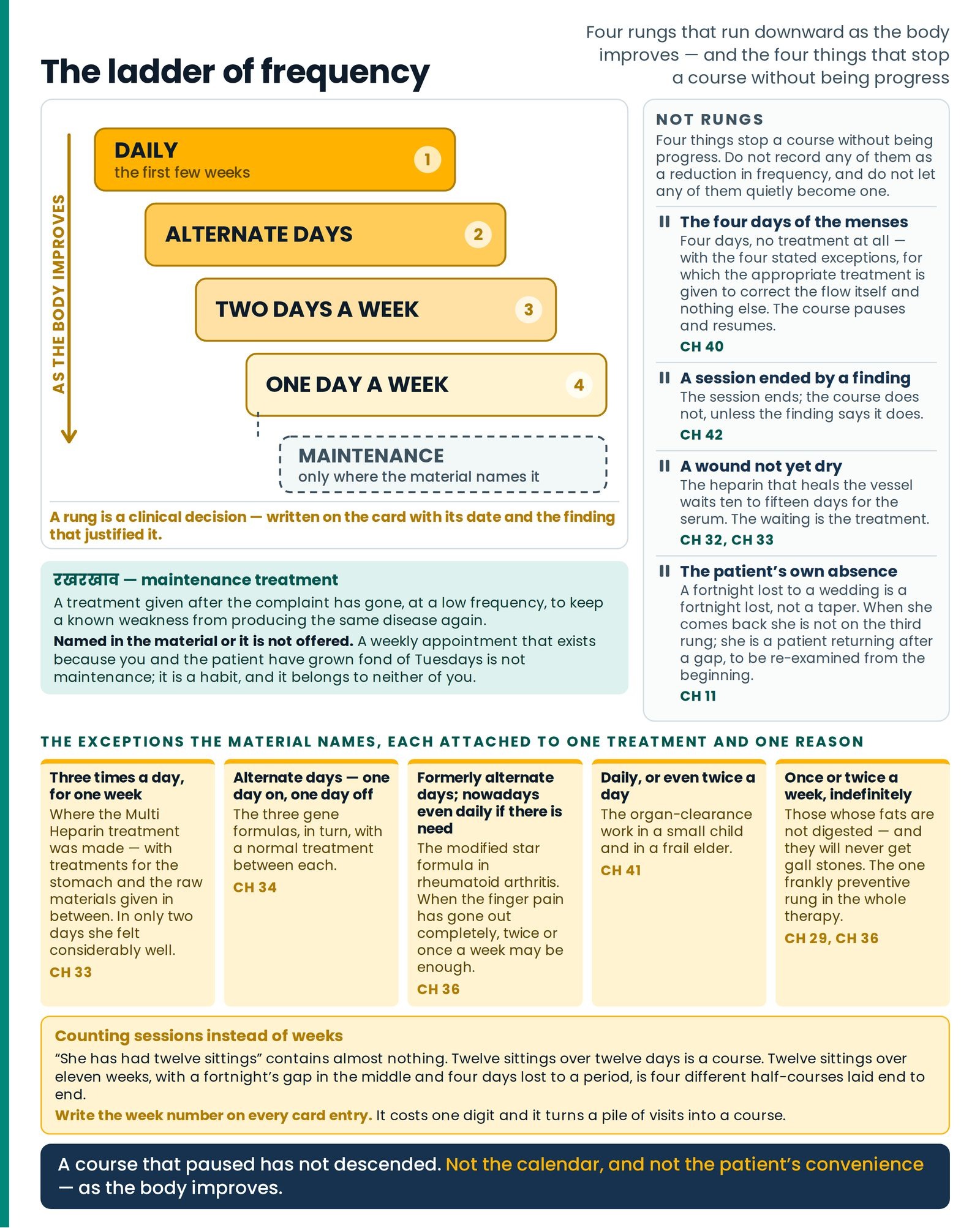
The therapy gives one plain ladder for how often a patient comes, and it runs downward as the patient gets better.
The ladder of frequency
For the first few weeks, take treatment daily. Then, as the body improves — alternate days, then two days a week, then one day. Reducing in this way.
Four rungs. Note what moves a patient down a rung: not the calendar, and not the patient's convenience. As the body improves. The rung is a clinical statement, and it should be written on the card as one, with the date and the finding that justified it.
The whole residential arrangement this ladder belongs to — the 20–25 day admission after a full investigation, the days that go simply in improving the digestive system, the return to the nearest centre, and the relative taught to treat at home where no therapist is available — is taught in The History That Cannot Mislead You, "The History That Cannot Mislead You". What is used here is the ladder itself, because it is the backbone of every course you will ever plan.
The ladder is a default and the material names its own exceptions, each attached to a particular treatment and a particular reason. Carry them exactly: (Figure 43.2)
Three times a day, for one week. Where the Multi Heparin treatment was made, for a therapist whose left side had begun to go numb, it was given three times a day for a week, with treatments for the stomach and the raw materials given in between; in only two days she felt considerably well, and at one week the imaging that had shown ischaemic foci read as an essentially normal study.
Alternate days, one day on and one day off. The three gene formulas, in turn, with a normal treatment between each.
Formerly alternate days, nowadays even daily if there is need. The modified star formula in rheumatoid arthritis — and this is one of the places where the material has openly changed its own practice over time and says so. When the finger pain has gone out completely, twice or once a week may be enough.
Daily, or even twice a day. The organ-clearance work in a small child and in a frail elder.
Once or twice a week, indefinitely. Those whose fats are not digested — and they will never get gall stones. This is the one frankly preventive rung in the whole therapy.
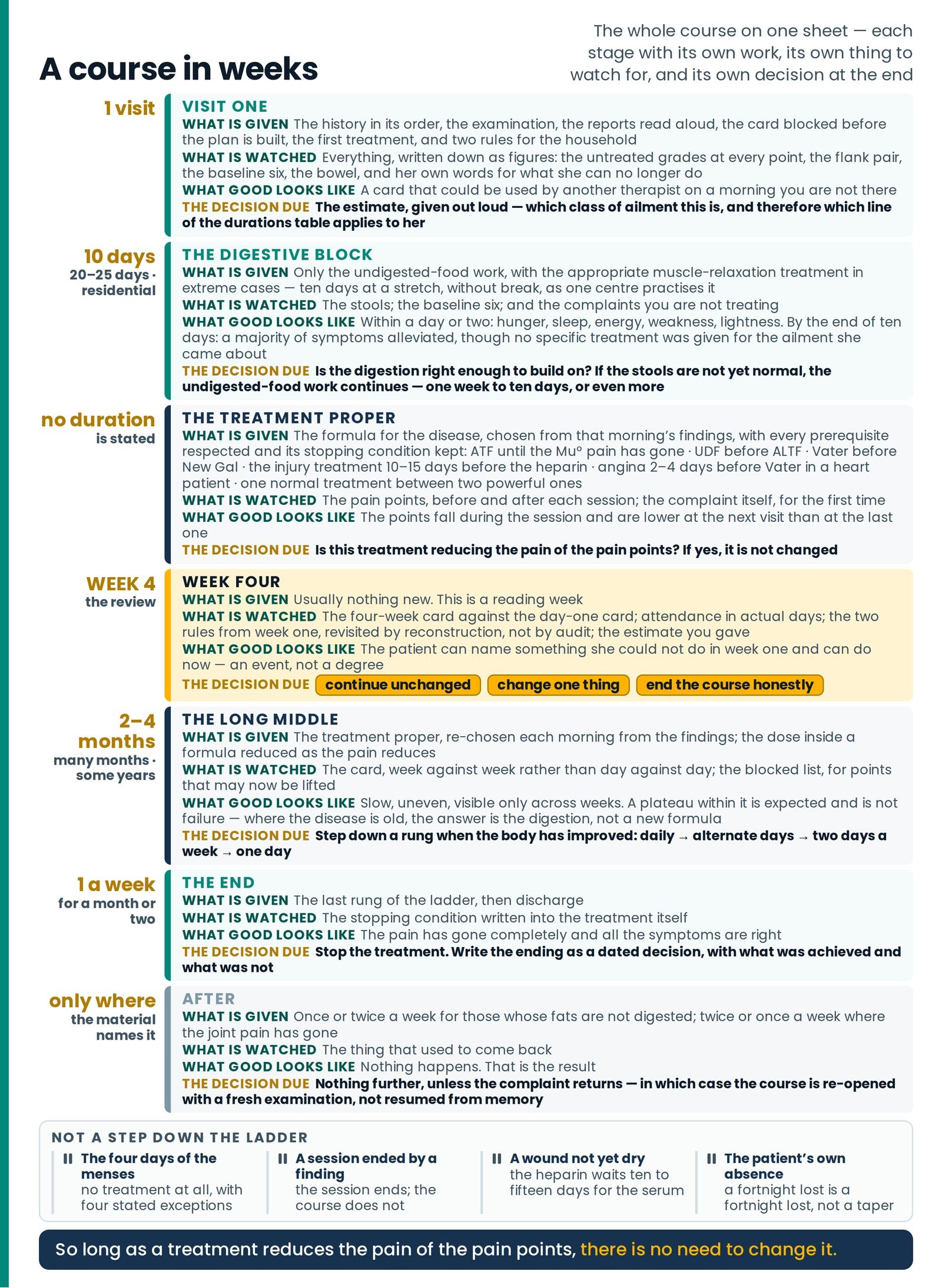
This is the part of the article to photocopy and keep inside the register. (Figure 43.3)
Two warnings before you use it. First, the stage names are ours and the numbers are the material's. Where a stage has a stated duration it is printed; where it has none, the column says no duration is stated, and you are not to supply one — not to a student, not to a patient, not in your own head. Second, the aid does not choose treatments. It tells you what kind of work belongs to a stage, what to watch for, and what decision is due. Which formula is decided by the findings of that morning, in the ordinary way.
Reading a week
Five things can be true at the end of a week, and each has an answer
Five things can be true at the end of a week, and each has a different answer. Most therapists know three of them. (Figure 43.4)
The second row of that table is the one to learn hardest, because it is the row on which a therapist's judgement is most often wrong in the direction that costs a patient a cure. A treatment that relieves and does not hold is not a treatment that failed. It is a treatment doing exactly what it was built to do, in a life that is undoing it every night. Change the treatment and you have thrown away something that works and kept the thing that does not.

Why the fourth week
Falling enthusiasm meets the disease’s slowest stretch
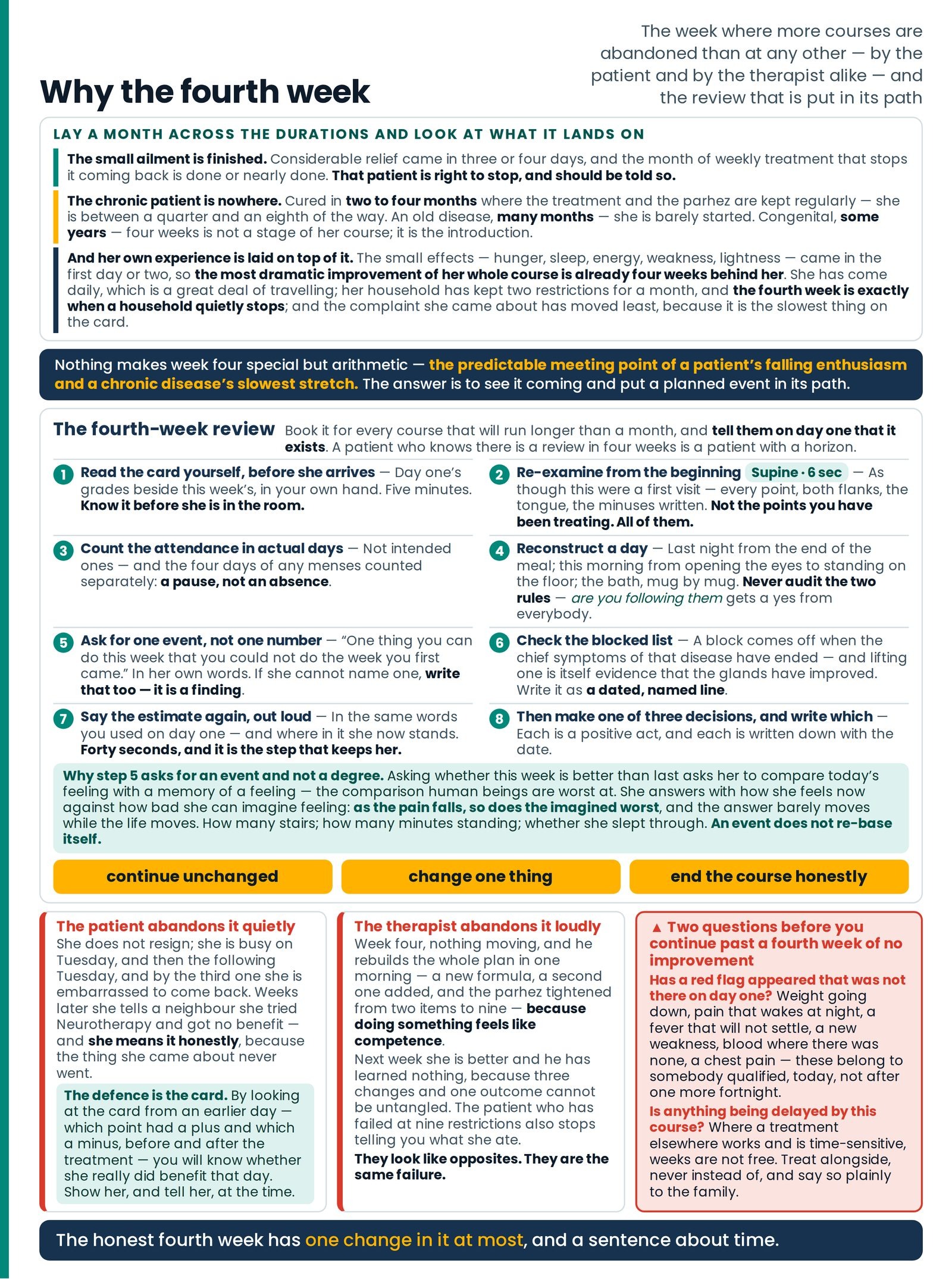
Nothing in this therapy makes week four special. What makes it special is arithmetic, and it is arithmetic that runs against you.
Look at Table 1 again and lay a month across it. A small ailment is finished — considerable relief came in three or four days, and the month of weekly treatment that stops it coming back is either done or nearly done. That patient is right to stop, and should be told so.
A chronic patient is nowhere. If she is one of the fortunate ones for whom, treatment and parhez kept regularly, many diseases are cured in two to four months, she is between a quarter and an eighth of the way. If hers is an old disease, taking many months, she is barely started. If it is congenital, and the honest figure is some years, four weeks is not a stage of her course; it is the introduction.
Now put the patient's own experience on top of that arithmetic. She has had the small effects — hunger, sleep, energy, weakness, lightness — and they arrived in the first day or two, which means the most dramatic improvement of her entire course is already four weeks behind her. She has come daily for the first few weeks, which is a great deal of travelling. Her household has been keeping two restrictions for a month, and the fourth week is exactly when a household quietly stops. And the complaint she actually came about has moved least of anything, because it is the slowest thing on the card.
That is the cliff in the Erode register. It is not a mystery and it is not a failure of gratitude. It is the predictable meeting point of a patient's falling enthusiasm and a chronic disease's slowest stretch — and the whole of the answer is to see it coming and to put a planned event in its path. (Figure 43.5)
The rule, and the day it stops holding
Change a treatment when it stops reducing the pain of the pain points
The wiki's most useful decision rule was established beside the after-treatment check in Six Seconds, "Six Seconds", and its full working — the grades written before and after, and the notation they are written in — belongs to Uncommon Problems and to The Record That Shows the Truth, "The Record That Shows the Truth". This article is where it is used, because it is a rule about a course.
The decision rule
In this therapy, removing or finishing the pain of the pain points is the main aspect of the treatment.
Therefore: so long as any treatment reduces the pain of the pain points, there is no need to change it and give another.
Read the consequence, which is where therapists go wrong. A treatment is not changed because the patient is bored, because you are bored, because four weeks have passed, or because the complaint she came about has not gone yet. It is changed when it has stopped doing the thing it is judged by.
And read the second consequence, which is quieter. The rule requires the grades to exist. If the points were not graded before the treatment and again after it, there is nothing to apply the rule to, and the decision falls back on impressions — which is to say, on how much the patient likes you.
The same rule protects you against the returning patient, who is a fixture of every centre. Patients take two or four days of treatment, do not come for many days, and when the trouble comes back they say they got no benefit from the treatment, because their pain came back just as it was. By looking at the card from that earlier day — which point carried a plus and which a minus, before the treatment and after — you know whether that day's treatment benefited them or not. Then you can decide whether the old treatment is to be given again, or a different treatment given. Nine times in ten, the old treatment worked and was stopped.
The plateau in old, chronic disease — the material's own account
The therapy names the plateau itself, and answers it with digestion
Here is the passage every therapist in a fourth week should have read, because it is the therapy saying out loud the thing students think they are the first to notice.
The problem that remained
As the therapy became popular the number of patients went on growing, and good results were coming in all of them — but in old, chronic diseases it was seen that the results came only after many days, and often, after a few days, the effect of the treatment was next to nothing.
That is a plateau, named by the therapy, in its own words, without apology and without tidying.
And it was not accepted as the natural limit of the work. It was taken as a question. Guruji began study and research about this, and the answer that came out of it is the undigested-food formula — which is why the whole of that family of treatments sits where it does in the formulary.
The working instruction that falls out of this is repeated elsewhere in the formulary and is worth stating as a rule of course planning: where a disease is old, the stomach and intestines must be put right before the powerful treatments are used — and if undigested food is coming, treating that is necessary. That is not only the first ten days of a course. It is also what you go back to in the middle of one, when a long course has flattened out. The commonest reason a chronic course stalls in month two is that the digestion has slipped back while you were busy with the disease.
The order in which you look, before you touch the plan
Attendance, then the twenty-three hours, then the body, then the plan
When a course stalls, four things can be wrong, and only the last of them is the treatment. Look in this order, because the earlier ones are commoner, cheaper and more often missed.
Was the plan carried out? Attendance in actual days. The parhez, asked as tell me everything you ate and drank yesterday, from waking. The water, in glasses. A plan that stopped being carried out is not a plan that failed.
What is happening in the twenty-three hours? Reconstruct a day. The window, the bed, the hands under the head, the fridge water, the sour thing nobody in that household thinks of as a food.
Has the body changed under the plan? Re-examine from the beginning. A finding may have moved without going away, and the treatment may now be aimed at where the trouble was rather than where it is. Neurotherapy treats according to the condition of the body, and Thursday's body is not Monday's.
Only then, the plan itself — and then one change, written down, with the date and what you expect to see if it was the right change.
Changing the dose rather than the formula
A written maximum is a ceiling, not a count to be given every day
Students think of changing a plan as swapping one formula for another. There is a gentler move written into the formulary itself, and it is the commonest change a good therapist makes.
Where a formula carries a count marked maximum, the word has a particular meaning: it is not that the maximum is to be given on all days.
Every day, before the treatment, the therapist must check the patient's pain at that point. According to the pain, how much to give that day is to be decided by oneself. For the first few days give the full count; but after some days, as the pain decreases, keep reducing the quantity — a count of three in place of eight, of three in place of ten.
The written ceiling, and how a count comes down across a course
And when the pain has gone completely and all the symptoms are right, stop the treatment.
That is a whole course in four sentences: examine daily, give according to what you find, reduce as it improves, stop when it is done. The Vater formula is where it is written out — see also → Setting the Stomach, "Setting the Stomach" — but the habit belongs to every formula that carries a ceiling.
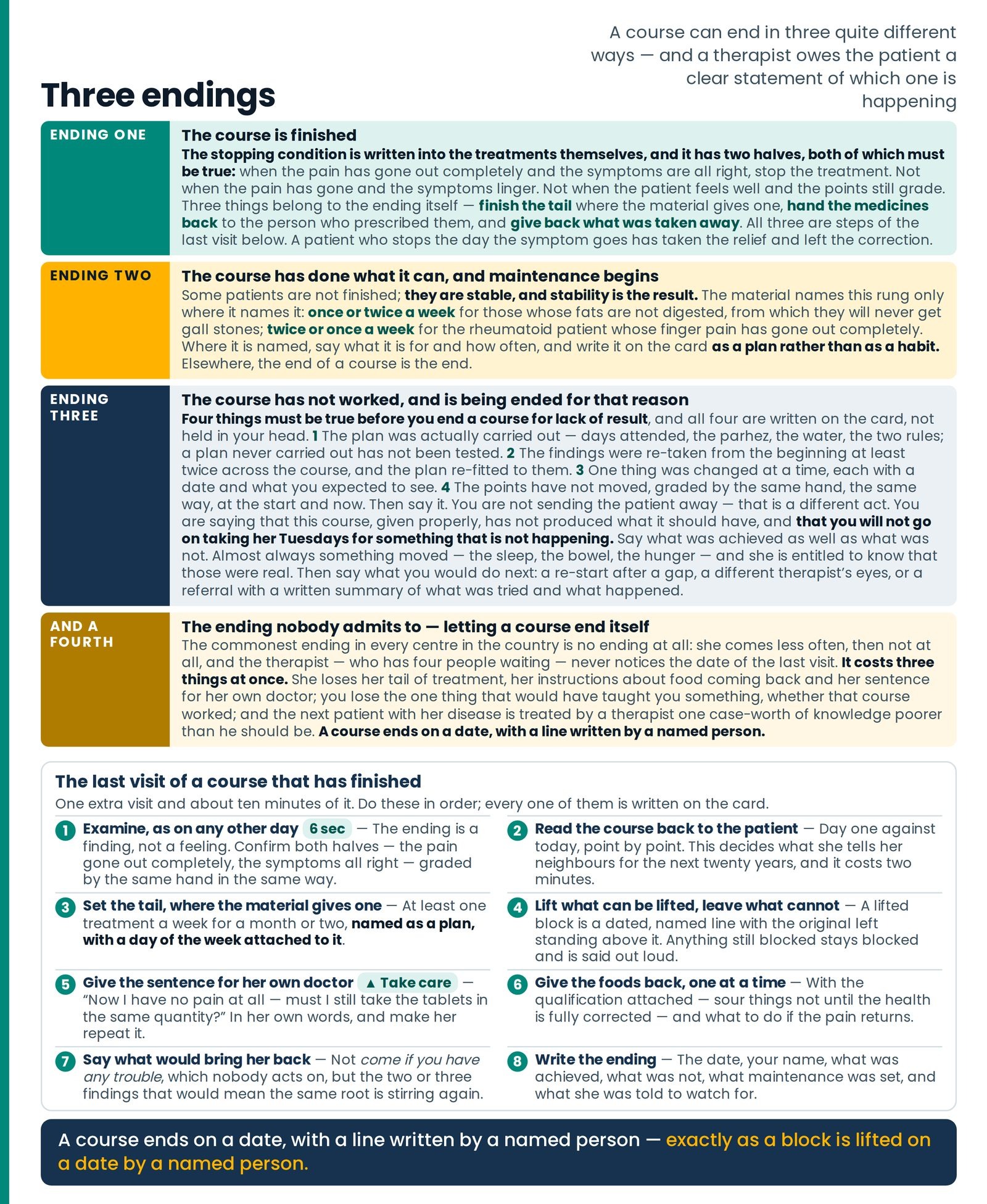
This is the instruction with no technique attached to it, and it is the one most therapists never learn, because nothing about a busy morning teaches it. A course can end in three quite different ways, and a therapist owes the patient a clear statement of which one is happening.
Ending one — the course is finished
Both halves: the pain gone completely and the symptoms all right
The stopping condition is written into the treatments themselves and it has two halves, both of which must be true: when the pain has gone out completely and the symptoms are all right, stop the treatment. Not when the pain has gone and the symptoms linger. Not when the patient feels well and the points still grade. Both halves. (Figure 43.6)
Three things belong to the ending itself.
Finish the tail where the material gives one. For the small ailments — fever, cold, cough, indigestion, constipation, stomach ache — considerable relief comes in three or four days, but for a complete cure at least one treatment a week for a month or two means the trouble does not come again. A patient who stops the day the symptom goes has taken the relief and left the correction, which is precisely the distinction this therapy was built on.
Hand the medicines back to the person who prescribed them. When the complaint has gone entirely, the patient is told to say to their own doctor: "Now I have no pain at all — must I still take the tablets in the same quantity?" Then the doctor himself tells them what to do. We do not advise anyone to reduce medicine without the doctor's opinion. Where a patient has, on his own responsibility, adopted the gradual taper, remember the sentence that governs it: the treatment is not to be stopped while the taper runs, until he has been well for many days without medicine. The taper itself, quarter by quarter, is taught in The History That Cannot Mislead You, "The History That Cannot Mislead You".
Give back what was taken away. The restrictions are part of the prescription and they end when the prescription ends — with one qualification stated exactly. Those with the diseases of acidosis should not eat sour things until the health is fully corrected; later, if there is need, they may eat them. If the pain comes back, stop them completely for some months, until the body is fully corrected. A therapist who returns a food is believed the next time he takes one away.
Ending two — the course has done what it can, and maintenance begins
Stability is a result — but maintenance only where it is named
Some patients are not finished; they are stable, and stability is the result. The material names this rung only in particular places and you should not extend it beyond them: once or twice a week for those whose fats are not digested, from which they will never get gall stones; twice or once a week for the rheumatoid patient whose finger pain has gone out completely. Where it is named, say what it is for and how often, and write it on the card as a plan rather than as a habit.
Ending three — the course has not worked, and is being ended for that reason
Four things written on the card before you end it for lack of result
This is the hard one, and there is no way to make it comfortable. There is a way to make it honest.
Ending a course that has not worked
Four things must be true before you end a course for lack of result, and all four are written on the card, not held in your head:
1. The plan was actually carried out — the days attended, the parhez, the water, the two rules. A plan that was never carried out has not been tested. 2. The findings were re-taken from the beginning, at least twice across the course, and the plan re-fitted to them. 3. One thing was changed at a time, each with a date and each with what you expected to see. 4. The points have not moved — graded by the same hand, the same way, at the start and now. This is the evidence, and without it you are ending a course on a feeling.
Then say it. You are not sending the patient away — that is a different act, taught in When the Hand Must Stop, "When the Hand Must Stop". You are saying that this course, given properly, has not produced what it should have produced, and that you will not go on taking her Tuesdays for something that is not happening.
Say what was achieved as well as what was not. Almost always something moved — the sleep, the bowel, the hunger — and she is entitled to know that those were real. Then say what you would do next: a re-start after a gap, a different therapist's eyes, or a referral with a written summary of what was tried and what happened.
You will have to make this judgement about your own work, with nobody to check it, several times a week for the rest of your life. Three things flatter you and three things protect you. (Figure 43.7)
The three flatterers
Her kindness, the worst day, and your own memory
The patient's kindness. She is being treated free, or nearly free, by someone who is plainly working hard on her behalf, in a culture that treats a healer with reverence. Asked how she feels, she will say better — and she is not lying; she is being decent. The therapist who asks "are you feeling better?" will be told yes for eleven weeks.
The worst day. People come to a healer when they are at their worst, and by its nature a worst is unusual for that person. Some of what improves in the first fortnight of any course, anywhere, in any system, would have improved anyway, because the patient arrived at the bottom of a swing and the swing was going to come back up. This is not an argument against the therapy. It is an argument for measuring, because the only defence against it is a record long enough to show a trend rather than a bounce.
Your own memory. You remember the patients who got well; they came back and thanked you. You do not remember the ones who stopped in the fourth week, because nothing happened to make you remember them. Every therapist's memory is a collection of successes, honestly formed and completely useless as evidence.
The three defences
Grades by the same hand, events not degrees, the untreated complaints
Grades written before and after, by the same hand. This is the therapy's own measure and it is the only one that is independent of the patient's mood. Pan at four plus on day one and one plus in week four is not an opinion.
Events, not degrees. How many stairs; how many minutes standing; whether she can sit on the floor; whether she slept through; whether she has stopped the afternoon nap she needed every day. Record them in her words on day one and read them back in week four.
The complaints nobody is treating. Where the picture really is one picture, the things you were not aiming at move — and families notice what no card records. In the ten-day account from one centre, what the relatives reported was not the disease at all: the patient's disposition had become remarkably better, and irritability drastically reduced, within ten days. Ask the daughter. One sentence from a daughter outranks a session of guessing.
The honest sentence, and the two dishonest ones
When a course is going slowly, there are three things you can say and only one of them is defensible.
Dishonest, in the encouraging direction: "It is working, you will see, be patient." You do not know that. If it turns out to be false she will remember that you said it, and so will her family, and so will her village.
Dishonest, in the modest direction: "I'm sorry, I don't think this is doing very much." — said in week three of a chronic course that is running exactly on schedule. This is not humility; it is a therapist managing his own discomfort at the patient's expense, and it ends courses that were going to work.
Honest: "Here is what has moved" — naming it — "and here is what has not. This is a disease of nine years, and the time I gave you on the first day was many months. We are in week four of that. I am not changing the treatment, because it is still reducing these pains, and I will tell you the day it stops."
That answer contains a measurement, a timescale, a decision and a promise. It is also, in the ordinary sense of the word, true.

Questions students ask
1. I am twenty-two and this is my first year. How do I plan a course when I can barely choose today's formula? You do not plan the formulas in advance; nobody does. What you plan is the shape — the digestive stage and its length, the honest estimate, the fourth-week review, the rungs of the frequency ladder, and the review points where a decision is due. The formula for any given morning is chosen that morning from that morning's findings. A course plan is a calendar of decisions, not a calendar of treatments.
2. I am a housewife learning this for my mother-in-law, who lives with me. Does any of this apply if I treat her at home every day? All of it, and one part more than for anybody else. Treating a relative daily makes the fourth week invisible, because she never stops coming — she is in the next room. So you lose the natural review and you keep going out of habit. Fix the date for a review, write the grades down even though she is family, and be willing to say to her that something is not working. That is harder at home than at a centre, not easier.
3. Why not just change the treatment every week? Surely more variety is better. Because you would be throwing away the one measurement you have. So long as a treatment reduces the pain of the pain points, there is no need to change it. Change it anyway and you will never know whether the improvement came from what you stopped or what you started. Variety in a course is not a virtue; it is a loss of information.
4. I am a retired bank manager and I like numbers. What should I actually write down each visit so a course can be read later? The week number, the grades before and after at every point you examined, attendance in actual days, any change with its date and what you expected it to do, and once a month an event in the patient's own words. That is enough to reconstruct a course a year later, and it is not enough to take you five minutes.
5. A doctor asked me how I know my treatment is doing anything, rather than the patient simply improving with time. What is the honest answer? The honest answer is that in a single patient you often cannot know, and that this is true of every clinician. What you can show is what you measured: the grades before and after each session in your own hand, the events that changed, and the pattern across weeks rather than the bounce across one. Then say the thing that is actually persuasive — that you are willing to name the day a course is not working and to stop it. Anyone who will do that is measuring something.
6. I work in a village and half my patients cannot come daily. The ladder says daily for the first few weeks. Then plan for the patient you have. Where the arrangement was made for people who cannot reach a therapist at all, the instruction is to teach a relative — the family member comes with the patient, learns the treatment, and gives it at home; after some months both come back for a few days of follow-up so that new treatments can be taught. That is the therapy's own answer to your problem and it is a better one than a diluted course.
7. A patient improved for three weeks and then went backwards, with nothing changed in the plan. What do I change? Probably nothing. Nothing changed in the plan is the point — something changed outside it. Reconstruct a day, ask the family, and ask specifically about foods given back and about the four ordinary things: the window, the bed, the water and the hour of the night meal. Only if that search is genuinely empty do you re-examine and change one thing.
8. How do I know a plateau is the middle of a success and not the end of one? By its company. A plateau in a patient whose grades fell for four weeks first, whose sleep and hunger are holding, and whose disease is old, is the stretch the therapy itself describes — and the thing to look at is the digestion. A plateau in a patient whose grades never fell at all is not a plateau; it is a course that has not started. The difference is visible only if day one's grades exist.
9. I have a patient I like very much and she has had eleven weeks with almost nothing. I cannot bring myself to say it. Then you have understood the hardest part of the article. Write the four things down first — that the plan was carried out, that you re-examined twice, that you changed one thing at a time, and what the grades have done — and read them yourself before she arrives. Having the evidence in front of you makes the sentence sayable. And say what did move; something almost always did, and she is entitled to it.
10. Does the four-week review apply to a small ailment too? For a small ailment the four-week mark is usually the end, not a review — considerable relief in three or four days, and at least one treatment a week for a month or two so it does not come again. The review belongs to any course that will run longer than a month. Decide which kind of course you are in on the first morning; that decision is half of planning.
11. My centre is busy and I am told to see thirty patients a day. When exactly am I supposed to do any of this? Most of it costs seconds. The week number is one digit. The estimate is one sentence. The grades are already being written. The only genuinely slow item is the fourth-week review, and it is not due for every patient on the same day — spread across a month it is one extra ten-minute conversation a day. Compare that with the cost of the cliff: a patient who leaves in week four took four weeks of your mornings and produced nothing.
12. What do I do with a patient who wants to keep coming for ever? Find out what she is coming for. If it is a named maintenance — the undigested fats, the joint pain that has gone — then set it properly at once or twice a week and write it on the card as a plan. If it is not, then she is coming for the half hour of attention, which is a real human need and not a medical one, and the kind thing is to say so: the course is finished, here is what to watch for, come back the day it returns. Then send her home well rather than keeping her mildly treated.
Questions patients ask
1. "How long will this take?" It depends on five things, and I will tell you all five: your build, which disease it is, how many organs it has reached, how many years you have had it, and how closely you keep the food and daily rules. For a small trouble like a cold or an upset stomach, considerable relief comes in three or four days, and then one treatment a week for a month or two so it does not return. For an ordinary complaint, a week to ten days. For a chronic one, about a year or more — although where the treatment and the restrictions are kept regularly many diseases are corrected in two to four months. Yours has been there nine years, so I am telling you months, not weeks, and I will tell you in the fourth week exactly where we have got to.
2. "Why am I not better yet?" Some of you is better, and I will name it: your sleep, your hunger, and your bowel, all of which changed in the first fortnight. The thing you came about has not changed yet, and that is the part I cannot hurry. It is also the slowest thing on your card, because it is the oldest. What I am watching is not how your knee feels — it is these pain points around your navel, which I check before and after every session, and they are still coming down. On the day they stop coming down I will change the treatment, and I will tell you that I have.
3. "Should I come every day? It is two buses." For the first few weeks, yes, daily if you can — an interrupted start is not a shorter course, it is a different one. Then it comes down as your body improves: alternate days, then twice a week, then once. If the journey is genuinely impossible, bring somebody from your household and I will teach them the treatment to give you at home, and the two of you can come back to me every few months.
4. "I feel completely fine now. Can I stop?" I am glad, and I want you to stop at the right point rather than the pleasant one. The rule I work to is that the treatment stops when the pain has gone completely and the symptoms are all right — both halves. Let me check the points today. If they have gone, then for something like yours we still give one treatment a week for a month or two, so the trouble does not come back. That month is the difference between feeling better and being finished.
5. "Is it worth going on? It has been a month and I don't see much." Let us look together rather than guess. Here is what your card said on the first day and here is what it says today — and this point has come from four marks to one. Here is what you told me you could not do in your first week, and here is what you told me today. That is what a month looks like in a disease of this age. If you had shown me nothing across this month, I would have said so and changed something — I am not going to keep you coming for a treatment that is not working.
6. "My doctor wants me to start a new medicine. Should I wait and see if your treatment works first?" No. Start what your doctor has given you. We use no medicine here and we do not tell anybody to stop or postpone theirs; our treatment runs alongside, not instead. If a day comes when your complaint has gone entirely, then go back to him and say: "I have no pain at all now — must I still take the same quantity?" That decision is his.
7. "Last time I came for four days and it came back, so it did not work." Let us find out. I have your card from then. Look — these two points were painful before that day's treatment and not painful after it, in my handwriting on the day. So the treatment did work on the day it was given. What did not happen is the course: four days is not a course for what you have. If you would like to try again, we will do it properly this time, and I will tell you on the first day how long it should take.
Words used here
| Hindi | English | Neurotherapy code / usage |
|---|---|---|
| कोर्स / उपचार-क्रम (kors / upachār-kram) | A course of treatment | The whole prescription in time: which work, how often, for how long, and what the patient does between sessions |
| पठार (paṭhār) | Plateau | The stretch in which the card stops moving; named by the therapy for old chronic diseases |
| परहेज़ (parhez) | Abstinence, dietary restriction | One of the five things that decide how long a course takes — and the only one the therapist can move |
| क्रमशः घटाना (kramaśaḥ ghaṭānā) | To reduce step by step | The frequency ladder: daily → alternate days → two days a week → one day |
| एक दिन छोड़कर (ek din chhoṛkar) | On alternate days | One day on, one day off — the gene formulas; formerly the modified star formula |
| लगातार (lagātār) | Continuously, without break | Ten days at a stretch, without break — the digestive block at the start of a course |
| रखरखाव (rakhrakhāv) | Maintenance | Treatment continued at low frequency after the complaint has gone — only where the material names it |
| समीक्षा (samīkṣā) | Review | The planned fourth-week reading of the card against day one |
| अनपचा खाना | Undigested food | UDF — corrected first, and returned to when a long course stalls |
| — | ATF | Given only where there is more pain at Mu°; other treatments follow once that pain has gone |
| — | NAN / FAN | The normal treatment given between two powerful treatments, so their chemicals do not mix |
| — | max. | On a formula, a written ceiling — not a count to be given every day; reduced as the pain reduces |
| — | Pan⁺⁺⁺⁺ → Pan ₋ | The before-and-after grading by which a course is judged; the notation is The Record That Shows the Truth's |