- How it is given
- The Low Back
- What it is used for
- Each Point in Use
Watch


From The Low Back
BLOOD SUPPLY TO SIDES — its own entry
The same sole, the same sweep, at the hip — to relax the muscles around it
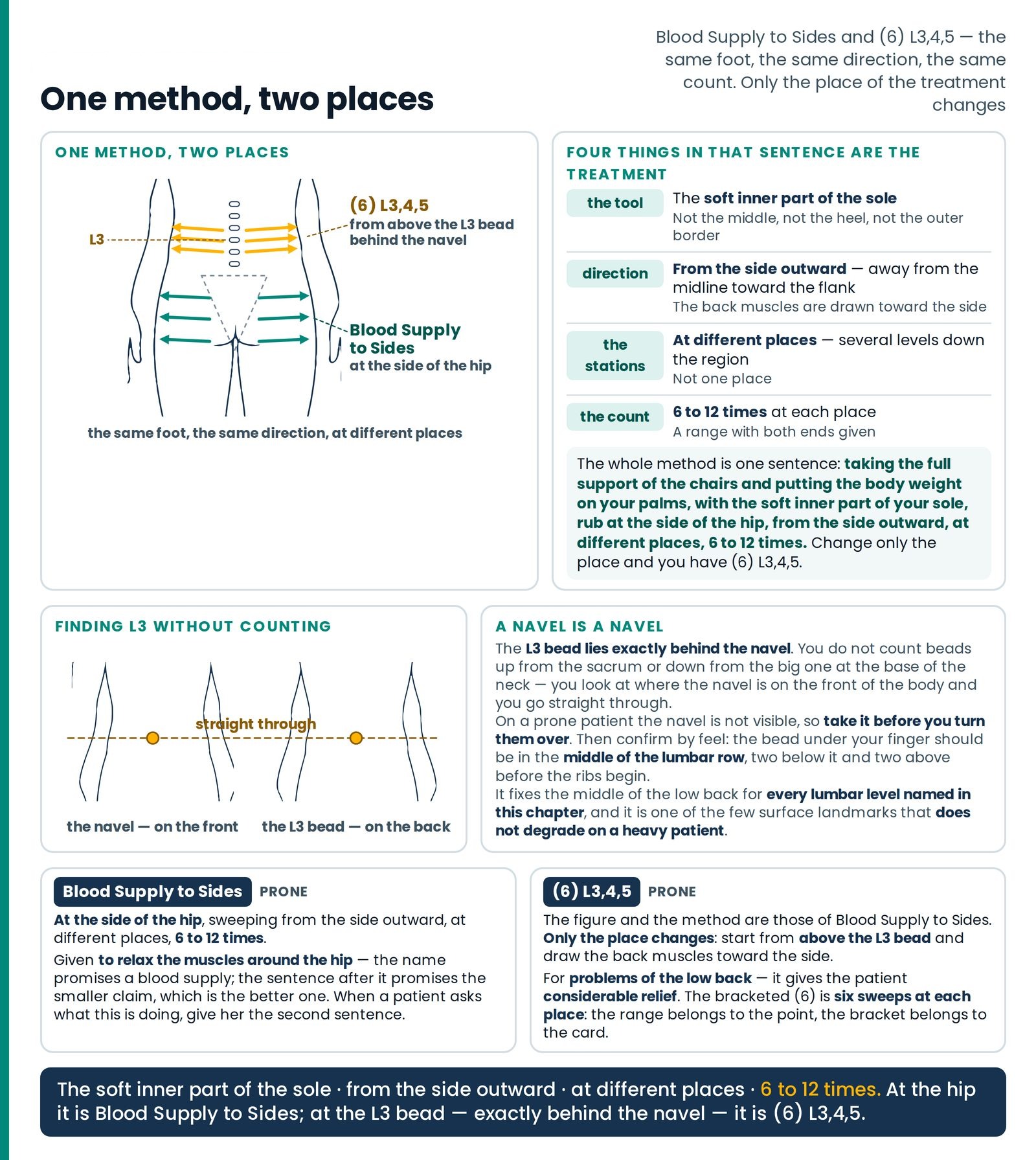
The method was taught in full above, because (6) L3,4,5 cannot be given without it. Here is the point in its own right, with the indication that belongs to it. (Figure 22.3)
Taking the full support of the chairs and putting the body weight on your palms, with the soft inner part of your sole, rub at the side of the hip, from the side outward, at different places, 6 to 12 times. It is given to relax the muscles around the hip.
| Patient's position | Prone, 1½ pillows; therapist taking the full support of the chairs, body weight on the palms Prone |
|---|---|
| Where the feet are placed | The soft inner part of the sole, at the side of the hip, sweeping from the side outward, at different places |
| Duration and repetitions | 6 to 12 times at each place |
| What it is for | Relaxing the muscles around the hip |
Note the modesty of the stated purpose and keep it. The name promises a blood supply; the sentence after it promises relaxed muscles around the hip, which is the smaller claim and the better one. When a patient asks what this is doing, give her the second sentence.
Also explained in
- (6) L3,4,5 — the plainest landmark in the wiki The Low Back
The figure and the method of this treatment are those of Blood Supply to Sides.
- The knee and the lower limb Each Point in Use
Blood supply to sides For those who have numbness in the side portion of the thighs, this treatment increases the flow of blood in that part and ends the numbness — Its own entry, and its own region — the side of the thi
- Introduction The Low Back
Give Blood Supply to Sides complete, so that any point built on it can be given without turning a page.
- The heading this group carries The Low Back
Where the therapist stands Named in Astride the L5–S1 joint, weight on the palms through the chairs L5–S1 ghisai, stage 3 Prone Comfortably near the waist, full weight on the hands through the chairs Fracture point — th
- BINDU POINT — the long diagonal The Low Back
Blood Supply to Sides: the soft inner part of the sole, at the side of the hip, from the side outward, at different places, 6 to 12 times — to relax the muscles around the hip.
- Questions students ask The Low Back
Why is (6) L3,4,5 written with a bracket when Blood Supply to Sides is written as a range, six to twelve? Because the range belongs to the point and the bracket belongs to the card.
- The master list — every treatment point, by the position the patient is placed in The Shorthand
Code Full name / Hindi Where it is taught in this wiki Adr Adrenal Face Down Swt Sweat Face Down Back Arrow Back Arrow, or Blood supply to lungs Face Down H arrow — Face Down On the spine — Face Down Beside the spine — Face Down Round arrow —
- Every symbol, and how to say it in words The Shorthand
(Figure 14.2) Table 10 — The written symbols and their names (first plate) Symbol (described) Code Full name A small circle flanked by inward-leaning strokes — \ ° / Back Arrow Back Arrow, or Blood supply to lungs Two
- a. BACK OF KNEES — given face down Knee, Leg, Foot
The last named method that article taught was Blood Supply to Sides — the soft inner part of the sole, at the side of the hip, from the side outward, at different places, 6 to 12 times, to relax the muscles around the hi
- b. KNEE CAP FREE — given laid straight, or seated Knee, Leg, Foot
→ The Shorthand The Shorthand — the bare open circle, and the arrows drawn through it → The Low Back The Low Back — Blood Supply to Sides, the parent of stages 2 and 3 → The Record That Shows the Truth The Record That Shows the Truth —