- How it is given
- The Low Back
- What it is used for
- Each Point in Use
Watch


From The Low Back
BLOOD SUPPLY TO LEGS — the stance that faces the wrong way
The one treatment given facing the heels, 30 to a thigh, crossed feet
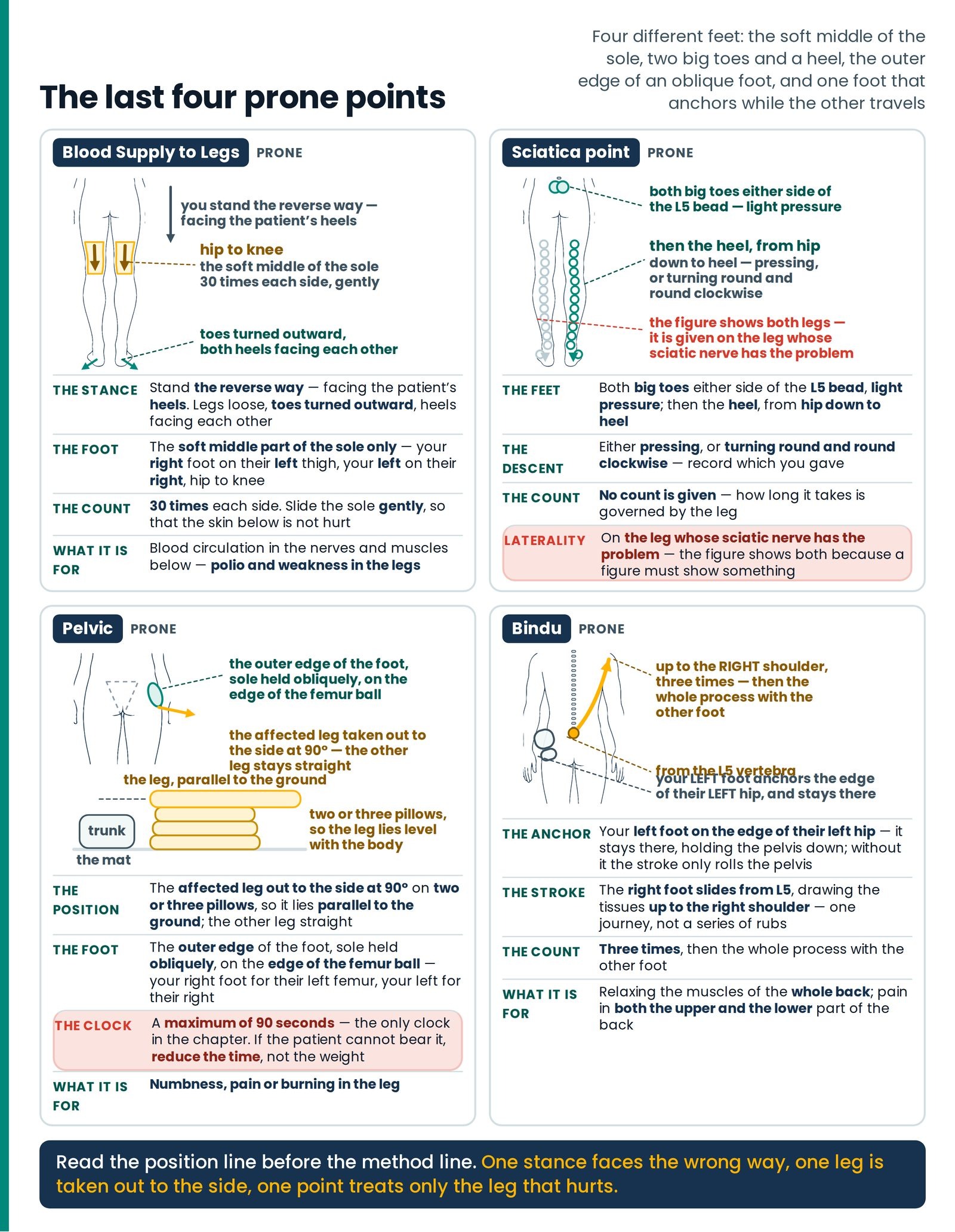
Note that in this treatment there is one main change in the therapist's standing position. Taking the support of the chairs, stand the reverse way compared with the other treatments — that is, facing toward the patient's heels. The treatment is given with the soft middle part of the sole only. Prone Left Right (Figure 22.5)
Tell them to keep their legs loose, the toes turned outward, and both heels facing each other. Now, on the back of their left thigh, with your right foot, rub from hip to knee 30 times. Then with your left foot, rub their right thigh in the same way, 30 times. Each time, slide the sole gently, so that the skin below is not hurt, but the blood circulation in the nerves and muscles below is increased.
This is an excellent treatment for polio and for weakness in the legs.
When writing it on the card, its symbol is → → → an inverted triangle marked 30, with two downward arrows beneath it.
| Patient's position | Prone, 1½ pillows; legs loose, toes turned outward, both heels facing each other. Therapist taking the support of the chairs, standing the reverse way — facing the patient's heels Prone |
|---|---|
| Where the feet go | The soft middle part of the sole only, back of the thigh, hip to knee — your right foot on their left thigh, your left foot on their right Left Right |
| Duration and repetitions | 30 times each side. Slide the sole gently, so that the skin below is not hurt |
| What it is for | Increasing blood circulation in the nerves and muscles below; an excellent treatment for polio and for weakness in the legs |
The reverse stance has a reason you feel at once: the sweep runs hip to knee, away from you, and a foot pushing away has a long clean travel where a foot pulling toward the body runs out of range in a hand's breadth. The crossing is written too — the crossed foot is the one that arrives square on the muscle and can travel the whole thigh.
The patient's position is half the treatment. Legs loose, toes turned outward, heels facing each other rolls both thighs outward at the hip and slackens the back-of-thigh muscles, so the sole rides soft bellies rather than a drawn bowstring. And gently is load-bearing: thirty repetitions with a therapist's whole weight available is a great deal, and the instruction names its own limit — so that the skin below is not hurt. The check is the skin. Pink is treated; scuffed, hot or marked is dragged.
What lies beneath, and the honest boundary. The sweep covers the three muscles at the back of the thigh, from the sitting bone to below the knee, with the great sciatic nerve running down the middle between them. For a weak leg, no amount of rubbing substitutes for using the muscle — what rebuilds a weak muscle is loading it and practising the task. What a slow thirty-stroke sweep gives is a leg less stiff, less sore and more willing to be moved, and a patient more willing to move it. Say it at that size and it is entirely true, and worth giving every day.
Also explained in
- The knee and the lower limb Each Point in Use
Blood supply to legs — for polio Given to increase blood circulation in the arteries of the legs of polio patients.
- Introduction The Low Back
Give JJ⁺¹ and JJ⁺² with their pillows, territories and three graded rounds; L4 Fracture face up on the inner calf and L5 Fracture face down on the outer; and Blood Supply to Legs from the one stance in the atlas that fac
- The heading this group carries The Low Back
Where the therapist stands Named in Astride the L5–S1 joint, weight on the palms through the chairs L5–S1 ghisai, stage 3 Prone Comfortably near the waist, full weight on the hands through the chairs Fracture point — th
- BINDU POINT — the long diagonal The Low Back
Blood Supply to Legs: the only treatment given facing the patient's heels; legs loose, toes out, heels facing each other; soft middle of the sole only; your right foot on their left thigh, hip to knee, 30 times, then the
- One disease, several points, one plan Each Point in Use
Blood supply to legs is given for polio — for the leg weakness, the numbness in the legs and the front or the back of the thighs, usually thirty times on both legs.
- Questions students ask Each Point in Use
Blood supply to legs addresses the weak leg, thirty times on both legs.
- The master list — every treatment point, by the position the patient is placed in The Shorthand
Code Full name / Hindi Where it is taught in this wiki Adr Adrenal Face Down Swt Sweat Face Down Back Arrow Back Arrow, or Blood supply to lungs Face Down H arrow — Face Down On the spine — Face Down Beside the spine — Face Down Round arrow —
- Every symbol, and how to say it in words The Shorthand
Table 11 — The written symbols and their names (second plate) Symbol (described) Code Full name A ring atop a line forking into two limbs, each ending in a dot, above a ground line Hydrocele point — Left and right arro
- Polio, and why it belongs in this article Fire and Swelling
Blood Supply to Legs is given for the leg weakness — a different point, doing a different job, in the same patient.
- Autoimmune disorders · arthritis · inflammatory diseases · polio When the Hand Must Stop
Blood supply to legs is given for polio — for the numbness and the weakness in the legs, in the front or the back of the thighs, usually thirty times on both legs.