Left to right, in the order performed — and the order is not negotiable
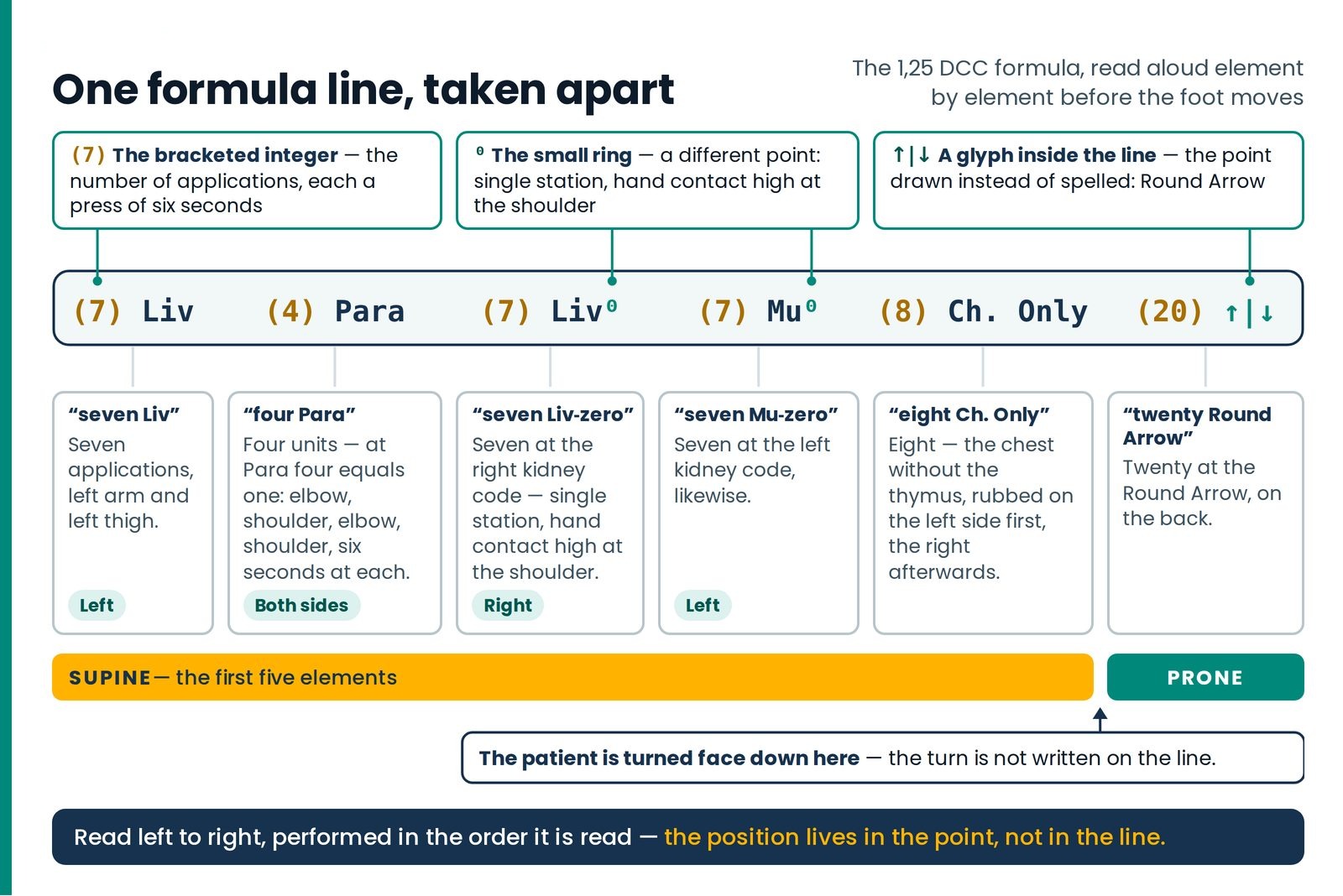
Everything above was vocabulary; this is grammar. A formula is read left to right and performed in the order it is read. (Figure 14.4) (Figure 14.5)
Key teaching
The rule that governs every formula in this wiki
a.
For the formulae to give the stipulated result, the most important thing to be remembered is that the timing of 6 seconds pressure at each pain point should be strictly followed, except when mentioned otherwise.
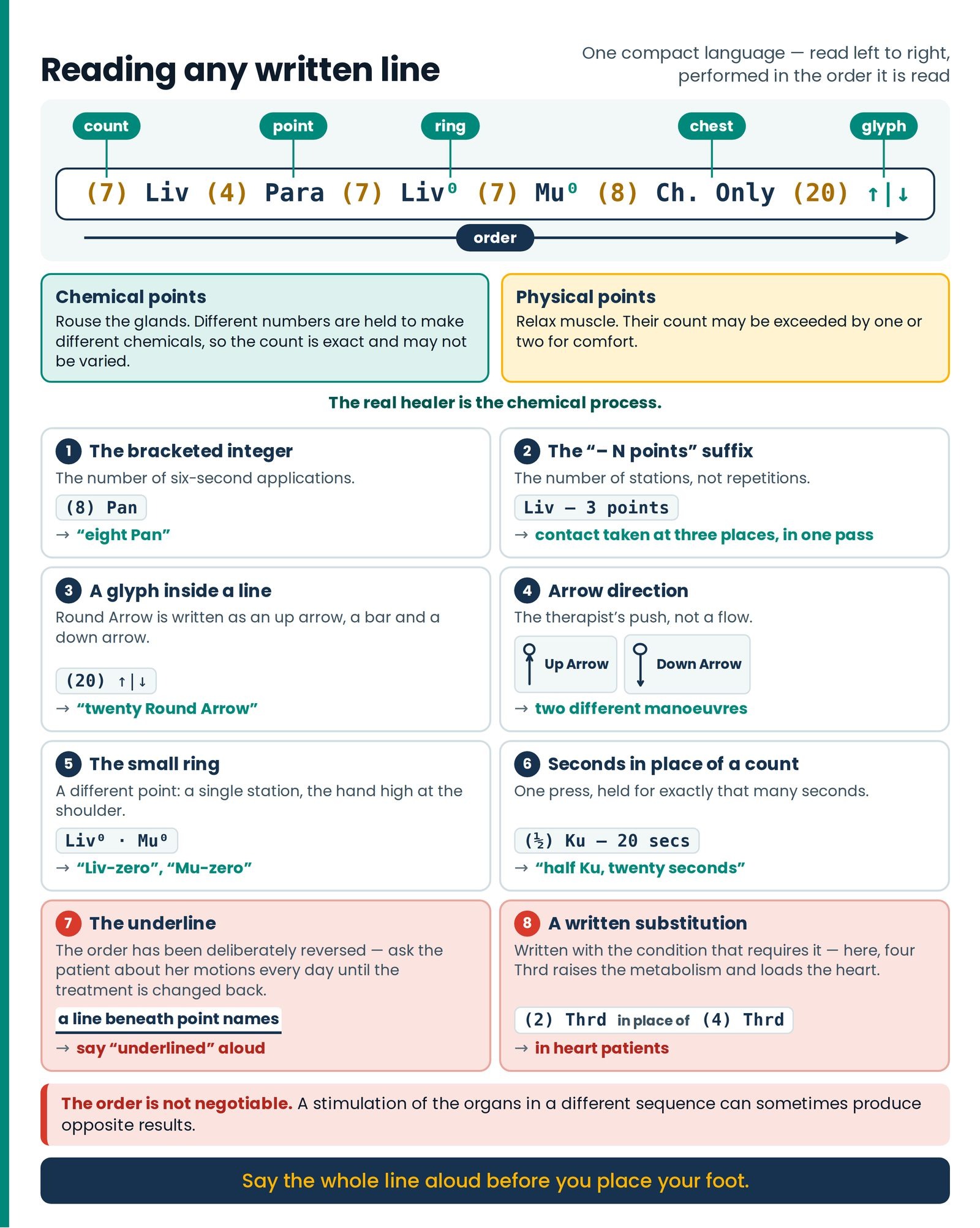
b. The sequence given in the formulae is to be followed exactly. A stimulation of the organs in a different sequence can sometimes produce opposite results.
Not a weaker result. Opposite.
First example — the commonest formula there is
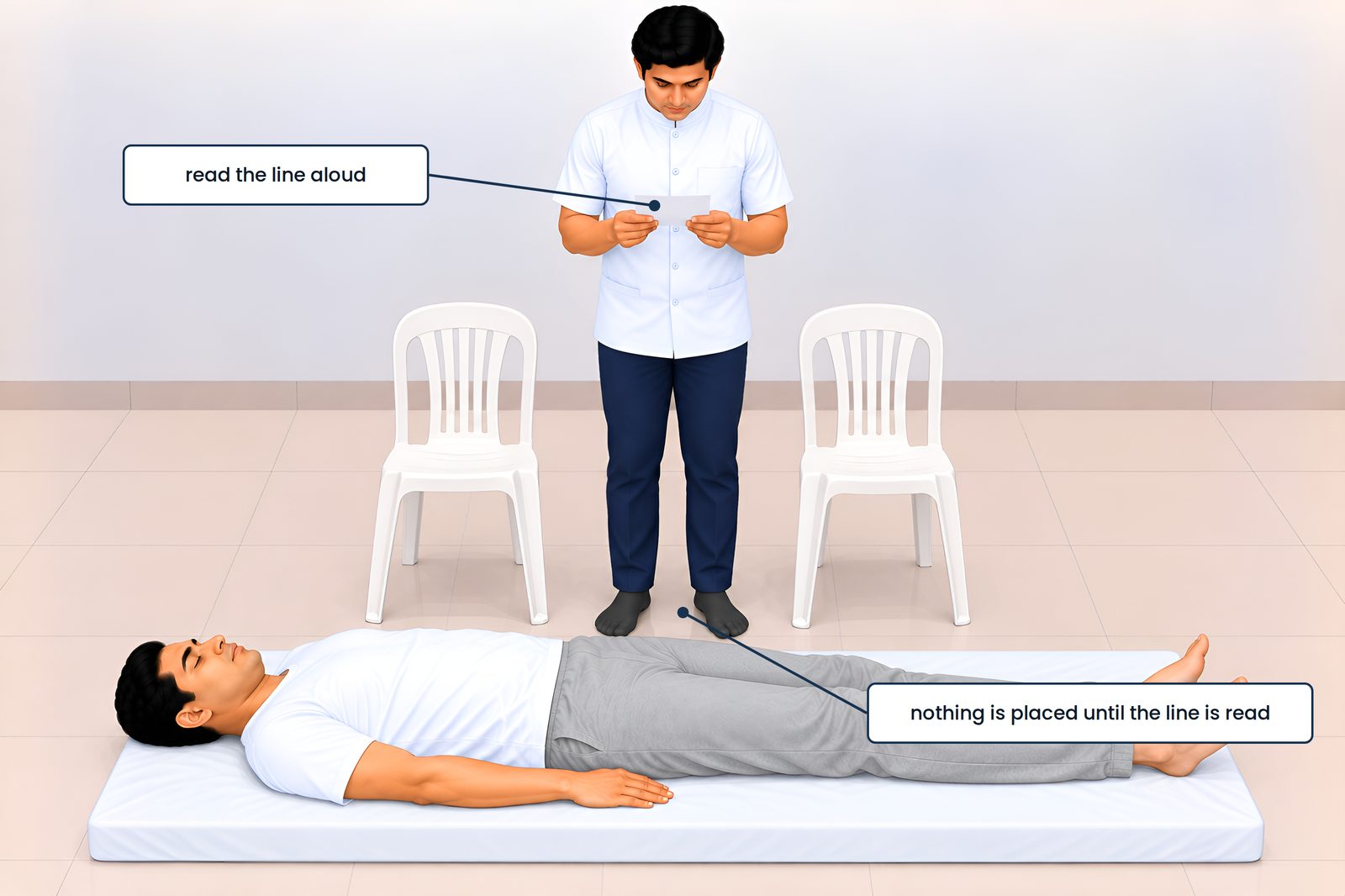
The card, read aloud before the foot is placed. The therapist stands between the two chairs beside the patient, both feet on the floor, and reads the next line of the card aloud to himself before any contact is made. Nothing has yet been placed.
Second example — a longer line, with a glyph inside it
One formula line, taken apart. The 1,25 DCC line (7) Liv (4) Para (7) Liv⁰ (7) Mu⁰ (8) Ch. Only (20) ↑|↓ split into its six elements. For each element the figure gives how it is read aloud and what is done, with call-outs for the bracketed integer, the small ring and the glyph. A position band shows the first five elements supine and the last prone, with the turn marked though it is not written.
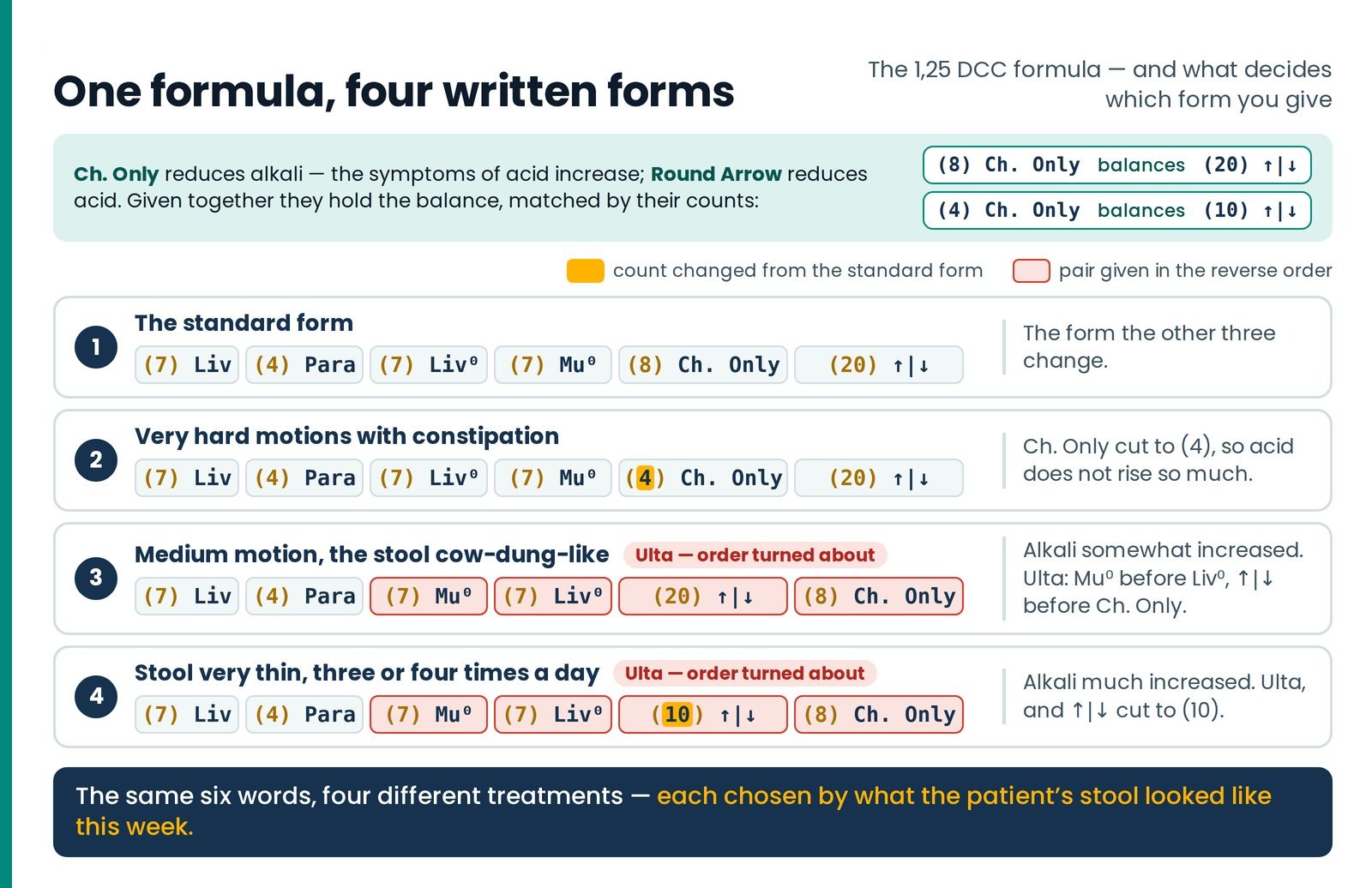
Ch. Only reduces alkali — the symptoms of acid increase; Round Arrow reduces acid. Given together they hold the balance, and they are matched by their counts: to balance (20) ↑|↓ you need (8) Ch. Only, whereas (4) Ch. Only is balanced by (10) ↑|↓.
One formula, four written forms. The four written forms of the 1,25 DCC formula, aligned element by element so that the changed count (Ch. Only cut to 4; Round Arrow cut to 10) and the reversed pairs (Mu⁰ before Liv⁰, ↑|↓ before Ch. Only) stand out. Each form carries the stool picture that calls for it, and a note above gives the matched counts that hold the acid–alkali balance.
The same six words, four different treatments — each chosen by what the patient's stool looked like this week. (Figure 14.6)
Third example — seconds in place of counts, and where the gaps fall
Gaps fall in three places only: inside a point, between one application and the next; between rounds of a × N treatments line, a stated rest, most often one minute, not optional; and between formulas, where the patient is turned. A session for a common ailment runs about thirty minutes and is not continuous — the formula sets the gaps, and those minutes are when a patient may speak.
Everything a written line can contain is in the table below. Several of these you met in Six Seconds, "Six Seconds", where the count is taught as the dose; they are set out here in their written form, because a convention you can recite but cannot recognise on a card is no use at the mat. (Figure 14.8)
Table 13 — Every element you will meet in a written line
Element
Written like this
How to say it
What it instructs
The bracketed integer
(8) Pan
"eight Pan"
The number of applications — presses of six seconds, each released
The number of stations, that is places, in one pass — not repetitions at one place. With a bracket in front, the whole pass is performed that many times
The small ring
Liv⁰ · Mu⁰
"Liv-zero" · "Mu-zero"
A different point: single station, hand contact high at the shoulder
One element swapped, with the condition that requires it
A written omission
Spl absent, or noted "not given"
say the omission aloud
A point deliberately left out. The absence is the instruction
Roman numerals, Trt.
I … II … · Acid trt.
"part one, part two"; "acid treatment"
Two formulas given as one treatment in that order, as in NAN and FAN; and the abbreviation for treatment
The underline, and why it exists
In the Ulta Normal formula the usual order has been changed on purpose — Spl before Gal, Mu before Liv — and to give notice of that, a line is drawn beneath some of the points, so the therapist does not give the Normal order out of habit.
It does a second job. Seeing that line every day reminds the therapist to ask the patient every day about his motions — because as soon as the stool becomes firm, formed like a banana, the treatment must be changed, and for at least one day the Normal formula given to bring the body back. A reversed order is permitted only for a limited period, for a particular problem. One mark that says this is deliberate, ask her today, and this is temporary.
How a substitution is written
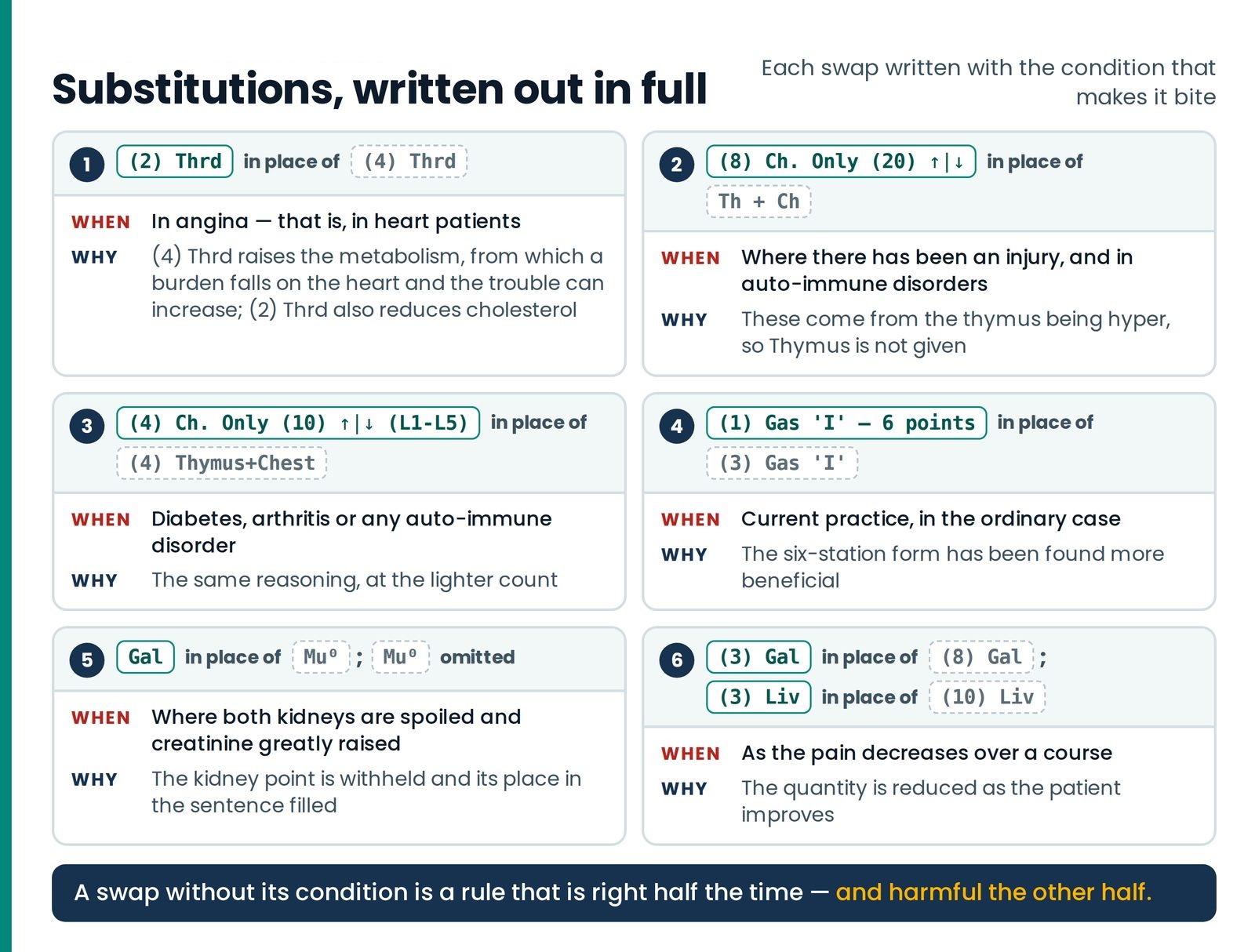
A substitution is written as a swap plus a condition. Both halves are the instruction: a swap without its condition is a rule that is right half the time and harmful the other half. (Figure 14.7)
Substitutions, written out in full. The six written substitutions, each shown as a swap (the element given in place of the one it replaces) together with the condition that requires it and the reason attached to it.
Writing a prescription another therapist can follow
Seven steps to a card a stranger can act on a year later
Now turn the skill around: a therapist must also write, for a reader he will never meet.
Two cards, and what they taught
A card written for a family, and a line guessed at 900 km away
Reading any written line. A one-page poster: the 1,25 DCC line tagged count, point, ring, chest and glyph, with an order arrow; chemical and physical points; eight conventions (bracketed integer, '– N points', a glyph inside a line, arrow direction, the small ring, seconds in place of a count, the underline and a written substitution), each with an example and its reading; and the rule that the order is not negotiable.
Ready to begin?
Send COURSE for course details, or your name, age and health issue for a consultation.