- How it is given
- Knee, Leg, Foot
- What it is used for
- Each Point in Use
Watch


From Knee, Leg, Foot
JJ GROIN and JJ BACK — for the pain that is left over
Inner side of the knee → Groin; outer side → Back. Two words decide
From Knee, Leg, Foot
JJ BACK — given face down
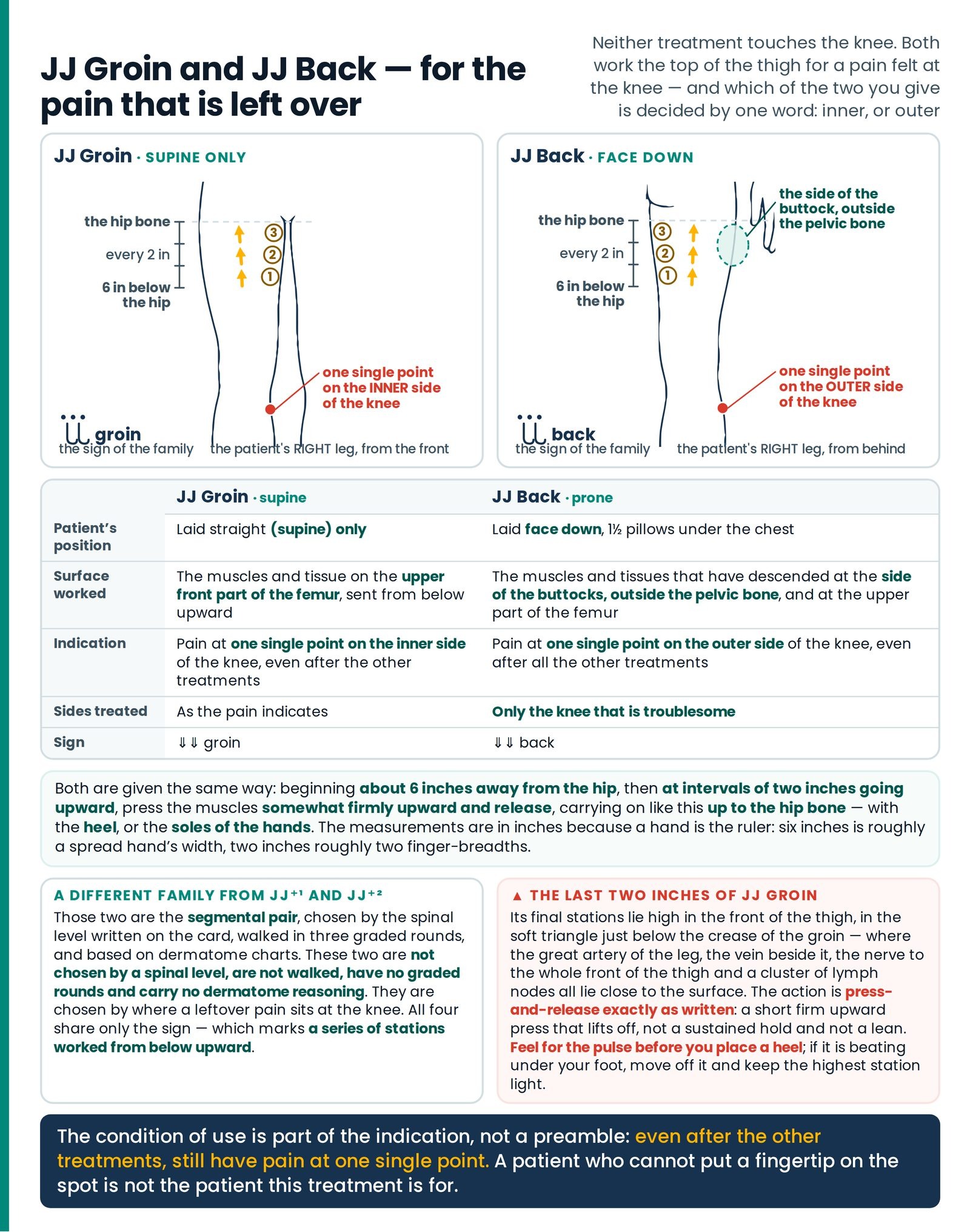
This treatment is given with the patient laid face down. It is for those who, even after all the other treatments, still have pain at one single point on the outer side of the knee. Prone
In this, the muscles and tissues that have descended at the side of the buttocks, outside the pelvic bone, and at the upper part of the femur, are to be carried from below upward. Beginning about 6 inches from the hip, as in the figure, at two-inch intervals going upward, press somewhat firmly and release. Carry on like this up to the hip bone. Give it with the heel, or the soles of the hands may also be used. Treat only the knee that is troublesome. Its sign is ⇃⇃ back.
| JJ Groin | JJ Back | |
|---|---|---|
| Patient's position | Laid straight (supine) only Supine | Laid face down, 1½ pillows under the chest Prone |
| Surface worked | The muscles and tissue on the upper front part of the femur, sent from below upward | The muscles and tissues that have descended at the side of the buttocks, outside the pelvic bone, and at the upper part of the femur, carried from below upward |
| Where it starts | About 6 inches away from the hip | About 6 inches from the hip |
| Stations | Every two inches, upward, to the hip bone | |
| Action and tool | Press the thigh muscles somewhat firmly upward and release — the heel, or the soles of the hands | Press somewhat firmly and release — the heel, or the soles of the hands |
| Indication | Pain at one single point on the inner side of the knee, even after the other treatments | Pain at one single point on the outer side of the knee, even after all the other treatments |
| Sides treated | As the pain indicates | Only the knee that is troublesome |
| Sign | ⇃⇃ groin | ⇃⇃ back |
The condition of use is written into both entries and is not decoration. Even after the other treatments, still have pain at one single point. These are not openers; they come after the sequence has been given long enough to show what it can do, and they are for one single point, not a knee that aches all over. A patient who cannot put a fingertip on the spot is not the patient this treatment is for. (Figure 23.4)
The inner–outer rule is the whole of the choosing. Inner side → JJ Groin, supine, front of thigh. Outer side → JJ Back, prone, back and outer thigh and side of the buttock. Two words, and they cannot be swapped. Neither treatment touches the knee — both work the top of the thigh for a pain felt at the knee, which is the logic running through this whole wiki and is worth saying to a patient in those words.
Also explained in
- The knee sequence, said aloud Knee, Leg, Foot
ine separable treatments, their counts and their sides, in one order THE METHOD, STEP BY STEP The order, with its counts — to be learnt by heart · Treatment · Position · Tool · Count · Which side 0 · The chemical points
- Introduction Knee, Leg, Foot
Tell JJ Groin from JJ Back by position, surface, indication and sign — and say plainly why neither is the same family as JJ⁺¹ and JJ⁺².
- Why the chemical points come first Knee, Leg, Foot
Where the therapist stands or sits Named in Beside the patient, the usual way, weight on the palms through the chairs Back of knees, BOF Prone Hands only, no chairs Knee Cap Free, Giriraj, calf muscle ghisai Supine
- Questions students ask Knee, Leg, Foot
Write which you gave, on which side, and which variant of Pradeep — and if you gave JJ Groin or JJ Back, write which and why.
- The line that closes the chemical half Each Point in Use
Once you know the word, three entries fall into place at once: J groin lifts the tissue that has descended on the inner side of the kaṭorī, J back the outer, and Pradip pulls the muscles and nerves of both sides away fro
- The knee and the lower limb Each Point in Use
J back Prone With this treatment we pull upward the tissue on the outer side of the knee that has descended, and bring it back to its own place.
- Every symbol, and how to say it in words The Shorthand
Table 11 — The written symbols and their names (second plate) Symbol (described) Code Full name A ring atop a line forking into two limbs, each ending in a dot, above a ground line Hydrocele point — Left and right arro