- How it is given
- The Low Back
- What it is used for
- The Low Back
- Take care
- a helper raises the legs to 45°, never the patient; never on the knee joint
Watch


From The Low Back
FRACTURE POINT ('T' + 1-2-3) — two treatments, no pause between
Heels at S5, then the raised thigh — and somebody else does the lifting
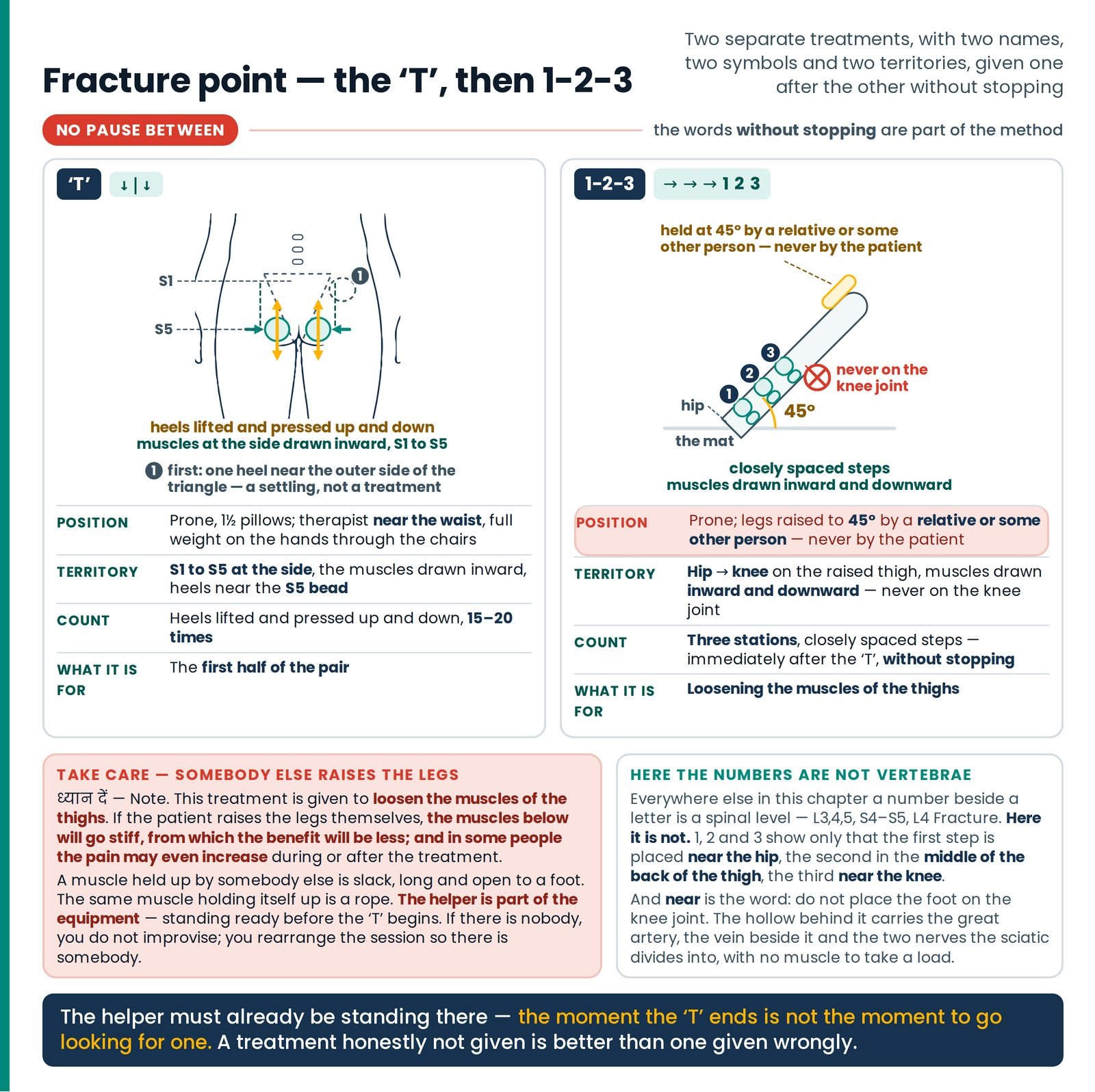
This includes two separate treatments, which are to be given one after the other without stopping. They have two names, two symbols and two territories, and on the card they may appear as one instruction. The words without stopping are part of the method — which means the helper the second half needs must already be standing there, because the moment the 'T' ends is not the moment to go looking for one. (Figure 22.2)
The symbol of the first treatment is ↓|↓. This is called 'T'.
The settling heel comes first and is not a treatment — one heel down near the outer side of the pelvic triangle, so the foot has found bone before weight arrives. The action is a pump, not a press and not a jerk: where Triangle for piles is one upward jerk at each of three stations and (2) S4, S5 one inward-and-downward jerk then a press-and-release, 'T' is fifteen to twenty repetitions of a rising and falling heel at one station.
The next treatment's symbol is → → → 1 2 3. This is called 1-2-3.
Everywhere else in this article a number beside a letter is a spinal level — L3,4,5, S4–S5, L4 Fracture. Here it is not. Read the glyph: three arrows in a row, travelling.
| 'T' | 1-2-3 | ||
|---|---|---|---|
| Symbol | ↓\ | ↓ | → → → 1 2 3 |
| Position | Prone, 1½ pillows; therapist near the waist, weight on the hands through the chairs Prone | Prone; legs raised to 45° by a relative or some other person ▲ Take care | |
| Territory | S1 to S5 at the side, the muscles drawn inward, heels near the S5 bead | Hip → knee on the raised thigh, muscles drawn inward and downward — never on the knee joint | |
| Count | Heels lifted and pressed up and down, 15–20 times | Three stations, closely spaced steps — immediately after the 'T', without stopping | |
| What it is for | The first half of the pair | Loosening the muscles of the thighs |
And the name must be handled plainly, because it is the point's name. The entry is called Fracture point, and its own stated purpose is loosening the muscles of the thighs — which is the claim it carries in its own words, and a defensible one. A vertebra that is broken is an X-ray question and a doctor's question, and that question gets asked before a foot goes near the back. The teaching section later in this article says when, how and in what words.
Also explained in
- Introduction The Low Back
The card said Fracture point — the 'T', then 1-2-3, straight into each other with no pause between.
- BINDU POINT — the long diagonal The Low Back
Plate — 1-2-3: the raised thigh and the person holding it · PLATE — AND THE PROMPT TO REDRAW IT Caption: The second half of the fracture point, begun the instant the 'T' ends.
- The heading this group carries The Low Back
Where the therapist stands Named in Astride the L5–S1 joint, weight on the palms through the chairs L5–S1 ghisai, stage 3 Prone Comfortably near the waist, full weight on the hands through the chairs Fracture point — th
- The master list — every treatment point, by the position the patient is placed in The Shorthand
Code Full name / Hindi Where it is taught in this wiki Adr Adrenal Face Down Swt Sweat Face Down Back Arrow Back Arrow, or Blood supply to lungs Face Down H arrow — Face Down On the spine — Face Down Beside the spine — Face Down Round arrow —