- How it is given
- The Front of the Body I
- What it is used for
- Each Point in Use · Correcting the Two Kingdoms
Watch


From Correcting the Two Kingdoms
The Gas 'I' ladder, and what a dose can decide
One point, four counts — and nine seconds turns (6) into (9)
This last section of the article is a different kind of teaching, and it belongs here rather than anywhere else because it is the plainest demonstration in the wiki of the thing the two kingdoms have been telling you all along: the same point, at two different counts, is two different treatments — and they can pull in opposite directions.
In our intestines there are 100 million — that is, ten crore — neurons, which are called enteric neurons, that is the neurons of the intestines. And these neurons too make, in smaller quantity, the very same chemicals that are made in larger quantity in the brain. In this therapy it has been seen that from the Gas 'I' point the intestines can be stimulated.
Dopamine, in the therapy's own account
Dopamine is a chemical which is made in the part of the brain named the basal ganglia. Besides this it is also made in the adrenal medulla.
After being made, it is changed into norepinephrine according to the body's need.
It is made in the body from the exchange of the tyrosine amino acid. The work of changing one thing into another in the body is called metabolism, that is cayāpacaya. Tyrosine amino acid is found in the protein of milk named casein. So for it to be made properly, milk should be digested properly; and for the metabolism of tyrosine, vitamin C and folic acid are needed. All this will happen only when the digestive system works properly.
One chief work of dopamine is to carry messages from the brain to certain other parts. That is why it is called a neuro-transmitter. Its property is to carry the message of stopping the unwanted movements of the limbs — which is why it is called an inhibitory neuro-transmitter, that is, a stopping neuro-transmitter.
Notice where that paragraph ends up. Tyrosine comes from the protein of milk; the protein of milk must be digested; and the metabolism of tyrosine needs vitamin C and folic acid, which must be absorbed. A article that began at the kidneys has arrived back at the stomach, which is where Setting the Stomach said every article of this Part would end up.
Now the table the ladder was inferred from. It describes what the drug dopamine does when it is put into a patient's blood in a hospital, and it is given here because it is the reasoning the therapy used — nothing whatever is administered in this treatment.
Table 31 — The effect of the drug dopamine on the body
| The quantity of the drug * | Its effect on the body |
|---|---|
| 2 to 5 µgm per minute | Widens the internal diameter of the arteries of the kidney and the intestines. If the flow of blood inside the kidneys increases, the systolic BP will fall |
| 5 to 15 µgm per minute | The contractile power of the heart will increase; blood will come out in greater quantity and with greater speed, from which the BP will rise |
| More than 15 µgm per minute | In this quantity it stimulates the α-adrenergic receptors, from which all the blood vessels of the body contract. This is given to patients of Parkinson's disease, and to those who have extremely low BP because of shock |
* The total quantity of the drug is calculated according to the weight of the patient and is put into the blood. Whatever the patient's weight may be, the drug is to be put up for that many minutes.
Shock is what it is called when, from any cause whatever, the quantity of blood reaching the heart from the venous blood, that is from the veins, becomes so little that the tissues do not get sufficient oxygen for their normal working. (A microgram, µgm, is the ten-lakhth part of one gram.)
Read down the middle column and the thing that matters jumps out. The same chemical lowers the blood pressure at a small dose and raises it at a larger one. Not works less at the small dose — works the other way. That is the fact the ladder was built on.
How the ladder was inferred, step by step
The inference.
When a Parkinson's patient is benefiting from (12) Gas 'I', then from (6) Gas 'I' less dopamine should be made, which might perhaps reduce high BP.
The test. From that inference, when (6) Gas 'I' was given to a patient of high BP, that person's systolic BP came down. From then on, for many years, (6) Gas 'I' is given to high BP patients to reduce systolic BP, from which they get great benefit — and the inference drawn is that this treatment is working like the dopamine dosage of 2–5 µgm/kg/min.
The next thought, and what happened to it. After this the thought came that when (6) Gas 'I' reduces high BP, then from (9) Gas 'I' perhaps more dopamine will be made, from which BP will rise — which we could use in the treatment of low BP. But patients of low BP come only occasionally, so we could not test this on many patients.
That last sentence is left exactly as it stands. A prediction was made, the patients to test it on did not come in sufficient numbers, and the therapy says so rather than filling the gap.
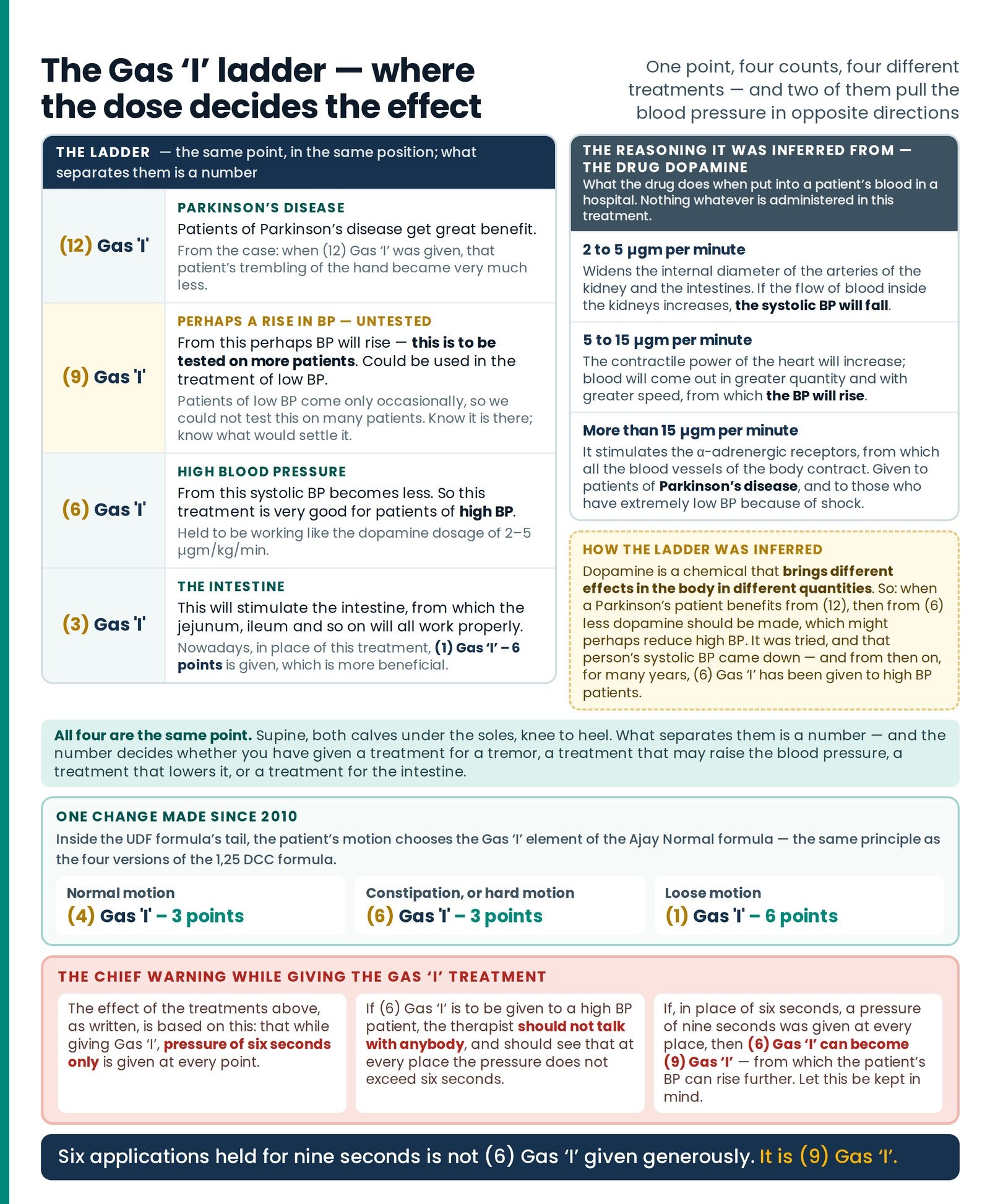
All four are the same point, in the same position, with the patient supine and both calves under the soles, knee to heel. What separates them is a number — and the number decides whether you have given a treatment for a tremor, a treatment that may raise the blood pressure, a treatment that lowers it, or a treatment for the intestine. There is nothing else in the wiki where so much rides on the count alone, which is why what follows is written as a warning rather than as a note. (Figure 28.6)
Also explained in
- Heavy and light treatment Correcting the Two Kingdoms
Table 8 — Card: Normal Ajay Normal formula (the old, heavy form) Supine 6 sec Written I (8) Pan (3) Gal (3) Spl (7) Liv (5) Mu · II (8) Pan (3) Gal (7) Liv (6) Gas 'I' What it is The two parts given as one treatment,
- The gall bladder, the stomach and the intestines Each Point in Use
For children who drool — where Lu + Sh has not helped, Gas 'I' does (see the (6) Gas 'I' box) (6) Gas 'I' Increases blood flow in the arteries of the intestines and the kidneys.
- One change made since 2010 Correcting the Two Kingdoms
Table 33 — The 2010 modification of the Ajay Normal formula inside UDF, by the patient's motion The patient's motion The Gas 'I' element to give Normal motion (4) Gas 'I' – 3 points Constipation, or hard motion (6) Gas '
- Choosing between them Correcting the Two Kingdoms
either ALTF reduced form 2 The same sentence, twice over Calcium to be raised; osteoporosis; heavy menses; mand buddhi with hypothyroidism; cramps at night; or pain at both Liv° and Mu° with indigestion and aching waist
- Questions students ask Correcting the Two Kingdoms
Six seconds at every place is what makes (6) Gas 'I' the treatment it is.
- The Folic acid and Pure Folic acid formulas Vitamin and Gene Formulas
From this the formula was made in this way — Folic acid formula → (6) Gas Only (6) Gas 'I' (6) Rt.Ov.
- When the burning is not the acid — the Chole treatment Setting the Stomach
To stimulate the digestive system by means of the vagus, the tenth cranial nerve Step 2 (6) Gas 'I' — soles and heels down both calves, six or more stations knee to heel Both sides .
- The four compared Clearing the Ash
(1) Gas 'I' – 6 points came off and (6) Gas 'I' – 3 points went on — six applications at three stations, the constipation setting.
- Black treatment, or Genes Formula No. 1 Vitamin and Gene Formulas
So could it not be that those whose colour is black are so precisely because of a deficiency of Vitamin B₁₂ and folic acid? Keeping this estimate in mind, the following formula was made — Black treatment → (6) Gas खाली (
- How a substitution is written The Shorthand
If (6) Gas 'I' is given to a high-blood-pressure patient and the pressure runs to nine seconds at each place, (6) Gas 'I' can become (9) Gas 'I', from which the blood pressure can rise further; while giving it the therap
- The formula defined by what it leaves out — Ajay Normal Setting the Stomach
Table 3 — Card: Ajay Normal Formula Supine 6 sec Written (8) Pan (3) Gal (7) Liv (6) Gas 'I' – 3 points Family Built from the therapy's own logic.
- Two formulas given as one — NAN and FAN Setting the Stomach
Table 4 — Card: NAN and FAN Supine Seated 6 sec NAN, written in full I (8) Pan (3) Gal (3) Spl (7) Liv (5) Mu · II (8) Pan (3) Gal (7) Liv (6) Gas 'I' – 3 points FAN, written in full I Fast : Gas : Gas I : Gal : S
- The general UDF formula Clearing the Ash
Left — the ovary points, which are in no other formula of this group Part VI Ajay Normal, closing on (4) Gas 'I' – 3 points — four applications at three calf stations Substitution — constipation Those who have constipa
- The stomach-setting formula Clearing the Ash
Table 17 — Card: the stomach-setting formula Seated Side-lying Prone Supine 6 sec Written I (15) Medulla · II (2) Rt Parkhoo (2) Lt Parkhoo · III (8) Rt Parkhoo (8) Lt Parkhoo · IV (½) Ku – 20 secs × 2 treat