This article is the woman's half of the therapy, and it is put together from two kinds of teaching that look different and are not. One kind is a set of withholdings and directions on the mat — what is not given during the menses, what is not given in pregnancy, what is blocked in a descended womb, and what is given instead. The other is a set of facts about a woman's health, given plainly, which run from how she should sit to what happens in a delivery room. They belong together because they answer one another. The rule tells you what not to do; the fact tells you why, and what to say.
Three things are worth fixing before we begin.
First, the tone. A woman on your mat is owed accurate information and no embarrassment. Nothing here is coy and nothing here is prurient. The words for a woman's body are the ordinary words, said in an ordinary voice, because a therapist who goes pink at the word bleeding teaches a patient that there is something here to be ashamed of, and she will then hide from him the very things he needs. A great many of the therapists who will read this are women treating women in a village, and they need the vocabulary as much as anyone. A great many others are men, who must know exactly where the limits of their practice lie — and that is taught here too, plainly, without apology on either side.
Second, the reason is the teaching. As in the two articles before this one, every rule is given with the reason that is given for it. Where no reason is given, the rule is given plainly and none is invented — and you will meet at least one important withholding in this article for which the material states the restriction and offers no reason at all. Do not supply one. See also → Between Two Sessions, "Between Two Sessions", which established that principle, along with the two working methods this article takes for granted: reconstruct a day, never audit a rule, and two rules to a visit, not eleven.
Third, this article carries one table that exists nowhere else in this wiki. The withholdings that bite on a woman — because she is menstruating, because she is pregnant, because she wants a child, because her womb has descended — are scattered across a dozen articles, one line at a time, each in its proper place beside its own point. Scattered, they are unusable. Gathered, they are a single page you can keep beside the mat. Part eight of this article is that page. It is the most useful thing here.
Everything about dress, bearing, consent, draping and the chaperone is taught in Before You Touch Anyone, "Before You Touch Anyone", and is not repeated here. What follows is what that teaching becomes when the patient is a woman and the regions are these regions.
Watch



The question that must be asked before she travels
Told when the appointment is made, asked sitting down, and in both halves
Tell her the rule beforehand — both halves of it
Ordinarily treatments are not given to women during their menses. Tell them this beforehand.
But if the bleeding is very heavy or the flow very scanty, then giving the appropriate treatment to correct that is in the patient's own interest, and it may be given. Until it is necessary, however, give no other treatment.
Read the two sentences as one instruction. Tell them this beforehand is not a courtesy; it is the operative clause. A woman who learns the rule at the door has already spent her fare and her morning, and a rule that costs a day's wages to obey is a rule that will be got round. A woman who learns it when the appointment is made rearranges her week and tells you the truth for the next two years.
And both halves go together, on the first day. The half that says not during the menses and the half that says but for these things, come. Given only the first, a patient concludes that her period makes her unwelcome and hides it. Given both, she understands that her period is a thing this therapy treats — which is the truth, and is a great deal more useful to her than a prohibition.
The chaperone, in this territory particularly
Ask, not allow — and name the regions aloud while she is still sitting up
The standing instruction, applied here
As far as possible, when treating girls, women or small children, ask their mother, husband or some other relative to be present. Then there will be no hesitation on either side in giving or receiving the treatment.
The word is ask, not allow. That distinction is taught in Before You Touch Anyone and is worth one further sentence here, because this article's regions are the ones where it decides whether a course happens at all.
The work in this article reaches the lower abdomen — WD, Lt. Ov., Rt. Ov. — the middle of the thigh for P point, the sacrum for Triangle for piles and (2) S4, S5, and the side of the neck and cheek for Ton 'P' and Ton 'T'. A woman who has not been told, before she lies down, which of those regions will be touched and why, will spend the session braced, and a braced patient is a patient in whom nothing moves. Name the regions aloud while she is still sitting up. Draw the cloth back one region at a time. Say the stop rule first — tell me and I will change the angle — and mean it.
Two practical notes for a male therapist working alone. If a woman arrives without a relative, say so when the appointment is made and not at the door — the arrangement is made in advance or not at all. And where she genuinely arrives alone and the work cannot wait, work with the door open, keep strictly to the regions you named aloud, and write on the card that no chaperone was available and that it was discussed. On the day somebody asks a question, that line is the only evidence that the standard was kept.
Two questions, added to the standing list of Before You Touch Anyone, and asked of every woman of childbearing age at every first visit and at the start of every new course:
What must be asked before she lies down, every time
"When did your last period begin, and how many days did it run?"
"Is there any chance you are pregnant?"
Both change the plan. The first decides whether today is one of the four days and, if it is, which of the four exceptions applies. The second closes off an entire group of treatments, and it closes them off from the moment it is a possibility, not from the moment it is confirmed.
Ask the second question plainly and without ceremony, in the same voice as do you have sugar or BP. It is not an indelicate question. It is the question that keeps a child out of harm, and a therapist who cannot ask it should not be treating women of that age. ▲ Take care
The four days
A bar, a doorway through it, a bar inside the doorway, and what is given
The rule as it stands on the therapist's side
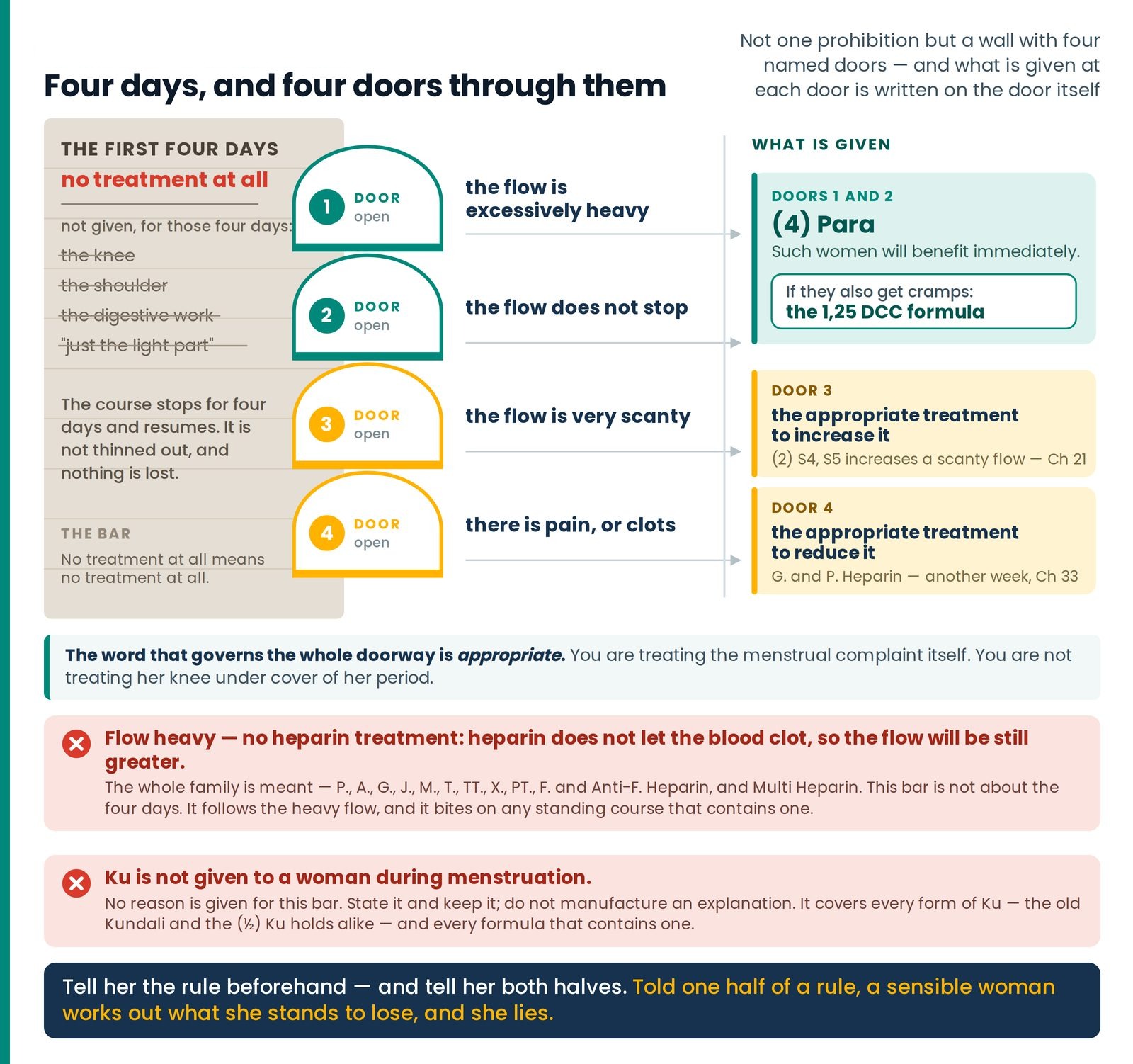
For four days of the menses, no treatment at all is to be given.
But if she has excessive flow, or very little flow, or pain in the menses, then the appropriate treatment is to be given to reduce it.
If the flow is heavy, heparin treatment is not to be given — because heparin does not let the blood clot, so the flow will be still greater.
Such women will benefit immediately from (4) Para. If they also get cramps, give the 1,25 DCC formula.
Four instructions, and they are not of one kind. The first is a bar. The second is the doorway through it. The third is a bar inside the doorway — a thing you must not give even to the woman you have decided to treat. The fourth names what is given instead, and what is added when there is one more finding.
The bar. No treatment at all means no treatment at all: not the knee, not the shoulder, not the digestive work she has been having for five weeks, not "just the light part of the formula". The course stops for four days and resumes. This is the rule a therapist most often bends, usually out of kindness — she has travelled, she is here, it seems a pity — and bending it is how the woman in the story at the head of this article went home weak.
The doorway. Four findings open it, and they are worth learning as four and not as a vague sense of if her period is troubling her:
the flow is excessively heavy
the flow does not stop
the flow is very scanty
there is pain, or clots, in the menses
For those, the appropriate treatment is to be given to reduce it — and the word that governs the whole doorway is appropriate. You are treating the menstrual complaint itself. You are not treating her knee under cover of her period. ▲ Take care
The reasoning underneath is the therapy's own and it is consistent. A heparin treatment is understood to do what heparin does: stop blood from clotting. In a woman already losing more blood than she should, that is exactly the wrong direction. And the same reasoning read forward explains something a student often finds puzzling — that the heparin work is elsewhere given for the woman whose menses carry clots and pain, in a different week and for a different reason.
What is given. For heavy flow: (4) Para, of which it is said that such women benefit immediately. And if there are cramps as well: the 1,25 DCC formula. Both belong to the calcium work, and the connection is stated plainly elsewhere — women who bleed very heavily in their menses because of calcium deficiency: giving this treatment reduces or stops their bleeding. (Figure 40.1)
Reading the cycle as a finding
Too much and too little on one balance, and the treatments opposite too
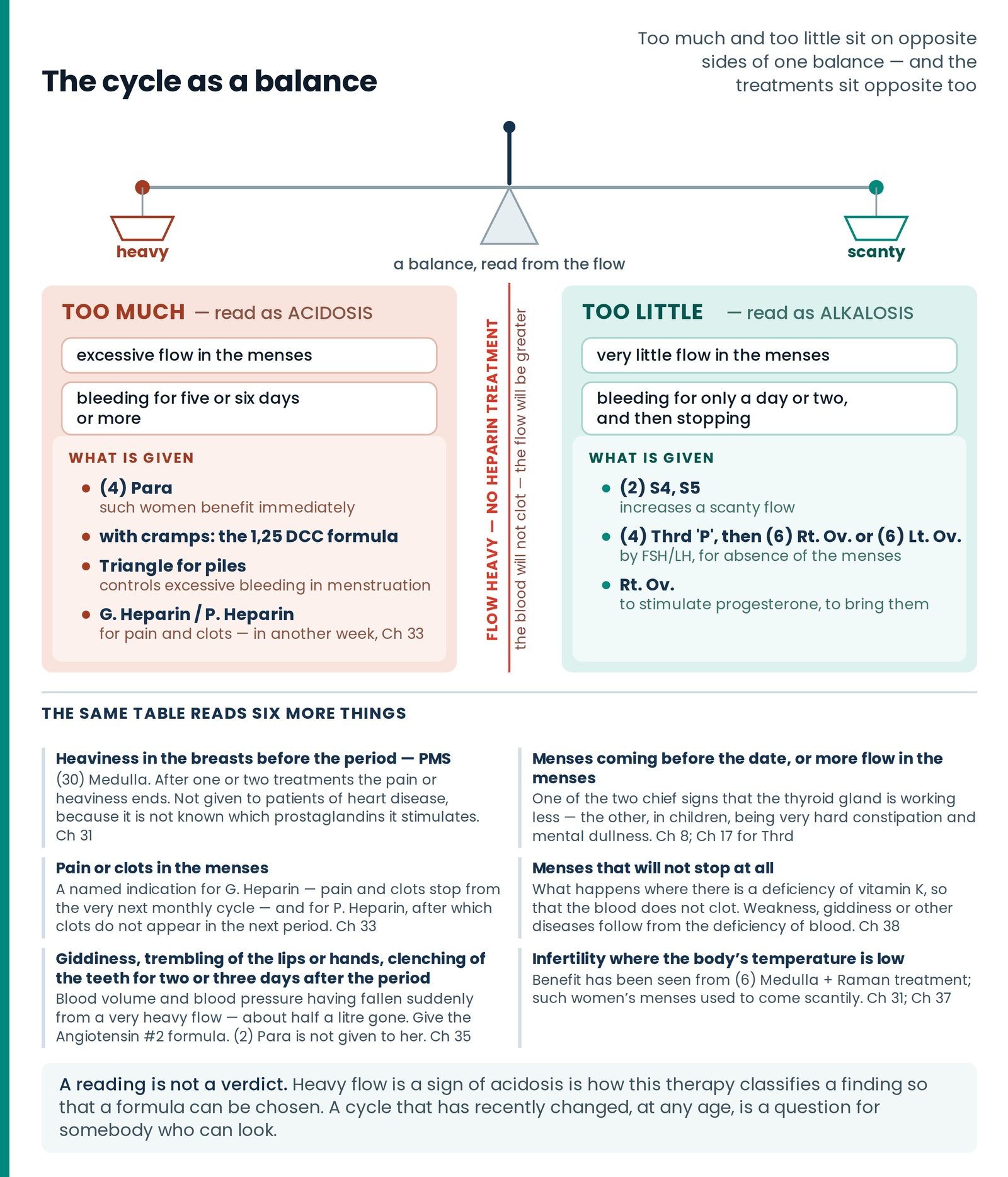
A woman's cycle is one of the plainest readings available to a therapist, and it is read in this therapy the way everything else is read — as a report on a balance. The material sets the pattern out in two places and the two agree.
Table 1 — What the flow is taken to mean
| What she reports | How it is read | Where the reading is taught |
|---|---|---|
| Excessive flow in the menses, or bleeding for five or six days or more | A chief sign of acidosis | The Two Kingdoms, "The Two Kingdoms" |
| Very little flow in the menses, or bleeding for only a day or two and then stopping | A chief sign of alkalosis | The Two Kingdoms, "The Two Kingdoms" |
| Menses coming before the date, or more flow in the menses | One of the two chief signs that the thyroid gland is working less — the other, in children, being very hard constipation and mental dullness | The Two Kingdoms; and The Front of the Body II for Thrd |
| Pain or clots in the menses | A named indication for G. Heparin — pain and clots stop from the very next monthly cycle — and for P. Heparin, after which clots do not appear in the next period | The River — Heparin, "The River" |
| Heaviness in the breasts before the period — what is called PMS | A named indication for (30) Medulla: after one or two treatments the pain or heaviness ends. (30) Medulla is not given to patients of heart disease, because it is not known which prostaglandins it stimulates | The Medulla Family, "The Medulla Family" |
| Absence of menses, or other disorders of the menses | (4) Thrd 'P' followed, as required, by (6) Rt. Ov. or (6) Lt. Ov. — by FSH/LH | The Front of the Body II; Each Point in Use |
| The menses do not come | Rt. Ov. — to stimulate progesterone, to bring them | The Front of the Body II; Each Point in Use |
| Menses that will not stop at all | Named as what happens in a woman when there is a deficiency of vitamin K, so that the blood does not clot — attributed to antibiotics, and to the caffeine and nicotine of tea, coffee and cigarettes harming the bacteria that make it. Weakness, giddiness or other diseases follow from the deficiency of blood | Between Two Sessions, "Between Two Sessions" |
| Giddiness, trembling of the lips or hands, clenching of the teeth for two or three days after the period | Read as blood volume and blood pressure having fallen suddenly from a very heavy flow — about half a litre gone. Give the Angiotensin #2 formula. (2) Para is not given to a woman whose low BP came on suddenly from heavy menstrual bleeding, or from a miscarriage | Water and Salt, "Water and Salt" |
| Infertility where the body's temperature is low | Benefit has been seen from (6) Medulla + Raman treatment; such women's menses used to come scantily | The Medulla Family; Cranial Nerve and Brain Formulas |
Two things about that table are worth saying out loud to a student.
It is a reading, not a verdict. Heavy flow is a sign of acidosis is how this therapy classifies a finding so that a formula can be chosen. It is not a statement about what is wrong inside that particular woman's womb, and it is not a substitute for the examination that would find out. A woman whose flow has changed recently, at any age, has a question to be answered by somebody who can look. (Figure 40.2)
It is symmetrical, and the symmetry is the useful part. Too much and too little sit on opposite sides of the same balance, and the treatments sit opposite too — which is why one and the same manual gives you (2) S4, S5 to increase a scanty flow and Triangle for piles to control an excessive one, from two treatments given at almost the same place on the sacrum, in opposite directions.
The milk for heavy bleeding
Three-quarters of a litre, lukewarm, and the khārak boiled in the morning
Here is the household half of the heavy-flow rule, and it is the one instruction in this article that a patient can begin this evening without you.
Milk for heavy bleeding — the quantity, the temperature and the reason for both
If there is greater bleeding during the menses, then so that a deficiency of calcium does not come in the body, the woman should drink at least three-quarters of a litre of lukewarm milk.
But the milk should not be more hot, because from that the bleeding can increase further.
At night, put one khārak — a dried date — into a cup of milk and keep it in the fridge. In the morning boil that milk together with the khārak, and eating the khārak, drink the milk as well.
Four separate things are asked for, and a student who gives only the first has given about a quarter of the rule.
The quantity: at least three-quarters of a litre. Not a cup. Three-quarters of a litre is about three ordinary tumblers, and it is a quantity a household has to plan for, which is why you say the number out loud and let her do the arithmetic in front of you.
The stated purpose: so that a deficiency of calcium does not come in the body. That is the reason given, and it is the reason you give her. Note that it sits in the same country as the treatment you are giving on the mat — (4) Para and the 1,25 DCC formula are the calcium work, and the material says of 1,25 DCC that women who bleed very heavily in their menses because of calcium deficiency have their bleeding reduced or stopped by it. The rule at home and the rule on the mat are pointing the same way.
The temperature, and the reason it is a rule and not a preference. Lukewarm. Not more hot — because from that the bleeding can increase further. This is the sentence students drop, and it is the one with a consequence attached. Say it to her in her own kitchen's terms: warm enough to drink comfortably, not hot enough to make you blow on it. A mother-in-law who believes that hotter is better for a woman who is bleeding will need to hear the reason, not the rule.
The khārak. A procedure, performed the night before and finished in the morning.
From the moment pregnancy is a possibility, an entire group of treatments closes. Learn the closed list first, because it is short and because the cost of forgetting it is not borne by your patient.
What is blocked in pregnancy, and why
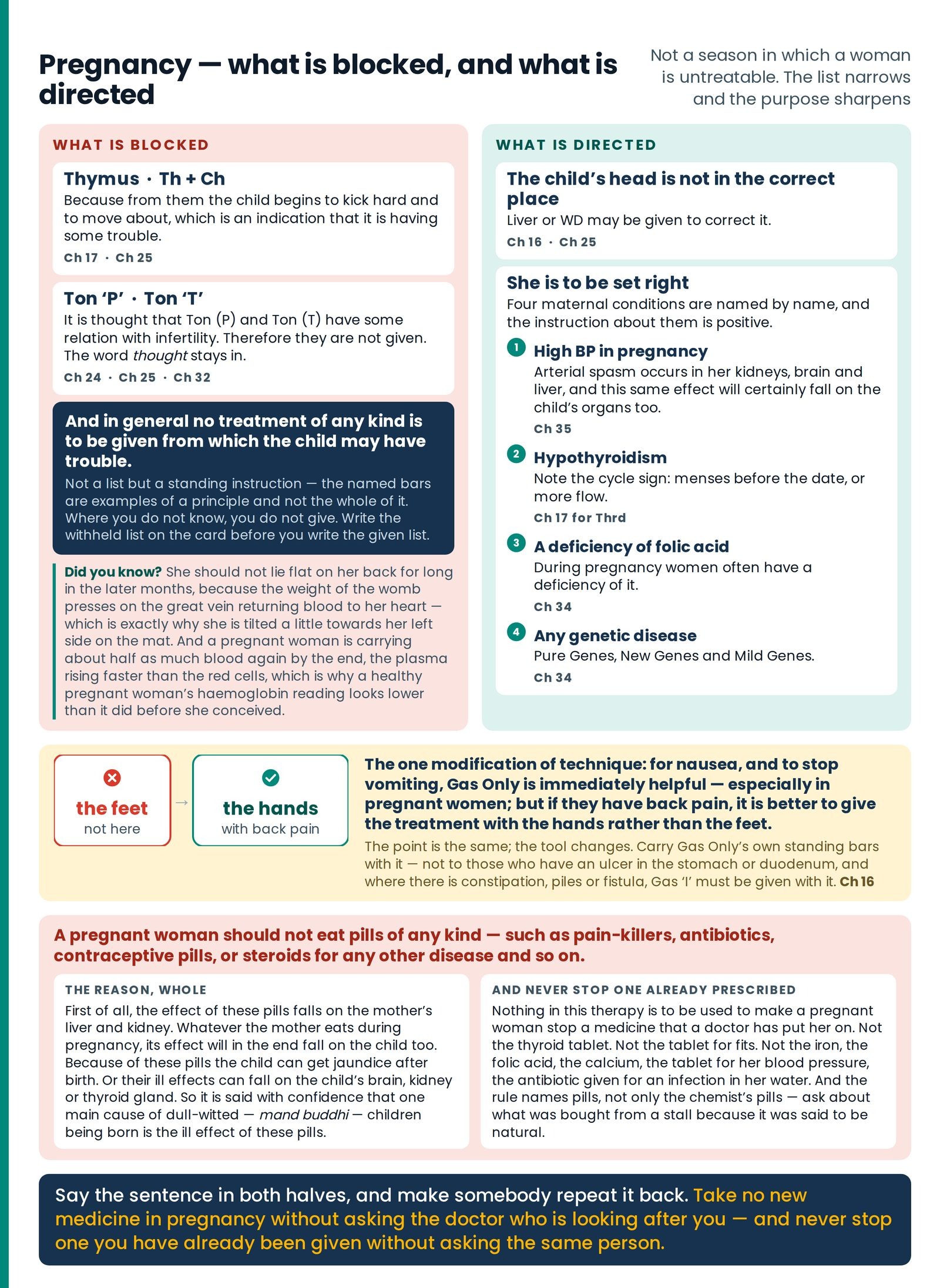
Blocked: Thymus, Th + Ch, Ton 'P'.
Thymus or Th + Ch are not to be given, because from them the child begins to kick hard and to move about, which is an indication that it is having some trouble.
And in general no treatment of any kind is to be given from which the child may have trouble.
It is thought that Ton (P) and Ton (T) have some relation with infertility. Therefore they are not given.
Read the middle sentence twice, because it is the one that does the most work and the one a student is likeliest to skip past. No treatment of any kind is to be given from which the child may have trouble. That is not a list; it is a standing instruction, and it means that the named bars are examples of a principle and not the whole of it. Where you do not know, you do not give. That is the whole of the rule and it needs no elaboration. (Figure 40.3)
The reason given for the thymus bar is an observation, and it is an unusually concrete one: after giving this, the babies begin to move about vigorously, from which it may be judged that the baby must be experiencing discomfort. Nobody is claiming to know what the child feels. Something was watched, it was read as distress, and the treatment was withdrawn. Teach it in exactly that shape.
What is directed in pregnancy
If the child's head is not in the correct place, then Liver or WD may be given to correct it.
If the mother has high BP, hypothyroidism, a deficiency of folic acid, or any genetic disease, then she is to be set right by giving the appropriate treatment.
So pregnancy is not a season in which a woman is untreatable. It is a season in which the list narrows and the purpose sharpens. Four maternal conditions are named by name and the instruction about them is positive: set her right.
Each of those four has its own article, and this is where they meet.
High BP in pregnancy is taken seriously in this material and for a stated reason: if during pregnancy a woman gets high BP, then arterial spasm occurs in her kidneys, brain and liver — a kind of tightening comes into the arteries so that they cannot contract properly, and this same effect will certainly fall on the child's organs too.
Hypothyroidism — see also → The Front of the Body II for Thrd, and note the cycle sign in Table 1 above.
A deficiency of folic acid — see also → Vitamin and Gene Formulas, "The Missing Links", which owns the folic acid work whole, and which carries the reasoning that during pregnancy women often have a deficiency of it.
Any genetic disease — see also → Vitamin and Gene Formulas again, for Pure Genes, New Genes and Mild Genes.
Nausea and vomiting — and the one modification of technique
For nausea, and to stop vomiting, Gas Only is immediately helpful — especially in pregnant women; but if they have back pain, it is better to give the treatment with the hands rather than the feet.
Two instructions in one sentence, and the second is a modification of technique, not of the point. The point is the same; the tool changes.
Why the hands? The material gives the condition — if they have back pain — and does not spell the mechanism out. What it plainly asks for is less load, more control, and a tool you can modulate under your own eye. A hand can feel what it is doing on a body that is already carrying a load it did not carry last year; a sole is a blunter instrument. Treat it as it is written: back pain present, hands rather than feet. Supine
The caution about pills
Say the whole rule — and the sentence that must always travel with it
That is the rule, complete, with every consequence it names: the mother's liver and kidney first; then the child; jaundice after birth; the brain, the kidney, the thyroid gland; and mand buddhi children. It is stated with more force than almost anything else in this material, and the force comes from the thing it is protecting.
And the thing it is protecting is the reason a therapist must handle it with more care than any other rule in this article, not less. So say the whole of it, and then say the second half of your own duty, which is not a softening of the rule but the same rule applied honestly.
Before she is a mother — the years that carry their own bars
The epiphyseal line, and a bar reasoned from mumps in boys
One group of withholdings in this wiki falls on girls and young women for reasons that belong to this article, and they are set out where the teenage years are discussed rather than where women are.
The teenage years
Blocked: Lt. Ov., Rt. Ov., WD, Ton 'P', Ton 'T'.
Oestrogen and progesterone provoke the epiphyseal line to close early. If it has closed, after that the height will not increase. Therefore those whose height is low are not to be given Lt. Ov. and Rt. Ov.
WD is not given because it provokes the genital organs, so from that too perhaps oestrogen will be made.
The parotid glands at the side of the cheek have some kind of relation with the testes. Because when in the disease called mumps the parotid glands swell, during that disease in some boys the testes disappear, after which they are not able to become fathers. Therefore it is thought that Ton (P) and Ton (T) have some relation with infertility. So to those young people — especially to women, up to the age of bearing children — Ton (P) and Ton (T) are not given.
Two things to hold on to. The epiphyseal line is the growing edge at the end of a long bone; once it seals, the bone has finished lengthening, and no treatment reopens it. That is why the bar is worded around the purpose of the course — those whose height is low, children who are being treated to increase height — rather than around an age.
And the Ton reasoning is worth teaching in full because of its shape: an observation about a different disease in a different sex — mumps, boys, the testes — extended, cautiously and with the word thought, to a treatment that provokes the same glands. That is how this restriction was arrived at, and the material says so.
At the point's own entry the restriction stands alone, with no reason attached to it:
Ton 'P', and the question you must ask before you give it
Ton 'P' treatment is not given to those women who wish to become mothers.
Where a reason is offered, it is offered hedged, and the hedge is part of the instruction: from this there may perhaps be some adverse effect on conception. Therefore do not give it to women who want children. It is also not proven that it prevents conception — therefore do not call it a contraceptive treatment. Research is to be done.
Give all three parts to the patient, in that order: it is withheld · it is not claimed · it is not settled. A woman told only no goes looking elsewhere for a yes.
And note that the restriction is not carried by Ton 'T' at its own entry, though Ton 'T' is named alongside Ton 'P' in the pregnancy list and in the teenage list. Read the letter and the counts together before you begin: the two treatments are the same three rubs in the same order, and only the counts differ.
So the question is not how old is she. The question is "do you want a child — now, or later?" — asked once, plainly, before Ton 'P' is ever written on a card, and asked of a woman of any age who could answer yes. It is a short question and it is not an impertinent one, and a therapist who is too shy to ask it will one day give the treatment to somebody who would have said yes.
What follows is a set of statements about childbirth. Some of them will surprise you. They are given here as they stand, in their own order, with the reason attached to each — and one of them ends with an instruction to spread it as widely as possible, which is a thing this material asks for nowhere else.
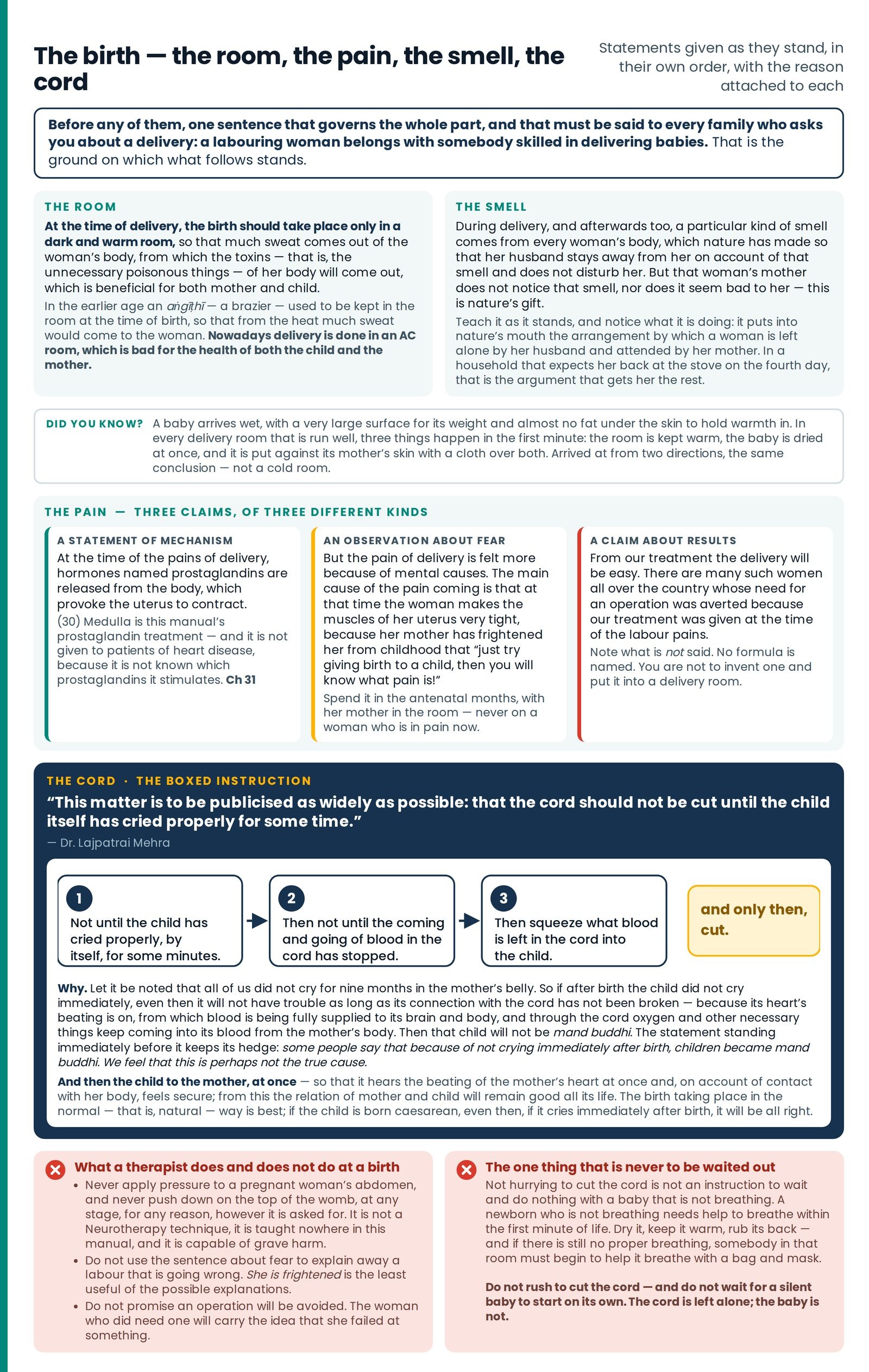
Before any of them, one sentence that governs the whole part, and that must be said to every family who asks you about a delivery: a labouring woman belongs with somebody skilled in delivering babies. That is not a retreat from what follows. It is the ground on which what follows stands.
The room
Dark and warm so that the sweat comes — and not an air-conditioned room
A dark and warm room, and the reason given
At the time of delivery, the birth should take place only in a dark and warm room, so that much sweat comes out of the woman's body, from which the toxins — that is, the unnecessary poisonous things — of her body will come out, which is beneficial for both mother and child.
In the earlier age an aṅgīṭhī — a brazier — used to be kept in the room at the time of birth, so that from the heat much sweat would come to the woman.
Nowadays delivery is done in an AC room, which is bad for the health of both the child and the mother.
Dark and warm, and the aṅgīṭhī is named as how it used to be done. The objection is to the air-conditioned room specifically, and it is stated as bad for both.
The pain
Prostaglandins, a mother's fright, and a claim with no formula attached
What is said about the pain of labour
At the time of the pains of delivery, hormones named prostaglandins are released from the body, which provoke the uterus to contract.
But the pain of delivery is felt more because of mental causes. The main cause of the pain coming is that at that time the woman makes the muscles of her uterus very tight, because her mother has frightened her from childhood that "just try giving birth to a child, then you will know what pain is!"
From our treatment the delivery will be easy. There are many such women all over the country whose need for an operation was averted because our treatment was given at the time of the labour pains.
Three claims, of three different kinds, and a student should be able to tell them apart.
The first is a statement of mechanism and it names a chemical: prostaglandins, released at the time of the pains, provoking the uterus to contract. That same chemical family has a treatment named after it in this wiki — see also → The Medulla Family, "The Medulla Family", for (30) Medulla, the prostaglandin treatment, of which it is said that giving it reduces the pain in the menses, and this has been proved on many women across the country, and which carries its own bar: not to patients of heart disease, because it is not known which prostaglandins it stimulates.
The second is about fear, and it is worth reading precisely. It says the pain is felt more because of mental causes, and it names where the fear comes from — a mother who frightened her daughter from childhood. That is an observation about how a woman is prepared for the event, and it is not a small one. Fear genuinely does make pain worse, in labour as everywhere else, and it is why a woman who is talked to, breathed with and kept company has an easier time than a woman left alone in a corridor.
The third is a claim about results: from our treatment the delivery will be easy, and many such women all over the country whose need for an operation was averted because our treatment was given at the time of the labour pains. Note what is and is not said. No formula is named. The material does not tell you which treatment was given at the labour pains, and you are not to invent one and put it into a delivery room.
The smell
Nature's own arrangement: the husband kept away, the mother attending
The smell that appears at a birth
During delivery, and afterwards too, a particular kind of smell comes from every woman's body, which nature has made so that her husband stays away from her on account of that smell and does not disturb her.
But that woman's mother does not notice that smell, nor does it seem bad to her — this is nature's gift.
Teach it as it stands, and notice what it is doing. It is a statement that the period after a birth is a period in which a woman is to be left alone by her husband and attended by her mother — and it puts that arrangement into nature's mouth rather than into a rule-book's. In a household where the new mother is expected to be back at the stove on the fourth day and available to everyone, that is not a quaint observation. It is the argument that gets her the rest.
The cord
Not until it has cried; not until the blood stops moving; then squeeze
The birth, and the two warnings that are given before it
The birth of the child taking place in the normal — that is, natural — way is best. If the child is born caesarean, even then, if it cries immediately after birth, it will be all right.
(The doctor has to give two warnings to the nurse and the āyā before the delivery itself.)
One: that they should not cut the child's cord until the child cries properly by itself for some minutes.
Even after it has cried, the cord should not be cut until the coming and going of blood in the cord stops.
And before cutting, the little blood that is inside the cord should be pressed or squeezed into the child's body, and only after that should it be cut.
Three separate instructions about one cord, in order, and each has its own condition: (Figure 40.4)
Not until the child has cried properly, by itself, for some minutes.
Then not until the coming and going of blood in the cord has stopped.
Then squeeze what blood is left in the cord into the child, and only then cut.
And the reasoning behind the whole of it is set apart, in its own bordered panel at the foot of the page, as the thing this material most wants carried out of the room.
The boxed instruction — why the cord is not cut early
Let it be noted that all of us did not cry for nine months in the mother's belly. So if after birth the child did not cry immediately, even then it will not have trouble as long as its connection with the cord has not been broken — because its heart's beating is on, from which blood is being fully supplied to its brain and body, and through the cord oxygen and other necessary things keep coming into its blood from the mother's body. Then that child will not be mand buddhi.
This matter is to be publicised as widely as possible: that the cord should not be cut until the child itself has cried properly for some time.
And the statement that stands immediately before it, with its hedge intact: some people say that because of not crying immediately after birth, children became mand buddhi. We feel that this is perhaps not the true cause of that child becoming mand buddhi.
The child to the mother, at once
In the Hindu scriptures it is said that after birth the child should be brought to the mother immediately, so that it hears the beating of the mother's heart at once and, on account of contact with her body, feels secure. From this the relation of mother and child will remain good all its life.
That instruction is about the mother as much as about the child, which is why it stands here and not in the next article. Everything that follows it on that page — the antiseptic fluid the child has lain in, the wrinkles, the wrapping, why the first bath is delayed and the washing done slowly over seven days, the child lifted with both hands, what is given when the teeth are coming — belongs to The Child, the Elder and the Frail, "The Child, the Elder and the Frail", and is taught there whole. The mother is this article's; the baby is the next article's.
The mother's milk, and the child's opened hand
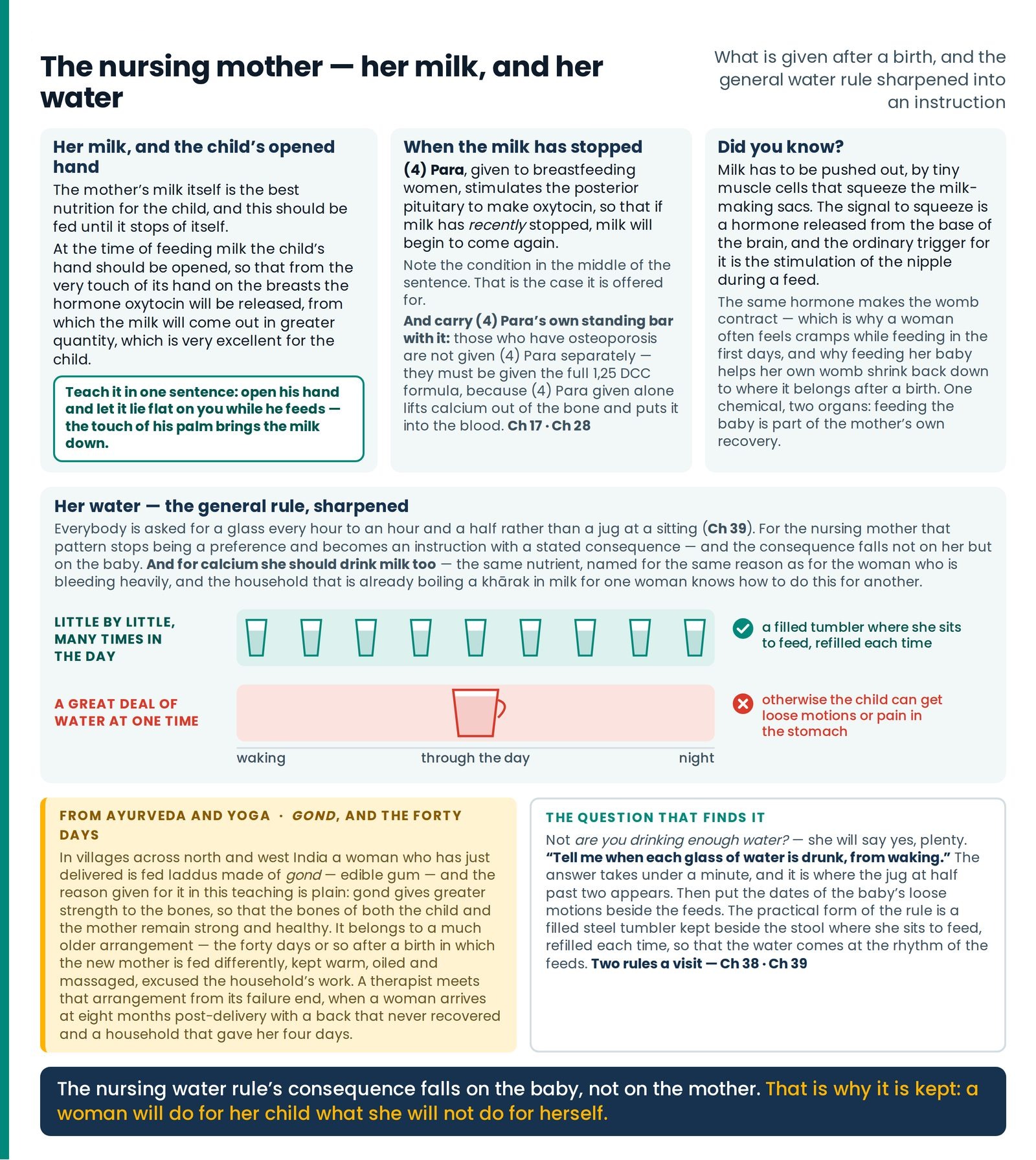
The mother's milk itself is the best nutrition for the child, and this should be fed until it stops of itself.
At the time of feeding milk the child's hand should be opened, so that from the very touch of its hand on the breasts the hormone oxytocin will be released, from which the milk will come out in greater quantity, which is very excellent for the child.
Two instructions, and the second is the one nobody has heard before and everybody can do tonight. A baby feeds with its fists closed against its own chest; the instruction is to open the hand and let the palm rest against the mother, and the stated consequence is more milk, by way of a named hormone.
Teach it to the mother directly, in one sentence: open his hand and let it lie flat on you while he feeds — the touch of his palm brings the milk down. It costs nothing, it is easy to remember, and it gives a tired woman something to do that is not being corrected. Seated
The nursing mother's water — the general rule, sharpened
Such women should drink water little by little many times in the day, instead of drinking a great deal of water at one time — otherwise the child can get loose motions or pain in the stomach.
For calcium they should drink milk too.
This is the rule Food as Medicine gave you bare, and here is the context it belongs in: it is an instruction to a woman who is feeding a child, and the consequence it names falls not on her but on the baby — loose motions or pain in the stomach. (Figure 40.5)
Read beside the general water rule, it is the same pattern pressed harder. Everybody is asked for a glass every hour to an hour and a half rather than a jug at a sitting; for the nursing mother that pattern stops being a preference and becomes an instruction with a stated consequence. And the practical form is the same one that works for everyone: a filled tumbler where she sits to feed, refilled each time, so that the water arrives at the rhythm of the feeds and not in one gulp at two o'clock when she suddenly notices she is parched.
And milk, for calcium. That is the second half of the instruction and it is given to the nursing woman as it is given to the woman who is bleeding heavily — the same nutrient, named for the same reason. A household that is already boiling a khārak in milk for one woman knows how to do this for another.
When the milk has stopped
(4) Para, given to breastfeeding women, stimulates the posterior pituitary to make oxytocin, so that if milk has recently stopped, milk will begin to come again.
Note the condition in the middle of the sentence: if milk has recently stopped. That is the case it is offered for.
And carry (4) Para's own standing bar with it, because it travels with the point everywhere: those who have osteoporosis are not given (4) Para separately — they must be given the full 1,25 DCC formula, because (4) Para given alone lifts calcium out of the bone and puts it into the blood.
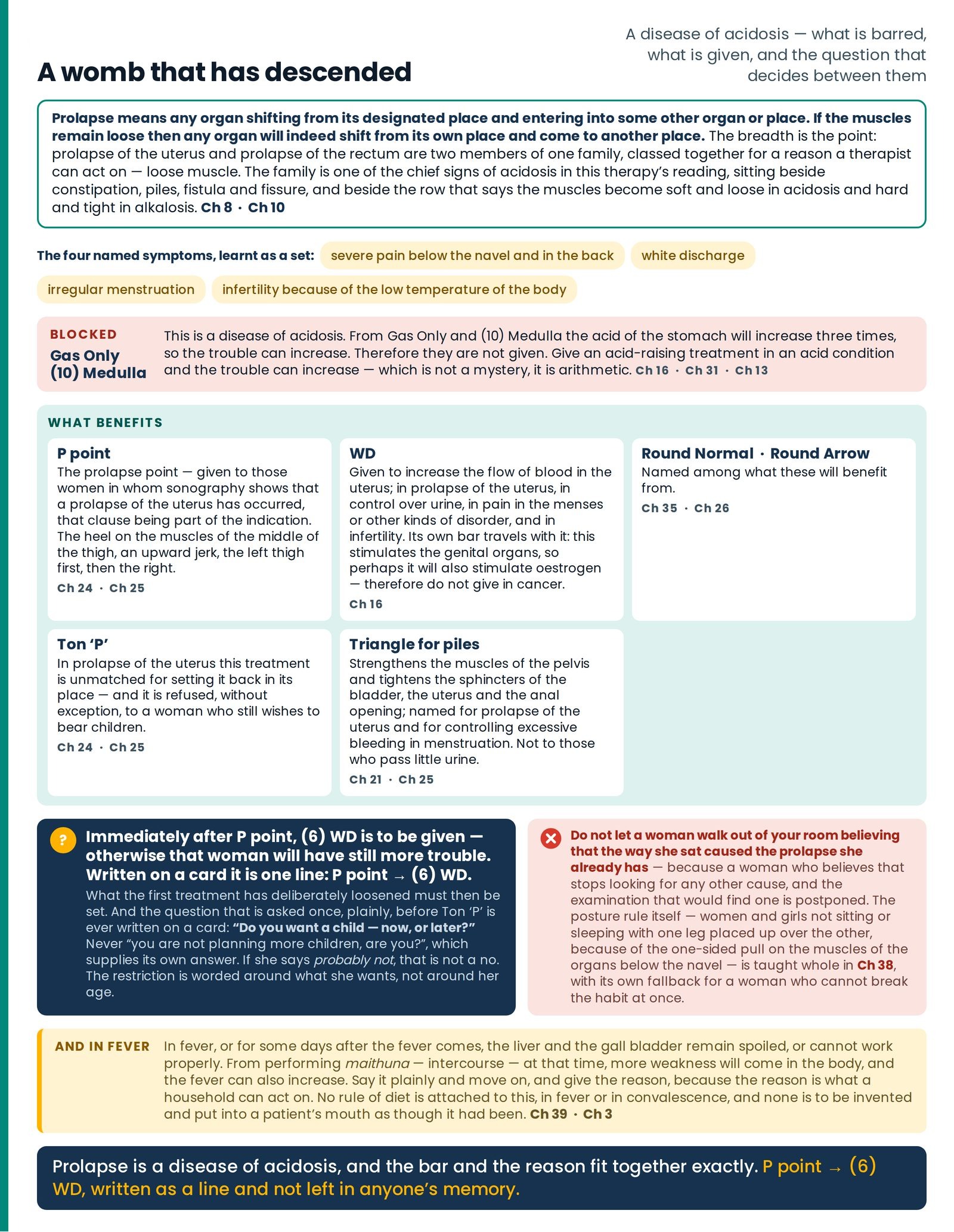
Uterine prolapse — what is barred and what is given
Blocked: Gas Only, (10) Medulla.
This is a disease of acidosis. From Gas Only and (10) Medulla the acid of the stomach will increase three times, so the trouble can increase. Therefore they are not given.
These will benefit from P Point, WD, Round Normal, Round Arrow and so on.
Ton 'P' may also be given to them — but to those women who still wish to bear children, Ton 'P' is not to be given.
The bar and the reason fit together exactly, and a student who has read The Two Kingdoms will see it at once. Prolapse is classed as an acid condition. Gas Only and (10) Medulla are the two treatments whose chief effect is stated as the acid of the stomach will increase three times. Give an acid-raising treatment in an acid condition and the trouble can increase — which is not a mystery, it is arithmetic. (Figure 40.6)
What is given is a short list and every member of it is taught elsewhere:
P point, the prolapse point — given to those women in whom sonography shows that a prolapse of the uterus has occurred, that clause being part of the indication. The heel on the muscles of the middle of the thigh, an upward jerk, the left thigh first, then the right. Prone Left Right And the instruction that must never be separated from it: immediately after this treatment, (6) WD is to be given — otherwise that woman will have still more trouble, because what the first treatment has deliberately loosened must then be set. Written on a card it is one line: P point → (6) WD.
WD in its own right — given to increase the flow of blood in the uterus in women, and to be given in prolapse of the uterus, in control over urine, in pain in the menses or other kinds of disorder, and in infertility. Its own bar travels with it: this stimulates the genital organs, so perhaps it will also stimulate oestrogen — therefore do not give in cancer. Note the hedge inside the prohibition, and that the bar is drawn anyway, in the restrictive direction.
Round Normal and Round Arrow — see also → Water and Salt, "Water and Salt", which owns Round Normal, and How a Formula Is Built, "How a Formula Is Built", for the Ch. Only / Round arrow pairing and the notation.
Ton 'P', of which it is said that in prolapse of the uterus this treatment is unmatched for setting it back in its place — and which is refused, without exception, to a woman who still wishes to bear children.
The symptoms named for prolapse of the uterus are: severe pain below the navel and in the back, white discharge, irregular menstruation, and infertility because of the low temperature of the body. Learn those four as a set, because they arrive together and because three of them will otherwise be treated as three separate complaints.
Two further treatments bear on this territory and belong to their own articles. Triangle for piles strengthens the muscles of the pelvis and tightens the sphincters of the bladder, the uterus and the anal opening, and is named for prolapse of the uterus and for controlling excessive bleeding in menstruation — with its own bar, not to those who pass little urine. And where an older woman loses a few drops of urine on laughing or sneezing, because the muscles below the navel have become loose, see also → Cranial Nerve and Brain Formulas, "The Twelve Messengers", which carries the treatment built for it, and Face Down, "Face Down", for Triangle for piles and (2) S4, S5 taught side by side.
And the posture rule that stands behind the whole family — women and girls not sitting or sleeping with one leg placed up over the other, because of the one-sided pull on the muscles of the organs below the navel — is taught whole in Between Two Sessions, "Between Two Sessions", with its own fallback for a woman who cannot break the habit at once. It is not repeated here. What belongs here is the warning that goes with it, in one line, because it is this article's patient who is at risk from it: do not let a woman walk out of your room believing that the way she sat caused the prolapse she already has — because a woman who believes that stops looking for any other cause, and the examination that would find one is postponed.
One statement about fever was begun in Food as Medicine and deliberately left half-taught, because its second half is a rule of conduct and belongs here.
In fever, the liver and the gall bladder — and what follows from it
In fever, or for some days after the fever comes, the liver and the gall bladder remain spoiled, or cannot work properly.
From performing maithuna — intercourse — at that time, more weakness will come in the body, and the fever can also increase.
That is the whole statement, and the two halves rest on one another. The organs that deal with food are not working properly; the body is therefore short of what it would ordinarily have; and a demand made on it at that time is a demand it cannot meet. No rule of diet is attached to this, in fever or in convalescence, and none is to be invented and put into a patient's mouth as though it had been.
The companion rule, from the same page, is a rule of the night meal, and it too has two halves: the night meal taken so that there is a gap of at least two hours before sleeping, so that food eaten in solid form becomes thin like water and is digested properly — and if intercourse is performed immediately after eating, then both husband and wife will get a gastric problem, because the blood which is needed for the digestive system is being used for other functions. Both halves are taught whole in Between Two Sessions, "Between Two Sessions", with the clock they produce; and the kitchen's side of the same rule is Food as Medicine's. They are named here only so that a student looking for them knows where they live.
Two practical notes on teaching rules of this kind, since this article is where they cluster.
Say them plainly and move on. A rule about intercourse delivered with embarrassment is a rule the patient will decline to discuss further, and the next thing she needs to tell you will go unsaid. It is one line, in the same voice as the line about the night meal, and then you are on to the next thing.
Give the reason, because the reason is what a household can act on. The blood that your digestion needs is being used somewhere else is a sentence two people can understand in four seconds. It is not allowed is a sentence that produces nothing but a nod.
This is the page this article exists for.
Each of these bars is taught in its own article, beside its own point, where it belongs. Gathered here, they become usable: before you write a card for a woman, run your eye down the first column and see whether any of it applies today. (Figure 40.7)
Table 2 — Withheld because of the state she is in
| The point or formula | Withheld from | The reason given | Where the point is taught |
|---|---|---|---|
| Every treatment | A woman during the first four days of her menses — except for the four named conditions | No reason given | Between Two Sessions; and Part two above |
| Every heparin formula — P., A., G., J., M., T., TT., X., PT., F., Anti-F., Multi | A woman whose menstrual flow is heavy | Heparin does not let the blood clot, so the flow will be still greater | The River — Heparin |
| Ku — every form, old Kundali and (½) Ku alike, and every formula containing one | Women during menstruation | No reason given. None is to be invented | Face Down · Each Point in Use · Clearing the Ash |
| Any treatment from which the child may have trouble | Pregnancy, in general | Stated as the governing rule of the whole season | Part three above |
| Thymus, Thymus + Chest | Pregnant women | After giving this, the babies begin to move about vigorously, from which it may be judged the baby is experiencing discomfort | The Front of the Body II · Each Point in Use |
| Ton 'P' | Pregnancy; and women who wish to become mothers, at any age | At the point's own entry, no reason. Elsewhere: perhaps some adverse effect on conception; it is not proven that it prevents conception, so it is not to be called a contraceptive treatment; research is to be done | Uncommon Problems · Each Point in Use · Fire and Swelling |
| Ton 'T' | Pregnancy; and young people up to the age of bearing children, especially women | The parotid glands have some relation with the testes — in mumps, some boys' testes disappear and they cannot become fathers; therefore it is thought Ton (P) and Ton (T) have some relation with infertility | Uncommon Problems · Each Point in Use |
| Lt. Ov., Rt. Ov. | Girls and boys whose height is low, or who are being treated to increase height | Oestrogen and progesterone provoke the epiphyseal line to close early; if it has closed, the height will not increase | The Front of the Body II · Each Point in Use · The Child, the Elder and the Frail |
| WD | The teenage years | It provokes the genital organs, so from that too perhaps oestrogen will be made | The Front of the Body I · Each Point in Use |
| (6) Medulla | Boys and girls between 13 and 20 who come for treatment to increase height — unless there is special need | Somatostatin stops growth hormone, so perhaps an obstruction may arise in the increase of height | The Medulla Family |
| Lt. Ov. | Cancer | Cancer arises from excess oestrogen | The Front of the Body II · Each Point in Use |
| Rt. Ov. | Cancer | Rt. Ov. also makes 20% oestrogen | The Front of the Body II · Each Point in Use |
| WD | Cancer | It stimulates the genital organs, so perhaps it will also stimulate oestrogen | The Front of the Body I · Each Point in Use |
| Gas Only | Uterine prolapse | The acid of the stomach will increase three times, so the trouble can increase — prolapse being a disease of acidosis | The Front of the Body I · From Findings to a Plan |
| (10) Medulla | Uterine prolapse | The same — the acid of the stomach will increase three times | The Medulla Family · From Findings to a Plan |
| Ton 'P' | A woman with prolapse who still wishes to bear children — though Ton 'P' is otherwise called unmatched for prolapse | As above | Uncommon Problems · Each Point in Use |
| (2) Para | A woman whose low BP came on suddenly from a miscarriage or from heavy bleeding in the menses | Not stated for the bar itself; the direction is given instead — they are to be given only the Angiotensin #2 formula | Water and Salt |
| (4) Para given separately, by itself | Osteoporosis — met most often in women after the menopause | Given alone it lifts calcium from the bone and puts it into the blood. They must be given the full 1,25 DCC formula | The Front of the Body II · Correcting the Two Kingdoms |
| The feet, as the tool | A pregnant woman with back pain who needs Gas Only for nausea or vomiting — a modification, not a bar | It is better to give the treatment with the hands rather than the feet | The Front of the Body I; Part three above |
Table 3 — Bars that ride on the treatments used for women's complaints
These do not turn on her being a woman. They turn on the treatment you have reached for — and because these are the treatments this article keeps sending you to, they are gathered here too.
| The treatment | Reached for in | Its own bar | Where it is taught |
|---|---|---|---|
| (30) Medulla | PMS — heaviness in the breasts before the period, ended after 1 or 2 treatments; and pain in the menses | Not given to patients of heart disease, because it is not known which prostaglandins it stimulates | The Medulla Family |
| Triangle for piles | Prolapse of the uterus; controlling excessive bleeding in menstruation | Not to those who pass little urine | Face Down · Each Point in Use |
| (2) S4, S5 | Increasing a scanty flow in the menses; obstructed urine | Not to those who pass too much urine | Face Down · Each Point in Use |
| (1) Acid / (2) Acid | Reducing heavy menstrual bleeding; prolapse of the uterus or rectum | Not if there are loose motions, or if there is no pain at Mu° | On the Side · Each Point in Use |
| (4) Thrd 'P' (followed by (6) Rt. Ov. or (6) Lt. Ov.) | Absence of menses and other disorders of the menses, by FSH/LH | Not where the osteoblasts are hyper — bamboo spine, spur, or bone grown anywhere unwanted | The Front of the Body II · Each Point in Use |
| Gas Only | Nausea and vomiting in pregnancy | Not to those with an ulcer in the stomach or duodenum. With constipation, piles or fistula, Gas 'I' must be given with it | The Front of the Body I · Each Point in Use |
| P point | Prolapse of the uterus, shown on sonography | (6) WD must be given immediately after, or the woman will have still more trouble | Uncommon Problems · Each Point in Use |
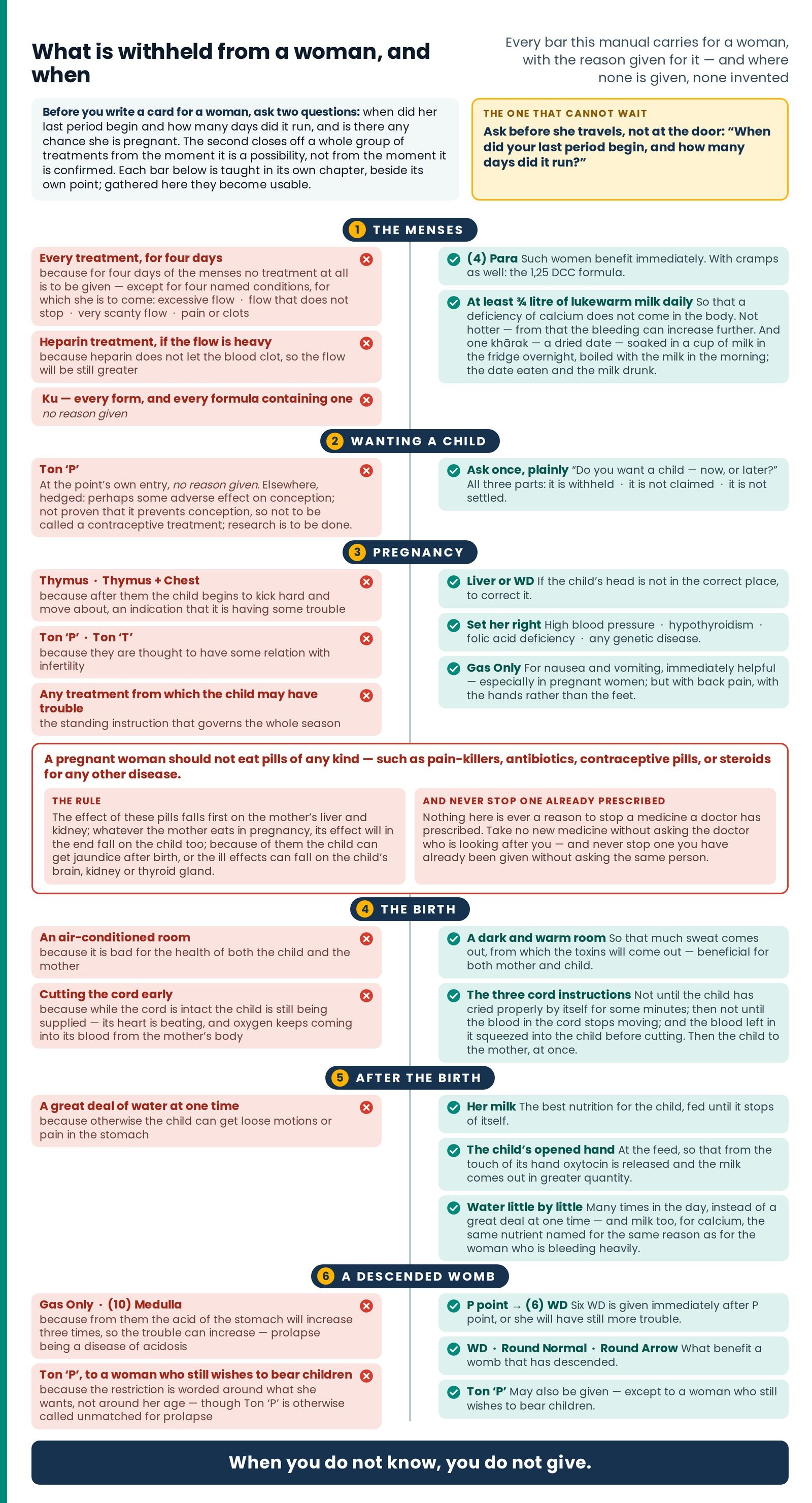
What follows is the woman's half of the patient's day and month, laid out in the order in which things happen, with the reason beside every line — written to be read aloud across the mat, and handed over afterwards, not instead.
Two rules a visit.
Table 4 — What to tell a woman, and why
| When | What to do | Why |
|---|---|---|
| Before your first visit | Treatment is not given during your period — but if your bleeding is very heavy, or will not stop, or is very scanty, or is painful, then come because of that, and we will treat that. | It is not that your period makes you unwelcome. It is that on those four days we treat nothing else — and those four complaints are things this therapy treats. |
| Every visit | Tell us when your last period began and how many days it ran. And tell us at once if there is any chance you are pregnant. | Both change what may be given. Pregnancy closes off a whole group of treatments from the moment it is a possibility, not from the day it is confirmed. |
| During the four days | No treatment at all — not the knee, not the back, not the course you are in the middle of. | The course pauses for four days and then goes on. Nothing is lost. |
| If your flow is heavy | At least three-quarters of a litre of milk a day — lukewarm. Not hot. | So that a deficiency of calcium does not come in your body. If the milk is hotter than lukewarm, the bleeding can increase further. |
| At night put one khārak, a dried date, into a cup of milk and keep it in the fridge. In the morning boil the milk with the khārak. Eat the khārak and drink the milk as well. | It is part of the same day's milk, not extra to it. | |
| Tell us if you are soaking a pad every hour, or passing very large clots, or feeling faint. And any bleeding at all after your periods have stopped for good is to be looked at by a doctor. | We will keep treating you either way. But some things need somebody who can look, and I cannot look. | |
| If you are pregnant | Say so before you lie down, not afterwards. | Some treatments are not given at all in pregnancy, and one is given with the hands instead of the feet if your back hurts. |
| Take no new medicine in pregnancy without asking the doctor who is looking after you — and never stop one you have already been given without asking the same person. | Both halves matter. Stopping a tablet you were given can do the child exactly the harm the rule is worried about. | |
| Tell us if you have blood pressure, a thyroid problem, or anything that runs in the family. | Those are named as things to be set right during the pregnancy, not left. | |
| Around the birth | A dark and warm room — not an air-conditioned one. | So that much sweat comes out of the body; it is said to be beneficial for both mother and child. An air-conditioned room is bad for both. |
| Say to the nurse before the delivery: do not cut the cord until the baby has cried properly by itself for some minutes; then not until the blood in the cord has stopped moving; and squeeze what blood is left in the cord into the baby before cutting. | While the cord is beating, blood and oxygen are still reaching the baby from you. This is to be told as widely as possible. | |
| Ask for the baby to be brought to you at once. | So that it hears your heartbeat straight away and feels safe from your body's touch — and the bond between you holds for life. | |
| After the birth | Your milk is the best food for the child. Feed until it stops of itself. | It is said plainly, and nothing replaces it. |
| While feeding, open the baby's hand and let the palm rest against you. | From the touch of its hand, the hormone oxytocin is released, and more milk comes. | |
| Drink water little and often through the day — never a jug at one sitting. | Otherwise the child can get loose motions or pain in the stomach. | |
| Drink milk too, for calcium. | The same reason as for heavy bleeding: so that calcium does not run short. | |
| Tell us if your milk has recently begun to reduce. | There is a treatment given for milk that has recently stopped, and it works best while it is recent. | |
| Every day, all your life | Do not sit or sleep with one leg over the other. If you cannot stop at once, keep changing which leg is on top. | A one-sided pull comes on the muscles below the navel — the womb and the ovaries among them — and the blood circulation there is spoiled. Sleep with the legs straight. |
| In a fever | Rest, and no intercourse during it or for some days after. | In a fever, and for some days after it comes, the liver and the gall bladder cannot work properly. More weakness will come, and the fever can also increase. |
| At night | Finish eating at least two hours before you lie down, and not intercourse straight after a meal. | So that solid food has time to become thin like water and be digested. Straight after a meal, the blood the digestion needs is being used elsewhere, and both husband and wife get a stomach problem. |
Questions students ask
1. I am twenty-two and just beginning. How do I ask a woman about her periods without both of us dying of embarrassment? Ask it in a list. "How is your sleep? How are the bowels? Appetite? And when did your last period begin — how many days did it run?" Four questions in one breath, in the same voice, and the fourth arrives as an ordinary item and not as a special topic. Sitting down, door shut, in the history — never at the door and never in front of a queue. If you flinch, she will decide there is something here to be ashamed of, and the next thing she needs to tell you will go unsaid. It gets easier after about the fifth patient, and you will use the answer every single week.
2. I am a man and I run a centre alone in a small town. How much of this article can I actually do? Nearly all of it, if you arrange the room properly, and none of it if you do not. Say when the appointment is made that a relative should come with her. Name the regions aloud while she is sitting up. Draw the cloth back one region at a time. Write consent, chaperone and draping on the card in twelve words. Work with the door open where there is no chaperone, keep strictly to the regions you named, and note on the card that it was discussed. See also → Before You Touch Anyone, "Before You Touch Anyone". What you cannot do is make a woman comfortable by being sincere about it; comfort here is made of arrangements.
3. A patient of mine is in the middle of a good course for her shoulder and her period has begun. She has come anyway and she has travelled an hour. Really nothing? Really nothing. For four days of the menses, no treatment at all is to be given. The temptation is entirely about your discomfort at her wasted journey, and it is solved the week before, not today — by telling her the rule when the appointment is made and marking the likely dates on the card. Today, sit her down, give her the ten minutes properly, ask about the flow, and if it is heavy or scanty or painful, treat that, which is permitted and is in her own interest. She will not have come for nothing.
4. I am a doctor. "For four days, no treatment at all" — what is that based on? Nothing is offered, and you should teach it as it stands rather than replacing it with a reason of your own or discarding it. Notice two things, though. It is one of a family of instructions in this material that give a woman room during those days rather than treatment, which is also what the older household order gave her. And notice the shape of the rule — a general bar with four named exceptions, and the exceptions are exactly the menstrual complaints. That is not a taboo; it is a scope statement. On the medical side, your own obligations are undisturbed: heavy bleeding gets a haemoglobin, bleeding after the menopause gets looked at, and a recently changed cycle gets investigated, and nothing in this article asks you to defer any of that.
5. I am a housewife learning this for my family. My daughter-in-law is expecting. What may I actually do for her? Less than you would like, and it is worth being precise about it. Nothing that comes under Thymus, Th + Ch, Ton 'P' or Ton 'T', and nothing at all from which the child may have trouble — which means, for somebody learning at home, that you leave pregnancy alone unless you have been taught this part properly by your centre. What you can do costs nothing: see that she is not standing all day, that the night meal finishes two hours before she lies down, that she never crosses her legs and sleeps with them straight, that she drinks through the day and not in gulps — and that she takes every tablet her doctor has given her and stops none of them because somebody in the lane said so.
6. Why is Ku singled out for menstruation when no reason is given? It seems arbitrary. It is unexplained, which is not the same as arbitrary. This wiki is careful about the difference: where a mechanism exists it is stated, where the rule rests on observation it is labelled a matter of experience, and where there is neither, the rule stands bare. Ku stands bare, and the honest thing is to say so — to a student and to a patient. What you may not do is invent a reason, because the day a patient catches you inventing one is the day she stops believing the fifteen reasons you gave her that were real. See also → Face Down, "Face Down".
7. I practise in a village. A family has asked me to come at the time of a delivery. Should I? Go if you are wanted, and be clear with yourself and with them about what you are there to do. You are not there to deliver a baby, and a labouring woman belongs with somebody skilled in delivering babies — that is the first thing you say and it is not negotiable. You may be useful for the room being warm and not cold, for the three cord instructions being said out loud to whoever will cut it, for the baby going to its mother at once, and for a frightened young woman having somebody calm beside her. Those are real contributions. What you never do is press on a pregnant abdomen, and what you never say is that an operation will be avoided.
8. The material says the pain of delivery is felt more because of mental causes. Do I tell a woman in labour that? No. Two reasons. It is not a useful thing to say to somebody in pain about their pain, at any time, about anything — the effect is that she stops telling you what she feels. And if this labour is one of the ones that is going wrong, she is frightened is the explanation that delays the people who could tell the difference. What the passage is genuinely good for is the months before: a girl who has been told since childhood that childbirth is an agony arrives braced, and a woman who has been prepared calmly arrives differently. That is where you spend it — in the antenatal months, with her mother in the room.
9. I am sixty and learning this for myself. My periods stopped eight years ago and I have started spotting a little. Is that a "heavy bleeding" question? It is a question for a doctor, this week, and it does not matter that it is only a little. Any bleeding at all after the periods have stopped for good is looked at, and the reason to say that plainly rather than gently is that most causes are harmless and the ones that are not are far better found early. Nothing in this article is a substitute for that examination, and nothing in it is affected by your going — treatment continues either way.
10. A woman's uric acid and her haemoglobin are both normal, and she still bleeds heavily. What do I tell her about her reports? That they are normal, and that you are not going to hint otherwise. That is the whole answer and it is not a weak one. What you can add is what this therapy is actually saying, which is a different kind of statement: that a heavy or long flow is read here as a sign of the acid direction, and that the treatment is aimed at that. The sentence your blood test says normal but your blood is really acid is a claim about a specific result in a specific woman, it is not true, and it costs you everything the first time she catches you in it. See also → Reading the Reports, "Reading the Reports".
11. Ton 'P' is called unmatched for prolapse, and I have a patient with a bad prolapse who is thirty-eight and says she does not want more children. May I give it? The restriction is worded around what she wants, not around her age, so the answer turns entirely on her answer — and on your having asked the question properly, once, plainly, and recorded it. Ask it as "do you want a child, now or later?", not as "you are not planning more children, are you?", which is a question that supplies its own answer. If she says no, Ton 'P' is open to her. If she says probably not, that is not a no. And whatever she says, she gets all three parts of the instruction: it is withheld from women who want children · it is not proven to prevent conception and is not to be called a contraceptive treatment · research is to be done.
12. Half of this article is a list of things not to give. What am I actually doing for a woman, then? A great deal, and it is worth listing so that you do not lose heart. You are treating heavy flow, scanty flow, pain and clots in the menses, PMS, the giddiness that follows a heavy period, the absence of menses, a womb that has descended, incontinence, infertility where the body's temperature is low, and the whole digestive and acid work that sits underneath most of it. You are giving a nursing mother back her milk. You are setting a child's head. The bars are short and the work is long — but the bars are written down first, because they are the part that cannot be recovered from.
Questions patients ask
1. "Why can't I have my treatment during my period? I have come all this way." Because for those four days we do not give any other treatment, and that is the rule everywhere in this therapy. But listen to the other half, because it is the half that matters to you: if your bleeding is very heavy, or it will not stop, or it is very scanty, or it hurts — you come for that, and we treat that, and it is in your own interest to come. Tell me about this period and we will see which of those applies today. And from now on I will tell you your dates in advance so that you never make this journey for nothing again.
2. "You say I must drink so much milk. My doctor has told me I am short of blood and given me iron tablets. Which do I do?" Both, and there is no quarrel between them. The milk is asked for here so that calcium does not run short while you are bleeding heavily, and it is to be lukewarm, not hot — if it is hotter, the bleeding can increase. Your iron tablets are for something else entirely, and they are your doctor's instruction, and you take them exactly as he said. One small thing worth knowing: iron is taken up better when you have it a little apart from a big glass of milk, so keep the milk to its own time of day. And do not let anyone take away your lemon and your tomato while you are short of blood.
3. "I am three months pregnant. Someone told me that in this treatment you say no medicines at all. Should I stop my tablets?" No — and I am very glad you asked me instead of just stopping. What is taught here is about not taking new pills in pregnancy without your doctor's advice, because what you swallow reaches the child. It is not about stopping something a doctor has already given you. Some of those tablets are there precisely to protect the child, and stopping them can do the harm we are all trying to prevent. So: nothing new without asking the doctor who is looking after you; and nothing stopped without asking the same person. Bring me the strip and let us look at it together, and if you like I will write a line for you to take to him.
4. "Is this treatment safe for my baby?" Some of it is and some of it is not, and I will tell you which as we go. There are two treatments I will not give you at all while you are pregnant, because after them babies begin to move about hard, and it is judged that the baby is uncomfortable. There is a third I will not give because it is thought to have some connection with a woman's ability to conceive. And there is a standing rule above all of them that I keep: nothing at all from which the child may have trouble — which means that where I am not sure, I do not give it. For the sickness, I will use something that helps quickly, and because your back hurts I will use my hands for it and not my feet.
5. "My mother-in-law says I should give the baby water in this heat. And she says I should drink less water so the milk is not thin." On the second, she has it the wrong way round, and there is a rule here that says so with a reason: drink your water little by little, many times in the day, rather than a great deal at one time — otherwise the child gets loose motions or a pain in its stomach. So: a glass beside you every time you sit down to feed him. Not less water — better spread. On the first question, what is taught here is that your milk is the best food for him and should be fed until it stops of itself, and the rest of that question belongs with whoever is looking after the baby, so ask them and follow what they say. I am looking after you.
6. "The doctor says I need an operation for my womb. Can you fix it instead?" I can treat it and I am going to. What I am not going to do is tell you to cancel anything. There are treatments here for a womb that has come down from its place, one of them is spoken of very highly, and I have seen women improve a great deal. I will need your sonography, because the treatment I want to use is written to be given to women in whom the sonography has shown it. And I have one question I must ask before I choose between two of them, and it is not an idle question: do you want another child, now or later? Whatever you answer, I will tell you exactly what I am giving you and what I am leaving out, and you will keep your appointment with the doctor.
7. "My periods have stopped since the treatment started. Is that a good sign?" No — it is a thing to look into, not a result to be pleased about. A period that does not come is a finding, exactly like one that goes on too long, and in this therapy a late or scanty cycle is read as its own kind of imbalance rather than as an improvement. First, is there any chance you are pregnant? Then let us look at the rest of the picture. And if it happens again next month, I will want you to be seen, and I will keep treating you while you go.
8. "Why does it matter what the room is like when I deliver? The hospital keeps everything cold." What is taught here is that the birth should take place in a dark and warm room, so that a good deal of sweat comes out of you — that is held to be beneficial for you and for the baby — and that an air-conditioned room is bad for both. You will not get to choose the hospital's setting. What you can do is ask them to keep the baby warm and dry it at once, which every good delivery room already does, and ask for the baby to be put against your skin straight away. And there is one thing worth saying out loud to the nurse before the delivery, which I will write on a slip for you: do not cut the cord until the baby has cried properly by itself for some minutes, and then not until the blood in the cord has stopped moving.
Words used here
| Hindi | English | Neurotherapy code / usage |
|---|---|---|
| मासिक धर्म / माहवारी | The monthly period, the menses | Four days: no treatment at all — except heavy flow, flow that will not stop, scanty flow, or pain and clots |
| खारक / छुहारा (khārak / chhuhārā) | The dried date | Soaked in milk overnight in the fridge, boiled with the milk in the morning; the date eaten and the milk drunk, for heavy bleeding |
| दूध (dūdh) | Milk | At least ¾ litre, lukewarm — never hotter, in heavy bleeding, so that calcium does not run short; and for calcium to the nursing mother |
| गर्भावस्था (garbhāvasthā) | Pregnancy | Thymus, Th + Ch, Ton 'P', Ton 'T' blocked; and no treatment of any kind from which the child may have trouble |
| गर्भाशय (garbhāśay) | The womb, the uterus | The organ behind WD; the organ that descends in prolapse |
| प्रोलैप्स (prolaps) | Prolapse — an organ shifting from its place | A disease of acidosis. Gas Only and (10) Medulla barred; P point → (6) WD, WD, Round Normal, Round Arrow given |
| सफ़ेद पानी (safed pānī) | White discharge | One of the four named symptoms of uterine prolapse, with pain below the navel and in the back, irregular menstruation and infertility |
| बांझपन (bāñjhpan) | Infertility | An indication for WD; and the thing Ton 'P' and Ton 'T' are thought to have some relation with |
| जच्चा (jachchā) | The newly delivered woman | Hers is the milk, the water little and often, the calcium and the rest; the child is The Child, the Elder and the Frail's |
| नाल (nāl) | The umbilical cord | Not cut until the child has cried properly by itself; then not until the blood in it stops moving; the remaining blood squeezed into the child first |
| अंगीठी (aṅgīṭhī) | A charcoal brazier | What used to be kept in the birth room, so that the woman sweated; the rule now reads warm room, not an AC room |
| गोंद के लड्डू (gond ke laḍḍū) | Laddus of edible gum | Fed to a woman after delivery, so that the bones of both mother and child stay strong |
| ऐंठन (ainṭhan) | Cramps | With heavy flow, the trigger for adding the 1,25 DCC formula to (4) Para |
| तजुर्बे की बात (tajurbe kī bāt) | A matter of experience | The label kept on any rule offered as observation; never removed |
| — | (4) Para | Heavy menstrual flow — immediate benefit; and, in a breastfeeding woman whose milk has recently stopped, milk begins to come again. Never alone in osteoporosis |
| — | 1,25 DCC | Added where there are cramps with the heavy flow |
| — | Ku, (½) Ku | Not to women during menstruation — no reason given |
| — | Thymus, Th + Ch | Not in pregnancy — the child kicks hard and moves about |
| — | Ton 'P', Ton 'T' | Not in pregnancy; Ton 'P' not to women who wish to become mothers |
| — | WD, (6) WD | Blood flow in the uterus; prolapse; pain in the menses; infertility. Follows P point immediately. Not in cancer |
| — | P point | The prolapse point — heel on the middle of the thigh, left thigh first; given on the evidence of sonography |
| — | Gas Only, (10) Medulla | Barred in uterine prolapse — the acid of the stomach increases three times |
| — | Lt. Ov., Rt. Ov. | The ovary points; oestrogen and progesterone; barred in cancer and where height is being treated |