- How it is given
- The Low Back
- What it is used for
- Each Point in Use
- Take care
- not with knee pain — give Pradeep
Watch


From The Low Back
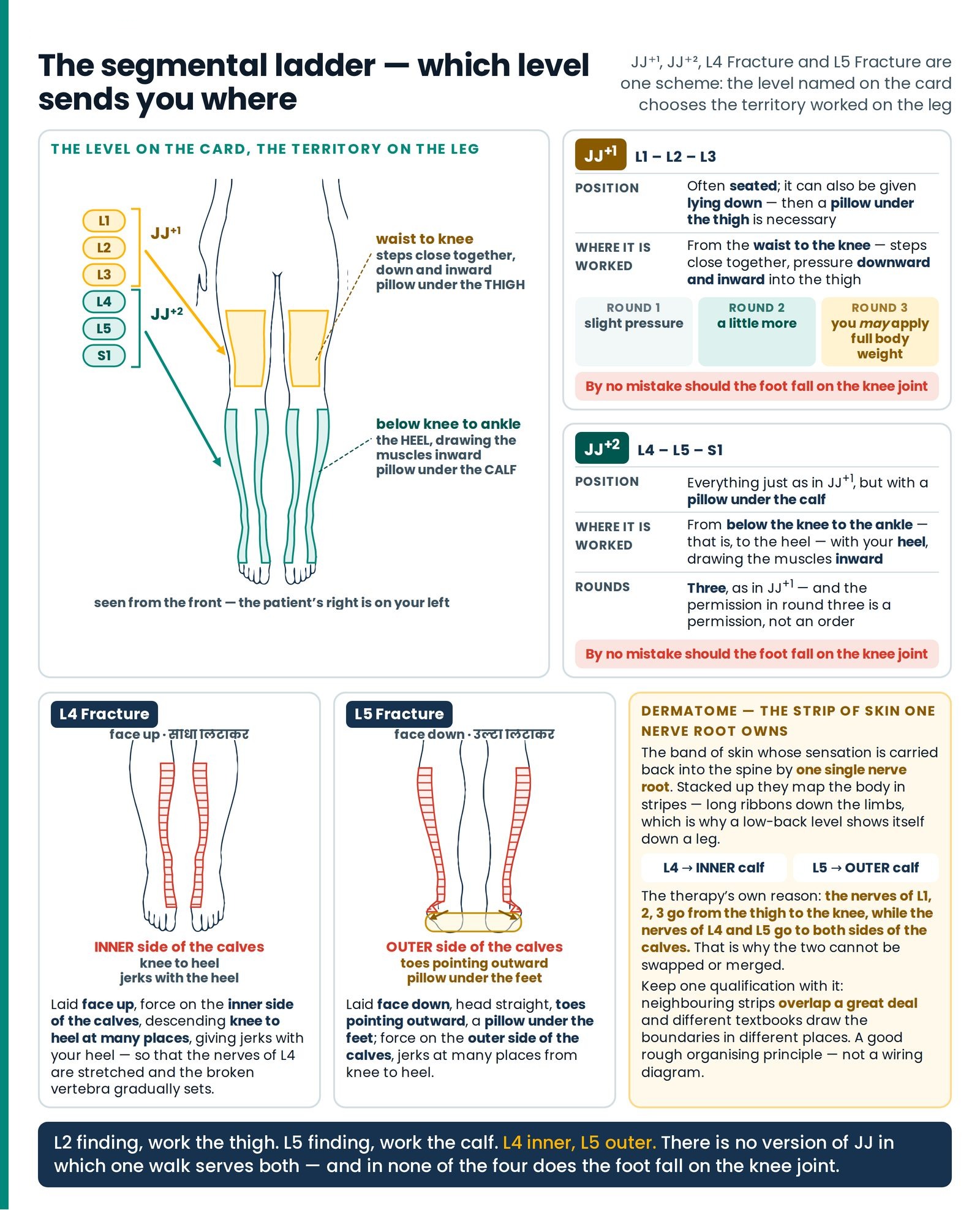
JJ⁺¹ and JJ⁺² — the segmental pair
L1-2-3 the thigh, L4-5-S1 the calf, and three rounds that ramp
From The Low Back
JJ⁺¹ FOR L1 – L2 – L3
This is often given seated. But it can also be given lying down. If given lying down, a pillow under the thigh is necessary. If given seated, perhaps no pillow will be needed. Its symbol is JJ⁺¹. (Figure 22.4)
Taking the body weight on the chairs, and placing the steps close together, giving pressure downward and inward into the thigh, walk from the waist to the knee. But by no mistake should the foot fall on the knee joint. Do three rounds. In the first round, taking your body weight on the hands, give slight pressure on their thighs. In the second round, increase the pressure a little. The third time, you may apply your full body weight on them. Seated Supine × 3
Also explained in
- JJ⁺² FOR L4 – L5 – S1 The Low Back
Everything is to be done just as in JJ⁺¹ above, but in this, placing a pillow under the calf, and with your heel drawing the muscles inward, walk from below the knee to the ankle — that is, to the heel.
- The low back, the sacrum and the tail bone Each Point in Use
Inner for L4, outer for L5, and that single word is the whole difference JJ⁺¹ Prone For pain in the middle part of the back, and for slip disc between L1, L2, L3 Those who have pain in the knee should not be given JJ⁺¹,
- Introduction The Low Back
Give JJ⁺¹ and JJ⁺² with their pillows, territories and three graded rounds; L4 Fracture face up on the inner calf and L5 Fracture face down on the outer; and Blood Supply to Legs from the one stance in the atlas that fac
- The heading this group carries The Low Back
Several points here are not prone: L4 Fracture is given face up, and JJ⁺¹, JJ⁺², Bending forward and Standing point may be given seated on a chair or laid straight.
- FRACTURE POINT ('T' + 1-2-3) — two treatments, no pause between The Low Back
The rule is written three separate times in this article — here, and at JJ⁺¹ and JJ⁺², where it is put more strongly still: by no mistake should the foot fall on the knee joint.
- BINDU POINT — the long diagonal The Low Back
JJ⁺¹ — L1, L2, L3 — waist to knee, steps close, down and inward, pillow under the thigh if lying.
- The knee and the lower limb Each Point in Use
In it we pull the muscles and nerves of both sides of the knee away from the *kaṭorī*, and bring them to their correct place, from which the patient gets immediate relief — The treatment named in the JJ⁺¹ bar: a knee pat
- The exclusions that are same-session, not permanent Each Point in Use
(Figure 25.8) Table 21 — Treatments that are not given together, and why If this is indicated Withhold The reason as given Pradip treatment (knee pain) JJ⁺¹ In Pradip we pull the muscles in the opposite direction.
- At a glance Each Point in Use
No JJ⁺¹ for a knee patient, who gets Pradip instead, in which the muscles are pulled in the opposite direction — but JJ⁺² may be given.
- Questions students ask Each Point in Use
Write the day's plan out in full before the patient lies down and read it once, top to bottom, looking for pairs — Pradip with JJ⁺¹, BOF with JJ⁺², S4–S5 with Triangle.
- JJ GROIN and JJ BACK — for the pain that is left over Knee, Leg, Foot
JJ⁺¹ and JJ⁺² were taught in The Low Back.
- Questions students ask Knee, Leg, Foot
JJ Groin and JJ⁺¹ are both on the front of the thigh.
- The master list — every treatment point, by the position the patient is placed in The Shorthand
Code Full name / Hindi Where it is taught in this wiki Adr Adrenal Face Down Swt Sweat Face Down Back Arrow Back Arrow, or Blood supply to lungs Face Down H arrow — Face Down On the spine — Face Down Beside the spine — Face Down Round arrow —
- Introduction Knee, Leg, Foot
Tell JJ Groin from JJ Back by position, surface, indication and sign — and say plainly why neither is the same family as JJ⁺¹ and JJ⁺².