- How it is given
- The Low Back
- What it is used for
- Each Point in Use
Watch


From The Low Back
L5–S1 GHISAI — three stages, three different counts
Three different actions in a fixed order: 20–25, then 12 a side, then 3
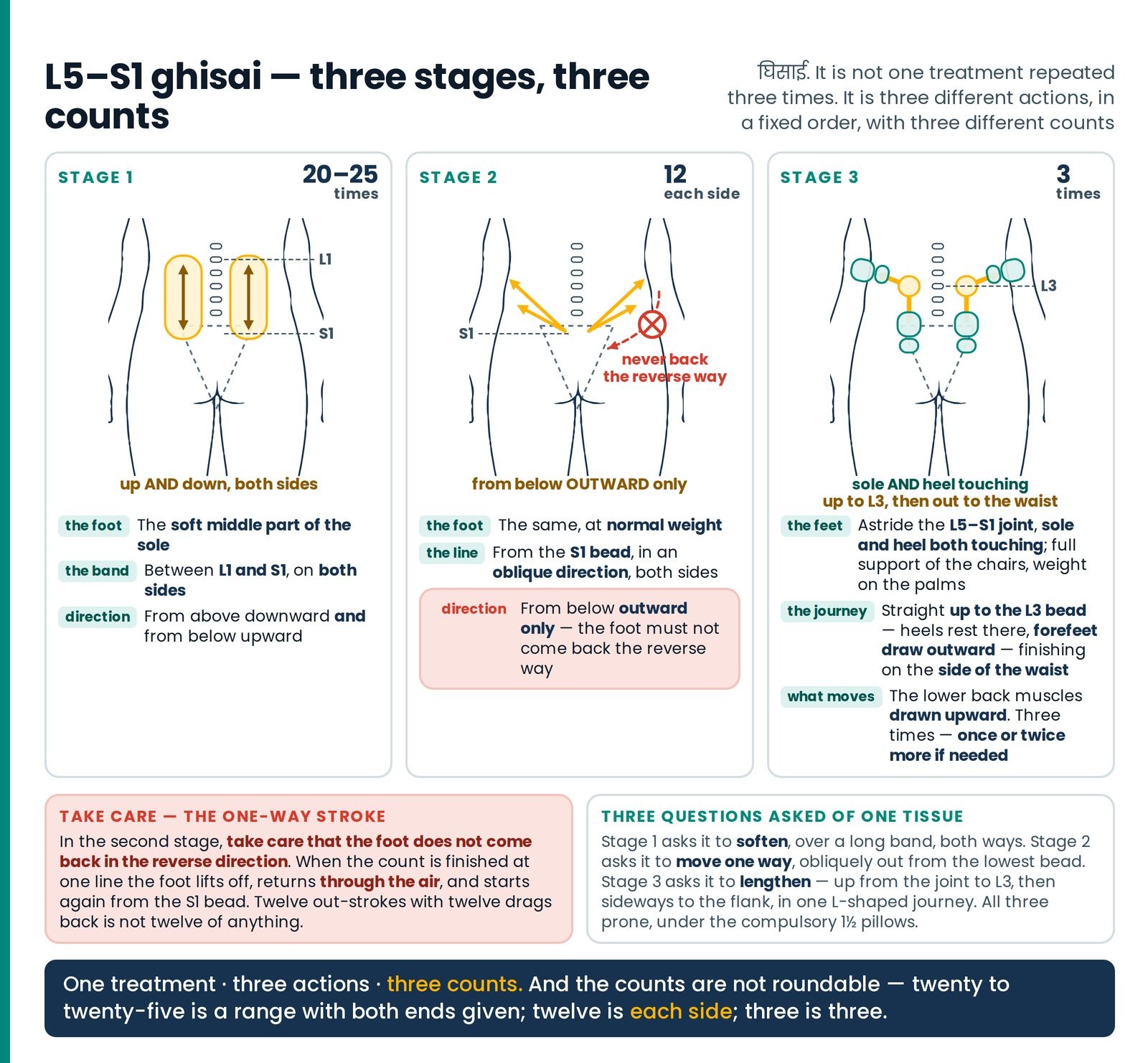
It is not one treatment repeated three times. It is three different actions, in a fixed order, with three different counts. A student who learns it as "rub the low back" has learned none of it. (Figure 22.1)
| Stage | The action, in short | Count |
|---|---|---|
| 1 | Soft middle of the sole, the band L1 to S1, both sides, up and down | 20–25 times |
| 2 | From the S1 bead, obliquely, from below outward only — the foot never coming back the reverse way — at normal weight | 12 times each side ▲ Take care |
| 3 | Weight on the palms through the chairs, astride L5–S1, sole and heel both touching, sliding up to the L3 bead, heels resting there while the forefeet draw outward, finishing with forefoot and heel on the side of the waist — the lower back muscles drawn upward | 3 times; once or twice more if needed |
All three stages are given prone, under the compulsory 1½ pillows, for problems of the low back. Prone
Three questions asked of one tissue. Stage 1 asks it to soften, over a long band, both ways. Stage 2 asks it to move one way, obliquely out from the lowest bead. Stage 3 asks it to lengthen — up from the joint to L3, then sideways to the flank — in one L-shaped journey ending with the whole foot, forefoot and heel together, on the side of the waist. And the counts are not roundable. Twenty to twenty-five is a range with both ends given; twelve is each side; three is three, with a written permission to go to four or five if needed — a judgement you should be able to state aloud, not a habit.
Also explained in
- The line that closes the chemical half Each Point in Use
These treatments are called after a place on the body, a movement of the hand, or the person in whom the treatment was first worked out — Back arrow, L5–S1 ghisai, Giriraj, Pradip, Shivaji, Sudhakar, Vasanti.
- Introduction The Low Back
WHAT YOU WILL LEARN IN THIS article By the end of this article you will be able to: Give L5–S1 ghisai as three stages with three different counts — 20–25, then 12 a side, then 3 — and say why the second stage must never
- The heading this group carries The Low Back
Where the therapist stands Named in Astride the L5–S1 joint, weight on the palms through the chairs L5–S1 ghisai, stage 3 Prone Comfortably near the waist, full weight on the hands through the chairs Fracture point — th
- The back that gets better, and the back that leaves the room today The Low Back
Sciatica point on the right leg only; L5–S1 ghisai in its three stages; digestive work alongside.
- BINDU POINT — the long diagonal The Low Back
WHAT TO CARRY AWAY L5–S1 ghisai is three stages with three counts.
- How to read this article Each Point in Use
A physical point is named for a place, a movement or a person — Back arrow, L5–S1 ghisai, Giriraj, Pradip, Shivaji, Vasanti.
- The low back, the sacrum and the tail bone Each Point in Use
Table 15 — The low back, the sacrum and the tail bone Point What it is used for When it must not be used Notes L5–S1 ghisai Prone Good for sciatica, and for all pains of the back — especially for lumbar spondylosis or s
- The master list — every treatment point, by the position the patient is placed in The Shorthand
Code Full name / Hindi Where it is taught in this wiki Adr Adrenal Face Down Swt Sweat Face Down Back Arrow Back Arrow, or Blood supply to lungs Face Down H arrow — Face Down On the spine — Face Down Beside the spine — Face Down Round arrow —
- The notation, complete How a Formula Is Built
(6) Left Swt opens; (6) Right Swt closes Left Right The ghisai suffix L5–S1 ghisai · Gal–Spl ghisai · Calf muscle ghisai "ghisai" A rubbing action (घिसाई), not a still press.