The Hand That Heals said what this therapy is. The Body's Own Pharmacy said how blood, nerve and gland make one system, and why an organ short of supply falls sick. This article is about the smallest thing in the whole therapy — one press, held for six seconds, and let go — and about the fact that every formula in this wiki is nothing but a great many of these, arranged in a determined order with determined gaps between them. Own this article and the rest is assembly. Skip it and you will spend years giving something that looks like the therapy and does not behave like it.
Watch


One application: the whole therapy in six seconds
Contact, hold and release — and the words application, station, round and sitting
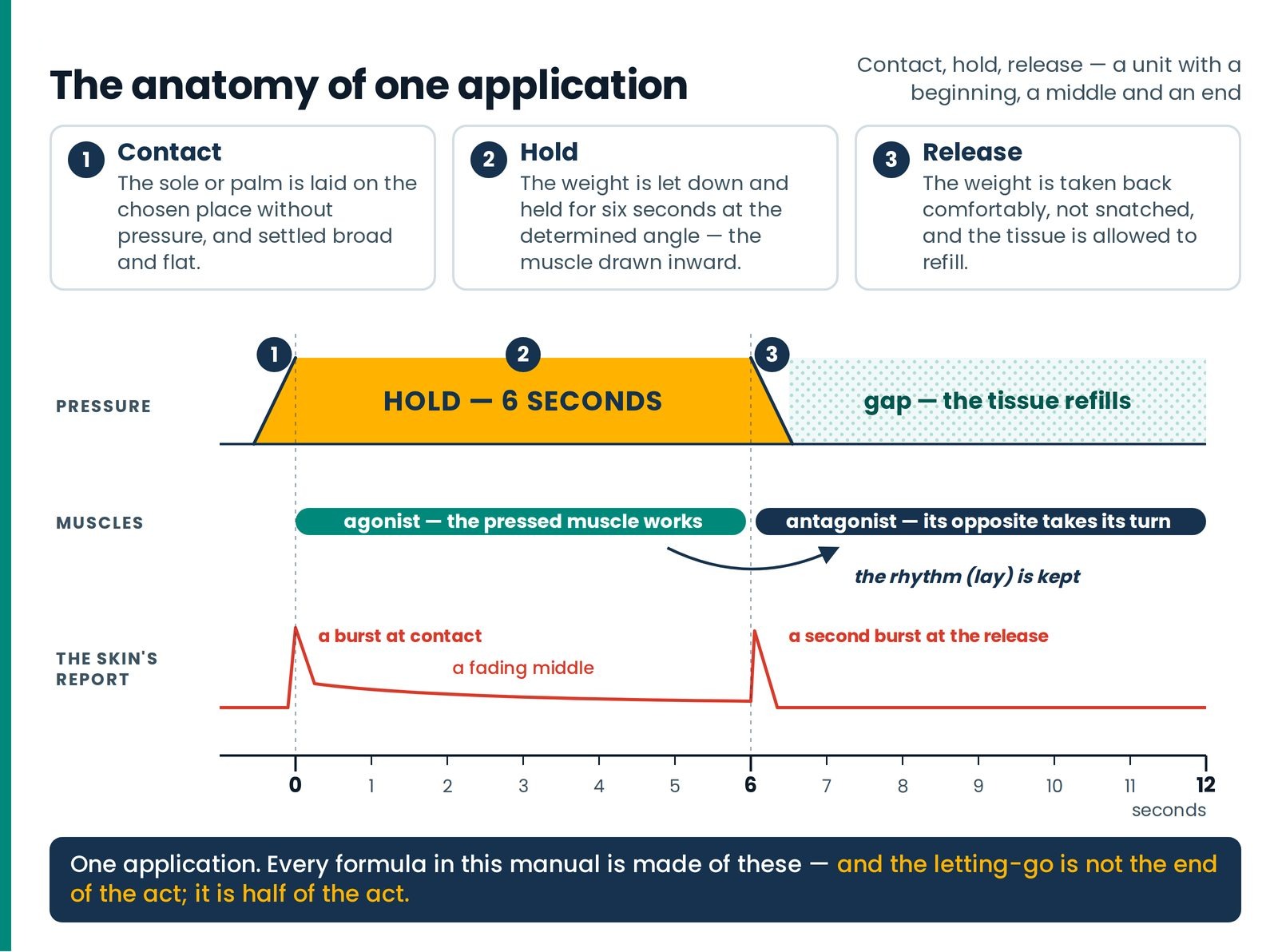
Everything begins here, so begin slowly. (Figure 4.1)
What one application is
Ordinarily the duration of pressure is 6 seconds.
One application is a complete small act with three parts, and all three matter:
1. Contact. The chosen part of you — the soft middle of the sole, or the flat of the palm — is laid on the chosen place on the patient, without pressure, and settled there so that it lies broad and flat.
2. Hold. The weight is let down and held for six seconds, at the determined angle, so that the muscle is drawn inward, not outward.
3. Release. The weight is taken back — comfortably, not snatched — and the tissue is allowed to refill.
An application that is not released is not an application. The letting-go is not the end of the act; it is half of the act.
Notice what is not in it: any instruction about how hard. Weight is not a variable in this therapy — if the place is right, a therapist of small build gets the same result as a large one, and the treatment may be given by any person irrespective of age, weight, size or sex, with identical results.
What is in it is a number, and the number is not approximate.
The six-second rule
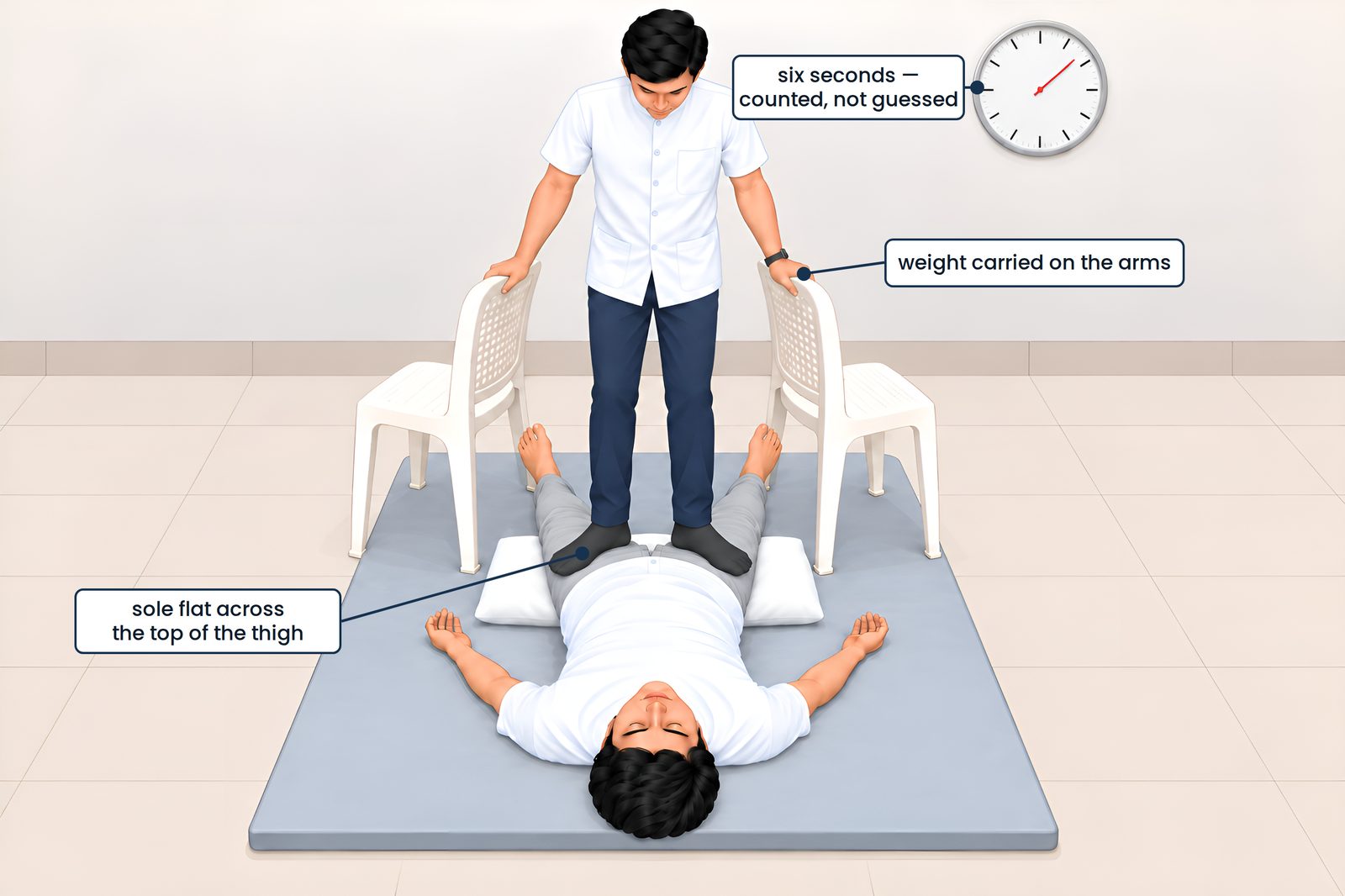
Ordinarily the duration of pressure is 6 seconds. But do not guess at it.
Until you are fully competent, ask a friend, every day, to check you against a watch — do you change your position exactly at 6 seconds, or a little before or after?
And the second half of the same rule, which students forget faster:
Giving certain points in different counts creates different chemicals. So the number of times pressure is given at a point must also be exact — let there be no mistake in this either.
Those two sentences carry the whole discipline of this therapy. The duration of each application is fixed at six seconds; the number of applications is written on the card and is not yours to adjust.
Why the count is the dose
Chemical and physical points, and a count that shortens under haste
The therapy divides its treatment points into two kinds, and the distinction decides how much freedom you have with the count.
Chemical points and physical points — and how much the count may move
Chemical points rouse the working of the various glands. Guruji obtained, through sixty years of tapasyā and experience, that many among these show different effects when given in different numbers — from which we understand that they make different chemicals.
So take care that the pressure is exactly 6 seconds and is given exactly as many times as is written; let there be no mistake in the count. Otherwise either the effect we want will not occur, or, in some rare cases, the opposite effect may occur. The wiki's own examples: (2) Pan and (4) Pan are not the same treatment; (6) Gas 'I' and (9) Gas 'I' are not the same treatment. Same place, same angle, same six seconds — different number, different result.
Physical points are given to relax the muscles. These too have a usual count, fixed by Guruji from experience. But if it is ever needed, in order to give the patient more comfort, one may give them one or two times more than that count. ▲ Take care
Learn which is which before you take a liberty with either.
This is the sentence to carry out of the article if you carry nothing else: in this therapy the count is the dose. A doctor does not write some on a prescription. Two applications at the pancreas point and four at the pancreas point are as different as two different medicines — and a therapist who rounds a four down to a three because the patient is restless has not given a smaller version of the treatment. He has given a different one, whose effects he was not taught.
Why six seconds — the reasoning in full
Agonist and antagonist, two columns of blood, and the lactic acid past six
It has been said in many places that in Neurotherapy the pressure that is given should be of six seconds. But why?
Begin with the history, because it is part of the teaching. Guruji had already determined, fifty years ago, by an intuition of his own, that everywhere the pressure should be of six seconds. The rule came first, from a man watching bodies. Its scientific explanation remained a secret for half a century afterwards — and that secret has now been opened.
There is a way of holding such a thing in the mind, and this therapy offers it in a comparison worth learning.
The Ramanujan pattern — a result proved by experience before it is proved by explanation
Everyone knows that in the last century the Indian scientist named Srinivasa Ramanujan is counted among the world's rare and highest-order, incomparable mathematicians. But very few people would know that several of his results are such that, even so many years after his death, some students in the great universities of America are spending their whole lives in the research of proving those results.
In exactly the same way, there are many facts of Neurotherapy which have certainly been proved by experience, but which the coming generations will have to labour to prove by explanation.
The six-second rule is one in that series.
Sit with that comparison, because it is precise and not merely flattering. Ramanujan wrote down identities he could see and could not always prove. They were not vague; they were exact — this equals that, to the last term. Precisely because he wrote them exactly, other people could check them, one by one, for a century. An intuition written down as a number can be worked on for a hundred years; a vague one simply fades.
Six seconds is a number — the same number in every formula in this wiki, at every point, for every patient, from an infant of one day to a man of ninety.
Now the explanation itself, given whole.
The physiological basis of giving six seconds of pressure
Whenever any muscle contracts, it should be only for 6 seconds.
When exactly six seconds are complete and we release the pressure, then the opposite muscle contracts. In this, the contraction that occurs from giving the pressure is called the agonist, and the contraction of the opposing muscle on releasing the pressure is called the antagonist. Agonist and antagonist — it is necessary that their rhythm (लय, lay) be maintained.
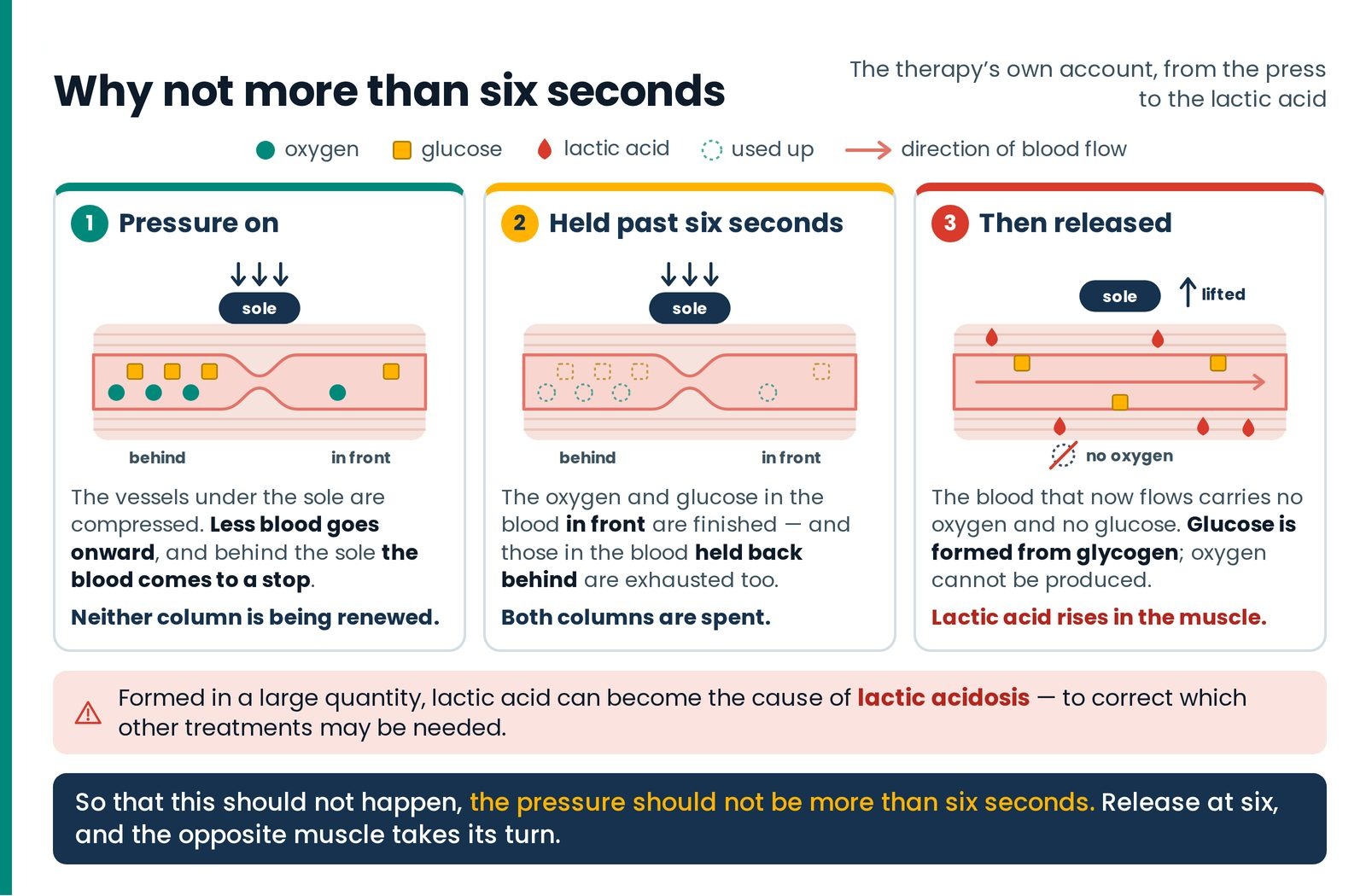
When pressure falls on a muscle, the blood vessels are compressed. Because of this, the blood supply going onward becomes less. At the same time, behind the place where the pressure is, the blood comes to a stop. In the blood that lies towards the front, the available oxygen and glucose are finished when the pressure lasts more than 6 seconds. In the same way, the oxygen and glucose of the blood held back behind are also exhausted.
When the pressure is released, then in the blood that flows there is no oxygen and no glucose. In this situation oxygen cannot be produced; but by the breakdown of glycogen, glucose is formed. In this, the quantity of oxygen is next to nothing.
In such a situation, lactic acid becomes greater in the muscle. And its formation in a large quantity can become the cause of lactic acidosis, to correct which other treatments may be needed.
So that this should not happen, the pressure should not be more than 6 seconds.
This account is given in the Marathi work आहार हेच औषध — "Food Itself Is the Medicine" — of Dr. Sardesai of Pune, in the translation of Shri Govind Apte of Aurangabad.
Now take it apart in ordinary words, because you will have to say it to a patient one day and to a doctor the next.
The two muscles that take turns. Every joint is worked by muscles pulling in opposite directions — one to bend, one to straighten. They are not enemies; they are a pair of oarsmen. When one pulls the other gives way, and when the first lets go the second takes its turn. The teaching says this taking of turns has a rhythm — a lay — and that our pressure joins that rhythm rather than overriding it. The press is one oarsman's stroke; the release at six seconds is the other's. Hold past six and you have stopped the boat and started leaning on it.
The two columns of blood. Lay a firm broad pressure across a limb and you have squeezed shut the small vessels under it. Downstream, beyond your foot, less blood arrives. Upstream, behind it, blood arrives and cannot go on, so it stands still. Two columns, one thinning and one stalled, neither being renewed. And blood is not only a fluid; it is a delivery, carrying oxygen and glucose that living tissue spends continuously. A column going nowhere is a delivery van with the engine off: what is in it is all there is. Beyond six seconds, the account runs, both columns are spent. (Figure 4.2)
What happens on release. Let go and the blood that moves has nothing in it. The body cannot make oxygen out of nothing. But it can make glucose very quickly, by breaking down glycogen, the sugar kept in the store cupboard of muscle and liver. So glucose appears and oxygen does not — and burning fuel without air is exactly the condition in which lactic acid builds in the muscle. Enough of it and you have lactic acidosis, needing treatments of its own to correct.
Therefore: not more than six seconds. The ceiling is not there for convenience. It is there because past it you begin to create a second problem while treating the first.
Read that twice. Six seconds, at the speed the body's own messages travel, is a kilometre of nerve — hundreds of times the length of the person lying in front of you. From the point of view of the body's messaging, six seconds is not a short time but an enormously long one. The number is small only on a clock.
Place, time and angle — the three things determined every time
What goes wrong when each one is wrong — and one foot at a time
The therapy's own description of itself names them in a row: pressure applied at particular places of the body, in a determined time, angle and order. Three of those are settled inside a single application; the fourth, order, belongs to the formula and gets its own section below.
The three things determined in every application
1. The place.
Not "the thigh" but this part of it — the middle, below the waist joint, at the station the point specifies. A point is a named site together with the way it is loaded; move the contact two inches and you are treating something else. Left Right Both sides
2. The time. Six seconds, held, then released.
3. The angle. The direction in which the pressure travels into the body. The standing rule: place your heel or your palm so that the weight falls over a broad surface, not on a single point, and so that the muscles are drawn inward, not outward. When giving pressure with the foot or the heel, your body weight must be so directed that the muscles are drawn inward — otherwise the patient will have a great deal of pain, because it would be against the natural direction of the muscles. ▲ Take care
What happens when each one is wrong?
Wrong place. Nothing happens, and that is the deceiving part. No pain, no complaint, no sign — just a treatment that quietly does not work while you conclude the case is difficult. Two feet two inches apart are two different treatments.
Wrong time. Short of six and the application is under-given. Past six and you work against the release you were relying on. The count is a separate matter again: at a chemical point a wrong number can produce a different chemical from the one intended — or, rarely, the opposite effect.
Wrong angle. The only one of the three that hurts, and the patient will tell you. Pressure driven across the natural line of the muscle, or delivered on an edge instead of a broad surface, produces real pain — a signal to be acted on at once, not endured.
Two further pieces of the angle belong here, because they are where beginners go wrong.
Steadiness is part of the angle. Keep the weight equal on both feet and exactly at the centre of your own body; do not shift it from one foot to the other in between. If your own balance does not feel right, the patient too will feel discomfort. And note the specific warning: if without realising it you stiffen your toes, or move them during the hold, the patient's muscles will be pulled the wrong way and they will have pain for a long time after the treatment. A six-second hold is six seconds of stillness.
One foot at a time. For Pan, Liv, Mu, Liv⁰, Mu⁰, Gas Only and Gas 'I' — and the same caution for WD, Rt. Ov, Lt. Ov, Pit and Para — you must not put both feet onto the patient at once while holding the chairs. First place one foot, without pressure; then, taking your full weight on both hands upon the chairs, place the second, also without pressure; only then, standing straight and in balance, let your weight down. Two reasons: at the touch of the first foot the patient becomes alert and then lies relaxed without moving; and if your hand slips or you turn an ankle, you will not hold your balance. (Figure 4.3)
The counting conventions of this wiki
The bracket, the stations, the “equal one” family, seconds and rounds
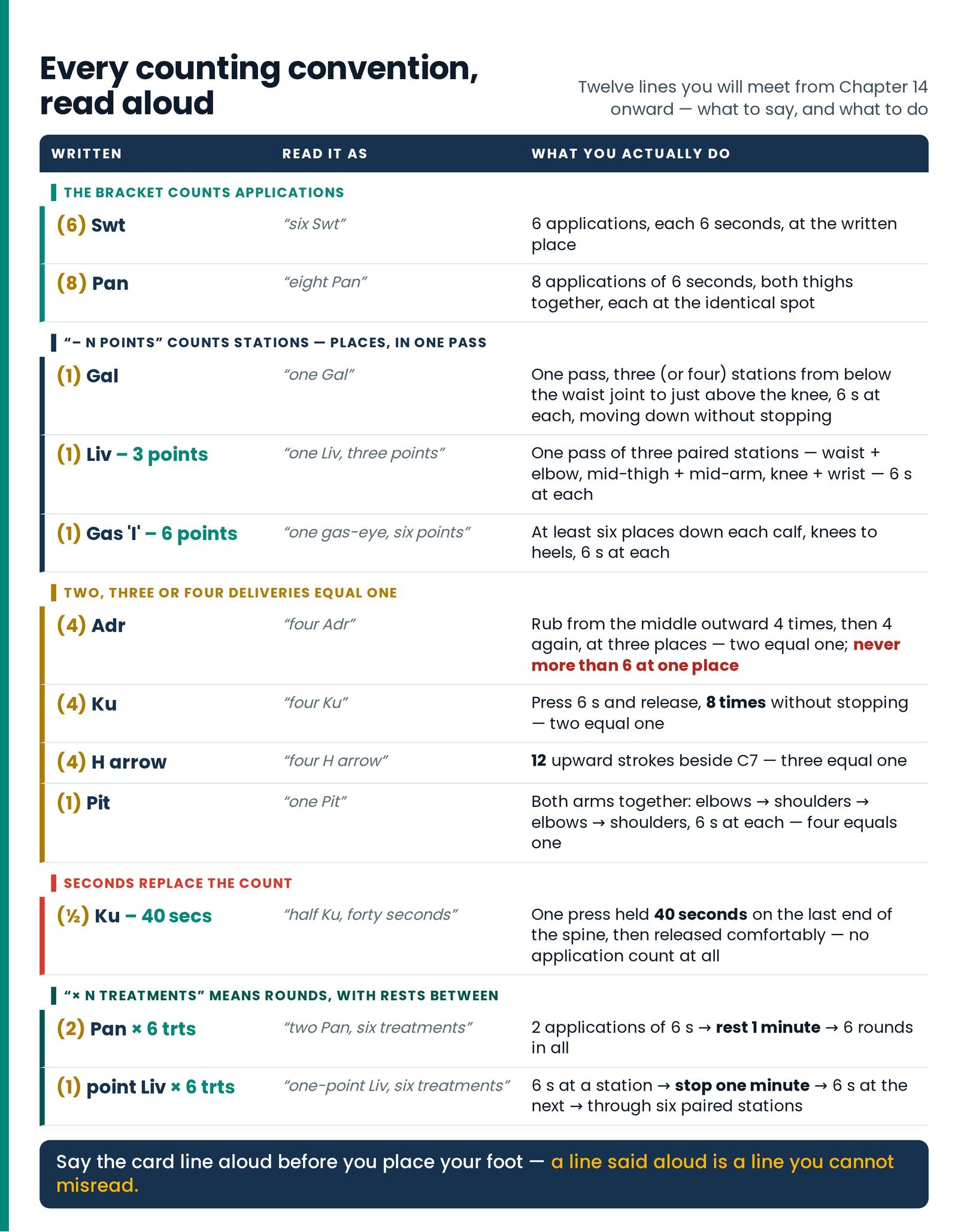
From The Shorthand onward you will meet formulas written in a compressed shorthand, and every element of that shorthand is a count. Learn the conventions now and they will never trouble you again. Every point also carries a written symbol — ↑o↑ is the H arrow, ↑|↓ the Round arrow — and the complete plate of symbols with their full names is given in The Shorthand, "The Shorthand". What concerns us here is not the glyphs but the numbers that travel with them. (Figure 4.5)
How a count is written, and what it means
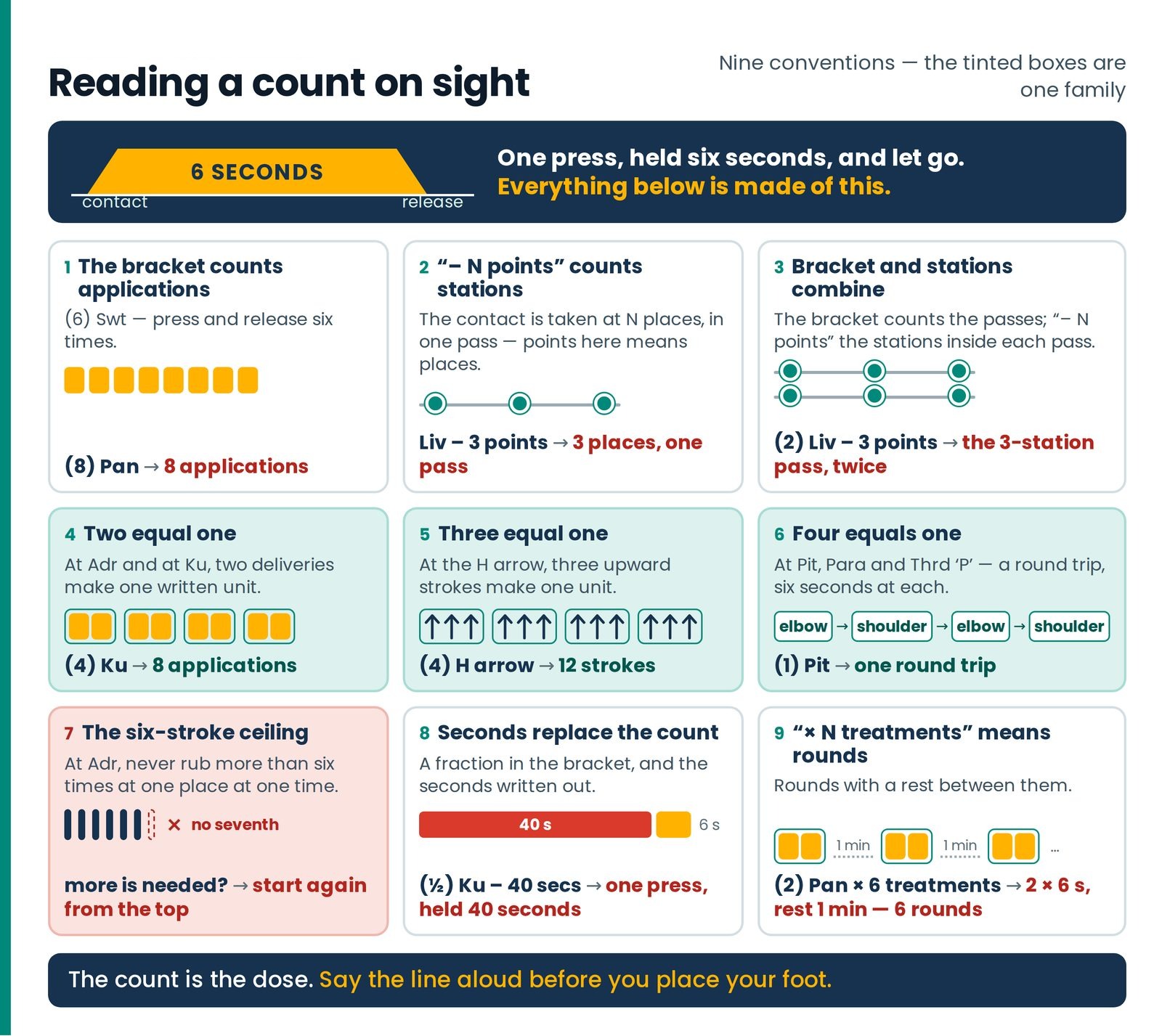
1. The bracketed integer is the number of applications.
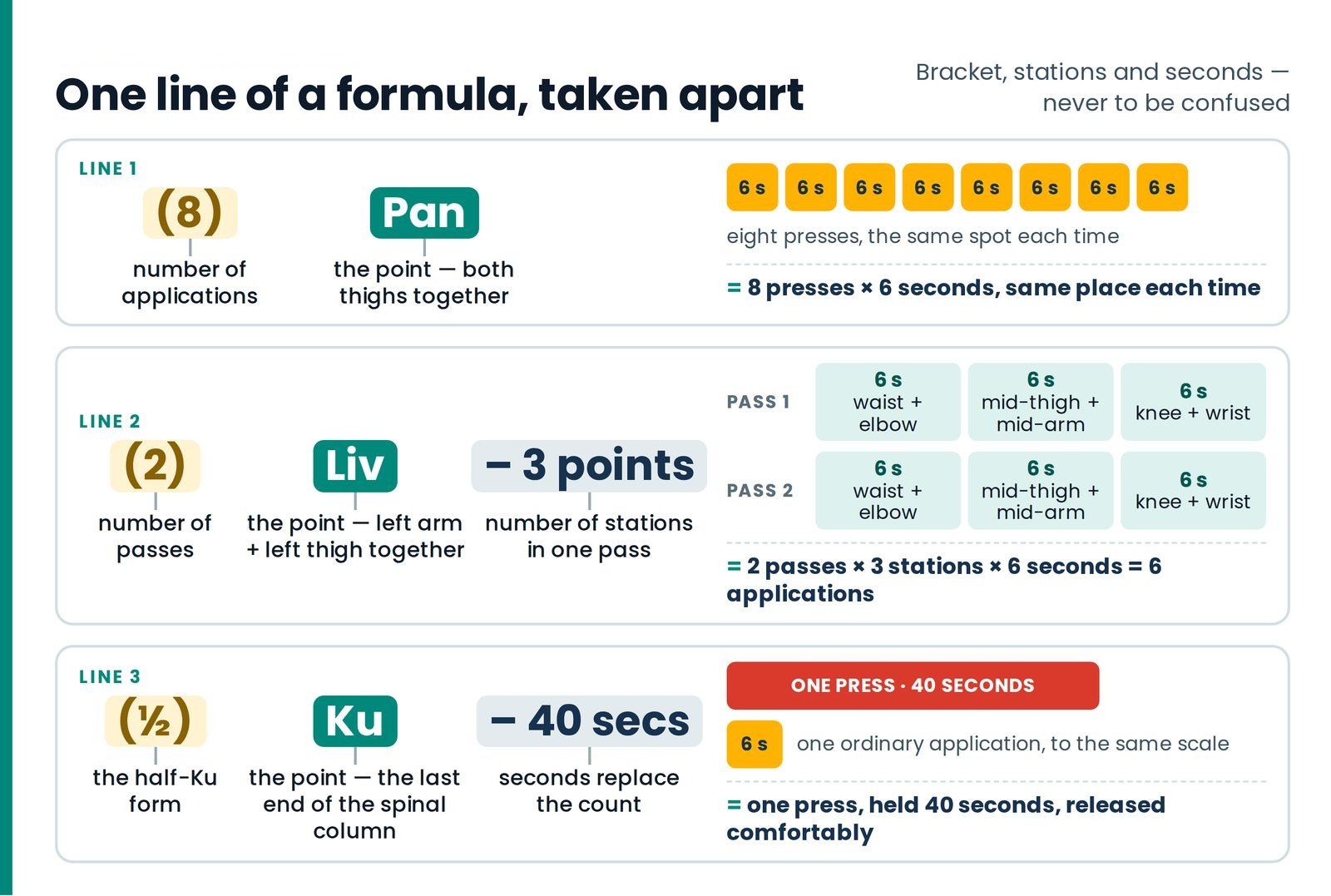
(6) Swt means press and release six times; (8) Pan, eight applications at the pancreas point. Unless a convention below says otherwise, the bracketed number is the number of six-second applications. (Figure 4.6)
2. "– N points" is the number of stations. Liv – 3 points means the contact is taken at three places, not three times in one place: waist and elbow; mid-arm and mid-thigh; wrist and knee. Gas 'I' – 6 points means at least six places down each calf. Points here means places.
3. The bracket and the stations combine. (2) Liv – 3 points is the whole three-station pass, done twice: the bracket counts the passes, the "– N points" the stations inside each pass. (Figure 4.4)
4. "Two equal one." At Adr the rub runs from the middle outward as many times as the number written, and the same again — at three places, two equal one. At Ku, the old Kundali, the time is six seconds and the count is two equal one: if (4) Ku is written, press for 6 seconds and release, and do this 8 times without stopping.
5. "Three equal one." At the H arrow — between both shoulders, on both sides of the C7 bone, rubbing from below upward — the count is three equal one, so (4) H arrow calls for twelve strokes.
6. "Four equals one." At Pit, Para and Thrd 'P' the unit is a round trip — elbow, shoulder, elbow, shoulder, six seconds at each — and the count of four equals one.
7. The six-stroke ceiling. At Adr: at one place, do not rub more than 6 times at one time. If more is to be given, start again from the top. ▲ Take care
- 8. Seconds may replace the count altogether. At ½ Ku the bracket carries a fraction and the seconds are written out: (½) Ku – 6 secs, (½) Ku – 20 secs, (½) Ku – 40 secs. You count no applications at all — one press, with normal pressure, on the last end of the spinal column, held for exactly as many seconds as is written, then released comfortably.
- 9. "× N treatments" means rounds with rests inside them. (2) Pan × 6 treatments: press on both thighs twice for six seconds and release; rest one minute; six such rounds.
Why the sequence matters
Right follows left, the reversed order, and how a formula is reasoned
Sooner or later a student asks: if I am giving all the right points the right number of times, does the order really matter? The answer is short.
Can we provoke any point at all, in any order at all?
Answer — no. We cannot provoke the organs in an order of our own choosing.
For that there are certain general rules, and it is necessary to follow them.
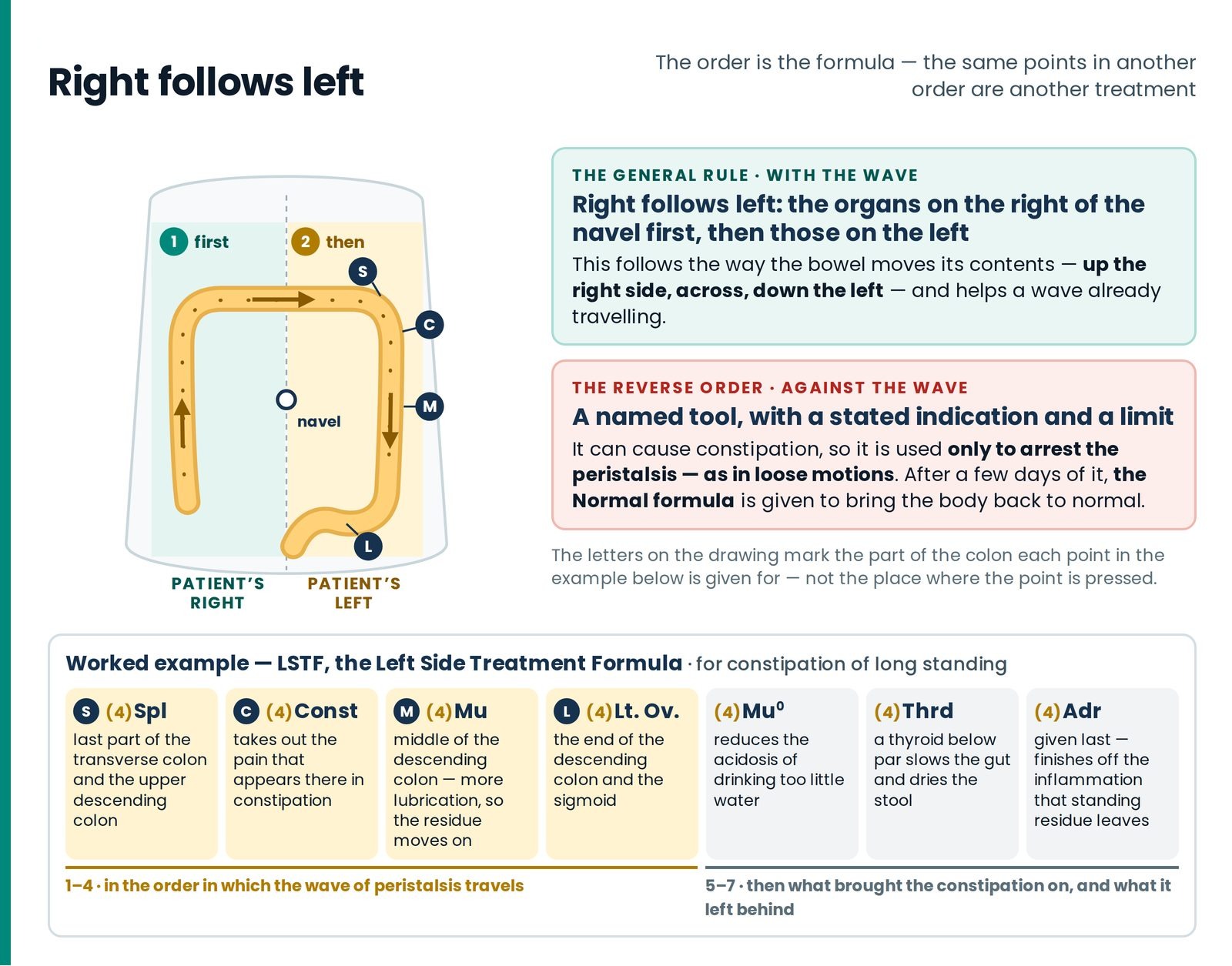
The general rule for proper peristaltic movement is: right follows left — that is, first stimulate the organs on the right side of the navel, and then stimulate the organs on the left side of the navel.
A reverse order can cause constipation; and it is to be resorted to only when we wish to arrest the peristalsis — as, for example, while treating loose motions.
Application of pressure cannot be done in any random sequence.
Read that carefully: it holds both the rule and its exception, and each is complete where it stands. The usual order follows the direction in which the bowel moves its contents — up the right side, across, down the left. Work with that direction and you help a wave already travelling; work against it and you slow the wave, which is a fault in constipation and exactly the treatment in loose motions. The reversed order is not a mistake that sometimes helps; it is a named tool with a stated indication, and it carries its own limit: after a few days of it, the Normal formula must be given, to bring the body back to normal again. (Figure 4.7)
Hence the definition of a formula: a number of organs must be stimulated continuously one after another, in a particular sequence, to cure a particular set of symptoms — and each such set of sequences is called a formula. The sequence is not the packaging round the formula. The sequence is the formula.
One example shows how a sequence is reasoned rather than decreed. The Left Side Treatment Formula, for constipation of long standing, is built by asking what the descending colon needs and in what order —
LSTF — (4) Spl (4) Const (4) Mu (4) Lt. Ov. (4) Mu⁰ (4) Thrd (4) Adr
— and every position has a reason. Spl, for the last part of the transverse colon and the upper descending colon. Const, to take out the pain that appears there whenever there is constipation. Mu, for the middle of the descending colon, and to increase lubrication so the residue moves on easily. Lt. Ov., for the terminal descending colon and the sigmoid — four points given in the same order in which the wave of peristalsis travels. Then Mu⁰, to reduce the acidosis that comes of drinking too little water and brings constipation with it. Then Thrd, because a thyroid working below par slows the gut and dries the stool. Then Adr last, because constipation of long standing leaves residue in the bowel; where rubbish stands infection follows, and a chronic infection turns into inflammation, which must be finished off or the patient will not get complete relief.
Shuffle those seven and you have not given LSTF. You have given seven points in an order nobody has studied.
To cure constipation, why stimulate Spl — the spleen — and Lt. Ov. — the left ovary? Both are outside the alimentary canal.
Why a point reaches more than the organ it is named for
By our points we increase the blood circulation in the various parts of the abdomen all around the navel. Each point's name has been given by keeping in mind the chief organ in that region. But when we give that point, it will increase blood flow not only in that organ, but in all the organs that are in that region.
A point is an address in a region, not a wire to a single organ.
Why the rest intervals matter
Sixteen breaths, and a change that must not arrive too fast
A formula is not a list to be run through. Many carry stated gaps — one minute here, ninety seconds there, two minutes before a re-check — and the temptation on a busy day is to close them up. Nothing looks lost. Something is. Here is one gap with its reason attached; understand it and you will never treat a gap as slack again.
In the treatment where every joint from the fingers to the shoulder is given a very light rubbing, Guruji insists that after the ghisai of each single joint it is necessary to give an interval of one minute — and gives the reason.
During metabolism the processes inside the cells produce carbon dioxide. Where oxygen is short, or blood circulation in the tissues is low, it accumulates in the cells and tissues as carbonic acid, and the acid in the tissues rises. In Neurotherapy we have found that because of this acidity too, pain can come in the joints.
So when we increase the blood circulation in a joint, that carbonic acid changes back into carbon dioxide and water, dissolves into the blood, travels to the air sacs of the lungs and is breathed out.
But for more than about 90% of that carbon dioxide to come out, sixteen breaths are needed — and an ordinary person takes one minute to take sixteen breaths.
What one minute is for: sixteen breaths
If we do not give this interval, the carbon dioxide will not come out fully, and the full benefit of the rubbing will not be had.
That is the whole idea of a rest interval, with its arithmetic showing. The gap is not the absence of treatment; it is the part of the treatment the patient's own body performs — and one minute is not a round number chosen for convenience. It is a breath count wearing a clock face.
There is a second reason for a gap, and it is protective.
So a gap does two things: it gives the body time to complete a change, and it stops the change arriving faster than the body can absorb it. A therapist who runs a formula straight through has not saved four minutes; he has removed the interval in which the effect was to be realised.
Three practical notes, all of which you will meet in the formulary:
A gap has a length, and the length is written. One minute between rounds of Pan and of Liv × 6 treatments; ninety seconds between repetitions of several acid and alkali formulas, and between the three repetitions of (6) Adr; two minutes after a round of breathing before the finger is re-checked; five minutes between an inflammation formula and the abdominal sequence that follows. Read the gap off the card as carefully as the count.
The gap is when you talk to the patient. Ordinarily one does not talk during treatment. But when different formulas are given in one session, then in the gap after each formula one must certainly ask the patient how they are feeling. If their trouble increases after any point or formula, take the chief therapist's opinion at once — and write this clearly on the card, so that in future that point is not given again, or is given with proper caution. ▲ Take care
The gap is not a break for you. Do not talk unnecessarily with anyone during the treatment or in the gaps.
Duration: the session, the course, and what decides it
Half an hour in gaps, and a course that tapers
Patients ask three questions about time, always in the same order and usually before they lie down. Have all three answers ready.
How long a session runs
How much time will each day's treatment take? It depends on that person's state that day, but for common ailments about thirty minutes a day is enough — and not continuously: according to the formula there may be gaps of a few minutes.
Where needed, small treatments at shorter intervals may be given through the day — and these are taught to the household, so relief comes more quickly.
Some treatments carry their own daily frequency: (1) point Liv × 6 treatments is to be done four to six times in a day, and is useful in everything from malaria and typhoid to every major illness. 6 sec Supine
Half an hour, in gaps — and say both halves to the patient, because the second stops her thinking the therapist is idling.
How many days a course takes, and what decides it
The same period does not apply to all.
It depends on the person's body structure; which disease it is; how many organs it has affected; how many years it has been present; and how far the parhez is kept. Even so, this much is certain:
For ordinary ailments, the average is a week to ten days.
For chronic ailments, about a year or more.
By regularly following the treatment and the parhez, many diseases are cured in just two to four months.
For conditions present from birth it may take some years.
For old diseases it takes many months.
And the question to give back to a patient who is impatient, gently: a disease that has come over many years — will it not take at least that many months to be put right?
What improvement looks like
Appetite, sleep and energy first — the disease afterwards
The third question, and the one on which a patient decides whether to come back.
What improves first, and over what span
In most cases, regular treatment produces almost a permanent relief from the ailment.
The emphasis is not on curing the symptoms alone: the body organs are gently stimulated so that they automatically start resuming their original functions all by themselves. Taken over a number of days, the treatment brings a substantial improvement in the quality of health.
What the patient notices comes long before the disease goes. Within a day or two, small and large effects begin to show — hunger improves, sleep improves, energy increases, weakness reduces, the body feels light, life becomes enjoyable. And with improvement in all these, even if the disease itself is slow to be fully cured, the likelihood of another disease coming is averted.
Over longer spans, measured values move: blood pressure, blood sugar, serum cholesterol and serum uric acid normalise, T₃ and T₄ improve with a corresponding reduction of TSH. Great numbers of patients with gall stones or kidney stones have been benefited by this treatment alone, without surgery. And in children with disorders branded incurable — intellectual disability, Down syndrome, ADD and ADHD, dyslexia, ataxia, fits, autism, muscular dystrophy — there has been substantial improvement in the quality of life.
Say the second paragraph of that to every new patient on day one. It is true, it is modest, and it sets the right measuring stick: do not judge this in week one against a cure — judge it against your appetite, your sleep, your energy and how heavy your body feels. A patient given that frame stays; a patient left to invent her own measures week one against a cure and leaves in week two.
The last ten minutes: what to attend to after a treatment
Re-check, write the card, and get the patient up safely
Almost everything that goes wrong in a hands-on practice goes wrong here, not during the treatment. The counting is finished; the discipline is not.
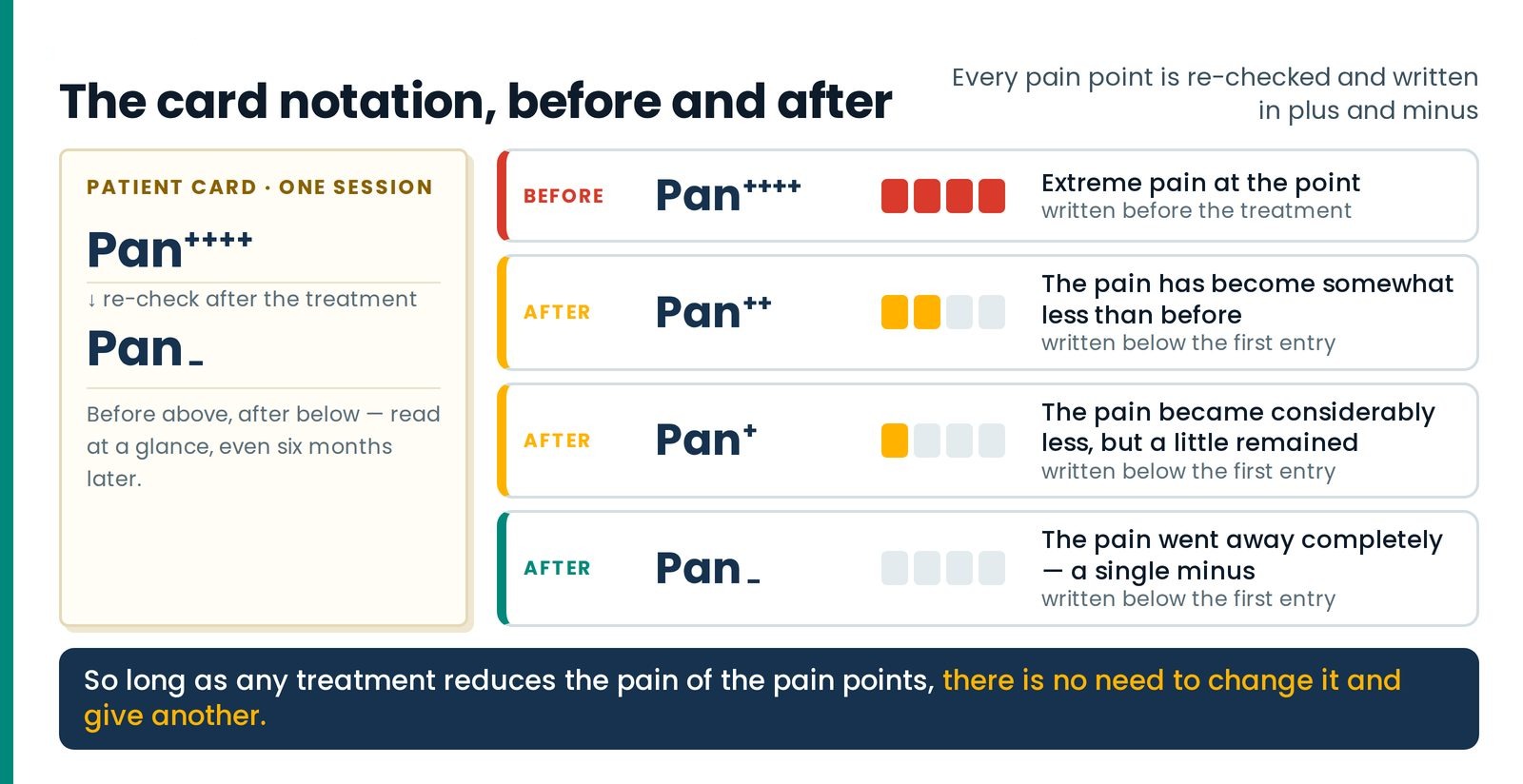
A card for one session reads downward: Pan⁺⁺⁺⁺ at the top and, beneath it, whatever the re-check found. Before and after sit one above the other and can be read at a glance in six months' time. (Figure 4.8)
Why go to this trouble? Guruji gives two reasons. The first: "By showing or telling them in this way that the pain is decreasing, their faith in this therapy increases greatly. They feel that this is magic!"
The second is the working one. Patients sometimes take two or four days of treatment, then stay away for weeks; when the trouble returns they say they got no benefit, because the pain came back just as it was. In Neurotherapy, removing or finishing the pain of the pain points is the main aspect of the treatment. So by looking at the card from that earlier day — which point had a plus and which a minus, before the treatment and after — we will come to know whether the patient really did benefit from that day's treatment or not, and can decide whether to give the old treatment again or a different one.
And from that follows the single most useful decision rule in the wiki: so long as any treatment reduces the pain of the pain points, there is no need to change it and give another.
Two things may happen as the patient sits up, and both have their handling.
Giddiness after a treatment
If, during the treatment or after getting up, the patient feels somewhat giddy, do not be alarmed.
It means that by our treatment the digestive system has improved so much that insulin has come out from the pancreas, on account of which the quantity of sugar in the blood has become less. This is momentary.
What to do:
Sit them on a chair, and stand near them giving support until their nervousness has gone. Seated
If need be, dissolve a little jaggery in half a glass of water and give it to them to drink.
Tell them to rest for some time, and only then to set out for home. ▲ Take care
Note also that those who have cervical spondylosis may become giddy while taking the Pan treatment; they may be given a thin pillow under the head.
The heavy head, and the neck manoeuvre
Some people, because the flow of blood in the forehead has increased, may feel the head heavy for a little while.
If this happens, tell the patient not to be alarmed. Sit them on a chair, place your palm behind their neck like a cup, draw the muscles and nerves backward for a second or so, and release them slowly — the heaviness of the head will go. Seated
Three details are the whole technique: the palm is cupped behind the neck and never on the front or the side of the throat; the draw is backward and lasts about a second; and the release is slow, not dropped.
The room rules — the phone and the mat
Only after doing all this may you, or they, talk to anyone on the mobile — not before this.
The reason given is worth more than the rule: if you yourself observe the rules, the patient too will observe this rule, and from that the feeling of respect towards you and towards the therapy will increase. The therapist's own phone goes out of the pocket and to a distance, on silent, before the session begins, and is not touched until the treatment is completely finished. Then clean the mat and re-lay the pillows — a fold in a sheet digs into a back for half an hour.
Two bodies, and what the count and the order did
A shortened count, and an order reversed and then restored
Questions students ask
- 1. I am nineteen and cannot feel the difference between four seconds and six. Will I ever? No, and neither can anyone else. That is why the rule says do not guess. Nobody develops an inner stopwatch; competent therapists develop a habit of checking. Get a friend to time you daily for a fortnight, then twice a week for a year.
- 2. Would eight seconds not be better than six, if pressure is doing good? No. Past six seconds the blood held in front of and behind your foot is spent, and on release you are feeding a muscle glucose without oxygen. Lactic acid rises, and in quantity that brings on a state you must then treat separately. Six is a ceiling, not a minimum.
- 3. I am a doctor. What exactly is being asserted by "six seconds"? Three separable things. A rule: every application is held six seconds. A history: the rule was arrived at by intuition fifty years before any account of it existed. And an account: the agonist–antagonist rhythm, the two exhausted columns of blood, the lactic acid on release. Teach all three, in that order.
- 4. My teacher gives (4) Ku as eight presses. Is she double-dosing? She is giving it exactly right. At Ku the count is two equal one, so (4) Ku means eight applications of six seconds without stopping — as three equal one governs the H arrow and four equals one governs Pit, Para and Thrd 'P'.
- 5. A card says Liv – 3 points. Three presses, or three places? Three places, in one pass: waist and elbow, mid-thigh and mid-arm, knee and wrist, six seconds at each. If the bracket says (2), that whole pass twice. Say the line aloud before you place your foot.
- 6. My patients come on foot from far away. May I close up the gaps to save them time? No. The gap is where the effect is completed — one minute is about sixteen breaths, what the lungs need to clear the carbon dioxide the work released — and it also stops a change arriving faster than the body can absorb. If time is short, give fewer formulas properly rather than more badly.
- 7. I am a retired schoolteacher learning this for my daughter-in-law. If I press more lightly than a young man, must I hold longer to compensate? No. Weight is not the variable and time is not a substitute for it. If place, angle, count and order are right, the treatment given by a woman of sixty-eight is the treatment given by anyone else.
- 8. My results have fallen off and I cannot see why. Where do I look first? Before you touch a single card: your count, your angle, your order, your gaps — in that sequence, with somebody else watching. Only when all four are clean do you go back to re-examining the patient.
- 9. Is the six-second rule the same for a newborn as for a heavy adult? Yes. What changes for the very small, the old and the weak is the tool — the hand rather than the foot, the whole palm laid flat so the pressure is not felt as pressure — never the count. See also → The Child, the Elder and the Frail, "The Child, the Elder and the Frail".
Questions patients ask
1. "Why exactly six seconds? It sounds like a made-up number." There is a reason for the ceiling. When I press, I close the small blood vessels under my foot. Held longer than six seconds, the blood on both sides of it runs out of the oxygen and sugar it carries; then, when I let go, the muscle starts burning fuel without air and acid builds up in it. Six seconds is where the good part happens and the unwanted part has not yet begun.
- 2. "You spend more time waiting than pressing. Am I paying for you to stand about?" Those gaps are part of the treatment, not a break. After each part of the work your body has to carry something away in the breath, and that takes about sixteen breaths — roughly a minute. If I ran everything together you would get less benefit, not more.
- 3. "Can you not press a bit longer today? My pain is worse than usual." I can give you more of the treatment, and I will if the examination says so. What I cannot do is hold each press longer, because past six seconds it begins to work against you. More is done by repeating correctly, never by holding on.
- 4. "I felt dizzy standing up. Is something wrong?" Nothing alarming. Sit here a few minutes and let me stay with you. It passes on its own; if it does not settle quickly I will give you a little jaggery in water. Do not set off home until you feel steady — and always get up by rolling onto your side.
- 5. "You keep writing plus and minus signs. What are you writing about me?" Exactly what I found with my fingers, at each place, before and after today's treatment — four plus for a lot of pain, down to a single minus for none. It is how you and I will know in three weeks whether a treatment is doing its job. Look at it with me; it is your record.
Words used here
| Hindi | English | Neurotherapy code / usage |
|---|---|---|
| दबाव (dabāv) | Pressure | Held 6 seconds and released — the unit of the therapy 6 sec |
| छह सेकंड का नियम | The six-second rule | Do not guess at it; be checked against a watch |
| लय (lay) | Rhythm | The taking of turns between agonist and antagonist, which the count preserves |
| घिसाई (ghisāī) | Rubbing, abrading | A sliding application; counted in strokes, not in six-second holds |
| कड़कपन (kaḍakpan) | Stiffness, hardness | Graded with the pain and written as plus or minus on the card |
| परहेज़ (parhez) | Dietary restriction | One of the five things that decide how long a course takes |
| गुड़ (guṛ) | Jaggery | In half a glass of water for a patient who feels giddy after treatment |
| — | (N) before a point | The number of six-second applications |
| — | – N points | The number of stations, not applications |
| — | Two / three / four equal one | Deliveries that combine into one written unit — Ku, H arrow, Pit/Para/Thrd 'P' |
| — | (½) Ku – 40 secs | Seconds replacing the application count; one press, held that long |
| — | Pan⁺⁺⁺⁺ → Pan ₋ | The card notation: extreme pain before, no pain after |