Before You Touch Anyone — Hands, Room, Conduct and Consent
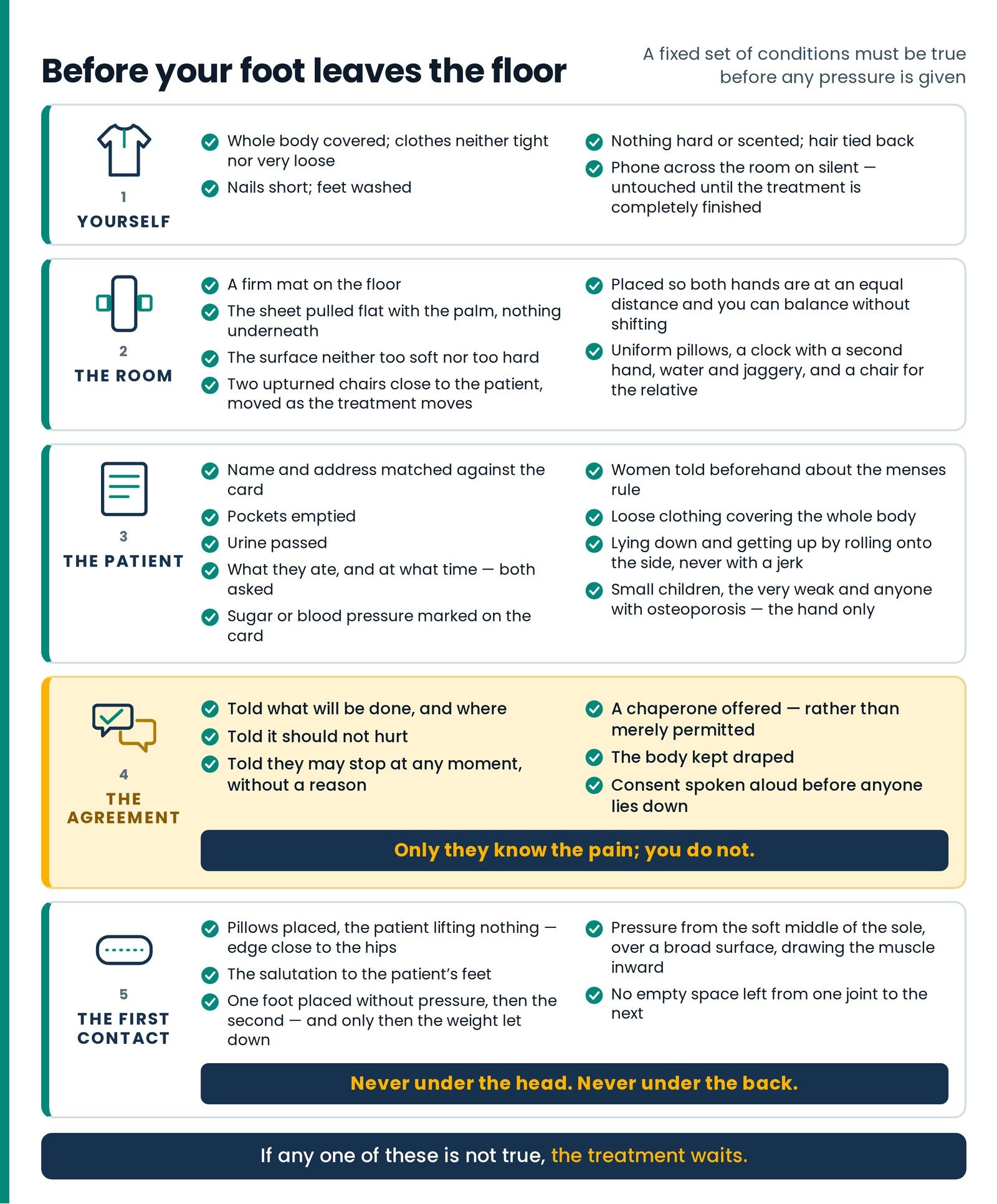
Six Seconds gave you the six-second unit out of which every formula is built. This article is everything that must be true before that unit is delivered even once — your clothes, your nails, your balance, the floor, the chairs, the pillows, your mouth, and above all the agreement of the person in front of you. The points can be learned in a year; these pages decide whether anybody will let you use them.
Watch


The therapist arrives before the treatment does
Dress, nails, feet, and the old conduct of the physician
A patient reads you before you have said anything, so this therapy begins not with the hands but with the clothes.
Dress — libāj
When giving treatment your dress should be such that the whole body is properly covered.
The clothes should be neither tight nor very loose — because with either of these it is the therapist who will have the greater difficulty during the treatment.
The best are: pyjama-kurta; salwar-kameez; full pants with a full shirt or a closed-neck T-shirt, and so on.
For a woman to give this treatment wearing a saree-blouse, or jeans, or a sleeveless kameez, or for a man to give it wearing a dhoti or half-pants, is not considered quite proper according to our culture.
The practical reason is about you — a garment that binds hip or knee makes it impossible to keep the standing knee straight and the weight centred between the chairs. The cultural reason is stated as a cultural reason, and in a therapy that depends on a stranger trusting you with her abdomen, what is considered proper is a clinical matter.
Conduct with the patient
Gentle speech, the naman, and the vows that come before technique
How a therapist behaves
When speaking to the patient or their relatives, always speak smiling, in a sweet and gentle voice. Every patient is one's own relative — speak to them with that feeling.
To be ready to serve the patient is not only our duty, it is in our own interest. Do not take wrong advantage of a patient's illness. Give the treatment with full dedication. Always keep in mind that they are already suffering, and that our behaviour must not add to their suffering. Their blessing is our real "fee", and it cannot be priced.
In this therapy, trust (bharosā) and reverent faith (śraddhā) play the principal role.
This is a distinctive system of treatment, and its honour is yours to keep. Whatever reverence is in your mind, that same reverence will arise in the patient's mind towards this therapy.
A sick person will agree to things she would never agree to if she were well. That is what do not take wrong advantage forbids.
The room and its furniture
The mat and the sheet, the room set for the day, and the two chairs
The mat and the sheet
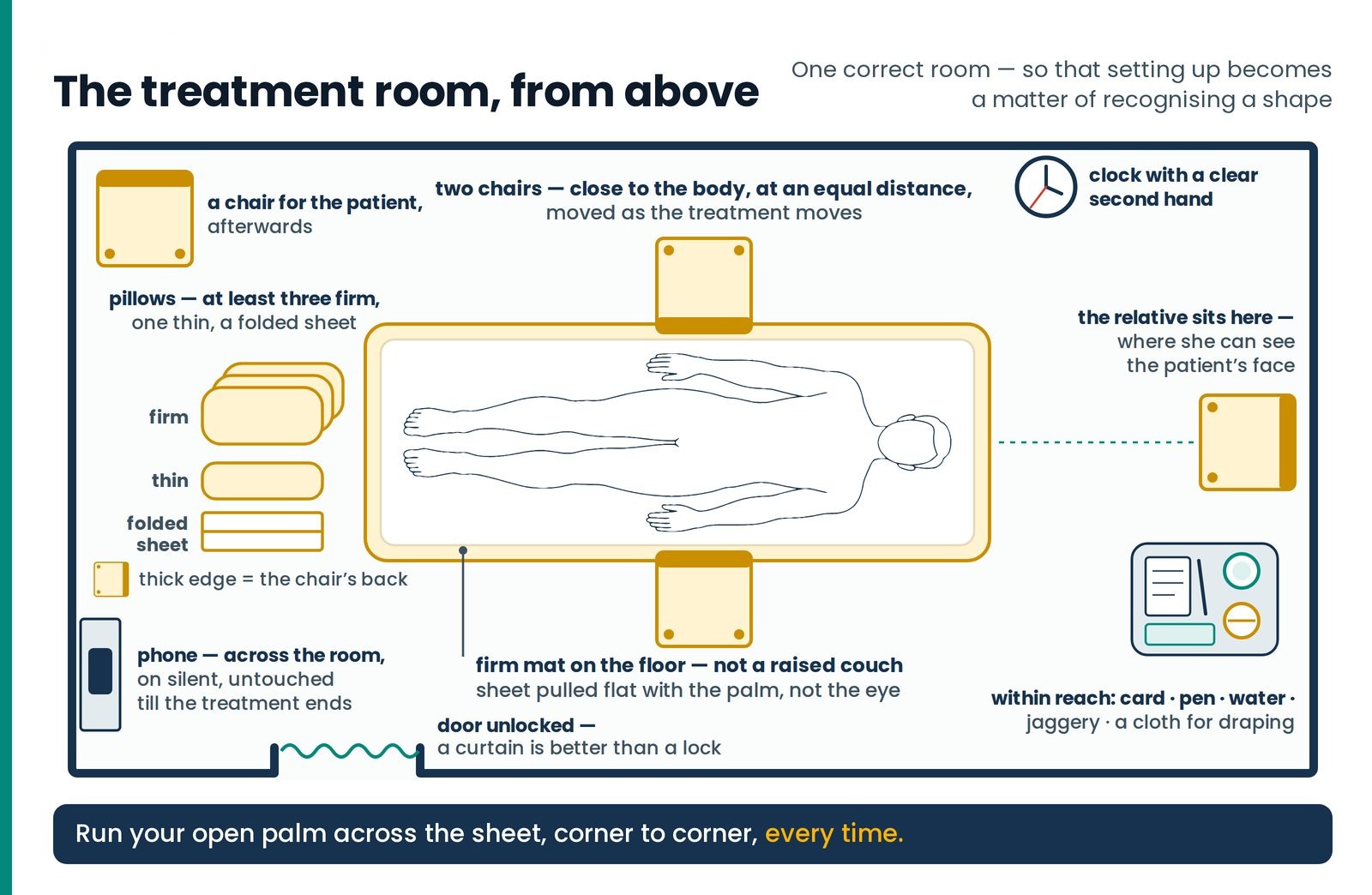
Before making the patient lie down, see that the carpet and the sheet are flat and that nothing small is lying underneath.
A fold in the middle of the sheet can dig into the patient's back during treatment.
And the reason, in a picture nobody forgets: a bone lying on a flat surface can bear even a hundred kilos of weight — but if there is a pen or a pencil underneath the bone, then even a small tin of powder falling on the hand can break that bone.
Take care too that the sheet and carpet are neither too soft nor too hard. ▲ Take care
Pressure is force shared out over the area it lands on: a pencil under one bony ridge sends a whole body's weight through a contact the size of a grain of rice. So run your open palm across the sheet, corner to corner, every time. (Figure 5.2)
The two chairs, and why they are not furniture
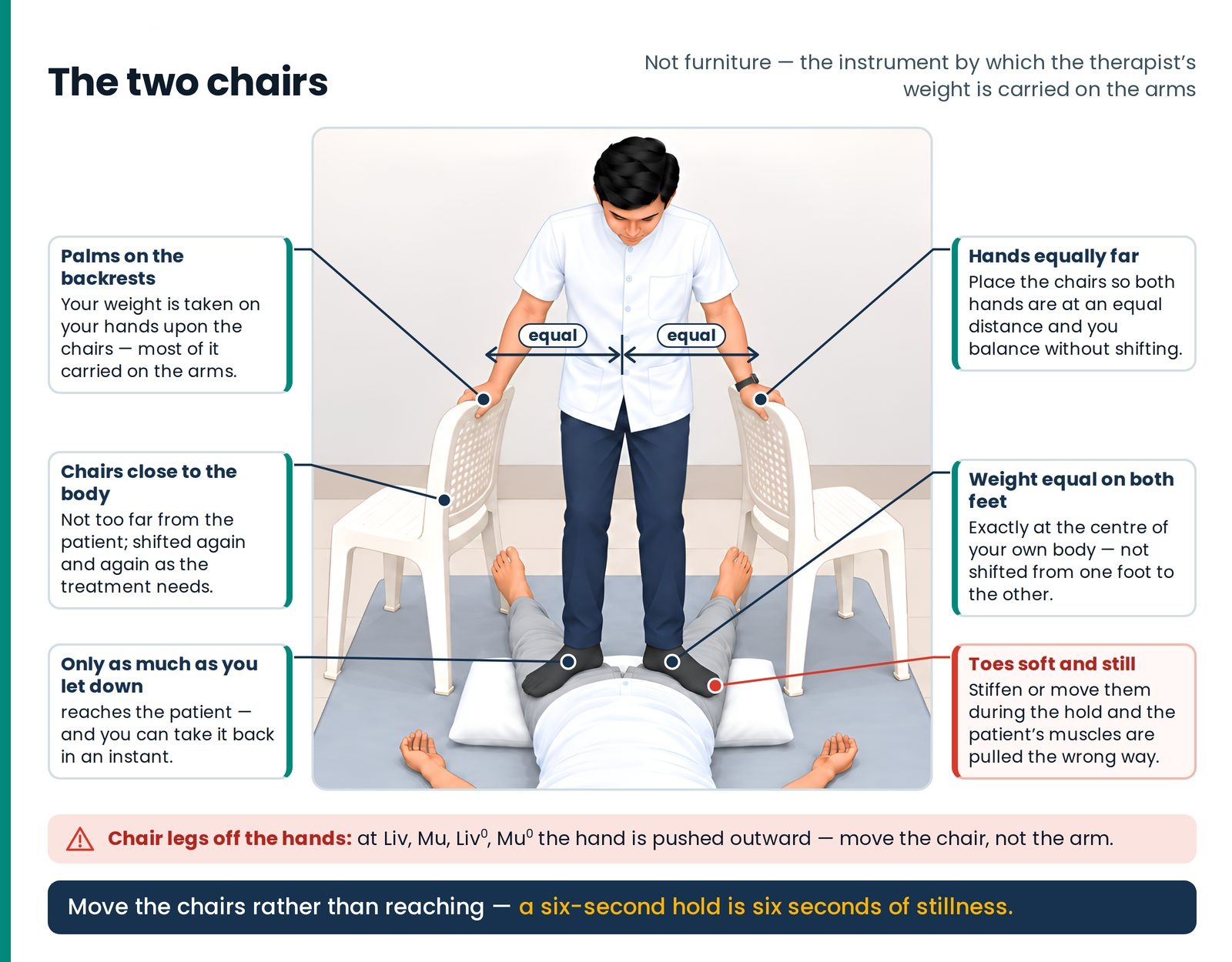
Pressure may be given either with the hand or with the feet. If with the feet, lay the patient down between two upturned chairs and, taking your weight on your hands upon the chairs, give the treatment.
Two ordinary four-legged chairs are stood facing each other and turned over, so their seat and back frames form parallel rails at about hip height. The patient lies supine between them; the therapist stands astride, grips both frames, and carries most of his body weight on his arms. What reaches the patient is only as much of the therapist as he chooses to let down — and he can take it back in an instant.
Where they stand. The chairs should not be kept too far from the patient's body. Depending on the treatment they may have to be shifted again and again. But always place them so that both your hands are at an equal distance between them, and so that you can balance your body weight easily, without shifting.
How you stand. See that the weight stays equal on both feet, and exactly at the centre of your own body. Do not shift the weight from one foot to the other in between. If your own balance does not feel right, the patient too will feel discomfort. If without realising it you stiffen your toes, or move them during the hold, the patient's muscles will be pulled the wrong way and they will have pain for a long time after the treatment. ▲ Take care
Move the chairs rather than reaching: a shift of your centre is felt from below as a wobble, and a treatment given from an awkward stance is one the patient braces against. A six-second hold is six seconds of stillness. (Figure 5.1)
The pillows
The standing rule, pillow by treatment, and the patient in a hurry
A pillow here is not comfort but positioning: a treatment given without its pillow is not a gentler version of it but a different one, delivered into a body arranged wrongly.
The standing pillow rule
Under the part on which pressure is to be given, place pillows as required.
Even if the patient says they are in a hurry, do not give the treatment without placing the pillows properly.
And the rule printed along the foot of every page of the treatment atlas, applying to all of them:
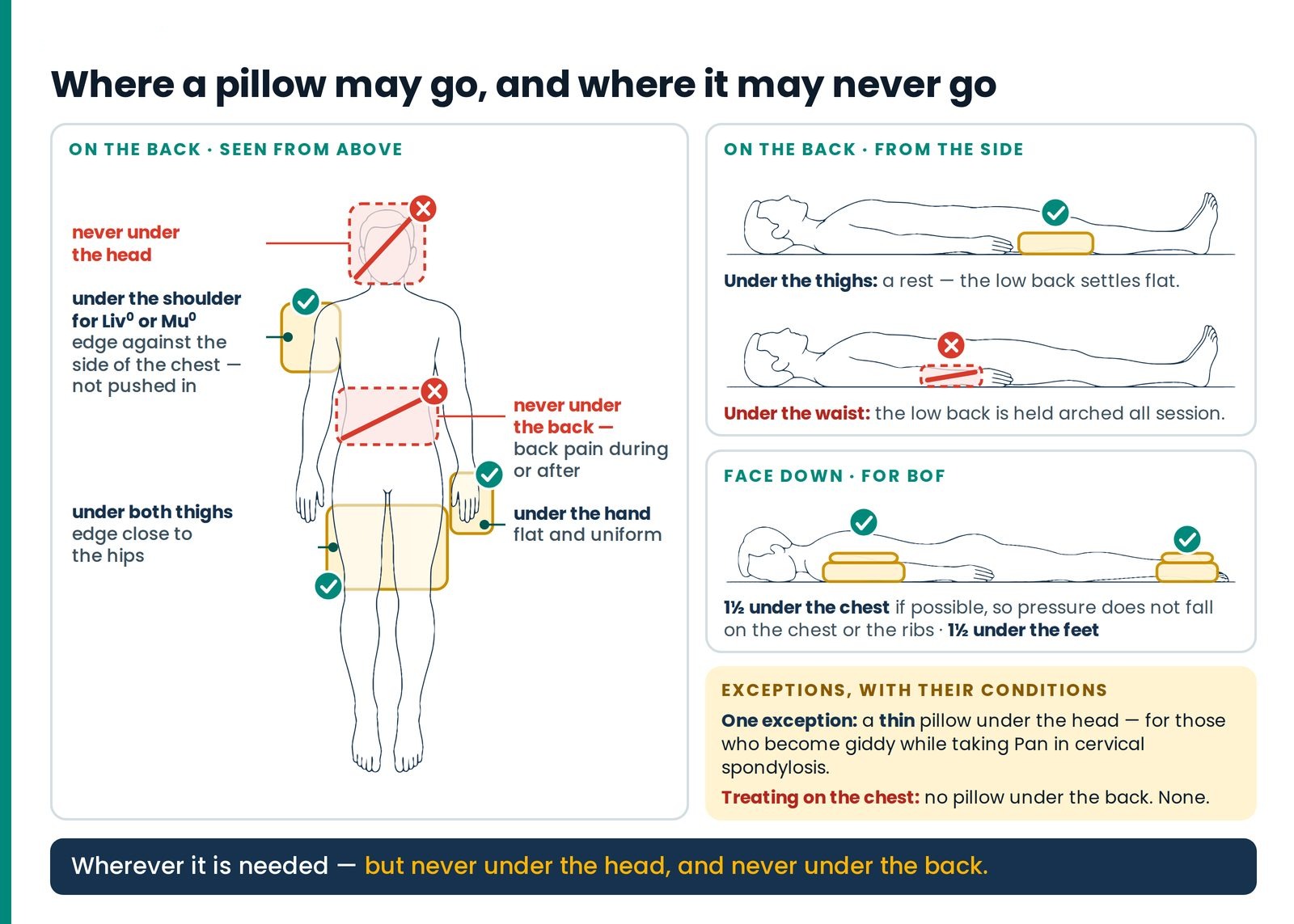
Place the pillow at the proper place as needed — but never under the head, and never under the back. Supine ▲ Take care
Both halves matter. Unless it is needed, no pillow should be placed under the head, so that the spine stays straight. And the pillow must not come under the patient's waist, or they may get back pain during or after the treatment — it arches the low back and holds it arched for the entire session. A pillow at the knees is a rest; a pillow at the waist is a strain held for half an hour. (Figure 5.3)
Table 1 — Where the pillows go, treatment by treatment
| Treatment | Pillows, and exactly where | Chips |
|---|---|---|
| Pan, Gal–Spl and the like | One pillow under both thighs, edge close to the hips. It must not come under the waist — back pain during or after the treatment follows if it does | Supine Both sides ▲ Take care |
| Liv⁰ or Mu⁰ | Two pillows. One under the thigh; the second under the shoulder, so the shoulder joint rests well upon it. Do not push it too far in under the back or the shoulder — only so far that the edge of the pillow stays pressed against the side of the chest | Supine Left Right |
| Liv, Mu and the arm treatments | A flat pillow under the hand; if it is not uniform the patient gets pain in the hand or fingers. Failing a good pillow, a thick book such as a telephone directory is better | Supine |
| The elbow that will not reach the floor — the carrying angle | Place the pillow at the edge of the elbow, so there is no gap between the wrist and the pillow and the whole hand comes properly onto it | Supine |
| WD | As a rule, no pillow. But if someone's muscles are very weak, one is used — and then it must be uniform, not soft in one place and hard in another. Best of all is a folded sheet | Supine Both sides |
| Pan in cervical spondylosis | A thin pillow under the head may be given, for those who become giddy while taking the Pan treatment | Supine ▲ Take care |
| BOF — bottom of the feet | 1½ pillows under the feet. And if possible 1½ pillows under the chest as well, so that pressure does not fall on the chest or the ribs | Prone |
| Any treatment on the chest | No pillow under the back. None | Supine ▲ Take care |
The shoulder pillow supports the joint so the head of the arm bone is not levered forward as you press; pushed deep it wedges the spine instead. The 1½ pillows under the chest for BOF lift breastbone and rib cartilages clear, so the load passes through pelvis and legs.
Before a hand is laid on anyone
One fixed check before every treatment, and four that stop a session
Learn this as one fixed order, run every time, so that on a day when you are behind you need not decide which items to keep.
When an old patient forgets
Sometimes even old patients, returning after a gap of some days, forget that they must lie down by rolling onto the side.
Do not ask them why they cannot remember.
Explain calmly, again, how to lie down and how to get up. What is ordinary for us is new for them, so forgetting is natural.
The irritation a busy therapist feels at the ninth repetition leaks into the voice, and a patient made to feel slow stops asking questions.
The patient's clothing mirrors yours: loose clothing that keeps the whole body covered — loose so nothing binds a thigh or arm you are about to work through, covered because dignity is not something a patient should have to negotiate for. Say it when the appointment is made, not when they arrive; and a chain or mangalsutra is tucked inside.
Precautions during the treatment
The naman, one foot at a time, the soft middle of the sole, silence
The salutation, and the first rule of pain
In most of our treatment points we have to touch the patient with our feet. Therefore, before beginning, touch the patient's feet with both hands in salutation (naman), so that they are made ready in mind to receive the treatment.
If the patient screws up their face, or tells you that it is hurting, then without arguing change the angle of your foot or reduce the weight.
Only they know the pain; you do not. So do not think, "I have seen many patients, nobody has ever said such a thing."
Sometimes, out of fear of this pain, the patient does not want to take treatment from that therapist — or they become so negative towards the therapy that they may stop coming to the centre altogether. Arguing in this way will damage both you and the therapy. ▲ Take care
No instrument can measure another person's pain, and a patient raised not to complain to somebody who is helping her will go quiet, leave sore, and be "too busy to come" next week.
The mind you bring, and the mouth you keep shut
Whatever reverence is in your mind, that same reverence will arise in the patient's mind towards this therapy. Your vibrations and your positive thinking play an important part in the success of the treatment.
As far as possible, give the treatment with the eyes closed, so that along with your good feelings the influence of alpha waves also helps the patient recover sooner. Bring this thought into your mind: that by this treatment the patient will gradually become well, because by Guruji's grace this therapy has given me this capacity.
If during the treatment or in the gap you do anything that lowers the dignity of the therapy, it will harm both you and the therapy.
So while giving the treatment, and in the gaps between, do not talk unnecessarily with the patient or with anyone else.
And the one time you must speak: ordinarily one does not talk to the patient during treatment, but when different formulas are given in one session, then in the gap after each formula one must certainly ask the patient how they are feeling. If their trouble increases after any point or formula, immediately take the opinion of the chief therapist as to whether the treatment should be changed. And write this clearly on the card, so that in future that point is not given again — or, if it must be given, so that proper caution is taken. ▲ Take care
Explain the silence before you begin: I am counting; between the formulas I will ask how you are. And write down any point that made a patient worse — it exists nowhere but in your memory, which loses it inside a month.
One foot at a time
For Pan, Liv, Mu, Liv⁰, Mu⁰, Gas Only and Gas 'I' — and the same caution when giving WD, Rt. Ov., Lt. Ov., Pit and Para — Guruji says emphatically that you must not put both feet onto the patient's body at once while holding the chairs.
1. First place one foot, without pressure, at the proper place on their body. 2. Then, taking your full weight on both hands upon the chairs, place the second foot at the right place, also without pressure. 3. Only after that, when you are standing well, quite straight and in full balance, put your full weight onto the patient — not before.
Two reasons are given. First: as soon as the patient feels the touch of one foot, they become alert and will then lie relaxed without moving. Second: conditions are not always the same — if for some reason your hand slips on a chair, or you turn an ankle, you will not be able to hold your balance. It is so that no harm comes to you or to the patient that Guruji repeats this again and again. 6 sec Both sides ▲ Take care
A body touched without warning startles, and a startled muscle grips. You are not putting your foot down; you are announcing it, and then putting it down.
The soft middle of the sole, and no empty space between joints
Always give pressure from the middle part of the sole only.
If you press with the toes, the patient will feel a pricking sensation on the thigh, and you yourself may get pain in your calves.
If you press with the heel, the patient will feel pain at that place for a long time after the treatment.
Place your heel or your palm so that the weight falls over a broad surface, not on a single point, and so that the muscles are drawn inward, not outward. When giving pressure with the foot or the heel, your body weight must be so directed that the muscles are drawn inward — otherwise the patient will have a great deal of pain, because it would be against the natural direction of the muscles. ▲ Take care
For very small children, use the soft part of the palms, so laid that the whole palm rests on their thigh and the pressure is not felt as pressure. If the palm is held crooked, or pressure is given with the edge of the palm or with the fingers, they will not bear it and will begin to cry.
How many places? For Gas, Gas I, Gal, Spl, Liv, Mu, Lt. Ov., Rt. Ov. and WD, three places is enough for an ordinary person — but this depends on the length of the patient's thigh and the width of the therapist's foot. The main issue is that no space should be left empty from one joint to the other joint. a. For a tall patient, four places may be enough for an ordinary therapist — but if the therapist is a young child, then even five places may be needed, and that too is correct. b. For a very small child, even two places may be enough. This is a matter of experience. c. While giving WD and Pit, keep equal weight on both soles → pay attention to this. Both sides
The edge of anything is never a tool, and the station count is a rule that is not a number: lay each contact where the last ended, and count afterwards.
Consent, dignity and the chaperone
Consent in five parts, a chaperone offered, the body kept draped
A person you met twenty minutes ago lies on the floor, and you stand over her between two chairs and place your bare foot on her thigh, her lower abdomen, her groin, her arm — for half an hour, with her eyes closed, while you say nothing. No other common therapy in India asks for as much. So it must be asked for. Every time. In words. (Figure 5.5)
What consent means at this mat
Consent is not the patient's silence, and it is not her presence in the room.
She came because she is in pain and somebody told her to come; she would lie down if you pointed at the floor. That is compliance.
Consent here has five parts, and all five must happen: she is told what will be done — the pressure is given with the foot, where on her body, over her clothes, roughly how long, and that most of your weight is on the chairs; she is told in words she uses herself; she is told what she will feel — pressure, not pain; she is told she may stop it at any moment, without a reason, and that nothing is spoiled by stopping; and she says yes, out loud, before you move.
And it is renewed, not banked — consent given on Monday for the abdomen is not consent for the chest on Thursday.
The chaperone
The general position. In this therapy trust and reverent faith play the principal role.
Guruji always said that the patient is a form of God, and that if your spectacles are the right ones, then a therapist — whether a woman or a man — can treat any patient. Our Indian culture is so great that patients look upon every healer with reverence, whether that healer is a woman or a man. There are more than 600 centres across the country, of which very few have women therapists; almost everywhere the therapists are men, and women too take treatment from them and are satisfied — which is witness to this.
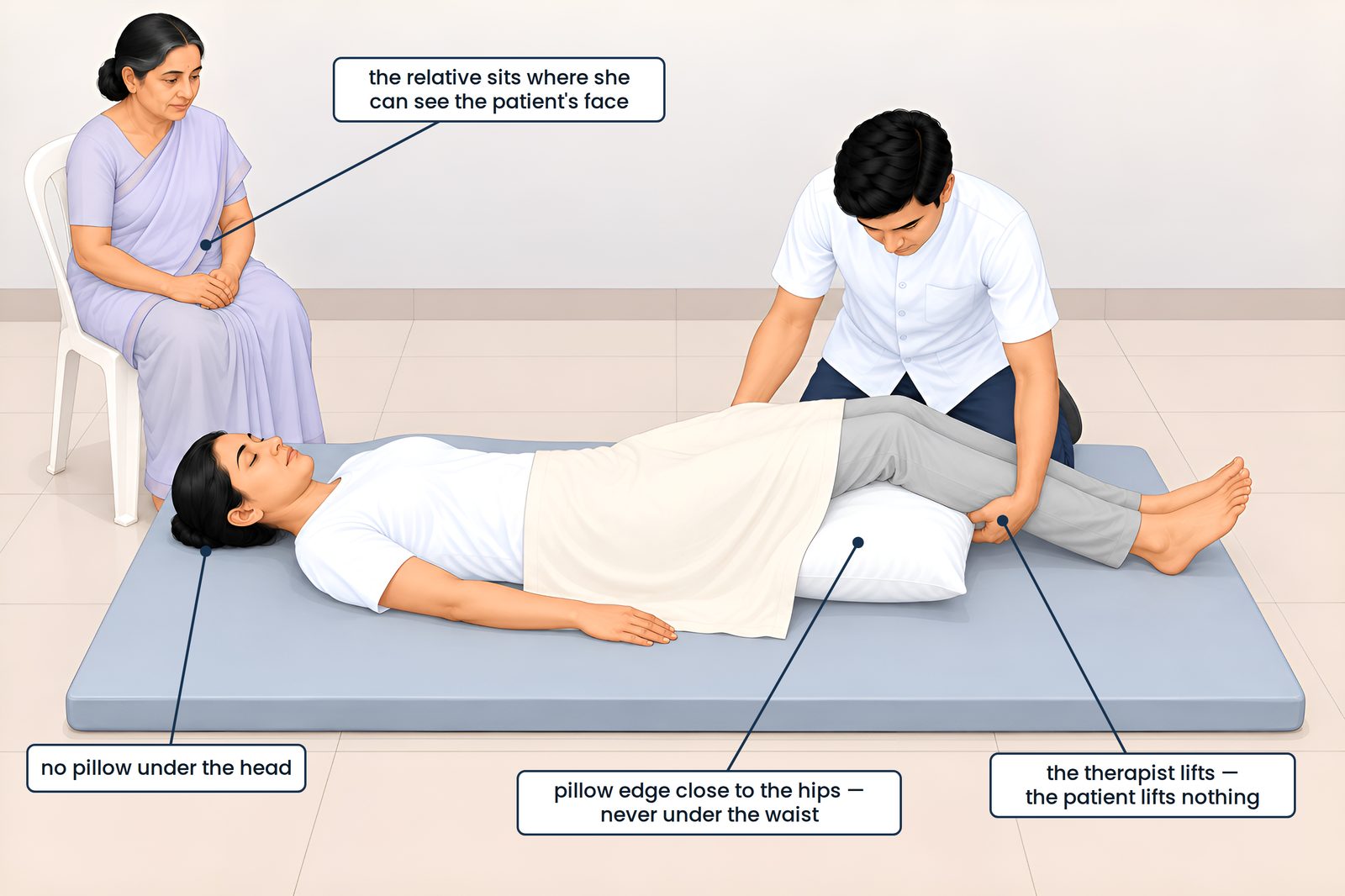
And even so — a warning for male therapists. As far as possible, when treating girls, women or small children, ask their mother, husband or some other relative to be present. Then there will be no hesitation on either side in giving or receiving the treatment. ▲ Take care
Note the wording: ask the relative to be present — not allow, not permit if requested. A patient will almost never ask for herself, because she would have to say, in front of you, that she does not entirely trust you. Offer it as routine; routine tells her that saying yes is not an accusation. And the stated reason cuts both ways — so there will be no hesitation on either side. (Figure 5.4)
Draping, and the conduct that makes a patient feel safe
This therapy is given over the patient's clothes; nothing is removed. Even so, a body lying flat and moved from position to position is exposed more than its owner intends, and she is the one person who cannot see it happening.
Lay a light cloth over the patient before you begin; uncover only the region you are working. A kameez or shirt is drawn down, not up.
Watch the turn — clothing rides and garments gape as a patient turns onto her side or front. Steady the cloth for her; she cannot.
Say what you are about to do before you do it, and never treat the abdomen, the groin or the chest without the patient having heard those words out loud.
The door stays unlocked; a curtain is better than a locked door. Nobody is asked to remove anything. Personal remarks: none. No treatment for a patient who is not fully awake and able to speak.
When she says stop, you stop mid-application, not at the end of the six seconds; afterwards cover her before you stand up.
The test of all of it: would I be content for my own mother to be treated exactly as I am treating this person?
The spirit of the work
The ashram fire, and the mantras that open and close a day of study
Every day of study opens with three Sanskrit verses and closes with three others. A practice tells you what it thinks it is by what it asks for at the start of a day.
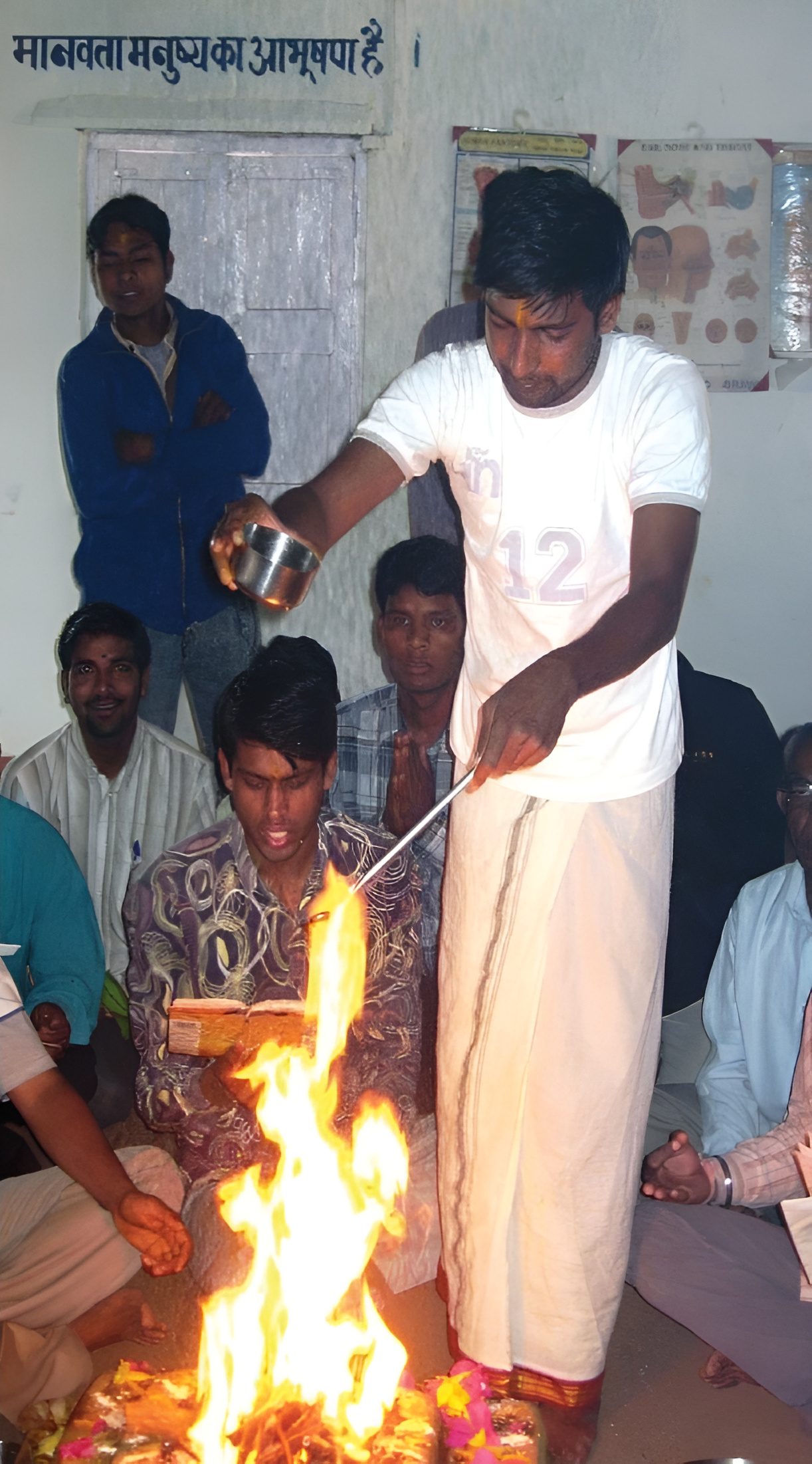
The fire at the ashram. Two photographs are kept from the twentieth training batch. The first, of 11 April 2007, is captioned आश्रम में गायत्री हवन करते वक्त प्राप्त मैया का त्रिशूल धारिणी रूप — "the trident-bearing form of the Mother, received while performing the Gayatri havan at the ashram". The second, of 17 January 2007, is captioned गायत्री हवन में पूर्णाहुति करते वक्त प्राप्त मैया का चित्र — "the image of the Mother, received at the moment of the pūrṇāhuti". A third, smaller photograph carries the line आश्रम में अग्निहोत्र रोज किया जाता है — "Agnihotra is performed daily at the ashram". And along the classroom wall, painted beside the anatomy charts: (Figure 5.6)
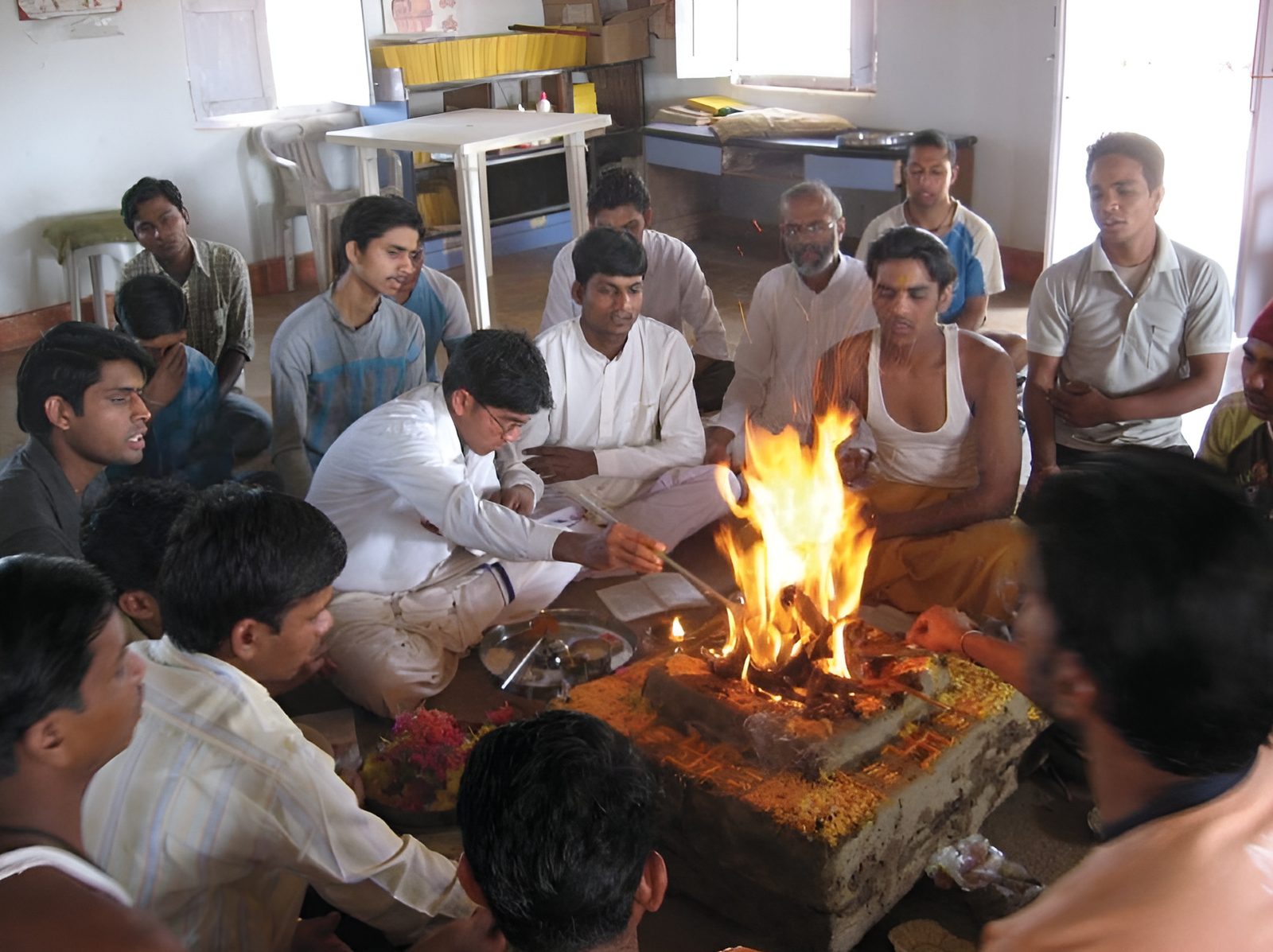
The account stands as it is given: at those two fire-offerings the form of the Mother was seen in the flame, and the photographs were kept. It belongs to the devotional life of a community that gathers on a classroom floor around a brick fire-pit before going out to treat the sick, and is nowhere claimed to be an account of how the therapy works. Agnihotra, the daily fire oblation of sunrise and sunset, is among the oldest ceremonies still performed anywhere; a havan is the larger offering, closed by the pūrṇāhuti. (Figure 5.7)
Why the class invokes anything at all
The wonderful power that is running this great universe has many aspects, which we human beings call by different names.
The ordinary person cannot see them with the naked eye, but our ancestors were able to feel them during meditation; some people today feel one of them, called pranic energy or the aura, which it is even possible to photograph by Kirlian photography.
Even small children know that we are surrounded on all sides by radio, television, mobile and who knows what other waves. In just the same way, our ancestors knew that we are surrounded by every power that runs this world. They are of the nature of waves, and that is why we cannot see them. But there can be no place at all where those powers are not present. Whatever we ask for with a true heart, they will certainly give.
Join both hands in the namaskāra mudrā. Take the attention to the ājñā cakra — the place where the tilak is applied. After only a few days of practice you will feel that, while saying the mantra, waves of some kind are entering into you.
The three mantras said at the beginning of study
Palms joined at the chest, attention between the brows, one long easy exhalation to a line — and the three śāntis slowest of all.
1 — The Sarasvatī invocation
ॐ सरस्वति नमस्तुभ्यं वरदे काम रूपिणी । विद्या आरंभम् करिष्यामि, सिद्धिर्भवतु मे सदा ॥
oṃ sarasvati namas tubhyaṃ, varade kāma-rūpiṇi | vidyā-ārambham kariṣyāmi, siddhir bhavatu me sadā ||
Oṃ. Salutation to you, Sarasvatī, giver of boons, you who take whatever form is desired. I am about to begin my study: may accomplishment always be mine.
2 — The Dhanvantari invocation
ॐ नमो भगवते वासुदेवाय धन्वन्त्रये, अमृत कलश हस्ताय, सर्वामय विनाशाय, त्रैलोक्य नाथाय, श्री महाविष्णवे नम: ।
oṃ namo bhagavate vāsudevāya dhanvantaraye, amṛta-kalaśa-hastāya, sarvāmaya-vināśāya, trailokya-nāthāya, śrī-mahāviṣṇave namaḥ |
Oṃ. Salutation to the Lord Vāsudeva, to Dhanvantari, who holds in his hand the pitcher of the nectar of immortality, who is the destroyer of all disease, the master of the three worlds — to the glorious Great Viṣṇu, salutation.
3 — The śānti pāṭha of teacher and student
ॐ सह नाववतु । सह नौ भुनक्तु । सह वीर्यं करवावहै ॥ तेजस्विनावधीतम् अस्तु । मा विद्विषावहै ॥ ॐ शान्तिः शान्तिः शान्तिः ॥
oṃ saha nāvavatu | saha nau bhunaktu | saha vīryaṃ karavāvahai || tejasvi nāv adhītam astu | mā vidviṣāvahai || oṃ śāntiḥ śāntiḥ śāntiḥ ||
Oṃ. May the Divine protect us both together. May it nourish us both together. May we together work with vigour. May what we have studied together be full of light. May we never hate one another. Oṃ, peace, peace, peace.
Three glosses are given with them. Do not take Sarasvatī to be merely a name — she is the symbol of a power that signifies the storehouse of knowledge, and the capacity to receive learning and to bring it into proper use; and siddhi means that we should become so accomplished that always — sleeping or waking, at any time whatever, according to the need — the right knowledge should come to our memory. Dhanvantari is the symbol of that divine power which is the protector of the health of all living beings: ordinarily every single cell of the body performs its own work smoothly, because of which it does not allow any factor, blood pressure or sugar or salt, to go above or below a normal level — in English this quality of the body is called homeostasis. What is saluted at the start of the working day is therefore the body's own capacity to keep itself right.
Of the third: it is almost entirely in Sanskrit's dual number — nau, "of us two" — so it can only be said by both, about the pair they make. मा विद्विषावहै is the true touchstone of the guru–disciple tradition. The real guru shows no partiality among his disciples; he always wishes that the disciple should go further even than himself, and never feels envy at the disciple's progress. And the good disciple never thinks that Guruji loves some other disciple more than me. In many ashrams this third mantra is also said before meals, so that the one who cooks should cook with devotion, the one who serves should distribute with love, and no one should feel that another is being given more and I am being given less.
Why śānti is said three times
Our ancestors knew that when we wish to do any work at all, three kinds of obstruction can come to it. Over these three obstacles we have no control. That is why we ask the divine powers for the help of peace, so that our work may become free of obstruction and we may complete it in the right way. And while saying this, take a long breath and pronounce it remaining calm.
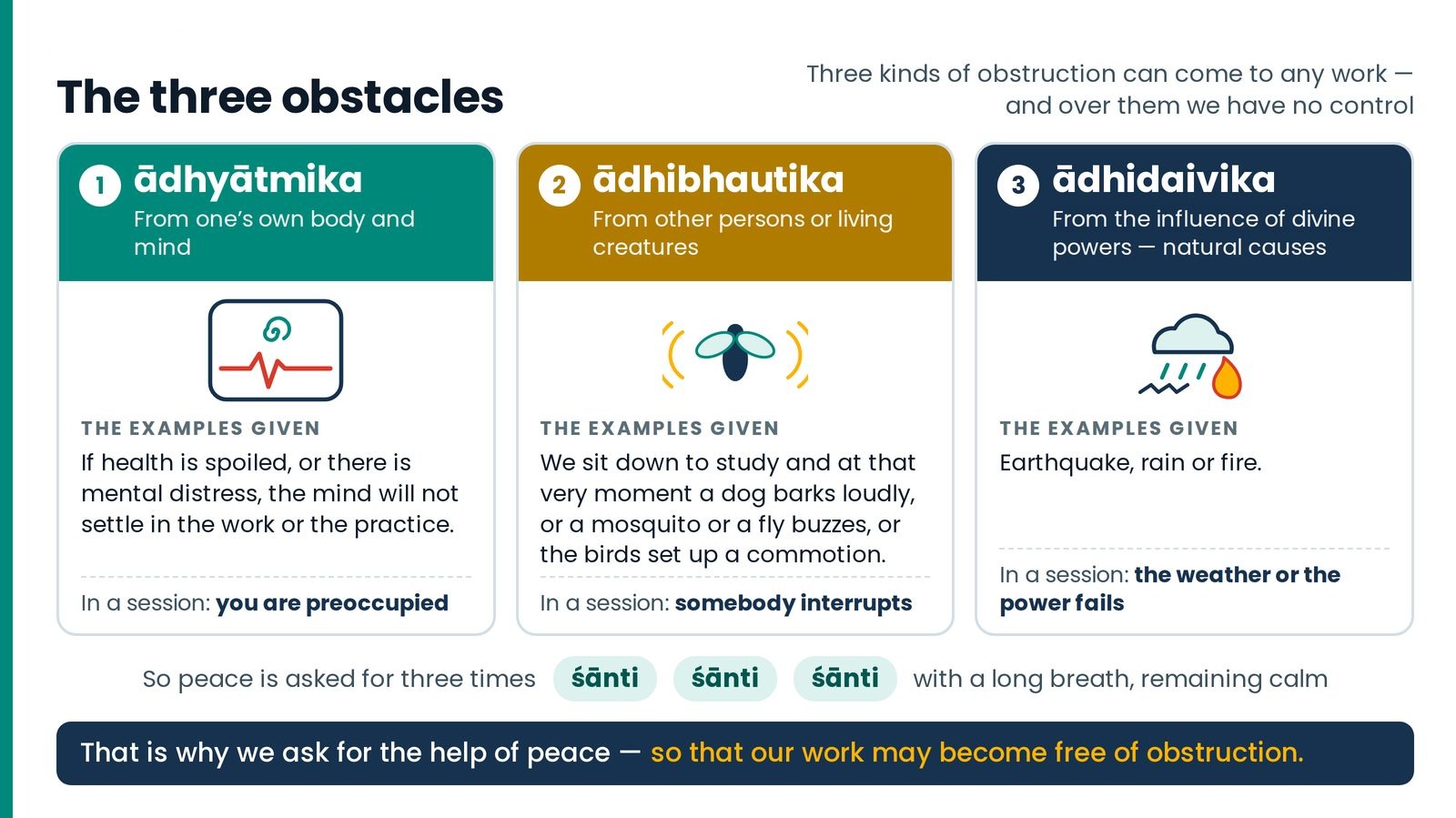
Those are the three things that ruin a session: you are preoccupied; somebody interrupts; the weather or the power fails. (Figure 5.8)
The well-wishing mantra, said at the close of every class
A class does not stop; it is closed — and this prayer runs outward first and only then back. The hands change shape with the meaning, which is the half most often lost when the verses are learned by ear.
1 — For the world and its government
ॐ स्वस्ति प्रजाभ्यः परिपालयन्तां न्याय्येन मार्गेण महीं महीशाः। गोब्राह्मणेभ्यः शुभम् अस्तु नित्यं लोकास्समस्ताः सुखिनो भवन्तु॥
oṃ svasti prajābhyaḥ paripālayantāṃ nyāyyena mārgeṇa mahīṃ mahīśāḥ | gobrāhmaṇebhyaḥ śubham astu nityaṃ lokāssamastāḥ sukhino bhavantu ||
Oṃ. May there be well-being for the people; may the rulers of the earth protect the earth by the path of justice. May there be perpetual good for cows and for the learned — and may all the worlds be happy.
2 — For everyone, without exception
सर्वे भवन्तु सुखिनः सर्वे सन्तु निरामयाः। सर्वे भद्राणि पश्यन्तु मा कश्चित् दुःखम् आप्नुयात्॥
sarve bhavantu sukhinaḥ sarve santu nirāmayāḥ | sarve bhadrāṇi paśyantu mā kaścit duḥkham āpnuyāt ||
May all be happy; may all be free of illness; may all see what is good; may no one, ever, come to sorrow.
3 — The eleven qualities asked for
ॐ श्रद्धां मेधां यशः प्रज्ञां विद्यां पुष्टिं श्रियं बलं तेजः आयुष्यं आरोग्यं देहि मे हव्यवाहन। ॐ शान्तिः शान्तिः शान्तिः॥
oṃ śraddhāṃ medhāṃ yaśaḥ prajñāṃ vidyāṃ puṣṭiṃ śriyaṃ balaṃ tejaḥ āyuṣyam ārogyaṃ dehi me havyavāhana | oṃ śāntiḥ śāntiḥ śāntiḥ ||
Oṃ. Faith, retentive intelligence, renown, insight, learning, nourishment, prosperity, strength, radiance, length of life, freedom from disease — grant these to me, O bearer of oblations. Oṃ, peace, peace, peace.
The first verse is a prayer for good government: the people will obtain svasti — wealth of every kind in abundance — only when the king governs the kingdom on the path of justice. Then the phrase that decides the character of the whole prayer: "समस्त लोक" — "the whole world": within this come all living beings, trees and plants, rivers and ponds, everything. For centuries our forebears have prayed, along with their own welfare, also for the welfare of other orders of living beings and of the environment.
The second verse asks that all be happy; all be nirāmaya, free of disease; everyone's outlook be bhadra, like that of good people; and no one ever have to undergo sorrow. Sarve bhadrāṇi paśyantu is read as a statement about the person looking: for health, the mind and the outlook must be such that at every moment nothing but goodness is seen.
Two textual notes stand as given: some scholars say "दुःख भाग् भवेत्" in place of "दुःखम् आप्नुयात्" — āpnuyāt is to obtain, bhāg bhavet is to undergo; the meaning of both is the same; and कश्चित् means "ever", so "मा कश्चित्" means "may it never be".
Table 3 — The eleven boons of the third verse, with their glosses
| The quality | What is meant by it |
|---|---|
| श्रद्धा śraddhā | Success will come only if there is full faith and dedication in the work |
| मेधा medhā | The capacity to reach the depth of knowledge and understand its subtleties |
| यशः yaśaḥ | Renown — acceptance of one's qualities spreading far and wide |
| प्रज्ञा prajñā | Chiefly knowledge of the soul; here, knowledge of all the aspects necessary for success |
| विद्या vidyā | Subject-knowledge |
| पुष्टि puṣṭi | A proper environment for the development of body and of mind |
| श्रियं śriyaṃ | Wealth and property of every kind |
| बलं balaṃ | Strength, and the capacity to do work of every kind |
| तेजः tejaḥ | That radiance by which, without recognising a person, we feel from a distance that they are worthy of respect |
| आयुष्यं āyuṣyaṃ | Length of life |
| आरोग्यं ārogyaṃ | A healthy, disease-free life. What is the use of a long life if there is no ārogya? |
| देहि मे हव्यवाहन | "Give me, O Agni Devatā" — havya, the things offered; vāhana, the one who carries: Agni, the postman of the gods |
Why Agni? The eleven powers are to be obtained from different energy centres, to which the names of different deities have been given, and Agni is that messenger who will carry our prayer to those deities — the postman, not the source of the gift. And in the obtaining of these powers the same three obstacles may come, so śānti is spoken three times at the end as well. The triple peace is therefore said twice in a day: to clear the obstacles to learning, and to clear the obstacles to receiving. Notice what none of the six verses asks for: not one asks anything for the practitioner alone.
Charging, or not charging
A nominal, stated, uniform fee — and four things never charged for
This therapy was given away. It was practised free for four decades before a nominal fee was ever charged; the training is free, with free lodging and a monthly amount for food much less than the food costs; the teachers take nothing; patients who could see no way ahead were taught the therapy free and taught to earn from it; and the Sunday clinic at the ashram treats villagers free, with food.
What may be charged for, and what may not
The blessing is the fee.
Their blessing is our real "fee", and it cannot be priced. That is a statement about what ranks first, not a prohibition on earning. A nominal fee is proper — a centre has rent, sheets, pillows and people, and a modest, stated, uniform amount is how it survives long enough to help anybody. That is the therapy's own history: free for decades, then a nominal fee, with the free work continuing alongside.
Four things must never be charged for:
Never charge for hope. No package, no course sold in advance, no "twenty sessions and your son will walk".
Never let the fee decide the plan. The pain points decide — so long as any treatment reduces the pain of the pain points, there is no need to change it and give another — and when the complaint is gone the course ends.
Never charge a person who cannot pay. The stated goal is a centre in one village in six.
Never charge for the teaching, in the manner of a secret — Guruji's habit was to share whatever he found, at once and free, unlike those who keep their findings secret in order to charge for them.
And the sentence that governs all four: Do not take wrong advantage of a patient's illness.
Three tests settle most cases. Disclosure: the fee is stated before the first session, in a number, the same for everyone who can pay it. The direction of your advice: if plans lengthen for the prosperous and shorten for the poor, you know the answer. The free half: carry some work that pays nothing — a camp, a Sunday, a household taught to treat its own patient at home.
Questions students ask
- 1. I feel ridiculous touching a patient's feet. Must I? Yes, and the awkwardness is the point — postures work on the person holding them. If a patient is startled, say what it is for: "I am about to treat you with my feet."
- 2. I am sixty-eight and cannot hold my weight on two chairs for half an hour. You are not meant to: the treatment is a series of six-second holds with gaps, and for the very small, the old and the weak the pressure is given with the hand anyway.
- 3. I have no science. Why does a pillow under the waist cause back pain and one under the knees not? Lie on the floor and slide a hand under your low back: there is a gap, and holding it open is work. A pillow props that arch open all session; under the knees, the back settles flat and the work stops.
- 4. I am a physician. What is your consent standard? Disclosure of what will be done and where, in the patient's own language; that it should not hurt; an explicit right to withdraw at any moment; the offer — not the mere permission — of a chaperone; draping; a note on the record. We add that consent is renewed for any new region, and taken while the patient is still sitting up.
- 5. I am the only therapist at a village centre and there is nobody to be a chaperone. Then the relative comes with her, and you say so when the appointment is made, not at the door. Where a woman genuinely arrives alone, work with the door open, keep to the regions you named aloud, and write on the card that no chaperone was available and that it was discussed.
- 6. A patient asked me to press harder — the last therapist gave more weight. Weight is not the variable; the place, the angle, the count and the order are. Then re-examine: a request for more weight is usually a report that something is not moving. See also → Six Seconds, "Six Seconds".
- 7. How many stations on a thigh? My teacher says three and my feet are small. Three is what it usually comes to; the rule is that no space is left empty from one joint to the other. A tall patient may need four, a therapist with small feet five, a very small child two.
- 8. Everything here takes time I do not have. Fifteen patients are waiting. Then fifteen must not be booked: every rule here takes seconds and prevents something that costs hours. See also → The Record That Shows the Truth, "The Record That Shows the Truth".
Questions patients ask
1. "You are going to put your foot on my stomach? On me?" I stand between these two chairs and my weight goes onto my arms — only a small part of it comes down through my foot, and I can take it all back in an instant. The sole is broad and soft in the middle, so the pressure is spread out; that is why this does not sting the way a thumb on one spot does. It will be over your clothes, and you will be covered. And before I begin I will bow and touch your feet, because in our country a foot means something.
- 2. "Can my daughter sit with me?" Please — I would have asked you if you had not. Most people prefer it, and it is quite usual.
3. "What if it hurts? I do not want to make a fuss." Then say so at once — it is the one thing I need from you during the treatment. This should feel like firm pressure and should not hurt; if it does, I change the angle and we carry on, and the treatment loses nothing by it. If you feel pain and say nothing, the pain may remain afterwards, or you may feel weak. And you may tell me to stop at any moment, without giving a reason.
- 4. "Why do you not talk to me? Are you annoyed?" I am counting — every press is held exactly six seconds. Between each part of the treatment there is a gap, and in that gap I will ask how you are feeling; that is when you tell me everything, including anything you did not like.
- 5. "You say prayers before the class. Is this a religious treatment? I am not a Hindu." No. The prayers are how the teaching is opened and closed at the school, the way a school anywhere has an assembly; the treatment itself is pressure, at particular places, for particular counts. Nobody is asked to believe anything or say anything.
- 6. "How much will this cost? I have already spent a lot." The fee is the same for everybody and I will tell you the amount before we start. Each week I will tell you roughly how many sessions I think you need and why, and if your pain points settle sooner we stop sooner. If there is a week when you cannot pay, tell me — you come anyway.
Words used here
| Hindi | English | Neurotherapy code / usage |
|---|---|---|
| लिबाज (libāj) | Dress, attire | Whole body covered; neither tight nor very loose |
| नमन (naman) | Salutation, bowing | Touching the patient's feet with both hands before the treatment begins |
| तकिया (takiyā) | Pillow | Positioning, not comfort — never under the head, never under the back |
| कुर्सी (kursī) | Chair | Two, upturned; the instrument by which the therapist's weight is carried on the arms |
| श्रद्धा (śraddhā) | Reverent faith | Whatever reverence is in your mind arises in the patient's |
| — | Chaperone | A third person present, offered by the therapist and not merely permitted; recorded on the card |
| चादर / दरी (cādar / darī) | Sheet, mat | Pulled flat with the palm; a fold in the middle digs into the back |
| भरोसा (bharosā) | Trust | With śraddhā, said to play the principal role in this therapy |
| हवन (havan) | Fire offering | Performed daily at the ashram; closed by the pūrṇāhuti |
| शान्ति (śānti) | Peace | Said three times, for the three obstacles, with a long unhurried breath |
| — | Draping | Covering all but the region being treated |