- Category
- Glands, hormones, thyroid and diabetes
- What is given
- See Height, low
- What is barred
- Lt. Ov. · Rt. Ov. · WD · Ton 'P' · Ton 'T' — no substitute is named for any of the five, and none is to be invented. And (2) Pan; and (6) Medulla between 13 and 20
- Explained in
- The Child, the Elder and the Frail
Watch


From The Child, the Elder and the Frail
Lighter formulas exist, and they are named
The light version is not a dilution — sometimes it is said to be better
The last kind of adjustment in this part is not made by the therapist at all. It was made when the formula was written. Several of the most-used formulas exist in a heavy version and a light one, and the light version is not a dilution — in more than one case it is described as better.
| The formula | The lighter form, and what is said about it | Where it is taught |
|---|---|---|
| Jeevan Dhara | The heavy four-part version was made lighter, in five parts, in which the results are better still. It may be given to persons of any age, and to a patient of any age to remove fatigue or weakness in the body | APR — Abdominal Pain |
| VTF (the viral treatment formula) | VTF (Mild) — (1) Lymph (1) point Spl (1) Th. Only × 6 trt. — is beneficial for everyone, may be given even after fever has come, and is also suitable for small children. Not to a patient with an auto-immune disorder, because provoking the lymphocytes may increase their disease | Fire and Swelling |
| Ajay Normal Mild, Mild Kidney Clear, Mild Genes | Named mild members of their families, used as the parts of the light Jeevan Dhara | Setting the Stomach · Vitamin and Gene Formulas · Water and Salt |
| Organ Clearance | The general remedy that gives benefit to everybody; and this treatment may be given to small children and to elderly people daily, or even twice a day | Face Down |
That last line is the one to write on the card of a very old patient. Organ Clearance, daily or twice a day, for small children and elderly people, is a written permission for a frequency that would be unusual in an adult course, and it fits the two groups for whom a long single session is hard and a short frequent one is easy. The name says what it does: it removes the obstructions of the blood arteries going to all the organs of the body, by which the pain of the organs beside the navel comes out.
And Jeevan Dhara carries an observation about old people that is worth quoting to their families. The treatment from which the abdominal pain comes out at once also produces, even in the elderly, and in those who have no particular complaint, an immediate freshness and briskness; many to whom it was given began to say that they had received a new life — which is where the formula's name came from. Especially to people of greater age, after this treatment is given, it feels as though they have obtained new life.
This is the page this article exists for.
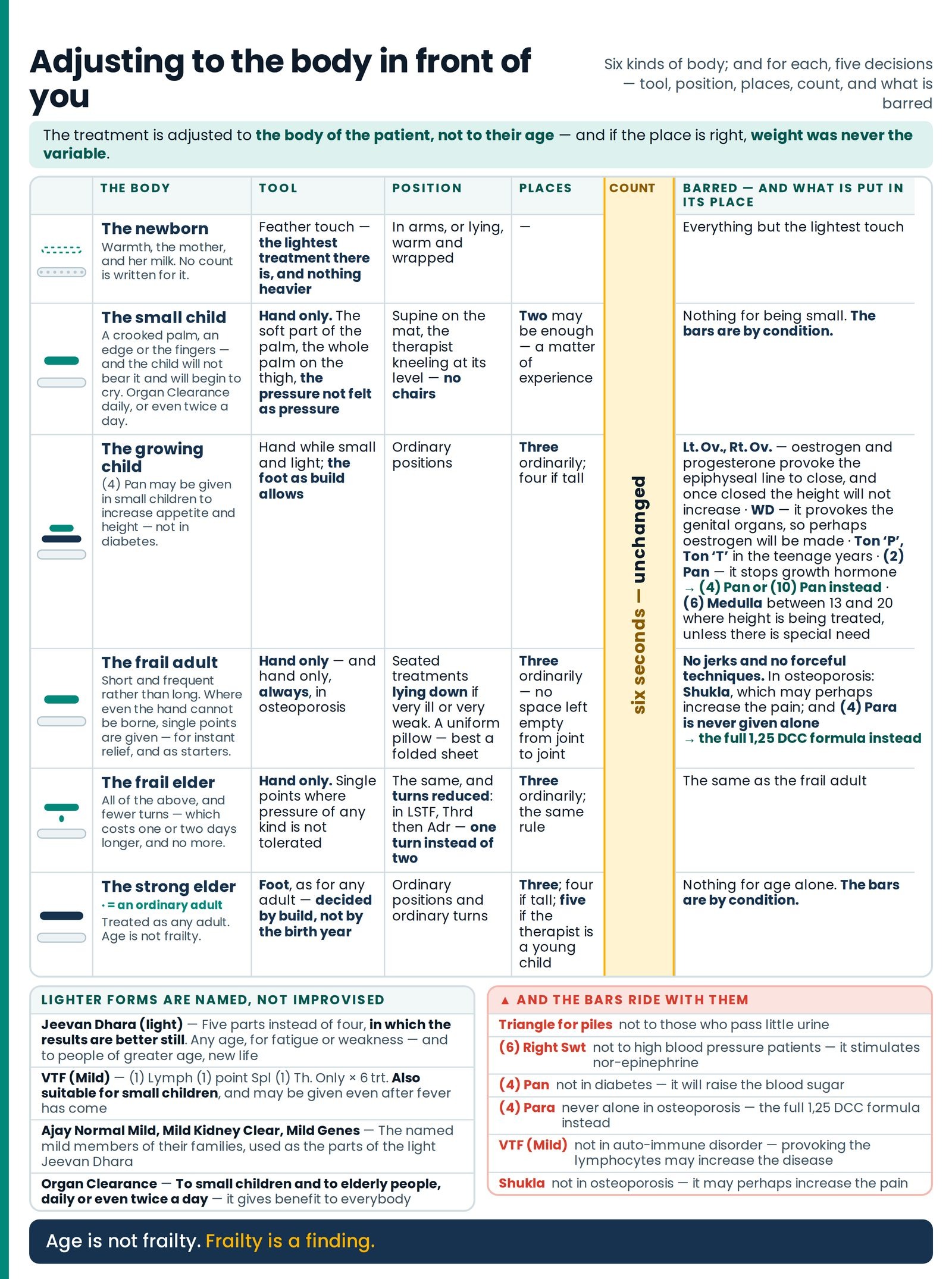
Every rule in it is taught in its own place, beside its own point or in its own article. Gathered, they become a single sheet you can look at with a frightened three-year-old on the mat and a mother watching your face.
Table 1 — The body in front of you, and what changes
| Newborn | Small child | Older child (growing) | Frail adult | Elderly — frail | Elderly — strong | |
|---|---|---|---|---|---|---|
| Tool | Feather touch — the treatment for the patient who can be given nothing else | Hand only. The soft part of the palm, whole palm on the thigh, pressure not felt as pressure | Hand while small and light; the foot as build allows | Hand only — and hand only, always, in osteoporosis. If even the hand cannot be borne: single points as starters | Hand only. Single points where pressure of any kind is not tolerated | Foot, as for any adult — decided by build, not by the birth year |
| Position | In arms, or lying, warm and wrapped | Supine on the mat, therapist kneeling at its level — not standing over it, no chairs | Ordinary positions | Seated treatments may be given lying down if very ill or very weak. Uniform pillow — best a folded sheet — where muscles are very weak | The same; and turns reduced: LSTF given Thrd then Adr, one turn instead of two | Ordinary positions and ordinary turns |
| Places along a limb | — | Two may be enough — a matter of experience | Three ordinarily; four if tall | Three ordinarily — the rule is that no space is left empty from joint to joint | Three ordinarily; same rule | Three; four if tall; five if the therapist is a young child |
| Count | — | Six seconds, unchanged. The number written, unchanged | Six seconds, unchanged | Six seconds, unchanged. Physical points may be given one or two times more for comfort | The same | |
| Duration where a ceiling is written | — | Pelvic: 90 seconds maximum — if the patient cannot bear it, reduce the time | The same | 90 seconds | ||
| Frequency | — | Organ Clearance daily, or even twice a day | Ordinary | Ordinary; short and frequent rather than long | Organ Clearance daily, or even twice a day | Ordinary |
| Barred | Everything but the lightest touch | Nothing barred for being small; the bars are by condition | Lt. Ov., Rt. Ov., WD, Ton 'P', Ton 'T' in the teenage years; (2) Pan and (6) Medulla where height is being treated | Osteoporosis: Shukla — it may perhaps increase the pain. Every jerk and every forceful technique | The same as the frail adult | Nothing for age alone; the bars are by condition |
| Substituted | — | (4) Pan or (10) Pan in place of (2) Pan | The full 1,25 DCC formula in place of (4) Para alone | The same | — | |
| Given particularly | Warmth, the mother, her milk | Organ Clearance; VTF (Mild); TF reversed in ordinary loose motions; Rt. Chest only within the first few sneezes; Triangle for piles for control of urine | (4) Pan to increase appetite and height | Jeevan Dhara, light version, for fatigue or weakness at any age; single points for instant relief | Jeevan Dhara — new life; Organ Clearance; Triangle for piles for control of urine; (6) Right Swt for drops of urine on laughing or sneezing | The whole atlas |
Two columns that are not in the table, because they are not a body type. Pregnancy is Treating Women's and has its own gathered table of twenty-six withholdings. Every disease and condition with its blocked points is When the Hand Must Stop's. Use all three sheets together: this one asks what kind of body, Treating Women asks what state is she in, When the Hand Must Stop asks what disease does he have. A patient can be caught by all three at once. (Figure 41.4)
The mother's half of a birth — the room, the pain, the smell, the cord, her milk, her water, her calcium and her rest — is Treating Women's, and is not repeated here. What follows is the child's half, taught whole. It begins on the same page where that article stopped.
The fluid the child has lain in, and why it is not washed off
The fluid in which the child stays inside the mother's belly is antiseptic — that is, germ-killing — which Hari has made so that it will protect the child's skin from external germs.
Since the child has stayed in wet amniotic fluid, from that there are wrinkles all over its body; therefore it should be lightly cleaned with warm water, wrapped in a soft blanket and given rest, and must certainly be given to the mother, so that the warmth of her body is remembered by it all its life, and this itself will bring it comfort.
So immediately after birth that fluid should not be cleaned off completely; it should be cleaned slowly, slowly, after seven days.
But nowadays in nursing homes, only a short while after birth, the child is fully washed and scented powder is applied on it — which is perhaps not right for its body — and only afterwards is the child given to the mother. This is a matter to think about.
Take that apart carefully, because four separate instructions are folded into it and a therapist asked about it in a corridor will need all four. (Figure 41.5)
One — what the coating is said to be. Antiseptic; germ-killing; made so that it will protect the child's skin from external germs. That is a statement about function, and it is the reason for everything that follows.
Two — what is done on the first day. The child is lightly cleaned with warm water — not washed, cleaned, and with warm water rather than cold. Then wrapped in a soft blanket. Then given rest. Then given to the mother, and the word used is certainly.
Three — the seven days. The coating is not cleaned off completely immediately after birth; it is cleaned slowly, slowly, after seven days. Slowly, slowly — dhīre dhīre — is the instruction, and it describes a week of ordinary careful handling rather than an event.
Four — the hedge, which is kept exactly. Of the nursing-home practice of a full wash and scented powder, what is said is perhaps not right for its body, and this is a matter to think about. It is not stated as a prohibition and it is not to be taught as one. A therapist who converts perhaps not right into never do this has made the material say something it declined to say — and a family who is later told by a good doctor that a bath is not harmful will then distrust the twelve things you told them that were exact.
Also explained in
- What is given to a small child at the mat The Child, the Elder and the Frail
It is is this plate still open, and is this course meant to use it? Blocked in the teenage years: Lt.
- Questions students ask The Child, the Elder and the Frail
The ovary points and WD are worded around the teenage years and around low height.
- The warnings that shape a plan — blocking From Findings to a Plan
Table 2 — The conditions, and the points blocked in each Disease or condition Blocked points Autoimmune disorders, arthritis, inflammation / polio Th · Th+Ch · Lymph · Armpits · Ton 'P' · Ton 'T' · Spl Asthma Spl · Thrd
- Before she is a mother — the years that carry their own bars Treating Women
he epiphyseal line, and a bar reasoned from mumps in boys One group of withholdings in this wiki falls on girls and young women for reasons that belong to this article, and they are set out where the teenage years are
- The cord Treating Women
Girls and boys whose height is low, or who are being treated to increase height Oestrogen and progesterone provoke the epiphyseal line to close early; if it has closed, the height will not increase The Front of the Body II · Each Point in Use · The Child, the Elder and the Frail WD