- Category
- Blood
- What is given
- Neck ghisai — the first stage with light hands; Necklace; Raman; Sudhakar; (11) Medulla; M. Heparin; (11) Left Medulla where the neck will not turn towards the good side
- What is barred
- Pressure on the front or sides of the neck is never given, in any treatment, whatever a card says. None within three months of a stroke or passing weakness, numbness or loss of vision; none with a goitre, swelling, or a thyroid running fast. New or unusual neck pain with headache ends the session
- Explained in
- Seated I — Brain, Medulla, Neck
Watch
From Seated I — Brain, Medulla, Neck
The standing rules of every seated treatment
A firm chair, three stances — and glide, never thrust
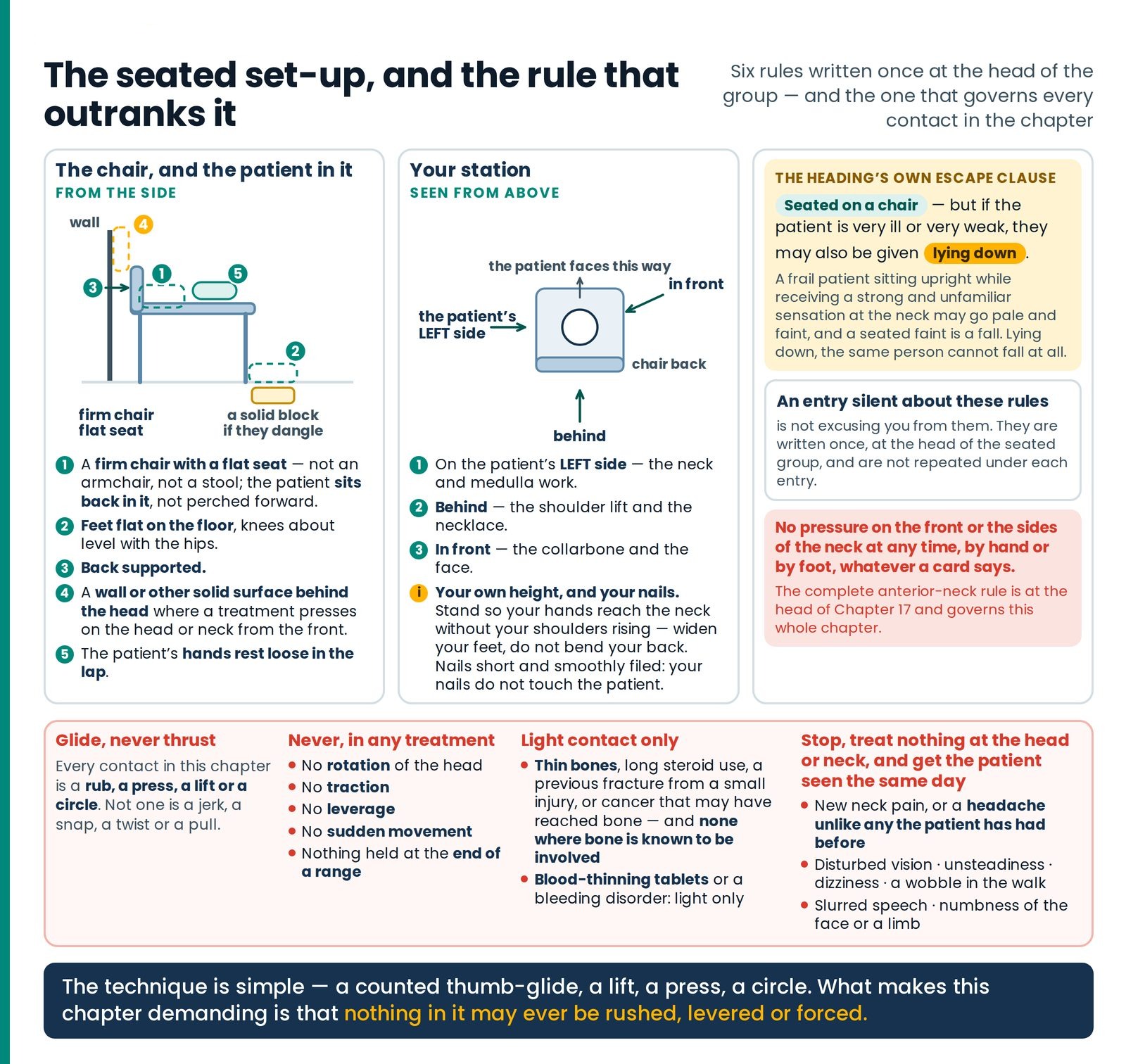
These are written once, at the head of the seated group, and are not repeated under each entry. An entry silent about them is not excusing you from them. (Figure 18.1)
The four positions and their rules — including the seating method in full — are taught in Placing the Patient, "Placing the Patient". What follows is the check-list to run before your thumbs go anywhere near a neck.
The six rules that hold for every point in this article
1. The heading of this group, and its own escape clause.
These treatments are given with the patient seated on a chair — but if the patient is very ill or very weak, they may also be given lying down.
That is a rule, not a courtesy. A frail or unwell patient sitting upright while receiving a strong and unfamiliar sensation at the neck may go pale and faint, and a seated faint is a fall. Lying down, the same person cannot fall at all. Seated Supine
2. The chair. A firm chair with a flat seat — not an armchair, not a stool — and the patient sits back in it, not perched forward.
3. The feet and the back. Feet flat on the floor, knees about level with the hips; if the feet dangle, put something solid under them. Back supported, and where a treatment presses on the head or neck from the front, a wall or other solid surface behind the head.
4. The hands. The patient's hands rest loose in the lap.
5. Your own height, and your nails. Stand so your hands reach the neck without your shoulders rising — widen your feet, do not bend your back. And nails short and smoothly filed: here the thumbs and fingertips are the instruments and the skin under them is thin. Your nails do not touch the patient.
6. Your station. Three stances, each named in the treatment that uses it — on the patient's left side for the neck and medulla work, behind for the shoulder lift and the necklace, in front for the collarbone and the face. The stance is part of the point.
And the rule that outranks all six.
The anterior neck is governed from The Front of the Body II and is not restated here. The complete rule — no pressure on the front or the sides of the neck at any time, by hand or by foot, whatever a card says; what lies there; and the conditions under which it bites — is set out in full at the head of The Front of the Body II, "The Front of the Body — II". Read it before you give a single point in this article. Several points here work close to that boundary, and each one says below what its own boundary is.
Also explained in
- Endorphin — एंडोर्फिन Seated I — Brain, Medulla, Neck
Neck pain that arrived with a wobble in the walk or a change in the voice is the same.
- Necklace — नैकलेस Seated I — Brain, Medulla, Neck
Together they are a pattern that must be excluded before any hand touches that neck — a tear in the wall of a neck artery, which announces itself as neck pain and headache, often with a drooping lid, and before the strok
- Shivaji — शिवाजी Seated II — Face, Jaw, Ear, Sinus
It also gives relief in neck pain.
- The position is the treatment On the Side
Especially for those who have neck pain or cervical spondylosis, this precaution is compulsory.
- 1986 — the year the work stepped outside the house The Man Who Would Not Accept 'Incurable'
In the year 1976, in the account kept of the centre itself, he gave this therapy the name "Neurotherapy" — the same account which says the foundation of the therapy was laid in Mumbai some forty years ago, in the year 19
- Charging, or not charging Before You Touch Anyone
Shankarrao Deshpande · 66 · retired postmaster · Nanded · came with neck pain, giddiness on turning the head, and "new" low back pain of six weeks What he said.
- The back pain chart The Navel Speaks First
No abdominal pressure at all, and not a muscle until a doctor says so Back pain with a cancer history, unexplained weight loss, night pain that wakes the patient, fever or recent serious infection; thin bones or long-ter
- Position one — supine Supine Placing the Patient
In all the side-lying treatments a pillow under the head is needed, so the neck rests comfortably; for those who have neck pain or cervical spondylosis this precaution is compulsory.
- Position three — side-lying Side-lying Placing the Patient
Especially for those who have neck pain or cervical spondylosis, this precaution is compulsory.
- The rule that governs the head end The Front of the Body II
New neck pain or a headache unlike any the patient has had before, with disturbed vision, unsteadiness, dizziness, slurred speech, or numbness of the face or a limb: stop, treat nothing at the neck, and get the patient s
- Stretch (स्ट्रेच) The Front of the Body II
Excellent for respiratory diseases and for mild neck pain.
- What this article hands to the next On the Side
WHAT TO CARRY AWAY A pillow under the head in every one of these treatments — compulsory for neck pain or cervical spondylosis — and a pillow between both thighs in all of them.
- The rule printed at the foot of every page Face Down
The condition under which it bites hardest is a neck already stiff — neck pain or cervical spondylosis — but it is written for everybody, and it is called compulsory.
- UPPER SHOULDER BLADE PAIN — given with the feet Uncommon Problems
Is there new or unusual neck pain with headache, or any disturbance of vision or balance? Then nothing is pressed on that neck at all, today or until a doctor has looked.