That sentence has stood at the front of this wiki since The Hand That Heals, and every article since has been written for the body in the middle of it: an adult, of ordinary build, who can lie down and get up, turn over, hold a position, and tell you honestly when something hurts. Forty articles of points, counts, angles, orders and formulas have assumed that body.
This article is about the two ends of the sentence, and about everybody in between whose body will not take what an ordinary body takes. The newborn. The small child. The older child, who is still growing and whose growing is itself a thing that can be spoiled. The frail adult of forty whose bones break at a knock. The elder of eighty who must be helped onto the mat, and the other elder of eighty who walks five kilometres a day and can take everything in the atlas.
Two things must be said before we begin, because the whole article turns on them.
First: this is not a article of softer treatments. A student arrives expecting to be told to press more gently, and finds instead that the adjustments are different decisions, made for stated reasons — a different tool, a different position, a different number of places along the thigh, a substituted point, a barred point, a treatment given lying down that is ordinarily given seated, an order reversed to save a frail spine one turn. Weight is very nearly the only thing that is not adjusted, because weight was never the variable. The Hand That Heals established that: in this therapy we press the blood vessels so that the flow of blood goes towards those glands where it was not reaching before; weight has no part in this. Even if the therapist is of low weight, or applies less pressure, if the place is right the treatment will be just as effective. A therapy that did its work by force would have nothing to offer a two-year-old. This one has a great deal, precisely because it does not.
Second: the reason is the teaching. As in the three articles before this one, every rule here carries the reason that is given for it; where no reason is given, the rule is given plainly and none is invented. You will meet several bars in this article whose reasoning is stated with beautiful precision — the growth plate of a child's long bones is the finest of them — and one or two that stand bare. See also → Between Two Sessions, "Between Two Sessions", which established that principle, together with the two working methods this article assumes: reconstruct a day, never audit a rule, and two rules to a visit, not eleven.
Before any of the specific rules, learn the question that chooses between them. It is not how old is this patient. Age is a poor instrument. It is the commonest instrument, and it is wrong often enough to be dangerous in both directions.
The eighty-year-old who is strong. Men and women arrive at eighty having walked every day of their lives, eaten at fixed hours, slept properly and never broken a bone. Such a patient gets up off the floor without a hand on anything, turns prone and back without being asked twice, and takes an ordinary adult treatment as an ordinary adult. To give him a thin, cautious version of the therapy because of the number on his card is not kindness; it is a decision made without looking, and it will make his course longer for nothing.
The forty-year-old who is not. And into the same room walks a woman of forty who has been on steroid tablets for eleven years for another disease, or who has been in bed for five months, or who has had cancer treatment, or who has a spine that has already given way once. Age says treat her as an adult. Her body says otherwise, loudly, if you know what to look at.
Frailty is a finding, not a birthday
The decision is made from what you see, feel and are told — in this order, and every one of them before the first point is given.
What she tells you, or her family tells you. How does she get up in the morning — by herself, holding something, or lifted? How far does she walk in a day, and when did that change? Has she fallen, and how many times? Has any bone ever broken, and from how small a knock? Is she on steroid tablets, and for how long? Has she been in bed for a long stretch? Has she lost weight without trying? Does she have osteoporosis — and if the word means nothing to her, has any doctor told you your bones are thin?
What you see when she comes in. Whether she was helped through the door. Whether she got down onto the mat or was lowered onto it. Whether she can turn onto her side without help. Whether the skin over the shin and the back of the hand is thin enough to see the vessels through.
What your hand finds when you examine. This is the part a therapist has that nobody else has. Under your fingers at the navel you are already grading the give of the tissue — see also → The Educated Hand, "The Educated Hand", for the plus-and-minus scale. In a frail body the muscle over the thigh is thin and slack, the bony ridges of the pelvis and the ribs stand up under the skin, and there is nothing between your hand and the bone. A therapist who has palpated two hundred abdomens can feel the difference between thin and frail in about four seconds, and the difference is that in frailty there is no padding anywhere.
Then the rule. If two or more of those point the same way, treat the body and not the age. It is always permitted to treat a strong patient as a frail one for the first session and move up. It is never permitted to discover frailty afterwards.
And keep the patient's own report at the centre of it. The standing rule of every session applies here with more force than anywhere else in this wiki: if the patient screws up their face, or tells you that it is hurting, then without arguing change the angle of your foot or reduce the weight. Only they know the pain; you do not. So do not think, "I have seen many patients, nobody has ever said such a thing." The reason the material gives is entirely practical — sometimes, out of fear of that pain, the patient does not want to take treatment from that therapist, or becomes so negative towards the therapy that they stop coming to the centre altogether; arguing in this way will damage both you and the therapy. See also → Before You Touch Anyone, "Before You Touch Anyone".
With a child and with a very old person there is a complication in that rule, and it must be said plainly. Neither of them reports pain the way an adult of forty does. A small child does not say that is uncomfortable; it either tolerates or it screams, and by the time it screams you have already lost it. A very old person, and particularly a very old person in somebody else's house, very often will not complain at all — out of politeness, out of not wanting to be a burden, out of a lifetime's habit of bearing things. So with both of them you stop relying on the sentence and start reading the face, the hands and the breath: a small frown, a hand that comes up off the mat, a breath held. And with the elder you ask afterwards, of the daughter-in-law and not of the patient: was he stiff that evening? did he sleep?
The first adjustment, and the largest, is what part of the therapist reaches the patient.
The rule of the tool
To very small children, and to old and weak persons, treatment is given with the hands.
To persons of greater build, it is given with the feet.
And, printed among the precautions to be taken before beginning any treatment, in its own bordered panel:
Small children, very weak persons, and any patient with osteoporosis are to be treated with the hand only.
Read the two statements together and notice that the second adds a group the first does not name. Old and weak persons is a description of a body; osteoporosis is a named condition, and it appears in the rule whatever the patient's age and whatever their build. A woman of fifty-two with thin bones after the menopause is a hands-only patient although she looks entirely well, walks in unaided, and would be affronted to hear herself called frail. You do not have to call her anything. You use your hands.
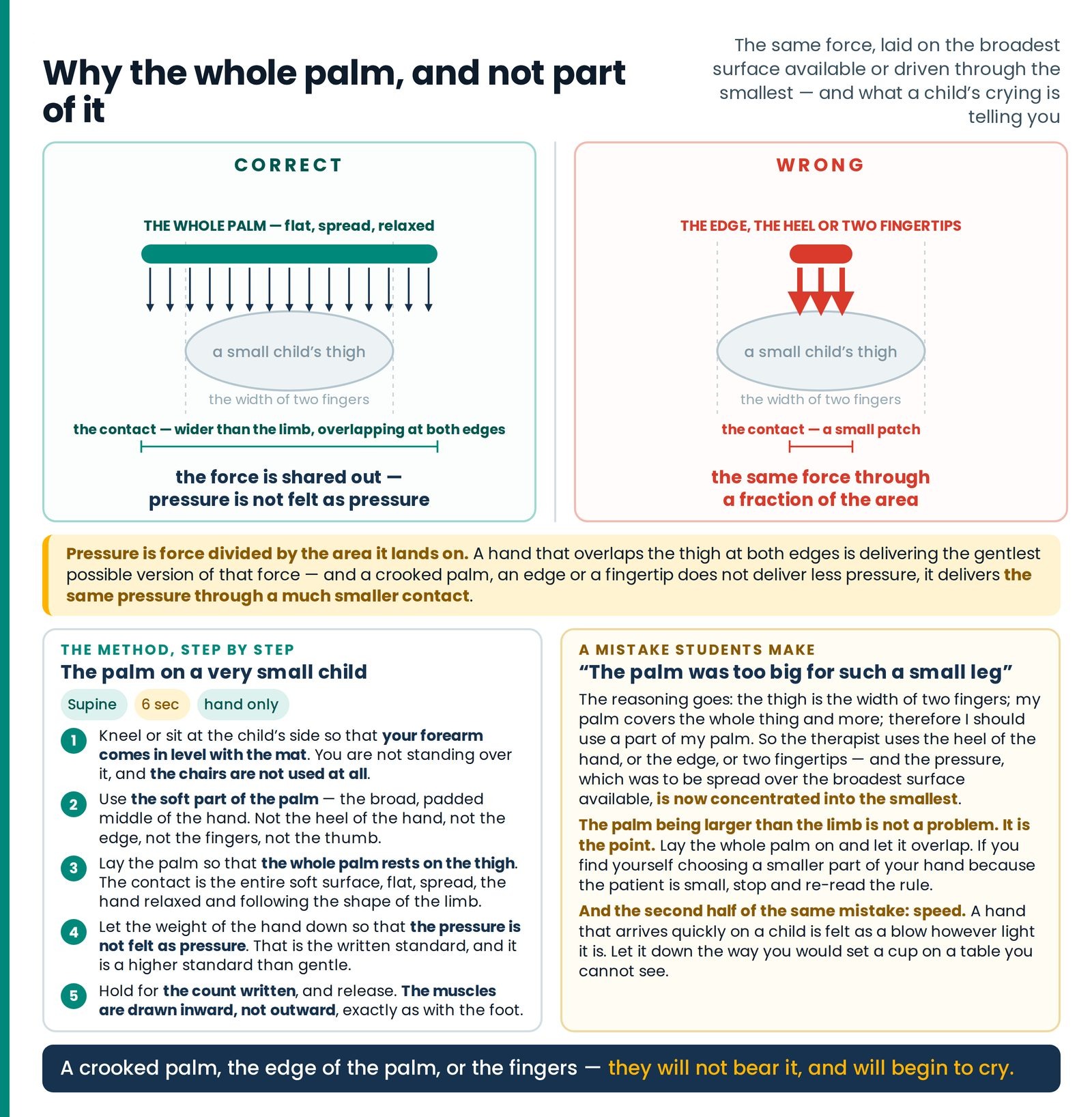
Deciding to use the hand is only half of it. How the hand is laid is the other half, and it is where the new therapist of the opening story came to grief. (Figure 41.1)
That last sentence is the reason, and it is worth reading as the clinical statement it is rather than as a comment about children being difficult. A crooked palm, an edge or a fingertip does not deliver less pressure — it delivers the same pressure through a much smaller contact, which is to say a great deal more of it, concentrated. A child's crying is an accurate instrument. It is telling you that you have made a small hard tool out of a large soft one.
Watch


The ladder of tools, from most to least
Foot, hand, single points, feather touch — and who goes on each rung
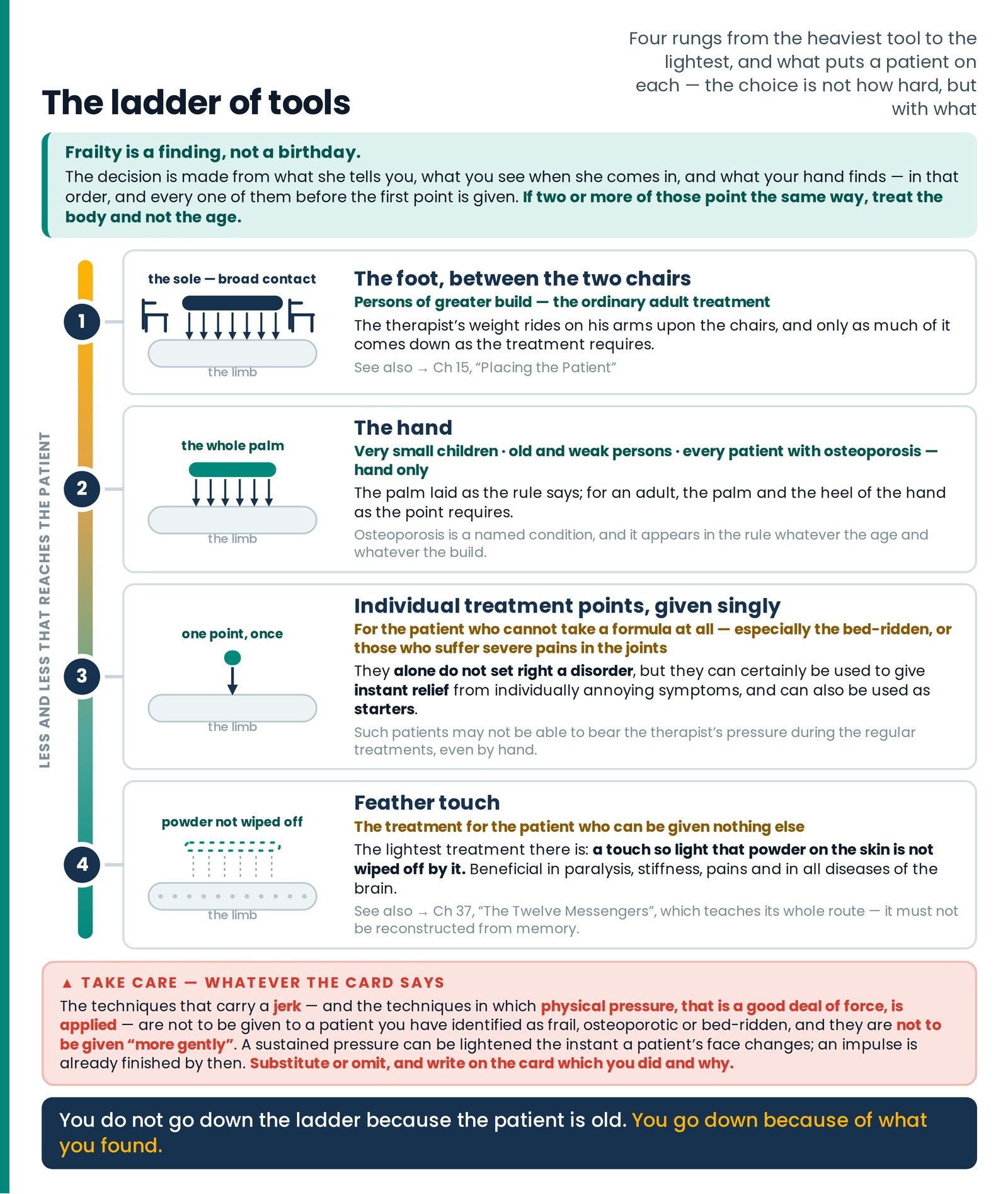
Put the whole thing in order and you have a ladder. A therapist's job is to start at the right rung, and the right rung is chosen by the body in front of them. (Figure 41.2)
Four rungs, and what puts a patient on each
1. The foot, between the two chairs.
The ordinary adult treatment. Persons of greater build. The therapist's weight rides on his arms upon the chairs and only as much of it comes down as the treatment requires.
- 2. The hand. Very small children. Old and weak persons. Every patient with osteoporosis — hand only. The palm laid as above; for an adult, the palm and the heel of the hand as the point requires.
3. Individual treatment points, given singly. For the patient who cannot take a formula at all. The statement is exact: individual treatment points alone do not set right a disorder, but they can certainly be used to give instant relief from individually annoying symptoms, and they can also be used as starters — and the footnote naming who this is for is the important half: especially in the case of patients who are bed-ridden, or who suffer from severe pains in the joints. Such patients may not be able to bear the therapist's pressure during the regular treatments, even if such pressure is applied by hand.
4. Feather touch. The lightest treatment there is: a touch so light that powder on the skin is not wiped off by it. This is the treatment for the patient who can be given nothing else — a newborn, a woman in the last weeks of pregnancy, a man whose bones break at a knock, a patient in the acute days after a stroke, somebody in too much pain to bear a palm. It is beneficial in paralysis, stiffness, pains and in all diseases of the brain.
Rung three deserves a moment, because students skip it. It is the rung for the patient whose pain is the obstacle to being treated for the pain — the bed-ridden woman with motor neuron disease, the man whose every joint hurts, the patient four days after a fracture. For them the formula is not available yet. What is available is one point, chosen for one symptom, given once, to buy the relief that makes tomorrow's session possible. The material's own words for it are instant relief and starters, and both halves are honest: it is a beginning, not a treatment, and it is not pretended to be one.
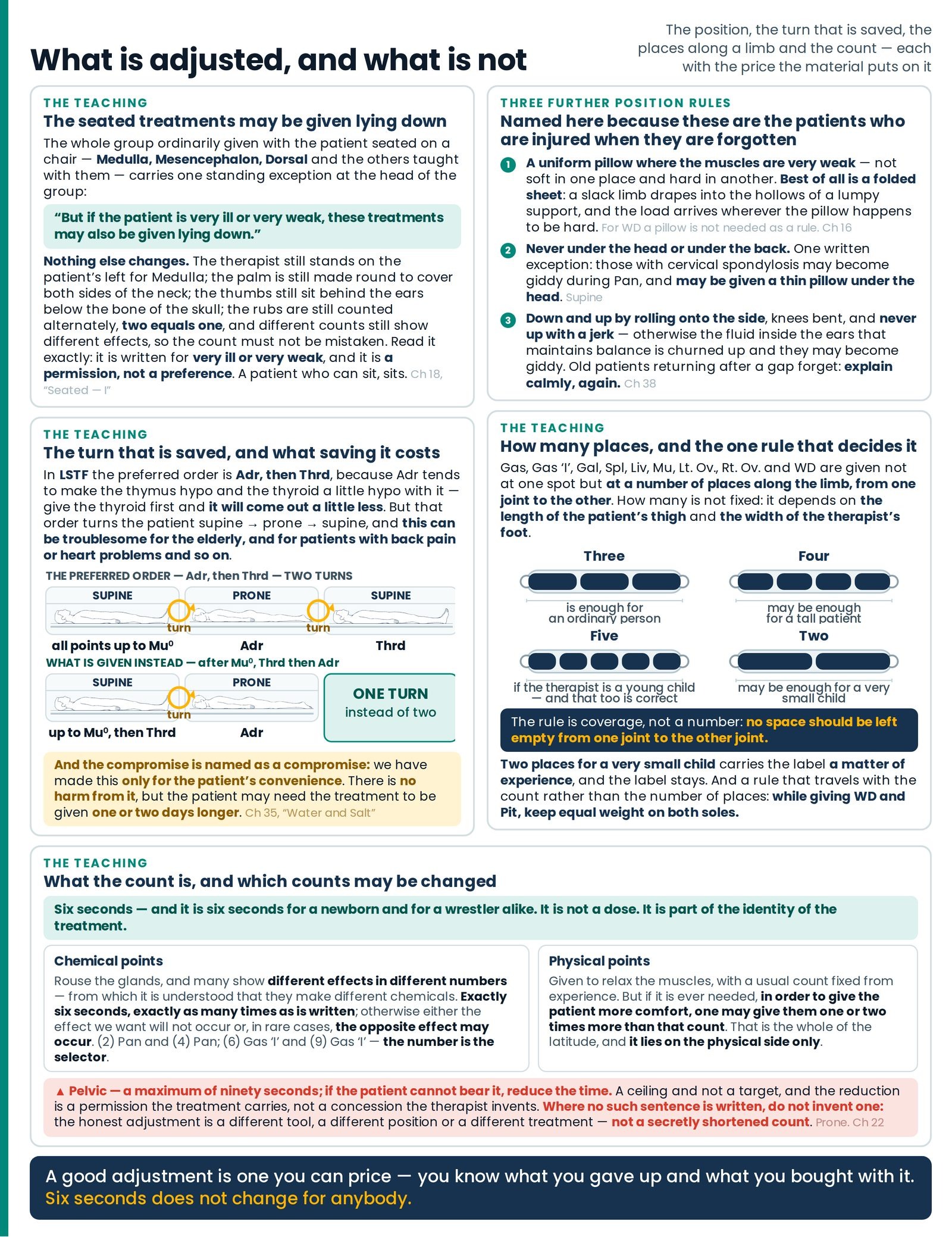
The second adjustment is where the patient's body is put. Two rules do most of the work here, and both are written. (Figure 41.3)
The whole group of treatments ordinarily given with the patient seated on a chair — Medulla, Mesencephalon, Dorsal, and the others taught with them — carries one standing exception at the head of the group:
The seated treatments may be given lying down
But if the patient is very ill or very weak, these treatments may also be given lying down.
Nothing else in those treatments changes. The therapist still stands on the patient's left for Medulla; the palm is still made round to cover both sides of the neck; the thumbs still sit behind the ears below the bone of the skull; the rubs are still counted alternately, two equals one, and different counts still show different effects, so the count must not be mistaken.
Read the exception exactly: it is written for very ill or very weak, and it is a permission, not a preference. A patient who can sit, sits. But it removes at a stroke the commonest reason a frail patient is denied the brain and neck work altogether — that she cannot hold herself upright on a chair for the length of it — and it should be known by every therapist who treats old people.
The second rule is subtler and is one of the most instructive things in this wiki, because it shows a therapist trading a known quantity of effect for a known quantity of comfort, and saying out loud what the trade cost.
In the LSTF formula, the physiologically preferred order gives Adr first and Thrd afterwards — because Adr tends to make the thymus hypo and the thyroid a little hypo with it, so that giving the thyroid first and Adr afterwards will not give a full hundred per cent result; it will come out a little less.
But in that order the patient must be turned supine → prone → supine: all the points up to Mu° are given face up, Adr requires face down, and Thrd face up again.
The turn that is saved, and what saving it costs
This can be troublesome for the elderly, and for patients with back pain or heart problems and so on.
So, in order that the patient should not have too much difficulty, after Mu° we give Thrd first and Adr afterwards — one turn instead of two.
And the compromise is named as a compromise: always remember that we have made this only for the patient's convenience. There is no harm from it, but the patient may need the treatment to be given one or two days longer.
That is the model for every adjustment in this article, and it is worth saying so explicitly. A good adjustment is one you can price. You know what you gave up, you know what you bought with it, and you can tell the patient and write it on the card. We are doing it in this order so that you only have to turn once; it may take a day or two longer. Nobody is deceived, least of all yourself.
Three further position rules bite harder on a small, old or frail body than on an ordinary one. All three are established elsewhere; they are named here because the patients in this article are the ones who are injured when they are forgotten.
The pillow that is uniform. For WD a pillow is not needed as a rule — but if someone's muscles are very weak, then the pillow must be uniform: not soft in one place and hard in another. Best of all is a folded sheet. A slack limb does not hold its own shape over a lumpy support; it drapes into the hollows, and the load arrives wherever the pillow happens to be hard. A folded sheet has no hollows.
No pillow under the head or under the back, unless it is needed. The footnote that runs along the bottom of the whole supine section — place the pillow at the proper place as needed, but never under the head or under the back — is a spine rule, and a thin old spine is where it matters most. The written exception stands: those who have cervical spondylosis may become giddy while taking the Pan treatment, and they may be given a thin pillow under the head. Supine
Lying down and getting up by rolling onto the side. Every patient is taught it; the frail patient is taught it twice and shown it. Down with the knees bent, straightening the legs afterwards; up without a jerk — otherwise the fluid inside the ears that maintains balance is churned up, and they may become giddy. And the material adds a note of manners that belongs particularly here: sometimes even old patients, returning after a gap of some days, forget. Do not ask them why they cannot remember. Explain calmly, again. What is ordinary for us is new for them, so forgetting is natural.
The third adjustment is the most easily missed, because it looks like arithmetic.
Many of the commonest points — Gas, Gas 'I', Gal, Spl, Liv, Mu, Lt. Ov., Rt. Ov. and WD — are not given at one spot. They are given at a number of places along the limb, working from one joint to the other. How many places is not a fixed number. It depends on the length of the patient's thigh and on the width of the therapist's foot, and there is exactly one rule that governs the whole thing.
How many places, and the one rule that decides it
Three places is enough for an ordinary person — but this depends on the length of the patient's thigh and the width of the therapist's foot.
The main issue is that no space should be left empty from one joint to the other joint.
For a tall patient, four places may be enough for an ordinary therapist.
But if the therapist is a young child, then even five places may be needed, and that too is correct.
If it is a very small child, then even two places may be enough. This is a matter of experience.
And a rule that travels with the count rather than with the number of places: while giving WD and Pit, keep equal weight on both soles.
Four things in that teaching are worth separating out.
The rule is coverage, not a number. No space left empty from one joint to the other is the instruction; three, four, five and two are consequences of it in four different situations. A therapist who memorises three has memorised an example.
The therapist's own size is a variable. This is the sentence that surprises students most, and it is the one that proves the rule is about coverage: a therapist who is a child has a narrow foot, so the same thigh needs five placements rather than three — and that too is correct. Nothing about the patient changed. Nothing about the treatment's effect changed. The geometry changed.
Two places for a very small child. Not because the child is delicate; because the child's thigh is short and a palm covers half of it.
And this is a matter of experience is kept exactly where it stands. It is attached to the two-places figure, and it is the wiki's standing label for a rule that rests on observation rather than on a stated mechanism. Preserve it.
Now the count — and here is the thing students expect to be adjustable and which is not.
What the count is, and which counts may be changed
Ordinarily the duration of pressure is six seconds 6 sec , and it is six seconds for a newborn and for a wrestler alike. It is not a dose. It is part of the identity of the treatment.
The wiki divides the points into two kinds, and the two kinds behave differently:
Chemical points rouse the working of the glands. Many of them show different effects when given in different numbers, from which it is understood that they make different chemicals. So while giving them, take care that the pressure is exactly six seconds and is given exactly as many times as is written; let there be no mistake in the count. Otherwise either the effect we want will not occur, or, in some rare cases, the opposite effect may occur. (2) Pan and (4) Pan; (6) Gas 'I' and (9) Gas 'I' — the number is the selector.
Physical points are given to relax the muscles. These too have a usual count, fixed from experience. But if it is ever needed, in order to give the patient more comfort, one may give them one or two times more than that count.
That is the whole of the latitude, and it lies on the physical side only. A frail patient may have a physical point one or two times more for comfort. A frail patient does not get (2) Pan for four seconds because she is frail.
There is a second, separate kind of latitude, and it is written into particular points rather than into the system. The clearest example is the Pelvic treatment, given at the edge of the head of the thigh bone with the leg taken out to the side.
Where a point carries such a sentence, use it. Where it does not, do not invent one: the honest adjustment for a patient who cannot bear a treatment is a different tool, a different position, or a different treatment — not a secretly shortened count.
Lighter formulas exist, and they are named
The light version is not a dilution — sometimes it is said to be better
The last kind of adjustment in this part is not made by the therapist at all. It was made when the formula was written. Several of the most-used formulas exist in a heavy version and a light one, and the light version is not a dilution — in more than one case it is described as better.
| The formula | The lighter form, and what is said about it | Where it is taught |
|---|---|---|
| Jeevan Dhara | The heavy four-part version was made lighter, in five parts, in which the results are better still. It may be given to persons of any age, and to a patient of any age to remove fatigue or weakness in the body | APR — Abdominal Pain |
| VTF (the viral treatment formula) | VTF (Mild) — (1) Lymph (1) point Spl (1) Th. Only × 6 trt. — is beneficial for everyone, may be given even after fever has come, and is also suitable for small children. Not to a patient with an auto-immune disorder, because provoking the lymphocytes may increase their disease | Fire and Swelling |
| Ajay Normal Mild, Mild Kidney Clear, Mild Genes | Named mild members of their families, used as the parts of the light Jeevan Dhara | Setting the Stomach · Vitamin and Gene Formulas · Water and Salt |
| Organ Clearance | The general remedy that gives benefit to everybody; and this treatment may be given to small children and to elderly people daily, or even twice a day | Face Down |
That last line is the one to write on the card of a very old patient. Organ Clearance, daily or twice a day, for small children and elderly people, is a written permission for a frequency that would be unusual in an adult course, and it fits the two groups for whom a long single session is hard and a short frequent one is easy. The name says what it does: it removes the obstructions of the blood arteries going to all the organs of the body, by which the pain of the organs beside the navel comes out.
And Jeevan Dhara carries an observation about old people that is worth quoting to their families. The treatment from which the abdominal pain comes out at once also produces, even in the elderly, and in those who have no particular complaint, an immediate freshness and briskness; many to whom it was given began to say that they had received a new life — which is where the formula's name came from. Especially to people of greater age, after this treatment is given, it feels as though they have obtained new life.
This is the page this article exists for.
Every rule in it is taught in its own place, beside its own point or in its own article. Gathered, they become a single sheet you can look at with a frightened three-year-old on the mat and a mother watching your face.
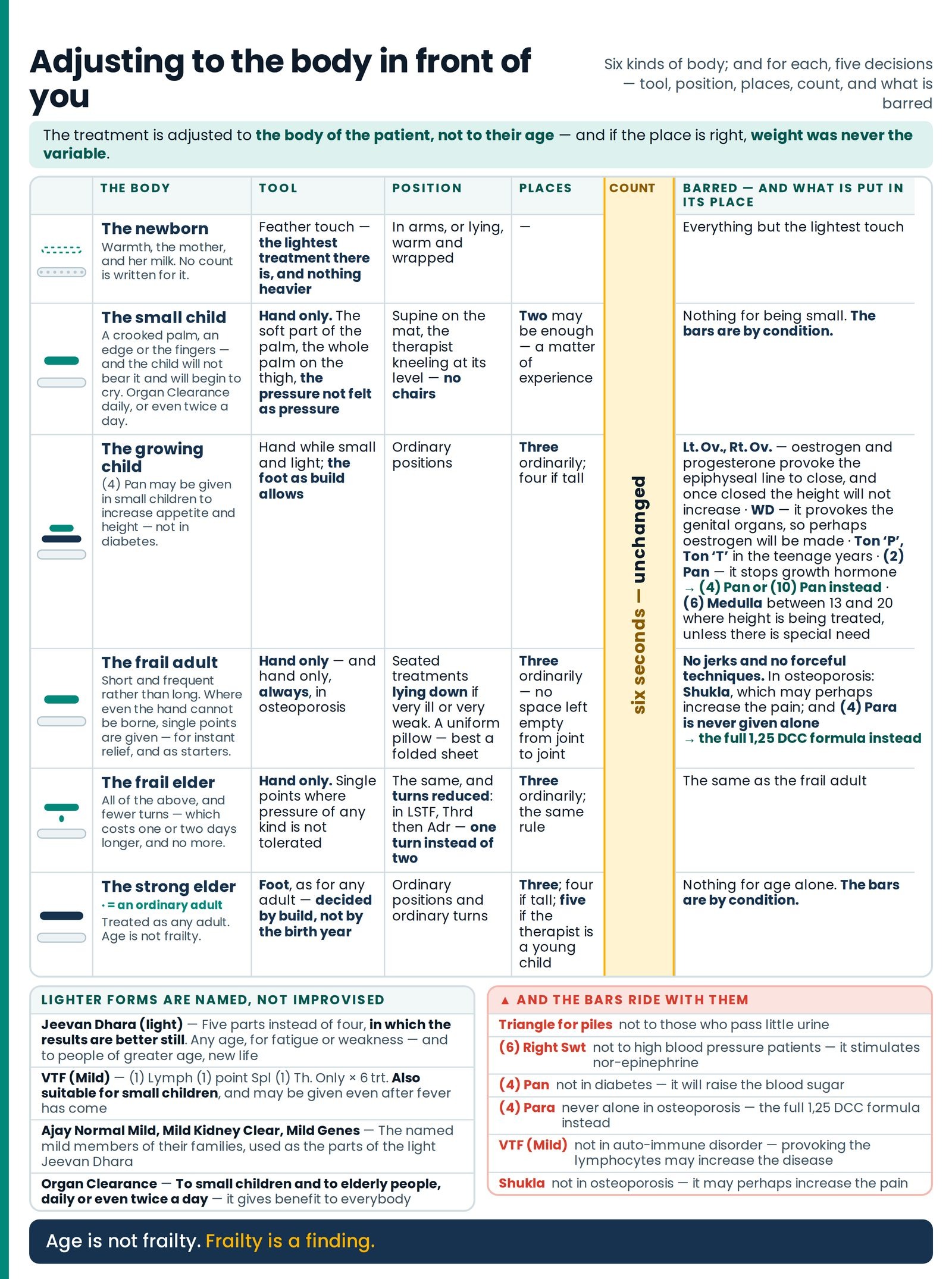
Table 1 — The body in front of you, and what changes
| Newborn | Small child | Older child (growing) | Frail adult | Elderly — frail | Elderly — strong | |
|---|---|---|---|---|---|---|
| Tool | Feather touch — the treatment for the patient who can be given nothing else | Hand only. The soft part of the palm, whole palm on the thigh, pressure not felt as pressure | Hand while small and light; the foot as build allows | Hand only — and hand only, always, in osteoporosis. If even the hand cannot be borne: single points as starters | Hand only. Single points where pressure of any kind is not tolerated | Foot, as for any adult — decided by build, not by the birth year |
| Position | In arms, or lying, warm and wrapped | Supine on the mat, therapist kneeling at its level — not standing over it, no chairs | Ordinary positions | Seated treatments may be given lying down if very ill or very weak. Uniform pillow — best a folded sheet — where muscles are very weak | The same; and turns reduced: LSTF given Thrd then Adr, one turn instead of two | Ordinary positions and ordinary turns |
| Places along a limb | — | Two may be enough — a matter of experience | Three ordinarily; four if tall | Three ordinarily — the rule is that no space is left empty from joint to joint | Three ordinarily; same rule | Three; four if tall; five if the therapist is a young child |
| Count | — | Six seconds, unchanged. The number written, unchanged | Six seconds, unchanged | Six seconds, unchanged. Physical points may be given one or two times more for comfort | The same | |
| Duration where a ceiling is written | — | Pelvic: 90 seconds maximum — if the patient cannot bear it, reduce the time | The same | 90 seconds | ||
| Frequency | — | Organ Clearance daily, or even twice a day | Ordinary | Ordinary; short and frequent rather than long | Organ Clearance daily, or even twice a day | Ordinary |
| Barred | Everything but the lightest touch | Nothing barred for being small; the bars are by condition | Lt. Ov., Rt. Ov., WD, Ton 'P', Ton 'T' in the teenage years; (2) Pan and (6) Medulla where height is being treated | Osteoporosis: Shukla — it may perhaps increase the pain. Every jerk and every forceful technique | The same as the frail adult | Nothing for age alone; the bars are by condition |
| Substituted | — | (4) Pan or (10) Pan in place of (2) Pan | The full 1,25 DCC formula in place of (4) Para alone | The same | — | |
| Given particularly | Warmth, the mother, her milk | Organ Clearance; VTF (Mild); TF reversed in ordinary loose motions; Rt. Chest only within the first few sneezes; Triangle for piles for control of urine | (4) Pan to increase appetite and height | Jeevan Dhara, light version, for fatigue or weakness at any age; single points for instant relief | Jeevan Dhara — new life; Organ Clearance; Triangle for piles for control of urine; (6) Right Swt for drops of urine on laughing or sneezing | The whole atlas |
Two columns that are not in the table, because they are not a body type. Pregnancy is Treating Women's and has its own gathered table of twenty-six withholdings. Every disease and condition with its blocked points is When the Hand Must Stop's. Use all three sheets together: this one asks what kind of body, Treating Women asks what state is she in, When the Hand Must Stop asks what disease does he have. A patient can be caught by all three at once. (Figure 41.4)
The mother's half of a birth — the room, the pain, the smell, the cord, her milk, her water, her calcium and her rest — is Treating Women's, and is not repeated here. What follows is the child's half, taught whole. It begins on the same page where that article stopped.
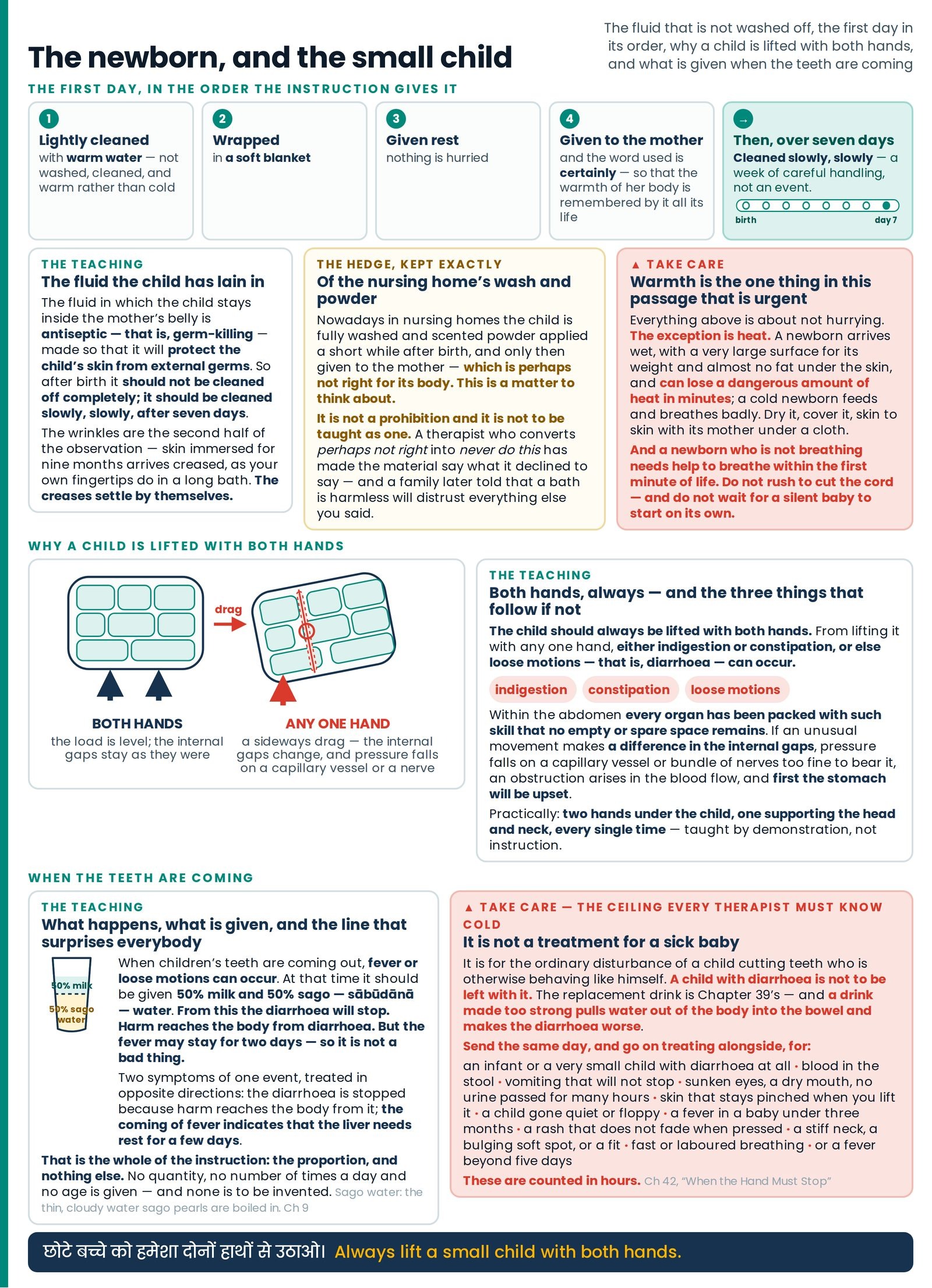
The fluid the child has lain in, and why it is not washed off
The fluid in which the child stays inside the mother's belly is antiseptic — that is, germ-killing — which Hari has made so that it will protect the child's skin from external germs.
Since the child has stayed in wet amniotic fluid, from that there are wrinkles all over its body; therefore it should be lightly cleaned with warm water, wrapped in a soft blanket and given rest, and must certainly be given to the mother, so that the warmth of her body is remembered by it all its life, and this itself will bring it comfort.
So immediately after birth that fluid should not be cleaned off completely; it should be cleaned slowly, slowly, after seven days.
But nowadays in nursing homes, only a short while after birth, the child is fully washed and scented powder is applied on it — which is perhaps not right for its body — and only afterwards is the child given to the mother. This is a matter to think about.
Take that apart carefully, because four separate instructions are folded into it and a therapist asked about it in a corridor will need all four. (Figure 41.5)
One — what the coating is said to be. Antiseptic; germ-killing; made so that it will protect the child's skin from external germs. That is a statement about function, and it is the reason for everything that follows.
Two — what is done on the first day. The child is lightly cleaned with warm water — not washed, cleaned, and with warm water rather than cold. Then wrapped in a soft blanket. Then given rest. Then given to the mother, and the word used is certainly.
Three — the seven days. The coating is not cleaned off completely immediately after birth; it is cleaned slowly, slowly, after seven days. Slowly, slowly — dhīre dhīre — is the instruction, and it describes a week of ordinary careful handling rather than an event.
Four — the hedge, which is kept exactly. Of the nursing-home practice of a full wash and scented powder, what is said is perhaps not right for its body, and this is a matter to think about. It is not stated as a prohibition and it is not to be taught as one. A therapist who converts perhaps not right into never do this has made the material say something it declined to say — and a family who is later told by a good doctor that a bath is not harmful will then distrust the twelve things you told them that were exact.
The child is lifted with both hands
From any one hand: indigestion, constipation, or loose motions
Both hands, always — and the three things that follow if not
The child should always be lifted with both hands. From lifting it with any one hand, either indigestion or constipation, or else loose motions — that is, diarrhoea — can occur.
And the reason, given elsewhere in this material in full:
For every organ to work smoothly it must go on receiving, twenty-four hours a day and without obstruction, blood through the capillaries and messages through the nerves. Within the abdomen every organ has been packed with such skill that no empty or spare space remains. If, through any unusual movement, a difference comes about in the internal gaps between the organs, then pressure can fall upon some capillary vessel or bundle of nerves. These are so fine that from that pressure an obstruction will arise in the blood flow within them. First the stomach will be upset, and then slowly the balance of the whole body will certainly be disturbed.
This is exactly why the elders always warn that small children must never be lifted with one hand — always with both — otherwise the child may get loose motions, or hard constipation, or anything at all.
Three named outcomes, and they are not three ways of saying one thing: indigestion, constipation, loose motions. The reasoning is the reasoning of the whole therapy in miniature — that the abdomen is packed without spare room, that a sideways drag changes the internal geometry, that a capillary or a nerve bundle is fine enough to be obstructed by very little, and that the stomach is the first thing to show it.
Give it to a household as a practical instruction and not as a warning: two hands under the child, one supporting the head and neck, every single time — lifting out of a cot, taking it from somebody else's arms, swinging it up onto a hip. The single-handed lift that this rule is aimed at is the one every busy mother makes twenty times a day with the child on one arm and something else in the other hand. It costs nothing to change and it is changed by demonstration rather than by instruction: put your own arms into the right shape and ask her to copy you.
When the teeth are coming
Half milk and half sago water — and the fever that may stay two days
Teething — what happens, what is given, and the line that surprises everybody
When children's teeth are coming out, then fever or loose motions can occur.
At that time it should be given 50% milk and 50% sago — sābūdānā — water.
From this the diarrhoea will stop. Harm reaches the body from diarrhoea.
But the fever may stay for two days — so it is not a bad thing.
Read the last sentence twice. It is the one nobody expects and it is not carelessness; it is consistent with what this material teaches about fever everywhere else. The diarrhoea is to be stopped, because harm reaches the body from diarrhoea. The fever is not to be stopped, and may stay for two days, and that is not a bad thing. The two symptoms of one event are treated in opposite directions, for stated reasons, and a therapist should be able to say why.
The why is in the teaching on undigested food, and it is where this rule connects to the rest of the wiki. To small children, UDF comes for the first time when their teeth are coming out — and a few days after undigested food appears in the motion, the child may get pain in the stomach or the head, or fever, for a day or two. The coming of fever indicates that the liver needs rest for a few days. A white layer-like coating appears on the child's tongue, and at that time hunger is not felt. A fever read that way is not an enemy to be put down; it is the body's own instruction to stop working the liver for a few days, and the food rules of the febrile child follow from it.
What is given to a small child at the mat
TF reversed, Rt. Chest early, and the Triangle for control of urine
Three small, specific adjustments belong to children and are easily lost among the formulas that carry them.
TF, reversed. The toe-finger work is ordinarily begun at the big toe of the left foot and worked to the little toe, then the right side in the same way. If children have ordinary loose motions, give the order reversed — start from the little toe of the right foot and work to the big toe, then do the left side in the same way — and it will give immediate benefit. Everything else about TF is unchanged: at every joint of the toes, as many times as the number written, counting as you go, rubbing the three sides so that the nerves under the skin are roused, but not so hard that a wound is made there.
Rt. Chest only, early. It controls the tendency of sudden sneezing, usually accompanied by a running nose, especially in children — provided it is given within the first few sneezes. The condition is part of the indication; given late it is a different situation.
Triangle for piles, for control of urine. Besides piles, anal fissure, fistula and prolapse of the rectum, it is beneficial for control of urine in children and in the elderly — one treatment answering the same complaint at both ends of a life. For an ordinary person three times is enough. Its own bar travels with it: not to those who pass little urine.
Now the adjustment that is unique to children and has nothing to do with pressure at all. There is a period of life in which certain treatments are withheld not because the body cannot bear them but because they would end something that is still happening — and a therapist who does not know this list can, with a correct and well-given treatment, cost a child two inches of adult height.
The teenage years — the block, exactly as it stands
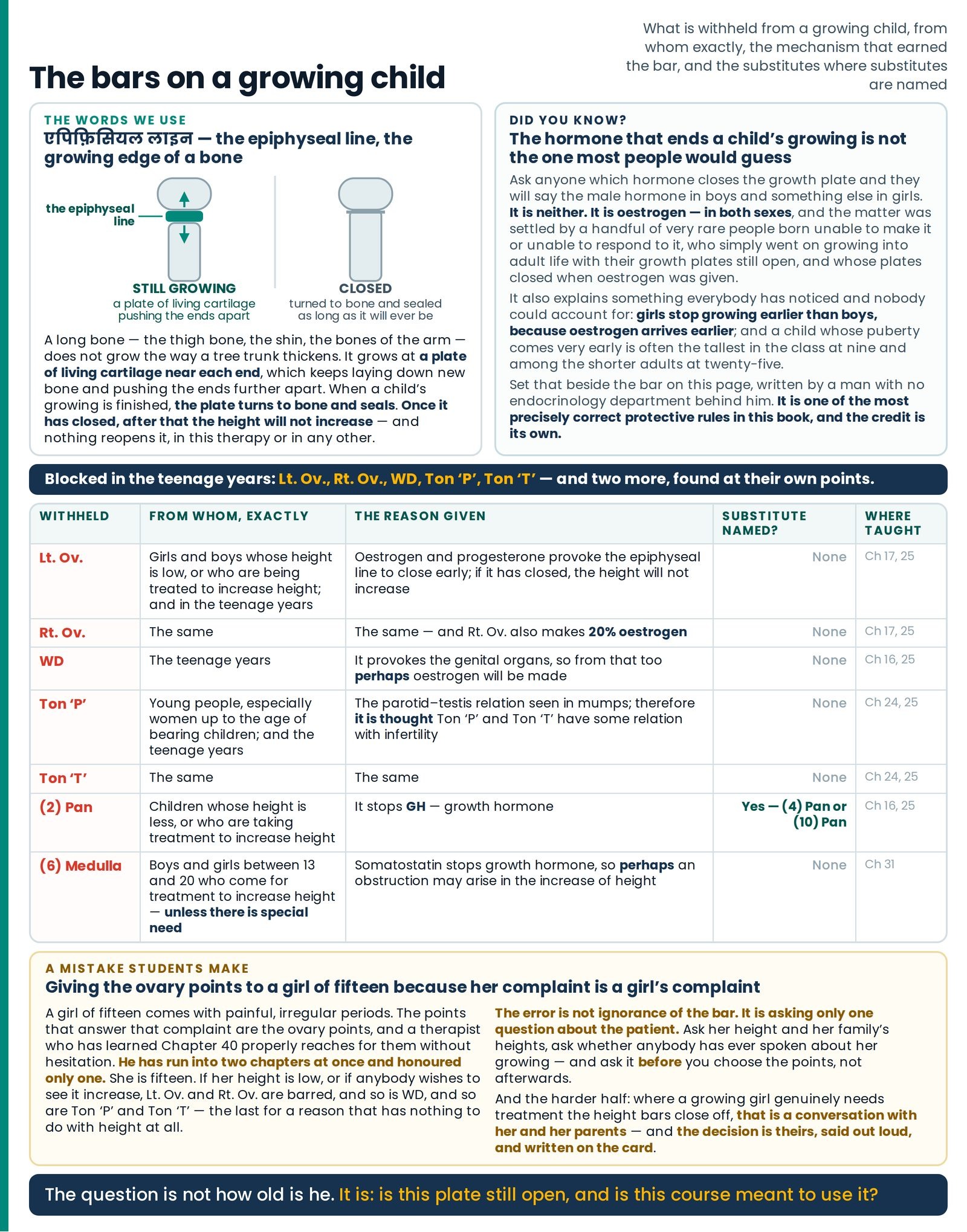
Blocked in the teenage years: Lt. Ov., Rt. Ov., WD, Ton 'P', Ton 'T'.
Lt. Ov. and Rt. Ov. — oestrogen and progesterone provoke the epiphyseal line to close early. If it has closed, after that the height will not increase. Therefore those whose height is low are not to be given Lt. Ov. and Rt. Ov. And separately, at the points' own entries: Rt. Ov. also makes 20% oestrogen, so the same bar attaches to it.
WD — is not given because it provokes the genital organs, so from that too perhaps oestrogen will be made. The perhaps is the material's own and stays where it is.
Ton 'P' and Ton 'T' — the parotid glands at the side of the cheek have some kind of relation with the testes. Because when in the disease called mumps — kanphūl — the parotid glands swell, during that disease in some boys the testes disappear, after which they are not able to become fathers. Therefore it is thought that Ton 'P' and Ton 'T' have some relation with infertility. So to those young people — especially to women, up to the age of bearing children — Ton 'P' and Ton 'T' are not given.
Two more bars belong to the same family and are found at their own points rather than in that block. Both are stated with their mechanism, and both name a substitute, which is the mark of a rule that has been thought through rather than merely feared. (Figure 41.6)
(2) Pan, and what is given instead
(2) Pan stops GH — that is, growth hormone. Therefore do not give (2) Pan to children whose height is less, or who are taking treatment from us to increase height.
They may be given (4) Pan or (10) Pan.
And the other side of the same coin, at (4) Pan: it corrects weakness arising from lack of sugar, by means of glucagon — glucagon will give nourishment to the cells, so it may be given in small children to increase appetite and height. Its own bar rides with it: those who have diabetes — giving (4) Pan will raise the blood sugar, so do not give them (4) Pan.
The hypothalamus makes a hormone called somatostatin, which is an inhibitory hormone. Somatostatin stops growth hormone — so it is inferred that perhaps by this treatment an obstruction may arise in the increase of children's height.
(6) Medulla between thirteen and twenty
Therefore we do not give (6) Medulla to boys and girls between 13 and 20 years of age who come to us for treatment to increase height, unless there is a special need for it.
The perhaps and the unless there is a special need both stand. This is a bar with a door in it, and the door is opened by a therapist who can say what the special need is.
One instruction about children is so specific, and so easily missed among the formulas, that it is set apart here and given its own heading. It belongs to the New Gal family, and it is not a rule about pressure or position at all. It is a rule about what you ask the mother.
The child of a mother whose blood pressure rose in pregnancy
If some child comes to you for a long course of treatment, and on enquiry you learn that during pregnancy his mother's BP had gone up — whether they are children of dull intellect, or have come for some other illness — they are first to be given only this treatment for ten to fifteen days, and there will be considerable benefit. Afterwards other suitable treatments may be given.
The treatment is the New Gal formula, and the same instruction is stated a second time in its list of uses, with two more conditions of the mother's pregnancy added:
This same treatment is to be given to those children whose mother, during pregnancy, had high BP, or any skin disease, or itching.
Take the instruction apart, because every clause in it is load-bearing.
"A long course of treatment." This is for the child who is going to be with you for months — the child with cerebral palsy, the child of dull intellect, the child with autism, the child with a developmental condition — and not for the child brought in on Tuesday with loose motions.
"On enquiry." The mother will not volunteer it. Seven years have passed; she does not connect her blood pressure in the eighth month with the child in front of you; and nobody has ever asked her. You ask. During this pregnancy, did your BP go up at any time? Did you have any skin trouble, or itching? Three questions, thirty seconds, at the first visit, of every child who comes for a long course.
"Whether they are children of dull intellect, or have come for some other illness." The instruction is not restricted to one diagnosis. The mother's pregnancy is the indication, not the child's disease.
"First to be given only this treatment for ten to fifteen days." Only, and first, and a stated number of days. It is a course that goes before the course — ten to fifteen days of New Gal and nothing else — and then the plan you would otherwise have written. A therapist who gives New Gal alongside six other things on day one has not followed the instruction.
And the best order, where the ampulla is to be opened too: first the ampulla of Vater is to be opened; afterwards the gall bladder is to be stimulated — so, in order: I. Vater formula. II. New Gal treatment formula.
The instruction has a history, and the history teaches the method better than the rule does.
Two further instructions about such children sit beside that one and must be given with their hedges intact, because the hedges are printed.
Chole, after a pregnancy with high blood pressure. If a pregnant woman's blood pressure rises during pregnancy, and after the birth it is found that the child is mentally slow, then giving that child the Chole treatment and other treatments brings considerable improvement in its digestive power within three months — this is a matter of experience. Note precisely what is claimed: considerable improvement in its digestive power, within three months. Not more than that, and the experience label stays on.
(10) Pan, in the same situation — with the question marks the material printed. At the entry for (10) Pan there stands: if the mother of a CP — cerebral palsy — child had high BP during pregnancy, giving that child (10) Pan will benefit ??? The three question marks are the material's own and are not to be tidied away. In the same entry, and equally marked: a child who is very hyper may become even more hyper on being given (10) Pan ??? Both statements are given as open questions, and a therapist who gives (10) Pan to a hyperactive child should know that the material itself has flagged a possible opposite effect.
Old age is not a disease and this wiki does not treat it as one. But two observations about age change what a therapist expects to find, and both are worth holding.
What changes with age, and the exception that is stated with it
Up to the age of 30–35 years most people have pain at Mu°, and they frequently get the diseases of acidosis. With increasing age the diseases of alkali begin to come.
But remember that it will not always be so. And the stated exception is a children's one: a chief cause of diseases such as fits and CP — cerebral palsy — in children is an increase of alkali.
A second finding of the same kind, from the teaching on undigested food: sometimes an older person, because of poor water consumption, shows pain at Mu° and yet has UDF — meaning the stomach's secretion of hydrochloric acid is poor. Never decide that a patient cannot have UDF because his flank finding was on the left. Ask everybody.
So the expectation shifts with age and the examination does not. You look for the same things in the same order, in a man of eighty as in a man of thirty, and you let the findings choose — which is the first rule of the whole wiki and is not suspended for grey hair.
What is different in an old body is everything in the adjustment table: the tool, the turns, the pillow, the frequency, and the honest recognition that the twenty-three and a half hours outside your session are harder for this patient than for most. The daily rules of Between Two Sessions bite harder here and are worth going over again with the son or daughter rather than with the patient: the side-turn on getting up matters more in a thin, old spine; the thirty seconds sitting on the edge of the bed matters more when the reflexes that hold the blood pressure up are slower; the slippers matter more when a cold floor is also a slippery one; and cold-water bathing is the one rule where age is a genuine reason to go carefully rather than boldly.
And Food as Medicine's kitchen matters more too, for a reason a therapist can find in four seconds and nobody else asks about. A patient who has quietly stopped eating anything that needs chewing — who lives on tea and soft rice, and has been doing so for a year — has told you something about her nutrition as surely as any report would. Ask how many teeth she chews on. It is not an undignified question if you ask it plainly.
This article's sheet is not addressed to the patient. It is addressed to the parent, the son or daughter, or the carer — the person who will actually carry it out, and who is very often the one who has not been spoken to at all.
Two rules a visit, as always.
Table 3 — What to tell the parent, the son or daughter, the carer — and why
| Who, and when | What to do | Why |
|---|---|---|
| A parent, on the first day | Sit where he can see you, and hold his hand. Do not hold him down. | A child who is held down learns that this room is a place where things are done to him. A child whose mother is in his sight sits still on his own by the third visit. |
| If he cries, tell me at once — do not wait for me to notice. | Ordinarily this does not hurt. If a child cries, something about how my hand is laid needs changing, and I would rather change it in five seconds than lose a month. | |
| A parent of a newborn | He does not have to be made to look clean on the first day. A light clean with warm water, wrapped in a soft blanket, given rest — and given to his mother. | The fluid he has lain in protects his skin from germs outside. It is not washed off; it is cleaned away slowly, slowly, over about seven days. |
| Keep him warm and covered, and against his mother's skin. | A newborn loses heat very fast, and a cold baby feeds badly and does badly. This is the one part of the first hour that is urgent. | |
| Always lift him with both hands — never with one, even for a second. | From lifting a child with one hand he can get indigestion, or constipation, or loose motions. The organs in a small belly are packed with no spare room, and a sideways drag presses on vessels and nerves too fine to take it. | |
| His mother's milk is the best food he has. Feed until it stops of itself. | It is said plainly, and nothing replaces it. Her half of this — her water, her calcium, opening his hand at the feed — she has been given separately. | |
| A parent, when the teeth are coming | Fever or loose motions can come at this time. Give half milk and half sago water. | From this the diarrhoea will stop, and harm reaches the body from diarrhoea. |
| The fever may stay for two days, and that is not a bad thing. | The fever is telling you the liver needs a few days' rest. It is the diarrhoea we are stopping, not the fever. | |
| But come the same day if he has blood in the stool, will not stop vomiting, passes no urine for many hours, has sunken eyes or skin that stays pinched, goes quiet or floppy, or is under three months old with any fever at all. | Some things are counted in hours, and I cannot look inside. We will go on treating either way. | |
| A parent of a child on a long course | Tell me about the pregnancy — did your BP go up? Was there any skin trouble, or itching, even before it? | There is a treatment given first, for ten to fifteen days and by itself, to children whose mother had those things, and it works best when it comes first. |
| Do not stop any medicine he is on, especially for fits, and do not stop his speech or physio. | We use no medicine, and we never tell anybody to stop theirs. That is a matter for the doctor who prescribed it. | |
| A parent of a growing child or teenager | Tell me if anybody is hoping his height will increase — and how tall the family is. | Certain treatments would make the growing ends of the bones close early, and once they have closed the height will not increase. I need to know before I choose, not afterwards. |
| A son or daughter, of an older parent | Let him get onto the mat by himself if he can. Help only when help is needed. | How he gets down and up tells me more about what his body will take than anything else I will see today. |
| Tell me the truth about the falls. How many, when, and what he was doing. | A fall is the most useful single fact you can give me, and families hide it out of kindness. | |
| Tell me if any doctor has ever said his bones are thin, or if he has been on steroid tablets for a long time. | If so, he is treated with the hand only, always — and some treatments are not given at all. That rule does not depend on how well he looks. | |
| Tell me afterwards how he was that evening — stiff, sore, or well — because he will not tell me himself. | Old people who are being helped very often will not complain. You are my instrument for that. | |
| A carer, every day | Rolling onto the side to lie down and to get up. Never up with a jerk. Thirty seconds sitting on the edge of the bed before the feet go down. | Getting up with a jerk churns the fluid in the ears that keeps balance, and the body's own machinery for holding the blood pressure up is slower with age. |
| Small mouthfuls, unhurried, and never fed lying flat. And tell me how many teeth he chews on. | Somebody who has quietly given up everything that needs chewing has been living on tea and soft rice for a year, and that changes what I do. | |
| If he is in bed most of the day, move him and move his limbs. | Blood has a pump; lymph has none — it moves when the body moves. That is why the bed-bound collect troubles the rest of us do not. |
Questions students ask
1. I am twenty and strongly built. Am I allowed to treat a child at all, or should it be given to somebody smaller? You are allowed, and your build is irrelevant to the result. Weight is not the variable — if the place is right, the treatment is just as effective given by a small person as by a large one. What your build changes is the tool: you use your hands, laid the way the rule says, and never your feet. And notice the rule that runs the other way, which will tell you the principle better than any argument — if the therapist is a young child, then even five places may be needed on a thigh where an adult uses three, and that too is correct. The therapist's size changes the geometry. It does not change the therapy.
2. I am a housewife learning this for my family. My mother-in-law is seventy-nine and will never say anything hurts. How do I treat somebody like that? You change your instrument from her words to her face and her family. Watch the eyes and the jaw during the hold — not the mouth. Watch whether a hand lifts off the mat. And ask somebody else afterwards: was she stiff in the evening, did she sleep? Then treat one rung lower than you think you need for the first fortnight, and move up on evidence. A fortnight of the hand costs you nothing. Being wrong about a bone costs everything.
3. I am a doctor. "Small children, very weak persons, and any patient with osteoporosis are to be treated with the hand only." Is osteoporosis really a hands-only condition here even in a well-looking patient? Yes, and it is written as a flat instruction rather than as a judgement call, which I would keep exactly as it stands. Two things follow from it that are worth your attention. First, the bar does not depend on how the patient looks or on how much force you intend to use — which is the right shape for a rule about a tissue whose weakness is silent. Second, it comes with two companions that show the same reasoning: Shukla is withheld because it may increase the pain, and (4) Para is never given alone because given alone it lifts calcium out of the bone into the blood, the full 1,25 DCC formula being required instead. Three rules, one condition, one direction of thought.
4. A mother has asked me why we do not wash off the vernix. What do I actually say? Say what is taught, with the hedge in it. The fluid he has lain in is antiseptic — it protects his skin from germs outside. So he is cleaned lightly with warm water, wrapped, given rest and given to you, and the rest of it is cleaned away slowly over about seven days rather than washed off in the first hour. If she then says the nursing home washed him and powdered him, do not tell her they were wrong, because the material does not. It says perhaps not right for its body, and calls it a matter to think about. Say that. She will trust you more for the perhaps than she would for a verdict.
5. In a village, a child has loose motions with teething. Am I meant to give sago water instead of the sugar-and-salt drink? No, and this is the most important thing in the article to get straight. The teething instruction is half milk and half sago water, and it is for the ordinary disturbance of a child cutting teeth who is otherwise himself. It is not fluid replacement and it does not replace it. A child who is actually losing fluid gets the drink taught in Food as Medicine — a packet of oral rehydration salts in exactly the quantity of water printed on it, or six level teaspoons of sugar and half a level teaspoon of salt in one litre of clean water, sipped slowly. And an infant or very small child with diarrhoea is sent the same day while you go on treating.
6. Why does the material tell us to stop the diarrhoea but not the fever? Because it reads them as two different things. Harm reaches the body from diarrhoea — that is the stated reason for stopping it. The fever is read as an instruction from the body: it comes when undigested food has appeared, and the coming of fever indicates that the liver needs rest for a few days. So the sentence is exactly what it says — the fever may stay for two days, so it is not a bad thing. Teach it with its ceiling attached, which is in The Fire and the Ash and in the caution above: this is the ordinary two-day fever of a child behaving like himself, and a list of things that mean a doctor the same day.
7. I am a retired engineer, sixty-six, learning this. The height bars confuse me. Is (2) Pan forbidden to all children? No — read the wording, because the wording is the rule. (2) Pan is not given to children whose height is less, or who are taking treatment from us to increase height. It is a bar attached to a purpose, not to an age band, and it names its substitute: (4) Pan or (10) Pan. (6) Medulla is worded the same way — boys and girls between 13 and 20 who come for treatment to increase height, unless there is special need. The ovary points and WD are worded around the teenage years and around low height. So the question you ask is not how old is this patient but is this child still growing, and is anybody hoping he will grow more?
8. I run a small centre and see mostly old people. Is there anything I can give almost all of them? Two things are written for exactly that. Organ Clearance may be given to small children and to elderly people daily, or even twice a day — it gives benefit to everybody, and short and frequent suits an old body better than long and occasional. And the light Jeevan Dhara, which may be given at any age to remove fatigue or weakness in the body, and of which it is said that people of greater age feel afterwards as though they have obtained new life. Neither replaces examining each patient and letting the findings choose.
9. A patient is bed-ridden and cannot bear my hand anywhere. Is there anything left? Two rungs. Individual treatment points, given singly — which will not set right a disorder, but are used to give instant relief from individually annoying symptoms and as starters, and the footnote naming who they are for names exactly your patient: bed-ridden, or severe joint pains, who cannot bear the regular treatments even by hand. And below that, Feather touch, which is the treatment for the patient who can be given nothing else. Give one point for one symptom and see what tomorrow allows.
10. I have no science at all. What does "the epiphyseal line closes" actually mean? A child's long bones grow at a soft strip of gristle near each end, which keeps making new bone and pushing the ends apart. When growing is finished, that strip turns to bone and seals over, and the bone is then as long as it will ever be. Nothing reopens it. So a treatment that makes the strip seal earlier does not slow a child's growing — it ends it, and whatever height had not yet been made is not made. That is why these particular bars are absolute rather than cautious.
11. Should I be reducing the six seconds for a very old patient? No. The six seconds is not a dose, it is part of what the treatment is, and the counts on chemical points are selectors — give the wrong count and either the effect you wanted does not come or, in some cases, the opposite one does. The written latitudes are three and they are specific: physical points may be given one or two times more for comfort; where a point carries its own ceiling, if the patient cannot bear it, reduce the time; and the number of places along a limb changes with the length of the limb and the width of your foot. Everything else you adjust is the tool, the position or the formula.
12. A grandmother is watching me treat her grandchild and keeps telling me I am doing it too gently. What do I say? Tell her the truth, in her own terms, and give her something to do. Mātājī, here we are not pushing the muscle — we are sending the blood where it was not going. If I press harder I do not send more blood; I only frighten him, and then he will not come tomorrow. Then ask her to sit where he can see her and hold his hand. Families who are given a job stop supervising. See also → Before You Touch Anyone, "Before You Touch Anyone".
Questions patients ask
1. (A mother) "He is so small. Will this hurt him?" It should not, and if it does, you will both know and I will change what I am doing at once. This is not given with a fingertip; it is given with the whole soft part of my palm laid flat on his leg, spread over as wide an area as I can make it — which is exactly why it does not sting. My hands stay warm and I go slowly. If he cries, tell me immediately rather than waiting to see whether he settles.
2. (A son) "My father is eighty-eight. Is he too old for this?" No. The treatment is given from a one-day-old infant up to a hundred years. What changes for him is not whether he takes it but how it is given — with my hands rather than my feet, in positions he can hold, with fewer turns, and in shorter sessions more often rather than long ones. What I need from you is honesty about the falls, about any doctor ever having said his bones are thin, and about how he was in the evening after each session, because he himself will tell me he is perfectly fine.
3. (A father) "The doctor has given him medicine for fits. Should we stop it now that we have started this?" No. We use no medicine of any kind here, and we never tell anybody to stop theirs. That is between you and the doctor who prescribed it. Please keep giving it exactly as it is written, keep his speech therapy and his physiotherapy going, and when the time comes that you think things have changed, take him to that same doctor and let that doctor decide. Stopping a fit medicine on anybody's advice but the prescriber's is dangerous, and it would be the one thing that could undo everything we do here.
4. (A mother) "The hospital bathed him and put powder on him the day he was born. Have I harmed him?" No. What is taught here is that the fluid he was born in protects his skin, so it is cleaned away slowly over about a week rather than washed off at once — and of the nursing home's quick wash and scented powder, what is said is only that it is perhaps not right for his body, and that it is a matter to think about. That is not the same as saying harm was done, and I will not tell you it was. From today you can keep him warm, keep him wrapped, feed him, and lift him with both hands.
5. (A grandmother) "My grandson's teeth are coming and he has loose motions and a little fever. Should I take him to a doctor or is this normal?" Both can come when the teeth are coming, and what is given is half milk and half sago water, from which the diarrhoea settles — and it is said that the fever may stay two days and that this is not a bad thing. But I want you to watch four things and come the same day if you see any of them: blood in the motion; vomiting that will not stop; no urine for many hours, or sunken eyes; or if he goes quiet and floppy instead of cross. And if he were under three months old, any fever at all would mean a doctor the same day, no matter how well he seemed. I will keep treating him either way.
6. (A woman of fifty-three) "You keep saying you will use only your hands. Am I that weak?" Not weak — and it is not about strength. You have been told that your bones are thin, and the instruction here is plain: where there is osteoporosis, treatment is given with the hand only, always, however well somebody looks and however much force I was or was not planning to use. It costs you nothing in result. The place and the order are what decide the effect; the weight never was.
7. (A father of a girl of fourteen) "She has painful periods. Why are you refusing the treatment you would give my wife?" Not refusing — choosing differently, and I would rather tell you why than let you think I am being cautious for no reason. Some of the treatments that answer that complaint work by way of oestrogen, and oestrogen makes the growing ends of the bones close early. Once they close, height stops. She is fourteen and still growing. So I will use what I can use safely, and if we reach a point where the choice is a real one, I will put it to you and to her plainly and you will decide, not me. Tell me now how tall you and her mother are, and whether her growing is something anybody in the family is thinking about.
Words used here
| Hindi | English | Neurotherapy code / usage |
|---|---|---|
| छोटे बच्चे (chhoṭe bachche) | Very small children | Treated with the hand only — the soft part of the palm, whole palm on the thigh, pressure not felt as pressure |
| कमज़ोर (kamzor) | Weak | Very weak persons — hand only; and very ill or very weak — seated treatments may be given lying down |
| बिस्तर पर पड़ा रोगी | The bed-ridden patient | May not bear the therapist's pressure even by hand — individual points given singly, for instant relief and as starters |
| हड्डियों का भुरभुरापन | Osteoporosis | Hand only, always. Shukla not given; (4) Para never alone — the full 1,25 DCC formula |
| एपिफ़िसियल लाइन | The epiphyseal line — the growing edge of a long bone | Closed early by oestrogen and progesterone; once closed, the height will not increase |
| तरुण अवस्था (taruṇ avasthā) | The teenage years | Blocked: Lt. Ov., Rt. Ov., WD, Ton 'P', Ton 'T' |
| कनफूल (kanphūl) | Mumps | The parotid swelling from which the parotid–testis relation was inferred, and with it the Ton 'P' / Ton 'T' bar |
| साबूदाना (sābūdānā) | Sago | Half milk and half sago water, when the teeth are coming and there are loose motions |
| दाँत निकलना | The teeth coming | Fever or loose motions can occur. The diarrhoea is stopped; the fever may stay two days — not a bad thing. Also when UDF first comes to a small child |
| नाल का द्रव / जच्चा-द्रव | The fluid the child lay in | Antiseptic — protects the skin from germs outside. Cleaned slowly, slowly, after seven days, not washed off at birth |
| दोनों हाथों से उठाना | Lifting with both hands | Always. From one hand: indigestion, or constipation, or loose motions |
| मन्द बुद्धि (mand buddhi) | Of dull intellect | Among the children for whom the New Gal ten-to-fifteen-day rule is written, where the mother's BP rose in pregnancy |
| तजुर्बे की बात (tajurbe kī bāt) | A matter of experience | Kept on the two-places figure, and on the Chole three-month statement. Never removed |
| — | Organ Clearance | To small children and to elderly people, daily or even twice a day |
| — | Jeevan Dhara (light) | Any age, for fatigue or weakness; to people of greater age, new life |
| — | VTF (Mild) | (1) Lymph (1) point Spl (1) Th. Only × 6 trt. — also suitable for small children; not in auto-immune disorder |
| — | TF | Reversed — little toe of the right foot to the big toe, then the left — for children with ordinary loose motions |
| — | Rt. Chest only | Sudden sneezing with a running nose, especially in children — within the first few sneezes |
| — | Triangle for piles | Control of urine in children and in the elderly. Three times for an ordinary person. Not to those who pass little urine |
| — | (6) Right Swt | Drops of urine on laughing or sneezing in women and elderly people. Not to high BP patients |
| — | (2) Pan | Stops growth hormone — not to children whose height is less. Give (4) Pan or (10) Pan |
| — | (4) Pan | In small children, to increase appetite and height, by glucagon. Not in diabetes |
| — | (6) Medulla | Not to boys and girls 13–20 treated to increase height, unless special need |
| — | New Gal | Ten to fifteen days, alone, first, to a child whose mother's BP rose in pregnancy, or who had skin disease or itching. 9 treatments in place of 6 at part III for a very restless child |
| — | Pelvic | Ninety seconds maximum — if the patient cannot bear it, reduce the time |
| — | Feather touch | The lightest treatment there is — for the patient who can be given nothing else |