- Category
- Infection, immunity, inflammation and cancer
- What is given
- The cancer list applies
- What is barred
- Lymph; and Armpits
- Explained in
- The Front of the Body II
Watch


Wounds
Blocked: the Heparin formula ▲ Take care
| Blocked | The reason as it is given |
|---|---|
| Heparin treatment | It is not to be given, because heparin prevents the blood from clotting, so the wound will not heal quickly |
The shortest entry in the article and one of the best reasoned. A clot is not the obstacle to healing; it is the scaffolding on which healing is built — the first thing a body does to a wound, and the mesh on which everything that follows is laid. A treatment aimed at keeping blood from clotting is aimed at the first stage of the repair.
And it is time-limited in its own terms. The heparin family's blow treatments are written for after the wound has dried — T. Heparin for the ordinary blow, TT. Heparin for the deeper or older blow and the haematoma, at ten to fifteen days once the serum has dried. The bar is on the open wound, and it lifts when the wound closes.
Do not work over or immediately around an open wound, a fresh incision, a graft or a burn. And send, rather than treat, a wound that is spreading red, increasingly painful, discharging pus, or accompanied by fever — and any wound in a diabetic foot that is not healing.
The twenty entries above are the therapy's own list of warnings. They are not the whole of what is barred. Across forty-one articles, bars have been set down one at a time, each beside the point it belongs to, where it belongs. Scattered, they are unusable at the mat. Gathered and sorted by the patient, they become the second half of this article's index. (Figure 42.7)
Each is given here with the condition that triggers it, the reason as it stands, and the article that teaches it. The point's own full entry is always elsewhere; this is the finding aid. (Figure 42.8)
Table 2 — Barred by a condition of the body
| The condition | What is withheld | The reason as it is given | Taught in |
|---|---|---|---|
| Osteoporosis | The foot, as the tool — the whole treatment is given with the hand only | Printed among the precautions before any treatment: small children, very weak persons, and any patient with osteoporosis are to be treated with the hand only | The Child, the Elder and the Frail |
| Osteoporosis | Shukla | For osteoporosis patients this treatment may perhaps increase the pain — so do not give them this treatment | Uncommon Problems · Each Point in Use |
| Osteoporosis | (4) Para given separately, by itself | Given alone it will lift calcium from the bone and put it into the blood. They must be given the full 1,25 DCC formula | The Front of the Body II · Correcting the Two Kingdoms |
| Osteoporosis · frail bone · long-term steroids · a bone broken from a trivial knock | Every jerk in the atlas — Katka, Motor neuron point, P point, the Pradeep jerk and its full-weight stage, Abdomen setting where a spinal bone has already crumbled | A jerk cannot be graded and cannot be withdrawn once begun | The Low Back · Knee, Leg, Foot · Uncommon Problems |
| Menstruation — the four days | Every treatment, except for the four named complaints of the menses themselves | No reason is given, and none is to be invented | Between Two Sessions · Treating Women |
| Menstruation | Ku — every form | No reason is given. None is to be invented | Face Down · Each Point in Use · Treating Women |
| A heavy menstrual flow | Every heparin formula | Heparin does not let the blood clot, so the flow will be still greater | The River — Heparin · Treating Women |
| Pregnancy | Thymus, Thymus + Chest | After giving this the babies begin to move about vigorously, from which it may be judged that the baby must be experiencing discomfort | The Front of the Body II · Each Point in Use · Treating Women |
| Pregnancy | Any treatment from which the child may have trouble; and the jerk points | Stated as the governing rule of the season | Treating Women |
| A woman who wishes to become a mother | Ton 'P' | At the point's own entry, no reason at all. Elsewhere: from this there may perhaps be some adverse effect on conception; it is also not proven that it prevents conception, therefore do not call it a contraceptive treatment. Research is to be done | Uncommon Problems · Each Point in Use · Treating Women |
| Uterine prolapse | Gas Only, (10) Medulla | Prolapse being read as a disease of acid — the acid of the stomach will increase three times | From Findings to a Plan · The Front of the Body I · Treating Women |
| Long-standing diabetes with numb feet | Body weight through any foot treatment — BOF, Big Toe Gas, the foot stage of the calf ghisāī | Sustained loading damages tissue whether or not it is felt, and in that foot the alarm is gone | Knee, Leg, Foot |
| A replaced or resurfaced joint | Body-weight compression and every jerk, permanently | Ask — people forget to mention a joint they have had for nine years | Knee, Leg, Foot |
| Blood-thinning medicine, or a bleeding disorder | Deep work and every jerk | Deep work leaves a bruise at pressure an ordinary patient does not notice | Knee, Leg, Foot · Uncommon Problems |
| A stroke, or a passing weakness, numbness or loss of vision, within three months | All neck work | For these patients there is no version of neck pressure that is acceptable | The Front of the Body II · Seated I — Brain, Medulla, Neck |
| A swelling in the neck, a goitre, a thyroid running fast | All neck work | Pressure there can squeeze the airway and push hormone into the blood | The Front of the Body II |
| Every patient, always | Pressure on the front or the sides of the neck, by foot or by hand, in any treatment, whatever a card says | At the fork of the great artery lies a patch of pressure sensors; squeeze it and you tell the brain a lie | The Front of the Body II · Seated I — Brain, Medulla, Neck |
| A dialysis patient | Pressure on the arm carrying the fistula, and abdominal work where a peritoneal catheter is in place | The access is the patient's lifeline and is not loaded, rubbed or used for a blood pressure cuff | Practice; see also Before You Touch Anyone |
| A pacemaker or implanted device | Work over the device site | — | Practice; see also Before You Touch Anyone |
| Inflammation in the abdomen | Folded legs | But if there is inflammation in the abdomen, do not give | Each Point in Use |
| Fracture in any bone between L1 and S1 | L3, 4, 5 | If there is a fracture in any bone between L1 and S1, it is not to be given | The Low Back · Each Point in Use |
| Passing little urine | Triangle for piles; and Gal | The Triangle tightens the sphincters. For Gal, the line attached is: this is a matter of experience | On the Side · Face Down · Each Point in Use |
| Passing too much urine | (2) S4 – S5 | It relaxes and opens the sphincters, and is given to increase urine | Face Down · Each Point in Use |
| Loose motions, or no pain at Mu° | (1) Acid / (2) Acid | Stated as written, at the point's own entry | On the Side · Each Point in Use |
| Ulcer in the stomach or duodenum | Gas Only | Do not give to those who have an ulcer in the stomach or duodenum | The Front of the Body I · Each Point in Use |
| Kidney failure, or kidney cancer | Mu° and Liv° — do not stimulate them | The instruction is do not provoke — उकसाना — rather than do not treat the patient | On the Side · Each Point in Use |
| Cancer in the liver | Liv — otherwise the point that may be given in any disease | But if there is cancer in the liver, do not give it | The Front of the Body I · Each Point in Use |
| Cancer in a lymph node | Lymph | If there is cancer in the lymph node, do not give | The Front of the Body II · Each Point in Use |
| Leukaemia, blood cancer, or a raised white cell count | Gal | Stated at the point's own entry | The Front of the Body I · Each Point in Use |
| Lung cancer | Ch. Only, Thymus | The organ rule — and three substitutes are named | The Front of the Body II · Each Point in Use |
When one patient carries three conditions
This is the ordinary case, not the difficult one. A man of sixty with diabetes, a heart condition and a kidney that has been failing for two years is not unusual in any clinic in India, and his card is where this article earns its place.
1. The blocked lists add. They never cancel. Write out every list in full and keep them all. Diabetes closes twelve points; the heart closes nine; the kidney closes seven. Several appear on two lists or three, which is a convenience and not a discount.
2. Where a permitted list in one entry meets a blocked list in another, the block wins. (6) Adr is named as suitable in the kidney entry and blocked in the diabetes entry and again in infection, in cancer and in septicaemia. For a diabetic with kidney disease it is blocked. There is no line anywhere in this therapy that lets a recommendation outrank a prohibition.
3. A substitution must clear every list, not the one that produced it. The kidney entry sends you to P. Heparin; check P. Heparin against the heart list before you write it. The heart entry sends you to (10) Left Medulla; check (10) Medulla against the diabetes list — where it is blocked outright, on both sides, even inside UDF treatment.
4. What is left is usually smaller than a student fears and larger than a nervous one believes. Work it out and write it down. A short list you are certain of is a better card than a long one you are hoping about.
Some bars in this wiki do not say never. They say not today, or not with that — and they are the hardest kind to hold, because the point is not forbidden to the patient at all. It is forbidden in that company, and next week it may be exactly what is wanted. (Figure 42.5)
Each Point in Use holds these as pairs of treatments, in its Table 21, which is where a student learning the atlas needs them. Here they are re-entered from the other side — by the finding sitting in front of you today — with the column that only this article can carry: when the bar lifts.
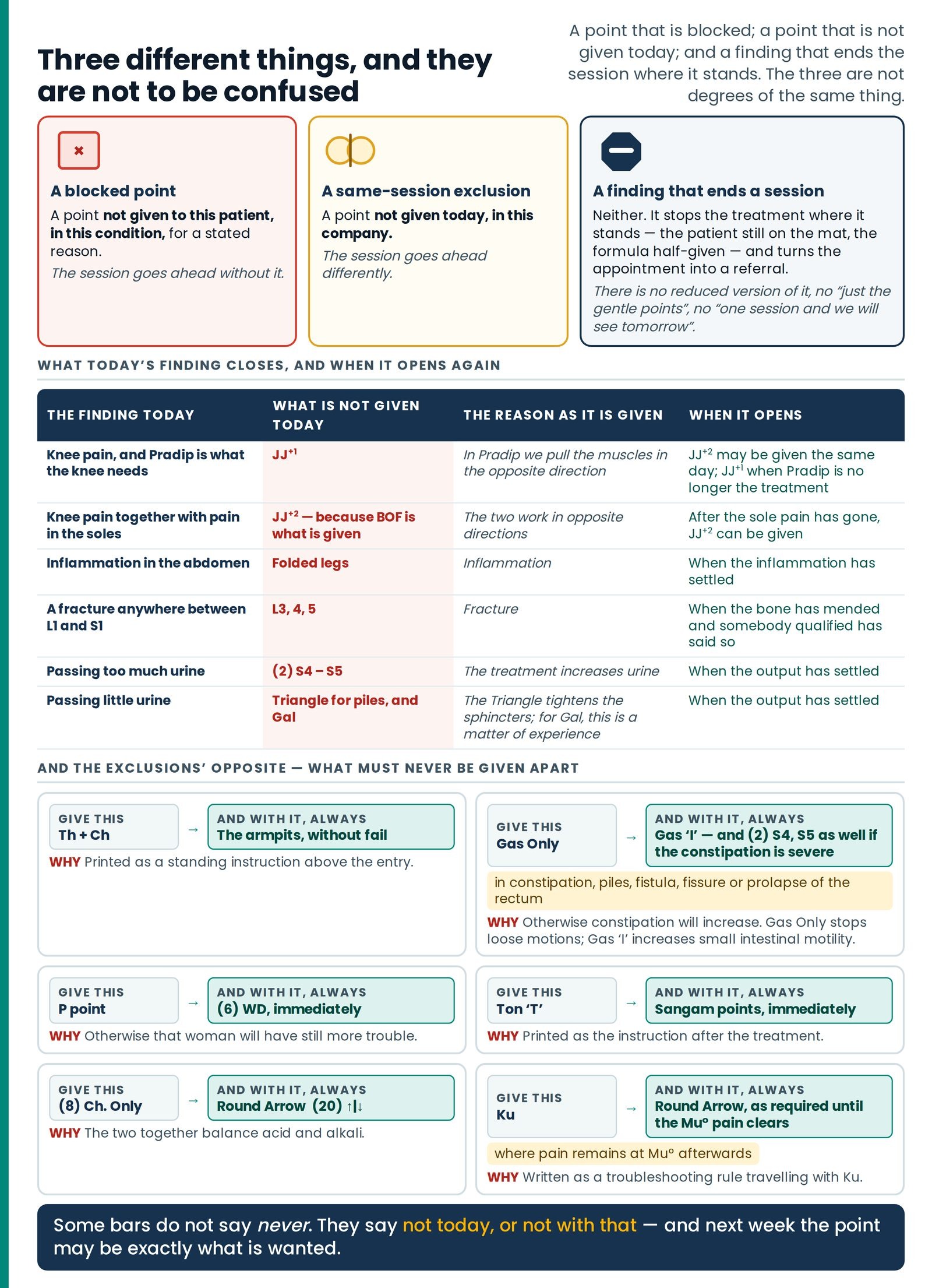
And the exclusions' opposite — the treatments that must never be separated. These are same-session rules of the other kind: not do not give both, but do not give one without the other.
Everything so far has been about what you write before a treatment. This part is about what happens during one, and it is the part of the article that will one day matter more than all the rest of it together.
Three different things, and they are not to be confused
A blocked point is a point not given to this patient, in this condition, for a stated reason. The session goes ahead without it.
A same-session exclusion is a point not given today, in this company. The session goes ahead differently.
A finding that ends a session is neither. It stops the treatment where it stands — the patient still on the mat, the formula half-given — and turns the appointment into a referral. There is no reduced version of it, no "just the gentle points", no "one session and we will see tomorrow".