Watch
knee and muscle pain
for constipation
How to Stimulate Pancreas Naturally? | LMNT Pan Point | Diabetes और Indigestion का जादुई इलाज
Early, sitting, dressed — the day named, and a note they can hand over
Five rules, and they are all about the patient's dignity rather than your comfort.
Say it early, sitting, and with them dressed. Nobody should receive this news lying on a mat with their clothing arranged for treatment. If you know at the history, say it at the history.
Say what you found, not what you fear . "You have told me two things that I do not treat around." Not "this could be something serious" — which tells them nothing and frightens them completely.
Name the timescale out loud. Today means today. Patients hear "see a doctor" as "see a doctor sometime" , and the gap between those two has cost people a great deal. Say the day. Say the hour if it is that kind of finding.
Give them something to carry. A short written note: what they told you, what you found, what you did not do, and the date. It converts an anxious patient repeating a half-remembered conversation into a patient handing over a document.
And do not discharge them. "This is not me sending you away. Come straight back when they have seen you, and we will go on." A patient who feels dismissed goes to somebody who will not ask the questions — and that, not your refusal, is what harms them.
A CASE FROM PRACTICE The man whose two diseases wrote his card between them A composite case, assembled from several patients at a district centre to teach the arithmetic of two blocked lists.
Shrikant Kulkarni · 61 · retired postal clerk · Solapur · came with pain and stiffness in both knees , unable to sit cross-legged for two years
What he came with. "Knees. Only knees. Everything else is under control — sugar is with tablets, heart they put one stent in 2016, doctor says it is all fine." He said it in one breath, in the tone of a man who had been told to mention these things and did not consider them relevant.
What was observed and palpated. Heavy build, breathless on the stairs to the room; both knees thickened, no heat, no redness, both the same temperature as the thighs; calves equal. A soft abdomen . On gentle inward pressure around the navel , tender at Pan and at Const , not at Liv° . Stools every second day, hard. He could feel light touch on both soles correctly at three places with his eyes closed — checked, because of the diabetes , and written on the card as checked.
Which reports mattered. His HbA1c mattered, because it says what three months were like rather than what this morning was. The letter from his cardiologist mattered, for one line in it: which vessel was stented and what he takes. His blood thinner mattered most of all, and he had not mentioned it — it came out of the letter, not out of him. An X-ray of the knees showing what such knees always show changed nothing.
What was done before the plan. The card was turned over and both lists were written out in full. Diabetes: twelve. Heart: nine. Four names appeared on both. (6) Adr was struck through twice, once for each list. (10) Medulla went down as blocked outright, not as (10) Left Medulla — because the heart entry names the left half as permitted and the diabetes entry blocks the point on both sides, even inside UDF treatment, and where two entries meet, the block wins. Against (4) Thrd he wrote → (2) Thrd . Against Round Arrow he wrote L1–L5 only. Against the blood thinner he wrote no jerks, no full weight, which closed the Pradeep jerk and its fifth stage before a knee was touched.
The choice, and why. Not a knee plan. The tenderness at Pan and Const and the hard stools said where the work began, and digestive work ran for nine days before anything went near a knee.
Session by session. Week one: stools daily by day six, and he volunteered — without being asked — that he was sleeping through the night. Week three: knee work begun, Knee Cap Free and Giriraj and Back of knees , no jerk and no full-weight stage, and the first improvement in getting out of a chair. Week six: cross-legged for the length of a meal, with a cushion.
What went wrong because something was withheld. In the fifth week his wife mentioned, while he was putting his shoes on, that he had been having "gas in the chest" walking to the market, twice, for a fortnight. He had not said so because it went away when he stopped walking, which is exactly the description that makes it urgent. The session that morning had not started. It did not start. He was sat up, asked about his spray, and sent the same day; the cardiology department admitted him that evening. He came back nineteen days later and the knee course went on.
What this case teaches
Blocked lists add and never cancel. Twelve plus nine, with four shared, is not nine.
Where a permitted line meets a blocked line, the block wins — which is how (10) Left Medulla was written out of a heart patient's card by his diabetes.
The medicine list is a source of contraindications, and patients do not think of a blood thinner as relevant to a knee.
"It goes away when I stop walking" is the sentence. He thought it was reassuring. It is the opposite.
A CASE FROM PRACTICE The session that lasted four minutes A composite, assembled to teach the recognition and the sentence said at the door.
Iqbal Ahmed Ansari · 47 · powerloom operator · Malegaon · came for the eleventh session of a course for rheumatoid arthritis
What he had been having. Ten sessions over five weeks for rheumatoid arthritis of four years, with the autoimmune list blocked on his card from the first day — Th, Th+Ch, Lymph , Armpits, Ton 'P' , Ton 'T' , Spl — and the permitted work built around (30) Medulla , (6) Adr and (1) Single point liver × 6 treatments, as the entry names. He had been doing well: morning stiffness down from two hours to about forty minutes, and both hands closing further than in March.
What was different on the eleventh morning. He arrived late, which he never did, and his brother had brought him on the motorcycle, which he never needed. He had a dressing on his left shin from a burn at the loom eight days earlier. He was shivering under a shawl in a room at thirty-one degrees, and he said, twice, that he was fine. His brother said the thing that actually mattered: "Since yesterday he is talking differently. He asked me who had come, and I was standing in front of him."
What was observed. Not palpation — observation, from three feet away, before anything was touched. Breathing fast and shallow. Pulse fast at the wrist and easy to feel from across the mat. Skin hot at the forehead and cold and mottled at the knees. The dressing on the shin was soaked and the skin above it was red for a hand's breadth beyond the edge of the gauze. He had passed urine once since the previous morning.
What was nearly done, and why it was not. His card said (6) Adr. (6) Adr was the right point for his disease, had been given ten times, and had helped him. And (6) Adr is the one point in this wiki whose entry says that, given by mistake in this situation, fits can come on immediately — because in septicaemia , immunity has already failed, and Adr reduces the thymus and immunity further.
What was done. The session ended before it began. Four minutes from the door: the shawl, the brother's sentence, the leg, the pulse, the urine. He was sat in the chair, his brother was told plainly and without drama that this was a finding the therapist did not treat around and that Iqbal needed a hospital now, this morning, not this evening, and a note went with them: the eleven sessions, the dates, the improvement, the burn, the fever with shivering, the confusion since yesterday, the spreading redness, the one passing of urine — and the line no treatment given today. The brother was asked to go with him rather than send him, which turned a worry into a job. He was admitted, given antibiotics through a drip, and kept nine days.
Which reports mattered. None. There were no reports, and none were needed. What ended that session was a shawl in a hot room, a brother's sentence and a wet dressing.
What went wrong because something was withheld. Iqbal had burned himself eight days earlier and had not mentioned it at the ninth or tenth session, because it was a small burn and "it had nothing to do with the joints ". Patients file their symptoms under the complaint they came about. The clinic's card afterwards carried one printed line at the top: anything new since last time — anywhere?
What this case teaches
A correctly blocked card is not the same as a safe session. His card was right. The danger came from a condition that had arrived since it was written.
The permitted point was the dangerous one. (6) Adr had helped him ten times. On the eleventh morning it was the worst thing in the room.
The most useful sentence came from the relative, not the patient — "he is talking differently". Ask the person who came with them.
Stopping is a treatment. Ten sessions of good work were not wasted by the eleventh being refused. They were protected by it.
A CASE FROM PRACTICE The blocks that came off in November A composite, assembled to teach what lifting a block does and does not mean.
Sulochana Rane · 38 · schoolteacher · Ratnagiri · came with asthma of eleven years and constipation
What she came with. "Every year from June to September I am on the pump four, five times a day. Rest of the year, two. And motions — not every day, never every day." She had been told at eighteen that she would have it for life and had arranged her life around it.
The card, in June. Asthma blocked Spl, Thrd and Gal , each with its reason written beside it: trouble increases · trouble increases · increases inflammation in the lungs . That removed a good deal, including the point she would otherwise have reached for first — Gal is what is given for skin disease with constipation, and she had both. What the entry gave instead was (1) Single point liver × 6 treatments, with the other treatments. Constipation blocked Gas Only , (10) Medulla and Dys , and sent the plan to Gas 'I' , Round Normal , Round Arrow and (2) S4–S5 — and she passed a normal amount of urine, so (2) S4–S5 was open to her, which it would not have been had she been passing little.
What was done when the first approach did not do enough. Six weeks in, the bowel had changed completely and the chest had not. The therapist did not add force and did not add points. She re-examined from the beginning as though it were a first visit, and retook the history differently — not has anything changed but about the room, the bedding, the kitchen, the sleep. The answer was a mattress aired once a year and a bedroom that had not had its window open at night since 2009.
Session by session. July: stools daily. August: pump down from four or five to two on most days. September, for the first time in eleven years, she went through the monsoon without a night she could not lie down in. November: no pump for nineteen days.
What happened to the blocks. In November the therapist did not rub the asthma line off the card. She wrote a new line under it, with the date, and her own name beside it: chief symptoms ended — Gal un-blocked for skin/constipation work, Spl and Thrd remain blocked pending review. One point back, not three; a dated decision with a name on it; and the reason preserved above it so that the next therapist could see both what had been true and when it stopped being true.
And what she was told, and not told. She was told that the blocks coming off was itself a result, and a good one — it is the proof that by our treatment the glands have improved. She was not told to reduce her preventer inhaler, and when she asked whether she could stop it she was given the sentence every patient of this therapy gets: "Go to your doctor and say — I have had no attack for two months, must I still take the same quantity? That decision is his."
What this case teaches
A blocked list is not a smaller treatment. Three points closed and the entry named what to give instead; the course was built out of the substitutions.
Blocks lift on the chief symptoms of the disease having ended — not on the patient feeling better, and not all at once.
Un-blocking is written, dated and signed, or it has not happened.
The best week of a patient's decade is the week they are most likely to stop their medicine on their own. Say the sentence before they ask.
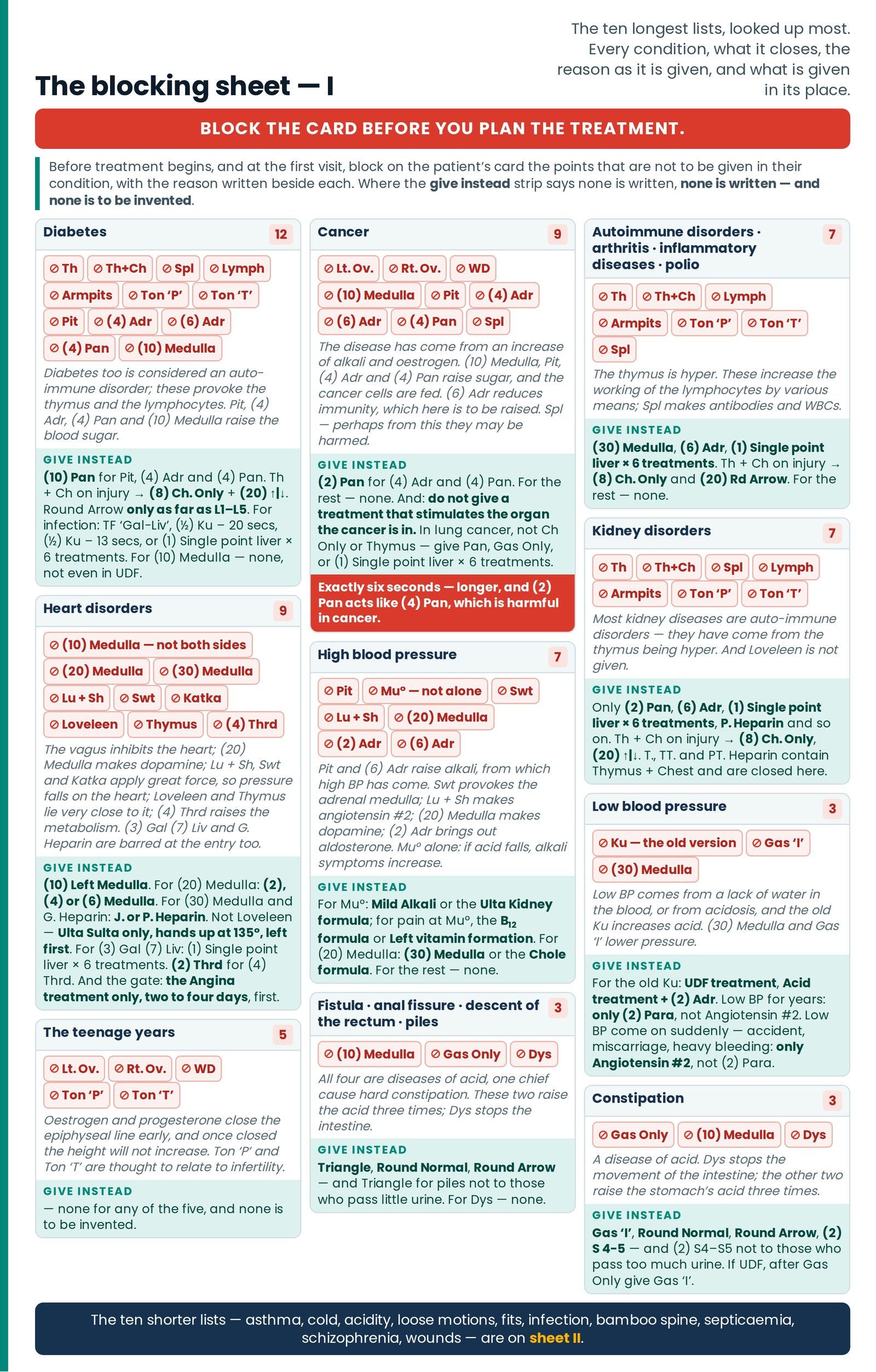
The blocking sheet — I. The ten longest condition lists as reference cards: the blocked points as crossed-circle chips with their exact count, the reason as it is given, and a give-instead strip that is left empty in words wherever no substitution is written. FROM AYURVEDA AND YOGA असाध्य and याप्य — the old physicians' three classes Classical Indian medicine divided illnesses into three, and the division was a physician's working tool rather than a philosophy. Sādhya — curable; treat it. Yāpya — not curable but manageable; keep the patient comfortable and functioning for years, and be honest that this is what you are doing. Asādhya — beyond this physician's means; do not take it on.
The teaching attached to the third class is the interesting part. A physician who accepted an asādhya case and promised a cure was held to have done something worse than fail: he had taken a family's hope and their money for a thing he knew he could not do. Refusing was a professional duty and a mark of standing, not an embarrassment.
Two thousand years later the same sentence still has to be taught to every new therapist, usually twice.
A MISTAKE STUDENTS MAKE Softening the refusal until it stops being one A therapist knows perfectly well that this patient needs a doctor today. He also knows the family has travelled four hours, and that the mother is looking at him the way mothers do. So he says: "You should also show this to a doctor when you get a chance — but come, let us do a little something today."
He has given the family two messages and they will keep the one they want. They will remember that the pressing was done, that it helped a little, and that the doctor was mentioned. The appointment gets made next month.
A referral that comes with a treatment attached is not a referral. It is a reassurance, and reassurance is precisely what this patient must not be given. The kind version is the clear one: "Not today. Today you need somebody who can look inside. I will write down what I found. Come back to me afterwards and we will start properly." ▲ Take care
WHAT TO CARRY AWAY In some diseases certain glands are already hyper. Since this therapy provokes glands, it is necessary to know in which diseases which glands must not be provoked. A blocked point is a good point aimed the way the disease is already travelling.
Blocking is done on the diagnosis card at the first visit, before treatment is planned — the points boxed, the reason beside each, the substitution on the same line, the list read aloud at the start of every session.
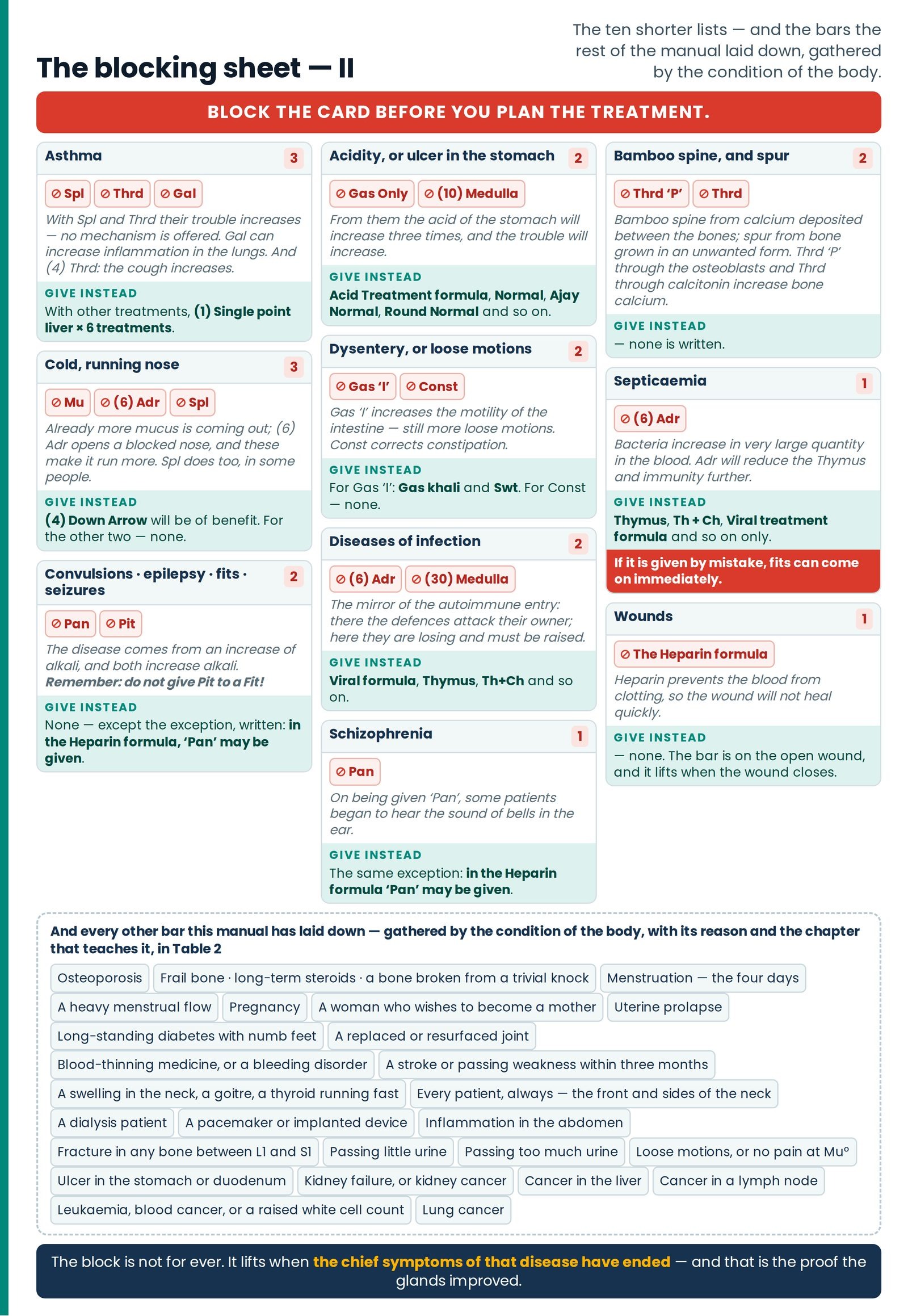
The block is not for ever. It is needed only for as long as the chief symptoms of that disease have not ended; afterwards, if the need arises, those points can be given. Lifting a block is itself the proof that the glands improved — and it is a dated, named decision, never a drift.
Twenty conditions carry their own blocked lists, from Wounds with one entry to Diabetes with twelve. Every one carries the reason and, where written, the substitution — and the substitution is the half a hurried therapist leaves out.
Where a permitted list meets a blocked list, the block wins. Blocked lists add and never cancel. A substitution must clear every list on the card, not the one that produced it.
The instructions that look like exceptions are instructions. Sulta Ulta is given in angina — arms at 135°, a little upward, not parallel to the shoulders, left side first. (10) Left Medulla is given to heart patients — the side names the half that is permitted. Pan is given inside the Heparin formula to a patient with fits or schizophrenia . (6) Adr is given in polio , which is an inflammatory disease. Each carries its qualifying detail, and the detail is the teaching.
(2) Pan in cancer is exactly six seconds. Longer and it acts like (4) Pan , which feeds the cells it was given to kill. Do not give a treatment that stimulates the organ in which the cancer is.
Thymus and Thymus + Chest are barred in pregnancy , polio, inflammation, heart disease, diabetes, RA, autoimmune disorder and kidney disease — which closes T., TT. and PT. Heparin to those patients. No substitution is written for the bar; none is invented. Where Th + Ch is given, the armpits are given without fail.
The teenage bars are the only ones whose harm cannot be undone. A growth plate that has closed does not open.
Some bars mean not today, not *never* — JJ⁺¹ against Pradip, JJ⁺² against BOF on the same day, Folded legs in an inflamed abdomen, L3,4,5 over a fracture, (2) S4–S5 and Triangle for piles at opposite ends of one range. And some pairs are never separated: Th + Ch with the armpits, Gas Only with Gas 'I', P point with (6) WD , Ton 'T' with Sangam.
A finding that ends a session is not a blocked point. It stops the treatment where it stands and turns the appointment into a referral. There is no gentle version.
We use no medicine and we do not tell a patient to stop theirs. Prescribing and un-prescribing belong to the person who prescribed.
Not everybody who comes to you can be treated by you. Say it early, sitting, plainly; name the day; write a note they can hand over; and make clear you have not sent them away.
The blocking sheet — II. The ten shorter condition lists in the same form, with the septicaemia callout; and beneath them, as a scan strip, every condition under which the rest of the wiki has laid down a bar, pointing to Table 2 for the reason and the article.