The article before this gave you the map. This one gives you the hand, and the second gift takes longer. A student learns where Gal lies in an evening and will still, six months later, find tenderness in half the healthy people he examines — because a map is knowledge and a hand is a skill, and skills are built by repetition under correction. This article is the correction, written down. (Figure 7.5)
A map is knowledge; a hand is a skill built under correction
The instruction as it is first given sounds too easy to need a article. With the tips of the fingers, press inwards, with soft pressure, at certain determined places.
Then you do it, and find four quantities hidden inside the word press — how hard, how fast, how deep, how long. A beginner gets all four wrong in the same direction, because effort feels like care and a hard press always seems to find more. It does find more: it finds tenderness in everybody. A test positive in everyone has told you nothing.
Key teaching
What you are actually measuring
You are not measuring how much pain the patient has. You are measuring how far your finger had to travel into the body before something pushed back — and, separately, what the patient's face did while it travelled.
Both come from the same press and both go on the card. But the first is what makes this examination repeatable, because a depth is a fact about tissue, while a wince is a fact about tissue and about the person on the mat that morning. This is why the grading scale is anchored to depth and not to loudness: read it forward and you have a technique, read it backward and it tells you exactly how to press.
Think of a belly wall as three things stacked on a firm floor: a cushion of skin and fat, a sheet of muscle, and beneath that whatever is going on inside. A finger sinking into a well-supplied wall passes through cushion and sheet without meeting anything that objects — the therapy's phrase for that is soft like butter. A finger sinking into a wall where something is wrong meets a floor early. How early is your finding.
How to press
Fingers, posture and the rhythm of one examining press
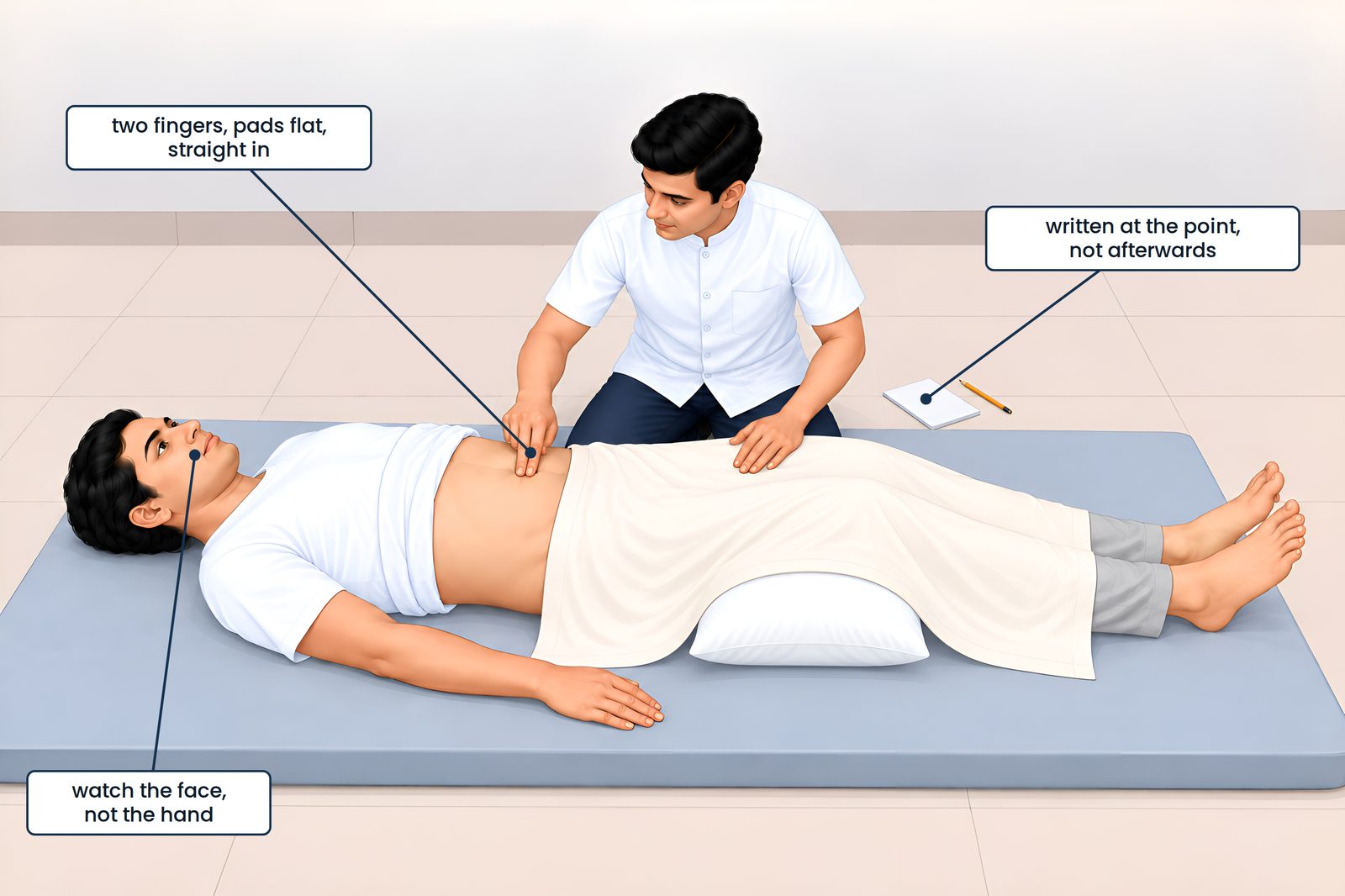
That is about eight seconds a point — four or five minutes for the eighteen, the cheapest four minutes in this therapy. (Figure 7.1)
The examining hand, and the card beside the knee. Kneeling level with the patient's hip, two finger pads rest flat a little to the patient's left of the navel and sink straight in; the other hand stays still on the patient; the card and pencil lie beside the knee; the eyes are on the patient's face, not on the hand.
Read next
Placing the Patient Placing the Patient — where you kneel, and weight through a soft arm
Six Seconds Six Seconds — the six-second unit belongs to treatment, not examination
The Shorthand The Shorthand — ghisāī — sliding is a treatment, so lift clear
The plus-and-minus scale
Five grades on one ruler: the depth at which resistance begins
Here is the notation you will use in every case record for the rest of your life. Its value lies in every therapist meaning the same thing by it.
Key teaching
How much pain, and how it is written
First of all, check how much pain or stiffness — kaḍakpan — there is at all the pain points around the navel. Form an estimate, and write plus (+) or minus (−) accordingly on the card.
Plus (+) means pain. Minus (−) means no pain.
To record how much, press with soft fingers on any one of the pain points and read the answer against these five:
If the patient cries out at the very lightest touch, that is pain of number four. So write four plus — ++++.
If stiffness or pain is felt once the finger has gone a little way in, we call that three plus — +++.
If the skin above is soft, but on going somewhat deeper stiffness is felt, write two plus — ++.
If the skin or muscle feels soft quite deep down and only then a mild stiffness is felt, we write one plus — +.
If the skin or fat feels soft like butter and the patient gives no reaction at all on pressing, then the bloodcirculation below that part is entirely correct, so write minus — −.
Table 1 — The plus-and-minus scale
Written
Said aloud
What your finger does
What comes back
What it means
++++
four plus
The very lightest touch — barely more than laying the pads on
The patient cries out at once
Pain of number four; the most this scale records
+++
three plus
The finger has gone a little way in
Stiffness or pain is felt
Marked
++
two plus
The surface is soft; the finger goes somewhat deeper
Stiffness is felt at that depth
Moderate
+
one plus
Soft quite deep down, and only then something
A mild stiffness
Slight
−
minus
Skin and fat soft like butter all the way
No reaction at all
The blood circulation below that part is entirely correct
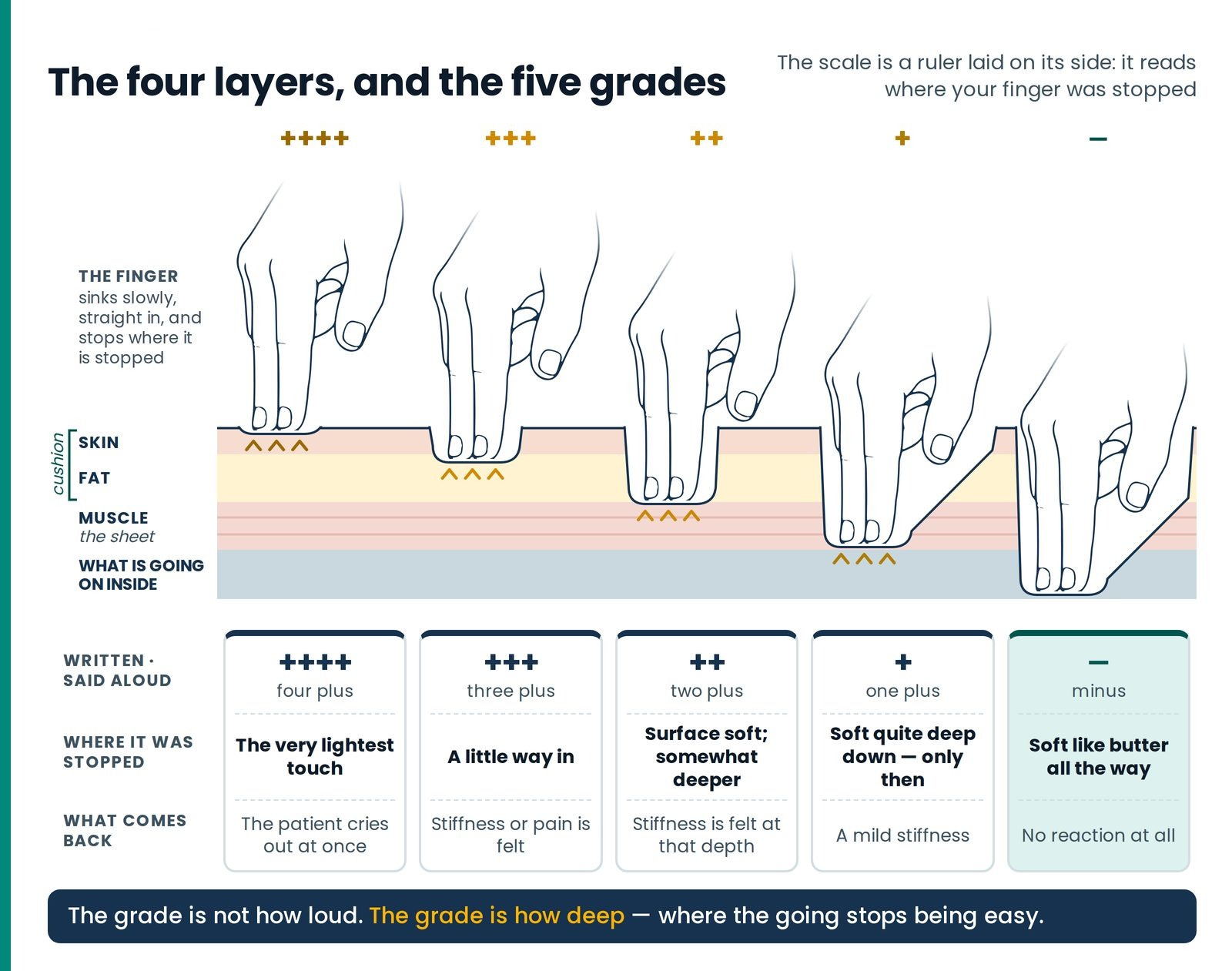
Read the middle column downwards and the scale is a ruler laid on its side: the grade is the depth at which the going stops being easy. Two therapists arguing about whether a patient is "quite tender" will never agree; two therapists asked at what depth did your finger first meet resistance have a question they can both answer. (Figure 7.2)
The four layers, and the five grades. The plus-and-minus scale read as a ruler of depth: the grade is decided by how far the finger sinks through skin, fat and muscle before something pushes back.
Where the two part company they are telling you something. Hardness without pain — the finger stopped early, the patient reporting nothing — is common in labourers, in stoical people, in patients on painkillers for something else, and where sensation is blunted. Record it and do not discount it: it is the more objective reading, and in the patient who will not complain it may be the only one you get. Pain without hardness should first send you to the four manufactures taught below; if it survives that, be careful with it, because a belly that hurts everywhere and resists nowhere is more often a frightened person than a map of eighteen findings.
A grade alone is still half a finding. Every named point recurs at three distances from the navel — threes immediately around it, twos in a middle ring, ones furthest out — and the ring decides where on the limb the treatment is given. A card recording Gal +++ and not the ring has recorded a fact you cannot act on.
Key teaching
The four parts of a written finding
Point · side · ring · grade — then one letter for what you found: H for hardness, P for pain, HP for both.
Gal R 1 +++ HP reads: the gall bladder point, on the right, at the outermost ring under the rib margin, three plus, both hard and painful. Right · Mu° L − reads: the left flank point, silent. Left
Where a point sits on the midline — Pan, Gas, Gas 'I', WD — leave the side blank rather than guessing. And an empty box means not examined; a minus means examined and silent. Confuse the two and next week's comparison will lie to you.
Left against right
Every point has a mirror, and the comparison is the finding
Key teaching
A finding means little alone and much beside its partner
Compare the two sides one after the other, never one alone.
Almost every point has a mirror: Gal right and Spl left; Liv right of the navel and Mu left; Dys right and Const left; Rt.Ov and Lt.Ov; Fluid at the right groin and Acid at the left; FA and B₁₂ at the front of the two hip crests, Thia and Nia at the back of them; and at the flanks, Liv° right and Mu° left. Left Right
A single flank graded three plus tells you only that this wall stopped your finger early on that side; whether it means anything depends on what the other side does. Three plus on the left and minus on the right is a finding. Three plus on both is a body — or a therapist — pressing hard.
The reason is arithmetic, not theory. Every quantity you cannot control — her build, her muscle, the thickness of her wall, her tolerance of being touched, what she ate at eleven o'clock — is shared by her two sides and cancels out in the comparison. Compare her left against your memory of somebody else's left and none of it cancels.
You will use this hardest at the flanks, because what they say against each other sorts a patient into one of two great families; what a tender Mu° against a quiet Liv° actually means belongs to the next article.
Read next
The Two Kingdoms The Two Kingdoms — what a tender Mu° against a quiet Liv° means
The Navel Speaks First The Navel Speaks First — right follows left in the giving of treatment
The silent finding
Minuses, and the tenderness the patient never knew she had
A patient comes because something hurts. She can tell you where, when and how much, and has told several people already. That complaint is the least interesting thing you will learn about her, because she already knew it. What she does not know is what your fingers are about to find.
Key teaching
The pain the patient does not know she has
Very often the tenderness you find is a tenderness the patient did not know was there until it was found.
Nothing in an ordinary life presses two fingers into that square inch and leans: a knee announces itself because she walks on it, while a place two inches left of the navel has never once been asked a question. So the ordinary sound of a first examination is not a complaint but a question — "What is that? Why is there pain there? There has never been pain there."
And the working consequence: what you discover frequently matters more than what she came in complaining of. The complaint tells you where she feels the trouble; the findings tell you where it is coming from. Those are often two different places, and the treatment follows the second.
Two rules come with that. Do not announce the discovery as a revelation — a patient told "your liver is blocked" will believe it for a year, and frightening explanations produce real symptoms in real bodies. Say instead: "There is a tender place here. In our system this one is connected with the working of the liver, and it is one of the things we will work on. It does not mean there is damage." And do not treat the complaint as a distraction: she came about her knees, so say on day one that you will be working on her digestion and why, and say it again in week two.
A student's instinct is that a minus is a blank. That is exactly backwards.
Key teaching
A minus is a positive statement
If the skin or fat feels soft like butter and the patient gives no reaction at all on pressing, then the blood circulation below that part is entirely correct.
That is a finding, and it does three jobs.
It rules something out — a quiet Const in a patient complaining of hard motions changes what you look for next. And it calibrates the pluses: a card with eighteen pluses is not a diagnosis but a confession, because a therapist who found no minuses was pressing too hard and every grade on it is suspect. A good examination almost always has minuses on it.
It is the baseline that lets a change be seen. A point reading minus this week and two plus next week has moved — which an empty box would never have shown you.
The most satisfying silence arrives later. A point three plus at the first visit and one plus at the fourth has told you what no conversation can: if the pain at a place is relieved, the blood supply to that place has been restored.
The four ways to manufacture a tenderness that is not there
Too hard, too long, the wrong place, and the leading question
Everything above tells you how to find what is there; this tells you how therapists routinely find what is not. Every one of the four feels, at the time, like doing the job properly. They are: pressing too hard · pressing too long · pressing in the wrong direction or over the wrong structure · leading the patient with the question. Three are your hand. The fourth is your mouth, and it is the one almost every student commits in the first month without noticing.
One — pressing too hard
Two — pressing too long
Three — pressing in the wrong direction, or over the wrong structure
Nothing about this one feels like an error: the therapist is gentle, brief, and standing in the right place. He is simply not pressing where he thinks he is.
Four — leading the patient with the question
This is the one almost nobody escapes, and the hardest to see in yourself, because it does not live in the hand at all.
The order of examination
Flanks first, away from the complaint, outer ring inward
A therapist who examines in a different order every day is running a different test every day. Fix an order and keep it. Four reasons build the one taught here, and they matter more than the sequence.
Start where the answer sorts the most. The two flanks come first, because what they say against each other divides patients into two great families and a large part of the plan follows.
Start away from the complaint. The first press of a session teaches the patient what pressing feels like; a first press at the sore place teaches her to brace, and every reading after that comes from a braced wall.
Work from the outer ring inward. The outer points sit over firmer ground and tolerate examination best, while the field around the navel is the most sensitive part of the abdomen in almost everybody. Outside-in, an irritated inner ring never contaminates your outer readings; inside-out, it does, every time. And keep the pairs together — right member, then left, then on.
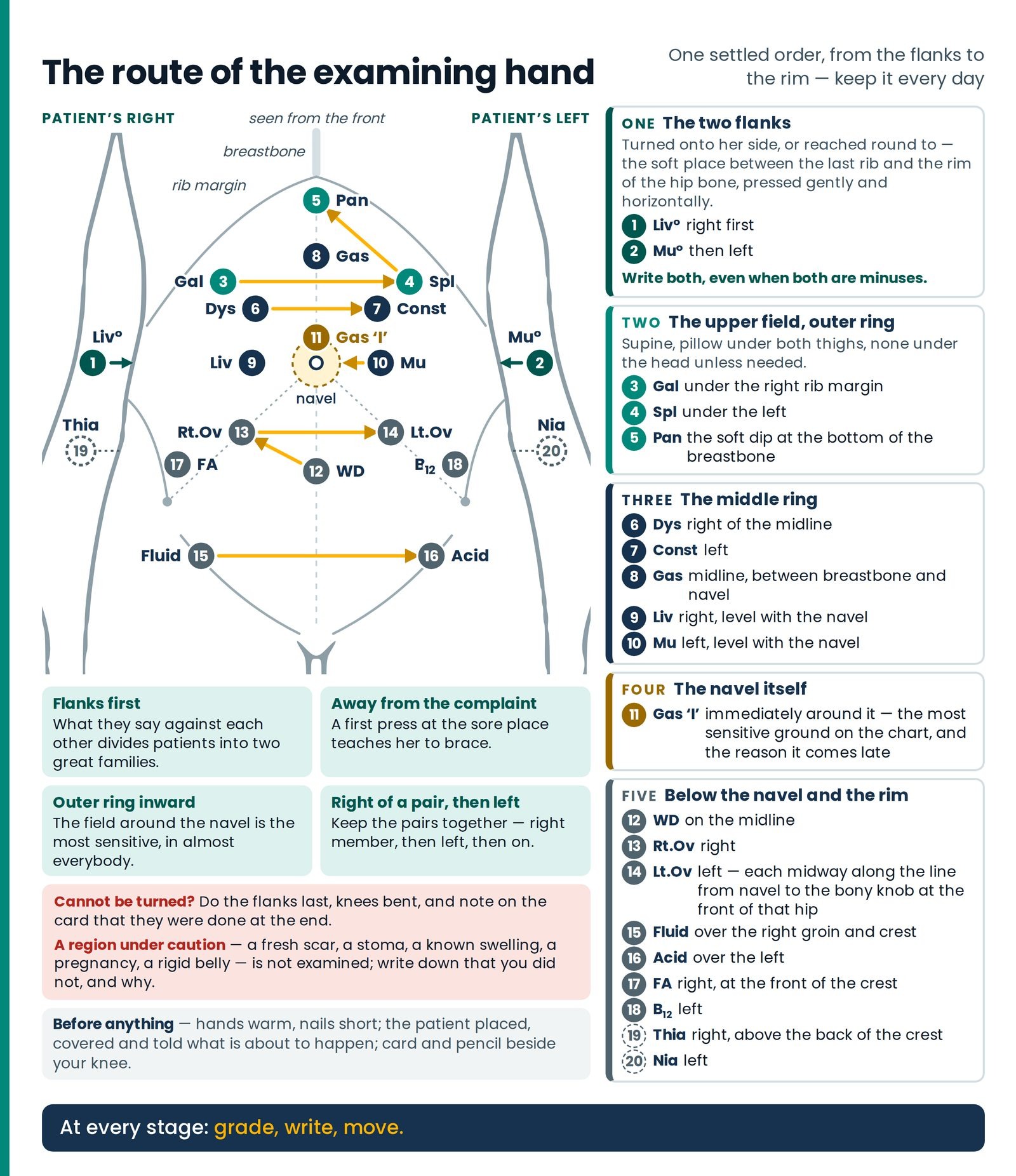
If a patient cannot be turned, do the flanks last, knees bent, and note on the card that they were done at the end. If a region is under caution — a fresh scar, a stoma, a known swelling, a pregnancy, a rigid belly — you do not examine it, and you write down that you did not, and why. ▲ Take care (Figure 7.3)
The route of the examining hand. The settled order of examination on a front-view trunk: the two flanks first, then the upper field, the middle ring, the navel, and below the navel to the rim — right member of each pair before the left.
Read next
Before You Touch Anyone Before You Touch Anyone — hands, patient and card ready before the route
Treating Women Treating Women — pregnancy among the regions left unexamined
Recording what you find
Grade, write, move: the card as the instrument of comparison
Asked why he keeps no records to show the world, Guruji answers: "In the time I would have to spend every day making written records to show to others, I could serve another fifteen or twenty lakh patients." That is a man choosing the patient in front of him over the notebook, every day for fifty years, and nobody who has run a free clinic will sneer at it.
But notice what was declined: a record kept to show to others.The card beside the mat is a different object — the instrument that lets today's session be compared with last Tuesday's. Without it there is no comparison, and without comparison this therapy loses the one thing that tells it whether it is working. A therapist who does not write cannot know; he can only feel that things are going well, and feelings favour whoever holds them.
Key teaching
Write it at the moment you make it
Grade, write, move. Not grade, grade, grade, then write.
A grade decays in about a minute. Four points later, "was that two plus or three plus?" has no honest answer, and you will resolve it in whichever direction fits the story you have begun telling yourself. And eighteen findings will not survive to the end of an examination: you will remember three — the loudest, the first, and the one you expected, which is a summary of your own expectations and not a record. Writing at the point also slows you down, which is a benefit: those two seconds are when you decide what you actually felt.
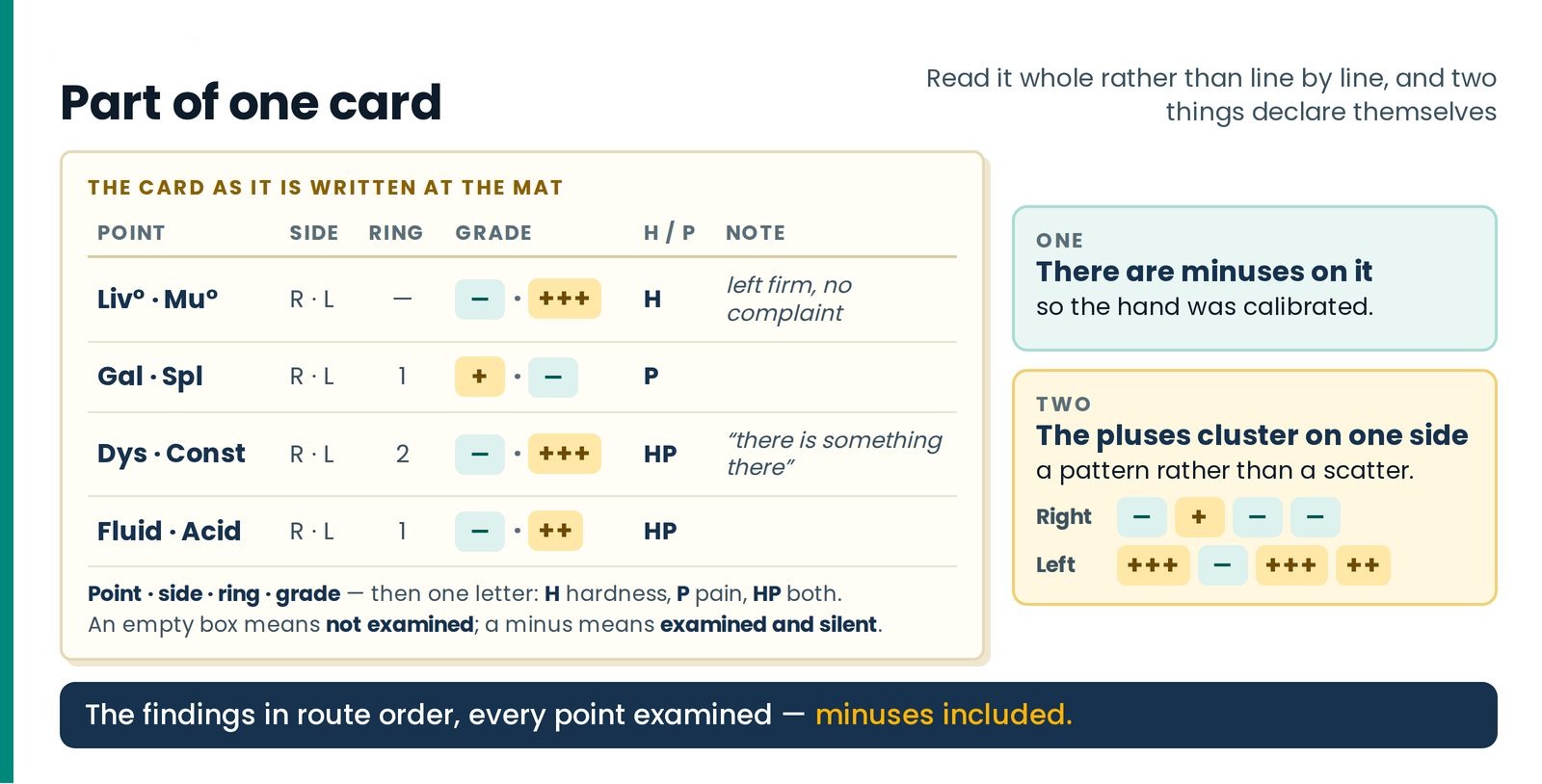
Part of one card. Four paired lines of a patient's card, read whole: minuses show the hand was calibrated, and the pluses gather on one side — a pattern rather than a scatter.
Read a card whole rather than line by line and two things declare themselves: there are minuses on it, so the hand was calibrated; and the pluses cluster on one side, a pattern rather than a scatter. What the pattern means is the next article's business. (Figure 7.4)
Two bodies, read with the fingers
A migraine read as a bowel, and a man who never said it hurt
Training your own hand
Well bellies, kept cards, and two therapists checking each other
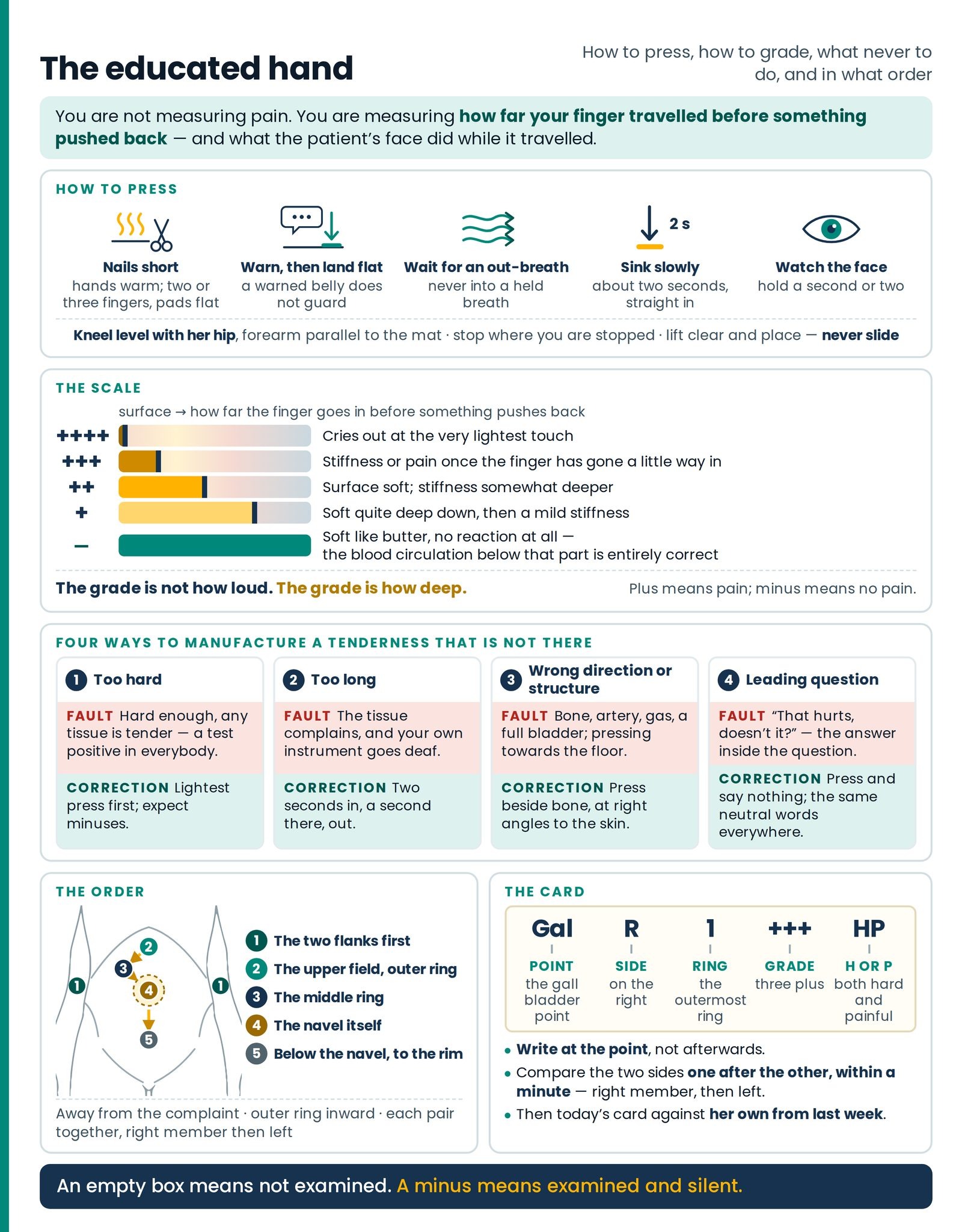
The educated hand. The whole article on one page: what is measured, how to press, the five grades, the four ways a tenderness is manufactured, the order of examination and how a finding is written.
Questions students ask
1. I am nineteen and every belly I press feels tender. What am I doing wrong? Almost certainly pressing too hard, and you will not believe how much lighter you must go. Calibrate: press two fingertips into the soft belly of your own forearm just below the elbow, until you first feel firm resistance — not until it hurts. That is about the weight that reaches two plus. Then examine six healthy people until their cards come back mostly minuses.
2. I am a retired schoolteacher, sixty-six, learning this for my husband. My hands are not strong. Is that a problem? It is close to an advantage. The weight comes from leaning your body a little through a soft arm, and a finger working hard cannot feel anything. You need short nails, warm hands, patience for two seconds, and the discipline to write it down.
3. I am a doctor, and this looks like abdominal palpation with a different vocabulary. What exactly is different? The purpose and the procedure. You palpate to characterise a structure — size, edge, consistency, movement with respiration — and you go where the history sends you. Here the sites are decided in advance, the same in every patient; a single sign is elicited, graded on a fixed five-point scale anchored to the depth at which resistance appears; and the treatment that follows is given somewhere else entirely, usually on a limb. Agreeing about the abdominal wall is not agreeing about what a finding means.
4. I have no science at all. What is the difference between "hardness" and "pain"? Pain is in the patient and only she knows it. Hardness is in the tissue and your finger knows it — a place where the wall has lost its give and meets your finger like a half-inflated ball instead of a cushion. A very patient man may have plenty of hardness and never say a word; a very frightened lady may say a great deal with a wall as soft as butter. That is why you record both.
5. My teacher checks the two flanks before anything else. Why not start at the navel? That comparison sorts a patient into one of two great families before you have spent twenty minutes on anything; and the field around the navel is the most sensitive ground on the chart — start there and you brace the wall for everything after. See also → The Two Kingdoms, "The Two Kingdoms".
6. A patient's belly is tender absolutely everywhere. What does that tell me? In this order. One, are you pressing too hard — the commonest answer and the first to exclude. Two, is she frightened, cold or braced? Three, is this a belly that should not be examined at all — rigid, board-like, exquisitely tender, with vomiting or distension? Then stop and send her the same hour. See also → When the Hand Must Stop, "When the Hand Must Stop".
7. My finding was three plus and the senior therapist said one plus. Which of us was wrong? Probably you, and that is the ordinary direction of a beginner's error rather than a rebuke. Press again while he watches, and watch the depth his fingers reach. Disagreement at the boundary between grades is where training happens, and the cure is doing this deliberately every month.
8. Do I re-examine at every session, or only weekly? Every session, before anything is given. The pain-point picture belongs to a day, not to a patient, and yesterday's picture has since been treated. It is the examination that chooses the treatment, so a session without it is not a shorter session but a different and unpredictable one. If there is no time to examine, give no treatment and ask the patient to come next day. See also → The Navel Speaks First, "The Navel Speaks First".
Questions patients ask
1. "How do you know where to press? Are you feeling for a lump?" No — I am not looking for lumps, and if I ever felt one I would tell you plainly and send you to a doctor. These are set places, the same on everybody, decided long before I met you. I press each one gently and notice two things: how easily my finger goes in, and what your face does. I write down every one, including the places where I find nothing.
2. "There is pain there! I never knew there was pain there. Is something wrong inside me?" It is a very common finding and not a frightening one. It tells me a part of your abdomen is not getting the blood flow it should — not that anything is damaged. Most people carry two or three of these without knowing, because nothing in an ordinary day presses on that spot. It usually settles as we work, and you will feel it settling.
3. "Will you press hard?" No. Firm enough to feel something, soft enough not to make it. If I press hard enough to hurt anybody, I will find pain in everybody — and then my examination has told me nothing and I have hurt you for nothing. Say so at once if anything is uncomfortable; I would far rather know.
4. "Nothing hurt anywhere. Does that mean you cannot help me?" It means several parts of your abdomen are working freely, which is good news and part of what I needed to know. Findings change from day to day, so I will check again next time. And what I find with my hands is one part of the picture; what you tell me and what I can see are the other two.
5. "My doctor examined my stomach last month and said everything was normal. So why is this sore?" Both things can be true and they are not in conflict. He was feeling for particular things — an enlarged organ, a swelling, a tender gall bladder — and did not find them, which is worth having. I am pressing set places to see how freely the wall gives, which tells me about the flow of blood in a region: two different questions asked of the same belly. I would not want you thinking his normal report is secretly abnormal; it is not.
Words used here
Hindi
English
Neurotherapy code / usage
कड़कपन (kaḍakpan)
Hardness, stiffness
What the finger meets; graded on the same plus scale as pain and recorded with an H
दर्द (dard)
Pain
What the patient has; recorded with a P. Only she knows it
दबाना (dabānā)
To press
The examining act: pads of two or three fingers, straight in, about two seconds down
नरम दबाव (naram dabāv)
Soft pressure
The standing instruction for finding a point; the method, not a politeness
मक्खन जैसा नरम (makkhan jaisā naram)
Soft like butter
The description of a minus — no resistance and no reaction
प्लस / माइनस
Plus / minus
++++ +++ ++ + − — the grading written on every card
घिसाई (ghisāī)
Rubbing, sliding
A treatment, not an examination; the reason you lift clear rather than slide
कार्ड (kārḍ)
The card
The patient's record; written at the point, not afterwards
—
Ring
The 1, 2 or 3 beside a grade; a distance from the navel, and what decides the station on the limb
—
Guarding
A wall tightening under the hand — voluntary, which melts; or involuntary, which ends the session
—
Silent point
A point examined and found quiet; a finding in its own right, never a blank box
Ready to begin?
Send COURSE for course details, or your name, age and health issue for a consultation.