That story is the reason this article exists in the form it does. The plate is the part of the patient's day that the patient argues with. Nobody quarrels about which side to roll off the bed on. Everybody quarrels about food, because food is not a behaviour — it is a household, a mother-in-law, a religion, a childhood, a memory of a particular kitchen, and the one pleasure left to a great many people who have lost most of the others. A rule you place on a plate is a rule you are placing in the middle of somebody's family.
So the rules of eating and drinking are taught here exactly as the rules of the day were taught in the article before this one: every rule with the reason given for it, and where no reason is given, the rule stated plainly and no reason invented. See also → Between Two Sessions, "Between Two Sessions", which carries the daily rules of sleeping, rising, bathing and conduct, and which establishes the two working methods this article takes for granted — never audit a rule, reconstruct a day, and two rules to a visit, not eleven. Those are not restated here. They are simply used.
One further thing is worth saying at the doorway. Some of the rules that follow carry a mechanism: a named structure, a named chemical, and a stated consequence. Others are given as a matter of experience — observed, offered, and honestly labelled. And one of the most important of them ends with an instruction found almost nowhere else in this material: try it on yourself and see. Keep those three kinds apart when you teach, and the patient will believe you about all three.
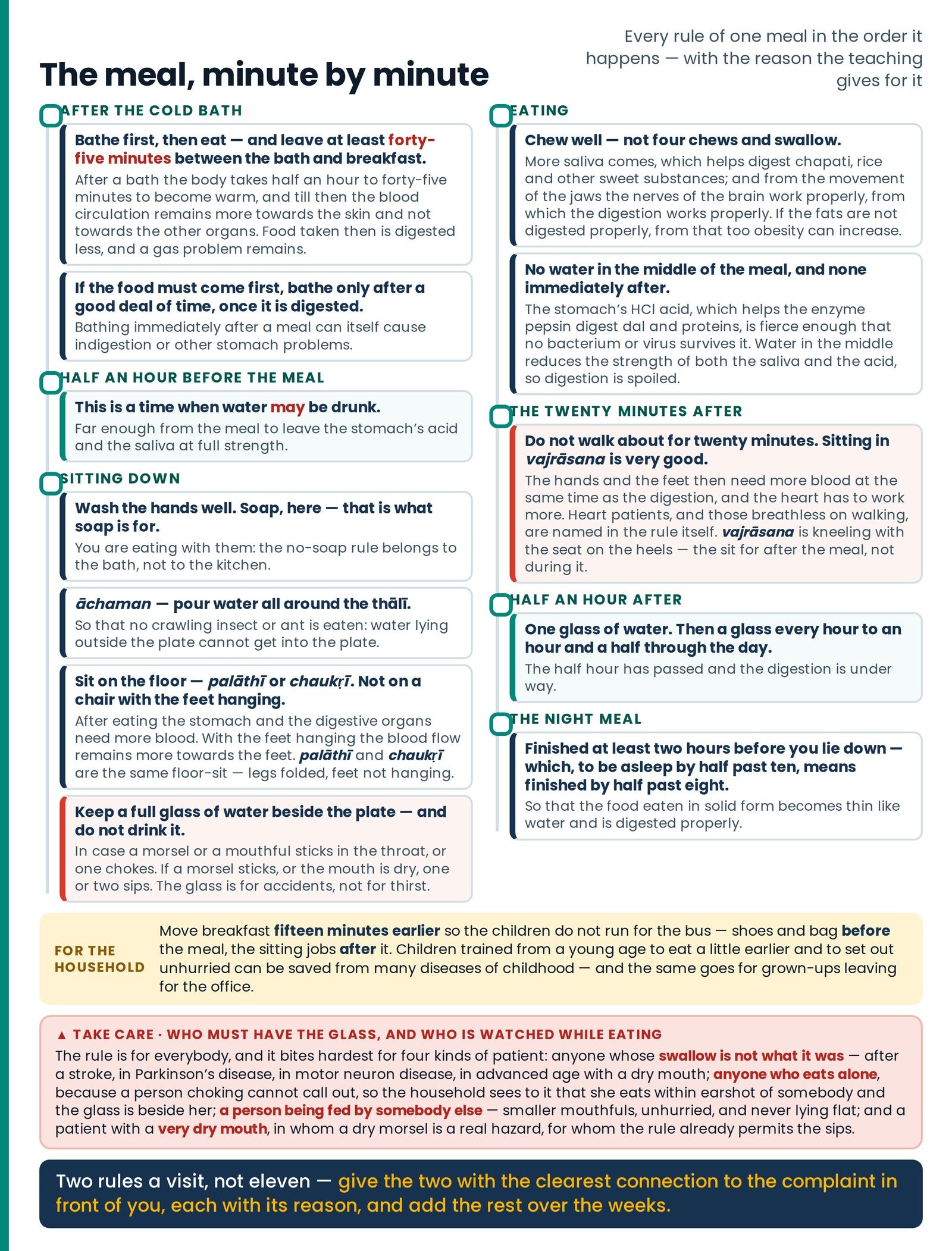
Three things happen before a morsel is lifted, and each of them has a rule. The hour at which the meal falls. The way the body is arranged to receive it. The state of the hands that carry it to the mouth. (Figure 39.2)
Watch



The gap between the bath and the breakfast
Forty-five minutes — and what to do when the food must come first
This rule has two halves, and they face in opposite directions. Between Two Sessions took the half that belongs to the bathroom. What belongs here is the half that belongs to the kitchen.
Breakfast comes after the bath, and not within forty-five minutes of it
After bathing in cold water in the morning, breakfast should not be taken for at least forty-five minutes.
Breakfast should be taken only after bathing. If for some reason it has to be taken first, then bathe only after a good deal of time, so that the food eaten is digested.
The reason. After bathing, the body takes half an hour to forty-five minutes to become warm. At that time the blood circulation remains more towards the skin and not towards the other organs. The stomach and the digestive system will not work properly until the whole body becomes warm and the circulation increases towards them — and food taken within that time will be digested less, and a gas problem will remain.
And the rule read from the other end: bathing immediately after breakfast or a meal can cause indigestion or other stomach problems.
Notice that this is not one instruction but a pair, and that the pair is complete. It tells you the preferred order — bathe, wait, then eat — and it tells you what to do when the preferred order is impossible, which in a house where four people share one bathroom before eight o'clock it very often is. If the food must come first, the bath waits, and it waits long enough for the food to be digested. A student who teaches only the first half has given the household an instruction it cannot keep on three mornings out of seven, and a rule that cannot be kept teaches the patient that your rules are for other people.
Across the mat it goes like this. When you come out of a cold bath your body is busy getting warm again, and to do that it keeps the blood near the skin. Your stomach is at the back of the queue for about half an hour. Food put into it in that half hour is not properly dealt with, and what you get for it is gas. Give it three-quarters of an hour and the blood has come back inward and the stomach is ready for you.
The practical form of the rule is a sequence, not a stopwatch: bathe first thing, then do the things that can be done sitting — the tea for the household, the small pooja, the newspaper, the phone call to the son — and eat at the end of them. Forty-five minutes disappears by itself when it is filled. A patient told to wait forty-five minutes stands in the kitchen watching a clock and gives up by Thursday.
Washing the hands, and the water poured around the plate
Soap for the hands, a ring of water for the ants, a glass for a choke
The hands, the āchaman, and the glass that stands beside the plate
Before eating, food should be eaten only after cleaning the hands well.
Our elders, performing āchaman, used to begin the meal by pouring water all around the eating plate — the thālī. This is because no crawling insect or ant should be eaten: if water is lying outside the plate, it cannot get into the plate.
Even so, water should certainly be kept near at the time of food, so that a morsel never sticks.
Three instructions, and the third is the one to teach hardest, because it will save somebody's life in your working career and the other two will not.
The first is plain and needs no defence. Hands cleaned well. In a country where a great many people eat with their fingers, that is not ceremony, and it is the one place in this wiki where soap belongs — a point worth making out loud to any patient who has taken the no-soap bathing rule of Between Two Sessions and carried it, as patients do, out of the bathroom and into the kitchen. The bathing rule is about the bath. The hands are a different matter, and they get soap.
The second is given as the explanation of an old practice, in the same manner as the wooden sandal and the twenty-four syllables in the article before this one: the ring of water around the thālī is a barrier, and a reason is supplied for it — an ant walking towards the plate meets water and does not cross it. Teach it as what it is, an old household custom with a stated purpose. It costs nothing, it offends nobody, and a family that does it will not eat an insect in the dark at the end of a pangat.
The third stands on its own, and it is the one rule in this whole article that contradicts nothing and yields to nothing.
The glass beside the plate — and why it is not about digestion
A glass of water should certainly be kept near at the time of food, because it may be of use whenever a morsel or a mouthful sticks in the throat, or one chokes.
If a morsel sticks, or if the mouth is dry, one or two sips of water may be drunk.
Read that beside the rule that comes next — do not drink water in the middle of a meal — and there is no conflict of any kind, because the two rules are about two different things. One is about digestion. This one is about choking, and choking does not wait for half an hour to pass.
This is the exception the whole water teaching is built to accommodate, and it is written into the teaching itself rather than bolted on afterwards. The glass stands there for the whole meal. It is not drunk with the meal. It is drunk when a mouthful sticks, or when the mouth is dry — one or two sips, which is the quantity named, and not a tumbler.
Say the distinction to the patient in six words: the glass is for accidents, not for thirst. A patient who has understood that will keep both rules, and will not be found at the end of the week either gulping water over her rice or, very much worse, sitting at a meal with nothing within reach. ▲ Take care
Here is the first rule in this article that patients find strange, that costs nothing, that is easy to demonstrate, and that carries a fully worked mechanism. Teach it well and you have bought credit for the harder ones that follow.
Eat sitting on the floor — chaukṛī or palāthī
Whatever we eat, we should always eat only sitting in chaukṛī or palāthī.
The reason. So that the flow of blood is more towards the stomach.
According to nature's law, after eating there is greater blood flow in the stomach and the digestive organs, because at that time they need more blood.
If we eat sitting on a chair, the feet hang — so on account of the earth's force of attraction the blood flow remains more towards the feet, and sufficient blood will not be obtained for the digestive system's functions.
The observation underneath that rule is entirely sound and is the foundation of half of this wiki: after a meal, a great deal of blood goes to the belly, because that is where the work is. The gut does not digest anything for nothing; it is an organ system running at full power for a couple of hours, and it is supplied accordingly. Everything else in the body has to manage on what is left over for that time. A student who understands only this much understands why heavy work after a meal is discouraged, why a heavy lunch makes an office sleepy, and why this therapy treats the abdomen before it treats anything else.
Teach it across the mat in the form the patient can picture. When you eat, your belly needs the blood. Sitting on the floor with your legs folded, everything is level and close — nothing is hanging down and nothing is being pulled away. Sit on a chair with your feet dangling for an hour and some of it is going down there instead.
The twenty minutes after a meal
Stay seated; vajrāsana is named — and so are the heart patients
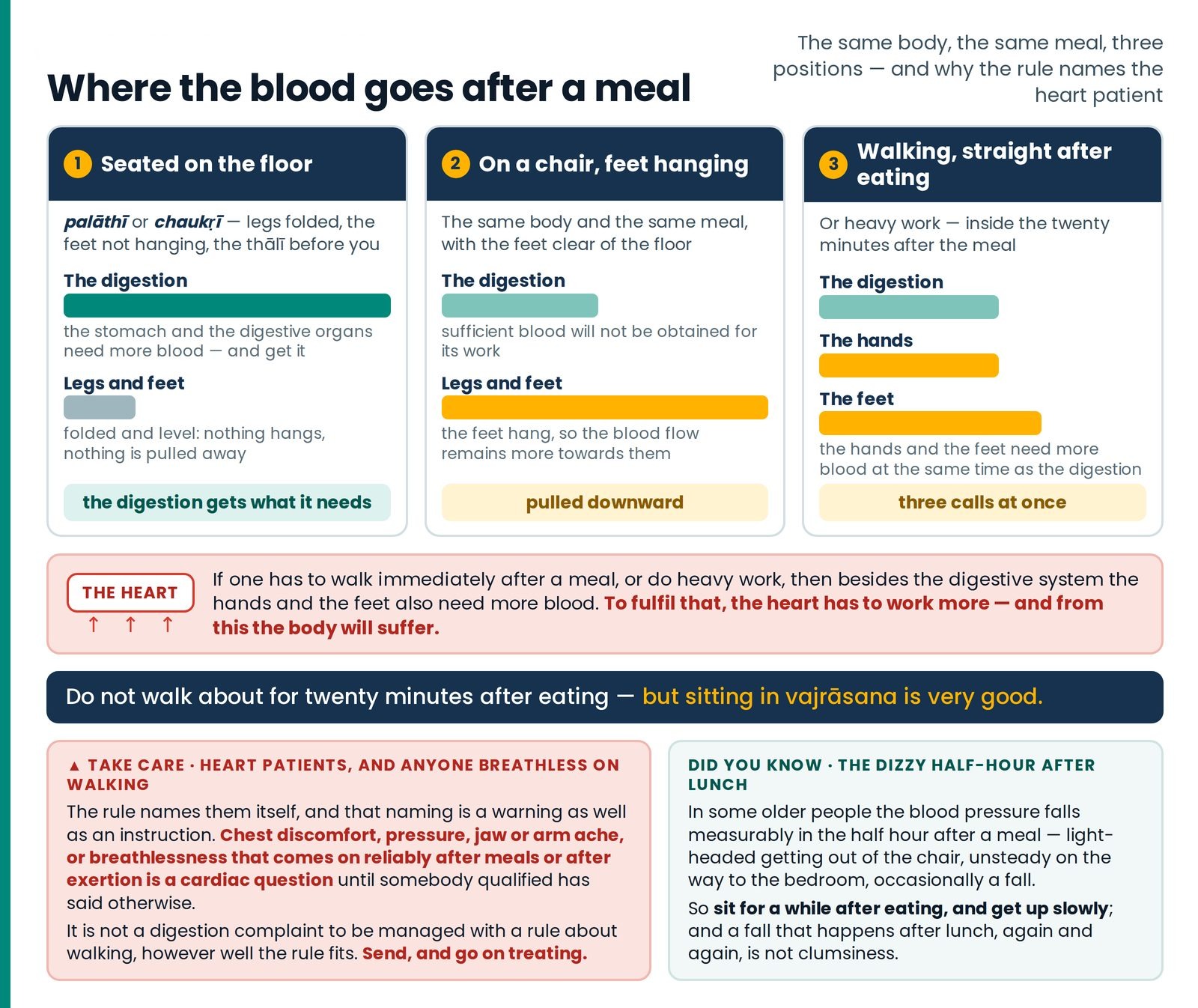
Do not walk about for twenty minutes after eating
Every person should not walk about until twenty minutes after eating — but sitting in vajrāsana is very good.
Mainly patients of heart disease, and those who become breathless on walking, should keep this precaution.
The reason. If one has to walk immediately after a meal, or do heavy work, then besides the digestive system the hands and the feet also need more blood. To fulfil that, the heart has to work more — and from this the body will suffer.
Read the rule with its two sentences in the order they are given. The first sentence is for every person. The second names the group in whom the precaution matters most and says so plainly: heart patients, and anybody who gets breathless walking. That is the material's own emphasis, and it is not to be flattened into a general piece of advice about strolling after dinner. A man with angina who eats a heavy lunch and then walks to the bus stop has asked his heart to supply two demands at once. (Figure 39.1)
The permitted alternative is named: sitting in vajrāsana is very good. So the instruction is not lie down and not do nothing; it is stay seated, and this particular seat is good. That matters in a household where the woman of the house has never once sat still for twenty minutes after serving a meal. Give her the permitted posture and a reason, and she has something to do rather than something to refrain from.
The schoolchild and the bus
Move breakfast fifteen minutes and the rest of the rule keeps itself
Children who run for the bus, and adults who run for the office
School and college children often have to run immediately after breakfast to catch a bus.
If from a young age they are trained to eat breakfast a little earlier, to do after breakfast whatever small tasks can be done sitting, and after sitting a while to set out comfortably for school, they can be saved from many diseases of childhood.
Likewise, if this instruction is kept in mind while going to the office, health will not deteriorate quickly.
This is the only rule in the article addressed to a household rather than to a person, and it is the one that changes most lives per minute of your time. A family that moves breakfast fifteen minutes earlier has, without a single further instruction, kept the twenty-minute rule, kept the schoolbag from being packed over a plate, and handed a child a habit that will outlive everybody in the room.
Ask the question that gets the answer: not "does he eat breakfast?" — he does — but "what happens between the last mouthful and the front door?" The reply is always the same shape and always useful: he eats at 7.35, the shoes are being tied at 7.38, and he runs the last hundred metres to the stop. Fifteen minutes earlier is a negotiation with a kitchen and a mother, not with a child, and it is usually winnable.
Note what the rule asks for in the middle — whatever small tasks can be done sitting. Even in a hurried morning the instruction is not to sit doing nothing for twenty minutes, which no schoolboy alive will do; it is to put the sitting tasks after the meal and the standing ones before it. Shoes and bag first, then eat, then the sitting things — that is a household rearranging itself rather than obeying a rule.
Chew well, and what chewing is held to do
Food should be eaten chewing it well, so that saliva comes out in greater quantity — which helps in digesting chapati, rice and other sweet substances.
And from the movement of the jaws the nerves of the brain will work properly, from which the digestive system will work properly and the food will be digested properly.
If the fats in the food are not digested properly, from that too obesity can increase.
Three separate claims sit in that rule, and each has its own use across the mat.
Saliva on the starches. The first is the one a patient can prove on herself before the week is out, and you should tell her how. Take a plain piece of chapati with nothing on it and chew it thirty times without swallowing. It turns sweet in your mouth. That is the work being described — something in the saliva going to work on the starch of the wheat while it is still in the mouth. A rule a person has verified with her own tongue is a rule she keeps.
The jaws and the nerves. The second claim links the working of the jaw to the working of the nerves of the brain and so back to the digestive system. Give it as it is given. It is the reason the rule asks for chewing well rather than merely eating slowly — the movement itself is part of what is being asked for, not just the time it takes.
The fats and the weight. The third is stated as it stands: if the fats in the food are not digested properly, from that too obesity can increase. Note the word too — it is one contributor named among others, not a complete account of why a person is heavy, and it should not be given to a patient as though it were. A great many heavy patients have been told a great many simple things about why they are heavy, most of them unkind.
More of this article is about water than about food, and that is not an accident of arrangement. Water is the one thing in the household that costs nothing, that everybody already has, and that most people take far too little of without ever once suspecting it of anything.
Teach it in four parts, and in this order: when it may not be drunk · how much is asked for · how it is drunk · and the waters that are refused.
When water may not be drunk
Half an hour before, half an hour after — the acid does the work
Not in the middle of the meal, and not immediately after
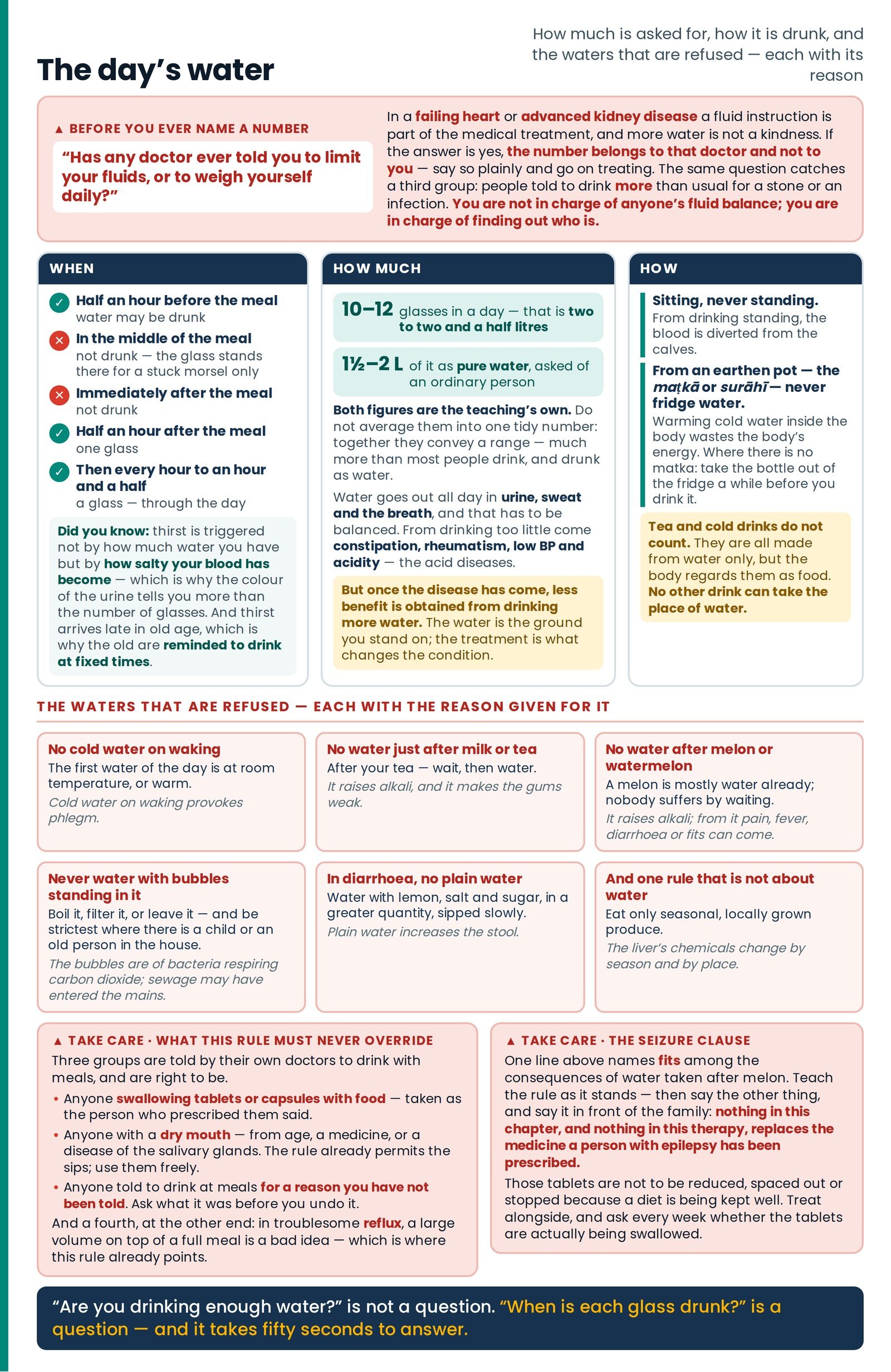
Do not drink water in the middle of a meal or immediately after it. It is better to drink half an hour before eating, or only half an hour after.
The reason. In the stomach, HCl acid is formed, which helps the enzyme named pepsin to digest dal, proteins and so on properly. This acid should be so strong that no bacterium or virus can remain alive in that fierce acid.
From drinking water in the middle of the meal, the strength of both the saliva and the acid will be reduced — so digestion will be spoiled.
But a glass of water should certainly be kept near at the time of food, because it may be of use whenever a morsel or a mouthful sticks in the throat, or one chokes. If a morsel sticks, or if the mouth is dry, one or two sips of water may be drunk.
Two windows, then, on either side of the meal: half an hour before, and half an hour after. In between, the glass stands there and is not drunk except for the accident it is there for.
The reason given has two limbs and they should be given separately, because they land on different patients. The first limb is about strength — the acid and the saliva are working substances, and the rule holds that watering them down weakens the work. The second limb is the one patients find more striking and remember longer: the acid of a healthy stomach is fierce enough that nothing living gets through it. That is a real and under-appreciated fact about the human body, and it is why the stomach is as much a gate as a bag. A patient who grasps that her stomach acid is part of her defences stops thinking of "acidity" as a purely wicked thing to be neutralised at every opportunity.
How much water in a day
Ten to twelve glasses, given as a rhythm rather than as a total
The day's water, and the diseases of drinking too little
Nature has given man everything, of which water is one, and it is free. But many people drink very little water in the day.
Half an hour after taking food, one glass of water may be drunk; and after that, a glass of water every hour to hour and a half.
Every person should drink at least ten to twelve glasses of water in a day — that is, two or two and a half litres must certainly be drunk.
The reason. From our body a good deal of water goes out through urine, sweat and the breath, which it is necessary to balance.
Because of drinking less water many diseases come — such as constipation, rheumatism, low BP, acidity and so on, which we call the acid diseases. Once the disease has come, less benefit is obtained from drinking more water.
Tea, cold drinks and so on are all made from water only, but the body regards them as food. No other drink can take the place of water.
So an ordinary person should certainly drink one and a half to two litres a day in the form of pure water.
Four things in that teaching are habitually lost, and each of them is a part that does work. (Figure 39.3)
The rhythm, not just the total. The instruction is not drink two litres somehow. It is a pattern through the day: one glass half an hour after the meal, then a glass every hour to an hour and a half. That is what makes the total reachable without anybody gulping, and it is the form to give a patient — a glass on the hour is an instruction a person can actually follow; two and a half litres is a number she will fail at by three in the afternoon.
The figures as they stand. The teaching gives ten to twelve glasses, that is two or two and a half litres, and then closes by asking of an ordinary person one and a half to two litres in the form of pure water. Both figures are the teaching's own and both are given here as they are given. Do not average them into a single tidy number for the patient's benefit. What the two together plainly convey is a range — considerably more than most people drink, and drunk as water and not as something else.
The stated list of diseases. Constipation, rheumatism, low BP, acidity and so on — and the name given them, the acid diseases. This is the point at which the water rule joins the rest of the wiki, because those are the conditions the acid-direction work addresses.
The sentence students skip. Once the disease has come, less benefit is obtained from drinking more water. That is an unusually honest line and it must not be dropped, because it sets the rule's scope. Water is given here chiefly as prevention. A woman with ten years of constipation who is told to drink more water and expects it to fix her has been set up to be disappointed, and her disappointment will be aimed at you. Tell her what the teaching itself says: the water is part of the ground you are standing on, the treatment is what changes the condition.
And the last limb — tea, cold drinks and so on are all made from water only, but the body regards them as food — is the single most useful sentence to carry into an argument, because the argument comes daily. "I drink eight cups of tea, I am drinking plenty." No: the body files that under food. No other drink can take the place of water.
How water is drunk, and the waters that are refused
Sitting, from an earthen pot — and seven rules, each with its reason
Table 1 — Further rules of eating and drinking, and the reason for each
| The rule | The reason |
|---|---|
| Eat only seasonal, locally grown produce. | The liver's chemicals change by season and by place. |
| No water after melon or watermelon. | It raises alkali; from it pain, fever, diarrhoea or fits can come. |
| Drink water only sitting. | From drinking standing, the blood is diverted from the calves. |
| Water from an earthen pot, never fridge water. | Warming cold water inside the body wastes the body's energy. |
| No cold water on waking; no water just after milk or tea. | Cold water on waking provokes phlegm; water on milk or tea raises alkali and makes the gums weak. |
| In diarrhoea, no plain water — water with lemon, salt and sugar in a greater quantity, sipped slowly. | Plain water increases the stool. |
| Do not drink water that has bubbles in it. | The bubbles are of bacteria respiring carbon dioxide; sewage may have entered the mains. |
Seven rules, and they are not of one kind. Two carry a mechanism you can draw on a piece of paper. Three are stated flatly, with their reason inside the sentence and nothing further offered. One is a public-health warning wearing the clothes of a drinking rule. And one — the diarrhoea rule — is the most consequential instruction in this entire article and gets a section of its own below. Take them in turn.
Eat only seasonal, locally grown produce, because the liver's chemicals change by season and by place. This is the same rule that appears at the very start of this wiki from another direction — that even the locale and the diet followed by the people of an area help decide the treatment to be given, and that a knee treatment suited to a patient in Ludhiana may not suit one in Chennai.
No water after melon or watermelon, because it raises alkali; from it pain, fever, diarrhoea or fits can come. Give the rule as it stands. It belongs to the same family of thought as the rule about water after milk or tea — a combination held to be harmful together though each is harmless alone — and it costs a household nothing whatever to keep. A melon is mostly water already; nobody suffers by waiting.
Drink water only sitting, because from drinking standing, the blood is diverted from the calves. Sitting to drink is the same instruction as sitting to eat, arriving in a smaller form, and it has one practical consequence worth naming to an old patient: a person who sits to drink does not swallow a glass of water in four seconds on his way through the kitchen, and a person who sits does not fall.
Water from an earthen pot, never fridge water, because warming cold water inside the body wastes the body's energy. This is a rule with a household solution older than any refrigerator: the matka or surahi keeps water cool without making it cold, by letting a little of it evaporate through the clay. A patient who keeps a matka filled has kept the rule and given herself pleasanter water than the fridge would have. Where there is no matka, the practical form is simply: take the bottle out of the fridge a while before you drink it.
No cold water on waking; no water just after milk or tea, because cold water on waking provokes phlegm; water on milk or tea raises alkali and makes the gums weak. Two rules with two reasons in one line, and both cost nothing. The first is easy to make positive rather than negative, which is always better: the first water of the day is at room temperature or warm. The second is easy to attach to something the patient already does: after your tea, wait — then water.
Do not drink water that has bubbles in it, because the bubbles are of bacteria respiring carbon dioxide; sewage may have entered the mains. The warning underneath this is entirely real and every therapist should carry it: in a great many Indian towns the drinking water pipe and the sewer run in the same trench, and when the supply pressure drops, what is outside the pipe can be drawn into it. That is how cholera and typhoid travel. Teach the warning with the full force it deserves — cloudy water, water that smells, water that arrives after a supply failure, water from a line being dug up in the street — and teach the household what to do about it, which is to boil it, filter it, or treat it, and to be more careful, not less, when there is a child or an old person in the house.
Now the rule that decides more courses of treatment than any other in this article, and the one that patients argue with hardest. It is also, by some distance, the most carefully constructed teaching on these pages — because it states a law, names its grounds, gives its lists, and then tells the patient to test it on himself.
Sour things, and pain
In Neurotherapy we say that pain in the joints often comes because of acid increasing in the blood. So such people should not eat sour things.
The reason. In Ayurveda too they say that from eating sour things pain increases.
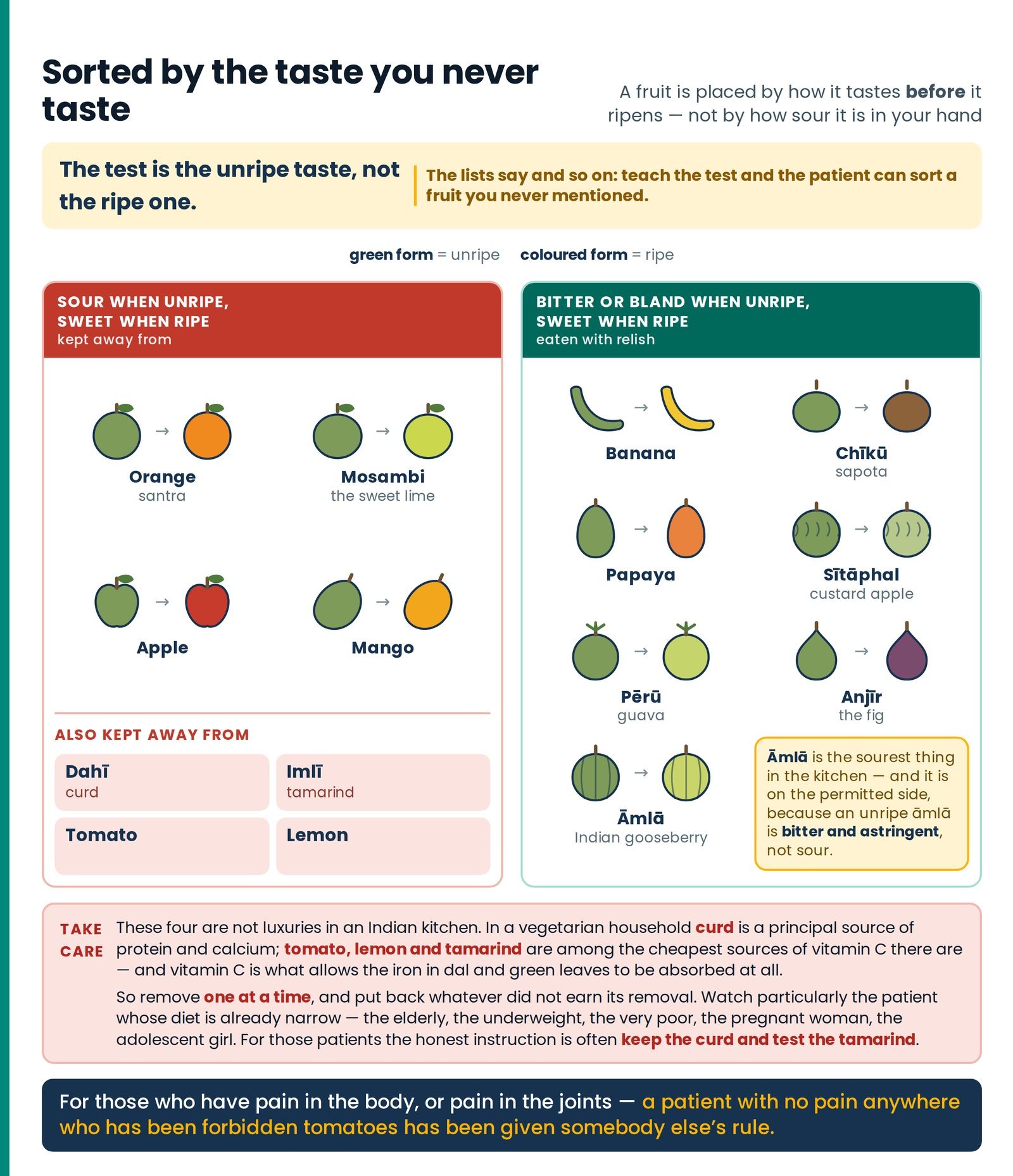
So those who have pain in the body, or joint pains — such people should not eat sour things: such as dahi (curd), tamarind, tomato, lemon and so on.
In the same way, fruits which are sour when unripe and sweet when ripe — such as orange (santra), mosambi or sweet lime, apple, mango and so on — those too should not be eaten.
Fruits which are bitter or bland when unripe but sweet when ripe — such as banana, chīkū, papaya, sītāphal (custard apple), pērū (guava), anjīr (fig), āmlā and so on — those may be eaten with relish.
Read the two fruit sentences again, because the sorting principle in them is not the one anybody expects and every student gets it wrong the first time.
The fruits are not sorted by how sour they taste when you eat them. They are sorted by how they taste before they ripen. (Figure 39.4)
An orange is sweet in the hand in December — and it goes on the forbidden side, because an unripe orange is sour. An apple is not a sour fruit by any ordinary reckoning — and it goes on the forbidden side by the same test. A ripe mango is one of the sweetest things in the world — forbidden, because a raw mango is the sourest thing in an Indian kitchen. And the āmlā, which will make a grown man's eyes water and which every household in India knows as the definition of sour, sits on the permitted side and may be eaten with relish, because an unripe āmlā is bitter and astringent rather than sour.
That is the rule. It is unexpected, it is consistent, it is easy to state, and it is the reason the grandmother in the story at the head of this article gave up the one fruit she was allowed. Teach the test, not the list, and the patient can sort a fruit you have never mentioned.
Note the words and so on in both columns. The lists are examples, not a complete inventory, and the test is what extends them. Note also, and say it out loud to every patient, who the rule is addressed to: those who have pain in the body, or joint pains. It is not given as a universal law of eating for every human being alive. A patient with no pain anywhere who has been forbidden tomatoes has been given somebody else's rule.
Lemon in a fast, kokum for acidity, and the instruction to test it yourself
The setting is part of the rule — and the patient tries it and sees
The qualification the rule carries with it
In naturopathy they say to drink lemon sharbat during a fast, as a treatment. If you do not fast, but take lemon along with food, then perhaps the pain will increase.
Likewise it is said that kokum is excellent for acidity. But the patient has to try for himself and see whether eating kokum causes joint pain or not.
Every single thing will not have the same effect on every person — this too is not so. This is a matter of experience.
This passage is the most valuable thing here and the most frequently trimmed. Do not trim it.
It says four things in order. One: the same lemon is given as a treatment in one setting — in a fast — and warned against in another, taken along with food. The setting is part of the instruction, exactly as the angle and the order are part of a treatment in of this wiki. Two: the word perhaps is used, and it is used deliberately. Three: for kokum, where the tradition says one thing and this teaching's own principle would say another, the answer given is not an adjudication. It is an instruction to the patient: try for himself and see. Four: the whole is closed with the honest label — this is a matter of experience.
That label has a precise meaning in this teaching and it was established in Between Two Sessions: it marks a rule that rests on observation rather than on a named mechanism. Preserve it wherever it appears. A therapist who can say "this one is a matter of experience, and this one is about the acid in your stomach" is a therapist who is believed about the second, because he has shown he can tell the two apart.
And note what the instruction to test actually gives you clinically: a method. Take one item. Remove it for two weeks. Put it back for a week. Ask the patient — not did it help? but what were your mornings like in the second week compared with the fourth? Then move to the next item. That is slower than handing over a list, and it is the only version of this rule that survives contact with a real household. It also respects the last sentence, which says in plain words that people differ.
The last rule of the day's eating is a rule about a clock, and the clock half of it was given in Between Two Sessions among the rules of the bed, where it decides whether a household can be asleep by half past ten at all. What belongs here is the other half: what the two hours are for, and how a kitchen is actually moved.
Two hours between the night meal and lying down
The night meal should be taken by such a time that there is a gap of at least two hours between eating and the time of sleeping — so that the food which has been eaten in solid form becomes thin like water and is digested properly.
The reason is worth giving to a patient in exactly its own words, because it is a picture rather than an abstraction: the food goes in solid and has to become thin like water. That takes a definite stretch of time, and it happens whether you are awake or not, but it happens best in a body that is upright and quiet rather than one that is lying down.
The rule is easy to state and very hard to keep, and the reason it is hard is never medical. It is that the meal waits for whoever comes home last. In a house where the husband reaches home at nine, dinner is at half past nine and the whole family's night is built around that; the woman of the house eats last of all, at ten, and is asked by her therapist to be asleep by half past. That cannot be done, and telling her again will not make it possible.
So the negotiation is with the kitchen, and it is a negotiation, not an instruction. Three moves work more often than any others:
Ask for four nights, not seven. A household will give you four. Seven it will refuse, and having refused it will stop discussing the matter.
Separate the meals. In many houses the children and the elders can eat at eight without waiting, and often already want to. The person who most needs the early meal is frequently the person who is serving it.
Move what is served, not only when. A lighter night meal is digested in the time that is available, and a household that cannot move the hour can sometimes move the weight.
And say the two rules together, because together they are convincing and separately they are nagging: finish two hours before you lie down, and be asleep by half past ten. Those two produce one arithmetic — the night meal is finished by half past eight — and a patient given one number will go and solve her own household better than any instruction of yours could.
Most of what this wiki has to say about the sick-room table belongs to the two articles that follow this one, because it is about a particular kind of body rather than about eating in general. What belongs here is the general instruction, the one emergency, and a clear statement of where the rest lives.
Diarrhoea
Not plain water: lemon, salt and sugar, sipped slowly — and the dose
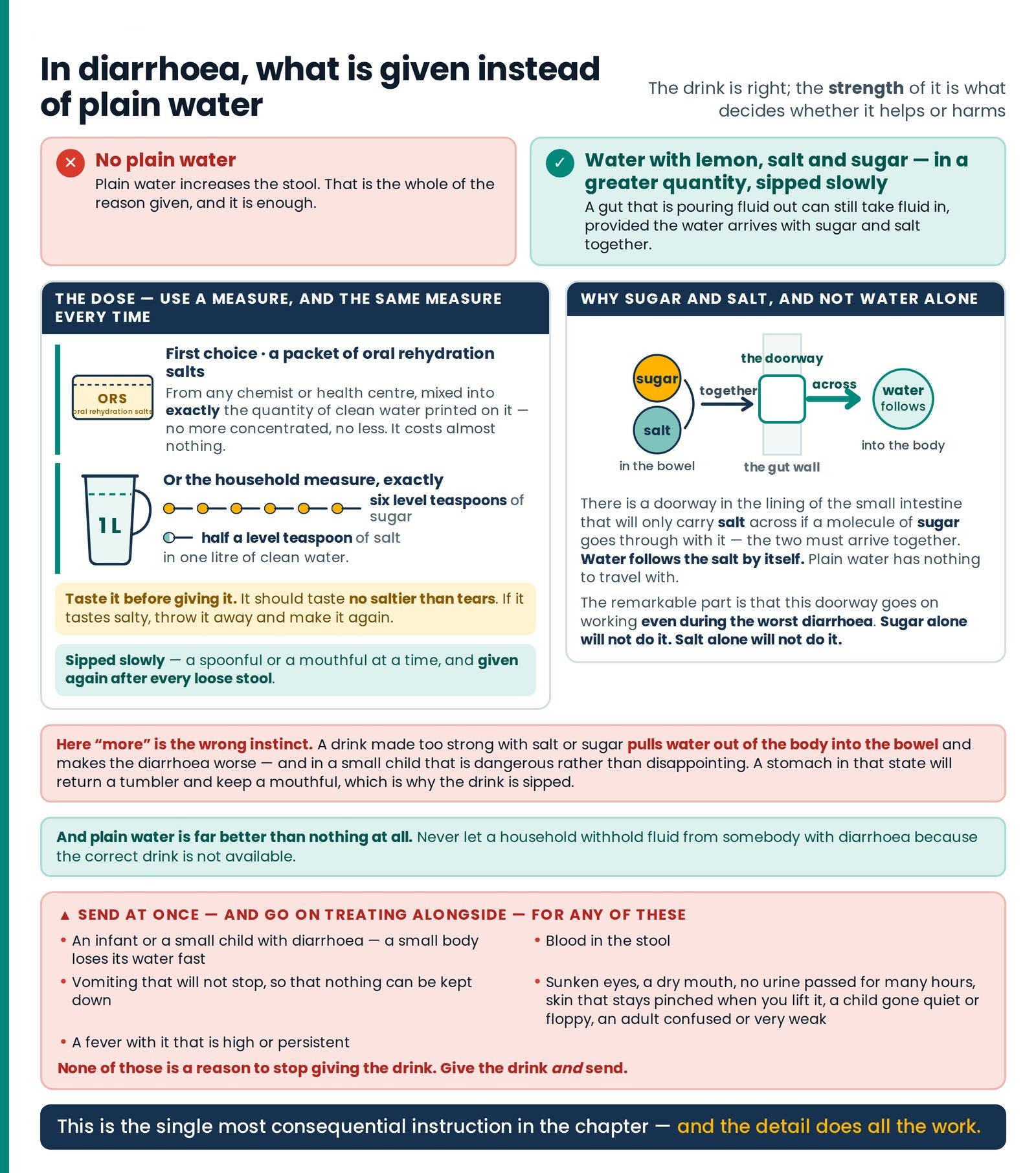
This is the single most consequential instruction in the article. It is also the one where the detail does all the work.
In diarrhoea, plain water is not what is given
In diarrhoea, no plain water. Water with lemon, salt and sugar in a greater quantity, sipped slowly.
The reason: plain water increases the stool.
The principle here is completely sound and is one of the great discoveries about the human gut: a gut that is pouring fluid out can still take fluid in, provided the water arrives with sugar and salt together. The sugar and the salt are carried across the wall of the intestine hand in hand, and the water follows them. Plain water has nothing to travel with. That is why the drink is made the way it is made, and why it is sipped slowly rather than swallowed — a stomach in that state will return a tumbler and keep a mouthful. (Figure 39.5)
What is said about food and the organs during a fever
The liver and the gall bladder are spoiled; no diet rule is attached
One further statement about illness belongs on these pages, and it is a statement about the organs of digestion rather than about the plate.
The liver and the gall bladder in fever
In fever, or for some days after the fever comes, the liver and the gall bladder remain spoiled, or cannot work properly.
That is the whole of what is said. No rule of diet is attached to it here, and none is to be invented and put into the patient's mouth as though it had been.
What is attached to it in the teaching is a rule about conduct during and after a fever, which belongs with the subjects of the next article and is taught there whole.
A student will want to extend it, because the extension is obvious and every grandmother in India has already made it. Resist the temptation to put words into the teaching. What you may honestly do is two things. You may say the statement itself to the patient, because it explains, better than anything else you could offer, why appetite disappears in a fever and why it takes a few days to come back after the temperature has gone: the organs that deal with food are not yet back at work. And you may ask about food in convalescence rather than instructing about it — what has he been able to eat since Tuesday, and what has he kept down? — which is a clinical question with a clinical answer.
The sick-room table that belongs to the articles ahead
Three instructions named here, and taught whole in Chapters 40 and 41
Three instructions in this material are about food or drink given for a specific condition, and every one of them belongs to the article that owns the body it concerns. They are named here so that no student goes looking for them in the wrong place, and they are not taught here.
| The instruction | Where it is taught |
|---|---|
| Milk for a woman whose menstrual bleeding is heavy — the quantity, the temperature, and the khārak soaked overnight | Treating Women, "Treating Women" — which owns it whole |
| The caution on pills in pregnancy, and everything that follows from it | Treating Women, "Treating Women" |
| What is given to a small child whose teeth are coming and who has loose motions or fever | The Child, the Elder and the Frail, "The Child, the Elder and the Frail" |
| The feeding of a newborn, and the mother's milk | The Child, the Elder and the Frail, "The Child, the Elder and the Frail" |
One rule of drinking sits in that same stretch of the material and is a rule of the glass rather than a rule of the sickbed, so it is given here in the form a therapist needs — and its whole context, the care of a woman after childbirth, is Treating Women's.
The nursing mother's water
Such women should drink water little by little many times in the day, instead of drinking a great deal of water at one time — otherwise the child can get loose motions or pain in the stomach.
For calcium they should drink milk too.
Notice that this is the general water rule of this article, sharpened: everyone is asked for a glass every hour to an hour and a half rather than a jug at a sitting, and for a woman who is feeding a child that pattern is not a preference but an instruction with a stated consequence.
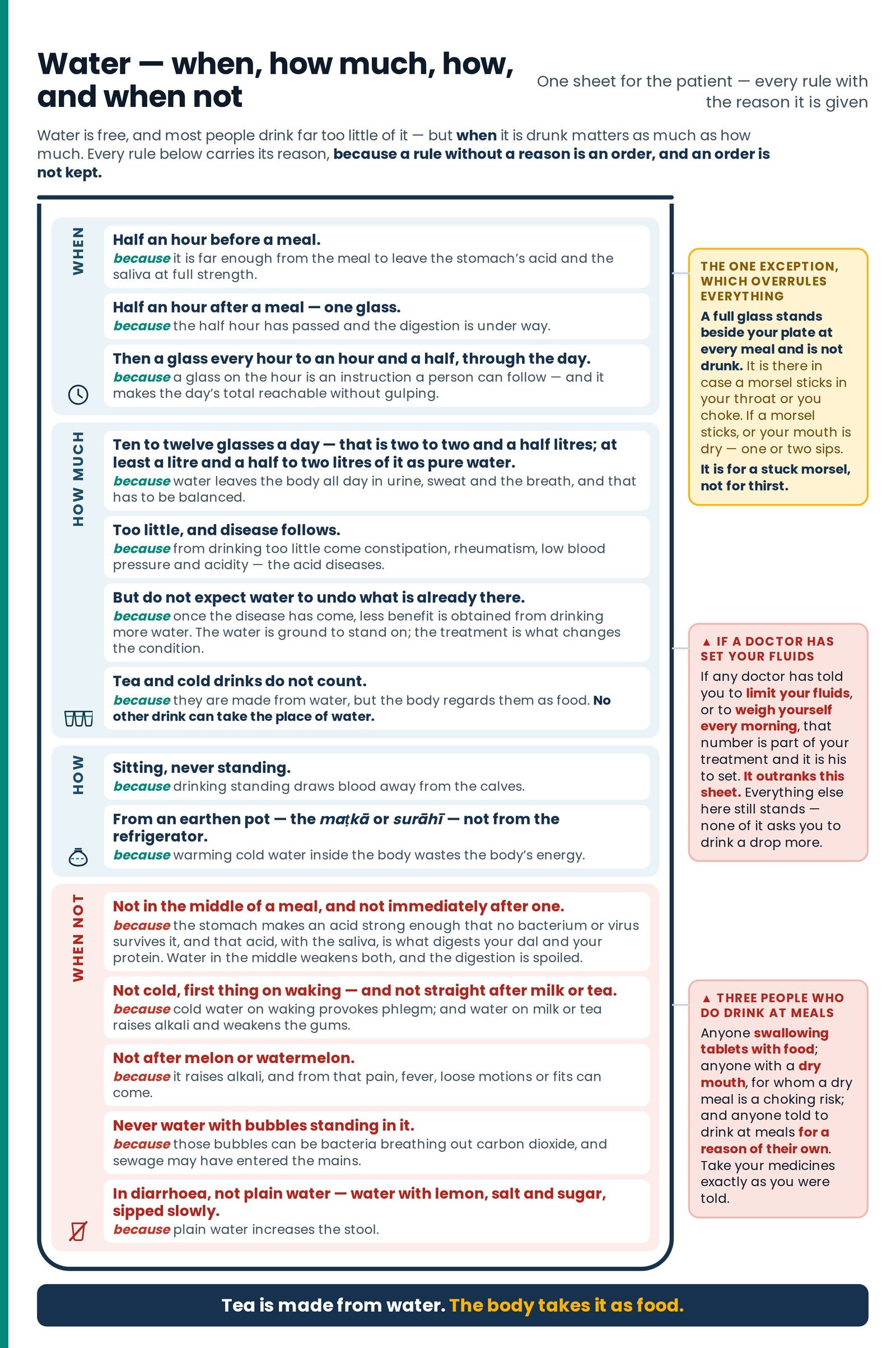
The rules of the plate, like the rules of the day, are a article when they are scattered and a usable thing when they are laid out in the order in which they happen. What follows is the whole of the eating and drinking half of the patient's day, with the reason beside every line, written to be read aloud across the mat — and handed over afterwards, not instead. (Figure 39.6)
Two rules a visit. The sheet is what the patient takes home at the end, when she already knows why.
Table 3 — Your plate and your glass, in the order of a day
| When | What to do | Why |
|---|---|---|
| On waking | No cold water first thing. Room temperature, or warm. | Cold water on waking provokes phlegm. |
| Before breakfast | Bathe first, then eat — and leave at least forty-five minutes between a cold bath and breakfast. If you must eat first, then bathe only after a good long while, once the food is digested. | After a bath the body takes half an hour to forty-five minutes to get warm, and until it does, the blood is at the skin and not at the stomach. Food eaten in that time is digested less and leaves gas. And bathing straight after a meal can itself cause indigestion. |
| Half an hour before the meal | This is a time when water may be drunk. | It is far enough from the meal to leave the stomach's acid at full strength. |
| Sitting down | Wash the hands well. Soap, here — that is what soap is for. | You are eating with them. |
| Sit on the floor to eat — palāthī or chaukṛī. Not on a chair with the feet hanging. | After eating, the stomach and the digestive organs need more blood. Sitting with the feet hanging, the blood is pulled down towards the feet and the digestion does not get what it needs. | |
| Keep a full glass of water beside the plate — and do not drink it. | It is there in case a morsel sticks or you choke. If something sticks, or the mouth is dry, one or two sips. That is what it is for. | |
| Eating | Chew well — properly, not four chews and swallow. | More saliva comes, which helps digest chapati and rice. The working of the jaws keeps the nerves of the brain working properly, and from that the digestion works properly. |
| No water in the middle of the meal, and none immediately after. | The stomach makes an acid strong enough that nothing living survives it, and that acid, with the saliva, is what digests your dal and your protein. Water in the middle weakens both, and the digestion is spoiled. | |
| If there is pain in your body or your joints: no sour things — curd, tamarind, tomato, lemon. And no fruit that is sour before it ripens — orange, sweet lime, apple, mango. | In this therapy we say joint pain often comes from acid increasing in the blood; and in Ayurveda too they say that sour food increases pain. | |
| You may eat with relish the fruits that are bitter or bland before they ripen — banana, chīkū, papaya, custard apple, guava, fig, and *āmlā*. | The test is how the fruit tastes unripe, not how sour it is when ripe. That is why āmlā is allowed. | |
| Eat what is in season and grown near you. | The liver's chemicals change with the season and with the place. | |
| After the meal | Do not walk about for twenty minutes. Sitting in vajrāsana is very good. Heart patients, and anyone who gets breathless walking, must keep this. | Walking or heavy work straight after eating means the hands and feet want blood at the same time as the digestion — and the heart has to do more work to supply both. |
| Half an hour after the meal | One glass of water. Then a glass every hour to an hour and a half through the day. | The half hour has passed and the digestion is under way. |
| Through the day | Ten to twelve glasses in the day — two to two and a half litres. At least a litre and a half to two litres of it as plain water. | Water leaves you all day through urine, sweat and the breath, and it has to be balanced. From drinking too little come constipation, rheumatism, low blood pressure and acidity — the acid diseases. |
| Tea and cold drinks do not count. | They are made from water, but the body takes them as food. No other drink can take the place of water. | |
| Sit down to drink. | Drinking standing draws the blood away from the calves. | |
| Water from an earthen pot, not from the fridge. | Warming cold water inside you wastes the body's own energy. | |
| No water straight after milk or tea. | It raises alkali, and it makes the gums weak. | |
| No water after melon or watermelon. | It raises alkali, and from that can come pain, fever, loose motions or fits. | |
| Never drink water with bubbles standing in it. Boil it, filter it, or leave it. | Those bubbles can be bacteria breathing out their gas, and sewage may have got into the mains. | |
| If there is diarrhoea | Not plain water. Water with lemon, salt and sugar, sipped slowly — a mouthful at a time, and again after every loose motion. | Plain water increases the stool. Sugar and salt together carry the water across into the body. Use a rehydration packet, or six level teaspoons of sugar and half a level teaspoon of salt in one litre — it should taste no saltier than tears. |
| The evening meal | Finish it at least two hours before you lie down — which, if you are to be asleep by half past ten, means finished by half past eight. | So that food eaten in solid form has time to become thin like water and be digested properly. |
| For the household | Move breakfast fifteen minutes earlier so the children do not run for the bus. Shoes and bag before the meal; the sitting jobs after it. | Children trained to eat a little earlier, to do the sitting tasks afterwards and to set out unhurried are saved from many of the illnesses of childhood — and the same goes for grown-ups leaving for the office. |
Questions students ask
1. I am twenty and new to this. A patient asked me why she must sit on the floor when her knees will not fold. What do I say? Say the truth, which is that the rule is asking for the feet not to hang, and then solve it. A low stool with the feet flat on the ground, or a chair with a box under the feet, gets most of what the rule is after. Do not force a painful knee into palāthī to satisfy a rule about digestion — you will lose the patient and the knee will be worse. And notice what you have just done: you have kept the reason and adjusted the form, which is what you will be doing with every rule in this article for the rest of your working life.
2. I am a housewife learning this for my family. My husband eats at nine and there is nothing I can do about it. Which rules do I even bother with? The ones that do not depend on him. Your own meal can move to eight with the children. Your water can move out of the meal today. The cold water on waking can stop tomorrow. The glass beside the plate costs nothing. The floor-sit costs nothing. Sorting the fruit costs nothing. That is six rules kept without a single argument in the house — and a household usually follows the person who changed first, six months later, without ever having been asked.
3. I am a doctor. The reason given for the eating posture is that gravity pulls the blood to the hanging feet. That is not how splanchnic circulation works. No, it is not, and you should teach the rule as it stands rather than replacing it with your own physiology or discarding it. Notice first that the observation underneath it is completely sound and is the foundation of this whole therapy: after a meal a large share of the circulation genuinely does go to the gut, and it is under neural and hormonal control. Notice second that the practice the rule prescribes is a good practice for other reasons — it slows a meal, it makes the eater sit, it stops the plate being carried about. What you gain by teaching it as given, with its reason attached, is that you have not quietly substituted your own authority for the teaching's; and what you owe the patient in exchange is the honesty you would show anywhere else. Where the rule has a name attached and a consequence — the heart doing more work in a heart patient — it is worth taking seriously.
4. I have no science at all. What is this HCl, and is it a bad thing? Everybody at home takes tablets to stop it. It is the acid your stomach makes, on purpose, every time you eat. It does two jobs: it helps break down dal and other protein foods, and it is so fierce that most germs arriving in your food are killed in it. So it is not an enemy — it is a working part of you, and a gate as well as a juice. What people call "acidity" is that acid turning up where it should not be, or at the wrong time, which is a different matter from having it at all. See also → The Two Kingdoms, "The Two Kingdoms".
5. I practise in a village. Half my patients cannot boil water and none of them have an earthen pot in the office. How do I teach the water rules? Teach the ones that are free, in this order: the timing (out of the meal, a glass every hour or so), the glass beside the plate, sitting to drink, and not cold on waking. Every one of those costs nothing at all. The matka is common enough in villages that it is usually the towns where it has been lost. And on cleanliness, give the warning rather than the equipment: cloudy water, water that smells, water after a supply failure, water from a line being dug up — boil it or do not drink it, and be strictest where there is a child or an old person in the house.
6. If joint pain comes from acid in the blood, why do you tell me not to say that to the patient with a normal report? Because those are two different sentences and only one of them is yours to say. The first is how this therapy speaks about the condition. The second — your blood test says normal but your blood is really acid — is a claim about a specific laboratory result in a specific patient, and it is not true, and a patient who catches you in it will disbelieve everything else you have told her, most of which was worth believing. Say the first. Never say the second. See also → Reading the Reports, "Reading the Reports".
7. I am sixty-eight and learning this for myself. The water instruction frightens me — I have been told to go easy on fluids because of my heart. Then the instruction is not for you, and nobody here is going to argue with your cardiologist. A prescribed fluid limit is part of a medical treatment, and it outranks a general rule of health every time. What you can still keep from this article is everything else — the timing, the posture, the chewing, the sour things, the two hours before bed — none of which asks you to drink anything at all. And notice how useful that question of yours is: ask it of every patient before you name a number.
8. Which of these rules would you give first if a patient would take only one? For most patients, the water out of the meal and spread across the day — because it is free, it is immediate, it is easy to describe, and it moves constipation and acidity often enough to buy you the patient's trust for everything else. For a patient who came with joint pain, the first rule is the sour one, tested one food at a time. Choose the rule with the clearest connection to the complaint in front of you, which is the same principle as in Between Two Sessions.
9. A patient asks whether āmlā is really allowed when it is obviously the sourest thing in the house. I could not answer him. Answer him with the test rather than the list. The classification goes by the unripe taste. An āmlā before it ripens is bitter and rough, not sour, so it sits with the banana and the guava and it may be eaten with relish. An orange before it ripens is sour, so it sits on the other side although the ripe fruit is sweet. Tell him the principle and he will sort the fruits on his own handcart without you. And if he pushes further — but how can that be? — the honest answer is that this is the classification as it is given, and that he is welcome to do what the teaching itself asks of him and try it and see.
10. My patient says her Ayurvedic doctor has told her to take lemon and warm water every morning. Do I argue? No, and you already have the material for the answer in this article, because the teaching makes the same distinction. Lemon is given as a treatment in a fast; lemon along with food is where the warning lies, and even there the word used is perhaps. So ask what she actually does — on an empty stomach, or with breakfast? — and if it is on an empty stomach and she has no pain in her joints, you have no quarrel to pick. Spend your credit on the rules that will decide this course. A therapist who fights every battle wins none of them.
11. How do I ask about food without the patient feeling accused? Do not ask about food at all. Ask about yesterday. "Tell me everything you put in your mouth yesterday, from when you woke up, in order." It takes three or four minutes, nobody can be wrong about it, and it produces the pickle, the churan after dinner, the two teaspoons of sugar in each of eight cups of tea, and the glass at the neighbour's house — none of which the patient thinks of as food and all of which she will tell you without shame. Then ask the one question that catches the rest: "And what is on the side of the plate that you would not call a dish?"
12. A patient of mine has lost eight kilos since we began and is delighted with me. Should I be? No. Weight falling that a patient did not set out to lose is a finding, not a result — and if you have just removed several foods from her diet you now have two possible explanations and no way of telling them apart. Ask what she is actually eating in a day, restore anything that was removed without earning it, and send her to a doctor to be looked at properly. Go on treating meanwhile. See also → When the Hand Must Stop, "When the Hand Must Stop".
Questions patients ask
1. "My doctor said milk and curd are good for me — that I need the calcium. Now you are telling me no curd. Who is right?" Your doctor is right that you need calcium, and I am not going to tell you otherwise. What I have asked you to stop is one sour food, for two weeks, because you have pain in your joints — and in this therapy joint pain is often held to come from acid rising in the blood, which is why sour things are kept away from; the old Ayurvedic teaching says the same about sour food and pain. Two weeks is a test, not a life sentence. If your mornings are no different at the end of it, you will have your curd back from me, in this room, and I will tell you so plainly. Meanwhile take your calcium in the other ways — milk itself is not on the list, and neither is paneer, and neither are the greens and the sesame. If your doctor has put you on a calcium tablet, keep taking it exactly as he said.
2. "I have eaten this way for sixty years and I am still here. Why change now?" You are, and I am not going to pretend that sixty years of anything counts for nothing. But look at what brought you here. Something in your body has changed — that is what the pain is telling you — and a way of eating that suited you at thirty is being asked to suit a different body now. I am not condemning your food and I am not asking you to eat like somebody else. I am asking you to change two things, for two weeks, and then tell me whether your mornings were different. If they were not, we will put them back. That is a fair bargain at any age.
3. "Then what is left to eat?" More than you think, and this is my fault for giving you the list of noes first. Here is the yes list. Banana, chīkū, papaya, custard apple, guava, fig and āmlā — those you may eat with relish, the teaching's own words. Everything cooked in your own kitchen from what is in the market this month. All your dals, all your grains, all your vegetables, milk, paneer, ghee, whatever meat or fish you eat if you eat them. What I have asked you to leave is four sour things and four fruits, and only while there is pain. You have not been put on a diet. You have been asked about eight items.
4. "You say drink two litres. My kidney doctor says one litre and weigh yourself every morning. What do I do?" You do what your kidney doctor says, and you do not take a general rule of health from me over a specific instruction from the person who is treating your kidneys. That number is part of your treatment and it is his to set. I should have asked you before I said anything about water, and I am glad you told me. Everything else in what I gave you still stands — the timing of your meals, how you sit, the chewing, the two hours before you lie down — because none of it asks you to drink a drop more.
5. "Water with my food? My whole family drinks water with food. Nobody has ever died of it." Nobody has. What is said here is that your stomach makes an acid strong enough that no germ survives it, and that this acid, together with your saliva, is what breaks down your dal — and that water taken in the middle of the meal weakens both and the digestion suffers for it. So the water moves rather than disappears: half an hour before you eat, and half an hour after, and then a glass every hour or so through the day, which is when most people are short of it anyway. And the glass stays on the mat beside you all through the meal — if a morsel sticks or your mouth is dry, take a sip or two. I would never ask you to sit down to food with nothing to hand.
6. "I am fasting on Tuesdays. Do these rules still apply?" Keep your fast; I am not going to interfere with it. Two things are worth knowing. The lemon is different in a fast — it is given as a treatment there, and the caution about lemon is about taking it along with food. And on a fasting day the water rules become more important rather than less, because the meals that usually carry your fluid are not there: a glass every hour to an hour and a half, sitting, not cold, and not straight after your tea. Tell me which day you fast and I will keep it in mind when I plan your week.
7. "My mother-in-law says fruit should never be eaten with a meal, and you have said nothing about that." She may well be right and I have not been given a rule about it, so I am not going to invent one to sound thorough. What I have been taught, I have told you. What I can tell you is which fruits to eat and which to leave for the present, and why — and I would rather say "I do not know" about the rest than make something up and be caught out by your nephew with a telephone.
Words used here
| Hindi | English | Neurotherapy code / usage |
|---|---|---|
| पालथी (palāthī) | The cross-legged sit on the floor | The posture for eating — always, so the blood goes to the stomach and not to hanging feet |
| चौकड़ी (chaukṛī) | The gathered floor-sit, legs folded | Given alongside palāthī as the posture for eating |
| वज्रासन (vajrāsana) | Kneeling, seat resting on the heels | The posture named as very good for the twenty minutes after a meal |
| थाली (thālī) | The round eating plate | The āchaman ring of water is poured around it |
| आचमन (āchaman) | Ritual sipping and sprinkling of water | Here, the water poured around the plate so no crawling insect can cross into it |
| खट्टा (khaṭṭā) | Sour | What is kept away from where there is pain in the body or the joints |
| दही (dahī) | Curd | Named sour; removed one item at a time, and returned if it does not earn removal |
| इमली (imlī) | Tamarind | Named sour |
| आँवला (āmlā) | Indian gooseberry | Permitted, and eaten with relish — bitter and bland when unripe, so it passes the test |
| सीताफल (sītāphal) | Custard apple | Permitted |
| पेरू (pērū) | Guava | Permitted |
| अंजीर (anjīr) | Fig | Permitted |
| चीकू (chīkū) | Sapota | Permitted |
| संतरा / मौसंबी | Orange / sweet lime | Kept away from — sour when unripe |
| परहेज़ (parhez) | Abstinence; what is kept away from | The food half of the daily rules; temporary in the patient's ear, and never a punishment |
| मटका / सुराही (maṭkā / surāhī) | Earthen water pot | The vessel the water rule asks for, in place of the refrigerator |
| लोटा / गिलास | Vessel / glass | The full glass beside the plate, kept for a stuck morsel, not for thirst |
| तजुर्बे की बात (tajurbe kī bāt) | A matter of experience | The label on a rule with no mechanism attached — kept on, never removed |
| — | HCl | The stomach's acid: works with pepsin on dal and protein, and is fierce enough that nothing living survives it |
| — | Const, Pan, Gas, Liv°, Mu° | Front pain points met in this article's cases; taught in The Navel Speaks First · The Front of the Body I |