Watch


Mu° sends you left, Liv° sends you right — and each has its own family
A short recall, and then we go to work.
The patient's condition today is read from the pain points around the navel, and three of them carry this article: Gas, Liv° and Mu°. Diseases that come from a deficiency of water in the body or the blood are the diseases of acidosis, and in most such people pain is found at Mu°. Diseases that come from an increase of water in the blood or in some part of the body are the diseases of alkalosis, and in most such people pain is found at Liv°. Many diseases belong to neither family and come from the disorder of one organ or one system, for which other methods of treatment have been adopted. Acidosis produces many symptoms, and they are easy to set right; alkalosis produces fewer, and they do not get right easily — to correct them takes considerable effort and time.
Up to about thirty or thirty-five years of age, most people have pain at Mu° and get the diseases of acidosis; with increasing age the diseases of alkali begin to come. But remember that it will not always be so: a chief cause of fits and CP in children is an increase of alkali. The complete two-column picture — the stool, the nose, the cough, the menses, the headache, the muscle, the thyroid, the side of the body that hurts, and the sixteen other rows that go with them — is taught in full in The Two Kingdoms, "The Two Kingdoms", and is not repeated here.
Two further findings from that examination decide a great deal of what follows, and they are worth stating separately because students run them together.
What pain at Gas is telling you, and why it is not the same finding as pain at Mu°
When there is pain in the Gas point, it tells us that the circulation of blood in the stomach is reduced, because of which hydrochloric acid cannot be made properly and there will be indigestion. Such people feel little hunger.
Some people have pain in Mu° but not in the Gas point. Some people can have pain in both Gas and Mu°.
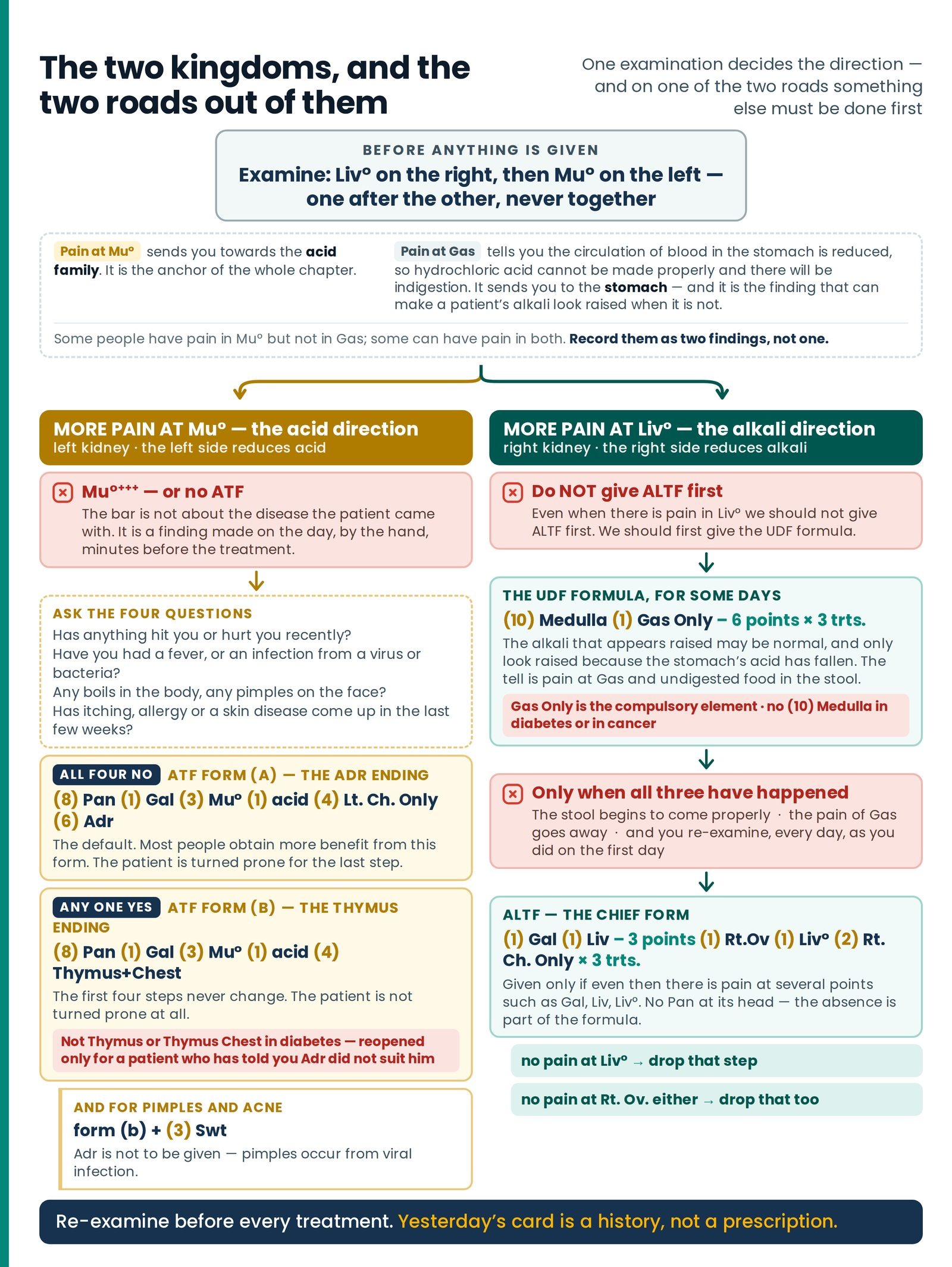
Record them as two findings, not one. Mu° sends you towards the acid family. Gas sends you towards the stomach and, as you will see when ALTF is reached, it is the finding that can make a patient's alkali look raised when it is not.
And the chemistry the therapy attaches to it, in one paragraph, because the names will recur. The acidity of the blood is not the acid of the stomach. The stomach's acid is hydrochloric acid, and it occurs only in the stomach, never in the blood. In the blood several acids are dissolved which maintain its acidity — amino acids, uric acid, lactic acid, folic acid, carbonic acid, and in the disease of diabetes the keto acids, which are a chief cause of acidosis in a diabetic patient. To balance all of these it is necessary that bicarbonate ions should come out from the kidneys at the right time and in the right quantity. Each of those acids is tied to an organ — the stomach's blood supply behind the amino acids, the liver behind uric acid and therefore behind a great many joint pains, the respiratory system behind lactic and carbonic acid — and the whole table is set out in The Two Kingdoms.
Now the part of the chart that belongs to the formulary rather than to diagnosis: its last row. Once the direction is known, a matched family of treatment is waiting for it, and the two families are mirror images — left-sided work for one, right-sided work for the other.
Table 1 — The two matched families of treatment
| To reduce acidosis Left | To reduce alkalosis Right | ||
|---|---|---|---|
| The named formula | ATF — Acid treatment formula — this article | ALTF — Alkali treatment formula — this article | |
| What must come first | Nothing, except the examination | The UDF treatment — Clearing the Ash, "Clearing the Ash" | |
| The Raman treatment | Left Raman — Seated I — Brain, Medulla, Neck | Right Raman — Seated I — Brain, Medulla, Neck | |
| The chest | Left Chest only — The Front of the Body II | Right Chest only — The Front of the Body II | |
| The spine | Round arrow ↑\ | ↓ — Face Down | — |
| The adrenal | Adr — Face Down | — | |
| The sacrum | — | (½) Ku – 40 secs / 60 secs / 80 secs — Face Down | |
| Vitamin formation | Left Vitamin formation — On the Side | Right Vitamin formation — On the Side | |
| Also | — | In some people alkali is also reduced by Th + Ch, thymus with chest — The Front of the Body II | |
| The governing bar | If there is no pain in Mu°⁺⁺⁺, then ATF is not to be given ▲ Take care | Even when there is pain in Liv°, do not give ALTF first. First give the UDF formula ▲ Take care |
Look at the column headings before you look at the entries. Every acid-reducing treatment in that list is left; every alkali-reducing treatment is right. That is not a mnemonic somebody invented afterwards; it follows from the observation on which the whole system rests — the left kidney filters most of the acid, that is, reduces the acidity of the blood, and the right kidney reduces most of the symptoms of increased alkali. Provoke the left kidney by way of Mu° and the symptoms of acidosis ease; provoke the right by way of Liv° and the diseases of alkalosis ease. Side, in this article more than any other, is part of the identity of a point and never a detail of technique. (Figure 28.1)
Acidosis and alkalosis are the two root causes from which other diseases are formed. That is why two separate treatments were made for them, and why setting one or the other right can set many symptoms right at one and the same time. It is also why the two bars in the last row of that table exist. A formula powerful enough to correct a root cause is powerful enough to carry a body past the middle, and the woman at Chandigarh is the proof of it.