Watch


The 1,25 DCC family
A formula built out of physiology — sun, liver, parathyroid, kidney
This is a unique formula in which Guruji, having practised the facts of physiology, has converted them, in his own unique style, into a medicine-free treatment. It is given in order to increase the quantity of calcium in the blood. Along with this, it also helps in improving the functions of the kidneys, and in the digestion and absorption of all the necessary elements.
Everything else in this article was built from observation and then explained. This one was built the other way round: a chain of physiology was read, organ by organ, and a point was found for each organ in the chain. It is the clearest worked example in the wiki of a formula assembled deliberately, and it is worth learning the chain before the formula, because once you have the chain the formula cannot be forgotten.
From eating curd, milk, spinach, radish (mūlī), onion (kāndā, that is pyāz) and, among fruits, banana, a great deal of calcium is obtained. Its absorption is done by the villi of the ileum, and from there it mixes into the blood. But in the ileum its absorption will happen only if there is a sufficient quantity of 1,25 DCC in the blood. Otherwise the whole of the calcium will go out in the stool.
And there is one more matter. Suppose the quantity of calcium in the blood is correct but 1,25 DCC is not there. Then, when the contents of the blood are filtered in the kidneys, their tubules will not reabsorb the calcium, and the calcium of the blood will keep going out through the urine.
What 1,25 DCC does, and what happens when it is missing
1,25 DCC raises the quantity of calcium in the blood by acting upon two different organs.
One — the intestine. It acts upon the cells of the villi of the ileum, so that they absorb calcium and phosphate. For this it causes a special kind of calcium binding protein to be prepared in the cells of the intestine, useful for delivering calcium inside the cytoplasm of the cell.
Two — the kidney. It acts upon the tubules of the kidneys so that they reabsorb calcium and do not let calcium go out through the urine — and in its place let phosphate go out.
If 1,25 DCC is not present in the blood, 90% of the calcium of the food will go out with the motion and the remaining 10% will go out through the urine.
And inside that first job is a piece of timing which is a dosing instruction, and the only one of its kind in this article.
The forty-eight hours, and what follows from them
To prepare the calcium binding protein, 1,25 DCC takes about two days.
But even after the 1,25 DCC has gone, this protein remains inside the cells for several weeks, so the effect on intestinal calcium absorption lasts many days.
Since this protein takes 48 hours to be formed, if 1,25 DCC is to be given a second time it should be given leaving one day in between.
That sentence is written about the hormone, and it is the reason the formula that provokes the hormone is not a formula you give every single morning without thinking. A therapist who gives it daily because daily is his habit is asking a cell to begin a two-day job afresh every twenty-four hours.
How 1,25 DCC is made in the body
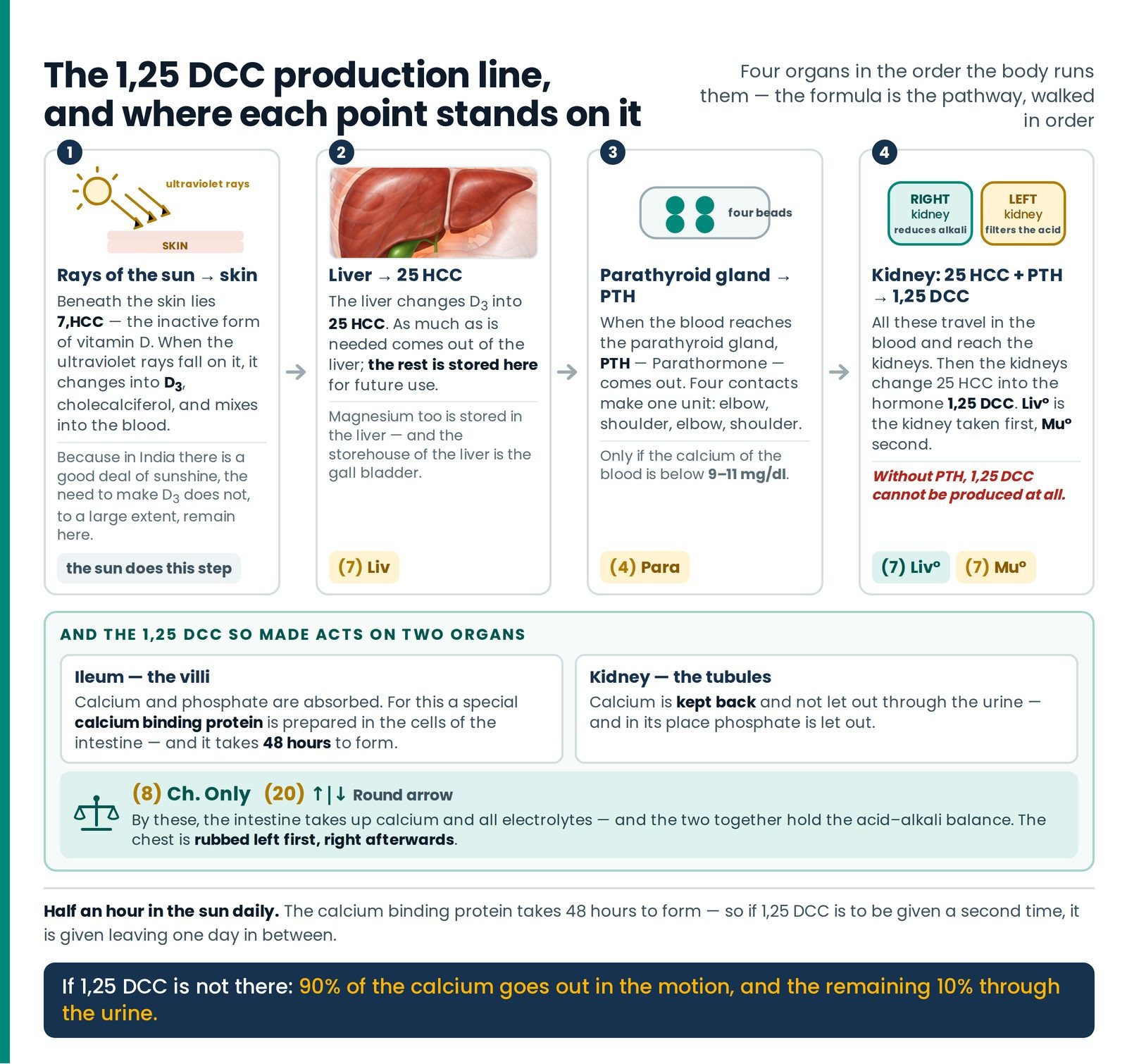
In the absorption and use of calcium, vitamin D has an important place. Beneath our skin a chemical named 7-hydroxycholecalciferol (7,HCC) lies deposited — the inactive form of vitamin D. When the ultraviolet rays of the sun's light fall on it, it changes into D₃, that is cholecalciferol, and mixes into the blood. (Figure 28.5)
When this blood reaches the liver, the liver changes it into 25 HCC (25-hydroxycholecalciferol), another form of vitamin D. In this form, as much vitamin D as is needed will come out of the liver, and the rest remains stored in the liver itself for future use.
When this blood reaches the parathyroid gland, and if the quantity of calcium in the blood is less than 9–11 mg/dl, a hormone named Parathormone (PTH) comes out of the parathyroid gland. All these things travel in the blood and reach the kidneys. Then the kidneys change 25 HCC into the hormone named 1,25 DCC. But for this work, the presence of PTH is essential. Without PTH, 1,25 DCC cannot be produced at all.
Table 22 — In brief: the making of 1,25 DCC, in four steps
| The step | What happens | |
|---|---|---|
| 1 | Rays of the sun → skin | 7,HCC (7-hydroxycholecalciferol) is changed into D₃ |
| 2 | 7,HCC → by way of the blood → liver | 25 HCC (25-hydroxycholecalciferol) |
| 3 | 25 HCC → by way of the blood → parathyroid gland | PTH will come out |
| 4 | 25 HCC + PTH → by way of the blood → kidney | 1,25 DCC |
The chief point of all is that sunlight is extremely necessary for the strength of the bones. This is the very reason why those who work in the fields or in the sun rarely get osteoporosis or other troubles of the bones. In cities people often shy away from the sun, and so their bones do not become strong; and if at some time they have to lift a heavy load, then all sorts of diseases of the bones come to them. If one makes it a habit to take, every day, ten to fifteen minutes of the gentle rays of the morning sun on the beads of the spine, it will be extremely beneficial for health.
How the formula was assembled
Because in India there is a good deal of sunshine, the need to make D₃ does not, to a large extent, remain here. From the facts above we understand that only if the liver, PTH and the kidneys work properly will 1,25 DCC be made — otherwise not.
On that basis the first formula was made, in which the liver, the parathyroid gland and the kidneys are stimulated in order.
Table 23 — Card: Pure 1,25 DCC Supine 6 sec
| Written | (7) Liv (4) Para (7) Liv° (7) Mu° |
|---|---|
| Family | Built from the therapy's own logic, out of the physiology of a pathway. Named after the hormone; nothing whatever is administered |
| Position | Supine throughout Supine |
| Step 1 | (7) Liv — left arm + left thigh, taken together Left . The liver will change D₃ into 25 HCC |
| Step 2 | (4) Para — the parathyroid point; four contacts make one unit — elbow, shoulder, elbow, shoulder, six seconds at each Left . Stimulating the parathyroid gland, it will make PTH |
| Step 3 | (7) Liv° — the right-kidney code beside the navel Right . Kidney, first side |
| Step 4 | (7) Mu° — the left-kidney code beside the navel Left . Kidney, second side — to change 25 HCC into 1,25 DCC |
| What was seen | After only a few days of treatment the quantity of calcium in the blood increases |
| Its character | This formula is very powerful. By this formula, in the intestines only calcium will be absorbed |
| How often it is used | Very little indeed — see the use of Pure 1,25 DCC, below |
| Points taught in | Liv, Liv°, Mu° — The Front of the Body I; Para — The Front of the Body II, "The Front of the Body — II" |
Read the four steps against the four steps of Table 22 and the formula disappears into its own reasoning. Liver, parathyroid, kidney, kidney — the production line, provoked in the order in which the body runs it. Nothing is arbitrary and nothing is decorative, and a student who can recite the pathway can write this card from memory for the rest of his life.
Later, from his own singular experience, and in order to make this formula still more effective, Guruji mixed into it two more points — (8) Ch. Only and (20) ↑|↓.
Table 24 — Card: the 1,25 DCC formula (the ordinary form) Supine Prone 6 sec
| Written | (7) Liv (4) Para (7) Liv° (7) Mu° (8) Ch. Only (20) ↑\ | ↓ |
|---|---|---|
| What it is | This is called the 1,25 DCC formula. Generally, to the majority of patients, this very formula is given | |
| Positions, in order | Supine for steps 1–5 Supine → prone for step 6 Prone | |
| Steps 1 to 4 | Pure 1,25 DCC, entire and unchanged — (7) Liv, (4) Para, (7) Liv°, (7) Mu° | |
| Step 5 | (8) Ch. Only — the chest without the thymus. We first rub on the left side of the chest and afterwards rub on the right side Left Right . Chest Only controls the air element (vāyu tattva) | |
| Step 6 | (20) ↑\ | ↓ — Round arrow; the thumb-edge down one side of the spinous processes and up the other, without lifting the finger, patient prone Prone . For stimulating the 31 pairs of nerves of the spine; and from it acid is also reduced |
| What the two added points do together | In several patients it has been seen that from Ch. Only alkali is reduced — that is, from this the symptoms of acid increase. But if (8) Ch. Only and (20) ↑\ | ↓ are given together, then the two together maintain the balance of acid–alkali |
| What it now absorbs | From this treatment it was seen that it will absorb not only calcium but every kind of electrolyte | |
| What the patient must do | To take full benefit the patient should remain in the sun for at least half an hour daily | |
| How often | Bearing in mind that the calcium binding protein takes 48 hours to be formed — if it is to be given a second time it should be given leaving one day in between | |
| What is checked before it is given | How much pain there is in Liv° and Mu° — and whether the stool that comes in the patient's motion is medium or hard. See the four versions below | |
| Points taught in | As Pure 1,25 DCC; Ch. Only — The Front of the Body II; Round arrow ↑\ | ↓ — Face Down, "Face Down" |
Table 25 — Why each element of the 1,25 DCC formula is given
| Element | Why it is given | |
|---|---|---|
| Rays of the sun | To change the chemical of the skin into vitamin D₃ (cholecalciferol) | |
| (7) Liv | The liver will change D₃ into 25 HCC | |
| (4) Para | Stimulating the parathyroid gland, it will make PTH | |
| (7) Liv° (7) Mu° | To stimulate the kidneys, to change 25 HCC into 1,25 DCC | |
| (8) Ch. Only (20) ↑\ | ↓ | By these, the intestine takes up calcium and all electrolytes |
| Left Chest Only | The pain of Mu° is reduced — that is, it reduces the symptoms of acidosis | |
| Right Chest Only | The pain of Liv° is reduced — that is, it reduces the symptoms of alkalosis |
The last two rows are printed as a note, and they are the most useful two lines in the article for a therapist who has been paying attention.
The two sides of Ch. Only, and what that settles
Nowadays it has been found that the treatments of the two sides of Chest Only work differently.
From Left Chest Only, the pain of Mu° is reduced — that is, it reduces the symptoms of acidosis.
From Right Chest Only, the pain of Liv° is reduced — that is, it reduces the symptoms of alkalosis.
Now go back two sections. The light form of ATF specifies (4) Lt. Ch. Only where the heavy form said only Ch. Only — and ATF is the acid formula, so the left chest is exactly the side it wants. ALTF ends at (2) Rt. Ch. Only — the alkali formula, and the right chest is exactly the side it wants. The lateralisation that looked like a small revision on page 267 is the same discovery arriving in its proper place.
And notice the word the therapy uses to date it. Nowadays. It is written as a thing that has come to be known, in a book of settled instructions, and it is left standing exactly as it is.
Two notes travel with (8) Ch. Only and must not be separated from it. It is not a still press but a rub, and the left side is rubbed first and the right side afterwards — which, given what the two sides are now known to do, means the acid-reducing side is given first and the alkali-reducing side second. And the pairing with (20) ↑|↓ is a balance mechanism, not two points that happen to sit together: each on its own pushes the internal environment one way, and together they hold it where the rest of the formula has put it. The balance pair, in all its counts and variants, belongs to Water and Salt, "Water and Salt"; rule 2 and rule 3 of sequence, which govern the order in which the two are given, are How a Formula Is Built.
The magnesium preface
Then it was learnt from physiology that for calcium to be absorbed properly, the binding — that is, the joining — of magnesium with it is necessary. Magnesium is stored in the liver. And the storehouse of the liver is the gall bladder. So the treatment was changed in this manner.
Table 26 — Card: the 1,25 DCC formula with the magnesium preface Supine Prone 6 sec
| Written | I (3) Gal (7) Liv — for the binding of magnesium · II the 1,25 DCC formula → (7) Liv (4) Para (7) Liv° (7) Mu° (8) Ch. Only (20) ↑\ | ↓ |
|---|---|---|
| What the Roman numerals mean | Part one, then part two, as one treatment, in that order | |
| I · Step 1 | (3) Gal — right sole down the patient's left thigh, hip crease → knee Left . For the binding of magnesium | |
| I · Step 2 | (7) Liv — left arm + left thigh together Left . Magnesium is stored in the liver | |
| II | The 1,25 DCC formula entire, beginning again at (7) Liv | |
| Why Gal opens it | Magnesium is stored in the liver, and the storehouse of the liver is the gall bladder | |
| What it is for | Everything the 1,25 DCC formula is for, with the absorption of calcium made proper by the magnesium binding | |
| Points taught in | Gal, Liv — The Front of the Body I; the rest as above |
Note that Liv is given in part I and again at the head of part II, and the counts differ — (3) Gal (7) Liv first, then the formula's own (7) Liv. That is not a printing accident and it is not an invitation to economise by giving Liv once. Part I is a preface with its own purpose; part II is the formula. Where the therapy writes two parts, two parts are given.
Intrinsic factor, and vitamin B₁₂
From this treatment the patients began to feel very well, saying that digestion and absorption had improved. Then a further thought: for the absorption of vitamin B₁₂ it is necessary that intrinsic factor be made in the stomach; only then, on reaching the ileum, will vitamin B₁₂ be stored in the liver. Otherwise the enzymes of the stomach and the intestine will digest it — that is, finish it off.
The stock of vitamin B₁₂ in the liver lasts five to six years. If someone has symptoms of vitamin B₁₂ deficiency, it means that for several years it has not been getting stored in his body. And for intrinsic factor to be made properly, the blood circulation in the stomach must be proper; in this therapy, for that we give Gas Only.
Table 27 — Card: the three-part sequence for combined calcium and vitamin B₁₂ deficiency Supine Prone 6 sec
| Written | I (1) Gas Only – 6 points · II (3) Gal (7) Liv · III the 1,25 DCC formula → (7) Liv (4) Para (7) Liv° (7) Mu° (8) Ch. Only (20) ↑\ | ↓ |
|---|---|---|
| Given to | Those who have a deficiency of both calcium and vitamin B₁₂ — in order to take the greatest benefit from the 1,25 DCC formula, it has been found better to give the treatment in this manner | |
| Part I | (1) Gas Only – 6 points — both thighs, six stations in one pass Both sides . To stimulate the stomach — for making intrinsic factor | |
| Part II | (3) Gal (7) Liv Left . For the magnesium stored in the liver — only by joining with magnesium will the absorption of calcium be proper | |
| Part III | The 1,25 DCC formula entire | |
| What the whole sequence is for | The absorption of calcium and B₁₂ and all such nutritive elements | |
| Where B₁₂ is taught whole | Vitamin and Gene Formulas, "The Missing Links" — B₁₂, folic and pure folic acid, the deficiency picture, and the gene formulas | |
| Points taught in | Gas Only — The Front of the Body I; the rest as above |
Three parts, and each of them is a door the calcium and the B₁₂ have to pass. Part I opens the stomach so that intrinsic factor is made and the B₁₂ survives the journey. Part II fetches the magnesium without which the calcium will not bind. Part III is the pathway itself. Read it downwards and it is a supply chain; read it upwards and it is a list of the three places a deficiency can be manufactured in a person who is eating perfectly well.
Calcium, the thyroid, and why a thin bone is not a simple thing
The quantity of calcium in the plasma should ordinarily be from 9.00 to 11.00 mg/dl. If there is an extreme deficiency of calcium, even the heart can fail. So that this may not happen, when the need arises the PTH of the parathyroid gland will tell the osteoclasts to take calcium out of the bones and put it into the plasma.
When the quantity of calcium goes above 11.00 mg/dl, from the thyroid gland a hormone named calcitonin will come out, which will tell the osteoblasts to put that excess calcium into the bones.
Calcium is found in milk, curd, paneer, jaggery (gur) and sesame (til) — more in black sesame. In banana, calcium is less and potassium is more.
What calcitonin does and does not govern
Note that calcitonin has no control over PTH. The control of calcitonin is only over osteoclasts and osteoblasts.
This effect too is found more in growing children. From the effect of calcitonin, within a few hours of calcium becoming deficient in the blood, PTH comes out in heavy quantity, which negates the effect of calcitonin.
Hypothyroidism means T₃ and T₄ being low — and this work of the thyroid gland depends upon the pituitary gland. The work of calcitonin depends only upon the quantity of calcium.
From calcitonin working less, osteoporosis will occur, in which the bones become hollow.
And where the quantity is high: when the calcium in the blood is more than 11 mg/dl, the parathyroid gland will stop the intestine and the osteoclasts from absorbing any more calcium from the bones, and will let calcium go out through the urine.
Now the loop that brings the whole article back to the thyroid chain of Table 2, and it closes in a way students find satisfying.
If the quantity of calcium in the blood is less than 9 mg/dl, the muscles cannot work properly. And for all the glands to work properly, and to send out their secretion regularly, the muscles beside them must work properly. If the T₃ and T₄ hormones of the thyroid do not come out in the proper quantity it is called hypothyroidism — and because of the deficiency of calcium in the blood the thyroid gland will be unable to work properly, so this too can be a chief cause of hypothyroidism.
On this inference Guruji thought that those who have hypothyroidism will benefit from the 1,25 DCC formula. Especially those children who have symptoms of mental slowness (mand buddhi) because of hypothyroidism have benefited greatly. In the treatment of such children this thinking is singular and matchless.
The balance rule, and the four versions chosen by the stool
In this formula, (20) ↑|↓ has been given along with (8) Ch. Only. Here is the observation that makes the rest of this section possible.
The balance rule — a proportion, not a list
It has been seen that from Ch. Only alkali becomes less — that is, the symptoms of acid increase — whereas from Round Arrow acid becomes less, that is the symptoms of alkali increase.
Not only that: to balance (20) ↑|↓, (8) Ch. Only is needed, whereas to balance (4) Ch. Only, (10) ↑|↓ is sufficient.
Since neurotherapy treats not the disease but the condition of the body, this observation has been used in a remarkable way: the two counts are deliberately unbalanced in one direction or the other according to what the patient's body needs today.
Twice the chest, twice the spine. Because the rule is stated as a proportion, the four versions that follow are not four things to memorise. They are derivable — and a therapist who has the proportion can check any card he is handed.
And before the treatment is given at all, two things are checked. One should check how much pain there is in Liv° and Mu°. And along with this one should ask the patient whether the stool that comes in his motion is medium or hard. During sixty years of tapasyā it was found that one and the same formula does not apply to all patients. Changing the treatment according to the condition of the patient will give greater benefit.
Table 28 — The four versions of the 1,25 DCC formula, selected by the form of the stool
| The stool | What it means | The formula | What changed | |||
|---|---|---|---|---|---|---|
| Banana-like, and the stomach clear daily — ordinarily people's motion is like this | Ordinary | (7) Liv (4) Para (7) Liv° (7) Mu° (8) Ch. Only (20) ↑\ | ↓ | The standard formula | ||
| Very hard indeed, and coming in small small pieces, like a goat's motion, coming after one or two days, or coming only with great difficulty — severe constipation; such people have pain in Mu° | There is a great deal of acid in the body. We have to reduce the acid further, and must not reduce the alkali too much | (7) Liv (4) Para (7) Liv° (7) Mu° (4) Ch. Only (20) ↑\ | ↓ | Chest cut from (8) to (4), spine left at (20) — when we give (4) Ch. Only the acid will not increase so much | ||
| Medium — cow-dung-like | The alkali has increased somewhat | (7) Liv (4) Para (7) Mu° (7) Liv° (20) ↑\ | ↓ (8) Ch. Only — Ulta 1,25 DCC | Mu° is given first and Liv° afterwards; and (20) ↑\ | ↓ is given first and (8) Ch. Only afterwards. Counts unchanged. A line is ruled underneath so that the therapist keeps in mind that here the order has been changed | |
| Coming three or four times in the day, and the stool very thin | The alkali has increased a good deal. In the treatment we have to increase the acid more | (7) Liv (4) Para (7) Mu° (7) Liv° (10) ↑\ | ↓ (8) Ch. Only | Order reversed as above, and the spine cut from (20) to (10) — *when we give (20) ↑\ | ↓ the acid will be reduced more, but when we give (10) ↑\ | ↓ the acid will not be reduced so much* |
And the explanation printed with that last version, which must travel with it because it is the therapy breaking its own balancing rule deliberately and saying so:
To balance (10) ↑|↓ one ought to give (4) Ch. Only only. By giving (8) Ch. Only, the alkali will be reduced more in comparison with (4) Ch. Only — which is necessary for patients who have thin stools.
That bracket is worth more than the formula it sits beside. A rule is stated; a case arrives in which the rule must be broken; the break is made on purpose, in a stated direction, for a stated reason, and it is written down beside the line so that nobody mistakes it for an error. That is what a working rule looks like in the hands of somebody who made it.
What the 1,25 DCC formula is used for
Table 29 — In brief: the uses of the 1,25 DCC formula
| To increase the quantity of calcium in the blood | Osteoporosis — the becoming hollow of bone |
|---|---|
| If there is bleeding in excessive quantity in the menses | Mental slowness (mand buddhi) and hypothyroidism |
| Those who get cramps at the time of sleeping — this can often happen in high BP patients | To improve the stomach and the digestive system — especially if there is pain in both Liv° and Mu°, and along with indigestion there is also pain in the waist or in the calves; then this formula is very beneficial indeed |
The last entry is the one you will use most often, and it is worth reading twice because it names a combination rather than a disease: pain at both kidney points, indigestion, and aching in the waist or the calves. That is a picture, not a diagnosis, and it is the kind of thing a patient describes in one breath while apologising for mentioning three things at once.
Pure 1,25 DCC, and where it leads
As has been written above, Pure 1,25 DCC is a very powerful and strong treatment. So it is used very little indeed. But there is one formula built directly out of it.
Table 30 — Card: Pure Genes formula Supine Side-lying 6 sec
| Written | (7) Liv (4) Para (7) Liv° (7) Mu° (8) Lt Parkhoo |
|---|---|
| What it is | Pure 1,25 DCC with vitamin B₁₂ mixed into it. If vitamin B₁₂ is mixed into Pure 1,25 DCC, then its name is Pure Genes formula |
| Steps 1 to 4 | Pure 1,25 DCC, entire and unchanged — (7) Liv, (4) Para, (7) Liv°, (7) Mu° |
| Step 5 | (8) Lt Parkhoo — the left Parkhoo, the vitamin B₁₂ station Left . It is this that makes the formula "Genes" |
| What it is for | By means of this formula the disorders of the genes — genetic disorders — can be corrected |
| How often it is used | This formula too is not generally used, because it is very much strong, that is, effective. It is used only in genetic disorders, that is diseases connected with the genes |
| Where the gene family is taught whole | Vitamin and Gene Formulas, "The Missing Links" — Pure Genes, New Genes, Pure and Large Folic Black, and the WD that follows Pan inside New Genes |
| Points taught in | As Pure 1,25 DCC; Lt. Parkhoo — On the Side, "On the Side" |
Two formulas named Pure, and both of them carry the same warning in the same words: very powerful; used very little indeed. That is a class of treatment, not two coincidences. Where the therapy calls a formula Pure, it means the pathway has been provoked without the balancing pair at the end — no Ch. Only, no Round arrow — and rule 3 of sequence tells you exactly what that costs. A formula that ends without a balance is a formula that leaves the patient somewhere. Give the ordinary form unless you have been taught otherwise by somebody who knows why.
The Gas 'I' ladder, and what a dose can decide
One point, four counts — and nine seconds turns (6) into (9)
This last section of the article is a different kind of teaching, and it belongs here rather than anywhere else because it is the plainest demonstration in the wiki of the thing the two kingdoms have been telling you all along: the same point, at two different counts, is two different treatments — and they can pull in opposite directions.
In our intestines there are 100 million — that is, ten crore — neurons, which are called enteric neurons, that is the neurons of the intestines. And these neurons too make, in smaller quantity, the very same chemicals that are made in larger quantity in the brain. In this therapy it has been seen that from the Gas 'I' point the intestines can be stimulated.
Dopamine, in the therapy's own account
Dopamine is a chemical which is made in the part of the brain named the basal ganglia. Besides this it is also made in the adrenal medulla.
After being made, it is changed into norepinephrine according to the body's need.
It is made in the body from the exchange of the tyrosine amino acid. The work of changing one thing into another in the body is called metabolism, that is cayāpacaya. Tyrosine amino acid is found in the protein of milk named casein. So for it to be made properly, milk should be digested properly; and for the metabolism of tyrosine, vitamin C and folic acid are needed. All this will happen only when the digestive system works properly.
One chief work of dopamine is to carry messages from the brain to certain other parts. That is why it is called a neuro-transmitter. Its property is to carry the message of stopping the unwanted movements of the limbs — which is why it is called an inhibitory neuro-transmitter, that is, a stopping neuro-transmitter.
Notice where that paragraph ends up. Tyrosine comes from the protein of milk; the protein of milk must be digested; and the metabolism of tyrosine needs vitamin C and folic acid, which must be absorbed. A article that began at the kidneys has arrived back at the stomach, which is where Setting the Stomach said every article of this Part would end up.
Now the table the ladder was inferred from. It describes what the drug dopamine does when it is put into a patient's blood in a hospital, and it is given here because it is the reasoning the therapy used — nothing whatever is administered in this treatment.
Table 31 — The effect of the drug dopamine on the body
| The quantity of the drug * | Its effect on the body |
|---|---|
| 2 to 5 µgm per minute | Widens the internal diameter of the arteries of the kidney and the intestines. If the flow of blood inside the kidneys increases, the systolic BP will fall |
| 5 to 15 µgm per minute | The contractile power of the heart will increase; blood will come out in greater quantity and with greater speed, from which the BP will rise |
| More than 15 µgm per minute | In this quantity it stimulates the α-adrenergic receptors, from which all the blood vessels of the body contract. This is given to patients of Parkinson's disease, and to those who have extremely low BP because of shock |
* The total quantity of the drug is calculated according to the weight of the patient and is put into the blood. Whatever the patient's weight may be, the drug is to be put up for that many minutes.
Shock is what it is called when, from any cause whatever, the quantity of blood reaching the heart from the venous blood, that is from the veins, becomes so little that the tissues do not get sufficient oxygen for their normal working. (A microgram, µgm, is the ten-lakhth part of one gram.)
Read down the middle column and the thing that matters jumps out. The same chemical lowers the blood pressure at a small dose and raises it at a larger one. Not works less at the small dose — works the other way. That is the fact the ladder was built on.
How the ladder was inferred, step by step
The inference.
When a Parkinson's patient is benefiting from (12) Gas 'I', then from (6) Gas 'I' less dopamine should be made, which might perhaps reduce high BP.
The test. From that inference, when (6) Gas 'I' was given to a patient of high BP, that person's systolic BP came down. From then on, for many years, (6) Gas 'I' is given to high BP patients to reduce systolic BP, from which they get great benefit — and the inference drawn is that this treatment is working like the dopamine dosage of 2–5 µgm/kg/min.
The next thought, and what happened to it. After this the thought came that when (6) Gas 'I' reduces high BP, then from (9) Gas 'I' perhaps more dopamine will be made, from which BP will rise — which we could use in the treatment of low BP. But patients of low BP come only occasionally, so we could not test this on many patients.
That last sentence is left exactly as it stands. A prediction was made, the patients to test it on did not come in sufficient numbers, and the therapy says so rather than filling the gap.
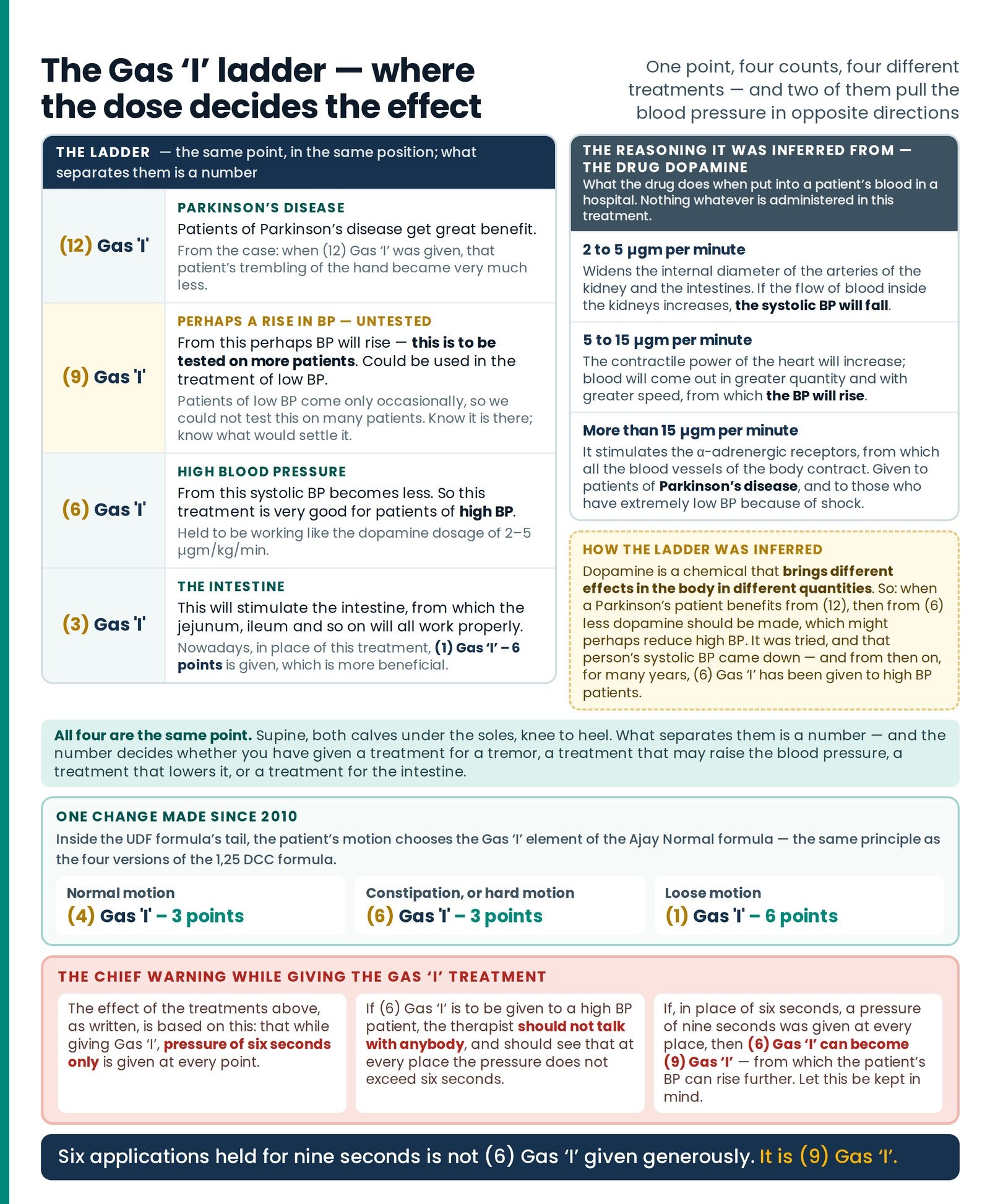
All four are the same point, in the same position, with the patient supine and both calves under the soles, knee to heel. What separates them is a number — and the number decides whether you have given a treatment for a tremor, a treatment that may raise the blood pressure, a treatment that lowers it, or a treatment for the intestine. There is nothing else in the wiki where so much rides on the count alone, which is why what follows is written as a warning rather than as a note. (Figure 28.6)
One change made since 2010
Since 2010, while giving the UDF formula, the following changes are to be made in the Ajay Normal formula according to the motion. It is the same principle as the four versions of the 1,25 DCC formula — the stool chooses the count — and it is placed here rather than in Clearing the Ash because the element that changes is a rung of the ladder you have just learned.
Table 33 — The 2010 modification of the Ajay Normal formula inside UDF, by the patient's motion
| The patient's motion | The Gas 'I' element to give |
|---|---|
| Normal motion | (4) Gas 'I' – 3 points |
| Constipation, or hard motion | (6) Gas 'I' – 3 points |
| Loose motion | (1) Gas 'I' – 6 points |
Three notes on that small table, and then the article turns to choosing.
It belongs to the UDF formula. The Ajay Normal formula is the tail of every UDF sequence — at the end of all UDF formulas, after the Fast treatment, the Mild Ajay Normal formula is to be given — and this modification governs the Gas 'I' element inside that tail. The whole family, generation by generation, is Clearing the Ash, "Clearing the Ash".
Read the counts against the ladder. Constipation gets six; loose motion gets one, at six stations. The same numbers you have just met at the Gas 'I' point, chosen by the same kind of finding as everything else in this article — what the stool looks like this week.
And a note on where the rest of the stomach work lives. Some other formulas for setting the stomach right — Chole, Vater, New Gal and the rest of the later generation — are taught in Setting the Stomach, "Setting the Stomach", and the two articles are meant to be used together. A patient whose Gas point is tender and whose food comes through undigested may need work from both.