Watch


The Acid Treatment Formula — when it is given at all
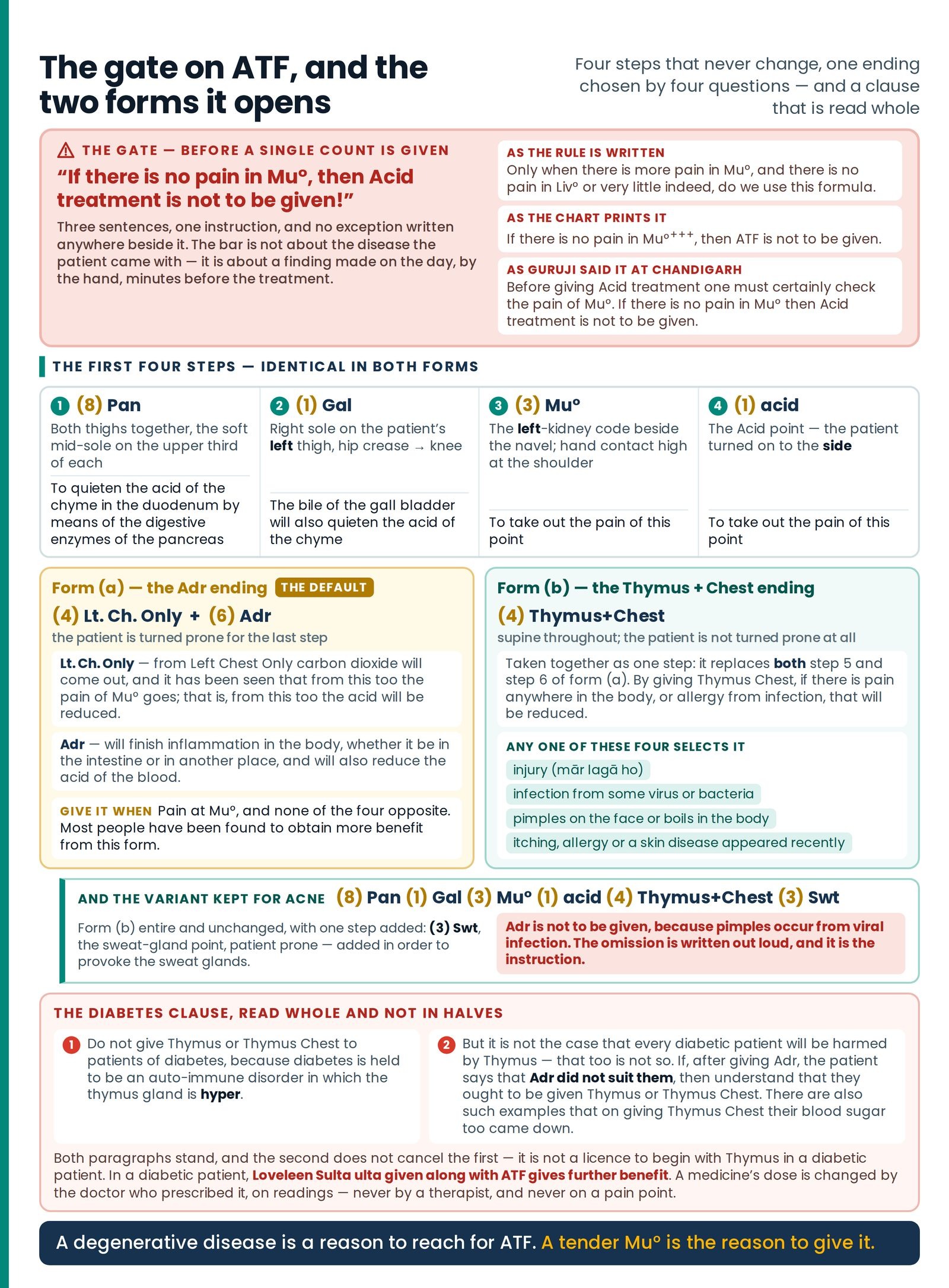
No pain at Mu°, no ATF — and the finding is made on the day, by the hand
The increase of acid in the blood is called acidosis, and it is the root cause of many different symptoms and diseases. ATF is the chief treatment for setting them right. Before a single count of it is given, the gate.
In such people there is more pain in the ring finger of the left hand than in the right; there is often pain in the organs of the left side of the body and not in the organs of the right; and some of them also have pain in the acid point. Those three are confirmations, not substitutes — the anchor is Mu°.
What follows is the picture ATF was written for, assembled over sixty years of unbroken tapasyā and the experience of lakhs of patients. It is given here as the formula's indication, in the six groups in which it is set down. The same material read the other way round — as a way of recognising the acid direction in a patient who has not yet been examined — is The Two Kingdoms, and a student who has both readings will use either better.
Table 2 — The picture ATF is written for, in its six groups
| What is found | ||
|---|---|---|
| 1. The consequences of a deficiency of water — appearing on the intestine, nose, hair, skin and the other organs of excretion | Hard constipation and the diseases connected with it — piles, that is bavāsīr; fissure, a splitting around the anus, called anal fissure; fistula, that is bhagandar, anal fistula · blocked nose; dry cough, or cough with yellow thick phlegm · passing yellow-coloured urine with burning · redness of the eyes and itching in them, because of dryness in the tear glands · pimples or blemishes on the face — pimples, acne or black heads; for these there is a variant of the formula, below · falling of the hair; dandruff or scaling; the hair going white at an early age · drying of the skin; warts or moles; allergy; psoriasis | |
| 2. The three that fall out of place — in these, pain has been found at Mu° | Prolapse of rectum — the rectum coming down from its place · prolapse of uterus — the womb coming down from its place · hernia — an organ shifting from its fixed place and entering inside some other organ or part. These are three different diseases, but one thing is common among all three: they all occur because the flesh-muscles have become loose | |
| and two more of the same family, in the blood vessels | Varicose veins, that is blue veins — varicose means to swell up; because the muscles of the vessels and of their valves become loose, a fault comes into them, from which they easily swell · low BP. When the muscle of the vessels becomes loose the pressure will be less; and because of the deficiency of water the volume of the blood will be less. From both these causes the BP goes down | |
| 3. The gland that runs slow | When acid increases in the blood the muscles become loose. For the secretion of any gland to come out properly the muscles around it must contract properly; if they are loose, the contraction will not happen properly and that gland will be hypo | |
| 4. Bone and joint, first kind — wearing away | Diseases in which the joints or bone wear away, called degeneration — rheumatism (vāt rog); cervical spondylitis, swelling in the beads of the neck; lumbar spondylitis, swelling in the vertebrae of the waist | |
| 5. Bone and joint, second kind — calcium in the wrong place | Calcium deposited between the bones or the joints — Bamboo spine, that is ankylosing spondylitis; Spur, a bone growing outward. For these there is a pair of altered orders, below | |
| 6. What travels with Mu° pain | Pain in the joints without cause · headache, often near the temples — this is called migraine · ulcer, that is sores, in the stomach or the duodenum |
The thyroid chain, and the sentence it produces
Group 3 is worth following all the way, because it is the therapy's own explanation of why one formula relieves so many complaints at once.
One chief gland of the body is the thyroid, which looks after metabolism — cayāpacaya, the body's exchange of one thing for another. We may say that this is the chief mistrī, the master craftsman, without whose order or supervision the other glands and organs will not work properly. All the functions of the GIT depend on the thyroid gland.
When the thyroid works less, digestion will not be proper; the motility of the intestines will not be right; the residue reaches the large intestine very late; and that person gets hard constipation. When the gland works less the T₃ and T₄ hormones do not come out in the right quantity, and two chief symptoms may be seen — in children, very hard constipation, and mental dullness (manda buddhi) can also occur; in women, menses coming before the date, or more flow in the menses. When such a condition lasts for years, the quantity of T₃ and T₄ in the blood becomes very much less than normal, and it is then called hypothyroidism — one chief indicator of which is that the quantity of TSH also rises.
And from group 4, the sentence to carry out of this section: whatever disease has come because of degeneration, or is connected with it, we can set right by giving ATF.
ATF in both its forms
Four steps that never change; four questions that choose the ending
There are two chief forms of the ATF formula — one in which Adr is given, and another in which Thymus Chest is given. But they have separate uses. The first four steps are identical in both. The whole clinical decision is about the ending.
Table 3 — Card: Acid Treatment Formula (ATF), form (a) — the Adr version Supine Side-lying Prone 6 sec
| Written | (8) Pan (1) Gal (3) Mu° (1) acid (4) Lt. Ch. Only (6) Adr |
|---|---|
| Family | Built from the therapy's own logic. Named for the condition it corrects — acidosis |
| Positions, in order | Supine for steps 1–3 and 5 Supine → side-lying for step 4 Side-lying → prone for step 6 Prone |
| Step 1 | (8) Pan — both thighs together, the soft mid-sole on the upper third of each Both sides . To quieten the acid of the chyme in the duodenum by means of the digestive enzymes of the pancreas |
| Step 2 | (1) Gal — therapist's right sole on the patient's left thigh, hip crease → knee Left . The bile of the gall bladder will also quieten the acid of the chyme |
| Step 3 | (3) Mu° — the left-kidney code beside the navel; single station, hand contact high at the shoulder Left . To take out the pain of this point |
| Step 4 | (1) acid — the Acid point, side-lying Side-lying . To take out the pain of this point |
| Step 5 | (4) Lt. Ch. Only — the left chest only, without the thymus Left . From Left Chest Only carbon dioxide will come out, and it has been seen that from this too the pain of Mu° goes — that is, from this too the acid will be reduced |
| Step 6 | (6) Adr — the adrenal point, patient prone Prone . Will finish inflammation in the body, whether it be in the intestine or in another place, and will also reduce the acid of the blood |
| Which form this is | The default. Most people have been found to obtain more benefit from this first formula — the one that has Adr |
| What it is for | The whole acid picture of Table 2 — the consequences of deficiency of water; the three that fall out of place and the two vessel diseases; the gland running hypo; whatever disease has come because of degeneration or is connected with it; the joint pain without cause, the migraine at the temples, the ulcer of the stomach or duodenum |
| Given only when | There is more pain in Mu°, and no pain in Liv° or very little indeed. No Mu°⁺⁺⁺, no ATF ▲ Take care |
| In a diabetic patient | Giving Loveleen Sulta ulta along with ATF will give further benefit |
| If the patient says Adr did not suit them | Then understand that they ought to be given Thymus or Thymus Chest — form (b) |
| The rest | Where ATF is given once or twice a day, it is given with a gap of ninety seconds in between — Table 8, How a Formula Is Built |
| Points taught in | Pan, Gal, Mu° — The Front of the Body I; acid — On the Side, "On the Side"; Lt. Ch. Only — The Front of the Body II; Adr — Face Down, "Face Down"; Loveleen and Sulta Ulta — The Front of the Body II |
Table 4 — Card: Acid Treatment Formula (ATF), form (b) — the Thymus + Chest version Supine Side-lying 6 sec
| Written | (8) Pan (1) Gal (3) Mu° (1) acid (4) Thymus+Chest |
|---|---|
| Positions, in order | Supine Supine → side-lying for step 4 Side-lying → supine for step 5. The patient is not turned prone at all |
| Steps 1 to 4 | Identical to form (a) — (8) Pan, (1) Gal, (3) Mu°, (1) acid, with the same glosses |
| Step 5 | (4) Thymus+Chest — the thymus with the chest, taken together as one step. Replaces both step 5 and step 6 of form (a) |
| What the ending does | By giving Thymus Chest, if there is pain anywhere in the body, or allergy from infection, that will be reduced |
| Given when | Pain at Mu° plus any one of the four circumstances of Table 5 |
| Also | In some people alkali too is reduced by Th + Ch — which is why it appears in the alkali column of Table 1 as well |
| Prohibition | Do not give Thymus or Thymus Chest to patients of diabetes — with the qualification printed beside it, below ▲ Take care |
| The rest | As form (a) — ninety seconds between treatments where two are given in a day |
| Points taught in | Pan, Gal, Mu° — The Front of the Body I; acid — On the Side; Thymus, Chest and Th + Ch — The Front of the Body II, "The Front of the Body — II" |
Table 5 — The four circumstances that select form (b)
| If there has been an injury (mār lagā ho) | If there has been an infection from some virus or bacteria |
|---|---|
| If there are pimples on the face or boils in the body | If itching, allergy or a skin disease has appeared recently |
Read that box as a single idea rather than four. Every one of the four names a body in which something is already being fought — a bruise, a fever, a boil, a rash that came up last week. In those bodies the formula does not push the adrenal; it recruits the thymus. In every other body with Mu° pain, the ending is Lt. Ch. Only and Adr. That is the entire decision, and the first four steps never change.
Table 6 — Choosing between the two forms of ATF
| Form (a) — with Adr | Form (b) — with Thymus + Chest | |
|---|---|---|
| The ending | (4) Lt. Ch. Only + (6) Adr | (4) Thymus+Chest |
| The default | Yes — most people obtain more benefit from this | Given in the four circumstances of Table 5 |
| Give it when | Pain at Mu°, without the features opposite | Pain at Mu° plus injury · viral or bacterial infection · pimples on the face or boils in the body · recently appeared itching, allergy or skin disease |
| Position | The patient is turned prone for the last step | The patient is not turned |
| Diabetes | Give Loveleen Sulta ulta along with ATF for further benefit | Do not give Thymus or Thymus Chest to patients of diabetes — but it is not the case that every diabetic patient will be harmed by Thymus; that too is not so |
| If Adr did not suit the patient | — | Then understand that they ought to be given Thymus or Thymus Chest |
| Recorded alongside | — | There are also such examples that on giving Thymus Chest their blood sugar too came down |
The variant kept for acne
Form (b) with (3) Swt added — and Adr expressly left out
Pimples occur because of viral infection. Therefore do not give Adr in the treatment of pimples. Form (b) is used instead, and one step is added to it. (Figure 28.2)
Table 7 — Card: ATF for pimples and acne Supine Side-lying Prone 6 sec
| Written | (8) Pan (1) Gal (3) Mu° (1) acid (4) Thymus+Chest (3) Swt |
|---|---|
| Positions, in order | Supine Supine → side-lying for step 4 Side-lying → supine for step 5 → prone for step 6 Prone |
| Steps 1 to 5 | ATF form (b), entire and unchanged — (8) Pan, (1) Gal, (3) Mu°, (1) acid, (4) Thymus+Chest |
| Step 6 | (3) Swt — the sweat-gland point, patient prone Prone . Added in order to provoke the sweat glands |
| The exclusion, stated | Adr is not to be given, because pimples occur from viral infection |
| What it is for | Pimples or blemishes on the face — pimples, acne or black heads — one of the items of group 1 in Table 2, which is why the base formula is ATF at all |
| Prohibition it inherits | Everything attached to Thymus and Thymus Chest — not to patients of diabetes, with the qualification of the box above ▲ Take care |
| Points taught in | As ATF form (b); Swt — Face Down, "Face Down" |
Three things about that card repay a second reading.
It is a worked example of how a variant is made. The trunk is left exactly as it stands, the ending is chosen by the condition, and one targeted step is added at the end. Nothing is rearranged, nothing is removed, no count in the first four steps is touched. When you meet a condition for which no formula is written, this is the shape the therapy uses, and rule 5 of sequence in How a Formula Is Built is what permits it — with the doorframe attached.
The exclusion is the instruction, and it is doubly written. Adr is not merely absent from this line; the therapy says do not give Adr, and gives the reason. An omission in this wiki is always an instruction, and where the therapy takes the trouble to say the omission out loud, a therapist who restores the point because the line looks unfinished has not tidied a prescription. He has given a different one.
And the honest clinical note beside it. Acne is, in this therapy, one of the dryness complaints of the acid column, and this is the formula written for it. It is also a condition that has treatments of its own that work well — and one pattern in particular ought to send a young woman to a doctor rather than back to the mat: acne that persists into adult life alongside irregular periods, or with unusual hair growth, deserves assessment. Say so, and go on treating.
Heavy and light treatment
Three counts cut to a third, because a spoiled gland is provoked less
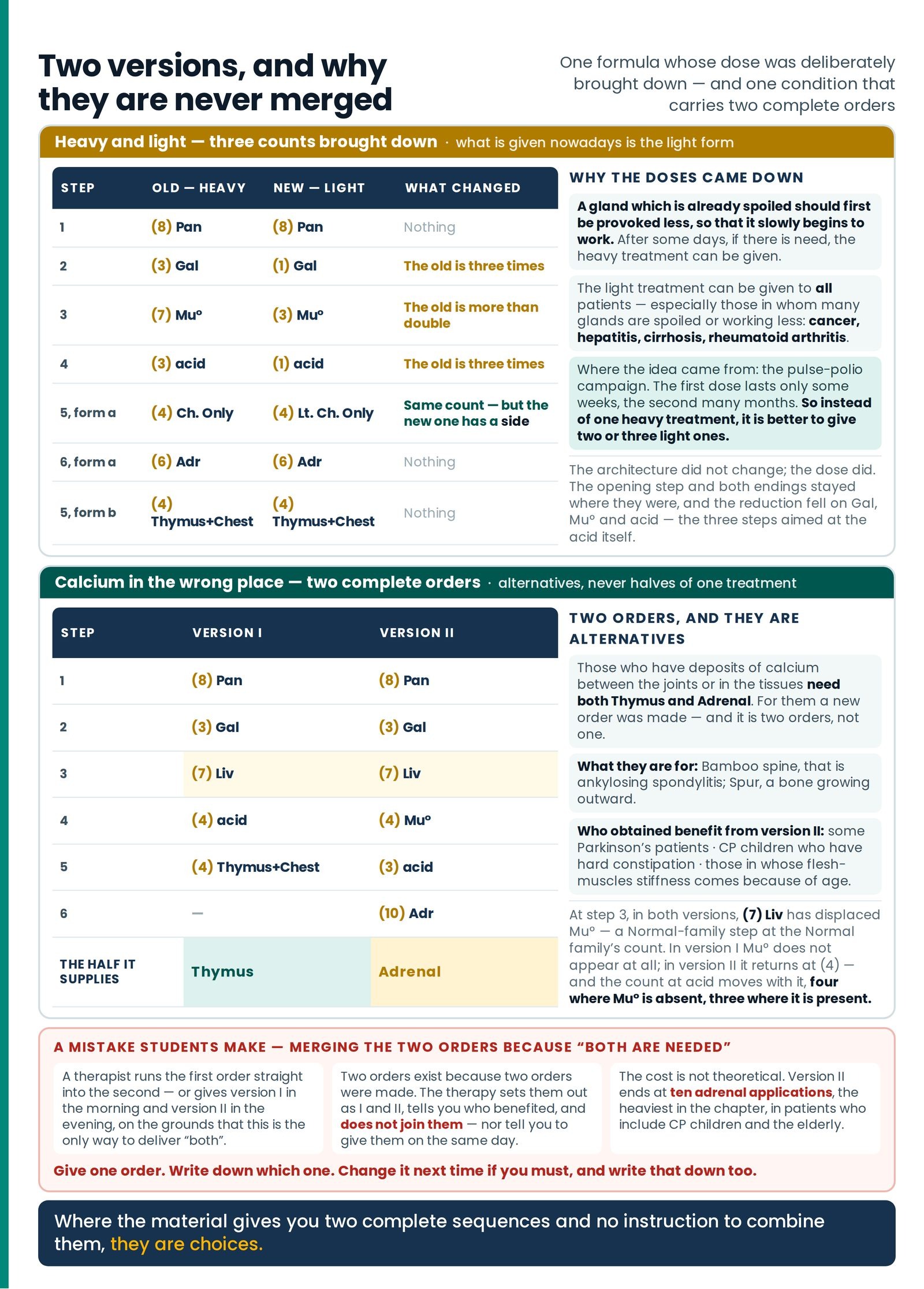
Everything you have been given so far is the light treatment. There was an earlier generation, heavier at three of its steps, and it is set down here for information — not because it has been withdrawn, but because knowing what was reduced, and why, teaches you more about dosing than any rule could.
For some years now Guruji has been giving only the light treatments given above, from which good results have been found. But until a decade ago he used to give the heavy treatments below, from which too there was benefit.
Why the doses came down — the reason, exactly as it was arrived at
One day it came into Guruji's mind that a gland which is already spoiled should first be provoked less, so that it slowly begins to work. After some days, if there is need, they can be given the heavy treatment, that is more stimulation.
The light treatment can be given to all patients. But it is to be given especially to those who have severe or chronic disease — that is, in whom many of the glands are either spoiled or working less. Such as cancer, hepatitis, cirrhosis, rheumatoid arthritis, and so on.
And where the idea came from: the pulse-polio campaign. The dose of polio drops is very mild indeed. The effect of the first dose lasts only some weeks, but the effect of the second dose remains for many months. So instead of giving one heavy treatment, it is better to give two or three light treatments.
Read that as a piece of clinical discipline rather than as history. A man who has taught a formula for twenty years, and whose patients have done well on it, has gone back to his own established sequences and cut three of their counts to roughly a third. It is a great deal harder to reduce your own doses than to raise them, and a student who understands why this page exists will be slower to add an extra application to a formula "because the patient is strong".
Table 8 — Card: Normal Ajay Normal formula (the old, heavy form) Supine
| Written | I (8) Pan (3) Gal (3) Spl (7) Liv (5) Mu · II (8) Pan (3) Gal (7) Liv (6) Gas 'I' |
|---|---|
| What it is | The two parts given as one treatment, in that order — the Roman numerals of Table 13, How a Formula Is Built |
| Position | Supine throughout Supine |
| I · Step 1 | (8) Pan — both thighs together Both sides |
| I · Step 2 | (3) Gal — left thigh, hip → knee Left |
| I · Step 3 | (3) Spl — right thigh, hip → knee Right |
| I · Step 4 | (7) Liv — left arm + left thigh Left |
| I · Step 5 | (5) Mu — right arm + right thigh Right |
| II · Step 1 | (8) Pan — both thighs together Both sides |
| II · Step 2 | (3) Gal — left thigh Left |
| II · Step 3 | (7) Liv — left arm + left thigh Left |
| II · Step 4 | (6) Gas 'I' — both calves Both sides |
| Its successors | Part I is the Normal formula; part II is the heavy ancestor of the Ajay Normal formula, whose modern light form is (8) Pan (3) Gal (7) Liv (6) Gas 'I' – 3 points — Setting the Stomach |
| Status | Given here for information. What is given nowadays is the light form |
| Points taught in | Pan, Gal, Spl, Liv, Mu, Gas 'I' — The Front of the Body I |
Table 9 — Card: Acid Treatment Formula (the old, heavy form), both versions Supine Side-lying Prone 6 sec
| Written, form a | (8) Pan (3) Gal (7) Mu° (3) acid (4) Ch. Only (6) Adr |
|---|---|
| Written, form b | (8) Pan (3) Gal (7) Mu° (3) acid (4) Thymus+Chest |
| Positions, in order | As the light forms — supine Supine , side-lying for the acid point Side-lying , prone for Adr Prone |
| Step 1 | (8) Pan — both thighs together Both sides . Unchanged in every version, old and new |
| Step 2 | (3) Gal — left thigh Left . Three passes, against one in the light form |
| Step 3 | (7) Mu° — the left-kidney code Left . Seven, against three in the light form |
| Step 4 | (3) acid — the Acid point, side-lying Side-lying . Three, against one in the light form |
| Step 5, form a | (4) Ch. Only — the chest, with no side stated. The light form specifies Lt. Ch. Only |
| Step 6, form a | (6) Adr — adrenal, prone Prone . Unchanged |
| Step 5, form b | (4) Thymus+Chest — unchanged; replaces steps 5 and 6 |
| The order | The same six steps in the same order as the light form. Only three counts and one side have altered |
| Who it was for, and who the light form is for | The heavy treatment was the earlier practice. The light treatment can be given to all patients, and especially to those with severe or chronic disease — cancer, hepatitis, cirrhosis, rheumatoid arthritis |
| Points taught in | As the light forms |
Table 10 — Old (heavy) and new (light) ATF, side by side
| Step | Old — heavy | New — light | What changed |
|---|---|---|---|
| 1 | (8) Pan | Nothing | |
| 2 | (3) Gal | (1) Gal | The old is three times |
| 3 | (7) Mu° | (3) Mu° | The old is more than double |
| 4 | (3) acid | (1) acid | The old is three times |
| 5, form a | (4) Ch. Only | (4) Lt. Ch. Only | Same count; the new one has a side |
| 6, form a | (6) Adr | Nothing | |
| 5, form b | (4) Thymus+Chest | Nothing |
That table is the most instructive thing here. The architecture did not change; the dose did. The opening step and both endings were left exactly where they were, and the reduction fell on the three middle steps — Gal, Mu° and acid — which are the steps aimed at the acid itself. A designer who cuts precisely the loaded part of his own sequence and leaves the frame alone knew which parts of it carried the weight.
And one change is not a dose at all. (4) Ch. Only became (4) Lt. Ch. Only. A step that had been the chest became a step that is the left chest, and in a article whose whole logic is left-for-acid and right-for-alkali, that is a correction of a different kind. What it means is taken up in full under the 1,25 DCC formula, where the therapy states plainly what the two sides of Ch. Only are now known to do differently.
The treatment given to a patient in coma
A formula defined by what it leaves out: no Mu°, both kidneys spoiled
What follows is not a formula for general use. It is a stripped ATF, given to one patient in one extreme condition, and it is taught here for one reason: it is the clearest example in of a formula altered for the organ state of the patient in front of you.
Table 11 — Card: (8) Pan (1) Gal (2) acid (4) Lt. Ch. Only treatment Supine Side-lying 6 sec × 3
| Written | (8) Pan (1) Gal (2) acid (4) Lt. Ch. Only |
|---|---|
| Positions, in order | Supine Supine → side-lying for step 3 Side-lying → supine for step 4 |
| Step 1 | (8) Pan — both thighs together Both sides . The unchanged opening of every ATF version |
| Step 2 | (1) Gal — left thigh, hip → knee Left |
| Step 3 | (2) acid — the Acid point, side-lying Side-lying . Two — neither the old form's three nor the light form's one |
| Step 4 | (4) Lt. Ch. Only — the left chest only Left . Closes the formula; no Adr, no Thymus+Chest |
| The omission that defines it | Mu° was not given — because both his kidneys were spoiled, on account of which his creatinine was greatly raised |
| How many times it was given | Twice |
| What was recorded | The pH changed from pH 7.32 to pH 7.4 |
| Points taught in | Pan, Gal — The Front of the Body I; acid — On the Side; Lt. Ch. Only — The Front of the Body II |
When calcium has gone where calcium should not be
Two complete orders, Thymus or Adrenal — give one, never both
Group 5 of Table 2 named a family: calcium deposited between the bones or the joints — bamboo spine, spur. For those patients the ordinary ATF endings are not enough, and the reason is stated in one line.
Those who have deposits of calcium between the joints or in the tissues need both Thymus and Adrenal. For them a new order was made — and it is two orders, not one.
Table 12 — Card: the calcium-deposit order, version I Supine Side-lying 6 sec
| Written | (8) Pan (3) Gal (7) Liv (4) acid (4) Thymus+Chest |
|---|---|
| Positions, in order | Supine Supine → side-lying for step 4 Side-lying → supine for step 5 |
| Step 1 | (8) Pan — both thighs together Both sides |
| Step 2 | (3) Gal — left thigh, hip → knee Left . The heavy-version count |
| Step 3 | (7) Liv — left arm + left thigh, taken together Left . Liv, not Mu° — a Normal-family step enters ATF here |
| Step 4 | (4) acid — the Acid point, side-lying Side-lying . Four — the highest count this point is given anywhere in this article |
| Step 5 | (4) Thymus+Chest — thymus with chest, as one step. This supplies the Thymus half of the stated requirement |
| What it is for | Deposits of calcium between the joints or in the tissues — Bamboo spine, that is ankylosing spondylitis; Spur, a bone growing outward |
| Prohibition it inherits | Everything attached to Thymus and Thymus Chest — not to patients of diabetes, with the qualification of the box above ▲ Take care |
| Points taught in | Pan, Gal, Liv — The Front of the Body I; acid — On the Side; Thymus + Chest — The Front of the Body II |
Table 13 — Card: the calcium-deposit order, version II Supine Side-lying Prone 6 sec
| Written | (8) Pan (3) Gal (7) Liv (4) Mu° (3) acid (10) Adr |
|---|---|
| Positions, in order | Supine Supine → side-lying for step 5 Side-lying → prone for step 6 Prone |
| Step 1 | (8) Pan — both thighs together Both sides |
| Step 2 | (3) Gal — left thigh Left . As version I |
| Step 3 | (7) Liv — left arm + left thigh Left . As version I |
| Step 4 | (4) Mu° — the left-kidney code Left . Restored, at four — neither the heavy form's seven nor the light form's three |
| Step 5 | (3) acid — the Acid point, side-lying Side-lying . Three, against four in version I |
| Step 6 | (10) Adr — adrenal, prone Prone . Ten — the heaviest adrenal dose in this article. This supplies the Adrenal half of the stated requirement |
| What it is for | The same family — calcium deposited between the joints or in the tissues |
| Who obtained benefit from this treatment | Some Parkinson's patients · those CP children who have hard constipation · those in whose flesh-muscles stiffness comes because of age |
| Points taught in | As version I; Adr — Face Down, "Face Down" |
Two things must be said about that pair, and the first is the one students get wrong.
They are alternatives, not halves of one treatment. The requirement is written as both Thymus and Adrenal, and a reader in a hurry concludes that the two orders are to be run one after the other, or that they can be spliced into a single line ending … (4) Thymus+Chest (10) Adr. Neither is written anywhere. What is written is two complete orders, each with its own counts at acid, each ending in one of the two elements. A therapist who merges them has invented a formula with thirty-five applications and two endings, and has done it in a patient with bone disease. (Figure 28.3)
And the second: look at step 3. In both versions Mu° has been displaced from its usual place by (7) Liv — a step out of the Normal family, at the Normal family's count. In version I Mu° does not appear at all; in version II it returns at step 4, at (4). That is the therapy rearranging the acid formula around a different target, and the counts at acid move with it — four where Mu° is absent, three where it is present. Copy the counts as carefully as the codes.