- Family
- Acid–Alkali — calcium-deposit pair
- Explained in
- Correcting the Two Kingdoms
Watch


From Correcting the Two Kingdoms
When calcium has gone where calcium should not be
Two complete orders, Thymus or Adrenal — give one, never both
Group 5 of Table 2 named a family: calcium deposited between the bones or the joints — bamboo spine, spur. For those patients the ordinary ATF endings are not enough, and the reason is stated in one line.
Those who have deposits of calcium between the joints or in the tissues need both Thymus and Adrenal. For them a new order was made — and it is two orders, not one.
Table 12 — Card: the calcium-deposit order, version I Supine Side-lying 6 sec
| Written | (8) Pan (3) Gal (7) Liv (4) acid (4) Thymus+Chest |
|---|---|
| Positions, in order | Supine Supine → side-lying for step 4 Side-lying → supine for step 5 |
| Step 1 | (8) Pan — both thighs together Both sides |
| Step 2 | (3) Gal — left thigh, hip → knee Left . The heavy-version count |
| Step 3 | (7) Liv — left arm + left thigh, taken together Left . Liv, not Mu° — a Normal-family step enters ATF here |
| Step 4 | (4) acid — the Acid point, side-lying Side-lying . Four — the highest count this point is given anywhere in this article |
| Step 5 | (4) Thymus+Chest — thymus with chest, as one step. This supplies the Thymus half of the stated requirement |
| What it is for | Deposits of calcium between the joints or in the tissues — Bamboo spine, that is ankylosing spondylitis; Spur, a bone growing outward |
| Prohibition it inherits | Everything attached to Thymus and Thymus Chest — not to patients of diabetes, with the qualification of the box above ▲ Take care |
| Points taught in | Pan, Gal, Liv — The Front of the Body I; acid — On the Side; Thymus + Chest — The Front of the Body II |
Table 13 — Card: the calcium-deposit order, version II Supine Side-lying Prone 6 sec
| Written | (8) Pan (3) Gal (7) Liv (4) Mu° (3) acid (10) Adr |
|---|---|
| Positions, in order | Supine Supine → side-lying for step 5 Side-lying → prone for step 6 Prone |
| Step 1 | (8) Pan — both thighs together Both sides |
| Step 2 | (3) Gal — left thigh Left . As version I |
| Step 3 | (7) Liv — left arm + left thigh Left . As version I |
| Step 4 | (4) Mu° — the left-kidney code Left . Restored, at four — neither the heavy form's seven nor the light form's three |
| Step 5 | (3) acid — the Acid point, side-lying Side-lying . Three, against four in version I |
| Step 6 | (10) Adr — adrenal, prone Prone . Ten — the heaviest adrenal dose in this article. This supplies the Adrenal half of the stated requirement |
| What it is for | The same family — calcium deposited between the joints or in the tissues |
| Who obtained benefit from this treatment | Some Parkinson's patients · those CP children who have hard constipation · those in whose flesh-muscles stiffness comes because of age |
| Points taught in | As version I; Adr — Face Down, "Face Down" |
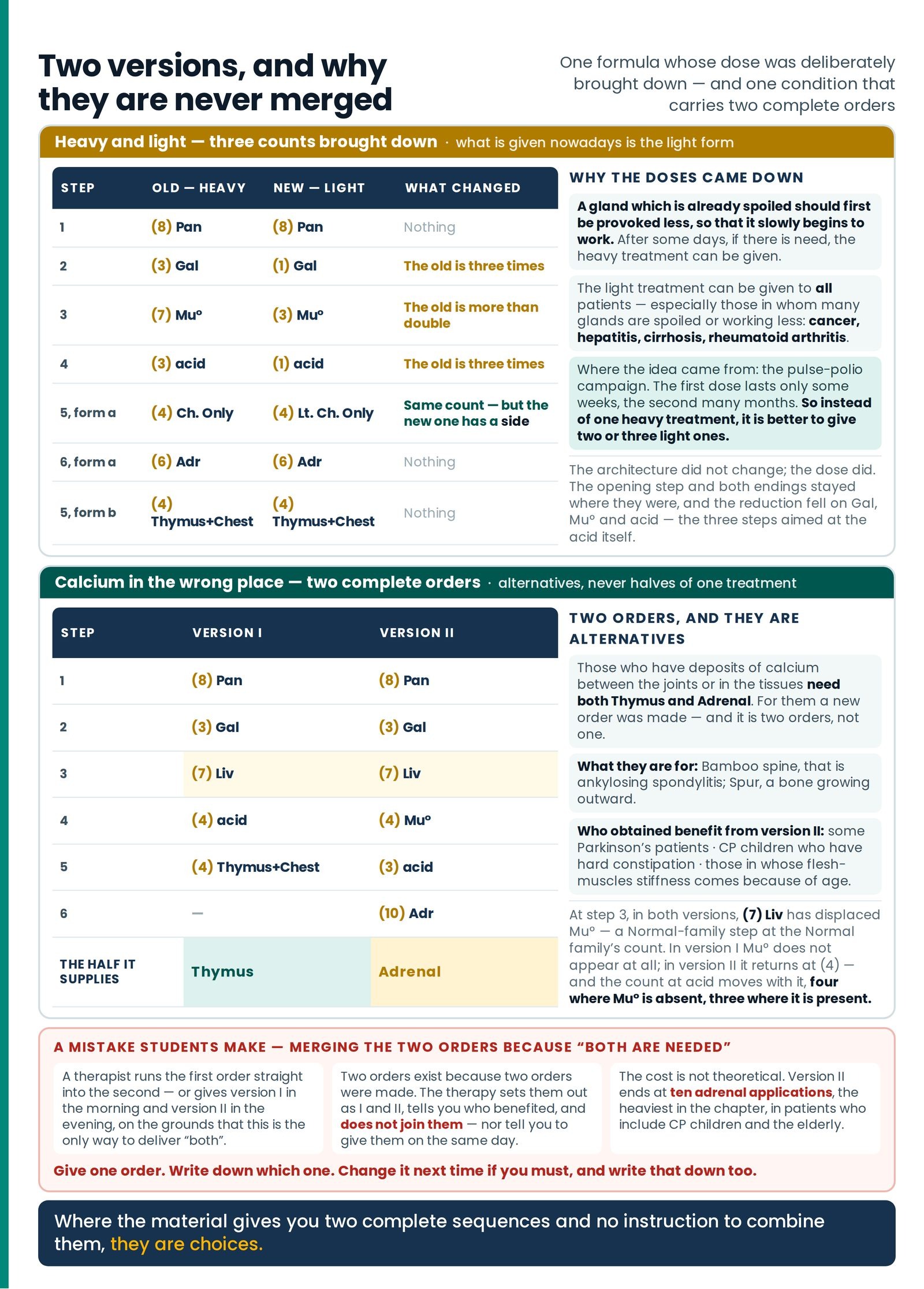
Two things must be said about that pair, and the first is the one students get wrong.
They are alternatives, not halves of one treatment. The requirement is written as both Thymus and Adrenal, and a reader in a hurry concludes that the two orders are to be run one after the other, or that they can be spliced into a single line ending … (4) Thymus+Chest (10) Adr. Neither is written anywhere. What is written is two complete orders, each with its own counts at acid, each ending in one of the two elements. A therapist who merges them has invented a formula with thirty-five applications and two endings, and has done it in a patient with bone disease. (Figure 28.3)
And the second: look at step 3. In both versions Mu° has been displaced from its usual place by (7) Liv — a step out of the Normal family, at the Normal family's count. In version I Mu° does not appear at all; in version II it returns at step 4, at (4). That is the therapy rearranging the acid formula around a different target, and the counts at acid move with it — four where Mu° is absent, three where it is present. Copy the counts as carefully as the codes.