The History That Cannot Mislead You — Taking a Patient's Story
Watch


Why the first question is the wrong question
“Any complaints?” asks for a judgement, and takes the smallest answer
Every beginner opens with the phrase they have heard in every clinic they ever sat in: "Do you have any complaints?" It is a courteous sentence and an almost worthless one, and the reason teaches the whole craft.
It asks for a judgement, not a fact. Complaint is the patient's own ranking of what is worth your time. A man with eleven years of burning in the stomach has stopped classing it as a complaint — it is simply how a stomach is. What comes back is not their symptoms but their opinion of them, and their opinion is the one thing in the room you cannot use.
It invites a single answer, and takes the smallest one — the complaint that hurts today, or the one they think you can help, or the one that is respectable to have. And it puts the patient on the wrong footing in five seconds, asking a person to present himself as a broken thing. Many will not — particularly men and elders — and having once said "I am fine" out loud, he must defend that sentence all visit.
What a history is, and what it is for
The history is the larger half of the diagnosis, and the half that decides what the examination should look for.
Three things are collected, and they must never be mixed on the card:
1. What the patient says — in the patient's own words, written as spoken. 2. What the patient does not say — and which of two reasons it is: they did not think it mattered, or they did not wish to say it. 3. What you find — with the fingers, with the eyes, and from the reports.
The second is where nearly all failed treatments come from. The third is taught in The Navel Speaks First, The Educated Hand and Reading the Reports, and is worth little without the other two.
That line is why a history is a living document and not a form. As treatment begins the glands improve and a change comes in them: the condition of the body has changed, and the next day's treatment may have to differ. So it is taken at length on the first day, and re-taken in small pieces every session for as long as that patient is yours.
The order, and why this order and no other
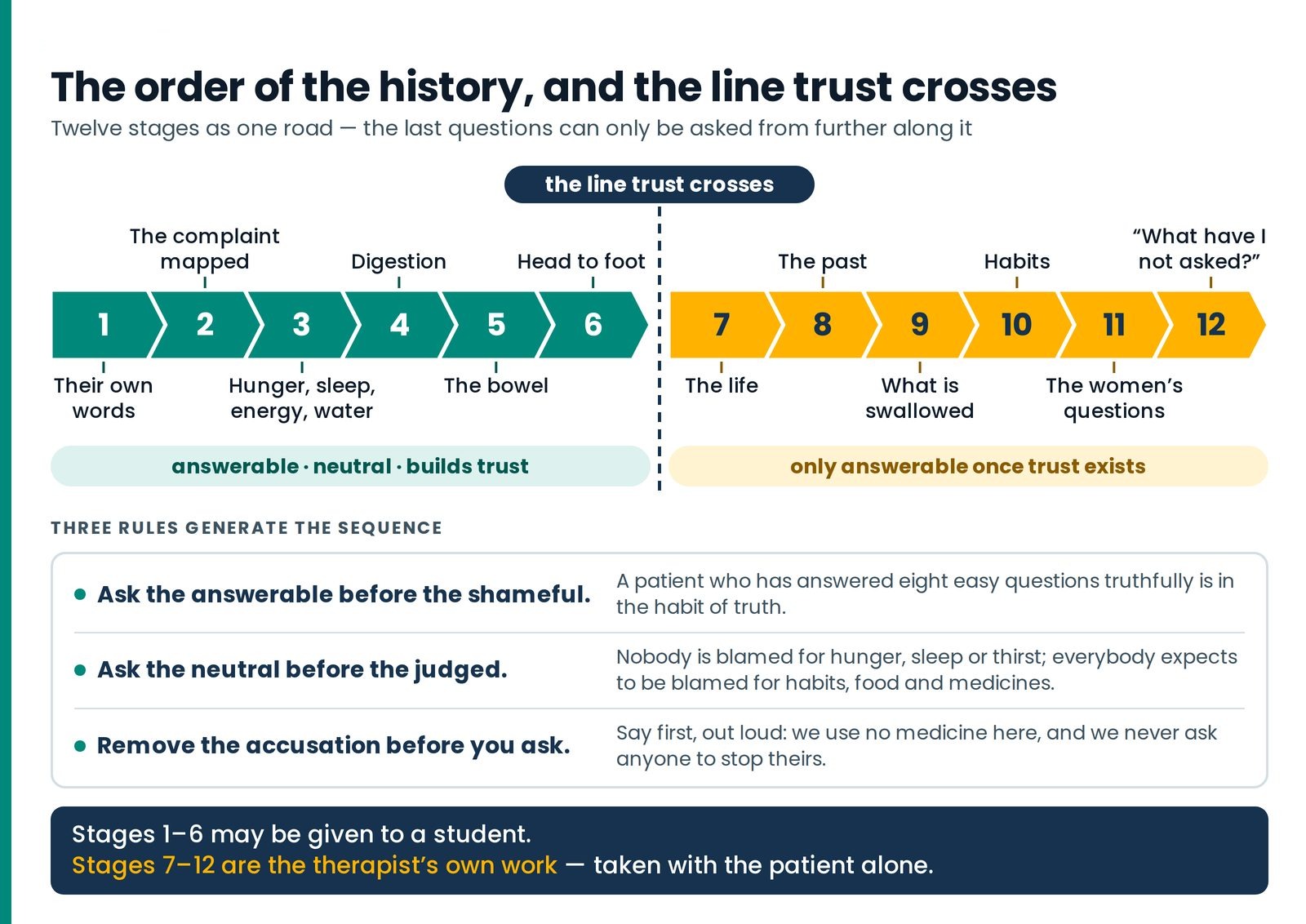
Twelve stages, three rules, and the three words kept apart on the card
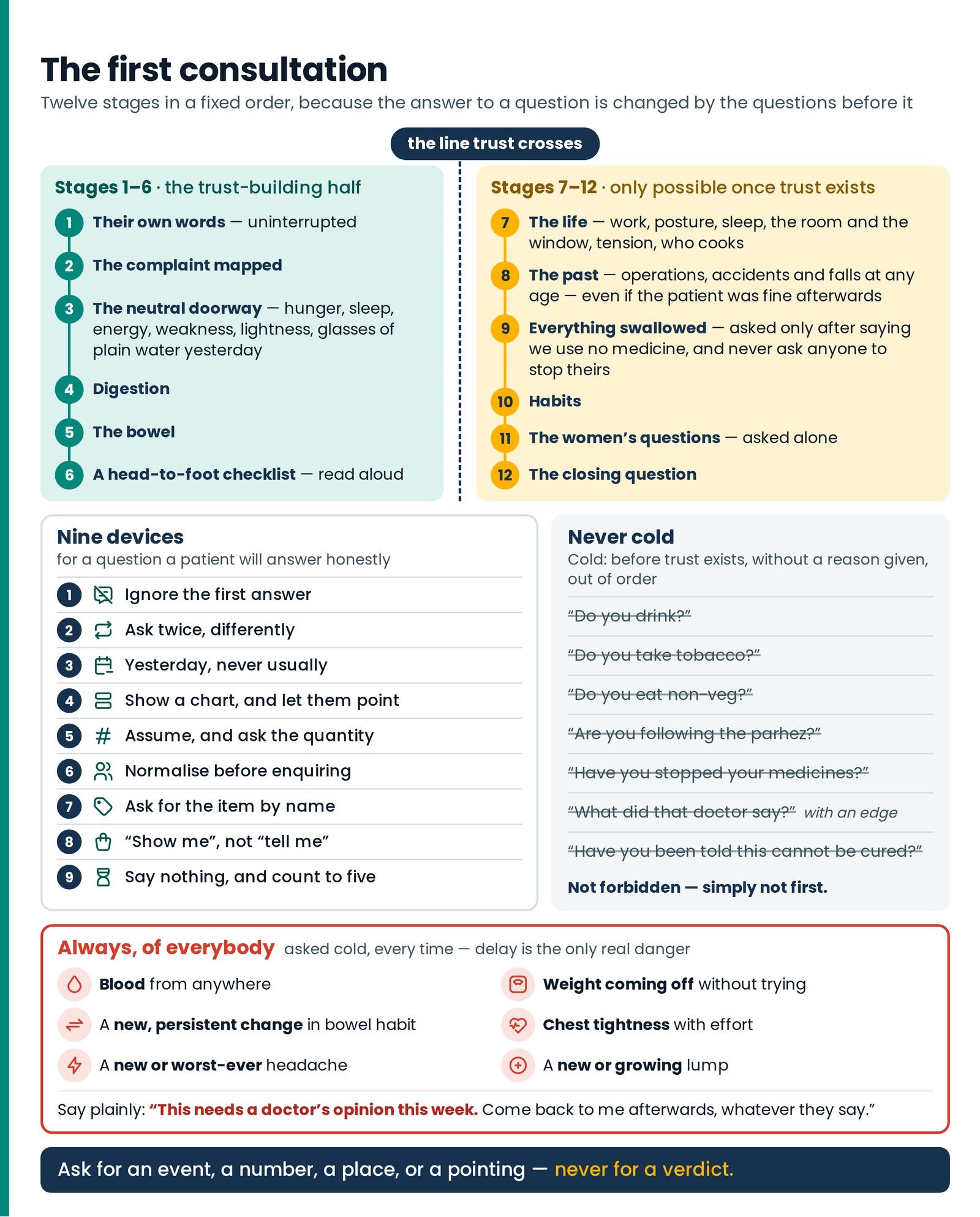
There is an order for a first history, and it is not the order a sensible person would invent — because the answer to a question is changed by the questions that came before it. (Figure 11.1) (Figure 11.2)
Three rules generate the sequence. The answerable before the shameful: a patient who has answered eight easy questions truthfully is in the habit of truth; one whose second question was about alcohol has learnt that this is a place of judgement, and everything afterwards is curated. The neutral before the judged: nobody is blamed for hunger, sleep or thirst; everybody expects to be blamed for habits, food and medicines. And never ask a question whose honest answer is a confession of disobedience until you have removed the accusation from it — "are you taking your tablets regularly?" asks a man to admit he ignored his doctor, and he will not; say first, out loud, we use no medicine here and we never ask anyone to stop theirs, and the answer changes.
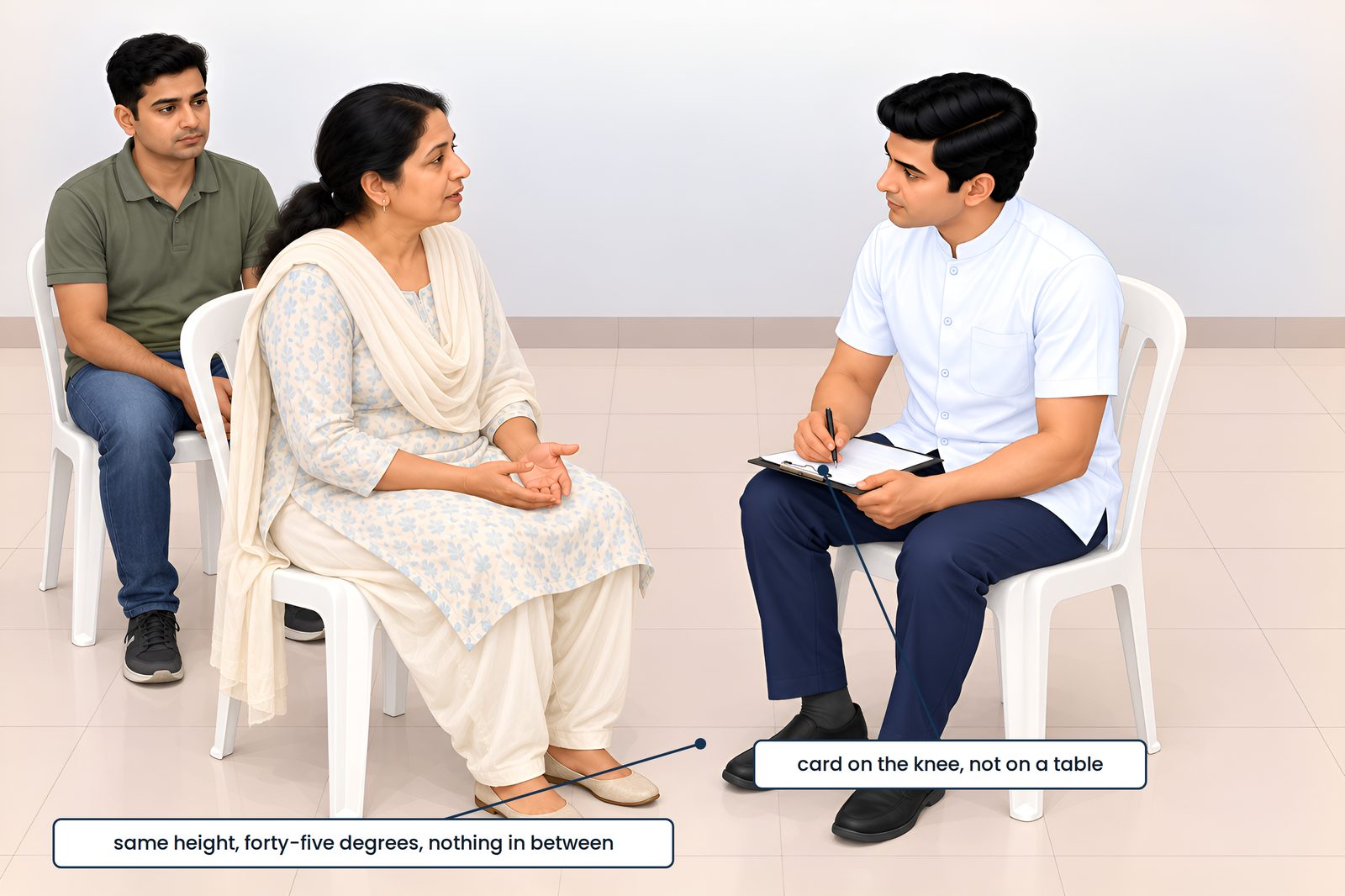
How to ask a question a patient will answer honestly
Nine devices, the question with its answer inside, and elicitation
The question that carries its own answer
The commonest fault in a beginner's history is not shyness but a question with the answer already inside it. (Figure 11.3)
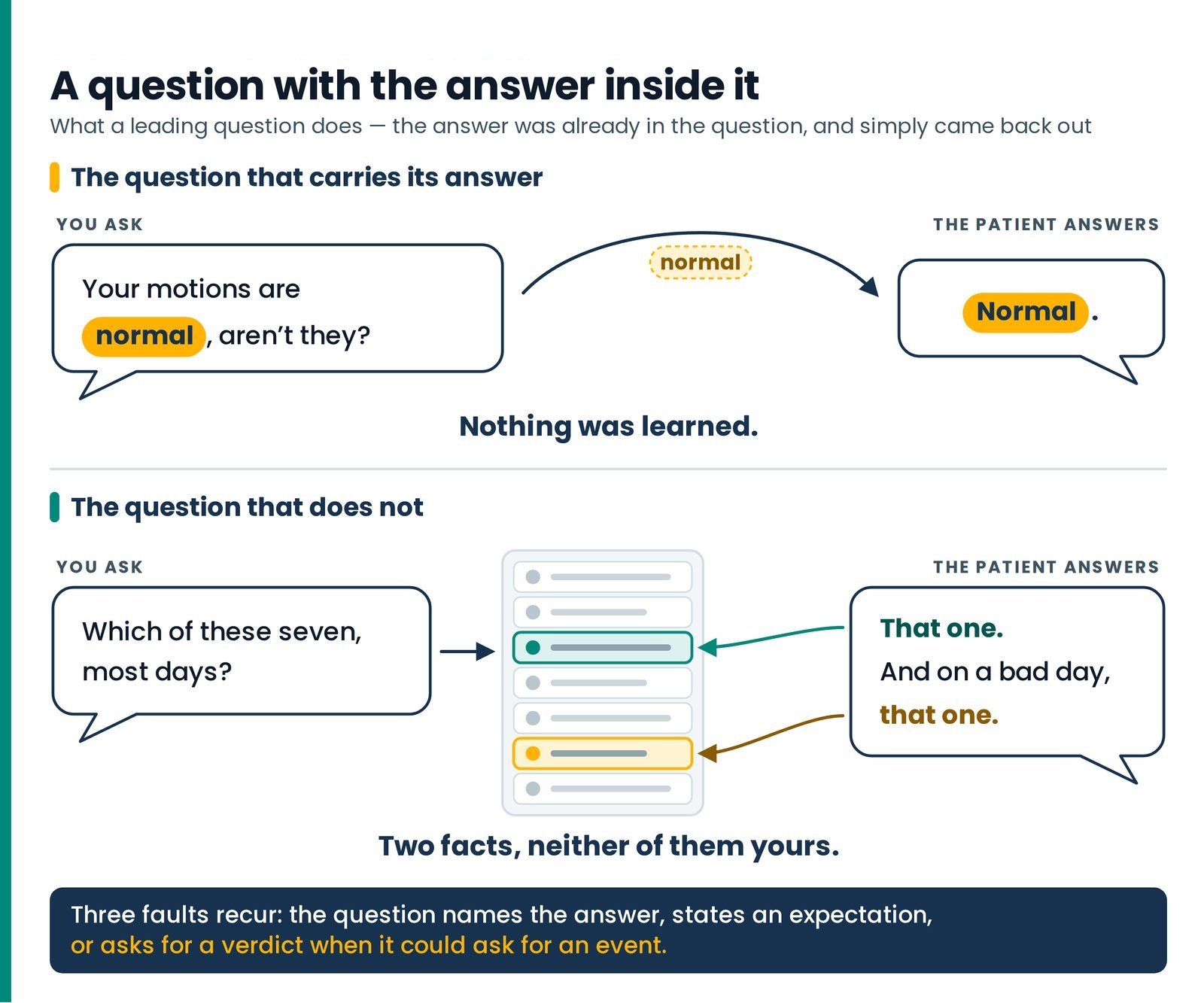
Table 1 — The same enquiry, two ways
| Carries its answer | What it gets you | Does not |
|---|---|---|
| "You don't get burning in the chest, do you?" | A no. You asked for one | "What happens in your chest after food?" |
| "Are your motions normal?" | His own definition of normal | "Which of these seven, most days?" — pointing at the chart |
| "You are following the food advice?" | Yes | "Tell me everything you ate and drank yesterday, from waking." |
| "You have not stopped your tablets, have you?" | Of course not | "Show me what you swallowed yesterday." |
| "Is it better?" | Yes, always, to be kind to you | "What can you do this week that you could not last week?" |
Three faults recur on the left: the question names the answer; it states an expectation the patient must meet or contradict; or it asks for a verdict when it could ask for an event. Ask for an event, a number, a place or a pointing — never a verdict.
The elicitation method — for a question the patient finds repugnant
The Fire and the Ash teaches this method on the hardest such question in the wiki — whether undigested food appears in the stools. It works on every repugnant question you will ask.
What patients withhold, and how each is caught
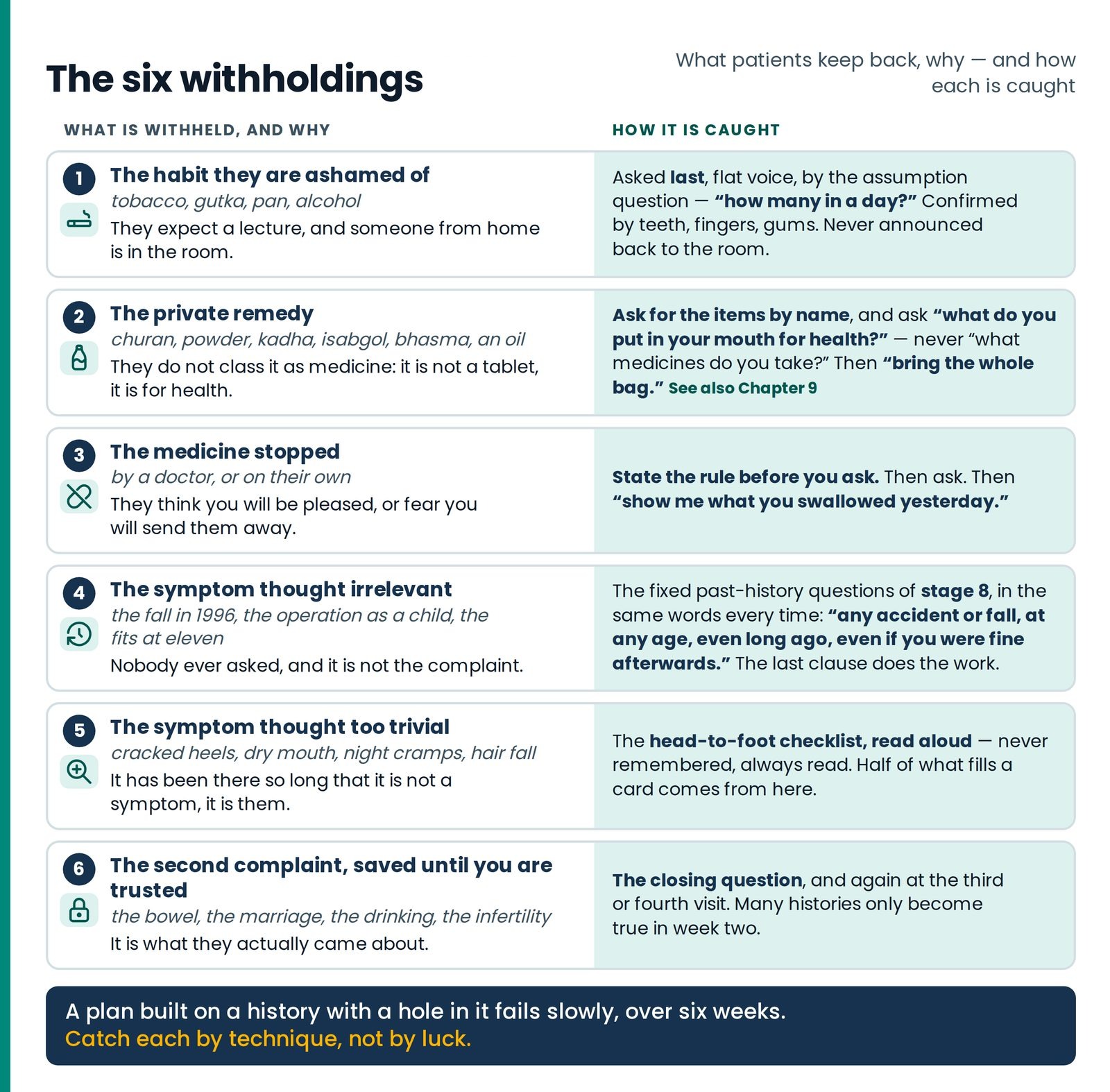
Six withholdings, the audience in the room, and looking before asking
A plan built on a history with a hole in it fails slowly, over six weeks, while you change the plan you should not have changed and the patient quietly loses faith. (Figure 11.4)
And look before you ask. Much of what a patient will not say is written on them — the brown staining and receding gum of a long pan or gutka habit, the yellowed fingers, the callus on the outer foot of a man who has squatted at work for thirty years, the way a person lowers himself into a chair, which tells you about the hip he did not mention. A question about something you have seen is easier to answer than one out of the air.
The questions that are never asked cold
What waits for trust, and the warning signs asked of everybody
Cold means asked before trust exists, without a reason given, and out of order. These are not forbidden; they are simply not first. Two more belong on the list. "What did that doctor say?", asked with an edge, invites the patient to defend or insult a previous practitioner — ask instead "what has been tried, and what helped even a little?" And "have you been told this cannot be cured?" puts the word incurable into the room in your voice; let them bring that one, as they almost always do, at the door.
Table 3 — Never cold, and what to do instead
| Never cold | What it does early | Instead |
|---|---|---|
| "Do you drink?" · "Do you take tobacco?" | Announces in the first minute that this is a place of judgement | Stage 10, assumption question, flat voice, alone |
| "Do you eat non-veg?" | The patient answers the verdict inside the question | Ask what was eaten yesterday, meal by meal, before you say a word about parhez |
| "Are you following the parhez?" | Once taught, it can only be answered yes | Ask about yesterday's food and drink in detail, and work it out yourself |
| "Have you stopped your medicines?" | Sounds like a trap, and often is one | State the rule first, then ask, then "show me" |
| "Why did you not come earlier?" · "Can you afford to come daily?" | Shames a person for poverty or distance; answered with a lie that breaks the plan in week two | "How far is your journey, and which days can you come, honestly?" |
| "How long have you been trying for a child?" — in a hall | Ends the consultation, whatever else is said | Alone, at stage 11, after the ordinary questions about her cycle |
| Any question aimed at a body's weight | Ends candour immediately | "Has anything become loose or tight this year?" — which also catches weight loss nobody has noticed ▲ Take care |
The parhez
Non-veg, smoking and alcohol, sour things — and teaching it so it is kept
What is to be avoided during treatment
1. Non-veg — meat-based food.
Mutton, chicken, fish and so on.
2. Smoking and alcohol — neither is to be consumed.
3. Sour things — tamarind, lemon, tomato, curd, lassi. This abstinence is especially for those who have pain in one or many joints of the body.
The three parhez questions, answered
Is it necessary for all patients to avoid sour things — or for which kind of patient?
Not for all. Those with pain in the joints — knee, back, waist — should not eat sour things, because the pains increase from them. Those with the diseases of acidosis also should not, until the health is fully corrected; afterwards, if there is need, they may eat them. And if the pain comes back, stop them completely for some months, until the body is fully corrected.
Is it necessary for all patients to avoid non-veg?
Yes — and not only for patients: it is better for all people to keep away from meat-based food.
Why must meat-based food be avoided?
Because the root cause of disease coming into the body is the digestive system not working properly. Meat-based food is made of heavy protein and fat, not easily digested. City-dwellers nowadays do no particular physical labour such as would require eating such heavy protein. And when somebody comes to us for treatment it means their digestive system is already spoilt — otherwise they would not have fallen ill. In that condition the body will be unable to digest meat-based food and to absorb the nutrients from it. Food that is not digested leaves toxins — unwanted substances — accumulating, and from these a burden falls on the liver, the skin and the kidneys, because it is they who must do the extra work of throwing them out.
A second thing is worth attention. Creatures reared for sale are given many hormone pills, so that they fatten quickly and the rearer profits more; and so that they do not fall prey to disease, antibiotics and other pills are given in their feed, which remain in their body, in the skin or in the flesh itself. The ill effect of all these will certainly fall on the health of the person who eats that flesh.
And this is a matter of experience: in diseases such as MD, MS or MND, a patient who has taken this treatment and become somewhat better, and who then takes even once the gravy of a meat dish, can lose it — months of our labour mixed into the dust in a single day — and to bring him back to that condition again becomes extremely difficult.
The energy account
For every function of the body we need energy, obtained from food; and when we obtain more energy than the day's work requires, we feel enthusiasm and freshness all day. But to obtain energy from food, digestion and absorption must happen properly.
Here is the part nobody thinks of. Passing food along the canal from mouth to rectum itself takes a good deal of energy, and how much depends on what the food is. People ordinarily believe that cooked food digests easily and raw food does not — the truth is exactly the opposite. To digest salad, sprouted food and fruit, and to expel the residue, the body must make very little effort. But fried things, spicy food, paneer, chholé, and things made from maida take a great deal of strength to digest — which is why some people feel a kind of fatigue, or become sleepy, after eating such food.
Most harmful of all are packet-packed things and non-veg food. Into packaged things many chemicals are put so that they last long and do not spoil, and from these chemicals too, ill effects can occur.
The energy obtained from meat-based food takes several times more labour to digest than the energy it gives — especially when the digestive power is weak. There is no benefit in eating eggs or heavy protein when we are unable to digest them; and even if we can digest them, there is no need, when with less effort we can get more energy from fruits and vegetables.
Food during illness
When we fall ill, even lying down, energy is still needed — for the heart, for the respiratory system, for the brain.
So during illness very light food is given, and in a quantity somewhat less than the appetite, so the body need not make particular effort to digest it and send the residue onward.
Good or suitable food is that after taking which a person immediately feels freshness and strength. The best examples: coconut water; fresh juice of the season's fruits; vegetable soup.
Not paying proper attention to eating and drinking is itself the foundation of diseases in the body.
What every new patient asks, and what you answer
Food before, clothing, pain, length, medicines, incurable, scientific
"How long before I come? What should I eat first?" Before treatment the emptier the stomach the better — one hour after breakfast, and two to two and a half hours after a heavy midday meal. Give the reason: he must lie flat, turn onto the side, lie face down and turn again, and with a full stomach that is difficult.
"What should I wear?" Loose clothing — so nothing binds — and, keeping our culture in mind, such that the whole body remains covered. The second half of that decides whether a woman comes back.
"You will press me with your feet. Will it hurt?" No — and this is exactly the speciality of this therapy. In acupressure pressure is given on one point, where there is sometimes a chance of feeling a little pain; here it is given over a large area. Very small children, and the elderly and weak, are treated with the hand; persons of larger build with the feet. The therapist is trained to apply pressure with the soft part between the soles, so that even a child of six to eight feels no distress. And every person, from a one-day-old infant to a hundred years of age, can take this treatment. Supine ▲ Take care
"How long is each day's treatment?" It depends on the person's state that day, but for common ailments about thirty minutes a day is enough — and not continuously: according to the formula there may be gaps of a few minutes. 6 sec Where needed, small treatments at shorter intervals may be given through the day, taught to the household.
What decides the length of a treatment
The same period does not apply to all.
It depends on the person's body structure; which disease it is; how many organs it has affected; how many years it has been present; and how far the parhez is kept.
Even so: by regularly following the treatment and the parhez, many diseases are cured in just two to four months. For congenital conditions it may take some years. For old diseases it takes many months.
And the sentence to give the patient: a disease that has come over many years — will it not take at least that many months to be put right?
This therapy does not only remove symptoms; it corrects the activity of all the organs of the body. From people all over the country it has been heard that within a day or two small and large effects begin to show:
The first effects, and what they are worth
hunger begins to improve · sleep begins to improve · energy increases · weakness reduces · the body feels light · life becomes enjoyable.
And with improvement in all these, even if the disease itself is slow to be fully cured, the likelihood of another disease coming is averted — a great benefit, not easily obtained in a medicinal system.
This is why stage 3 exists. A patient who says in week three that her sleep is better has told you nothing unless the card says what her sleep was in week one.
Fevers, colds, coughs, indigestion, constipation, stomach ache and such small things come in order to give us warning. Treated so that the symptom alone is suppressed, the warning is silenced and big diseases go on growing in the body. So as soon as such symptoms appear, treat at once, without delay: considerable relief will be obtained within three or four days — this is experience. But for a complete cure, at least one treatment a week for a month or two means the trouble does not come again.
The medicines question
Medicines — the first answer, given unasked
In Neurotherapy we use no medicine of any kind.
If a patient is already taking some medicine or tablet, we do not even tell them to stop it. Treatment goes on alongside it.
When somebody comes for pains and, after some days of treatment, the pain has stopped altogether, we say this: go to your own doctor and say, "Now I have no pain at all — must I still take the tablets in the same quantity?" Then the doctor himself tells them what to do.
Say this before you ask your medicines question, not after. It costs nothing, and it is the single most effective thing in this article for getting an honest list.
Medicines — the second answer, with all its conditions
Ordinarily we do not advise anyone to reduce medicine without the doctor's opinion.
But if, on his own responsibility, the patient wishes to stop medicines other than a painkiller, the following method should be adopted — and every condition attached is part of the instruction.
If you take one tablet each of different kinds in a day, then of the tablet you wish to stop:
Break off only ¼ of that dose, keep it aside, and take the remaining ¾. On that day do not reduce any other tablet at any other time.
Do the same for three days. On the fourth day take the ¼ portions of the three days that were kept aside — that is, in four days you have taken three tablets in place of four.
If your body still feels good, then from the fifth day reduce another ¼ — now take ½ tablet in place of ¾. This time keep taking the ½ tablet for eight days.
During this period you must certainly keep taking the treatment, so that no disturbance occurs.
If you feel that stopping the tablet is not making you feel well, remain on ½ tablet for another four or eight days, until you feel right.
Then reduce another ¼ — now take only ¼ tablet in place of ½, for four, eight or twelve days, as long as you feel well.
Then, for two weeks, take the ¼ tablet on alternate days; then, for some days, the ¼ tablet two days a week.
Doing so, stop the tablet gradually, and there will be no trouble in the body.
But always remember that while stopping the tablet you must not stop the treatment — until you have been well for many days without medicine.
If the same kind of tablet is taken three times a day (morning, noon, evening): on the first day stop the morning ¼, on the second day the noon ¼, on the third day the evening ¼ — and test for yourself at which time you need the tablet more, and according to your own body decide yourself how many days, and at which time, stopping is more beneficial.
Reducing the tablet gradually in this way while taking the treatment, you will not have the side effects of stopping the medicine, and you will get the full benefit of the treatment.
"They told me it is incurable." · "Is this scientific?"
Because treatment here is done keeping the root cause in mind, relief is generally obtained in all common diseases.
But of the following diseases and symptoms it is said that there can be no treatment — CP (cerebral palsy), epilepsy (fits), hepatitis, thalassaemias, sickle cell anaemia, aplastic anaemia, MD and DMD, MND, MS, kidney failure, polio, and so on.
The conditions called incurable
The truth is that in these diseases too, many patients have obtained quite good results by this treatment — even in HIV.
And the most important contribution of all: in the lives of children afflicted with congenital conditions such as intellectual disability, ADHD, dyslexia and autism, this therapy has brought considerable improvement — so their parents themselves say.
Give it to a family in those words, and notice what it does not say. It does not say these conditions are cured; it says the door is not shut, and that in the children the people best placed to judge report considerable improvement. That is hope without a sale.
As to whether it is scientific: we call it a scientific method because if its treatments are properly understood, then however many times anyone applies them — on the same person or on different persons — the same kind of results come out. Add what patients ask in the same breath: this therapy has its own methods of diagnosis and keeps coordination with what modern investigation shows — a blood test, an X-ray picture; it uses knowledge from medical science in a different way, in which the use of medicines is rejected; and there is no relation between the therapist's age or weight and the result — if pressure is given at the right place and in the right sequence, the results come out just the same.
"Will it come back?" · "Is this like yoga?" · "How many has it helped?"
Recurrence, answered honestly
This therapy corrects the root cause, not only the symptoms. When the root cause is corrected, not only that disease but all the symptoms related to that root cause go away, and they should not return.
But — and the but is given, not hidden — one main cause of disease is wrong thinking, and not following the ordinary rules of diet, sleep and exercise. And some diseases are so bound up with tension that a person well for many days finds the symptoms return with even a little tension.
Such a person needs, besides treatment, to change the way of life and the direction of the thoughts; and from time to time to keep visiting the nearby centre, for proper treatment to keep the stomach and digestion right. Doing that, not only that disease but any other disease can be prevented.
That is why a history keeps asking about the life. A main cause of all these disturbances is the modern way of living, our thinking, not following the ordinary rules of diet and sleep, and a tension-filled way of life — and the full treatment of the body will happen only when a person brings a particular change in all of these. Twenty-four hours belong to the patient; half an hour belongs to you.
On yoga: the effect of some of our treatments resembles some āsanas — that of Gas I is like vajrāsana, that of Ku like vīrāsana. And people who cannot do yogāsana at all because of pain, weakness or illness can, after being made healthy by this treatment, do yogāsana and keep their health that way. This therapy heals the defective organs; yoga helps to stabilise the body. The two are complementary.
On numbers, answer with the record and nothing more. From the Bandra clinic and the Suryamal ashram, at least one lakh patients in ten years; across the country at least 650 centres where this is the only treatment given, at least twenty patients a day, each gaining ten to fifteen new patients a month — six and a half to ten thousand monthly, seventy thousand to one lakh a year, at least eight lakh in the last decade in all of India; and about five thousand families earn their daily bread from it. The aim: at least ten thousand centres, as soon as possible. Then say what those figures are — a count of people treated.
The residential programme, and treatment at a distance
Twenty to twenty-five days at Suryamal, then the nearest centre
The rules of living, given at the end of the first visit
A sheet for the household: on rising, eating and drinking, sleeping
A first consultation ends with a sheet — not a lecture — in the patient's language, for the household to pin up. Two of its lines deserve a spoken sentence as well: sleep with the windows open is not a preference (a case in The Hand That Heals turns entirely on it), and lie down and rise only by turning onto the side applies always, so that no strain falls on the muscles of the abdomen and the back. The reason behind every other rule is taught in Between Two Sessions, "Between Two Sessions", and Food as Medicine, "Food as Medicine".
Table 4 — Some general rules for a healthy life
| Occasion | The rules |
|---|---|
| On rising | Rise before the sun rises, taking God's name, with good thoughts. Do not get up abruptly: sit on the bed itself for 10–15 seconds, and get up afterwards. Do not drink cold water immediately after rising — drink lukewarm water, or cold water later, when the body has become warm. In the morning, as far as possible, bathe only in cold water — best in all seasons |
| Eating and drinking | Take breakfast at least 45 minutes after bathing. Eat chewing thoroughly. Do not drink water while eating — it may be drunk half an hour after the meal; and rather than a great deal at one time, one glass after every hour is more beneficial. An ordinary person may drink at least two litres of water in a day, but not immediately on top of milk, tea or watermelon. Eat salt, sugar or papad in small quantity; stay away from tea, coffee and things made of maida. Eat the grains, fruits and vegetables not only of the season but of the province you live in — the special meaning being that it is better not to eat a thing where that thing does not grow. Stay away from non-veg — flesh food — and from liquor. If there is pain in the body, sour things should not be eaten. Do not drink water standing; and whatever you eat, eat only sitting |
| Sleeping and rising | Sleep only at least two hours after the night meal, and it is best to sleep before 10.30 at night. Lie down turning onto the side, and rise only by turning onto the side and taking the support of the hands. Sleep with mind and body loose and relaxed; do not sleep with the hands placed under the head; sleep with the legs straight. Sleep with the windows open, and sleep only in darkness. Get up before the darkness ends — before the sun rises — taking Hari's name, with good thoughts |
The rules are old ones. The classical texts set out a daily regimen and a seasonal one that between them govern almost everything on that sheet — rise before the light, bathe, eat only when the last meal has been digested, eat what the season and the region grow, sleep at a fixed hour. The point was never that any one rule is powerful, but that a body given the same shape of day spends much less of itself on adjusting.
Writing it down
The first-visit sheet, block by block, and a line every session
The test of a history sheet is one question: can a therapist who has never met this patient pick up the card in six weeks and say what has changed?
Two bodies, read as this article teaches
A teacher’s three unlisted remedies, and a driver’s forgotten accident
The closing question
“Anything I have not asked?” — and the three prompts that follow
Ask it at the end of every first visit — while they are gathering their things, because a person who has stood up has stopped being examined and starts telling the truth.
The question that changes more plans than any report
"Now — is there anything I have not asked you about?"
Then, without waiting for the no, the three prompts that do the real work:
"Anything you thought was too small to mention?"
"Anything you thought had nothing to do with this?"
"Anything you did not want to say in front of anybody?"
Then be quiet, and count to five.
The prompts are the three reasons a thing is withheld, said out loud by you, so the patient need not admit to any of them. Too small recovers the trivial symptom; nothing to do with this recovers the accident, the operation, the childhood illness; not in front of anybody recovers the second complaint, the habit and the private remedy — and that is the one which, six visits later, turns out to have been the reason they came.
A report can only answer the question it was ordered for. This one has no subject at all, and so it is the only question in the visit that can return something you did not already suspect. When nothing comes back, write that too — closing question asked, nil — and ask again on the third visit. (Figure 11.5)
Questions students ask
- 1. I am twenty and I freeze in front of a stranger. Where do I begin? With one sentence decided in advance: "Tell me in your own words what brought you, from the beginning." Then put the pen down and be quiet for a full minute. You are not required to be clever; you are required to be silent.
- 2. I am sixty-six, learning this for my family. Do I need all twelve stages for my own wife? More than for a stranger, not less — with your own family you assume you know the answers, and you will be wrong about at least two.
- 3. A patient talks for fifteen minutes and I cannot get a word in. Let the first minute run, then bring the shape back with a summary rather than an interruption: "So — burning after food, waking at two, and the knee since Diwali. Have I got those right?" It is the only interruption that makes a talker feel heard.
- 4. A patient answers everything with "everything is fine, just fix my knee." Ignore the answer, smile, and go politely on to the rest of the questions. Then use the devices that need no admissions: the chart to point at, the list read aloud, yesterday's glasses of water. Irritated patients answer factual questions perfectly well; they only refuse to be interviewed.
- 5. I am a physician. How does this differ from the history I was trained to take? The stage-3 baseline is not a review of systems but the outcome measure; the rule stated before the medicines question defeats the under-reporting of household remedies; and the history is re-taken every session, because treatment follows the condition of the body, not the name.
- 6. I work in a village. People come in groups and everyone hears everything. Make the separation with time instead of walls: stages 1 to 6 in the hall, then "the last few questions I ask everyone on their own". It is not the door that makes it private; it is that you did the same for the person before them.
- 7. How long should a first history take, and may I write while the patient talks? Twenty-five to forty minutes; a ten-minute first visit is a complaint, not a history. In stage 1 do not write — a person watching you write is editing for the page. From stage 2, write openly.
- 8. What if the patient and the family disagree — or a patient refuses to answer at all? Write both accounts, attributed; a disagreement about dates is itself a finding. Where a patient refuses, note asked, not answered and move on cheerfully. A refusal on day one is very often a full account on day nine — what changed in between is that they watched you not push.
Questions patients ask
- 1. "Why so many questions? My problem is only this knee." Because a knee is repaired out of the same stores as everything else, and those stores are filled by your digestion. Most of what I need to know about your knee is not in the knee.
- 2. "Should I stop my tablets?" No, and I am not going to ask you to. We use no medicines here and we do not tell anybody to stop theirs. Keep taking exactly what your doctor gave you. If a day comes when the complaint has gone completely, go to that doctor and say: "I have no pain at all now — must I still take the same quantity?" That decision is his, not mine.
3. "How long will this take? Give me a number." It depends on five things: your build, which disease it is, how many organs it has reached, how many years you have had it, and how carefully you keep away from what I will ask you to. With the treatment and the parhez kept regularly, many diseases settle in two to four months; an old disease takes many months; something you were born with can take years. A disease that came over many years — will it not take at least that many months to be put right?
- 4. "Will I feel anything this week?" Most people notice small things within a day or two — hunger improving, sleeping better, more energy by evening, less weakness, the body feeling lighter. Those are not the cure; they are the first sign that things are moving, which is why I wrote down today how you eat, sleep and feel by evening.
5. "My family eats meat, and you are asking about drink and tobacco. Are you going to lecture me?" No. I ask everybody the same questions in the same order, and for the same reason I asked about your water — because it changes what I do with my hands, not what I think of you. On the meat: leave it alone while you are under treatment. Your digestion is already tired, and heavy protein and fat are the hardest work you can give it. Eat the same meal without that dish; and at a wedding, eat only what came out of your own kitchen.
6. "Is this scientific?" Pressure at particular places, for a particular count, at a particular angle, in a particular order, so that the flow of blood and lymph and the working of the nerves improve and your own glands do their job. If the treatments are properly understood, then however many times anybody applies them, the same kind of results follow. That is what we mean by calling it scientific.
Words used here
| Hindi | English | Neurotherapy code / usage |
|---|---|---|
| परहेज़ (parhez) | Abstinence; what is kept away from | Non-veg; smoking and alcohol; sour things — the last especially for joint pain |
| शिकायत · इतिहास (shikāyat · itihās) | Complaint · history | The patient's own words, in quotation marks; and everything elicited, kept separate from the findings |
| चूरन (chūran) · काढ़ा (kāṛhā) | A digestive powder taken after food · a boiled household decoction | The commonest unreported remedies; ask for both by name |
| भस्म · ईसबगोल (bhasma · īsabgol) | A calcined mineral preparation · psyllium husk | Ask by name at stage 9; neither is classed as a medicine by anyone who takes it |
| खट्टा (khaṭṭā) | Sour | Tamarind, lemon, tomato, curd, lassi — the parhez list |
| करवट लेना (karvaṭ lenā) | To turn onto the side | Lie down and rise only by turning onto the side, with the support of the hands |
| — | UDF | Undigested food in the stool. UDF – Yes / No / Occasionally / Never, or UDF - ? — The Fire and the Ash |
| — | Suryamal | The ashram hospital; the 20–25 day residential programme |