Watch


How to read this article
Read the right column first; the bracket is a selector, not a dose
The atlas taught you a verb. This article teaches you a sentence.
The Front of the Body I to 24 answered how: where the patient lies, where the hand or the foot goes, how many times, at what angle, in what order. Not once did they answer why this patient. That was deliberate. A student who learns the indication before the technique starts fishing for diseases; a student who learns the technique first has something to hang the indication on.
Now the hanging is done, and it has two halves.
Three habits make this article usable rather than merely long.
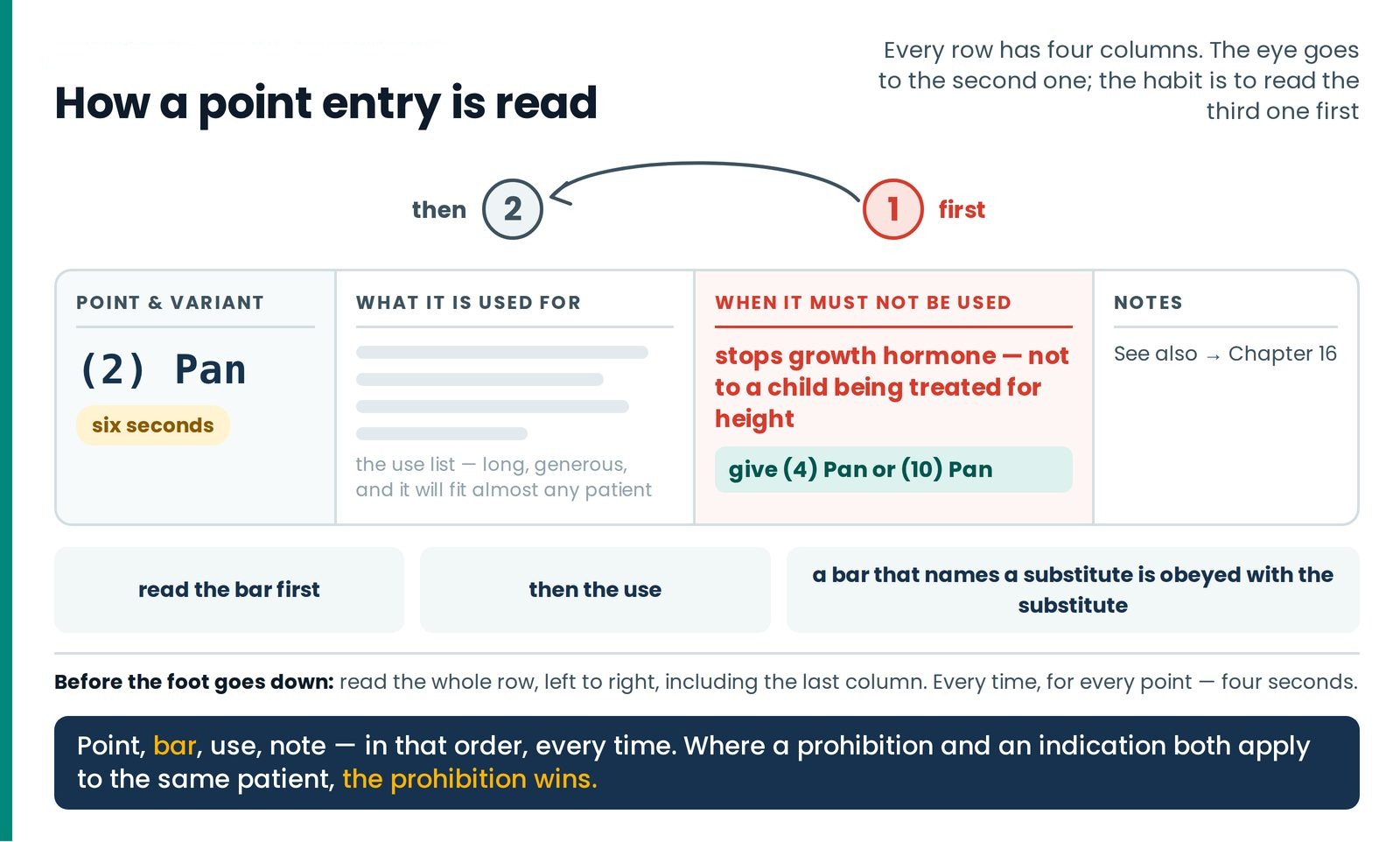
First — the number in the bracket is a selector, not a dose. This is the single most important sentence in the article and it is stated at the head of three separate families. Stimulating in different numbers produces different effects. (2) Adr raises sodium and is refused to a patient with high blood pressure. (4) Adr raises blood sugar and is refused to a diabetic. (6) Adr reduces inflammation and is refused to anybody whose immunity is already low. Those are not three strengths of one treatment. They are three treatments, and a prohibition attached to one of them does not travel to the others.
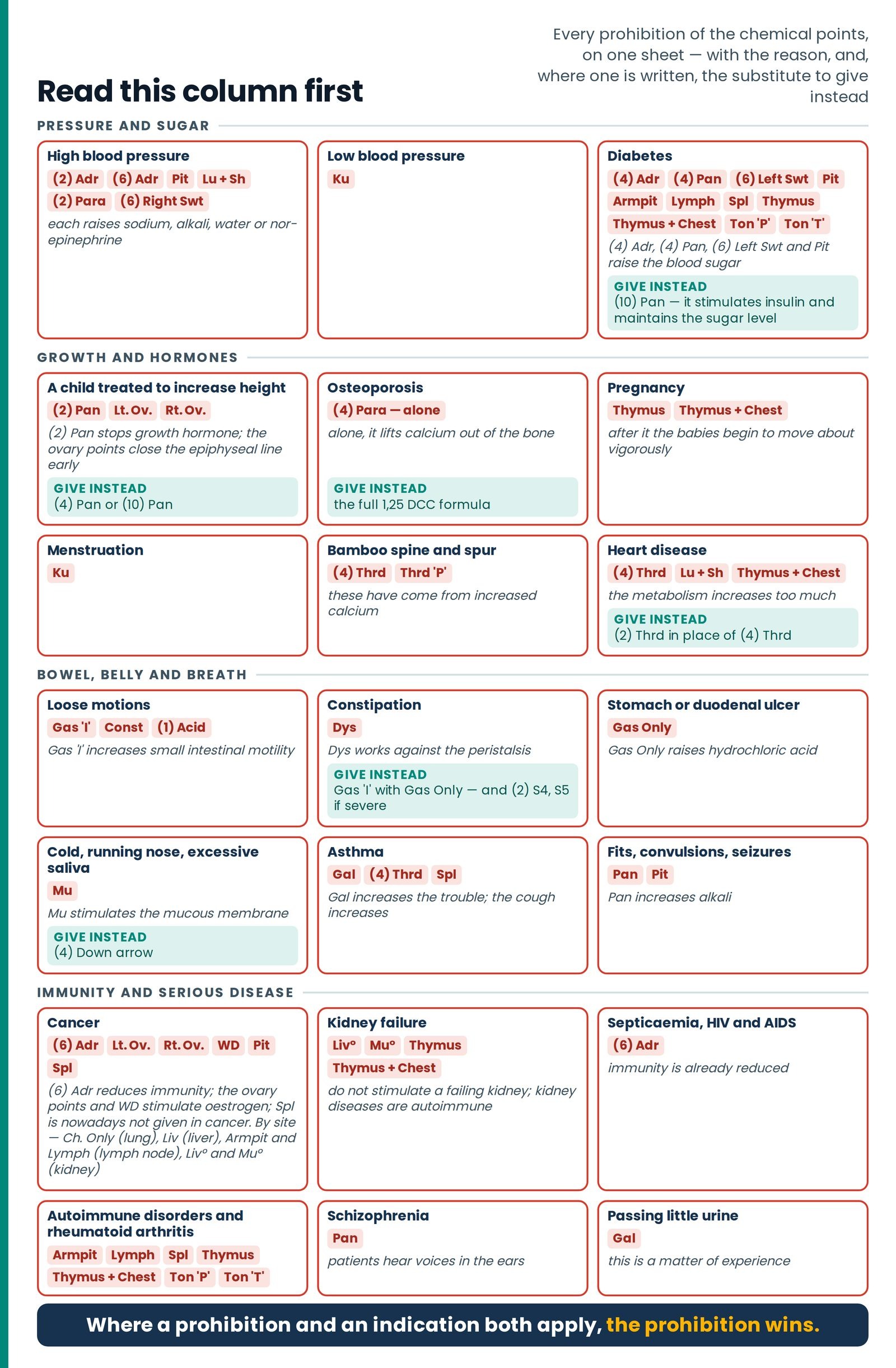
Second — read the right-hand column before the middle one. A therapist who reads the indications first will always find a reason to give a point; the list of uses is long and generous and some of it will fit almost any patient. Read the prohibitions first and you are asking the only question that can harm somebody: is there a reason this person must not have it? The story at the head of this article is that habit, arriving one week late. (Figure 25.2)
Third — a prohibition that names a substitute must be obeyed as written, substitute and all. Only a few entries do this, and they are the most useful lines in the article. Where Mu is forbidden, (4) Down arrow may be given in its place. Where (2) Pan is forbidden in a child being treated for height, (4) Pan or (10) Pan may be given. In heart patients, (2) Thrd is given in place of (4) Thrd. Where Gas Only must be given to a constipated patient, Gas 'I' must be given with it — and if the constipation is severe, (2) S4, S5 as well. A closed door with another door beside it is a rule a therapist can actually keep.
The three kinds of caution, and how each is to be treated
The caution reasoned from what the point does.
This point raises X; therefore withhold it where more X is harmful. (4) Adr raises blood sugar, so not in diabetes. Gas Only raises stomach acid, so not in ulcer. Gas 'I' increases the movement of the small intestine, so not in loose motions. Lu + Sh raises blood pressure, so not in high blood pressure or heart disease. Follow these, and learn the mechanism with them — the reason is the memory hook.
The caution learnt by watching. I saw this go wrong, and I do not know why. Gal in asthma increases the trouble — so it is not given. Gal is not given to those passing little urine, and the line attached to it says plainly: this is a matter of experience. Pan given to a patient with schizophrenia causes them to hear voices in the ears, so it is not given to them. These are the rarest and the most valuable kind, because nobody deduced them; somebody paid for them. Follow them exactly, and keep the same kind of record yourself.
The caution that protects a body still being built. (2) Pan stops growth hormone, so it is not given to a child whose height is less or who is under treatment to increase height. Lt. Ov. and Rt. Ov. are refused to the same child, because oestrogen and progesterone hasten the closure of the epiphyseal line of the long bones and the growth in height will stop before its time. These two are absolute and they are worth saying out loud to a parent, because a parent who understands them will not go looking for the treatment elsewhere.
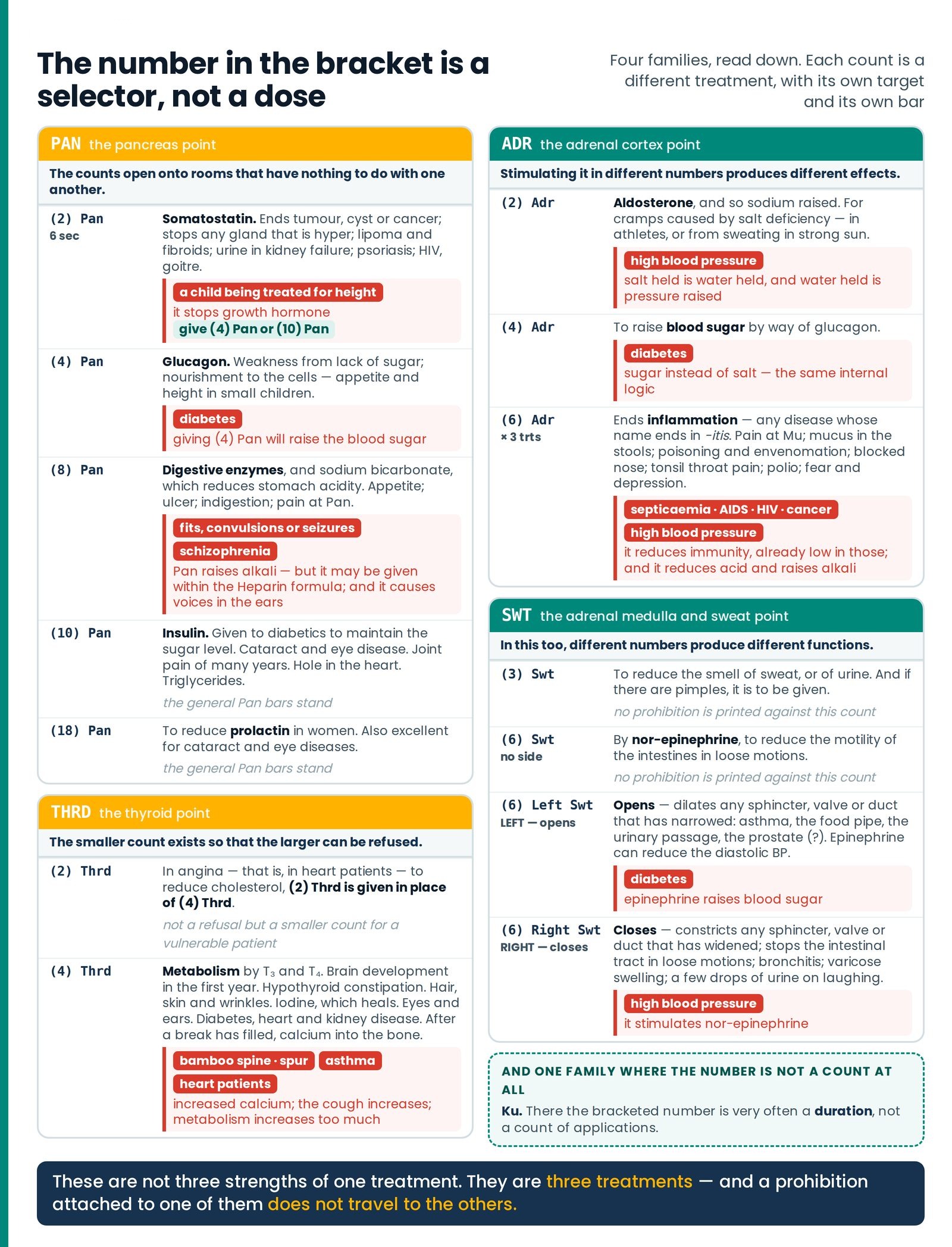
Thirty-two codes, in nine families. Each table gives the point and its variant, what it is used for, when it must not be used, and the notes attached to it — including the article where its method is taught, so that the reference and the atlas stay bound together. (Figure 25.1)
The two adrenal points — cortex and medulla
Adr is aimed at the rind, Swt at the core — and the counts differ
The adrenal gland is two glands in one wrapper. The outer rind makes the slow chemicals — the salt-holding one, the sugar-raising one, the one that puts out inflammation. The inner core makes the fast ones, the two that a fright releases. ADR is aimed at the rind; SWT is aimed at the core. That is the whole of why they behave so differently, and why the counts under each open onto such different rooms.
Table 1 — ADR, the adrenal cortex point
| Point and variant | What it is used for | When it must not be used | Notes |
|---|---|---|---|
| ADR (the family) | Stimulates the adrenal cortex — the upper, outer part of the adrenal gland. Stimulating it in different numbers produces different effects | — | The framing line for everything below it. Method: |
| (2) Adr | To stimulate aldosterone and so raise sodium. For cramps caused by salt deficiency — as occurs in athletes, or from sweating after walking in strong sun | Do not give (2) Adr to high blood pressure patients ▲ Take care | Salt held in the body is water held with it, and water held is pressure raised. The mechanism and the prohibition are one thought |
| (4) Adr | To raise blood sugar by way of glucagon | Do not give (4) Adr to diabetic patients ▲ Take care | The same internal logic, applied to sugar instead of salt |
| (6) Adr | Usually given as (6) Adr × 3 treatments. For pain at the Mu point — relief is immediate. When mucus (आँव) appears in the stools, motions normalise after a few treatments. For poisoning, drug side-effects, snake and scorpion envenomation, and poisonous herbs. Good for opening a blocked nose. For throat pain due to tonsils — immediate relief. For any disease whose name ends in *-itis* — ankylosing spondylitis (bamboo spine), conjunctivitis, appendicitis and so on. To end inflammation in the gall bladder or any other organ. Wherever cortisol medication would be needed, this gives relief. For polio and other inflammatory diseases. For fear and depression — extreme sadness. For knee pain with heat and swelling. In autoimmune disease, to suppress the thymus | It reduces immunity. So do not give in septicaemia, AIDS, HIV or cancer, because immunity is already reduced in these. It reduces acid and raises alkali. Therefore do not give in high blood pressure ▲ Take care × 3 | Two prohibitions, each drawn from a stated mechanism. Note that the count is written with the number of treatments as well as the number of applications |
Poisoning, envenomation and appendicitis are named in that list and each of them is a race. A (6) Adr given while somebody carries a child to a hospital is one thing; a (6) Adr given instead of carrying the child is another.
Table 2 — SWT, the adrenal medulla and sweat point
| Point and variant | What it is used for | When it must not be used | Notes |
|---|---|---|---|
| SWT (the family) | Stimulates the adrenal medulla — the inner part of the adrenal gland — and the sweat glands. In this too it has been seen that stimulating in different numbers produces different functions | — | Method: |
| (3) Swt | To reduce the smell of sweat, or the smell of urine. And if there are pimples, it is to be given | — | The smallest count and the mildest use |
| (6) Swt | By means of nor-epinephrine, to reduce the motility of the intestines in loose motions | — | Given as one point, without a side |
| (6) Left Swt Left | To open — dilate — any sphincter, valve or duct that has become narrowed. For those with difficulty breathing in asthma. It stimulates epinephrine, which can reduce the diastolic blood pressure. Where there is difficulty swallowing from constriction of the food pipe, immediate benefit has been found. Where narrowing of the urinary passage makes urine come with burning and pain in a forceful stream, this gives relief. In men, where prostate enlargement makes urine come in stops and starts, or drop by drop, it may perhaps be beneficial | Epinephrine raises blood sugar, so do not give to diabetic patients ▲ Take care | The opening side. The last claim is printed with its own question mark and is not to be promised to a patient |
| (6) Right Swt Right | Stops the movement of the intestinal tract — so beneficial in loose motions. To constrict any sphincter, valve or duct that has become dilated. For those with difficulty breathing out in bronchitis — immediate benefit is seen. Very effective for the swelling in the legs from varicose veins. Where expansion of the muscles of the urinary bladder makes some women, or elderly people, pass a few drops of urine on laughing or sneezing, it corrects that | It stimulates nor-epinephrine. Therefore do not give to high blood pressure patients ▲ Take care | The closing side |
Read those last two rows across each other and you will see the finest piece of bookkeeping in the whole atlas. One point, split by side, becomes two opposite treatments. The left opens and the right closes. The left is refused to a diabetic; the right is refused to a hypertensive. Nothing else in this therapy is built quite so symmetrically, and a student who can recite the left–right split of Swt has understood what is meant by the count and the side are the treatment.
The organs of digestion
The largest family: every gland draws its raw material from digestion
This is the largest family in the therapy and the reason the belly is worked before anything else. Every gland in the body draws its raw material from what digestion delivers.
The pancreas — PAN
By Pan we stimulate the pancreas. Stimulating in different numbers produces different effects — and here, more than anywhere, the counts open onto rooms that have nothing to do with one another.
Table 3 — PAN, by count
| Point and variant | What it is used for | When it must not be used | Notes |
|---|---|---|---|
| (2) Pan 6 sec | To end tumour, cyst or cancer by means of somatostatin. If any gland or hormone is hyper — that is, working too much — it stops it. To stop unwanted abnormal growth anywhere in the body. For lipoma — lumps of fat — for fibroids, or for stiffness in the muscles. Will also benefit HIV patients. To increase urine in kidney failure, uraemia and nephrotic syndrome. In psoriasis and other skin diseases it stops the skin from becoming hyper, and stimulates the kidney to throw out toxins. And to correct HIV, goitre — swelling of the thyroid gland — and the like | It stops GH, that is growth hormone. Therefore do not give (2) Pan to children whose height is less, or who are taking treatment from us to increase height. They may be given (4) Pan or (10) Pan ▲ Take care | A prohibition that names its mechanism and its substitute — the best-shaped rule in the article. And see the six-second warning below, which belongs to this row |
| (4) Pan | To correct weakness arising from lack of sugar, by means of glucagon. Glucagon will give nourishment to the cells — so it may be given in small children to increase appetite and height. For players who feel fatigue shortly after playing it may perhaps be beneficial — further research is going on | Those who have diabetes: giving (4) Pan will raise the blood sugar. So do not give them (4) Pan ▲ Take care | The hedge on the athletes is the therapy's own and is kept |
| (8) Pan | For the digestive enzymes of the pancreas, and for sodium bicarbonate, which will reduce the acidity of the stomach. To increase appetite. In stomach ulcer. In indigestion. Also to correct pain in the Pan area | Giving Pan increases alkali — therefore do not give in fits, convulsions or seizures. But it may be given within the Heparin formula. Giving Pan to schizophrenia patients causes them to hear voices in the ears. So do not give it to them ▲ Take care | Both prohibitions are written as rules for Pan in general, not for (8) alone — and the exception inside the first is part of it. |
| (10) Pan | Stimulates insulin. Given to diabetic patients to maintain the body's sugar level. Excellent for cataract and eye diseases. For joint pain of many years' standing, relief is immediate — because one function of insulin is to deliver proteins inside the tissues, and joint pains come precisely because proteins do not reach inside the cells. Given to correct hole in the heart (ASD, VSD, PDA). In heart disease or obesity, to reduce triglycerides — chiefly where the diabetes or heart disease arises from hypothyroidism. To end dead skin from tissues, to open old clots, and to protect the skin from bacteria, acting as an antiseptic. To correct cracking of the skin of the hands or the feet. To increase the number of white cells (?). If the mother of a cerebral palsy child had high blood pressure during pregnancy, giving that child (10) Pan will benefit (?). In kidney failure — uraemia, nephrotic syndrome — HIV and goitre, those who do not benefit from (2) Pan benefit from (10) Pan (?). A child who is very hyper may become even more hyper on being given (10) Pan (?) | (no separate box; the general Pan prohibitions above stand) | The question marks belong to the therapy and are kept exactly where they were put. Four of these claims are marked by their own author as not yet settled, and a student is entitled to know which |
| (18) Pan | To reduce the amount of prolactin in women. Also excellent for cataract and eye diseases | (the general Pan prohibitions stand) | The highest count in the family |
The gall bladder, the stomach and the intestines
Table 4 — GAL, GAS ONLY and GAS 'I'
| Point and variant | What it is used for | When it must not be used | Notes |
|---|---|---|---|
| Gal — TF 'Gal', (1) Gal, (3) Gal and so on | Pain in the right front of the chest. To stimulate the upper part of the ascending colon. To stimulate the gall bladder, so that bile is released in adequate quantity as required. To lower cholesterol. To heal a blow or an injury. For wrinkles in the skin — give after checking for pain. For frequent urination. For skin disease with constipation. And wherever there is pus or discharge — in the ear or anywhere on the body | Do not give in leukaemia, blood cancer or other diseases arising from a raised white cell count. In asthma this point increases the trouble — so do not give it. Do not give to those passing little urine. This is a matter of experience ▲ Take care | Three prohibitions of three different kinds. |
| (1) Pt. Gal × 6 treatments | In viral fever, if there is pain at Gal. In all skin diseases — allergy, psoriasis, leucoderma (vitiligo) and so on — and especially where the patient also complains of constipation, where the benefit is great. In the HCl formula, to stimulate the part of the stomach near the pylorus and so produce gastrin | (the Gal prohibitions above stand) | Six treatments, not six applications. |
| (9) Gal | To reduce excessive anger — anger spoils the gall bladder. Especially to settle hyperactivity and restlessness in children | (the Gal prohibitions above stand) | The one entry in the family aimed at temperament |
| Gas Only — TF 'Gas Only', (1) Gas Only – 6 points, (6) Gas Only | This is for the stomach. To reduce pain below Pan and above the navel. To increase hydrochloric acid in the stomach. To digest protein by means of pepsin. To form intrinsic factor, so that vitamin B₁₂ is properly absorbed. In cancer, spasticity, fits, cerebral palsy, rheumatoid arthritis and joint pain, and in the UDF formula. It stops loose motions. Giving Gas Only removes pain in the right ring finger — but give only as much as is needed to remove the pain. For nausea, and to stop vomiting, it is immediately helpful — especially in pregnant women; but if they have back pain, it is better to give the treatment with the hands rather than the feet | Do not give to those who have an ulcer in the stomach or duodenum. For those with constipation, piles or fistula, if Gas Only must be given for some reason, Gas 'I' must be given with it; and if the constipation is severe, (2) S4, S5 may also be given with Gas 'I' ▲ Take care | The ulcer prohibition follows from the point's own mechanism. The second half is not a prohibition but a compensation — the point's own side-effect answered in the same breath. |
| Gas 'I' — TF Gas 'I', (1) Gas 'I' – 6 points and so on | To reduce pain directly above the navel. To stimulate the jejunum and the ileum for secretin and CCK, so that digestion and absorption proceed properly. For constipated patients, to increase small intestinal motility. For children who drool — where Lu + Sh has not helped, Gas 'I' does | (see the (6) Gas 'I' box) | |
| (6) Gas 'I' | Increases blood flow in the arteries of the intestines and the kidneys. Prevents the kidney from producing renin, and so normalises high blood pressure. Enables the enteric neurons of the gastrointestinal tract to produce serotonin and other brain neurotransmitters | Gas 'I' increases small intestinal motility, so do not give it if there are loose motions ▲ Take care | The prohibition governs the whole Gas 'I' family, not this count alone |
| (12) Gas 'I' | Given in Parkinson's disease to produce dopamine. It works like (20) Medulla | (the loose-motions prohibition stands) |
The stomach point and its companion — the clearest compensation rule in the therapy
Gas Only stops loose motions. That is one of the things it is for, and it is also the reason it becomes a problem in the wrong belly.
So the instruction does not simply forbid it to a constipated patient. It says: if Gas Only must be given for some reason to somebody with constipation, piles or fistula, then Gas 'I' must be given with it — because Gas 'I' increases the movement of the small intestine and pulls in the other direction. And if the constipation is severe, (2) S4, S5 may also be given with Gas 'I'.
Three points, running together, each answering the last one's shadow. Learn the shape of this instruction, because you will meet it again in the formulary: a therapy that knows what its own treatments cost writes the payment into the same line.
The liver and the spleen
Table 5 — LIV and SPL
| Point and variant | What it is used for | When it must not be used | Notes |
|---|---|---|---|
| (1) Liv – 3 points / (2) Liv – 3 points | Pain to the right of the navel. To stimulate the liver and the middle part of the ascending colon. To reduce fever and fight infection through the Kupffer cells — excellent for fevers of every kind. To increase appetite and improve fat metabolism. To lower blood cholesterol. To improve circulation and keep blood sugar correct. To clear the scars of burns — from fire or from chemicals — and wounds from a blow. In kidney failure and other chronic diseases, to stimulate erythropoietin so that the red cell count does not fall too low. It may be given in any disease | But if there is cancer in the liver, do not give it ▲ Take care | The widest indication in the atlas and a single hard bar, printed in adjacent lines. |
| (7) Liv | Used in the Heparin, 1,25 DCC and angiotensin #2 formulas | (the liver-cancer bar stands) | |
| (12) Liv | Very beneficial for dissolving gallstones. Perhaps it works something like cholic acid. Also used in the Lactic acid formula | (the liver-cancer bar stands) | The hedge — perhaps — is the therapy's own and is kept. |
| (1) point liver × 6 treatments | Given all day, at one-hour intervals. Beneficial in liver diseases — hepatitis, jaundice, cirrhosis, or fatty infiltration of the liver, fat accumulating in the liver tissue and obstructing its function. In all serious or long-standing diseases — kidney disease, enlarged spleen, enlarged heart. In angina, HIV, AIDS, cancer. In blood clot in the brain. In circulation problems. To increase lung capacity, digestion, weight or immunity. For erythropoietin, for B₁₂ deficiency, and to raise red cells or haemoglobin — especially in pregnant women. Where white cells are raised, where ammonia is raised, where potassium is high or low, or to reduce abnormal protein | (the liver-cancer bar stands) | Six treatments through one day, an hour apart — the count is a timetable, not a number of presses |
| Spl — TF 'Spl', (1) point Spl, (1) Spl, (3) Spl | To stimulate the upper part of the descending colon — for those who have constipation, or pain in the left front part of the chest. To make white cells and antibodies by means of the spleen. To be given in viral fever, septicaemia, HIV and the like. Nowadays also given in inflammation. To be tried on polio patients, to see whether they benefit from it? | In cold, allergy, asthma and the like this does harm — so do not give it to asthma patients. Nowadays it is not given in cancer. It is not given in diabetes or in other autoimmune disorders ▲ Take care | But one myasthenia gravis patient obtained much relief from Spl after a single treatment. One patient, recorded as one patient — and the word nowadays, twice, marking a rule that changed |
Notice the word nowadays. It appears twice in the Spl box — nowadays it is also given in inflammation, nowadays it is not given in cancer — and it is doing something a therapist should respect. It marks a rule that was different before and was changed on evidence. A teaching that prints its own revisions rather than quietly rewriting them is telling you that the atlas is a living record, and that your own careful observations have somewhere to go.
The bowel points — MU, CONST, DYS
Table 6 — The three bowel points, and the substitution written for one of them
| Point and variant | What it is used for | When it must not be used | Notes |
|---|---|---|---|
| Mu — म्यूकस, mucus | For pain just to the left of the navel. To stimulate the middle part of the descending colon. Good for constipation, and for a blocked nose | It stimulates the mucous membrane from the mouth to the anus. So do not give to those who have a cold, or whose nose is running, or from whose mouth excessive saliva is coming. In its place, (4) Down arrow may be given ▲ Take care | The only chemical point whose prohibition names a substitute. Method: |
| (1) Const / (4) Const | In hard constipation there is pain in the region above and to the left of the navel. This treatment removes that pain, and also relieves the constipation that occurs in hypothyroidism, in bamboo spine (ankylosing spondylitis), in Parkinson's disease and in paralysis | Do not give to those who have loose motions ▲ Take care | The palpation finding comes before the treatment: the tenderness above and left of the navel is what selects the point |
| Dys | Loose motions — but give this only if there is pain in the upper part to the right of the navel; otherwise not. It may be given for a day or two to correct loose motions | Do not give to those who have constipation. And the standing warning: its use must be undertaken only with great thought — because it works against the natural motion, the peristalsis, of the intestines ▲ Take care | Three brakes on one point: a palpation gate, a time limit of a day or two, and a warning about the mechanism itself |
Dys — the most self-restrained point in the therapy
Read the three brakes again, because between them they are a small course in how to hold a powerful treatment.
The gate. Give this only if there is pain in the upper part to the right of the navel; otherwise not. Not if the patient has loose motions — the complaint is not enough. There must be a finding under your fingers.
The ceiling. It may be given for a day or two. A day or two is not a suggestion about how long it takes to work. It is the outer limit.
The reason. Its use must be undertaken only with great thought — because it works against the natural motion of the intestines. Loose motions are partly the body emptying something it wants out. A treatment that slows the bowel is holding that something in. The therapy says this about its own point, in its own voice, and asks you to think before you use it. ▲ Take care
And there is a reason that warning is not squeamishness. The gut carries its own nervous system — a complete network of nerve cells in the wall of the intestine, enough of them to run the whole organ on their own; cut every connection to the brain and an intestine still senses what is inside it, still decides, and still moves it along in orderly waves. Which means a bowel that has speeded up has usually decided to speed up, and something is in it that its own wiring wants gone. It works against the natural motion of the intestines is respect for a second brain that knows more about the situation than the therapist does.
The two kidneys and the two directions
Liv° reduces alkali, Mu° reduces acid — learn the two as a pair
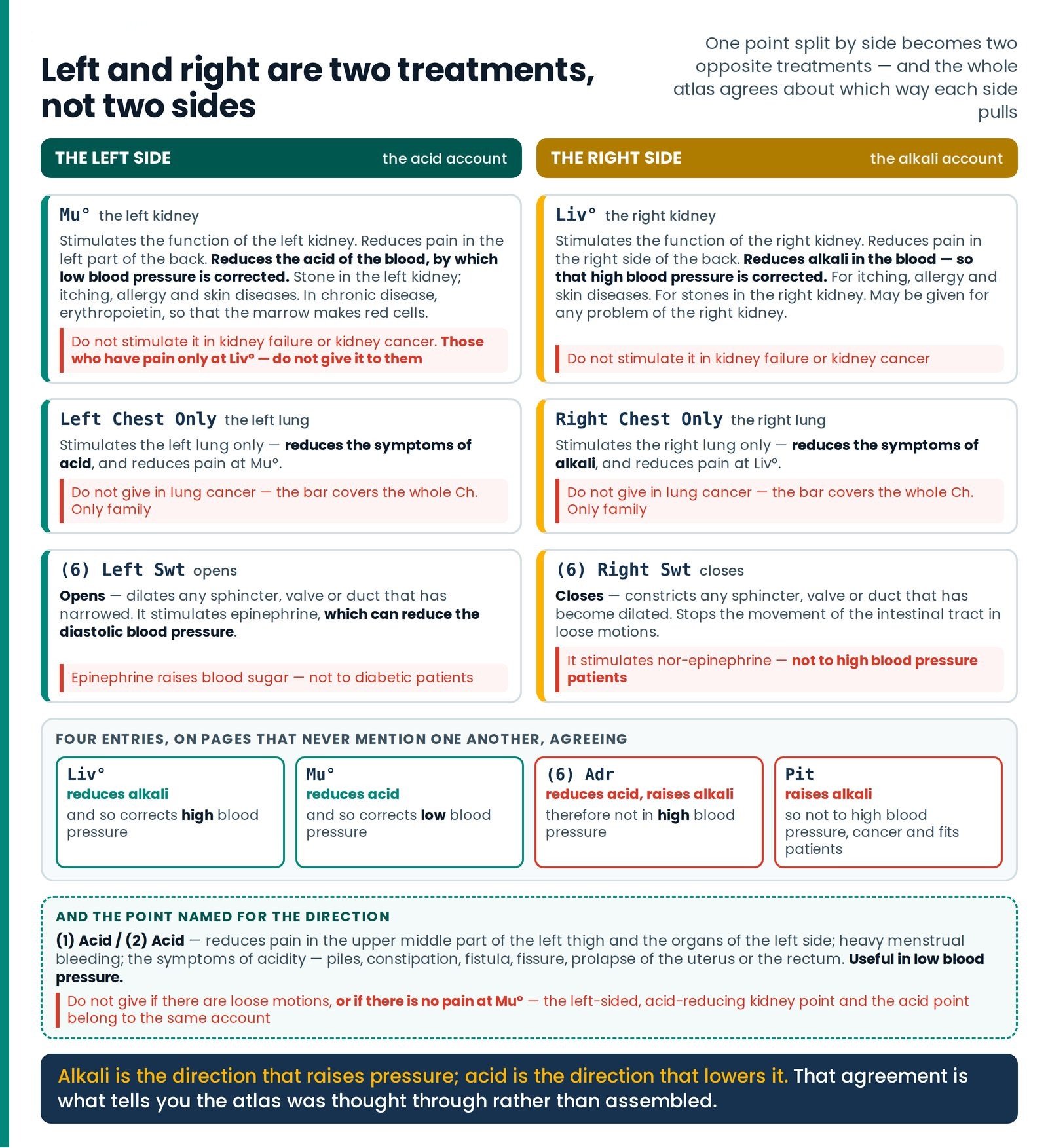
Everything in this therapy that has a left and a right has a reason for it, and nowhere is the reason plainer than here. The left kidney point pulls the body's chemistry one way; the right kidney point pulls it the other. Learn them as a pair or you will learn neither. (Figure 25.3)
Table 7 — LIV°, MU° and ACID
| Point and variant | What it is used for | When it must not be used | Notes |
|---|---|---|---|
| Liv° — the right kidney Right — (1) Liv°, (3) Liv°, (5) Liv°, (7) Liv° | Stimulates the function of the right kidney. Reduces pain in the right side of the back. Reduces alkali in the blood — so that high blood pressure is corrected. For itching, allergy and skin diseases. In intellectually disabled children with pneumonia, and in children with a forehead smaller than normal, it is given within the Kidney Clear formula. For stones in the right kidney. Used in the Alkali formula and the 1,25 DCC formula. May be given for any problem of the right kidney | But do not stimulate it in kidney failure or in kidney cancer ▲ Take care | The verb is stimulate, and it is chosen: this is not merely withholding a treatment but refusing to drive a failing organ harder. |
| Mu° — the left kidney Left — (1) Mu°, (3) Mu°, (5) Mu°, (7) Mu° | Stimulates the function of the left kidney. Reduces pain in the left part of the back. Reduces the acid of the blood, by which low blood pressure is corrected. For stone in the left kidney, itching, allergy and skin diseases. In intellectually disabled children with pneumonia, and in children with a forehead smaller than normal, it is given within the Kidney Clear formula. In chronic diseases it is given to make erythropoietin, which will stimulate the bone marrow to make red blood cells. Used in the Acid formula, the Angiotensin #2 formula and the 1,25 DCC formula | Give for all problems of the left kidney. But do not stimulate it in kidney failure or in kidney cancer. Those who have pain only at Liv° — do not give it to them ▲ Take care | The second bar is a laterality gate: if the finding is on the right, the left is not treated. |
| (1) Acid / (2) Acid Side-lying | Reduces pain in the upper middle part of the left thigh. Relieves pain of the organs of the left side of the body. Reduces heavy menstrual bleeding. For the symptoms of acidity — piles, constipation, fistula, fissure, and prolapse of the uterus or of the rectum from its place. Useful in low blood pressure | Do not give if there are loose motions, or if there is no pain at Mu° ▲ Take care | The second half of the bar is a diagnostic rule as much as a prohibition. Method: |
Set four separate entries beside one another and watch them line up.
The direction the whole system agrees on
Liv° reduces alkali — and so corrects high blood pressure.
Mu° reduces acid — and so corrects low blood pressure.
(6) Adr reduces acid and raises alkali — therefore do not give in high blood pressure.
Pit raises alkali — so do not give to high blood pressure, cancer and fits patients.
All four agree, on pages that never mention one another: alkali is the direction that raises pressure; acid is the direction that lowers it. That agreement is what tells you the atlas was thought through rather than assembled. And it is why Acid is useful in low blood pressure and (1) Acid is refused to a patient with no pain at Mu° — the left-sided, acid-reducing kidney point and the acid point belong to the same account.
The chest and the breath
Both wings of the lungs, one side at a time, and one bar over all
Table 8 — CH. ONLY and LU + SH
| Point and variant | What it is used for | When it must not be used | Notes | |
|---|---|---|---|---|
| Ch. Only (the family) | Stimulates both wings of the lungs | Do not give in lung cancer ▲ Take care | One bar covering the whole family. | |
| (2) Ch. Only / (4) Ch. Only | Stimulates the lungs to expel carbon dioxide completely through the breath | (the lung-cancer bar stands) | The therapy's most directly respiratory claim | |
| (8) Ch. Only | Used in the Oxygen, 1,25 DCC and Heparin formulas. Given together with Round arrow (↑\ | ↓), the two combine to maintain the body's acid–alkali balance | (the lung-cancer bar stands) | A pairing instruction, not merely a use. |
| Left Chest Only Left | Stimulates the left lung only — reduces the symptoms of acid, and reduces pain at Mu° | (the lung-cancer bar stands) | Left is paired with acid throughout the atlas | |
| Right Chest Only Right | Stimulates the right lung only — reduces the symptoms of alkali, and reduces pain at Liv° | (the lung-cancer bar stands) | Right is paired with alkali throughout the atlas | |
| (6) Lu + Sh | When we press on the shoulder with this treatment, the muscles of the chest open, by which the capacity of the lungs increases. This treatment is taught to the mothers of children who drool saliva from the mouth all day — it reduces that. It also reduces acidity, and watering of the eyes. Also for hiccups, and for hiatus hernia of the upper part of the stomach. When suddenly a great deal of blood is lost from the body, it is used in the Angiotensin #2 formula to raise the blood pressure | This raises blood pressure — so do not give in high blood pressure, and not in heart disease ▲ Take care | The prohibition follows straight from the stated action. |
Two things in the Lu + Sh row deserve saying out loud. The first is that this is one of the treatments taught to the mothers — a point given daily at home, by a parent, to a child who drools. Much of what this therapy achieves in children it achieves because somebody was taught to give it on a kitchen floor between meals.
The glands of the throat and the head
Four glands, and more mutual traffic than anywhere else in the atlas
Four points, four glands, and more mutual traffic than anywhere else in the atlas — one is given with another, one is given after another, one is given instead of another.
Table 9 — THRD, THRD 'P', PIT and PARA
| Point and variant | What it is used for | When it must not be used | Notes |
|---|---|---|---|
| (2) Thrd | In angina — that is, in heart patients — to reduce cholesterol, (2) Thrd is given in place of (4) Thrd | (governed by the (4) Thrd boxes below) | Not a refusal but a smaller count for a vulnerable patient. The substitution is the instruction. |
| (4) Thrd | To increase metabolism by means of the T₃ and T₄ hormones of the thyroid, and to raise the temperature of the body. In intellectually disabled children, for the development of the brain — because for one year after birth it is the thyroid gland that brings about the brain's development. For constipation due to hypothyroidism, and for falling asleep while sitting during the day. Oestrogen, progesterone, the gall bladder and the thyroid gland together take care of the skin — so for dandruff, scaling, lice, or hair falling at a young age; for roughness of the skin, or wrinkles. It will release iodine, which helps wounds, mouth ulcers and skin disease heal quickly. For cough, cold and catarrh, or throat problems; and for all problems of the eyes or the ears. Extremely good for diabetes, heart disease and kidney disease, because these diseases come from hypothyroidism. When a bone has broken, then after the wound has filled, giving (4) Thrd will fill calcium into the bone by means of calcitonin, making the bone strong | So do not give in bamboo spine, or spur and the like, because these diseases have come from increased calcium. In asthma the cough increases, so do not give. When the metabolism increases too much there can also be trouble — therefore do not give (4) Thrd to heart patients ▲ Take care | Three bars. Note the timing inside the bone indication: after the wound has filled, not before |
| (4) Thrd 'P' | Given to stimulate the anterior pituitary so that it will make its hormones — mainly growth hormone. If we give (4) Thrd 'P' + (4) Thrd, then by TSHRH the thyroid gland is stimulated to make iodine, and for the functions of the T₃ and T₄ hormones. If after (4) Thrd 'P' we give (6) Rt. Ov. or (6) Lt. Ov. as required, then by FSH and LH we can correct absence of menses or other disorders of the menses. Through stimulating growth hormone, children with a smaller head will also benefit. And by means of calcitonin, through the osteoblasts, to increase calcium in the bones, and for the repair of ligaments | Therefore, in a disease in which the osteoblasts are hyper — such as bamboo spine, or spur, or where bone has grown unwanted anywhere — do not give ▲ Take care | Two paired instructions live in this row: Thrd 'P' plus Thrd, and Thrd 'P' followed by an ovary point. |
| (1) Pit / (4) Pit | Given when we wish to stimulate the pituitary gland to make many hormones. Corrects weakness arising from lack of sugar. Good for players who feel fatigue after a few hours. To increase appetite and height. Given to fill water anywhere in the eye, the ear or the brain; and for absence of moisture in the eyes — what is called dry eyes. For the dizziness of vertigo — those who become giddy travelling in tall buildings, in buses or in aeroplanes get relief. Afterwards, giving (4) Up arrow gives complete benefit | Do not give to diabetic patients, because it raises sugar. It raises alkali — so do not give to high blood pressure, cancer and fits patients. Perhaps low blood pressure patients will benefit | The closing hedge is the therapy's own. The follow-on — Pit, then (4) Up arrow — is part of the instruction. |
| (2) Para | To stimulate the posterior pituitary to make vasopressin, which will stop water going out through the urine. By this, long-standing low blood pressure rises and becomes normal. Given in diabetes insipidus, because in it there is a deficiency of vasopressin | But do not give to high blood pressure patients ▲ Take care | Mechanism and prohibition in one thought |
| (4) Para | When given within the 1,25 DCC formula, to maintain the amount of calcium in the blood by means of the PTH hormone of the parathyroid gland. For those who get cramps from calcium deficiency, and for women with excessive flow during menstruation. When (4) Para is given separately by itself, it will lift calcium from the bone and put it into the blood — so it is given when bone has grown at some unwanted place anywhere in the body. Also usable in heart disease, to open unwanted clots, especially where the blood calcium is also low. Given to breastfeeding women, it stimulates the posterior pituitary to make oxytocin, so that if milk has recently stopped, milk will begin to come again | Those who have osteoporosis: do not give only (4) Para separately. They must be given the full 1,25 DCC formula ▲ Take care | The most carefully cut prohibition in the atlas. It does not forbid the point. It forbids the point alone, and requires the formula. |
What (4) Para alone does, and why the bar is cut where it is cut
Read the two halves of that row together and the rule assembles itself.
Inside the 1,25 DCC formula, (4) Para maintains the calcium in the blood — the parathyroid hormone working with the other points of that formula.
Given separately, by itself, it does something else: it lifts calcium out of the bone and puts it into the blood. That is precisely why it is the point used where bone has grown at some unwanted place.
So for a patient whose bones are already thin, the bar is not never give (4) Para. It is never give (4) Para alone; give the whole formula. The prohibition is aimed at the word separately, and a therapist who reads only the point code and not the word beside it will get this wrong in exactly the patient who can least afford it. ▲ Take care
The points of immunity
Six points, and the longest list of people who must not have them
Six points, and between them the therapy's whole account of resistance to disease. They are also the family with the longest list of people who must not have them, so read the right-hand column first. (Figure 25.4)
Table 10 — THYMUS, THYMUS + CHEST, ARMPIT, LYMPH, TON 'P' and TON 'T'
| Point and variant | What it is used for | When it must not be used | Notes |
|---|---|---|---|
| (4) Thymus / (8) Thymus | Given to increase the body's disease-resisting power by stimulating the various lymphocytes of the thymus gland. For Bell's palsy — paralysis of the face — for herpes zoster (shingles, नागिन), for septicaemia, for HIV, for viral fever, and for diseases caused by bacteria. If the adrenal is hyper — as when a person goes into coma from an injection of adrenaline — this can be given to correct it | (the prohibitions are printed jointly with Thymus + Chest and apply here in full) | |
| Thymus + Chest — (2), (4), (8) Th + Ch and so on | It is a painkiller — on being struck, or on a sprain, it ends the sensation of pain. It stimulates the filling of minerals into bones and tissues, so that wounds fill up quickly. It also erases old wounds inside the tissues, and the marks of burns from fire or from electricity. Give if the prostate gland is enlarged. Or for fibroid or cyst in the uterus. Useful to dry up excess water anywhere in the body — such as water or pus continually coming from the ear or the eyes. Used to dry up haemorrhage or haematoma inside the brain. For hearing the sound of bells in the ears without cause. In Ménière's disease, where dizziness comes even on turning over in bed: first give (8) Thymus + Chest, and afterwards give (4) Down arrow | Thymus and Thymus + Chest are not to be given to the following kinds of patients. To pregnant women — after giving this, the babies begin to move about vigorously, from which it may be judged that the baby must be experiencing discomfort; so they are not given during pregnancy. In polio or inflammatory diseases, and in heart disease and diabetes, in rheumatoid arthritis and autoimmune disorder — do not give. Also do not give in kidney diseases, because almost all kidney diseases are autoimmune disorders ▲ Take care | In this, the armpits must also be given, without fail. And the Ménière's instruction is an order of two points, not one. |
| (12) Armpits | The armpit contains many lymph nodes; this treatment opens the small blockages within them and so stimulates the function of the lymph nodes. For bacterial or viral illness, and for tonsils, sore throat and pain on swallowing. Also useful in children for earache, and for mild cold and cough | Do not give in lymph node cancer, in polio, in diabetes, or in any autoimmune disorder ▲ Take care | When giving Th + Ch, the armpits must also be given. |
| (1) Lymph / (5) Lymph | Near the waist, in the upper part of the thighs, there are many lymph nodes. By this treatment the small blockages inside them open, and in this way the lymph nodes are stimulated. Given in viral fever, cancer, HIV and the like, to end the infection of virus or bacteria. It raises the disease-resisting power by way of the lymph nodes' B cells, or gamma globulin and other lymphocytes | If there is cancer in the lymph node, do not give ▲ Take care | The same node-cancer bar as Armpit, printed again for the groin. |
| Ton 'P' | It stimulates the parotid glands beside the cheeks, which will fight any virus or bacteria in the mouth or throat — that is, give it if there is infection. Besides this, in prolapse of the uterus — if the uterus moves from its place — this treatment is unmatched for setting it back in its place | But from this there may perhaps be some adverse effect on conception. Therefore do not give it to women who want children. It is also not proven that it prevents conception — therefore do not call it a contraceptive treatment. Research is to be done. Do not give in diabetes, in rheumatoid arthritis and autoimmune disorder. Also do not give in inflammation ▲ Take care | Counts of 12, 6 and 3. |
| Ton 'T' | Given for tonsil infection. Also beneficial for trouble in the throat, or soreness of the throat | Do not give in diabetes, in rheumatoid arthritis and autoimmune disorder, and not in inflammation either ▲ Take care | Ton 'T' is followed immediately by Sangam points. |
Two instructions in this atlas are written as pairs, and a therapist who gives the first without the second has not given a smaller treatment — he has given an incomplete one.
P point → (6) WD, immediately. With this treatment we give in order to loosen her uterine muscles further. And immediately after giving this treatment, giving (6) WD is necessary; otherwise that woman will have still more trouble.
Two points that must never be separated from what follows them
Ton 'T' → Sangam points, immediately.
Write them on the card as a single line, with no room between them for a telephone call or a change of mind.

The points of generation
Two ovary points and WD — and the bar that protects a child's growing
Table 11 — LT. OV., RT. OV. and WD
| Point and variant | What it is used for | When it must not be used | Notes |
|---|---|---|---|
| Lt. Ov. Left — TF 'Lt. Ov.', (1) Lt. Ov., (6) Lt. Ov. and so on | Pain in the left lower abdomen, below the navel. For all problems of the left testis or the left ovary. For left-sided hernia; itching or skin disease of the left testis; left-sided hydrocele — swelling of the scrotum; cyst or fibroid in the left ovary. To stimulate oestrogen — in women, to increase the size of the breasts or the waist, and to make the skin soft and supple. In diabetes and other autoimmune disorders, to make the thymus hypo; and it will also correct infertility caused by autoimmune antibodies | Do not give in cancer, because cancer arises from excess oestrogen. Do not give to children who are being treated to increase their height — because oestrogen and progesterone hasten the closure of the epiphyseal line of the long bones, so that the child's growth in height will stop before its time ▲ Take care | |
| Rt. Ov. Right — (1) Rt. Ov., (6) Rt. Ov. | For pain of the right part below the navel. For all problems of the right testis or ovary. For pain of a right-sided hernia, or of the appendix. For itching in the right testis, skin disease, or hydrocele. For cyst or fibroid in the right ovary, to increase the blood supply there. To raise potassium and reduce sodium — high blood pressure will also come down. To stimulate progesterone — if the menses do not come, to bring them. If, because of retention of urine, swelling has remained in the body for 24 hours, this is excellent for reducing the swelling and bringing on urine | Rt. Ov. also makes 20% oestrogen. So do not give in cancer. Do not give to children who are being treated to increase height, because oestrogen and progesterone stimulate the epiphyseal line of the long bones to join early, so that the increase in height will stop before its time ▲ Take care | The growth bar is printed again, in the same words, on the other ovary point. It was not an accident of one page |
| WD — (1) WD, (3) WD, (6) WD and so on | Given to increase the flow of blood in the uterus in women, and in the prostate gland or genitals in men. Also beneficial for pain or numbness in the lower part of the back, or in the legs. To be given in prolapse of the uterus, in control over urine, in pain in the menses or other kinds of disorder, in infertility and the like. For genetic diseases such as Down syndrome, or club foot, it is given within the New Genes formula. (3) ONS + WD — extremely good for setting the navel | This stimulates the genital organs, so perhaps it will also stimulate oestrogen. Therefore do not give in cancer ▲ Take care | The hedge is inside the prohibition — perhaps — and the bar is drawn anyway, in the restrictive direction. (6) WD is what follows P point immediately. |
The hip pair — the vitamin points
B₁₂ on the left, folic acid on the right, and no prohibition printed
Two points, one on each hip, and between them the therapy's account of the two deficiencies that imitate a dozen diseases. They are also the only entries in the chemical half with no prohibition printed against them — which is a fact worth noticing rather than a licence.
Table 12 — LT. PARKHOO and RT. PARKHOO
| Point and variant | What it is used for | When it must not be used | Notes |
|---|---|---|---|
| Lt. Parkhoo Left Side-lying — (2) Lt Parkhoo, (8) Lt Parkhoo and so on | Given to those who have pain at the point in front of or behind the pelvic bone of the left thigh. To remove deficiency of vitamin B₁₂ and niacin — such as feeling fatigue; blackness between the joints of the fingers; numbness of the feet on sitting for a long time; anaemia; mouth ulcers; weaknesses of the nerves; weakness of the ear or the eye; fluttering of the eye. In paralysis, where the patient cannot lift the leg or feels weakness. Extremely useful in diseases of genetic disorder, and in diseases of metabolism | No prohibition is printed for this point | Given lying on the right side, working the left hip |
| (8) Rt Parkhoo Right Side-lying | Given in the following diseases for the production and absorption of folic acid: spina bifida; motor neuron disorder; muscular dystrophy; paralysis, and so on. For children who have a hole in the heart from birth — ASD, VSD, PDA and so on — it is used within the folic acid formula to correct it. Extremely useful in diseases of genetic disorder, and in diseases of metabolism | No prohibition is printed | Given lying on the left side, working the right hip |
An empty right-hand column is not the same as a safe point. It means the therapy names no condition in which this point is harmful — and it names none because this point gives, rather than drives. But the standing rules still hold: a patient who cannot be placed on her side is not placed on her side; a hip that has been fractured or replaced is not loaded; and a numb leg cannot report what your foot is doing to it.
KU — the one point whose counts are seconds
Here the number in the bracket is a duration, not a count of presses
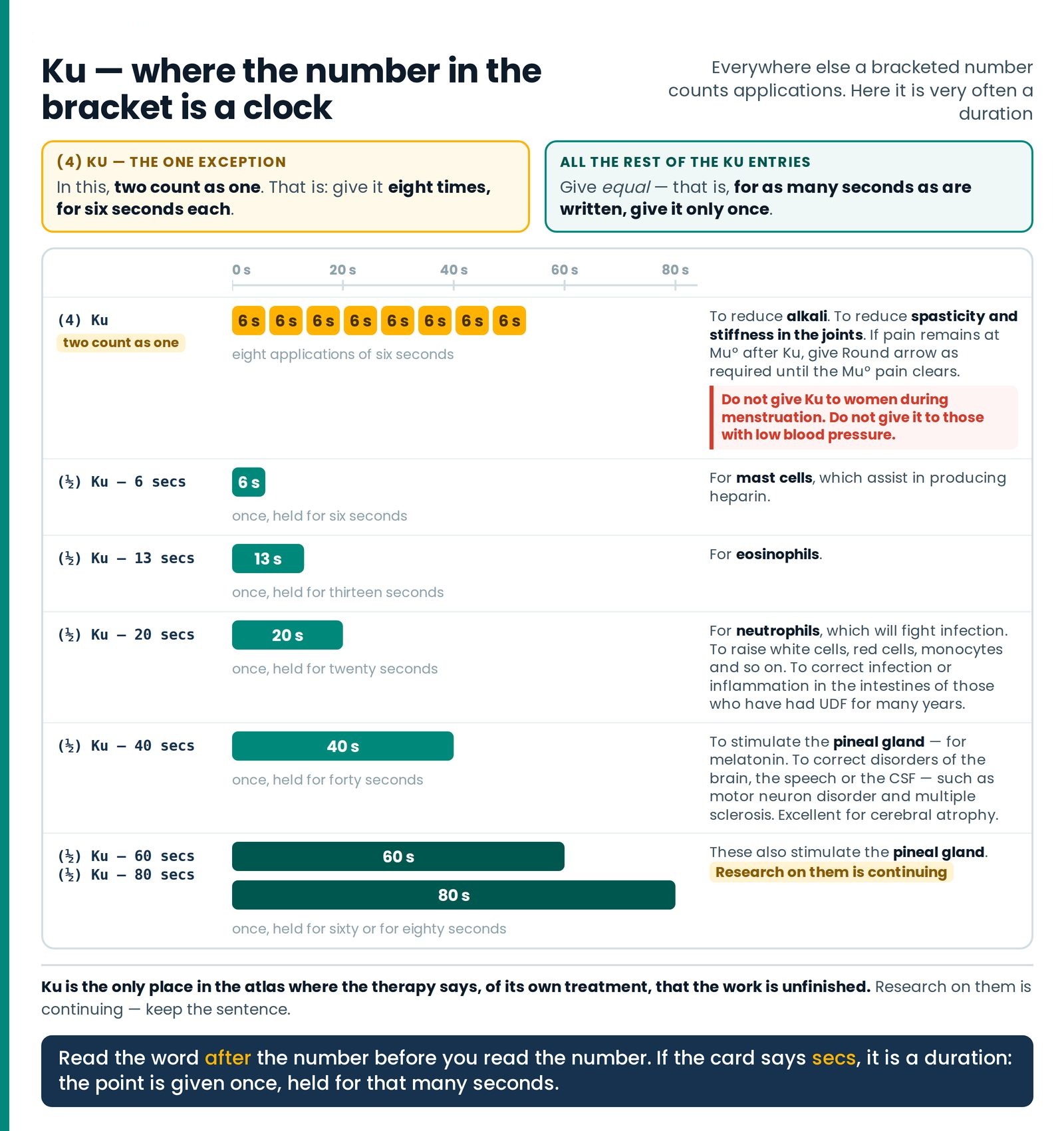
Ku is unlike anything else in the chemical half. Everywhere else a bracketed number counts applications. Here the number is very often a duration, and the entry states its arithmetic before it states a single use. (Figure 25.5)
How Ku is counted {{6s}}
(4) Ku — in this, two count as one. That is: give it eight times, for six seconds each.
For all the rest of the Ku entries, give *equal* — that is, for as many seconds as are written, give it only once.
So (½) Ku – 20 secs is one application, held for twenty seconds. Not twenty presses, not twenty of anything. Read the word secs on the card and the whole meaning of the number changes.
Ku is the only place in the atlas where the therapy says, of its own treatment, that the work is unfinished — research on these is continuing. Keep the sentence. A student who knows which parts of a system are settled and which are still being explored can use both honestly; a student who is told everything with the same confidence cannot use either.
The line that closes the chemical half
Correct the point at which there is pain — and keep every bar above
The chemical points end not with a summary but with a single sentence, set large across the foot of the page. (Figure 25.6)
The sentence the whole of the chemical half was written to support
Remember — whatever the disease may be, giving the appropriate chemical point to correct the LMNT point at which there is pain will of itself bring relief in the disease.
Read it as an instruction and it is the discipline that runs through every entry above: treat what you can find under your hands, not what you have been told the diagnosis is. That is why almost every row in the tables above begins with a pain — pain to the right of the navel, pain just to the left of the navel, pain at the point in front of the pelvic bone — and not with a disease name.
And the same pages that print it have already told you where it stops: the points withheld in cancer, in kidney failure, in pregnancy, in menstruation, from a growing child; the claims marked with their own question marks; the treatment refused the name of contraceptive until the research is done. Take the sentence as permission to stop asking what is wrong and you have contradicted eighteen pages of the same teaching.
The second half of the atlas is named differently and reads differently. These treatments are called after a place on the body, a movement of the hand, or the person in whom the treatment was first worked out — Back arrow, L5–S1 ghisai, Giriraj, Pradip, Shivaji, Sudhakar, Vasanti. Their entries do not talk about hormones. They talk about tissue that has come down and must be pulled back up, a tendon caught inside a band, a joint that has stiffened, a vertebra out of its place.
That changes what a prohibition means here. A chemical point is withheld because the body is already making too much of something. A physical point is withheld because of what the hand or the foot would be doing to a bone, a belly, a chest or a joint — and so the bars in this half are shorter, harder and more local: not if there is a fracture between L1 and S1; not if there is inflammation in the abdomen; not to heart patients, because pressure falls upon the chest; not to those who pass too much urine.