- Part of
- Reproductive system
Watch


The back pain chart
Twelve sites where the back reports an internal organ’s trouble
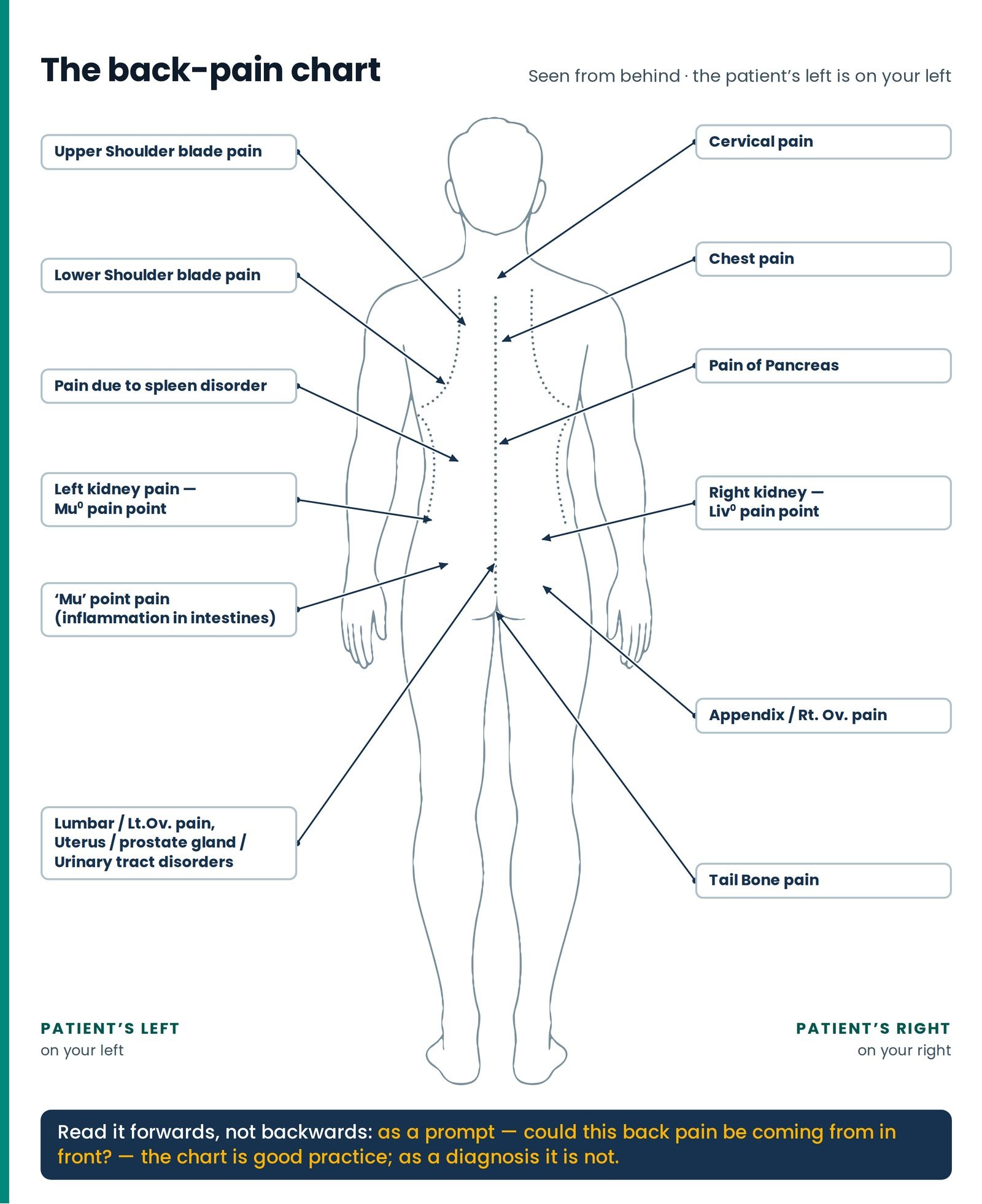
The second full-page chart is a whole-body outline seen from behind, head to heels, the spine a dotted line down the middle, the shoulder blades and lower rib margins dotted curves either side. Twelve labelled call-outs run around it, and together they make a compact statement of something the body does constantly and confusingly: it reports the trouble of an internal organ as an ache in the back wall. (Figure 6.2)
One drafting point must not catch you. The drawing is a view from behind, so the patient's left is on the reader's right — but the twelve call-out boxes have been placed for the sake of the page, the left-sided labels sitting on the reader's left and the right-sided ones on his right, the arrangement that would be correct facing the patient's front. A student who learns the chart as a picture will reverse every side on it the first time he stands behind a patient. Locate these points by anatomy, never by the side of the page: spleen and Mu° on the patient's left; liver, Liv° and appendix on the patient's right. Left Right
Table 4 — The back pain chart, label by label
| Label on the chart | Where the arrow lands | What lies at that level |
|---|---|---|
| Cervical pain | Nape, base of the neck, midline | The seven neck bones and the long muscles either side |
| Upper Shoulder blade pain | Upper scapular region, inside the shoulder blade | Upper trapezius, the muscle that lifts the shoulder blade, the small rhomboid, over ribs two to four |
| Lower Shoulder blade pain | At the bottom corner of the shoulder blade | Large rhomboid, lower trapezius, ribs six to eight; the base of the lung deep to it |
| Chest pain | Upper back, beside the spine | The first six thoracic beads, the long back muscles, and the joints where each rib meets the spine |
| Pain due to spleen disorder | Lower thoracic, below the shoulder blade | Ribs nine to eleven and the fascia of the low back; deep to them, spleen left, liver right |
| Pain of Pancreas | Mid-thoracic beside the spine | Long back muscles, ribs ten to twelve; the pancreas lies at the front of this level |
| Left kidney pain — Mu° pain point | The flank, between the twelfth rib and the rim of the hip bone Left | The square muscle of the low back, the hip flexor, the fat around the kidney, and the kidney |
| Right kidney — Liv° pain point | The mirror-image flank Right | The same, the right kidney about half a bone lower because of the liver above it |
| Mu point pain — inflammation in intestines | Lower lumbar, out from the spine | Long back muscles and fascia; deep and in front, the descending colon and small-bowel loops |
| Lumbar / Lt.Ov pain — uterus, prostate gland, urinary tract disorders | Lower lumbar and upper sacral region | The junction of low back and sacrum, the joints between sacrum and hip bones; deep in front, the tubes from the kidneys, the bladder, the uterus or prostate |
| Appendix / Rt.Ov pain | Lower lumbar to the sacro-iliac joint, opposite side | That joint and the bony knob behind it; deep in front, the caecum and appendix, or the pocket in which the ovary sits |
| Tail Bone pain | Coccyx, top of the cleft of the buttocks | The tail bone and its joint with the sacrum; the muscles of the pelvic floor taking their attachment there |
The chart is intelligent about a real thing. A pancreas in trouble really does bore through to the mid-back and ease when the patient leans forward; a kidney in trouble really is felt in the loin between last rib and hip rim, running towards the groin as a stone travels; trouble in the womb or prostate really is felt low in the back and over the sacrum. But read it forwards, not backwards. Most back pain at every one of these levels is muscle and posture, and an ache between the shoulder blades is far more often a woman who sews for nine hours than a pancreas. As a prompt — could this mid-back pain be coming from in front? — the chart is good practice; as a diagnosis it is not.
Also explained in
- The uses of the New Genes formula, and its three variants Vitamin and Gene Formulas
White water passing in women · club foot · diseases of the prostate gland · all problems of the uterus · cerebral palsy · Down syndrome, that is mongol children · diseases connected with the genes · pain in the lower par
- The front chart, complete The Navel Speaks First
(Figure 6.8) Table 1 — The pain points of the front chart Code Full name — organ or symptom Where it lies, by feel Pan Pancreas The pit of the stomach — the soft dip at the bottom of the breastbone, where the two rib mar
- WD — the white discharge point The Navel Speaks First
The code covers the corresponding organ in either sex: uterus and prostate gland.
- Two bodies, read from the navel The Navel Speaks First
Sixteen code names on the front chart: Pan pancreas · Gal gall bladder · Spl spleen · Liv liver · Mu mucus, the membrane of the entire digestive tract · Gas stomach and duodenum · Gas 'I' jejunum and ileum · Const consti
- The two adrenal points — cortex and medulla Each Point in Use
In men, where prostate enlargement makes urine come in stops and starts, or drop by drop, it may perhaps be beneficial Epinephrine raises blood sugar, so do not give to diabetic patients ▲ Take care The opening side.
- The points of immunity Each Point in Use
Give if the prostate gland is enlarged.
- The points of generation Each Point in Use
It was not an accident of one page WD — (1) WD, (3) WD, (6) WD and so on Given to increase the flow of blood in the uterus in women, and in the prostate gland or genitals in men.
- The other uses, and how the formula got its third name Vitamin and Gene Formulas
So for correcting all of them this treatment is beneficial — that is, it is beneficial for all problems of the prostate gland and the uterus.
- How the formula came to have a tail Water and Salt
We use this in problems of the uterus or the prostate gland.