Watch


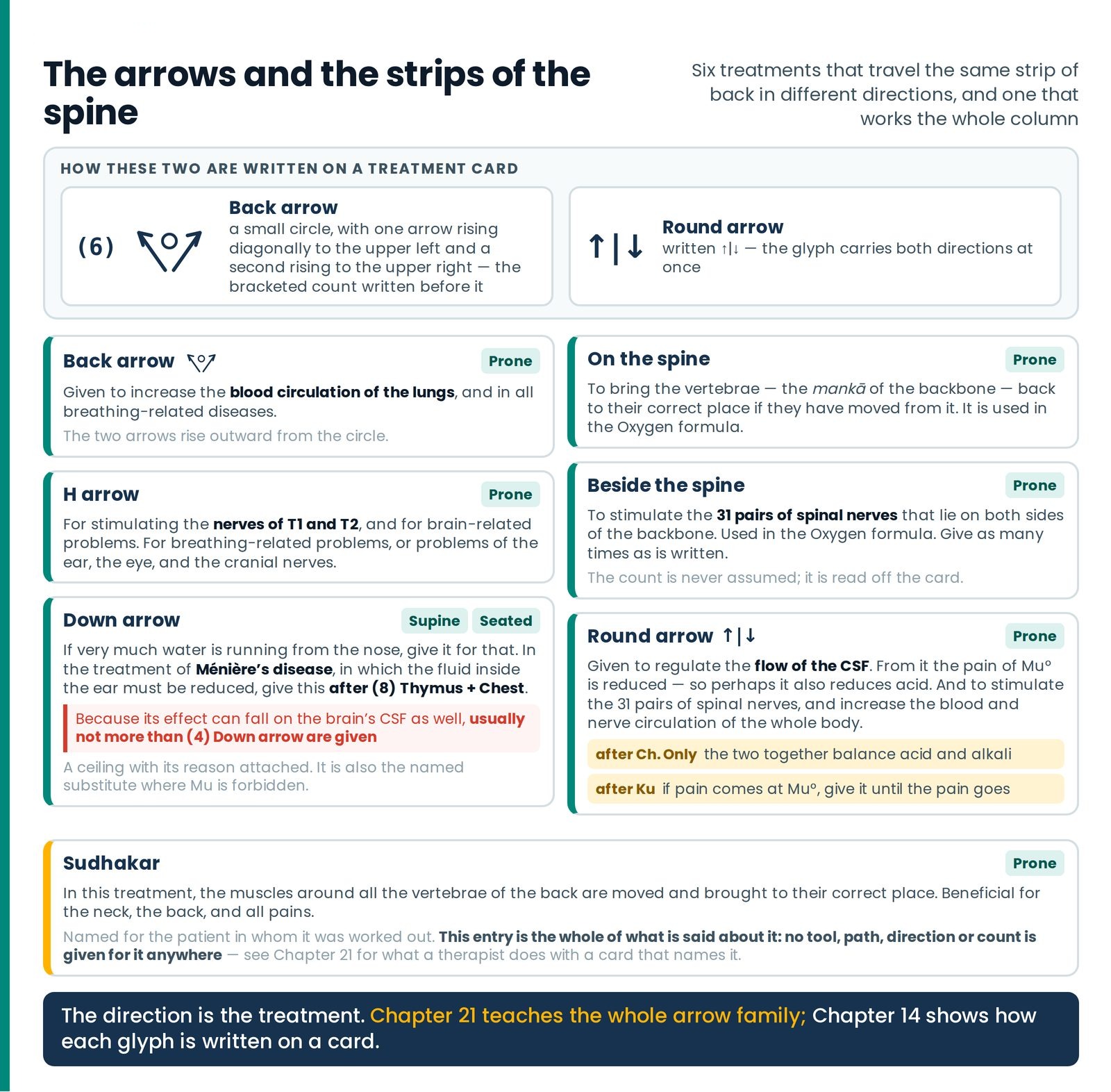
The arrows and the strips of the spine
Six treatments along one strip of back: the direction is the treatment
Six treatments that travel the same strip of back in different directions, and one that works the whole column. The direction is the treatment. (Figure 25.7)
A ceiling, and why Down arrow has one
Because its effect can fall on the brain's CSF as well, therefore usually not more than (4) Down arrow are given.
That is one of only a handful of places in the atlas where an upper limit is put on a count, and the reason is printed beside it. Two things follow for a working therapist.
First, obey the limit. A card reading (6) Down arrow is a card to query, not to give.
Second, learn the shape. This is what the treatment reaches; this is why more of it is not better. When you come to write your own notes on a patient — and you should — that is the shape to write them in.
The low back, the sacrum and the tail bone
Bone that can break and nerves that matter — the bars bite hardest
The largest physical family, and the one where the prohibitions bite hardest, because the hand here is over bone that can break and nerves that matter. Nothing in this family is given over the knee joint itself; The Low Back, "The Low Back", carries that rule with the points it governs, and it governs all of these.
Table 15 — The low back, the sacrum and the tail bone
| Point | What it is used for | When it must not be used | Notes |
|---|---|---|---|
| L5–S1 ghisai Prone | Good for sciatica, and for all pains of the back — especially for lumbar spondylosis or spondylitis. It works in three ways: 1. bringing the vertebrae of the back from L1 to S1 into their correct place; 2. relaxing the muscles of both sides of the buttocks; 3. pulling upward and setting right the muscles and nerves on both sides of the vertebrae that have descended | — | The three ways are the three stages of the technique. |
| (6) L3, 4, 5 Prone | Given to relax both kinds of back muscles from L1 to S1. Ordinarily (6) L3, 4, 5 are given | But if there is a fracture in any bone between L1 and S1, it is not to be given ▲ Take care | The plainest landmark and the plainest bar in the article. |
| L4 fracture Prone | Given if the L4 vertebra — the mankā — breaks or slips. With this treatment, the nerves of the L4 vertebra, which go to the inner side of the calves of both legs, are pulled — by which slowly that vertebra or disc comes back to its correct place | — | Inner side of the calves. This is the treatment for a fracture, where L3, 4, 5 is the treatment withheld because of one. |
| L5 fracture Prone | Given if the L5 vertebra or mankā breaks or slips. With this treatment, the nerves of the L5 vertebra, which go to the outer side of the calves of both legs, are pulled — by which slowly that vertebra or disc comes back to its correct place | — | Outer side of the calves. Inner for L4, outer for L5, and that single word is the whole difference |
| JJ⁺¹ Prone | For pain in the middle part of the back, and for slip disc between L1, L2, L3 | Those who have pain in the knee should not be given JJ⁺¹, because they are to be given the Pradip treatment, in which we pull the muscles in the opposite direction. They can be given JJ⁺² ▲ Take care | A bar that also names what may be given instead. |
| JJ⁺² Prone | For knee pain, low back pain, and slip disc between L4, L5, S1 | But if someone has knee pain together with pain in the soles of the feet, then they are to be given BOF treatment, and JJ⁺² is not to be given that day, because the two work in opposite directions. After the sole pain has gone, JJ⁺² can be given ▲ Take care | Not a permanent bar but a same-day one, with the condition for lifting it stated. |
| (2) S4 – S5 Prone | In it, to stimulate the sacral nerves, we pull the muscles on both sides of the S3–S5 vertebrae from above downward. This relaxes and opens the sphincters of the urinary bladder, of the uterus, and of the anus. This is given to increase urine, by which high blood pressure will also come down. If motions come less, or if the flow in the menses is less, it is also useful for increasing them | It is not to be given to those who pass too much urine ▲ Take care | The point that is given with Gas 'I' where the constipation is severe. |
| Triangle for piles Prone | This strengthens the muscles of the pelvis, and tightens the sphincters of the urinary bladder, of the uterus, of the anal opening and so on. Therefore it is useful in piles; fistula; anal fissure; and prolapse of the rectum — the rectum coming out through the anus. Give it for those children who pass urine in the bed | Do not give it to those who pass little urine ▲ Take care | Read this row against S4–S5 above: one opens the sphincters, the other tightens them. |
| Tail bone pain Prone | Given to remove the pain from an injury at the last end of the bone of the spine — that is, the tail bone. This pain often happens when someone slips on the stairs, or sits down with a thud, and the tail bone is injured | — |
Two sphincter treatments that face opposite ways
(2) S4 – S5 relaxes and opens the sphincters of the bladder, the uterus and the anus. It is given to increase urine, and it is not given to those who pass too much urine.
Triangle for piles tightens those same sphincters. It is given for piles, fistula, fissure and prolapse of the rectum, and for the child who wets the bed — and it is not given to those who pass little urine.
Two points, one region, opposite actions, opposite bars — and the two bars between them cover the whole range of a patient's water. Learn them as a pair and you will never give the wrong one: ask how much urine is coming before you touch the sacrum. ▲ Take care
The knee and the lower limb
Tissue pulled back to its place, and a numb leg that cannot report
Table 16 — The knee, the calf, the foot and the vessels of the leg
| Point | What it is used for | When it must not be used | Notes |
|---|---|---|---|
| Giriraj Supine | Given for knee pain. Those muscles that have descended from the waist down into the thigh and the inside of the knee are pulled upward; and those muscles that have climbed up from the calves or the heel are brought downward | — | Two directions in one treatment: down-from-above is pulled up, up-from-below is pushed down. |
| Knee cap free | Given for knee pain. In it we relax the following muscles: the muscles behind the knee; the thigh muscles above the knee; the muscles around the bone below the knee; the muscles around the *kaṭorī* — the knee cap; and the muscles inside the *kaṭorī* | — | Five groups of muscle, named in order. |
| Pradip trt. | Given for knee pain. In it we pull the muscles and nerves of both sides of the knee away from the *kaṭorī*, and bring them to their correct place, from which the patient gets immediate relief | — | The treatment named in the JJ⁺¹ bar: a knee patient is given Pradip, in which the pull runs in the opposite direction. Its full staged sequence — the pillow, the jerk, the walks and the stand — is taught in Knee, Leg, Foot |
| J groin Supine | With this treatment we pull upward the tissue on the inner side of the knee that has descended, and bring it back to its own place. After all the other knee treatments, if a little pain remains on the inner side of the kaṭorī, this treatment is given to remove it | — | A finishing point, not an opening one. Given supine only. |
| J back Prone | With this treatment we pull upward the tissue on the outer side of the knee that has descended, and bring it back to its own place. After all the other knee treatments, if a little pain remains on the outer side of the kaṭorī, this treatment is given to remove it | — | The mirror of J groin: inner side, supine; outer side, face down. |
| BOF — Bottom of Feet | Above the heel, at the back, there is something like a band, through which pass the blood vessels of the feet and toes, the nerves that control movement, and the tendons — the ropes that keep the bones in their place — all of which come down from the knee or the waist and reach the feet. On striking something, or when we bend to lift a heavy weight, or make some sudden movement, many tendons and nerves and blood vessels are pulled and slip down quickly; afterwards not all of them are able to go back, and some get caught inside that band, from which there is very severe pain in the heel, or around the toe concerned. With this treatment we press those tendons caught inside the heel from below upwards and pull them, bringing them to their correct place, from which the patient gets immediate relief. Excellent for numbness, pain, burning or any kind of trouble from the toes, soles and heel up to the calves | (see the note on sides) | Ordinarily it is not given on the upper side. It is given only on the three sides of the calves. But if there is a sprain, then it is to be given on the upper side too — for which we write on the card BOF – all four sides. And JJ⁺² is not given the same day as BOF for sole pain. |
| Blood supply to legs — for polio | Given to increase blood circulation in the arteries of the legs of polio patients. Give where there is numbness in the legs, or in the front or the back of the thighs. Some paralysis patients also get relief from it. Usually given thirty times on both legs | — | Thirty times, both legs Both sides . |
| Blood supply to sides | For those who have numbness in the side portion of the thighs, this treatment increases the flow of blood in that part and ends the numbness | — | Its own entry, and its own region — the side of the thigh, not the front or back. Method: |
| Hydrocele point | Given for hydrocele — that is, swelling in the scrotum — and in inguinal hernia. Pressing at the appropriate part of the calf, where there is intense pain, increases the flow of blood in the testis of that side and the patient gets relief | — | A scrotal complaint found and treated in the calf. |
| Vasanti | This is given to increase the circulation of blood in the veins. In diabetes, or in tarsal tunnel syndrome, when the feet go numb, give it from the heel towards the thigh. In carpal tunnel syndrome, when there is very severe pain, burning and numbness in the hands, give the treatment from the fingers towards the shoulder | — | The direction is the whole instruction, and it differs between the two conditions: heel → thigh for the foot, fingers → shoulder for the hand. |
The neck, the shoulder and the arm
Light hands at the front of the neck, and a fence never crossed
Table 17 — The neck, the shoulder blade and the arm
| Point | What it is used for | When it must not be used | Notes |
|---|---|---|---|
| Neck ghisai Seated | Beneficial for pain of the neck, head, shoulders, fingers and arms. To be given in cervical spondylitis or spondylosis. In it we relax the muscles all around the neck, in this order: first, with light hands, the muscles at the front of the neck and the muscles at the back; then the muscles of the right and left sides of the neck; then, giving a necklace-like treatment, if anything in the bundle of nerves that emerges from below the bone of the forehead has moved out of place, we bring them back to their place; finally, we also relax the muscles attached to the shoulder blade | (the anterior-neck rule governs it absolutely) ▲ Take care | Four stages, in order, and the first is given with light hands. |
| Necklace Seated | To reduce pain in the head, the neck, or the whole body. For those who have pains in half the body, excluding the forehead. To bring urine under control, and to correct the habit of passing urine in bed. Given in paralysis to reduce pain, and to relax the body | (the anterior-neck rule governs it) ▲ Take care | |
| Raman trt. Seated — (3) Raman × 3 treatments; (6) Raman × 6 treatments | To cure pain in the neck, shoulders or knees, or all the pains of the body. If the shoulder has moved from its place, with this treatment it will come back to its old place. Excellent for problems of the uterus; if the testes are not in their correct place; and for the big diseases that arise from problems of the pleura of the lungs, or the pericardium, or the peritoneum | — | Two counts, each with its own number of treatments. |
| Subclavian trt. Seated | Inside the subclavian junction of the thoracic duct, situated on the left side of the throat or neck, the contents of many lymph nodes of the body arrive. So by stimulating it, the movement of the lymphocytes increases, from which their function improves. This is a very powerful pain-killing treatment, by which pain anywhere in the body comes to an end | (the anterior-neck rule governs it) ▲ Take care | Press onto bone, never deep into the hollow. |
| Thoracic T1/T2 Seated | This provokes the lymph nodes. If there is pain in any part of the body, this puts an end to it | — | The station at the two beads below C7. |
| Electrical waves Supine | This relaxes the muscles of the neck. It has been found excellent for asthma or breathing difficulties. Formerly it was given in fits. But now several other good treatments have come for fits — therefore it is not given | — | A treatment retired from one of its uses, with the reason given: better ones came. |
| Stretch — (6) ← → Supine | Pressing on the tips of the fingers, they are pulled outward, because of which it relaxes the muscles of the neck. It gives tremendous relief in breathing troubles. Therefore it is used in asthma, in bronchitis, and in the Oxygen formula | — | It is not necessary to give both sides at the same time. If the left side is given first and the right side afterwards, the result has been found just as good. |
| Shivaji trt. Seated | Given to the patient who cannot raise the arm properly because of pain in the shoulder — the shoulder has become stiff, which is called frozen shoulder. With this treatment, by pressing again and again, we relax the muscles all around the shoulder, from which the blood circulation in them increases and flexibility comes, and the patient begins to get relief | — | |
| Shoulder blade lower Prone | Those who have pain anywhere behind the chest, in the middle part of the back, below the bone of the shoulder — with this treatment that pain goes out | — | Given with the palms, elbows bent, palms facing the sky. |
| Shoulder blade upper Prone | Those who have pain anywhere in the back between the shoulder and the vertebra of the neck — with this treatment the muscles of that part relax and they get relief | — | Given with the feet, elbows bent, palms facing the ground, arms raised. After these two treatments, giving BAFA will be of great benefit in cervical problems. |
| Tennis elbow | Given to take out the pain of the elbow joint. Sometimes the pain is so great that they cannot even lift a spoon. Give until the pain goes out | — | The count is the pain, not a number. |
Three of those entries deserve a second look, because each teaches something about how this therapy handles its own history.
Electrical waves was withdrawn from one of its uses — formerly it was given in fits; but now several other good treatments have come for fits, therefore it is not given. Not because it failed. Because something better arrived. That is a therapy keeping a ledger.
Stretch says the two sides need not be simultaneous — if the left side is given first and the right afterwards, the result has been found just as good. A sentence written by somebody who tested it, for the benefit of a therapist working alone.
Tennis elbow and T8 set their counts by the patient — give until the pain goes out. Where the atlas can name a number it names one; where it cannot, it says so rather than inventing one.
The head and the face
Hammering, speech, ear, eye and teeth — and the side crosses
Table 18 — The head, the face, the ear and the eye
| Point | What it is used for | When it must not be used | Notes |
|---|---|---|---|
| Bell's palsy Seated | For a person whose mouth is twisted to one side, which is called facial paralysis. They cannot smile properly, or cannot close the eye fully. They benefit greatly from this treatment | — | |
| Hammering Seated | To increase the circulation of blood inside the brain, a towel is placed on the head and it is struck lightly with a special kind of soft hammer. For paralysis patients, this treatment is given on the left side of the head for speech. And those who have difficulty in moving the left hand or leg are treated on the right side of the head | — | The side crosses. Left side of the head for speech; right side of the head for a left-sided limb. |
| Speech point — hammering for speech Seated | Given to increase the circulation of blood inside the brain above the left temple of the forehead. In paralysis, for those who have trouble with speech — that is, who cannot speak clearly or distinctly — it is given to stimulate Broca's area for speech. Broca's area is that part of the brain that controls speech, that is, pronunciation | — | |
| Ear points Seated | Given for reduced hearing, deafness and all problems of the ear. It stimulates the nerves around the ear and increases the capacity to hear | — | |
| Lacrimal point Supine | This is useful for opening the tear ducts if any dirt collects in them. Excellent for all diseases of the eyes. Give especially for glaucoma, for boils in the eyes, for debris, or for continuous watering of the eyes for no reason, and so on | — | |
| Teeth point Seated | Given to increase the circulation of blood in the teeth or the jaws, from which the pain in them comes to an end | — | Before this, the appropriate heparin treatment according to the patient's body is to be given. A point with a prerequisite, not merely a use. |
| Vocal ghisai Seated | This is given to relax the muscles of the voice box. For a bad throat, or hoarseness in the throat causing difficulty in speaking, or for those whose voice does not come out at all, it is excellent | (the anterior-neck rule governs it) ▲ Take care | |
| Dorsal Seated | This is mostly given in MS, MND and other such brain diseases. Research on this is still going on | — | The second of the two places in this article where the work is openly marked unfinished. |
Teeth point is the only entry in the physical half with a prerequisite. Before this, the appropriate heparin treatment according to the patient's body is to be given. Not a heparin treatment — the appropriate one, according to the patient's body, which is a whole family of formulas and a choice to be made. A card that reads Teeth point alone is a card missing a line.
The chest and the trunk
Where the weight lands decides the bar, not what the point makes
Table 19 — The chest, the abdomen and the trunk
| Point | What it is used for | When it must not be used | Notes |
|---|---|---|---|
| Loveleen Supine | Excellent for the chest pain that comes from poor digestion and similar causes | But pressure falls upon the chest — therefore it is not to be given to heart-disease patients ▲ Take care | The reason is mechanical, not chemical: it is about where the weight lands. |
| Sulta Ulta Supine | Sulta* will take out the pain at the front of the chest. Ulta* will take out the pain of the back behind the chest. For those who have angina or heart disease, keeping both arms extended — not parallel to the shoulders but a little upward, at 135° — and giving it, the pain of the chest, or the suffocation that is felt in it, will end | — | It is not necessary to give both sides at the same time. Give the left side first and the right afterwards Left Right . The angle and the order are the instruction. |
| T 8 Seated Supine | Given for diseases of the kidney, the pancreas, or the adrenal gland, and for cataract, weakness of the eyes, and in diabetes | Give until the pain goes out — but comfortably ▲ Take care | The limit is the entry: comfortably is the ceiling, and the pressure should not be so much that the pain increases further. |
| Folded legs Supine | This sets the abdomen. Excellent for pains below the navel | But if there is inflammation in the abdomen, do not give ▲ Take care | |
| Motor neuron point Prone | If there is pain or numbness in half the body from the head down to the foot, this gives immediate relief. Some patients will say that they also feel as if some insect is moving under their skin, which starts from the head in half the body and finishes in the sole of the foot — and this goes on all day long. Ordinarily it is given five times | (the shared note of Katka and Motor neuron point governs it) ▲ Take care | Four pillows — three under the chest and one under the chin — a three-finger gap checked with the hand near the prominence of the throat, and only a mild jerk. |
Sulta Ulta in angina — the angle and the order are the treatment
This is one of the places where a student's instinct says surely not in a heart patient and the entry answers the instinct with detail rather than with reassurance.
It is given in angina. And it is given like this: both arms extended — not parallel to the shoulders, but a little upward, at 135°. And: not both sides at the same time. The left side first, and the right afterwards.
The angle and the order are not refinements laid on top of the treatment. They are the treatment. Given at 135° and one side at a time, it is the entry above. Given flat, and both sides together, it is something else that has not been taught.
And beside it, in the same patient, the other cardiac instruction of this article: in angina — that is, in heart patients — to reduce cholesterol, (2) Thrd is given in place of (4) Thrd. Each rule is complete where it stands.
The navel, the womb and the paralysed limb
Setting the navel; and the prolapse point never written alone
Table 20 — The navel-setting points, the prolapse point and the limb points
| Point | What it is used for | When it must not be used | Notes |
|---|---|---|---|
| (3) ONS Supine | This treatment is given to correct disturbances of the navel, and to bring the navel back to its correct place if it slips | — | (3) ONS + WD is extremely good for setting the navel. |
| TF / NNS Supine | These two treatments together set all the organs of the navel. The number according to need | — | The standard closing pair after abdominal work. |
| 'P' point — the prolapse point | This is given to those women in whom sonography shows that a prolapse of the uterus has occurred — that is, her uterus has moved from its place. With this treatment we give in order to loosen her uterine muscles further | And immediately after giving this treatment, giving (6) WD is necessary; otherwise that woman will have still more trouble ▲ Take care | Some of the chief symptoms of prolapse of the uterus are: severe pain below the navel and in the back, white discharge, irregular menstruation, and infertility because of the low temperature of the body. The heel on the middle of the thigh, an upward jerk, left thigh first. |
| Shukla | Given to make the muscles of a limb — hand or foot — that has been paralysed, loose and flexible | For osteoporosis patients this treatment may perhaps increase the pain — so do not give them this treatment ▲ Take care | The wrist and the ankle, four ways each. |