What the Bowel Tells You — Constipation, Stool and Water
Watch


Constipation is a finding, not a complaint
Two faults only, read from two directions, and the words on the card
What constipation is
Constipation is not a disease. It is only a symptom.
It indicates improper functioning of the gastro-intestinal tract.
And improper functioning of the large intestine will show itself in two ways, and only two:
1. as very hard stools; or 2. as stools that are very semi-solid — but not watery enough to be called diarrhoea.
Those are opposite complaints and one finding: the large intestine is not doing its work. Which of the two a patient shows tells you which way he is leaning, and that is the beginning of the treatment.
A student hearing constipation thinks of a complaint the patient brings. Put that idea down. Here it is something you find, usually in a patient who came about a knee and has just told you his motions are perfectly all right. It belongs with tenderness at Mu° or a lined tongue: a reading you take, write down, and watch change.
Which is why the order of work matters. Having checked for pain at Liv° and Mu°, the next step is to inquire about the nature of the stools. The stool question is the second half of a finding you have already begun.
The two directions, read from the bowel
Patients with pain at Mu° tend to have very hard stools.
That is, they are acidic, in the language of this therapy — and that acidity is the root cause which leads to constipation. Patients with pain at Liv°, the alkaline side, show the other fault: soft or thin stool, stool coming again and again, loose motions, or undigested food appearing in it.
So the two commonest bowel complaints in the world are read from opposite sides of the same body and corrected from opposite directions. Hard stool is not simply less of loose stool. It is the other kingdom.
Why "normal" is not an answer
Three reasons the patient's verdict settles nothing, and what does
The patient's opinion is not a finding
That the stools are "normal" is the patient's opinion only. It has no bearing whatever on what is happening in his large intestine. Three reasons, each defeated differently:
He has never looked. A man who has never once observed his motions cannot tell you what they are like. He is not lying; he is reporting a habit of never noticing.
He holds a false standard. Many people believe constipation is bad for health but that passing semi-solid stools, or passing stools frequently, is a sign of normal health. A patient who goes four times a day will tell you his digestion is excellent, and mean it.
He wants the subject closed. It is repugnant to him, so he answers whatever comes to mind to end the conversation.
The trained therapist learns to distinguish a correct answer from an answer given just to put an end to the talk.
The full elicitation — how to ask, what the common answers mean, what to do when the head begins shaking before your question is finished, and how to write UDF - ? on the card in the patient's presence — is taught in The Fire and the Ash, "The Fire and the Ash". Use it here; do not repeat it. This article adds the layer that questionnaire does not settle: form, effort and water.
What actually decides whether a person is constipated
Normal bowel habit is a range, not a daily event — from about three motions a day to about three a week — so the number alone decides nothing. What decides it is effort and sensation, and a patient is constipated when two or more are habitually present: straining · lumpy or hard stool · incomplete evacuation · a sense of blockage at the anus · the need for manual manoeuvres · fewer than three spontaneous motions a week.
Habitually means for months, not a fortnight — a fortnight of change is a different question, taken seriously in a different way.
One picture inside that list is not yours to treat. Where the stool arrives soft and on time and still will not come out — long straining, a sense of a door held shut, sometimes fingers used — the fault is at the outlet and not in the colon: the pelvic floor tightening when it should let go. Neither abdominal work nor water nor any formula corrects it. Recognise it, name it honestly, refer.
Where the water goes, and where it is taken back
The colon's reclaiming, water in decides water out, and the two habits
The journey, applied to a hard stool
When chyme enters the beginning of the ascending colon it is a very watery fluid, thanks to everything poured onto it from the pancreas, the liver and gall bladder, and the intestinal enzymes. As it travels it is progressively drained of water, becoming sludge-like in the process.
So the contents of the caecum are highly alkaline; at the beginning of the transverse colon only weakly so; and as the residue crosses to the left, more and more water is absorbed, making the contents of the descending colon progressively more and more acidic, especially as it nears the sigmoid. Finally, at the rectum and the anus, the faecal matter is extremely acidic — most of all when nearly devoid of water, as in severe constipation.
The consequence: the water is taken back all the way along, and most of it on the left — which is where a constipated patient's tenderness sits, where the work is given, and why the family of complaints at the end of the pipe belongs to the acidic side of the chart.
Water in decides water out — stated for the bowel
At least one and a half litres of water are lost daily through respiration, sweat, urine and the rest, so drinking water regularly is essential to health. Over a whole day of ordinary living and work, an average person loses almost two litres — to be replaced daily with at least an equal quantity of pure water.
Not drinking adequate water between two meal times is one of the major causes of constipation, leading to accumulation of waste within the body.
And the mechanism, worth learning by heart: if one does not consume enough water, the body reacts by first stopping water excretion from all its exit points — one of which is the anus. The others are sweat, urine and saliva. So the stool at the rectum is made tighter and tighter — that is, more and more acidic — because an exit point is the first thing a body short of water closes.
From which: if an individual consumes very little water, even though he may be consuming other types of liquids, he is more likely to suffer from constipation — and it is inevitable that this is accompanied by acidity in the large intestine, especially the descending colon and rectum.
The stool does not dry because there was less water to put in it; the body closes its taps. So the dry mouth, the scanty dark urine, the skin that has stopped sweating and the hard stool are one event with four faces — and a patient who reports three will report the fourth if you ask.
The two habits, and the instruction for a constipated patient
One — drinking with the food, or immediately before or after. That it dilutes the stomach's acid and hampers protein digestion is taught in The Fire and the Ash, "The Fire and the Ash". Its consequence here is additional: a person who takes all his day's water at his two meals has drunk nothing in the twenty hours between them — precisely the interval in which the colon does its reclaiming.
Two — gulping in fits and starts. Half a litre or more at once when thirst becomes unbearable, then nothing for hours. The body cannot store water beyond a certain limit, so a major portion of a large draught leaves as urine within a short time; and not drinking until it is absolutely necessary causes an imbalance of water in the blood and in the fluid around the cells, leading to acidity, constipation and other disorders.
For a patient suffering from constipation or a digestive disorder the instruction is exact:
A glass of water half an hour AFTER a meal, and at hourly intervals thereafter.
And the sentence to send him home with: any drink other than pure water is a food, and cannot be a substitute for pure water.
Tea is a food. Buttermilk is a food, and a good one, and it is not water. A soft drink is the worst kind, and drunk alongside solid food it greatly hampers digestion. Ask for plain water in glasses, and ask what was drunk yesterday — not what is generally drunk.
Reading the stool
The chart of seven forms, colour, and whether it floats
The patient will not describe a stool accurately in words, because he has no words for it and would rather not try. Show him a picture and let him point. (Figure 10.1)
What the form tells you about the direction
The form tracks the speed of the journey better than the number of motions ever will, and the speed is what your work changes.
Form · The journey · Which kingdom
1 hard lumps · Very slow — squeezed nearly dry on the left · Acidic — expect tenderness at Mu° Left
2–3 lumpy or cracked sausage · Slow, but moving · Acidic, milder
4 smooth soft sausage · Right · Neither
5 soft blobs, easily passed · Faster than it should be — this is SSS · Alkaline — expect tenderness at Liv° Right , and undigested items
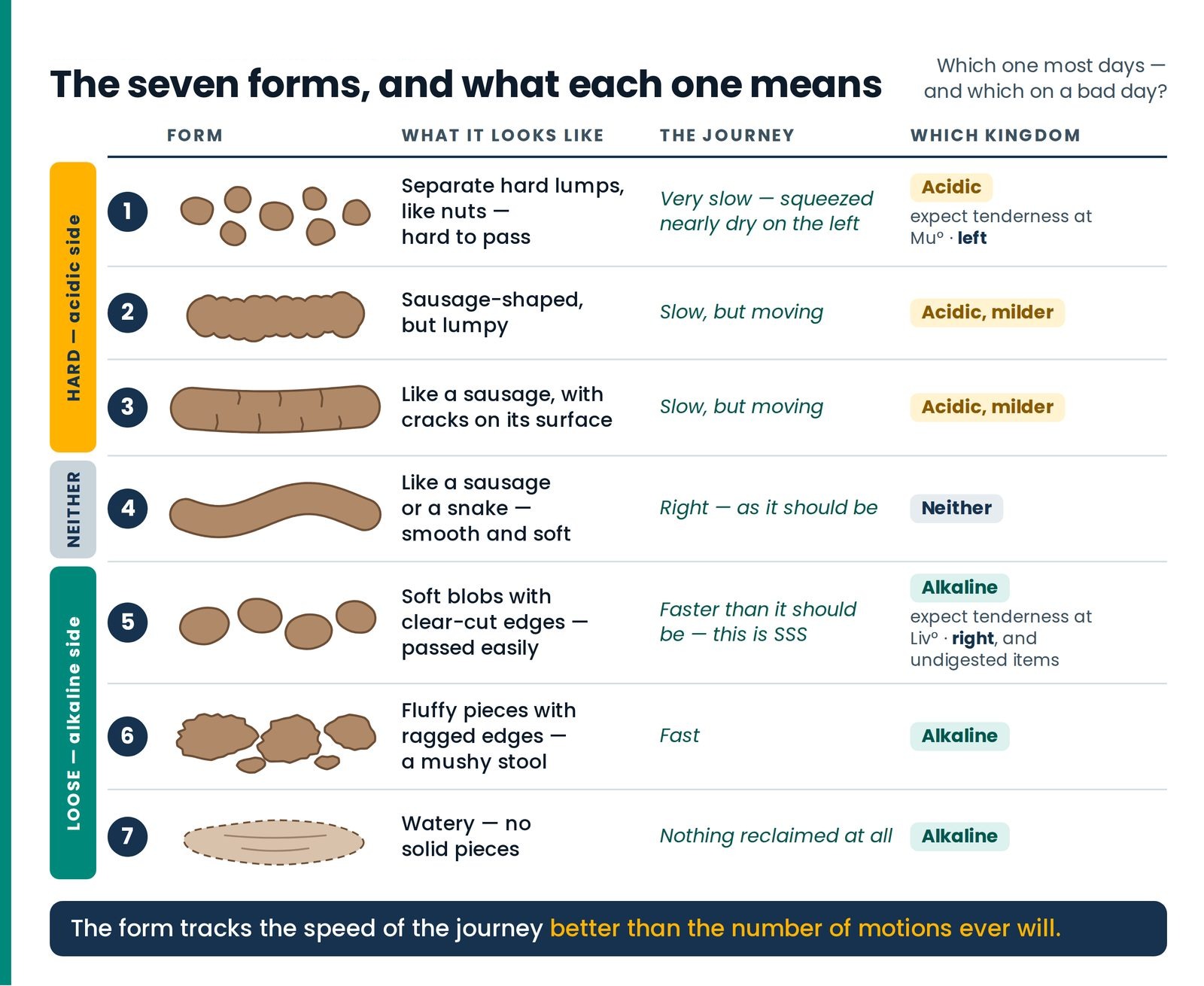
6 mushy, ragged · Fast · Alkaline
7 watery · Nothing reclaimed at all · Alkaline
And the two ends carry the two families of ordinary disease. On the hard end: constipation, piles, fissure at the anus, fistula, pimples, dandruff and scaling, hair falling or greying before its time, prolapse of the uterus or of the rectum. On the loose end: fits, epilepsy, cerebral palsy. Two rows of one chart, and a bowel finding that reaches all the way to a child's seizure.
Colour, and what to do about each
Ordinary brown.
The colour is not made by food but by the pigment in bile, altered on the way down: brown is a report that bile is arriving.
Pale, clay-coloured, putty. Bile is not arriving in normal quantity. With dark urine, or yellowness of the eyes, a doctor's matter today. ▲ Take care
Black and tarry. Never explain this away. There is a treatment in the formulary — Large Folic Black, given after the undigested-food work — after which the black colour of the face is said to be reduced by a quarter immediately, and the next morning the first inch of the stool will be black, meaning waste is coming out by way of the rectum. Learn that as it stands, with its boundary: it accounts for the first inch on the morning after that treatment, and for nothing else. Iron blackens a stool harmlessly; so does an ulcer bleeding higher up. ▲ Take care
The colours and consistencies that are not a matter for the mat at all — a bulky pale greasy floating stool with weight coming off, a black tarry stool, blood of any colour at any age — are listed with their instructions in The Fire and the Ash, "The Fire and the Ash", and are asked about of every patient, every time. Rectal bleeding is never put down to piles until a doctor has excluded what else it can be, and a patient genuinely having piles does not make the blood theirs.
Four readings are taken every time — form, frequency, effort and content — and none stands alone. Their information has to be correlated to arrive at a proper diagnosis, together with the pain points around the navel, the B₁₂ and folic acid points, and, in women, the menstrual history, which is an additional and very valuable tool. Content — the undigested items — is The Fire and the Ash's question, not this article's.
The causes of constipation, and the cure
Four causes, the acid treatment, and the left run in the wave's order
Having given a treatment for the acidity behind hard stools, the teaching turns round and says the treatment is not the whole answer, and lists everything else that may be wrong.
Constipation is a cumulative result
In actual practice, constipation is the cumulative result of a number of factors, each of which has to be set right.
The cause · The remedy
Not drinking enough water — hence the stools become hard · Advise the patient to drink water in small doses at specified intervals
Not having enough roughage — the reason for the poor motility of the faecal matter · Plenty of vegetables and fresh fruits, with their skins as far as possible
Sluggishness of the large intestine, due mainly to sedentary habits, or perhaps to age · Stimulate the descending colon
Insufficient quantity of secretions in the digestive tract · Stimulate the various organs of digestion
Two your hands correct and two only the patient can — and a therapist who forgets which is which will treat a man for eight weeks while he goes on drinking two glasses a day.
The primary treatment is to reduce the acidity, by the Acid Treatment Formula, given while there is pain at Mu° and repeated on subsequent days until that pain is removed. The formula and its two forms are taught in Correcting the Two Kingdoms, "Correcting the Two Kingdoms". Its standing warning is worth carrying from today: if there is no pain at Mu°, the Acid treatment is not to be given.
When the acid treatment is not enough
If the stools are hard even after the acid treatment, and he is drinking water in the right manner, then it means his descending colon is sluggish.
To rectify that, blood supply has to be increased to: the transverse colon, the descending colon, the sigmoid colon, the rectum and the anus.
Read the two conditions before the conclusion. The treatment was given and the water was corrected. A therapist who skips the second will diagnose a sluggish colon in a man whose only fault is a water pot.
The five points of the left run, and what each stimulates
Point · What it stimulates
Spl Left · The left end of the transverse colon and the beginning of the descending colon
Const Left · The area between the navel and the transverse colon, and parts of the small intestine
Mu Left · Mainly the middle part of the descending colon — and it increases lubrication in the intestines, so the residue moves forward easily
Mu° Left · The left kidney, which reduces acidity
Lt.Ov. Left · The lower descending colon, the sigmoid colon and the rectum
Between them, the whole left-hand run of the pipe from the bend under the spleen to the anus. It is not a scatter of useful places. It is the pipe itself, in order.
To cure constipation, why Spl, the spleen — and why Lt.Ov., the left ovary? Both are outside the alimentary canal.
Why a point named for one organ works on another
By these points we increase the blood circulation in the various parts of the abdomen all around the navel. Each point's name was given by keeping in mind the chief organ of that region. But when the point is given it increases blood flow not only in that organ, but in all the organs of that region.
Above and to the left of the navel the chief organ is the spleen — but the left terminal transverse colon and the upper descending colon lie there too, and all three receive the blood; and below and to the left, besides the ovary or testis, lie the terminal descending colon and sigmoid. In this work Spl is not given for the spleen at all, but for that part of the large intestine. Learn the names as addresses, not as claims.
The order is the peristalsis
The points are given in the same order in which the wave of peristalsis travels in the intestine — first the upper part of the transverse colon, then the middle, then the lower part, that is the sigmoid colon.
This is the deepest habit of thought in the therapy: study how the body does a thing, then stimulate the parts in that very order which sets right the body's own way of working. A hand that pushes downstream helps; a hand that pushes upstream is doing something else, whose effects nobody has taught you.
Two formulas rest on that principle and differ in reach. The Left Side Treatment Formula works the left run only and is the formula for chronic constipation — of very long standing. The Round Normal Formula is for ordinary constipation, and differs in that not only the descending colon but all the parts of the large intestine, from the ascending colon right through to the sigmoid, are stimulated in order. Both are taught in Water and Salt, "Water and Salt".
Its six points are anatomy you can carry to the mat tomorrow: Rt.Ov. the terminal ileum and the beginning of the ascending colon · Liv the middle of the ascending · Gal the upper ascending and the beginning of the transverse · Spl the terminal transverse and upper descending · Mu the middle descending · Lt.Ov. the terminal descending and sigmoid. Six points, and you have walked the whole large intestine in the direction the wave travels.
The third cause: the gland that sets the pace
The thyroid, the mistrī, and the low gland in children and women
Having covered the descending colon, the teaching asks a hard question of itself: does that cover ALL possible reasons for constipation? The answer given is: no, not completely.
Constipation is a cardinal symptom of the thyroid working too little
From physiology we know that constipation is one of the main symptoms associated with hypothyroidism. This means that, for curing constipation, we have to stimulate the thyroid gland also.
The thyroid's chief responsibility is metabolism, and for that it increases both the outflow of digestive secretions and the motility of the digestive tube. So:
The gland works less → digestive secretion comes out in smaller quantity → food is not properly digested and moves forward very slowly → stool and waste remain in the large intestine for a longer time → more fluid is absorbed from it → the stool becomes dry and hard, and that is the constipation.
And the line that makes the chain dangerous: the motility of the large intestine is already quite low. So even a small change in motility is enough to produce constipation.
That is why the thyroid is stimulated in this work, by the treatment called Thrd.
The same gland is called, in this therapy's own image, the chief craftsman — the mistrī — without whose order or supervision the other glands and organs will not work properly. All the functions of the digestive tract depend on the thyroid gland.
What the low thyroid shows, and in whom
When the gland works less, T₃ and T₄ do not come out in the right quantity, and two chief pictures are seen:
In children → very hard constipation; and mental dullness can also occur. In women → menses coming before the date, or more flow in the menses.
When that lasts for years, T₃ and T₄ become very much less than normal and it is called hypothyroidism; one chief indicator is that the TSH also rises.
And the loop closes. When acid increases in the blood the muscles become loose; for a gland's secretion to come out properly the muscles around it must contract properly; loose muscles mean poor contraction, and the gland runs hypo — and a hypo thyroid means a slow bowel, a dry stool, and more acidity still.
A child with very hard constipation and a school report saying he is slow is a child whose thyroid deserves a blood test. Say it plainly: "There is a simple blood test for the thyroid. Please have it done and bring me the paper." You are not treating a gland with a slip of paper; you are making sure a correctable cause is not sitting under your hands for six months.
The fourth cause: what long constipation does to the lining
Inflammation at Mu, Adr before Thrd, and the points blocked
Severe constipation and the mucous membrane
Severe constipation is certainly accompanied by inflammation of the mucous membrane of the gastro-intestinal tract, and this shows itself as severe pain at the pain point Mu.
Wherever rubbish accumulates, a favourable environment is created for germs to breed, which takes the form of infection. So if someone has had constipation for a very long time, there will certainly be some infection in the intestines — and a chronic infection, one that stays a long time, changes into inflammation.
Therefore: along with curing the constipation, the inflammation must also be finished, or the patient will not get complete relief. Inflammation is corrected here by stimulating the adrenal cortex to produce cortisol.
Recap, learnt as it stands: pain at Mu indicates inflammation in the digestive tract. The instant remedy is either (30) Medulla or Adr — the actual treatment being (6) Adr, repeated three times, with a gap of ninety seconds in between. × 3
A complete account of long-standing constipation therefore has four faults in it — the acidity, the sluggish left colon, the thyroid, and the inflammation the constipation itself produced — which is why the formula for it stimulates most of the organs of the left side of the body and is named for that side.
Adr before Thrd — and the compromise that reverses them
The physiology.
Whenever Adr is given it makes the thymus hypo, and with it the thyroid also becomes a little hypo. So if both are given one after the other, giving the thyroid first and Adr afterwards will not give a full hundred per cent result; it comes out a little less. For a full result, Adr should be given first and the thyroid afterwards.
The problem. The abdominal points up to Mu° are given face up Supine ; Adr requires face down Prone ; Thrd face up again. The ideal order turns the patient supine — prone — supine: two turns, troublesome for the elderly, and for patients with back pain or heart trouble.
The compromise actually taught. After Mu°, give Thrd first and Adr afterwards — one turn instead of two.
And the honesty that goes with it: always remember this compromise was made for the patient's convenience. There is no harm in it, but the patient may need the treatment to be given one or two days longer.
If, after all the above, the bowel movement is still not satisfactory enough, then it means the patient's intestines are not producing the correct quantity of secretions, and the organs of digestion themselves are set right — see also → Setting the Stomach, "Setting the Stomach". Separately: individual treatment points alone do not set right a disorder, but they can give instant relief from individually annoying symptoms and can be used as starters, chiefly for the bed-ridden and those with severe joint pains, who may not bear the pressure of the regular treatments even by hand. The points which reduce the symptoms of acidity are Mukha Dhauti · Raman treatment · Round Arrow · Adr · Left Chest Only.
Piles, fissure, fistula and prolapse — one family, not four diseases
Loose flesh-muscles, the Triangle for Piles, and bleeding to refer
The four are one family
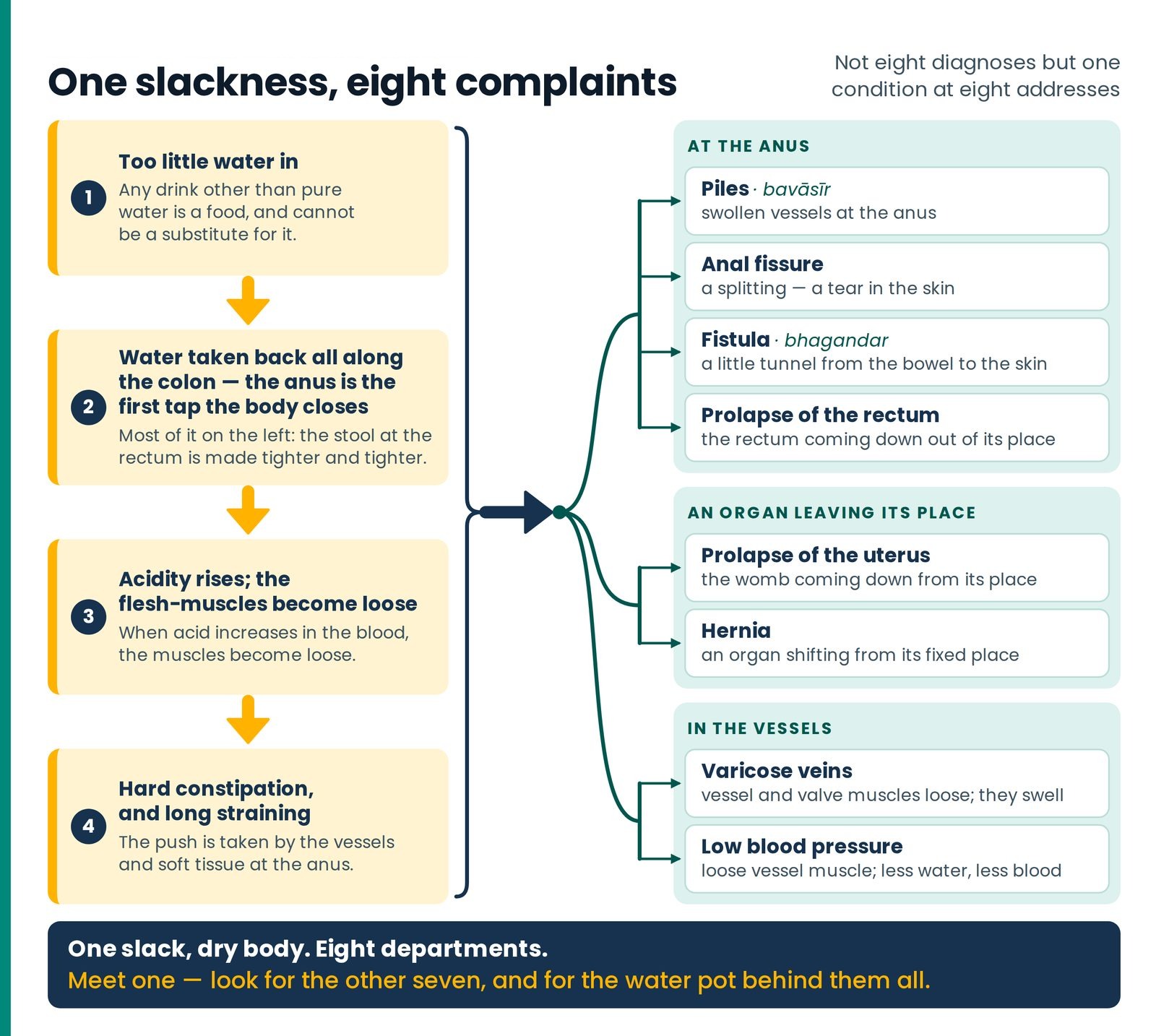
Piles, anal fissure, fistula and prolapse of the rectum are all four diseases of acid, and one chief cause of them is hard constipation.
They appear together on the acidic side of the chart under one heading — hard constipation and the diseases connected with it — in the same list as blocked nose, dry cough, burning yellow urine, dry itchy eyes, pimples, dandruff, hair falling or greying early, dry skin, warts and psoriasis. One chief aspect of acidity is deficiency of water in the body, and these are the symptoms that appear on the organs that get rid of things.
So when a patient shows you one member of this family, do not treat the member. Look for the constipation standing behind it, and for the water pot standing behind that.
Three conditions carry pain at Mu° with them: prolapse of the rectum — the rectum coming down from its place; prolapse of the uterus — the womb coming down from its place; and hernia — an organ shifting from its fixed place and entering inside some other organ or part.
The family is larger than the anus
These are three different diseases. But there is one thing common among all three: they all occur because the flesh-muscles have become loose.
And two more, in the blood vessels, which have also come only because the flesh-muscles became loose — one chief cause of that being acidity:
Varicose veins, the blue veins. Varicose means to swell up. Because the muscles of the vessels and of their valves become loose, a fault comes into them and they swell easily.
Low blood pressure. When the muscle of the vessels becomes loose the pressure will be less; and because of the deficiency of water the volume of the blood will be less. From both these causes together the blood pressure goes down.
Now read your patient again. Piles, a hernia repaired at forty, blue veins on both calves, a pressure always called "on the low side", a bowel that opens every third day with force — not five diagnoses, but one slack, dry body described five times by five departments. (Figure 10.2)
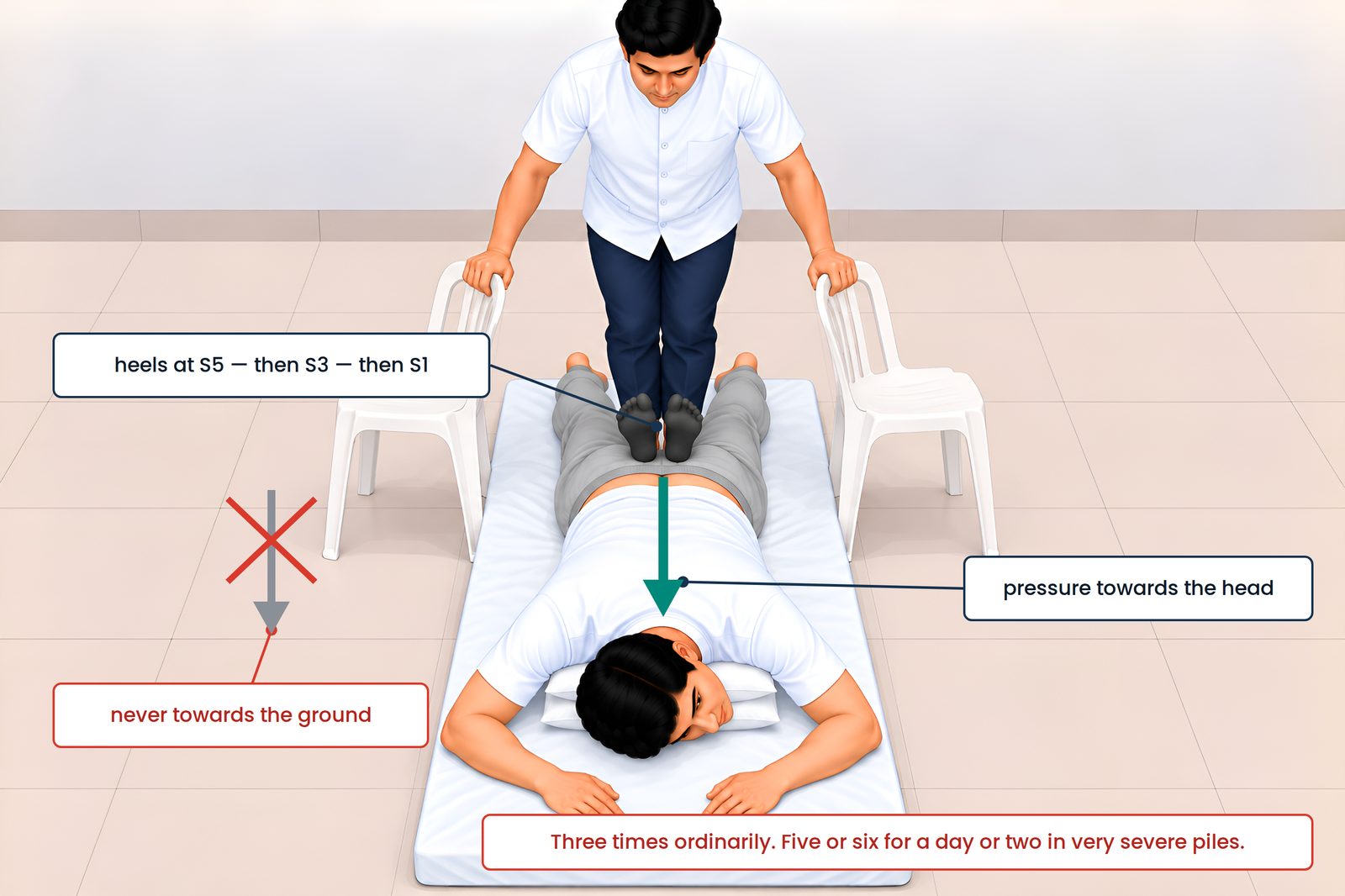
The treatment named for this family is the Triangle for Piles — so named because it is given for piles, and given across the triangle of the sacrum. It strengthens the muscles of the pelvis, and tightens the sphincters — of the urinary bladder, of the uterus, of the anal opening and so on.
Therefore, besides piles, it gives benefit in: anal fissure · fistula · prolapse of the rectum. It is also beneficial for control of urine in children and in the elderly — give it to children who wet the bed — and in women for prolapse of the uterus and for controlling excessive bleeding in the menses.
Two details of its giving are the instruction itself and must never be dropped: the pressure is in the direction of the head, and never in the direction of the ground — the chairs are placed so that this is what happens — and for an ordinary person three times is enough, but for very severe piles one may give five or six times for a day or two at first. Prone (Figure 10.3)
What is given, and what it strengthens
▲ Take care Do not give it to those who pass little urine.
Its neighbour on the same sacrum, S4–S5, is the exact opposite of the Triangle treatment: the heels draw and press the muscles inward and downward instead of jerking them upward, and it is given ordinarily twice — for obstructed urine, for high blood pressure, and to increase a scanty flow in the menses. Two treatments, one square of bone, opposite directions, opposite indications. The direction is not a detail of technique. It is the treatment. Both are taught in Face Down, "Face Down".
Straining, posture, and the act of passing stool
The seat, the squat, straining, and the urges that must not be held
The seat itself is a cause
The use of Western-type toilets does not aid easy defecation; it puts a strain on the bowels and on the bladder.
It belongs to a longer list of modern arrangements, each trivial alone and serious together:
Sitting for long hours in chairs with the legs hanging downwards is a major contributor to digestive disorders, because it interferes with proper blood flow to the abdominal organs.
Regular use of lifts and vehicles even for short distances robs the feet of much-needed exercise.
Setting out to work immediately after breakfast, lunch or dinner hampers digestion — and children who rush to school munching something on the way pay for it.
Eating standing up, as one must at a fast-food counter, leads to poor blood supply to the organs of digestion.
And behind all of them, tension and stress, which take their toll by frequently arousing the sympathetic nervous system and inhibiting normal parasympathetic activity — on which almost all the functions of the digestive system depend.
Each answers a question you will ask a constipated patient: what do you do all day, and where do you eat it?
What straining does, and what it becomes
A patient who strains is not merely uncomfortable. He is manufacturing the next disease. The pressure of a long forced push is taken by the vessels and the soft tissue at the anus — the mechanical half of how piles arise, how a tear becomes a fissure, and how the rectum is pushed down out of its place.
And it works the other way too. An uncontrollable urge on waking — sometimes so great that a patient cannot even wait to close the door — is often due to semi-solid stools; and behind it may lie a weak anal sphincter, probably an acquired habit of straining while passing stools, or else a congenital deficiency of folic acid. ▲ Take care
The man who strains at hard stools today is the man whose sphincter will not hold soft ones in ten years. The tightening treatment across the sacrum addresses the second half; only the patient's own habit addresses the first.
The questions to ask, and how to ask them
The second layer of the bowel interview, asked in the same voice
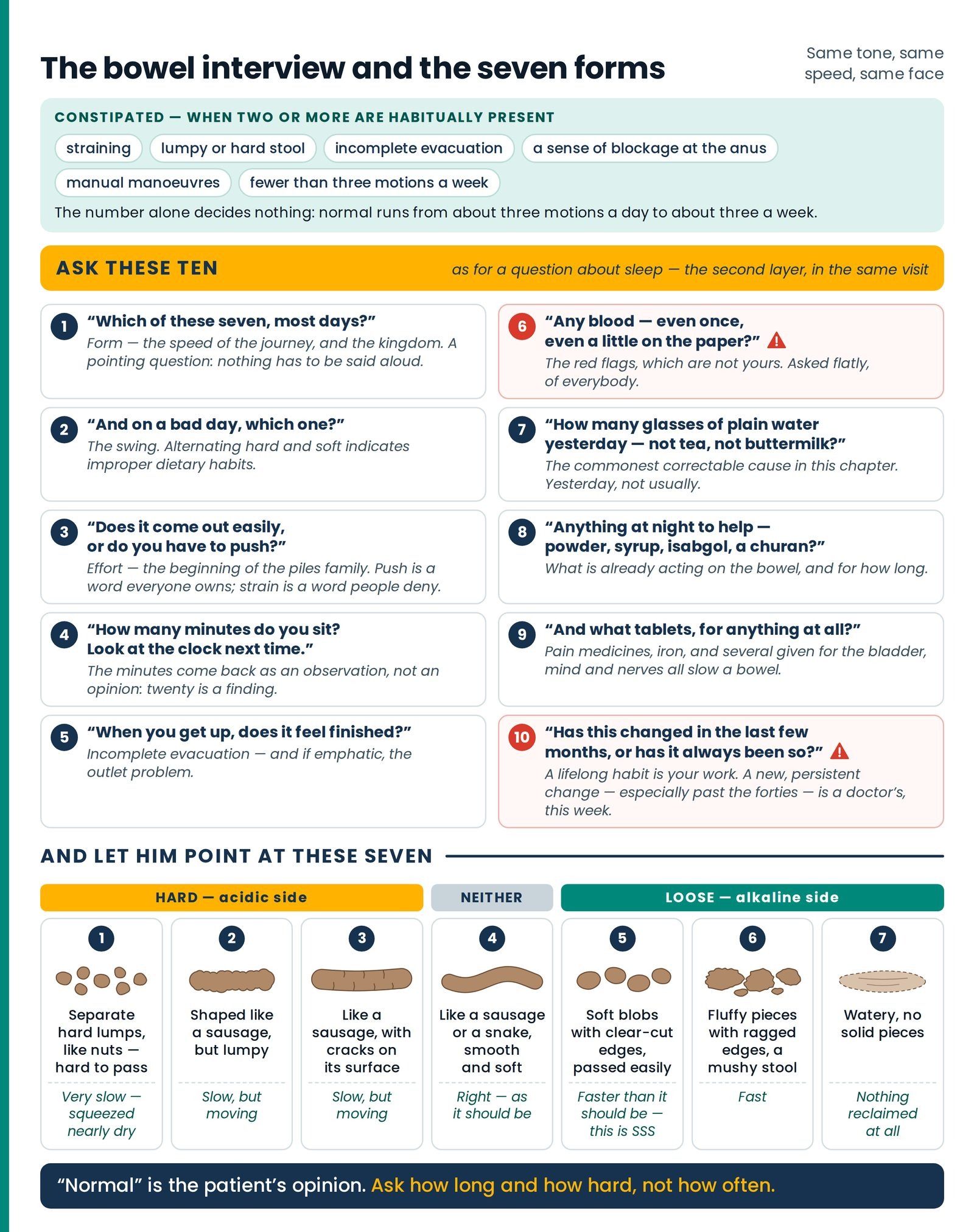
The Fire and the Ash gave you the five questions of the general stool interview and the elicitation script for undigested food. What follows is the second layer, asked in the same visit and in the same voice.
Three devices carry the interview. Show, do not ask — the chart turns a description into a pointing. Ask about yesterday, not about usually — usually returns the patient's self-image, yesterday returns an event. And ask the same thing twice, differently: "how often daily?" and, later, "once, or more than once?" are the same question, and the second gets a more accurate answer and makes the patient more responsive besides. A patient who insists irritably that everything is fine is met with no reaction and no irritation of your own — ignore the answer, just smile, and go politely on to the rest of the questions. (Figure 10.4)
Recording it, so that improvement can be shown
What goes on the card, and the order in which improvement arrives
Two bodies, read as this article teaches
A tailor operated twice for piles, and a boy who had stopped going
At a glance
The Triangle for Piles, and the bowel interview on one sheet
Questions students ask
- 1. I am nineteen and I would rather ask about anything else. How do I get through these ten questions? Put the chart on the wall and let it do half the work, then ask in exactly the voice you used for the question before and the one after. The patient reads your face, not your words: look apologetic and she learns the subject is shameful. Use her own words — kabz, push, how many minutes.
- 2. I am a retired bank manager, sixty-six, learning this for my wife. She says her motions are fine and gets annoyed when I ask. Do not fight her. An irritable patient insisting everything is fine is met with no reaction and no irritation — ignore the answer, smile, go on; then later ask the same thing in a different shape: not how are your motions but once, or more than once?
3. I am a housewife with no science at all. Why should drinking less water make a stool hard, if the stool is not made of water? Because the stool arrives at the colon as a soup and leaves it as a solid, and the colon's whole job in between is taking the water back. When you are short, the body closes its taps — the mouth goes dry, the urine dark and scanty, the skin stops sweating — and the anus is one of them. So the colon is thorough, and what reaches the end is squeezed dry.
4. I am a physician. You treat constipation and refer for a thyroid test in the same breath. Which is it? Both, in separate pockets. The observation — that constipation is a cardinal feature of a low thyroid — is correct, and it is the move most non-medical systems fail to make. What follows in a clinic is a blood test, because thyroid-driven constipation resolves when the gland is replaced. The abdominal work goes on alongside.
5. My patient's stool is soft and she still cannot get it out. Nothing I do helps. Probably nothing that is in your hands. Soft stool, long straining, a door held shut, sometimes fingers used — that is the outlet failing to open rather than the colon failing to deliver, and no abdominal work, water or formula corrects it. Say so honestly, refer for retraining of the pelvic floor, and go on with the rest of her treatment.
6. Why is Spl in a constipation treatment? The spleen has nothing to do with the bowel. It is not being given for the spleen. Every point is named for the chief organ of its region, but giving it raises blood flow in all the organs of that region — and above and to the left of the navel, besides the spleen, lie the left end of the transverse colon and the top of the descending colon. Read the names as addresses.
- 7. A patient tells me the treatment made her constipated. Did I do that? Very possibly, and it is the commonest self-inflicted wound here. Check whether you gave Gas Only and (10) Medulla without the Gas 'I' that must follow in a constipated patient: those two treble the stomach's acid and are the pair blocked in constipation. Students drop the instruction because it is written in a footnote.
- 8. I practise in a village with no laboratory. How much of this can I use? Almost all of it. The chart costs a sheet of paper, the ten questions four minutes, the water instruction nothing. What you must have instead of a laboratory is the discipline to send: blood, a new persistent change in habit, weight coming off, a pale greasy floating stool, a black stool no iron explains.
Questions patients ask
- 1. "My motions are absolutely normal. Why do you keep asking?" Because normal means something different to everyone who says it, and I need to know what it means to you. It takes a minute: look at this chart and tell me which one is yours, whether you have to push, and how long you sit. If all three are good I will never ask again.
- 2. "I drink plenty — tea, buttermilk, juice, all day long." All good things, and none of them water. Here a drink with anything in it is treated as food, and it cannot stand in for plain water. Count me the glasses of plain water you drank yesterday, and let us start from that number rather than from an impression.
- 3. "It's piles. It runs in my family. Everyone has it." It very likely does — and so does the way your family eats, sits and drinks. Piles sit at the end of a chain whose last three links are a hard stool, a long sit and a hard push. Those three we can change, and that is why an operation at the far end has held three years and not thirty.
4. "Do I have to have this test? My doctor already said everything is normal." Then that is good news and worth having — those reports have ruled out what they were designed to find. The one I am asking for is a different test, for the thyroid, asked because of the combination I am seeing: a very hard bowel with the slowness and the cold hands. It changes nothing I will do this week, and it may change a great deal about the next six months.
5. "Is it dangerous to take this powder every night? I have taken it nine years." I am not going to tell you to stop it: I did not start it, and nine years of anything is not stopped on my word. As your bowel begins working on its own you may find you need less — and when that day comes, take the packet back to the person who gave it to you and ask: "I am going daily without this now. Must I still take the same quantity?" That decision is his.
Words used here
| Hindi | English | Neurotherapy code / usage |
|---|---|---|
| कब्ज़ (kabz) | Constipation | A finding, not a disease; Const is the point that accompanies it |
| दस्त (dast) | Loose motions, dysentery | Dys — the mirror point on the right; blocked in constipation |
| मल (mal) | Stool, faeces | Read for form, colour, frequency, effort and content |
| बवासीर (bavāsīr) | Piles, haemorrhoids | Acidic side; Triangle given, Gas Only and (10) Medulla blocked |
| भगन्दर (bhagandar) | Fistula — a tunnel from bowel to skin | Same family, same blocking, same cause behind it |
| — | Anal fissure — a splitting around the anus | Same family; soften the stool before anything is tightened |
| मलाशय का नीचे उतर जाना | Prolapse of the rectum | Prolapse = any organ shifting from its place into another; from loose muscles |
| श्लेष्मा (śleṣmā) | Mucus, the mucous membrane | Mu — the membrane of the whole digestive tract; not Mu°, the left kidney |
| पानी (pānī) | Water | A glass half an hour after food, then hourly; no other drink substitutes. Roughage — रेशा — from vegetables and fruit with their skins |
| थायरॉइड | Thyroid gland | Thrd — the mistrī; a low thyroid gives hard constipation, with dullness in a child |
| — | SSS | Semi-solid stools — soft but not diarrhoea; the answer most patients call good health |
| — | Blocking | Marking on the card the points not to be given for this condition; lifted when the chief symptoms end |