- Category
- Digestion, stomach and bowel · Women's health
- What is given
- P point — given only to those women in whom sonography shows a prolapse has occurred; WD; Round Normal; Round Arrow; Ton 'P' — unmatched for setting it back in its place; Triangle for piles; (1)/(2) Acid
- What must come first
- Immediately after P point, (6) WD is necessary — otherwise that woman will have still more trouble. Written on the card as one line, P point → (6) WD. Do not begin P point at the end of a session
- What is barred
- Gas Only · (10) Medulla. Ton 'P' not to a woman who still wishes to bear children. Triangle not to those who pass little urine. The symptoms named are severe pain below the navel and in the back, white discharge, irregular menstruation, and infertility because of the low temperature of the body
- Explained in
- Uncommon Problems
Watch


From Treating Women
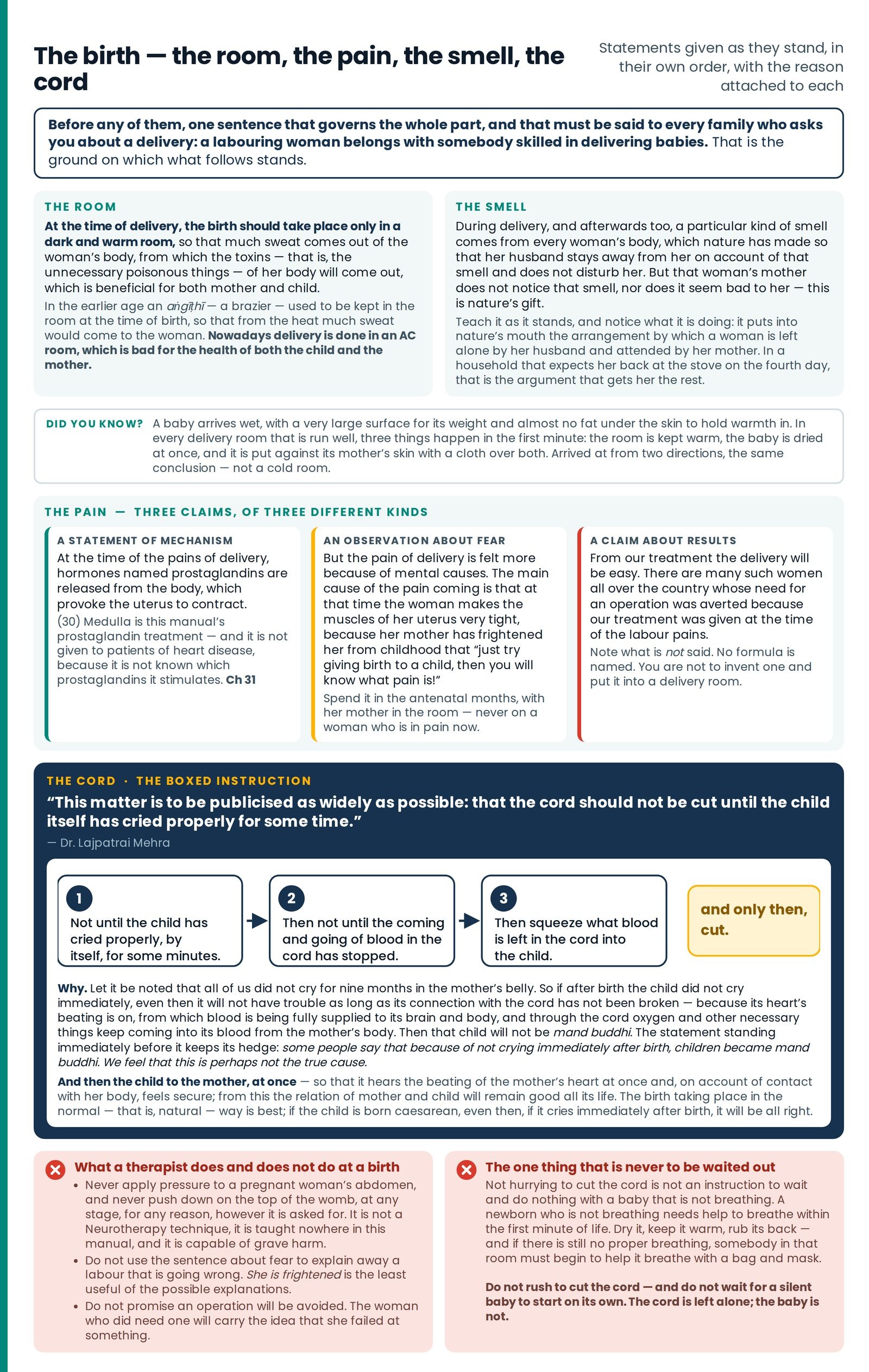
The cord
Not until it has cried; not until the blood stops moving; then squeeze
The birth, and the two warnings that are given before it
The birth of the child taking place in the normal — that is, natural — way is best. If the child is born caesarean, even then, if it cries immediately after birth, it will be all right.
(The doctor has to give two warnings to the nurse and the āyā before the delivery itself.)
One: that they should not cut the child's cord until the child cries properly by itself for some minutes.
Even after it has cried, the cord should not be cut until the coming and going of blood in the cord stops.
And before cutting, the little blood that is inside the cord should be pressed or squeezed into the child's body, and only after that should it be cut.
Three separate instructions about one cord, in order, and each has its own condition: (Figure 40.4)
Not until the child has cried properly, by itself, for some minutes.
Then not until the coming and going of blood in the cord has stopped.
Then squeeze what blood is left in the cord into the child, and only then cut.
And the reasoning behind the whole of it is set apart, in its own bordered panel at the foot of the page, as the thing this material most wants carried out of the room.
The boxed instruction — why the cord is not cut early
Let it be noted that all of us did not cry for nine months in the mother's belly. So if after birth the child did not cry immediately, even then it will not have trouble as long as its connection with the cord has not been broken — because its heart's beating is on, from which blood is being fully supplied to its brain and body, and through the cord oxygen and other necessary things keep coming into its blood from the mother's body. Then that child will not be mand buddhi.
This matter is to be publicised as widely as possible: that the cord should not be cut until the child itself has cried properly for some time.
And the statement that stands immediately before it, with its hedge intact: some people say that because of not crying immediately after birth, children became mand buddhi. We feel that this is perhaps not the true cause of that child becoming mand buddhi.
The child to the mother, at once
In the Hindu scriptures it is said that after birth the child should be brought to the mother immediately, so that it hears the beating of the mother's heart at once and, on account of contact with her body, feels secure. From this the relation of mother and child will remain good all its life.
That instruction is about the mother as much as about the child, which is why it stands here and not in the next article. Everything that follows it on that page — the antiseptic fluid the child has lain in, the wrinkles, the wrapping, why the first bath is delayed and the washing done slowly over seven days, the child lifted with both hands, what is given when the teeth are coming — belongs to The Child, the Elder and the Frail, "The Child, the Elder and the Frail", and is taught there whole. The mother is this article's; the baby is the next article's.
The mother's milk, and the child's opened hand
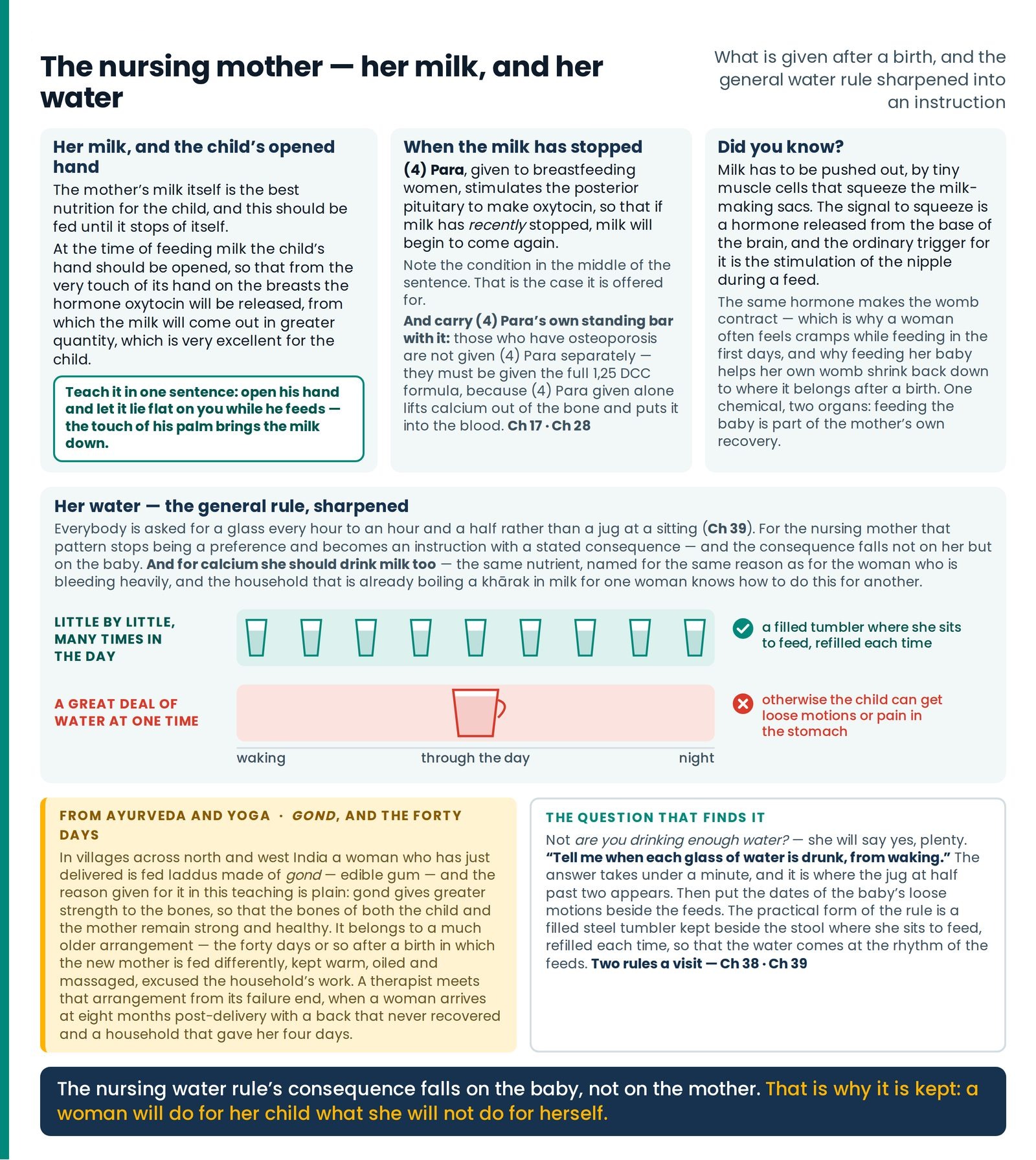
The mother's milk itself is the best nutrition for the child, and this should be fed until it stops of itself.
At the time of feeding milk the child's hand should be opened, so that from the very touch of its hand on the breasts the hormone oxytocin will be released, from which the milk will come out in greater quantity, which is very excellent for the child.
Two instructions, and the second is the one nobody has heard before and everybody can do tonight. A baby feeds with its fists closed against its own chest; the instruction is to open the hand and let the palm rest against the mother, and the stated consequence is more milk, by way of a named hormone.
Teach it to the mother directly, in one sentence: open his hand and let it lie flat on you while he feeds — the touch of his palm brings the milk down. It costs nothing, it is easy to remember, and it gives a tired woman something to do that is not being corrected. Seated
The nursing mother's water — the general rule, sharpened
Such women should drink water little by little many times in the day, instead of drinking a great deal of water at one time — otherwise the child can get loose motions or pain in the stomach.
For calcium they should drink milk too.
This is the rule Food as Medicine gave you bare, and here is the context it belongs in: it is an instruction to a woman who is feeding a child, and the consequence it names falls not on her but on the baby — loose motions or pain in the stomach. (Figure 40.5)
Read beside the general water rule, it is the same pattern pressed harder. Everybody is asked for a glass every hour to an hour and a half rather than a jug at a sitting; for the nursing mother that pattern stops being a preference and becomes an instruction with a stated consequence. And the practical form is the same one that works for everyone: a filled tumbler where she sits to feed, refilled each time, so that the water arrives at the rhythm of the feeds and not in one gulp at two o'clock when she suddenly notices she is parched.
And milk, for calcium. That is the second half of the instruction and it is given to the nursing woman as it is given to the woman who is bleeding heavily — the same nutrient, named for the same reason. A household that is already boiling a khārak in milk for one woman knows how to do this for another.
When the milk has stopped
(4) Para, given to breastfeeding women, stimulates the posterior pituitary to make oxytocin, so that if milk has recently stopped, milk will begin to come again.
Note the condition in the middle of the sentence: if milk has recently stopped. That is the case it is offered for.
And carry (4) Para's own standing bar with it, because it travels with the point everywhere: those who have osteoporosis are not given (4) Para separately — they must be given the full 1,25 DCC formula, because (4) Para given alone lifts calcium out of the bone and puts it into the blood.
Uterine prolapse — what is barred and what is given
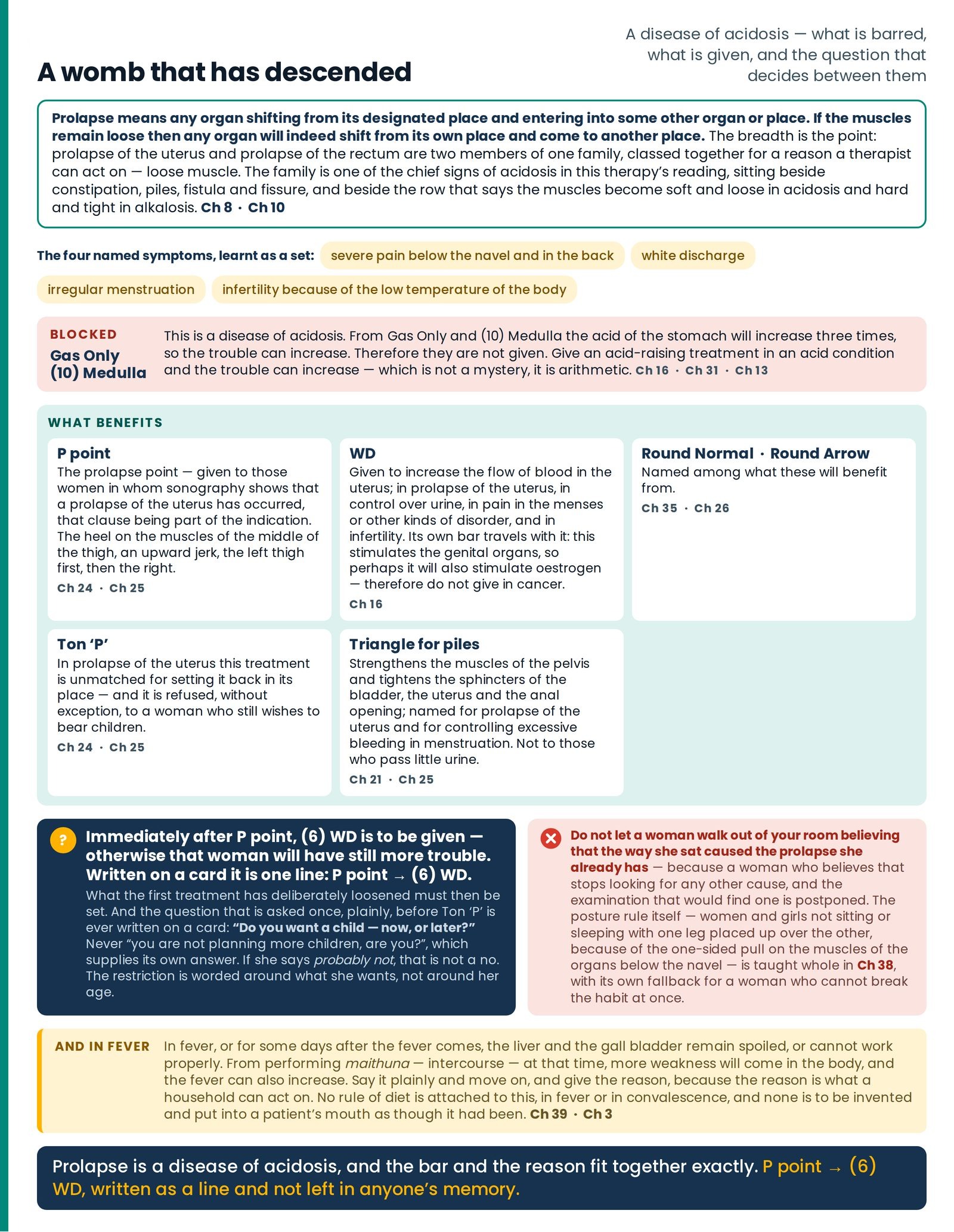
Blocked: Gas Only, (10) Medulla.
This is a disease of acidosis. From Gas Only and (10) Medulla the acid of the stomach will increase three times, so the trouble can increase. Therefore they are not given.
These will benefit from P Point, WD, Round Normal, Round Arrow and so on.
Ton 'P' may also be given to them — but to those women who still wish to bear children, Ton 'P' is not to be given.
The bar and the reason fit together exactly, and a student who has read The Two Kingdoms will see it at once. Prolapse is classed as an acid condition. Gas Only and (10) Medulla are the two treatments whose chief effect is stated as the acid of the stomach will increase three times. Give an acid-raising treatment in an acid condition and the trouble can increase — which is not a mystery, it is arithmetic. (Figure 40.6)
What is given is a short list and every member of it is taught elsewhere:
P point, the prolapse point — given to those women in whom sonography shows that a prolapse of the uterus has occurred, that clause being part of the indication. The heel on the muscles of the middle of the thigh, an upward jerk, the left thigh first, then the right. Prone Left Right And the instruction that must never be separated from it: immediately after this treatment, (6) WD is to be given — otherwise that woman will have still more trouble, because what the first treatment has deliberately loosened must then be set. Written on a card it is one line: P point → (6) WD.
WD in its own right — given to increase the flow of blood in the uterus in women, and to be given in prolapse of the uterus, in control over urine, in pain in the menses or other kinds of disorder, and in infertility. Its own bar travels with it: this stimulates the genital organs, so perhaps it will also stimulate oestrogen — therefore do not give in cancer. Note the hedge inside the prohibition, and that the bar is drawn anyway, in the restrictive direction.
Round Normal and Round Arrow — see also → Water and Salt, "Water and Salt", which owns Round Normal, and How a Formula Is Built, "How a Formula Is Built", for the Ch. Only / Round arrow pairing and the notation.
Ton 'P', of which it is said that in prolapse of the uterus this treatment is unmatched for setting it back in its place — and which is refused, without exception, to a woman who still wishes to bear children.
The symptoms named for prolapse of the uterus are: severe pain below the navel and in the back, white discharge, irregular menstruation, and infertility because of the low temperature of the body. Learn those four as a set, because they arrive together and because three of them will otherwise be treated as three separate complaints.
Two further treatments bear on this territory and belong to their own articles. Triangle for piles strengthens the muscles of the pelvis and tightens the sphincters of the bladder, the uterus and the anal opening, and is named for prolapse of the uterus and for controlling excessive bleeding in menstruation — with its own bar, not to those who pass little urine. And where an older woman loses a few drops of urine on laughing or sneezing, because the muscles below the navel have become loose, see also → Cranial Nerve and Brain Formulas, "The Twelve Messengers", which carries the treatment built for it, and Face Down, "Face Down", for Triangle for piles and (2) S4, S5 taught side by side.
And the posture rule that stands behind the whole family — women and girls not sitting or sleeping with one leg placed up over the other, because of the one-sided pull on the muscles of the organs below the navel — is taught whole in Between Two Sessions, "Between Two Sessions", with its own fallback for a woman who cannot break the habit at once. It is not repeated here. What belongs here is the warning that goes with it, in one line, because it is this article's patient who is at risk from it: do not let a woman walk out of your room believing that the way she sat caused the prolapse she already has — because a woman who believes that stops looking for any other cause, and the examination that would find one is postponed.
One statement about fever was begun in Food as Medicine and deliberately left half-taught, because its second half is a rule of conduct and belongs here.
In fever, the liver and the gall bladder — and what follows from it
In fever, or for some days after the fever comes, the liver and the gall bladder remain spoiled, or cannot work properly.
From performing maithuna — intercourse — at that time, more weakness will come in the body, and the fever can also increase.
That is the whole statement, and the two halves rest on one another. The organs that deal with food are not working properly; the body is therefore short of what it would ordinarily have; and a demand made on it at that time is a demand it cannot meet. No rule of diet is attached to this, in fever or in convalescence, and none is to be invented and put into a patient's mouth as though it had been.
The companion rule, from the same page, is a rule of the night meal, and it too has two halves: the night meal taken so that there is a gap of at least two hours before sleeping, so that food eaten in solid form becomes thin like water and is digested properly — and if intercourse is performed immediately after eating, then both husband and wife will get a gastric problem, because the blood which is needed for the digestive system is being used for other functions. Both halves are taught whole in Between Two Sessions, "Between Two Sessions", with the clock they produce; and the kitchen's side of the same rule is Food as Medicine's. They are named here only so that a student looking for them knows where they live.
Two practical notes on teaching rules of this kind, since this article is where they cluster.
Say them plainly and move on. A rule about intercourse delivered with embarrassment is a rule the patient will decline to discuss further, and the next thing she needs to tell you will go unsaid. It is one line, in the same voice as the line about the night meal, and then you are on to the next thing.
Give the reason, because the reason is what a household can act on. The blood that your digestion needs is being used somewhere else is a sentence two people can understand in four seconds. It is not allowed is a sentence that produces nothing but a nod.
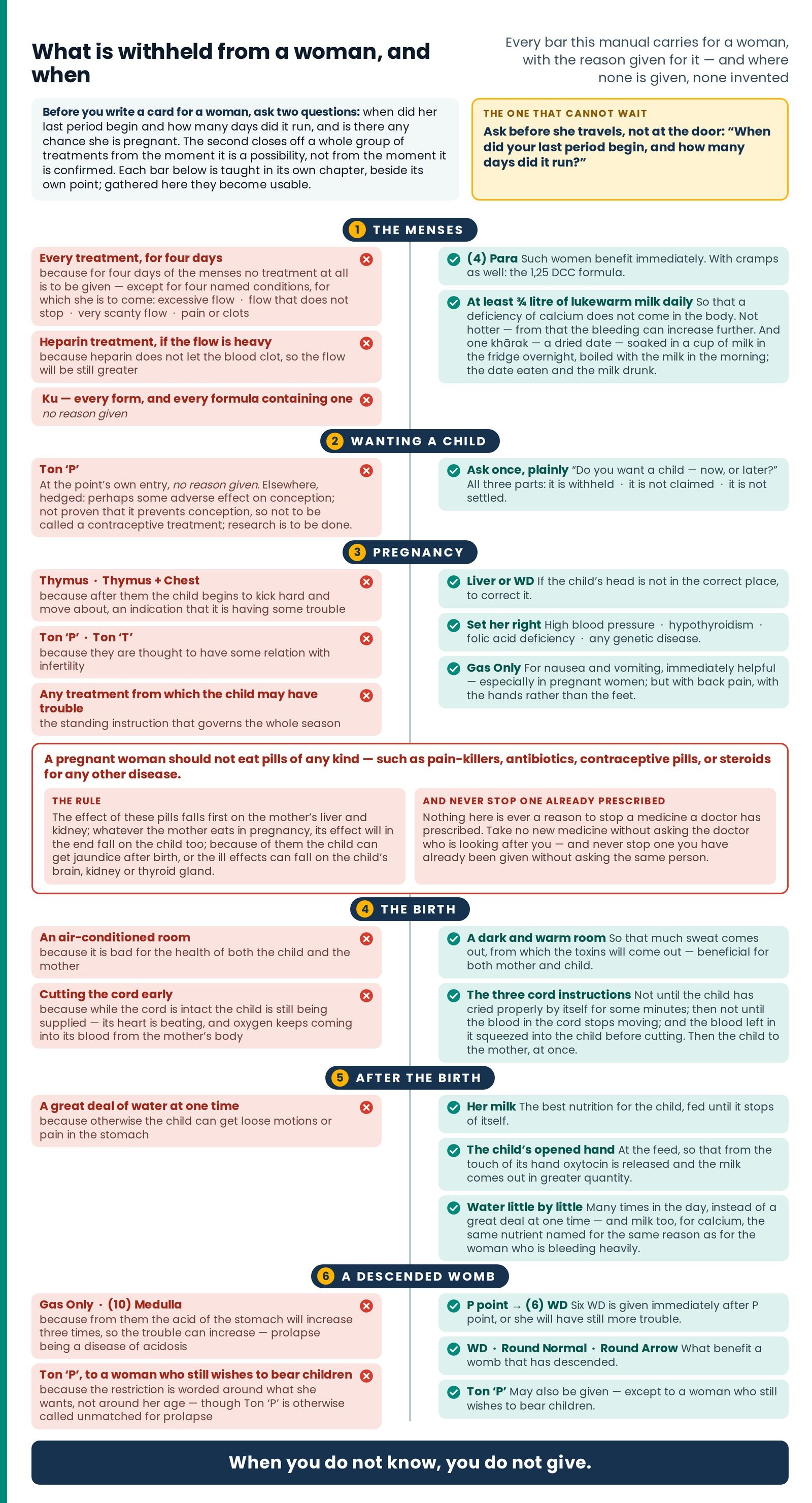
This is the page this article exists for.
Each of these bars is taught in its own article, beside its own point, where it belongs. Gathered here, they become usable: before you write a card for a woman, run your eye down the first column and see whether any of it applies today. (Figure 40.7)
Table 2 — Withheld because of the state she is in
| The point or formula | Withheld from | The reason given | Where the point is taught |
|---|---|---|---|
| Every treatment | A woman during the first four days of her menses — except for the four named conditions | No reason given | Between Two Sessions; and Part two above |
| Every heparin formula — P., A., G., J., M., T., TT., X., PT., F., Anti-F., Multi | A woman whose menstrual flow is heavy | Heparin does not let the blood clot, so the flow will be still greater | The River — Heparin |
| Ku — every form, old Kundali and (½) Ku alike, and every formula containing one | Women during menstruation | No reason given. None is to be invented | Face Down · Each Point in Use · Clearing the Ash |
| Any treatment from which the child may have trouble | Pregnancy, in general | Stated as the governing rule of the whole season | Part three above |
| Thymus, Thymus + Chest | Pregnant women | After giving this, the babies begin to move about vigorously, from which it may be judged the baby is experiencing discomfort | The Front of the Body II · Each Point in Use |
| Ton 'P' | Pregnancy; and women who wish to become mothers, at any age | At the point's own entry, no reason. Elsewhere: perhaps some adverse effect on conception; it is not proven that it prevents conception, so it is not to be called a contraceptive treatment; research is to be done | Uncommon Problems · Each Point in Use · Fire and Swelling |
| Ton 'T' | Pregnancy; and young people up to the age of bearing children, especially women | The parotid glands have some relation with the testes — in mumps, some boys' testes disappear and they cannot become fathers; therefore it is thought Ton (P) and Ton (T) have some relation with infertility | Uncommon Problems · Each Point in Use |
| Lt. Ov., Rt. Ov. | Girls and boys whose height is low, or who are being treated to increase height | Oestrogen and progesterone provoke the epiphyseal line to close early; if it has closed, the height will not increase | The Front of the Body II · Each Point in Use · The Child, the Elder and the Frail |
| WD | The teenage years | It provokes the genital organs, so from that too perhaps oestrogen will be made | The Front of the Body I · Each Point in Use |
| (6) Medulla | Boys and girls between 13 and 20 who come for treatment to increase height — unless there is special need | Somatostatin stops growth hormone, so perhaps an obstruction may arise in the increase of height | The Medulla Family |
| Lt. Ov. | Cancer | Cancer arises from excess oestrogen | The Front of the Body II · Each Point in Use |
| Rt. Ov. | Cancer | Rt. Ov. also makes 20% oestrogen | The Front of the Body II · Each Point in Use |
| WD | Cancer | It stimulates the genital organs, so perhaps it will also stimulate oestrogen | The Front of the Body I · Each Point in Use |
| Gas Only | Uterine prolapse | The acid of the stomach will increase three times, so the trouble can increase — prolapse being a disease of acidosis | The Front of the Body I · From Findings to a Plan |
| (10) Medulla | Uterine prolapse | The same — the acid of the stomach will increase three times | The Medulla Family · From Findings to a Plan |
| Ton 'P' | A woman with prolapse who still wishes to bear children — though Ton 'P' is otherwise called unmatched for prolapse | As above | Uncommon Problems · Each Point in Use |
| (2) Para | A woman whose low BP came on suddenly from a miscarriage or from heavy bleeding in the menses | Not stated for the bar itself; the direction is given instead — they are to be given only the Angiotensin #2 formula | Water and Salt |
| (4) Para given separately, by itself | Osteoporosis — met most often in women after the menopause | Given alone it lifts calcium from the bone and puts it into the blood. They must be given the full 1,25 DCC formula | The Front of the Body II · Correcting the Two Kingdoms |
| The feet, as the tool | A pregnant woman with back pain who needs Gas Only for nausea or vomiting — a modification, not a bar | It is better to give the treatment with the hands rather than the feet | The Front of the Body I; Part three above |
Table 3 — Bars that ride on the treatments used for women's complaints
These do not turn on her being a woman. They turn on the treatment you have reached for — and because these are the treatments this article keeps sending you to, they are gathered here too.
| The treatment | Reached for in | Its own bar | Where it is taught |
|---|---|---|---|
| (30) Medulla | PMS — heaviness in the breasts before the period, ended after 1 or 2 treatments; and pain in the menses | Not given to patients of heart disease, because it is not known which prostaglandins it stimulates | The Medulla Family |
| Triangle for piles | Prolapse of the uterus; controlling excessive bleeding in menstruation | Not to those who pass little urine | Face Down · Each Point in Use |
| (2) S4, S5 | Increasing a scanty flow in the menses; obstructed urine | Not to those who pass too much urine | Face Down · Each Point in Use |
| (1) Acid / (2) Acid | Reducing heavy menstrual bleeding; prolapse of the uterus or rectum | Not if there are loose motions, or if there is no pain at Mu° | On the Side · Each Point in Use |
| (4) Thrd 'P' (followed by (6) Rt. Ov. or (6) Lt. Ov.) | Absence of menses and other disorders of the menses, by FSH/LH | Not where the osteoblasts are hyper — bamboo spine, spur, or bone grown anywhere unwanted | The Front of the Body II · Each Point in Use |
| Gas Only | Nausea and vomiting in pregnancy | Not to those with an ulcer in the stomach or duodenum. With constipation, piles or fistula, Gas 'I' must be given with it | The Front of the Body I · Each Point in Use |
| P point | Prolapse of the uterus, shown on sonography | (6) WD must be given immediately after, or the woman will have still more trouble | Uncommon Problems · Each Point in Use |
What follows is the woman's half of the patient's day and month, laid out in the order in which things happen, with the reason beside every line — written to be read aloud across the mat, and handed over afterwards, not instead.
Two rules a visit.
Table 4 — What to tell a woman, and why
| When | What to do | Why |
|---|---|---|
| Before your first visit | Treatment is not given during your period — but if your bleeding is very heavy, or will not stop, or is very scanty, or is painful, then come because of that, and we will treat that. | It is not that your period makes you unwelcome. It is that on those four days we treat nothing else — and those four complaints are things this therapy treats. |
| Every visit | Tell us when your last period began and how many days it ran. And tell us at once if there is any chance you are pregnant. | Both change what may be given. Pregnancy closes off a whole group of treatments from the moment it is a possibility, not from the day it is confirmed. |
| During the four days | No treatment at all — not the knee, not the back, not the course you are in the middle of. | The course pauses for four days and then goes on. Nothing is lost. |
| If your flow is heavy | At least three-quarters of a litre of milk a day — lukewarm. Not hot. | So that a deficiency of calcium does not come in your body. If the milk is hotter than lukewarm, the bleeding can increase further. |
| At night put one khārak, a dried date, into a cup of milk and keep it in the fridge. In the morning boil the milk with the khārak. Eat the khārak and drink the milk as well. | It is part of the same day's milk, not extra to it. | |
| Tell us if you are soaking a pad every hour, or passing very large clots, or feeling faint. And any bleeding at all after your periods have stopped for good is to be looked at by a doctor. | We will keep treating you either way. But some things need somebody who can look, and I cannot look. | |
| If you are pregnant | Say so before you lie down, not afterwards. | Some treatments are not given at all in pregnancy, and one is given with the hands instead of the feet if your back hurts. |
| Take no new medicine in pregnancy without asking the doctor who is looking after you — and never stop one you have already been given without asking the same person. | Both halves matter. Stopping a tablet you were given can do the child exactly the harm the rule is worried about. | |
| Tell us if you have blood pressure, a thyroid problem, or anything that runs in the family. | Those are named as things to be set right during the pregnancy, not left. | |
| Around the birth | A dark and warm room — not an air-conditioned one. | So that much sweat comes out of the body; it is said to be beneficial for both mother and child. An air-conditioned room is bad for both. |
| Say to the nurse before the delivery: do not cut the cord until the baby has cried properly by itself for some minutes; then not until the blood in the cord has stopped moving; and squeeze what blood is left in the cord into the baby before cutting. | While the cord is beating, blood and oxygen are still reaching the baby from you. This is to be told as widely as possible. | |
| Ask for the baby to be brought to you at once. | So that it hears your heartbeat straight away and feels safe from your body's touch — and the bond between you holds for life. | |
| After the birth | Your milk is the best food for the child. Feed until it stops of itself. | It is said plainly, and nothing replaces it. |
| While feeding, open the baby's hand and let the palm rest against you. | From the touch of its hand, the hormone oxytocin is released, and more milk comes. | |
| Drink water little and often through the day — never a jug at one sitting. | Otherwise the child can get loose motions or pain in the stomach. | |
| Drink milk too, for calcium. | The same reason as for heavy bleeding: so that calcium does not run short. | |
| Tell us if your milk has recently begun to reduce. | There is a treatment given for milk that has recently stopped, and it works best while it is recent. | |
| Every day, all your life | Do not sit or sleep with one leg over the other. If you cannot stop at once, keep changing which leg is on top. | A one-sided pull comes on the muscles below the navel — the womb and the ovaries among them — and the blood circulation there is spoiled. Sleep with the legs straight. |
| In a fever | Rest, and no intercourse during it or for some days after. | In a fever, and for some days after it comes, the liver and the gall bladder cannot work properly. More weakness will come, and the fever can also increase. |
| At night | Finish eating at least two hours before you lie down, and not intercourse straight after a meal. | So that solid food has time to become thin like water and be digested. Straight after a meal, the blood the digestion needs is being used elsewhere, and both husband and wife get a stomach problem. |
Also explained in
- Piles, fissure, fistula and prolapse — one family, not four diseases What the Bowel Tells You
Three conditions carry pain at Mu° with them: prolapse of the rectum — the rectum coming down from its place; prolapse of the uterus — the womb coming down from its place; and hernia — an organ shifting from its fixed pl
- TRIANGLE FOR PILES — ट्रायंगल फॉर पाईल्स Face Down
It is also beneficial for control of urine in children and in the elderly, and in women for prolapse of the uterus and for controlling excessive bleeding in menstruation.
- The navel, the womb and the paralysed limb Each Point in Use
'P' point — the prolapse point This is given to those women in whom sonography shows that a prolapse of the uterus has occurred — that is, her uterus has moved from its place.
- The two directions, symptom by symptom The Two Kingdoms
Table 1 — The complete picture of the two directions Typical picture of the ACIDIC patient Left Typical picture of the ALKALINE patient Right The points Pain at the Mu° pain point and at the Acid point · pain in the r
- What the table's own footnotes carry The Two Kingdoms
Slackness automatically sets the stage for herniation, for prolapse of the uterus, for prolapse of the rectum — again, the same slackness at different doors.
- What travels with each direction The Two Kingdoms
In each of these, pain has been found at Mu°: prolapse of the rectum, the rectum coming down from its place; prolapse of the uterus, the womb coming down from its place; hernia, an organ shifting from its fixed place and
- Reading the stool What the Bowel Tells You
On the hard end: constipation, piles, fissure at the anus, fistula, pimples, dandruff and scaling, hair falling or greying before its time, prolapse of the uterus or of the rectum.
- At a glance What the Bowel Tells You
Piles, anal fissure, fistula and prolapse of the rectum are all diseases of acid, one chief cause being hard constipation; prolapse of the rectum, prolapse of the uterus and hernia are three different diseases with one t
- The reports that change nothing, and the discipline of saying so Reading the Reports
A prolapse of the uterus seen on sonography decides a treatment after which (6) WD is necessary — otherwise that woman will have still more trouble ▲ Take care (Treating Women); a blockage in the Ampoulla of Vater, which
- The two kidneys and the two directions Each Point in Use
For the symptoms of acidity — piles, constipation, fistula, fissure, and prolapse of the uterus or of the rectum from its place.
- The points of immunity Each Point in Use
Besides this, in prolapse of the uterus — if the uterus moves from its place — this treatment is unmatched for setting it back in its place But from this there may perhaps be some adverse effect on conception.
- The points of generation Each Point in Use
To be given in prolapse of the uterus, in control over urine, in pain in the menses or other kinds of disorder, in infertility and the like.
- Two cases from the reference Each Point in Use
The sonography mattered, and mattered specifically, because P point is given to those women in whom sonography shows that a prolapse of the uterus has occurred — the imaging is written into the indication itself.