Watch


Why (½) Ku – 20 seconds is given in a treatment for undigested food
The white cells, the ACTH, and the seconds that are the dose
This is the question part IV of OLD UDF raises, and it is answered at length because the answer governs six of the formulas still to come.
When someone gets UDF, then in his body there will be infection in a great many organs. And from this treatment it has been found that wherever in the whole body there is infection or inflammation — whether it be in the kidney or in the intestines — all are put right.
To explain how that happens, the functions of the WBCs — the white cells of the blood — were studied closely, and the inference drawn from them is set out below. It is a theory, and it is offered as one.
In our body there are many cells to fight infection, which fight infection in different ways. Chief among them are monocytes and granulocytes.
Table 14 — The white cells, and what each is held to do
| Cell | What it does |
|---|---|
| Monocytes | Cannot work in the blood — they can remain alive only 8 to 10 hours in the ECF, the extracellular fluid. But when they come out through the pores of the capillaries and enter into tissue, they can remain alive even up to ten years. When any infection occurs, monocytes come out from the tissues and fight the antigen, and themselves die. But before dying they kill at least 20 to 50 antigens. These will work in both — whether it be infection or inflammation |
| Granulocytes | Of three kinds — neutrophils, eosinophils and basophils |
| Neutrophils | Very powerful inside the blood. They can kill even cancer-like cells in the blood |
| Eosinophils | They make a highly reactive form of oxygen — a very powerful form — which will finish every kind of bacteria. This works like ozone, that is, pure oxygen. But they can work only inside the blood. They cannot enter inside the tissues |
| Basophils | Their quantity in the blood is 0–1%, that is, very little indeed. But Neurotherapy gets much benefit from this. When the body cannot combat some infection, then it changes into inflammation. When we give the Ku treatment, then it must be provoking, through the hypothalamus, the pituitary gland to make ACTH — which will provoke the adrenal gland to make cortisol, to stop that inflammation |
And then the sentence that makes the whole passage a piece of clinical humility rather than a claim.
What (½) Ku – 20 seconds is held to do
(½) Ku – 20 seconds — after giving it, whether it provokes the granulocytes, or the monocytes, or the ACTH — that is the body's work to see.
From this treatment, whether there is infection or inflammation in the body, it will be finished.
Read the first sentence again. The therapy does not claim to know which of the three routes the treatment takes. It names three possibilities, declines to choose between them, and hands the choosing back to the body. That is how the instruction stands, and it is not to be tidied into a mechanism.
Eosinophils, asthma, and a treatment named in passing
Attached to the note on eosinophils is a second observation with a formula in it, and it is easy to miss.
Eosinophils destroy parasitic organisms. They release chemicals that cause bronchoconstriction in asthma — that is, narrowing of the airways. From infection in the lungs, eosinophils increase.
And therefore: for bronchial asthma, that is bronchitis — the treatment is (6) Right Swt.
Right, not left.
The seconds, and what the suffix is doing
(½) Ku is a named half-form of the point, not half a count, and the number written after it is seconds of a single sustained press — not applications. Table 13, How a Formula Is Built. The manoeuvre is always the same; only the number changes.
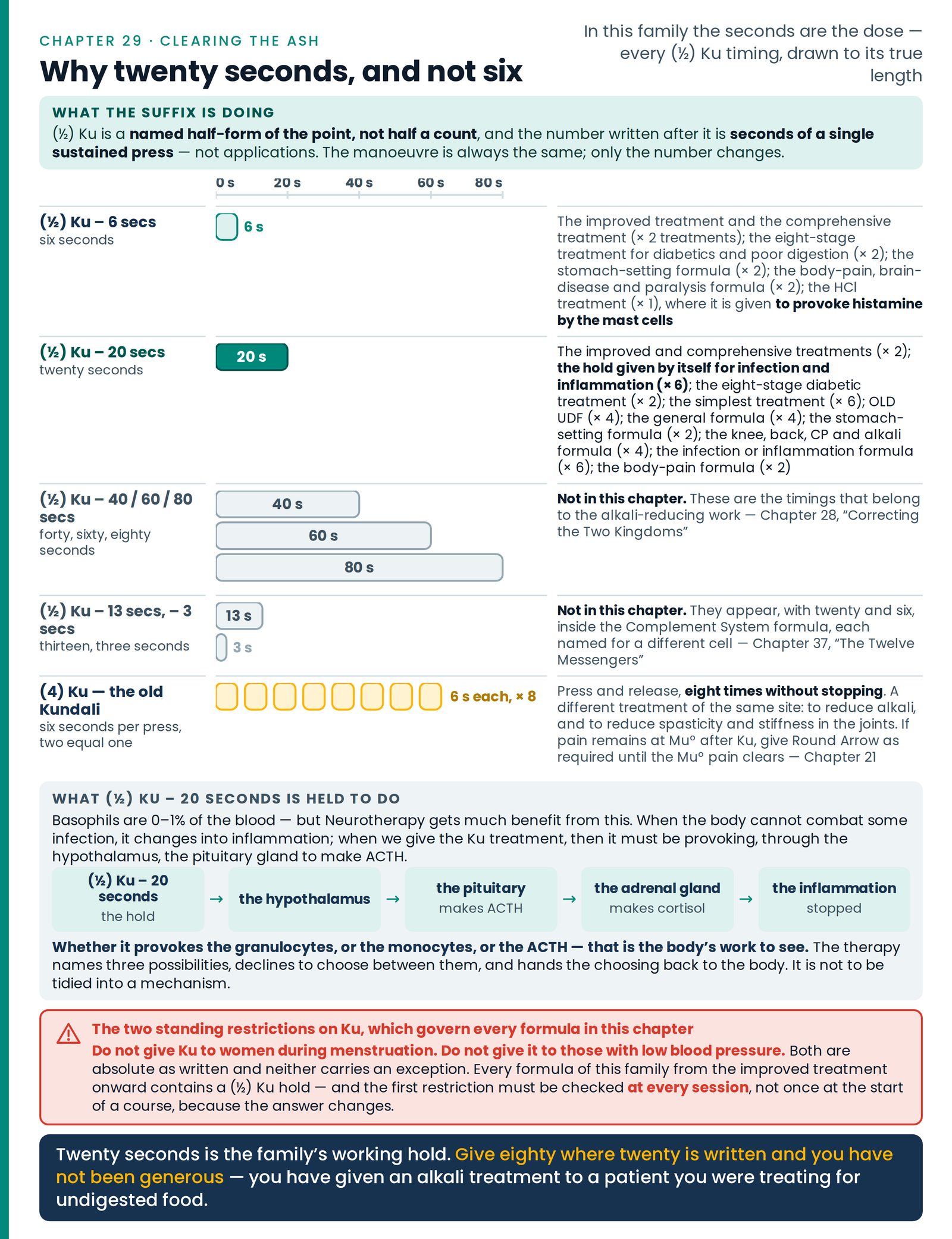
The point to carry away is that the seconds are the dose. Twenty seconds is the UDF family's working hold; six seconds is what is added when a second, shorter provocation is wanted in the same course; and the longer holds belong to another family of treatment altogether. Give eighty seconds where twenty is written and you have not been generous — you have given an alkali treatment to a patient you were treating for undigested food. (Figure 29.4)
Generation seven — the symptom-matched formulas
One spine, four formulas, and a closing step set by the bowel
Up to here the family has one general-purpose member. From here it splits, and the split is made on the patient's tendencies — what his bowel does, whether there is infection, whether he is a child with CP, whether his alkali has increased.
Before any of them, the rule that governs all four.
The rule that governs the whole group
Along with UDF, different formulas have been made for correcting different symptoms. In every formula, the presence of (10) Medulla and Gas Only is necessary and compulsory.
Some of the chief formulas among them are given below, which bring benefit to everybody.
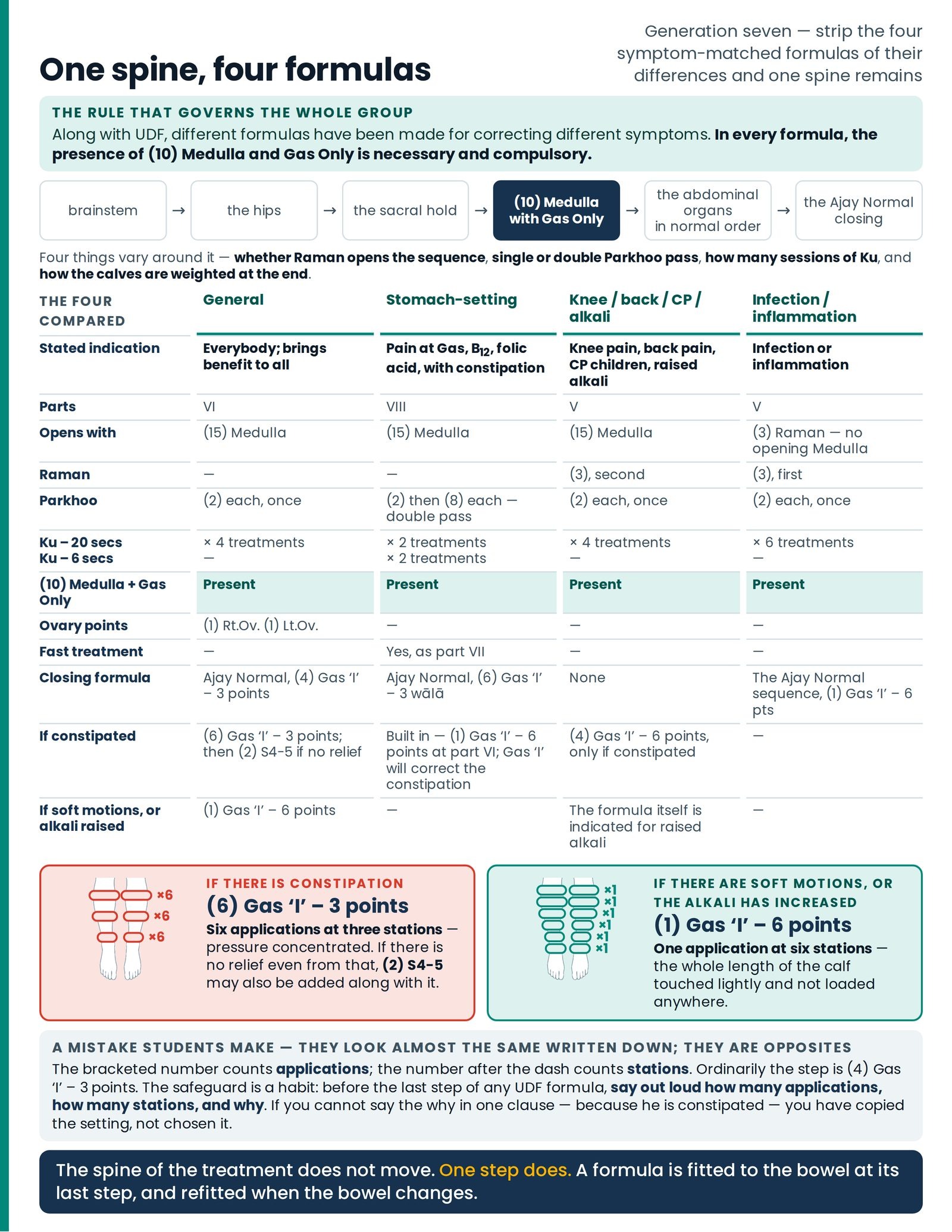
Strip the four formulas of their differences and one spine remains, always in this order: brainstem → the hips → the sacral hold → (10) Medulla with Gas Only → the abdominal organs in normal order → the Ajay Normal closing. Four things vary around it — whether Raman opens the sequence, whether the Parkhoo pass is single or double, how many sessions of Ku, and how the calves are weighted at the end. Learn the spine and the four formulas become four small decisions rather than four lists. (Figure 29.5)
The general UDF formula
Table 16 — Card: the general UDF formula Seated Side-lying Prone Supine 6 sec
| Written | I (15) Medulla · II (2) Rt Parkhoo (2) Lt Parkhoo · III (½) Ku – 20 secs × 4 treatments · IV (10) Medulla (1) Gas Only – 6 points · V (1) Gal (1) Spl (1) Liv – 3 points (1) Mu – 3 points (1) Rt.Ov. (1) Lt.Ov. · VI Ajay Normal → (8) Pan (1) Gal (2) Liv – 3 points (4) Gas 'I' – 3 points |
|---|---|
| Stated indication | Everybody. It is the member of the group written to bring benefit to all |
| Part I | (15) Medulla, seated Seated |
| Part II | (2) Rt Parkhoo, then (2) Lt Parkhoo, side-lying Side-lying , two equal one. Given once only — there is no heavy (8) pass in this formula |
| Part III | (½) Ku – 20 secs, × 4 treatments — four sessions, one twenty-second hold each Prone |
| Part IV | The compulsory pair — (10) Medulla Seated , then (1) Gas Only – 6 points Supine Both sides |
| Part V | Gal Left , Spl Right , Liv – 3 points Left , Mu – 3 points Right , one application each, normal order; then (1) Rt. Ov. Right and (1) Lt. Ov. Left — the ovary points, which are in no other formula of this group |
| Part VI | Ajay Normal, closing on (4) Gas 'I' – 3 points — four applications at three calf stations |
| Substitution — constipation | Those who have constipation are to be given (6) Gas 'I' – 3 points. If there is no relief even from that, then (2) S4-5 may also be added along with it ▲ Take care |
| Substitution — soft motions or raised alkali | Those who have soft motions, or whose alkali has increased, are to be given (1) Gas 'I' – 6 points |
| Prohibitions | (10) Medulla — not in diabetes, not in cancer; heart patients, (10) Left Medulla only. Ku — not during menstruation, not in low blood pressure ▲ Take care |
| Points taught in | Medulla — Seated I — Brain, Medulla, Neck; Parkhoo — On the Side; Ku, S4, S5 — Face Down; Gas Only, Gas 'I', Gal, Spl, Liv, Mu, Pan — The Front of the Body I; Rt. Ov., Lt. Ov. — The Front of the Body II |
Three things have changed from OLD UDF, and each one is a decision you can now read.
The heavy Parkhoo pass has gone. (2) each, once. Less work at the hips, because this formula is written for everybody rather than for a patient with a long chronic disease behind him.
The ovary points have arrived. (1) Rt. Ov. and (1) Lt. Ov., at the end of the organ part. They are in none of the other three formulas of this group.
The closing calf step has become adjustable, and this is the part that must be learned exactly, because it is where the formula is fitted to the patient's bowel.
The three settings of the closing Gas 'I' step
One step, three forms, chosen by what the patient's bowel is doing.
Ordinarily — (4) Gas 'I' – 3 points. Four applications at three stations down the calves.
If there is constipation — (6) Gas 'I' – 3 points. Six applications at three stations. And if there is no relief even from that, (2) S4-5 may also be added along with it — the sacral pair, given as one step naming two adjacent stations.
If there are soft motions, or the alkali has increased — (1) Gas 'I' – 6 points. One application at six stations, down both calves.
Notice what is being traded. Constipation gets more applications over fewer stations — pressure concentrated. A loose bowel gets one application over more stations — the whole length of the calf touched lightly and not loaded anywhere.
That last instruction completes one of the four inseparable pairs of this therapy. Gas Only calls for Gas 'I', and where the constipation is severe, (2) S4, S5 goes with the Gas 'I'. The pair was established in How a Formula Is Built and promised forward from Each Point in Use; here it is, doing its work inside the general UDF formula, with the condition that triggers the third element written beside it.
The stomach-setting formula
This one is also for 'setting' the stomach, and its indication is exact. Give it to those who have pain at Gas, at B₁₂ and at folic acid, and who also have constipation.
Table 17 — Card: the stomach-setting formula Seated Side-lying Prone Supine 6 sec
| Written | I (15) Medulla · II (2) Rt Parkhoo (2) Lt Parkhoo · III (8) Rt Parkhoo (8) Lt Parkhoo · IV (½) Ku – 20 secs × 2 treatments · V (½) Ku – 6 secs × 2 treatments · VI (10) Medulla (1) Gas Only – 6 points (1) Gas 'I' – 6 points · VII Fast treatment · VIII Ajay Normal (8) Pan (1) Gal (3) Liv (6) Gas 'I' – 3 wala |
|---|---|
| Stated indication | Pain at Gas, at B₁₂ and at folic acid, together with constipation |
| Parts II and III | The double Parkhoo pass — (2) each, then (8) each. Light, then heavy. Restored from OLD UDF |
| Parts IV and V | Both timings of the sacral hold, across two sessions each. (½) Ku – 20 secs × 2 treatments, and (½) Ku – 6 secs × 2 treatments. This is the only formula of the four that uses the six-second hold |
| Part VI | The compulsory pair, plus (1) Gas 'I' – 6 points — and the instruction attached to that third step: Gas 'I' will correct the constipation |
| Part VII | The Fast treatment entire — written out here as Gas only, Gas 'I', Gal, Spleen, Liv, Mu, WD. No six-second hold is counted anywhere in it: do not stay more than one or two seconds at any point, changing the place continually, the places so close together that pressure comes at about eighteen to twenty places. Setting the Stomach, "Setting the Stomach" |
| Part VIII | Ajay Normal, closing on (6) Gas 'I' – 3 wala — six applications at three calf stations, the constipation setting. Liv here is written plain, (3) Liv |
| Gas 'I' appears twice | Once in part VI at six stations, once in part VIII at three — which is this formula's answer to the constipation |
| Prohibitions | As for every formula in this group ▲ Take care |
The shape of it is worth saying aloud: this is the longest formula in the group, and everything added to it is added for the bowel. The heavy hip pass, both Ku timings, a Gas 'I' at part VI that is not in the others, the whole Fast treatment as a block, and a closing step weighted to the calves. A student who understands why each addition is there will never need to memorise the list.
For knee pain, back pain, CP children, and those whose alkali has increased
Table 18 — Card: the knee, back, CP and raised-alkali formula Seated Side-lying Prone Supine 6 sec
| Written | I (15) Medulla · II (3) Raman treatment · III (2) Rt Parkhoo (2) Lt Parkhoo · IV (½) Ku – 20 secs × 4 treatments · V (10) Medulla (1) Gas Only – 6 points + if there is constipation, then (4) Gas 'I' – 6 points |
|---|---|
| Stated indication | Knee pain · back pain · CP children · those whose alkali has increased |
| Part II — (3) Raman treatment | Seated Seated , the therapist standing behind. Both hands over the tops of the shoulders from behind, both first fingers very close to the neck, the palms of the two hands close to one another; the muscles of the back lifted upward from both sides. Lift and hold for six seconds, then release slowly; three times. Then the patient breathes in and out comfortably five or six times. Seated I — Brain, Medulla, Neck, "Seated — I" |
| Part III | The light pass only — (2) each |
| Part V | The compulsory pair; and only if there is constipation, (4) Gas 'I' – 6 points — four applications at six stations |
| What it does not have | No Ajay Normal closing. This is the only formula of the group that stops without one. The absence is the formula |
| Prohibitions | As for every formula in this group; and for a child with cerebral palsy, the further cautions below ▲ Take care |
Two things make this formula different, and both are readable from the card.
Raman has arrived, and it has arrived second. It is the first formula of the family to place it after the opening Medulla. In the two formulas that come after this one, Raman moves to the front and the opening Medulla is dropped.
And there is no absorption tail. The general and the stomach-setting formulas both end on Ajay Normal, which is the absorption step. This one ends at the compulsory pair. It is the shortest formula of the four, and the calves are added only for a costive bowel.
If there is infection or inflammation
Table 19 — Card: the infection or inflammation formula Seated Side-lying Prone Supine 6 sec
| Written | I (3) Raman Treatment · II (2) Rt. Parkhoo (2) Lt. Parkhoo · III (½) Ku – 20 sec. × 6 Treatments · IV (10) Medulla (1) Gas Only – 6 Pts (1) Gas 'I' – 6 Points · V (8) Pan (1) Gal (2) Liv – 3 Pts (1) Gas 'I' – 6 Pts |
|---|---|
| Stated indication | Infection or inflammation |
| Part I | (3) Raman opens it. This formula alone has no opening (15) Medulla |
| Part II | The light Parkhoo pass — (2) each |
| Part III | (½) Ku – 20 secs × 6 treatments — six sessions, the heaviest Ku dosing anywhere in this article, matching the very first and simplest UDF treatment |
| Part IV | The compulsory pair, plus (1) Gas 'I' – 6 points |
| Part V | The Ajay Normal sequence, printed here without its label, closing again on (1) Gas 'I' – 6 points |
| Gas 'I' appears twice | Once at the end of part IV, once at the end of part V — both at one application, six stations |
| Prohibitions | As for every formula in this group ▲ Take care |
The dosing tells you what this formula thinks it is doing. Six sessions of the twenty-second hold — the hold the therapy attaches to infection and inflammation — against four in the general formula and two in the stomach-setting one. The Ku is the treatment here; everything else is the UDF family's ordinary spine.
The four compared
Generation eight — the heaviest formula, and the widest indication
Necklace first; and the HCl treatment 5 to 15 minutes after
The family closes with one more formula and one appendix. The formula is the heaviest of the set, and its indication is the widest anywhere in this article.
Table 21 — Card: body pain, brain disease, paralysis — शरीर में दर्द, ब्रेन की बीमारियाँ, पैरालाइसिस Seated Side-lying Prone Supine 6 sec
| Written | I (3) Necklace · II (3) Raman Treatment · III (2) Rt. Parkhoo (2) Lt. Parkhoo · IV (8) Rt. Parkhoo (8) Lt. Parkhoo · V (½) Ku – 20 sec. × 2 Trts. · VI (½) Ku – 6 sec. × 2 Trts. · VII (10) Medulla (1) Gas only – 6 Pts. (1) Gas 'I' – 6 Points · VIII (8) Pan (1) Gal (2) Liv – 3 Pts. (1) Gas 'I' – 6 Pts. |
|---|---|
| Stated indication | Pain in the body · diseases of the brain · paralysis |
| Part I — (3) Necklace | Seated Seated ; the therapist behind, the left hand resting on the patient's head with light pressure so the forehead does not move. The tip of the right thumb at the edge of the skull bone, the other four fingers pointing upward and open, pressing at many closely spaced points from behind the left ear across as far as the right ear. Three times at every point; three rounds; from right to left. It relaxes the muscles just below the bone at the lower back of the skull, so that there is no obstruction in the coming and going of impulses between the brain and the rest of the body. Seated I — Brain, Medulla, Neck, "Seated — I" |
| Part II — (3) Raman | As in the previous formula — and named here as the treatment for the peritoneum |
| Parts III and IV | The double Parkhoo pass — (2) each, then (8) each Side-lying |
| Parts V and VI | Both Ku timings, two sessions each — twenty seconds × 2 treatments, then six seconds × 2 treatments Prone |
| Part VII | The compulsory pair, plus (1) Gas 'I' – 6 points |
| Part VIII | The Ajay Normal sequence, printed without its label, closing again on (1) Gas 'I' – 6 points |
| Gas 'I' appears twice | At the end of part VII and at the end of part VIII |
| The only formula opening on Necklace | Every other UDF formula opens on (15) Medulla or on (3) Raman. This one and its diabetic twin reach the base of the skull first |
| Its diabetic twin | The same eight stages, with (10) Medulla absent from part VII and Gas 'I' given once instead of twice — Table 8 above, the treatment for diabetics and for all those who have poor digestion |
| Prohibitions | As for every formula in this article ▲ Take care |
Two notes attached to it, and both are worth carrying.
Raman is named here for the peritoneum — the smooth membrane that lines the abdominal cavity and wraps the organs inside it, the way a cloth lining wraps the inside of a bag. That is the only place in the UDF family where Raman's target is named, and it explains why a treatment given at the shoulders belongs in a set of abdominal formulas at all. Seated I — Brain, Medulla, Neck owns the point.
And the symptom list — the therapy's own account of what the UDF formulas are good for.
The chief symptoms for which the UDF formulas are beneficial
Pain at the Gas point · heaviness in the abdomen · gas · nausea · headache together with heaviness in the abdomen — and so on.
Learn that list exactly as it is written, because it is the honest core of the article. The disease list on page 317 is what the family is aimed at over months. This is what a patient reports, and what changes first.
The HCl treatment formula
It was seen in some patients that the UDF treatment has to be given again and again, and even then the problem does not get fully right. So this treatment was made, which works especially to increase the stomach's HCl acid.
Table 22 — Card: the HCl treatment formula Seated Prone Side-lying Supine 6 sec
| Step | What it is for | |
|---|---|---|
| I | (15) Medulla Seated — both sides of the nape, below the ears | For acetylcholine |
| II | (½) Ku – 6 secs × 1 trt. Prone — one six-second hold, one session | To provoke histamine by the mast cells |
| III | 1 pt. Gall Supine — in the middle of the thigh, one station | To provoke the cells outside the pylorus that make gastrin |
| IV | B₁₂ 2 : 2 Side-lying — the patient on the right side, legs straight with the body, chest normal, pillow between the thighs; press on the left hip in the direction of the knees, and release immediately | B₁₂ also provokes acetylcholine |
| V | Fast : Gas : Gas 'I' : Gal : Spl : Liv : Mu Supine — the Fast treatment; no six-second hold anywhere, not more than one or two seconds at any point, eighteen to twenty closely spaced places | For the digestion of food |
| VI | Ajay Normal (8) Pan (1) Gal (2) Liv – 3 wala (4) Gas 'I' – 3 wala Supine | For absorption of digested food |
| Chief symptoms | Pain or stiffness at the Gas point · repeated gas · in children, vomiting immediately after drinking milk, or, when they burp, milk appearing instead of curd |
|---|---|
| Especially for | It is especially very beneficial for children of slow intellect — मन्द बुद्धि. UDF and HCl — both are to be taught to the parents of such children, who should be told to give them daily |
| Prohibitions | Ku — not during menstruation, not in low blood pressure ▲ Take care |
| Points taught in | Medulla — Seated I — Brain, Medulla, Neck; Ku — Face Down; Gal — The Front of the Body I; B₁₂ — On the Side; the Fast treatment and Ajay Normal — Setting the Stomach |
Look at what the first four steps have in common, because it is the most exactly reasoned formula in this article. Three things are needed for acid to be made: histamine, acetylcholine and gastrin. Part I goes after acetylcholine. Part II goes after histamine. Part III goes after gastrin — at the cells outside the pylorus, the gate at the stomach's outlet, which is precisely where the therapy places them. Part IV returns to acetylcholine by a second route. Four steps, three chemicals, one target: the acid. Then parts V and VI are the ordinary work of digestion and absorption, done on a stomach that has just been switched on.
And the sentence that closes the family. All the formulas above can be used to improve the working style of the stomach and the intestines. Ahead we shall see other formulas, which improve the work of other glands.
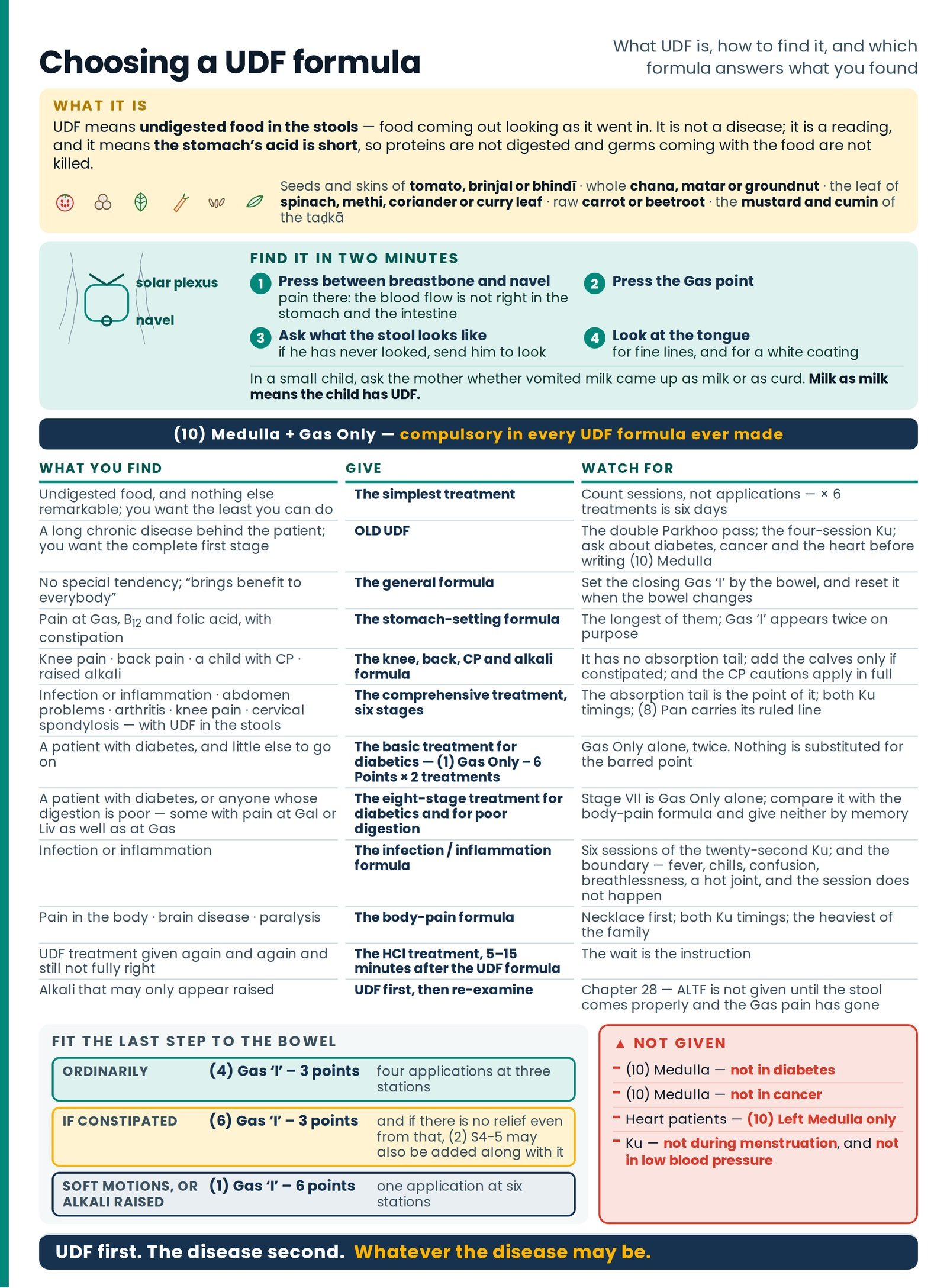
The whole family, and how to choose within it
Thirteen treatments and their companion, and the table that chooses
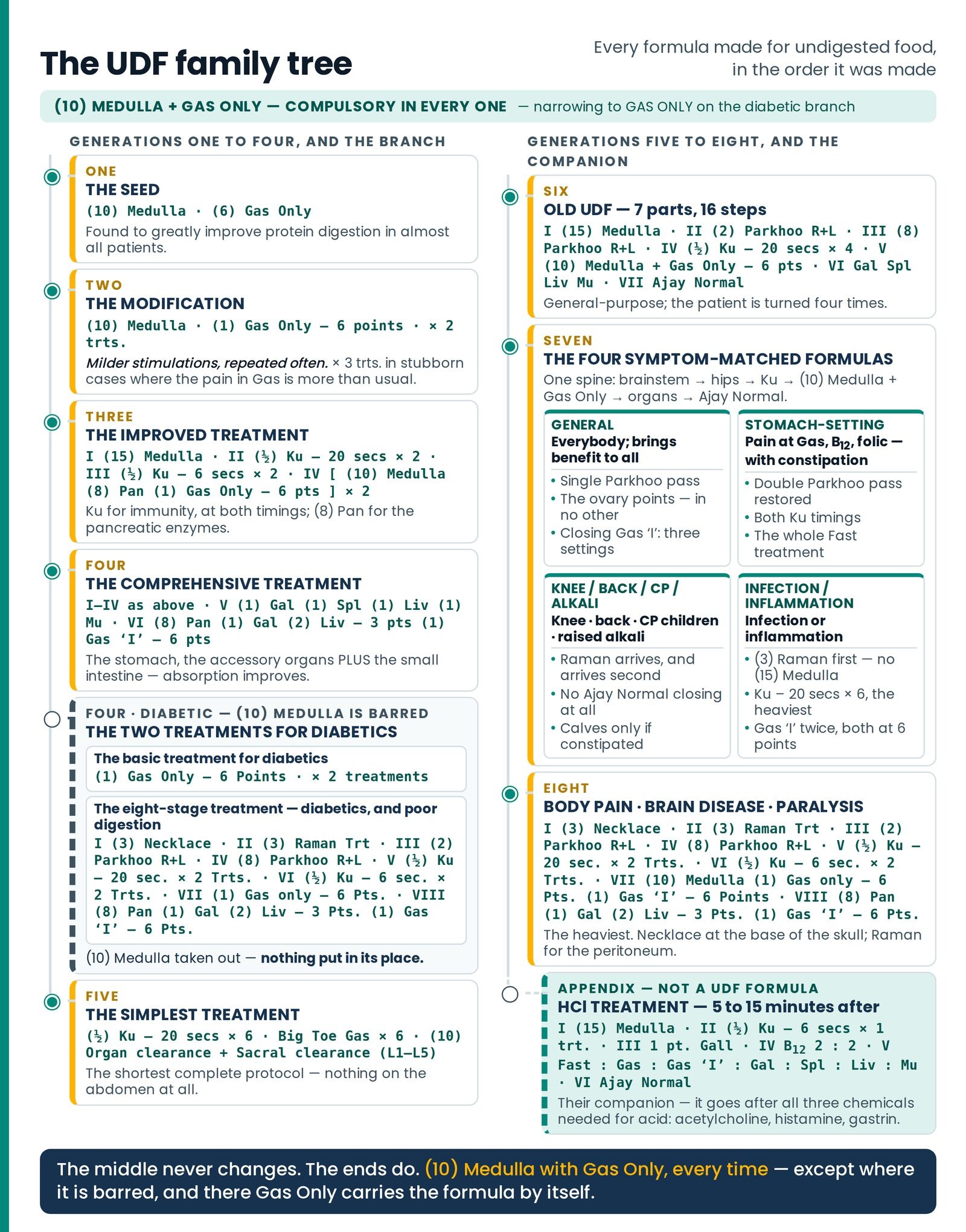
Thirteen treatments and their companion, made in this order, each one answering something the one before it could not. (Figure 29.6)
Table 23 — The generations of the UDF formulas, in the order they were made
| Generation | The formula | What it added, and why |
|---|---|---|
| One | The seed — (10) Medulla (6) Gas Only | The earliest and most basic. (10) Medulla provokes the vagus nerve; Gas Only improves the blood supply to the stomach for the proper secretion of HCl and pepsin. It was found to greatly improve protein digestion in almost all patients |
| Two | The modification — (10) Medulla (1) Gas Only – 6 Points × 2 treatments | Six applications at the point became one application across six stations, given twice — because milder stimulations, repeated often, were found to be more effective than one strong dose. × 3 treatments in stubborn cases where the pain in Gas is more than usual. Taught in Correcting the Two Kingdoms as the prerequisite of ALTF |
| Three | The improved treatment — four stages | Ku added to increase the body's immunity, at both of its timings; (8) Pan added for the pancreatic enzymes, to aid protein digestion; and the whole of stage IV bracketed and given twice |
| Four | The comprehensive treatment — six stages | Stages V and VI added, so that the treatment reaches the stomach, the accessory organs of digestion PLUS the small intestine; it improves the absorption of nutrients, and is given for infection or inflammation, abdomen problems, arthritis, knee pain and cervical spondylosis where there is UDF in the stools |
| Four · diabetic | The basic treatment for diabetics — (1) Gas Only – 6 Points × 2 treatments | The compulsory element standing alone, because (10) Medulla is barred in diabetes — and because most patients usually have pain in Gas |
| Four · diabetic | The eight-stage treatment for diabetics and for poor digestion | Necklace and Raman open it, the double Parkhoo pass and both Ku timings follow, and stage VII carries Gas Only with (10) Medulla taken out and nothing put in its place |
| Five | The simplest treatment — (½) Ku – 20 secs × 6 · Big Toe Gas × 6 · (10) Organ clearance + Sacral clearance (L1–L5) | The shortest of the complete protocols, and the one that attacks the infection side of UDF with a sustained sacral hold and nothing else. Nothing on the abdomen at all |
| Six | OLD UDF — seven parts, sixteen steps | The long general-purpose treatment: the vitamin work at the hips, the light-then-heavy double pass, the Ku thread across four sessions, the compulsory pair in the middle, the four organs in normal order, and an absorption tail |
| Seven | The general formula | OLD UDF made lighter and fitted to the bowel: single Parkhoo pass, the ovary points added, and a closing Gas 'I' with three settings — ordinary, constipated, loose |
| Seven | The stomach-setting formula | For pain at Gas, B₁₂ and folic acid with constipation: the double Parkhoo pass restored, both Ku timings, the whole Fast treatment as a block, and Gas 'I' twice over |
| Seven | The knee, back, CP and raised-alkali formula | Raman arrives. The shortest of the group, and the only one with no absorption tail — the calves added only if the patient is constipated |
| Seven | The infection or inflammation formula | Raman moves to the front and the opening Medulla is dropped. The Ku goes to six sessions, the heaviest dosing in the article |
| Eight | Body pain, brain disease, paralysis | The heaviest: Necklace at the base of the skull, Raman for the peritoneum, the double Parkhoo pass, both Ku timings, and Gas 'I' twice |
| Appendix | The HCl treatment | Not a UDF formula but its companion — given 5 to 15 minutes after one, going after all three of the chemicals that make acid |
Read that table downward and you can watch a therapist thinking. The dose goes milder and more frequent at the second step and never goes back. The opening moves — Medulla, then Medulla with Raman, then Raman alone, then Necklace before either. The hips go light, then heavy again where more is wanted. The Ku arrives at the third generation, gains its second timing there, and afterwards moves between two sessions and six. The tail grows: first nothing after the stomach, then the four organs, then the absorption sequence. And the last step of the formula becomes a dial rather than a number. Nothing in the middle ever changes: (10) Medulla with Gas Only, every time — except where (10) Medulla is barred, and there Gas Only stands alone and carries the formula by itself.
One name this article does not answer to
There is a name a student will meet in and will come back here to look up, and they should be told plainly that they will not find it. The Complement System formula — the fourteen-part treatment at the very end of the formulary — carries this instruction with it: giving the Complement System after the New UDF formula is beneficial for almost all old diseases.
That is the only place the phrase "the New UDF formula" appears, and no formula in this family is called by that name. The thirteen above are named by what they do or by the patient they were made for — the seed, the modification, the improved and the comprehensive treatments, the two written for diabetics, the simplest, OLD UDF, the four matched to symptoms, and the heaviest. Which of them the instruction means is not said, and it is not for a therapist to decide by guessing.
What the instruction does carry is its order, and the order is the part a therapist acts on: the Complement System comes after a UDF formula and not before one. That is the order this whole article has been teaching — the ash cleared first, the defences raised afterwards. No method is given here for a formula of that name, and none is supplied; choose the UDF formula for the patient in front of you by Table 24 below. (Figure 29.7)