Watch


The two treatments written for diabetics
What a barred point looks like when it is taken out properly
(10) Medulla is barred in diabetes. The bar and the reasoning behind it are established in Setting the Stomach, "Setting the Stomach", and are inherited by every formula that contains the point; this article applies the bar and does not argue it again.
That leaves the question every therapist meets on his second diabetic patient: if half the compulsory pair cannot be given, what is given? The answer is the other half — and most patients usually have pain in Gas in any case, which is where the treatment would have gone first.
Table 7 — Card: the basic treatment for diabetics Supine Both sides
| Written | (1) Gas Only – 6 Points × 2 treatments |
|---|---|
| The single step | (1) Gas Only – 6 points — supine Supine , the soft middle of the sole on both thighs, hip crease → above the knee, six stations in one pass Both sides |
| The rounds | × 2 treatments — two sessions, with the written rest between rounds: Table 8, How a Formula Is Built |
| Stated indication | The basic treatment for diabetics |
| What it is | The modified formula of generation two with (10) Medulla lifted out of it. Compare the two cards line by line and that is the whole of the difference |
| What it is for | The compulsory element doing its own work: blood supply to the stomach, so that HCl and pepsin are properly secreted |
| Prohibitions | None attached to Gas Only. That is exactly why Gas Only is the compulsory element ▲ Take care |
And beside it, a longer treatment for the same patient — and for a good many others.
Table 8 — Card: the eight-stage treatment for diabetics and for poor digestion Seated Side-lying Prone Supine 6 sec
| Written, stages I–IV | I (3) Necklace · II (3) Raman Trt · III (2) Rt. Parkhoo (2) Lt. Parkhoo · IV (8) Rt. Parkhoo (8) Lt. Parkhoo |
|---|---|
| Written, stages V–VIII | V (½) Ku – 20 sec. × 2 Trts. · VI (½) Ku – 6 sec. × 2 Trts. · VII (1) Gas only – 6 Pts. · VIII (8) Pan (1) Gal (2) Liv – 3 Pts. (1) Gas 'I' – 6 Pts. |
| Stated indication | Useful for diabetics, and for all those who have poor digestion. Some of them may have pain or tenderness at Gal or at Liv, in addition to the pain at Gas |
| Stage I — (3) Necklace | Seated Seated , the therapist behind; the manner of it is given in full with the body-pain formula at Table 21 below, and the point in Seated I — Brain, Medulla, Neck, "Seated — I" |
| Stage II — (3) Raman | Seated Seated ; both hands over the tops of the shoulders from behind, the muscles lifted, six seconds, three times, then five or six easy breaths. Seated I — Brain, Medulla, Neck |
| Stages III and IV | The double Parkhoo pass — (2) each, then (8) each; side-lying Side-lying , knees drawn very close to the chest, pillow between them, two equal one. Light first, heavy after. On the Side, "On the Side" |
| Stages V and VI | Both Ku timings, two sessions each — twenty seconds × 2 treatments, then six seconds × 2 treatments Prone |
| Stage VII | (1) Gas only – 6 Pts. — the compulsory element, supine, both thighs, six stations Supine Both sides |
| Stage VIII | (8) Pan Both sides , (1) Gal Left , (2) Liv – 3 points Left — the same thing as (6) Liv, The Front of the Body I — and (1) Gas 'I' – 6 points down both calves Both sides : the absorption tail |
| The Roman numerals | Each stage after the written rest — Table 8, How a Formula Is Built |
| Its twin | The same eight stages are the formula for body pain, brain disease and paralysis — Table 21 below — where stage VII reads (10) Medulla (1) Gas only – 6 Pts. (1) Gas 'I' – 6 Points |
| Prohibitions | Ku — not during menstruation, not in low blood pressure ▲ Take care . The (10) Medulla bar does not arise here, because the point is not in the formula |
| Points taught in | Necklace, Raman — Seated I — Brain, Medulla, Neck; Parkhoo — On the Side; Ku — Face Down; Gas Only, Pan, Gal, Liv, Gas 'I' — The Front of the Body I |
Set the two cards side by side and read stage VII across, because this is the clearest example in the wiki of how a formula is fitted to a patient who cannot be given one of its points.
Seven of the eight stages are identical. Necklace, Raman, the light Parkhoo pass, the heavy Parkhoo pass, the twenty-second Ku twice, the six-second Ku twice, and the whole of the closing stage VIII — all of them stand exactly as they stand in the formula for body pain, brain disease and paralysis. Only stage VII is different. There it reads (10) Medulla (1) Gas only – 6 Pts. (1) Gas 'I' – 6 Points. Here it reads (1) Gas only – 6 Pts. alone: (10) Medulla, which is barred in diabetes, is not written — and the (1) Gas 'I' – 6 Points that closed that stage is not written here either. Gas 'I' is given once in this formula, at stage VIII, and not twice.
That is what a barred point looks like when it has been taken out properly. Nothing was substituted for it and nothing was added to compensate for it. The stage that carried two points and a closing step now carries the compulsory element by itself, and the seven stages around it are untouched.
What the review of the points adds
Every point used against UDF has been met in this article as the formulas used it, and most of what the family says about each one has already been given — (15) Medulla for acetyl choline, (10) Medulla for the vagus and the threefold acid, Gas Only for HCl, histamine, pepsin and gastrin, Pan for the pancreatic enzymes, Gas 'I' for the small intestine, (½) Ku for the basophils and mast cells and so for immunity, infection and inflammation. Four entries in that review say something that has not been said yet, and they are worth having.
Table 9 — What the point-by-point review adds
| Point | The organ stimulated, and the purpose |
|---|---|
| Necklace | The ganglia leaving the skull — and it reduces pain |
| Raman treatment | The peritoneum, the serous membranes and so on — and thus it benefits the whole body |
| Rt. Parkhoo / Lt. Parkhoo | Stimulates the absorption of B₁₂ and niacin, folic acid and thiamine. B₁₂ and folic acid are necessary for proper blood formation. Niacin and thiamine are required for the proper working of the smooth muscles of the stomach and the intestines |
| Gal, Spl, Liv, Mu | Increases the blood supply to the liver, gall bladder and spleen, and to different areas of the mesenteric arteries and the colon — and thus improves digestion and absorption |
Two of those four are worth a second's thought at the mat. Necklace reduces pain — which is why the heaviest formula of this family, the one written for pain in the body, opens on it. And the four organ points reach the mesenteric arteries and the colon, not only the three organs they are named for; that is the anatomical reason a set of one-application steps across the thighs and arms can change what a patient's bowel does.
Generation five — the simplest treatment
Three techniques, and not one of them on the abdomen
The next formula made is the shortest of the complete protocols, and — this is the surprising part — none of its three techniques is on the abdomen at all.
Table 10 — Card: the simplest UDF treatment Prone Supine
| Written | I (½) Ku – 20 secs × 6 treatments · II Big Toe Gas × 6 treatments · III (10) Organ clearance + Sacral clearance (L1–L5) |
|---|---|
| Position | Prone for I and III Prone ; the patient lying for II, the therapist standing supported on the chairs |
| Step I — (½) Ku – 20 secs | One press, held exactly twenty seconds, then released comfortably. Prone, 1½ pillows under the chest, both heels turned to face each other; the therapist sits between the patient's feet and places the middle part of the sole, with normal pressure, on the last end of the spinal column. × 6 treatments is a count of sessions — one hold today, one tomorrow, six sessions in all |
| Step II — Big Toe Gas | The therapist's heel on the patient's big toe; standing on both feet together, or on one foot at a time; normally 6 or 12 seconds. × 6 treatments — again a count of sessions. Its stated purpose here is written beside it: to increase HCl in the stomach |
| The caution on step II | Place your foot in such a way that it does not pinch the patient's skin ▲ Take care |
| Step III — (10) Organ clearance | Prone with 1½ pillows under the chest, or seated on a chair; the therapist sitting on the patient's left side. The palm flat on the back, fingers pointing toward the side of the body, big thumb toward the head. First the vertical strokes, rubbing lightly over and around the spinal column from above downward, and then, without lifting the hand, from below upward; then the horizontal strokes, from right to left and from left to right. Begin from behind the neck and descend at very small intervals. (10) means ten times at every place |
| Step III, continued — Sacral clearance (L1–L5) | The same hand, the same two-direction stroke, confined to L1–L5 — joined to the Organ clearance by the + sign, that is, given as one step with it |
| What it is for | UDF, in the plainest form: level 3 by the Ku, level 1 by the Big Toe Gas, and the whole back cleared |
| Points taught in | Ku — Face Down, "Face Down"; Big Toe Gas — Knee, Leg, Foot, "The Knee, the Leg and the Foot"; Organ clearance and the sacral levels — Face Down and The Low Back, "The Low Back" |
Generation six — OLD UDF
Seven parts, sixteen steps, and the patient turned four times
After this, having considered many aspects, the following treatment was made, which has proved quite useful. It is called UDF पुरानी — OLD UDF — and the word old is the generation marker, not a comment: older versions stand beside their successors in this therapy, and they are not errors. Table 13, How a Formula Is Built.
It is the longest single prescription you have met so far: seven parts, sixteen steps, four positions, and the patient is turned four times.
Table 11 — Card: OLD UDF Seated Side-lying Prone Supine 6 sec
| Written, parts I–V | I (15) Medulla · II (2) Rt Parkhoo (2) Lt Parkhoo · III (8) Rt Parkhoo (8) Lt Parkhoo · IV (½) Ku – 20 secs × 4 treatments · V (10) Medulla (1) Gas खाली – 6 वाला |
|---|---|
| Written, parts VI–VII | VI (1) Gal (1) Spl (1) Liv – 3 वाला (1) Mu – 3 वाला · VII Ajay Normal → (8) Pan (1) Gal (2) Liv – 3 वाला (1) Gas ' I ' – 6 वाला |
| The order of positions | Seated (I) Seated → side-lying, left then right (II, III) Side-lying → prone (IV) Prone → seated again (V, first step) Seated → supine for everything after (V second step, VI, VII) Supine |
| What it is for | UDF in a patient of any ordinary tendency — the general-purpose member of the family before the symptom-matched formulas were made |
| The compulsory pair | Present, in part V: (10) Medulla with (1) Gas Only – 6 points |
| The prohibition it inherits | (10) Medulla is not given to patients of diabetes or of cancer; in heart patients only (10) Left Medulla ▲ Take care |
| The prohibition on Ku | Ku is not given to women during menstruation, and not to those with low blood pressure ▲ Take care |
| What may follow it | Large Folic Black — see below — Vitamin and Gene Formulas, "The Missing Links" |
Table 12 — OLD UDF, step by step
| Part | Step | Point | Count | Position and placement |
|---|---|---|---|---|
| I | 1 | Medulla | (15) | Seated Seated ; both sides of the nape, below the ears |
| II | 2 | Rt. Parkhoo | (2) | Side-lying on the left Side-lying , chest turned inward, knees very close to the chest, one or two pillows between the knees so the upper knee is not below the level of the waist. Foot or hand, press and release alternately at both points of the right hip, at the edge of the femur. Two equals one — once above and once below is one application |
| II | 3 | Lt. Parkhoo | (2) | Side-lying on the right Side-lying ; otherwise exactly as step 2, at both points of the left hip |
| III | 4 | Rt. Parkhoo | (8) | As step 2. The pair is given a second time, heavier |
| III | 5 | Lt. Parkhoo | (8) | As step 3 |
| IV | 6 | (½) Ku – 20 secs | × 4 treatments | Prone Prone , 1½ pillows under the chest, heels facing each other, therapist sitting between the feet; middle of the sole on the last end of the spine, held twenty seconds, released comfortably. Four sessions, one hold each |
| V | 7 | Medulla | (10) | Seated again Seated , as step 1 |
| V | 8 | Gas Only – 6 points | (1) | Supine Supine ; soft middle of the sole on both thighs, hip crease → above the knee, six stations in one pass Both sides . Gas खाली is simply the Hindi for Gas Only |
| VI | 9 | Gal | (1) | Supine; right sole down the left thigh Left |
| VI | 10 | Spl | (1) | Left sole down the right thigh Right |
| VI | 11 | Liv – 3 points | (1) | Left arm and left thigh, three paired stations in one pass Left |
| VI | 12 | Mu – 3 points | (1) | Right arm and right thigh, three paired stations Right |
| VII | 13 | Pan | (8) | Both thighs together Both sides — Ajay Normal begins here |
| VII | 14 | Gal | (1) | Left thigh Left |
| VII | 15 | Liv – 3 points | (2) | Left arm and left thigh Left |
| VII | 16 | Gas 'I' – 6 points | (1) | Soles and heels down both calves, knee → heel, six stations Both sides |
Reading OLD UDF point by point
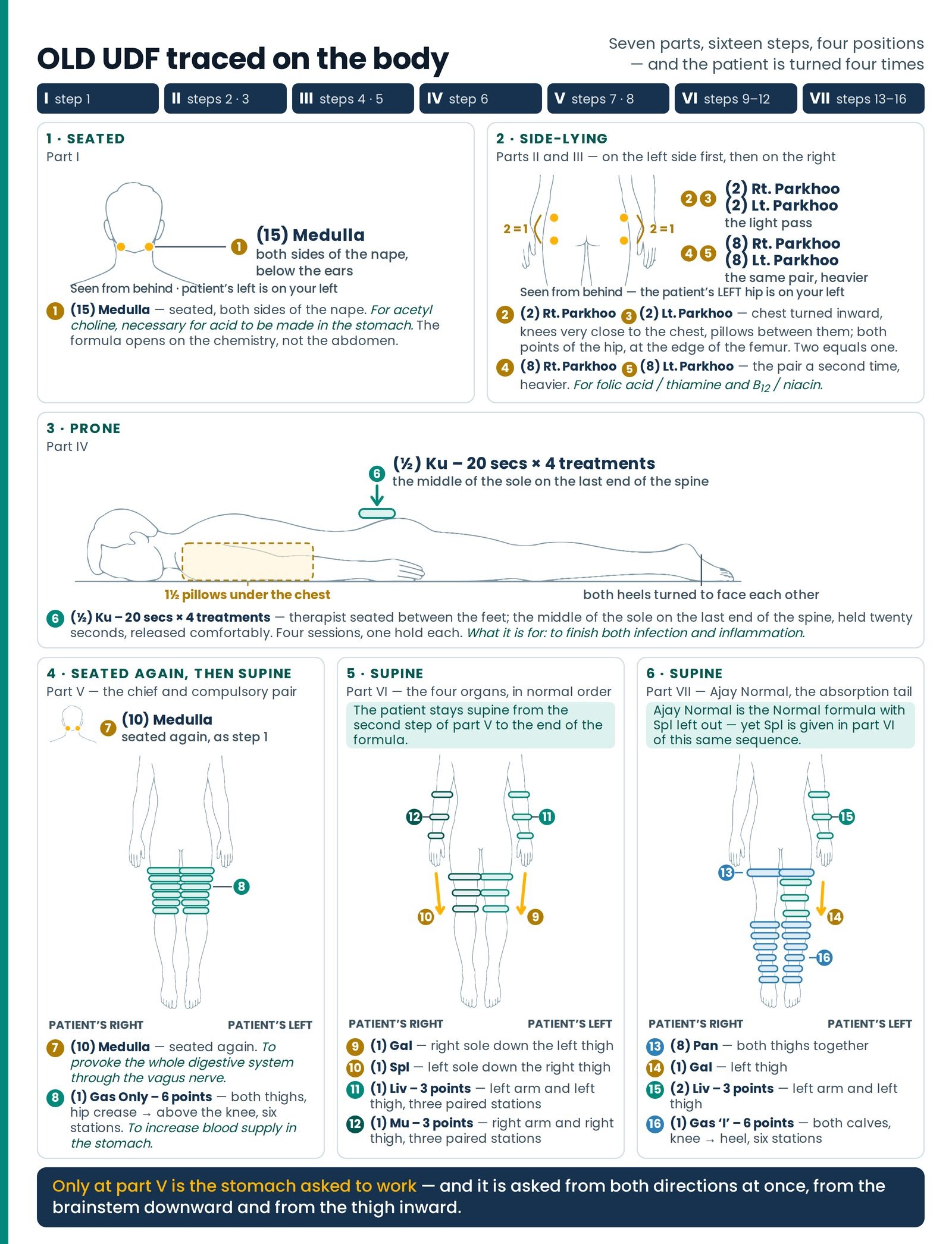
This is the part of the article to read twice. Not because the formula is hard — the counts are small and the order is plain — but because a student who can say what every step of one long formula is doing can read any formula in the wiki. The rest is vocabulary.
Take it part by part, and at each step ask the two questions that matter: what is this for, and why is it here and not somewhere else? (Figure 29.3)
Part I — (15) Medulla. What it is for: acetyl choline, which is necessary for acid to be made in the stomach.
Three names were given on page 314 as the things required for acid to be made: histamine, acetylcholine and gastrin. The formula opens by going after one of them. That is the first thing to notice about OLD UDF — it opens on the chemistry, not on the abdomen.
Why fifteen and not ten? Because ten is the other Medulla in this formula and it does a different job. Fifteen opens; ten, at part V, provokes the whole digestive system through the vagus. The number in front of the point is part of the point's identity in this family, and the Medulla series is graded for exactly this reason.
Why first? Because the patient is seated when he arrives, before he is laid down for anything. Position order and clinical order agree here, which is not an accident — a formula that turns the patient four times has been written so that the turns fall where the clinical logic wants them anyway.
Parts II and III — (2) then (8) Rt. Parkhoo and Lt. Parkhoo. What they are for: folic acid / thiamine & B₁₂ / niacin.
Two hips, four vitamins, two passes. The right hip carries folic acid and thiamine; the left carries B₁₂ and niacin. And the reasoning attached, which is worth learning as written because it names exactly what each vitamin is doing in a digestive formula:
Why niacin and thiamine are in a treatment for undigested food
Niacin and thiamine play an important role in the digestive system.
Niacin is necessary for the secretions of the glands to be properly made and released. From a deficiency of niacin there will be weakness in the muscles, the capacity of the glands to work will decrease, and inflammation comes in the mouth and in the intestines.
Thiamine is necessary for the smooth muscles of the stomach. For the smooth muscles of the stomach and of the pylorus to work in the right way, metabolized glucose is needed — for which thiamine is necessary.
Read that and the placement explains itself. Part I went after the signal that tells the stomach to make acid. Parts II and III go after the machinery that has to receive the signal: the glands that must secrete, and the muscle of the stomach wall and of the pylorus — the gate at the stomach's outlet, through which everything must eventually pass. Signal first, machinery second.
Why the pair twice, at (2) and then at (8)? The counts themselves answer it: a light pass, then a heavy one. It is the therapy's own standing principle, stated in Correcting the Two Kingdoms — a gland which is already spoiled should first be provoked less, so that it slowly begins to work. Here it is built into a single sitting, and in later generations of this same family the double pass appears and disappears depending on how much work is wanted at the hips. When you see (2) then (8) at the same point, you are looking at light-before-heavy, not at a repetition.
And notice the position rule that the count depends on. Parkhoo is not the Folic, Thia, B12 or Nia treatment, though it is given at the same hips. For Parkhoo, the chest is turned inward and the knees are drawn very close to the chest, with a pillow between them — especially compulsory for those whose thighs are very thin — so that the pressure lands at the edge of the femur bone. For the four vitamin points, the chest stays normal and the knees stay straight with the body. Same hip, different body, different point.
Part IV — (½) Ku – 20 secs × 4 treatments. What it is for: to finish both infection and inflammation.
Here the formula stops being about digestion for a moment and goes after the second of the two mechanisms — germs not killed. Why a treatment for undigested food should contain a sustained sacral hold aimed at infection is the subject of the next section of this article, and it is the most closely argued passage in the whole UDF family.
Note what the notation is telling you. – 20 secs means one press, held exactly twenty seconds, then released — no six-second count anywhere in this step. × 4 treatments means four sessions. So part IV is not a step of today's session in the way the others are. It is a thread running through four days of them.
Part V — (10) Medulla, then (1) Gas Only – 6 points. What they are for: to provoke the whole digestive system through the vagus nerve; and to increase blood supply in the stomach.
This is the heart of the formula, and it is the pair that is compulsory everywhere.
The chief pair, in its own words
Among all these points the chief are (10) Medulla and Gas Only. These two together will further increase the stomach's acid, from which pepsin's work will be good, and the digestion of proteins will be done well.
Why here, in the middle, and not at the opening? Because of what has already been done. The acetylcholine signal has been provoked. The glands and the stomach's muscle have been addressed at the hips. The infection and inflammation have been taken in hand. Only now is the stomach asked to work — and it is asked from both directions at once, from the brainstem downward and from the thigh inward.
And the prohibition that travels with (10) Medulla, in its own ruled box:
Part VI — (1) Gal (1) Spl (1) Liv – 3 points (1) Mu – 3 points. What it is for: the digestive system.
Four organs, one application each, in normal order — Gal before Spl, Liv before Mu. That order is not decoration. The therapy's own rule, stated in the Jeevan Dhara formula, is that giving Spl after Gal and Mu after Liv will increase normal peristalsis; reverse them and you are deliberately slowing the bowel, which is why the reversed pairs are written with a line ruled beneath them wherever they occur. There is no underline anywhere in OLD UDF. Read that absence: this formula is not trying to slow anything down.
Part VII — Ajay Normal → (8) Pan (1) Gal (2) Liv – 3 points (1) Gas 'I' – 6 points. What it is for: absorption.
Everything before this part has been about making something — acid, secretions, muscle tone, blood supply. This part is about getting it in. (8) Pan brings out the digestive enzymes of the pancreas; Gas 'I', down both calves, provokes the jejunum and ileum, by which the absorption of digested things takes place properly.
And the detail students walk past: Ajay Normal is the form of the Normal formula in which Spl is left out, and the omission is the formula. Yet Spl is given in part VI of this very sequence. Both facts stand as written. The spleen point is used in OLD UDF, and the closing absorption sequence is simply the version that does not contain it.
And what may be given after the whole of it.
Large Folic Black, given after this treatment
After this treatment, if Large Folic Black is given, then immediately after the treatment the black colour of the face is reduced by 25%.
And the next morning, in the motion, the first 1 inch of stool will be black — which means that toxins are coming out by way of the rectum.
The formula itself, and the whole Black family, belong to Vitamin and Gene Formulas, "The Missing Links".
Table 13 — The stated purpose of every part of OLD UDF, at a glance
| Part | What is given | What it is for |
|---|---|---|
| I | (15) Medulla | Acetyl choline, which is necessary for acid to be made in the stomach |
| II, III | (2) then (8) Rt. Parkhoo, Lt. Parkhoo | Folic acid / thiamine & B₁₂ / niacin — niacin for the secretions of the glands to be made and released; thiamine for the smooth muscles of the stomach and the pylorus, through metabolized glucose |
| IV | (½) Ku – 20 secs × 4 treatments | To finish both infection and inflammation |
| V | (10) Medulla | To provoke the whole digestive system through the vagus nerve |
| V | (1) Gas Only – 6 points | To increase blood supply in the stomach |
| V | the two together | The chief pair — they further increase the stomach's acid, so pepsin's work is good and proteins digest well |
| VI | (1) Gal (1) Spl (1) Liv – 3 points (1) Mu – 3 points | The digestive system |
| VII | Ajay Normal | Absorption |
| after | Large Folic Black | Face 25% less black at once; first inch of stool black next morning — toxins coming out by way of the rectum |