Watch



A bar, a doorway through it, a bar inside the doorway, and what is given
The rule as it stands on the therapist's side
For four days of the menses, no treatment at all is to be given.
But if she has excessive flow, or very little flow, or pain in the menses, then the appropriate treatment is to be given to reduce it.
If the flow is heavy, heparin treatment is not to be given — because heparin does not let the blood clot, so the flow will be still greater.
Such women will benefit immediately from (4) Para. If they also get cramps, give the 1,25 DCC formula.
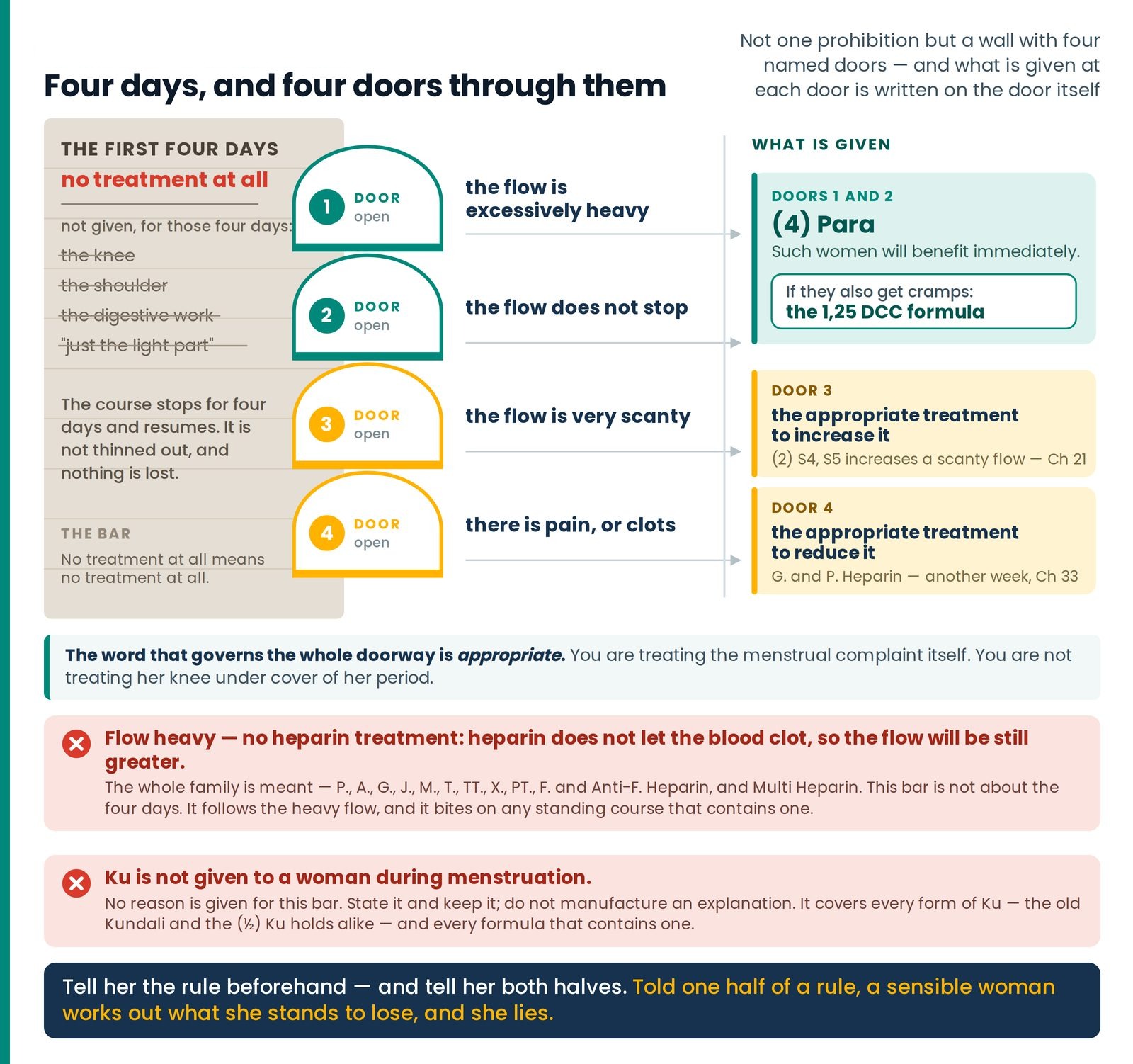
Four instructions, and they are not of one kind. The first is a bar. The second is the doorway through it. The third is a bar inside the doorway — a thing you must not give even to the woman you have decided to treat. The fourth names what is given instead, and what is added when there is one more finding.
The bar. No treatment at all means no treatment at all: not the knee, not the shoulder, not the digestive work she has been having for five weeks, not "just the light part of the formula". The course stops for four days and resumes. This is the rule a therapist most often bends, usually out of kindness — she has travelled, she is here, it seems a pity — and bending it is how the woman in the story at the head of this article went home weak.
The doorway. Four findings open it, and they are worth learning as four and not as a vague sense of if her period is troubling her:
the flow is excessively heavy
the flow does not stop
the flow is very scanty
there is pain, or clots, in the menses
For those, the appropriate treatment is to be given to reduce it — and the word that governs the whole doorway is appropriate. You are treating the menstrual complaint itself. You are not treating her knee under cover of her period. ▲ Take care
The reasoning underneath is the therapy's own and it is consistent. A heparin treatment is understood to do what heparin does: stop blood from clotting. In a woman already losing more blood than she should, that is exactly the wrong direction. And the same reasoning read forward explains something a student often finds puzzling — that the heparin work is elsewhere given for the woman whose menses carry clots and pain, in a different week and for a different reason.
What is given. For heavy flow: (4) Para, of which it is said that such women benefit immediately. And if there are cramps as well: the 1,25 DCC formula. Both belong to the calcium work, and the connection is stated plainly elsewhere — women who bleed very heavily in their menses because of calcium deficiency: giving this treatment reduces or stops their bleeding. (Figure 40.1)