Gather, set the direction, name organs, find the root, decide the work
Steps 1 to 3 are collection and sorting; a diligent student learns them in a week. Step 4 is judgement, and the whole of the art: what single thing, if corrected, would make most of the rest unnecessary?
Four problems, or one?
Many names, one root — and the signs that decide it
Key teaching
Many names, one root
In allopathy the names of diseases are attached to the symptoms themselves.
When several symptoms come together, and the same cluster recurs in other people, that cluster is given a name, so that one word brings several symptoms to mind at once and choosing a medicine becomes easy. That is all a disease name is for.
Now watch a body. If food is not digested properly in the stomach, the patient will have sometimes a headache, sometimes gas, sometimes loose motions or vomiting, sometimes burning in the chest — on one day or on different days. Named, the headache is migraine, the burning acidity, the gas flatulence, the loose motions diarrhoea, and for each a different medicine is given.
Although the symptoms are different, the root cause of all of them is one and the same — indigestion. Correct that one root cause, and not only these four but even more diseases or symptoms will be corrected, and they will not recur either.
The general form: all diseases — however many lakhs of names may be given to them — come only from a few among eight to ten glands not working in the proper way. That root appears in different persons as different symptoms, and in one person as different symptoms on different days; but on paying attention it will be found that the root cause is one and the same.
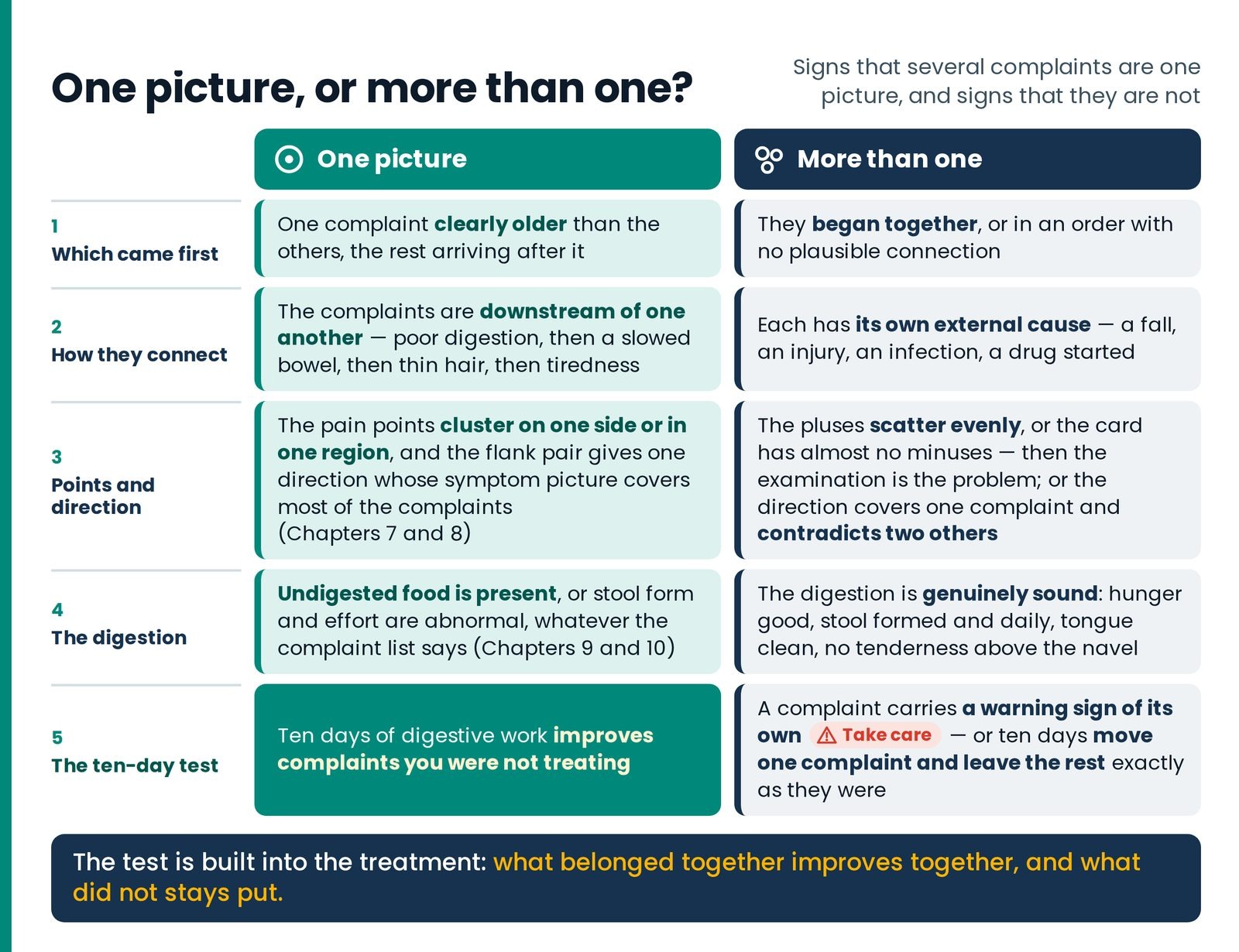
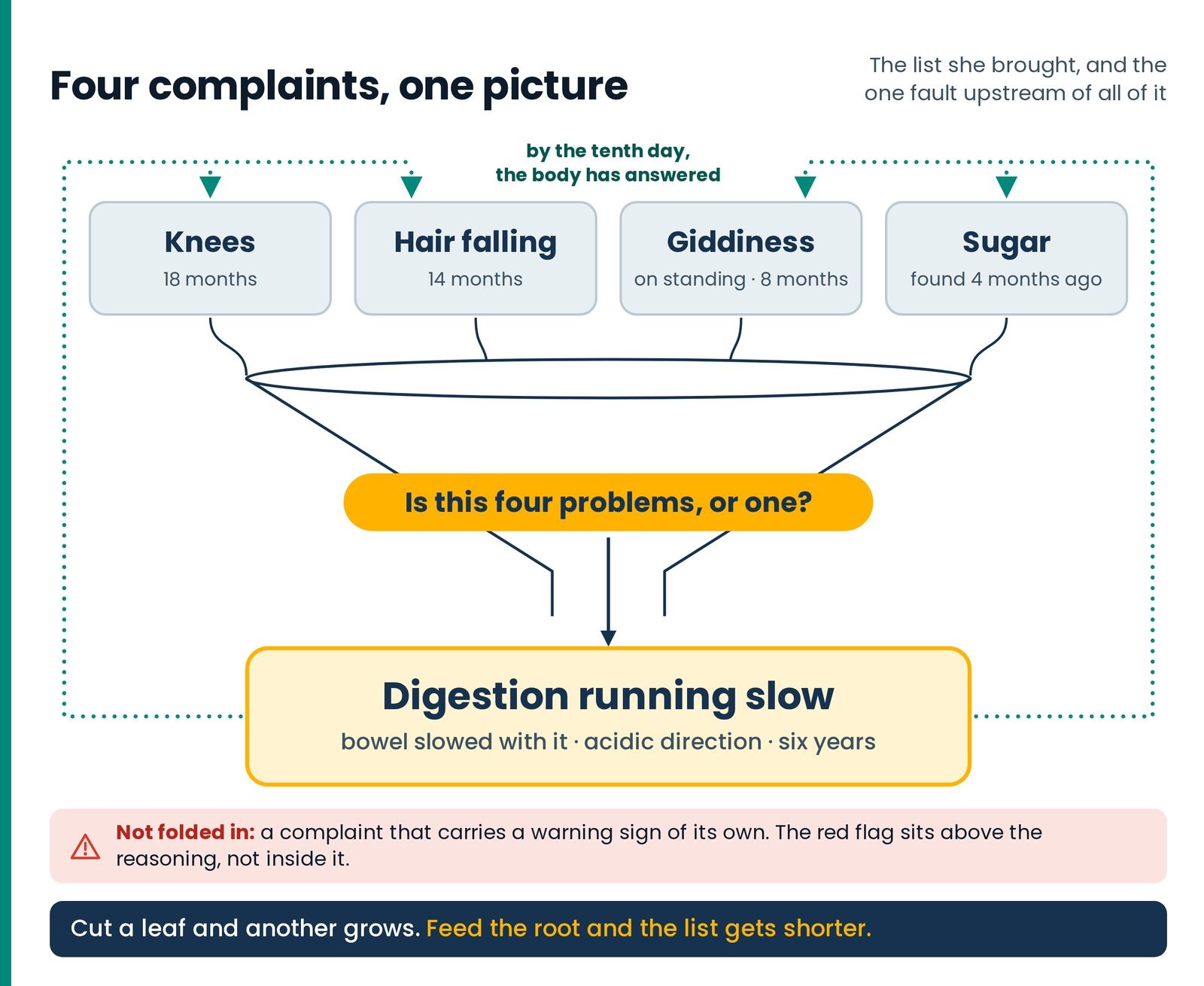
The question asked of every patient with more than one complaint is: are these four problems, or one problem with four faces? It is not answered by intuition. There are signs. (Figure 13.2)
The last row settles arguments, and it is why this therapy can afford confidence here: the test is built into the treatment. You act as though the complaints might be one, give the digestive work, and by the tenth day the body has answered you — what belonged together improves together, and what did not stays put, now visible because the noise has gone. (Figure 13.1)
One picture, or more than one?. Five signs, side by side, that several complaints are one picture — and the matching signs that they are not, ending with the test built into the treatment: ten days of digestive work.Four complaints, one picture. Knees, hair falling, giddiness and sugar drop into one funnel — 'Is this four problems, or one?' — and come out as one root: digestion running slow, bowel slowed with it, acidic direction, six years. Dotted arrows carry the answer back to all four complaints by the tenth day.
The order of precedence, the red flag, and the postmaster's knees
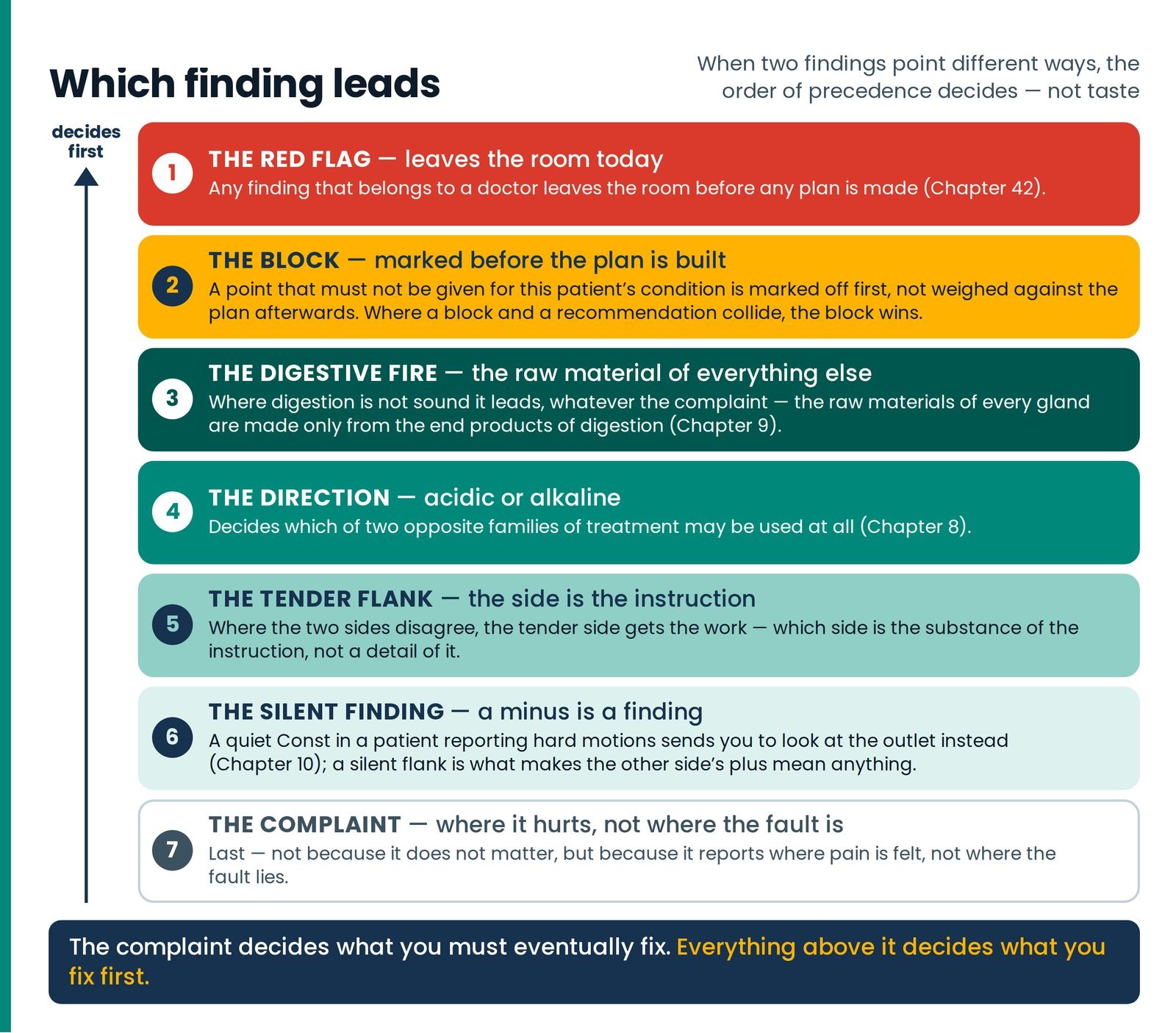
Two findings will point different ways in your second week of practice and go on doing it for the rest of your working life: the complaint says knee and your fingers say stomach. There is an order of precedence, and it is not a matter of taste. (Figure 13.3)
Key teaching
The order of precedence — which finding leads
First: the red flag.
Any finding that belongs to a doctor leaves the room before any plan is made. ▲ Take care
Second: the block. A point that must not be given for this patient's condition is marked off before the plan is built, not weighed against it afterwards. Where a block and a recommendation collide, the block wins.
Third: the digestive fire. Where digestion is not sound it leads, whatever the complaint — the raw materials of every gland are made only from the end products of digestion, so a plan aimed elsewhere is built out of nothing.
Fourth: the direction. Acidic or alkaline decides which of two opposite families of treatment may be used at all (The Two Kingdoms).
Fifth: the tender flank, and the region it belongs to. Where the two sides disagree, the tender side gets the work — and which side is the substance of the instruction, not a detail of it. Left Right
Sixth: the silent finding. A minus is a finding. A quiet Const in a patient reporting hard motions sends you to look at the outlet instead (What the Bowel Tells You); a silent flank is what makes the other side's plus mean anything.
Last: the complaint the patient came with — not because it does not matter, but because it reports where pain is felt, not where the fault lies.
That last line needs saying carefully at the mat, because it can be heard as dismissal. It is not: the complaint decides what you must eventually fix, and everything above it decides what you fix first.
Which finding leads. The order of precedence as a seven-rung ladder, from the red flag at the top to the patient's complaint at the bottom, with the one-line reason for each rung's place.