Watch



(4) Medulla — the clockwise treatment, with T1/T2
The one member with a direction, and the one with a conditional third part
The last member, and the only one in the family given with a stated direction of the hand.
(4) Medulla, in its original form
Formerly this treatment used to be given in this way: (4) Medulla clockwise + T1/T2 — by which relief was seen in the following symptoms:
the troubles of the cervical nerves C1–C4 — pain of the right and the left chest
mitral valve pain, spleen pain, pain of the upper part of the diaphragm
pain of cervical beads number 1 to 4, and
by giving T1/T2, right and left chest pain goes away
the pains which come because of disturbance of the cervical nerves C5–C8 —
all the pains of the arms, elbow, hand, wrist, palm, fingers and so forth are removed.
And the addition, with its condition: if, along with this treatment, the Raman treatment is also given, then the pain of the fourth finger of both hands used to go — which we take to be a sign of RA (rheumatoid arthritis).
Table 15 — Card: (4) Medulla clockwise with T1/T2 Seated 6 sec Both sides
| Written | (4) Medulla clockwise + T1/T2 · with Raman added under the condition below |
|---|---|
| The three parts, in order | (4) Medulla, clockwise → T1/T2 → Raman, conditional. Given as one pass — the panel above Seated |
| What part one is credited with | The troubles of C1–C4 — pain of the right and the left chest; mitral valve pain; spleen pain; pain of the upper part of the diaphragm; pain of cervical beads 1 to 4. And the pains that come from disturbance of C5–C8 — all the pains of the arms, elbow, hand, wrist, palm, fingers and so forth |
| What part two is credited with | By giving T1/T2, right and left chest pain goes away |
| When part three is added | When the fourth finger of both hands is painful — and only after checking Liv° and Mu° ▲ Take care |
| What part three is credited with | The pain of the fourth finger of both hands used to go — a finding we take to be a sign of RA |
| What the index adds | For spleen and mitral valve pain and for chest pains. For cervical spondylosis or spondylitis. And to stimulate the lungs |
| The word *formerly* | It stands in the instruction and is not removed. This is how the treatment used to be given; in this therapy the older form of a treatment is printed beside its successor and is not an error — Table 13, How a Formula Is Built |
| Points taught in | Medulla — Seated I — Brain, Medulla, Neck; the clockwise rotation of the neck — Seated I — Brain, Medulla, Neck, Neck Clockwise; Thoracic T1/T2 — Seated I — Brain, Medulla, Neck; Raman — Seated I — Brain, Medulla, Neck; the indications and precautions of T1/T2 — Each Point in Use |
Three things in that card need saying plainly.
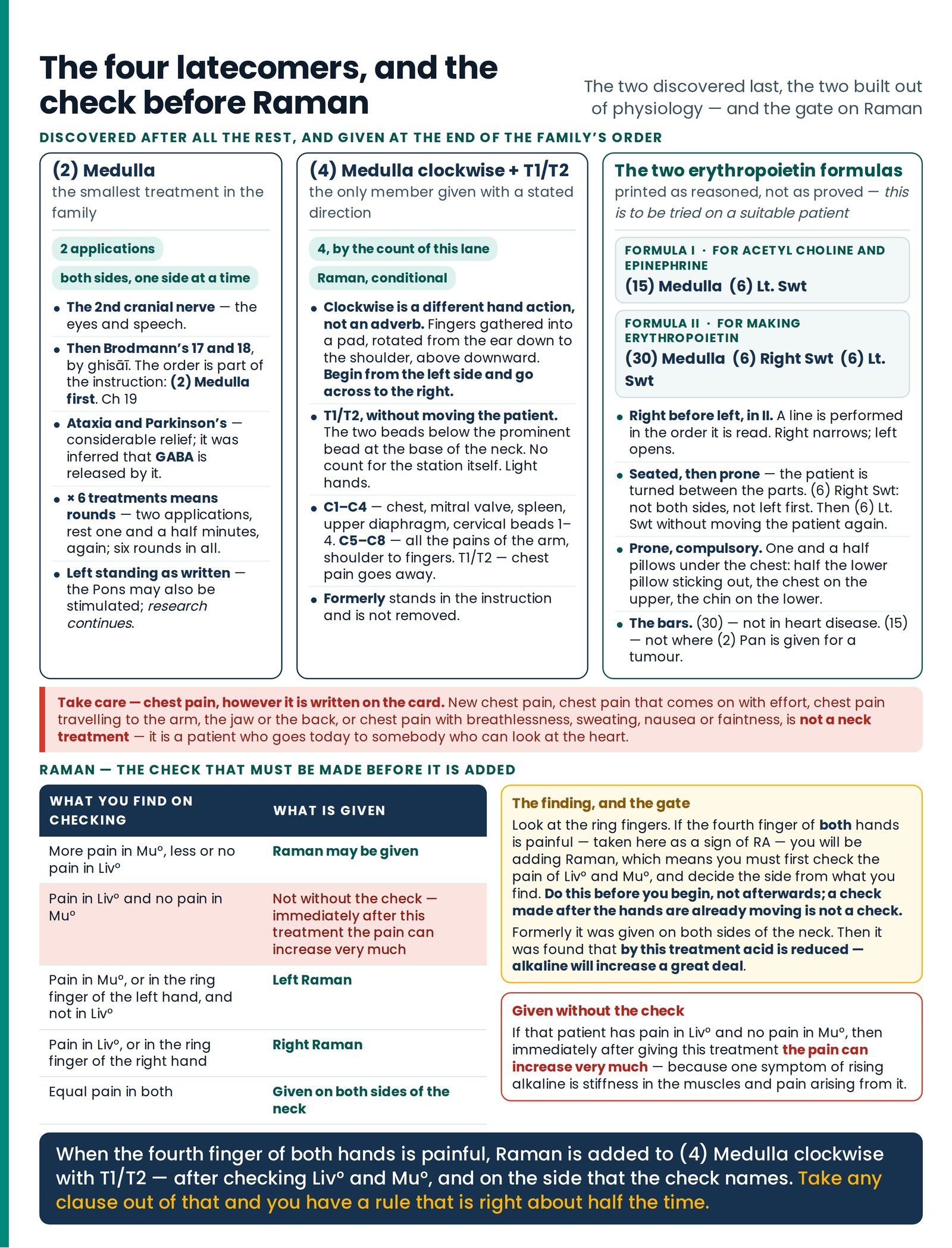
Clockwise is a different hand action, not an adverb. Everywhere else in this family the thumbs glide downward; here the fingers are gathered into a pad and rotated, and it is the action taught as Neck Clockwise in Seated I — Brain, Medulla, Neck, performed at the Medulla count. A therapist who reads clockwise and gives four ordinary downward strokes has given (4) Medulla and not (4) Medulla clockwise, and the two are not the same instruction.
The list of symptoms is not a jumble. Read it as a map of the neck and it falls into three tidy groups. C1–C4 are the nerves of the top of the neck, and the chest, the mitral valve, the spleen and the upper part of the diaphragm all report in at that level — which is why a treatment given at the nape is credited with a pain the patient feels under the ribs. C5–C8 are the nerves of the arm, and their list is simply the arm written out from the shoulder to the fingertips. And T1/T2 are the two beads where the chest begins. Three groups, three parts of the treatment, one card.
And the RA sign is a sign, not a treatment. Pain in the fourth finger of both hands — the two ring fingers, symmetrically — is read here as a sign of rheumatoid arthritis. The instruction attached to it is to add Raman, and the result reported is that the finger pain used to go. What that finding also does is tell you what you are looking at, and that is worth more than the relief.
Raman — the check that must be made before it is added
Find the pain at Liv° and Mu° first; the finding names the side
Raman is a treatment in its own right, and its hands, its six-second lift, its slow release and its five or six easy breaths are taught in Seated I — Brain, Medulla, Neck, "Seated — I". What belongs here is the gate: the reason it may not simply be added to (4) Medulla because the ring fingers hurt.
Why Raman is checked before it is given
Formerly the Raman treatment was given on both sides of the neck. Then it was found that by this treatment acid is reduced — that is, alkaline will increase a great deal.
So that treatment should be given only after checking the pain of Liv° – Mu°, and is to be given to those who have more pain in Mu° and less or no pain in Liv°.
Table 16 — Which Raman to give
| What you find on checking | What is given |
|---|---|
| More pain in Mu°, less or no pain in Liv° | Raman may be given |
| Pain in Liv° and no pain in Mu° | Not without the check — immediately after this treatment the pain can increase very much ▲ Take care |
| Pain in Mu°, or in the ring finger of the left hand, and not in Liv° | Left Raman Left |
| Pain in Liv°, or in the ring finger of the right hand | Right Raman Right |
| Equal pain in both | Given on both sides of the neck Both sides |
Nowadays a division has been made into Left Raman and Right Raman, as that table sets out. And the therapy's own closing line on it is left exactly where it stands: further experience will make it understood. (Figure 31.5)
So the full instruction for the addition, said as one sentence: when the fourth finger of both hands is painful, Raman is added to (4) Medulla clockwise with T1/T2 — after checking Liv° and Mu°, and on the side that the check names. Take any clause out of that and you have a rule that is right about half the time.
The rule that precedes every cranial-nerve treatment
Supply the transmitter first, then stimulate — (15) Medulla × 1
After the nine members of this family come a further set of treatments about which, after trying them on many patients, it is certain that they do the same work as the cranial nerve of that number does. Those belong to Cranial Nerve and Brain Formulas, "The Twelve Messengers", which teaches them one by one.
But one rule governs all of them, and it belongs here, because it is a rule about a member of this family.
What is given before any cranial-nerve treatment
Take note. Before doing the treatment of any cranial nerve whatever, giving (15) Medulla × 1 treatment will give greater benefit.
(Give acetylcholine before any stimulation of SNS or PSNS.)
Read the parenthesis. It is the reason, and it is the most precise line in the article. Acetyl choline is the transmitter used at the relay station of both nerve systems — the one that speeds the body up and the one that calms it down. Whichever of the two you intend to stimulate, the message has to pass through a cholinergic handover on its way. So the rule says: supply the transmitter first, then stimulate.
Say the anatomy of it once, plainly, because popular accounts get it wrong. Every automatic nerve in the body runs in two legs, with a relay station in between, and at that relay station — in both systems, the alarming one and the calming one — the chemical used is acetyl choline, without exception. Only after the relay do the two part company: the calming side goes on using acetyl choline all the way to the organ, while most of the alarming side switches to adrenaline's relative for the last leg. So all automatic nerve traffic whatsoever passes through an acetyl choline handover.
And notice what this does to (15) Medulla's position in the family. It is the only member carrying a standing instruction to be given before other things — before the parasympathetic system, before the nervous system of the intestines, before the smooth muscles, before any cranial nerve. That is why it heads the UDF formulas, and why it heads erythropoietin formula I. It is not the strongest member. It is the first member.