- Category
- Digestion, stomach and bowel · Brain, nerves and mind · Children
- What is given
- (12) Medulla — give it before sleeping; on the very next morning a great many worms have been seen coming out. Give it in this way for three days, and all the worms come out
- What must come first
- The instruction names a time of day, and the result reported depends on it
- Explained in
- The Medulla Family
Watch


From The Medulla Family
The order in which they were found
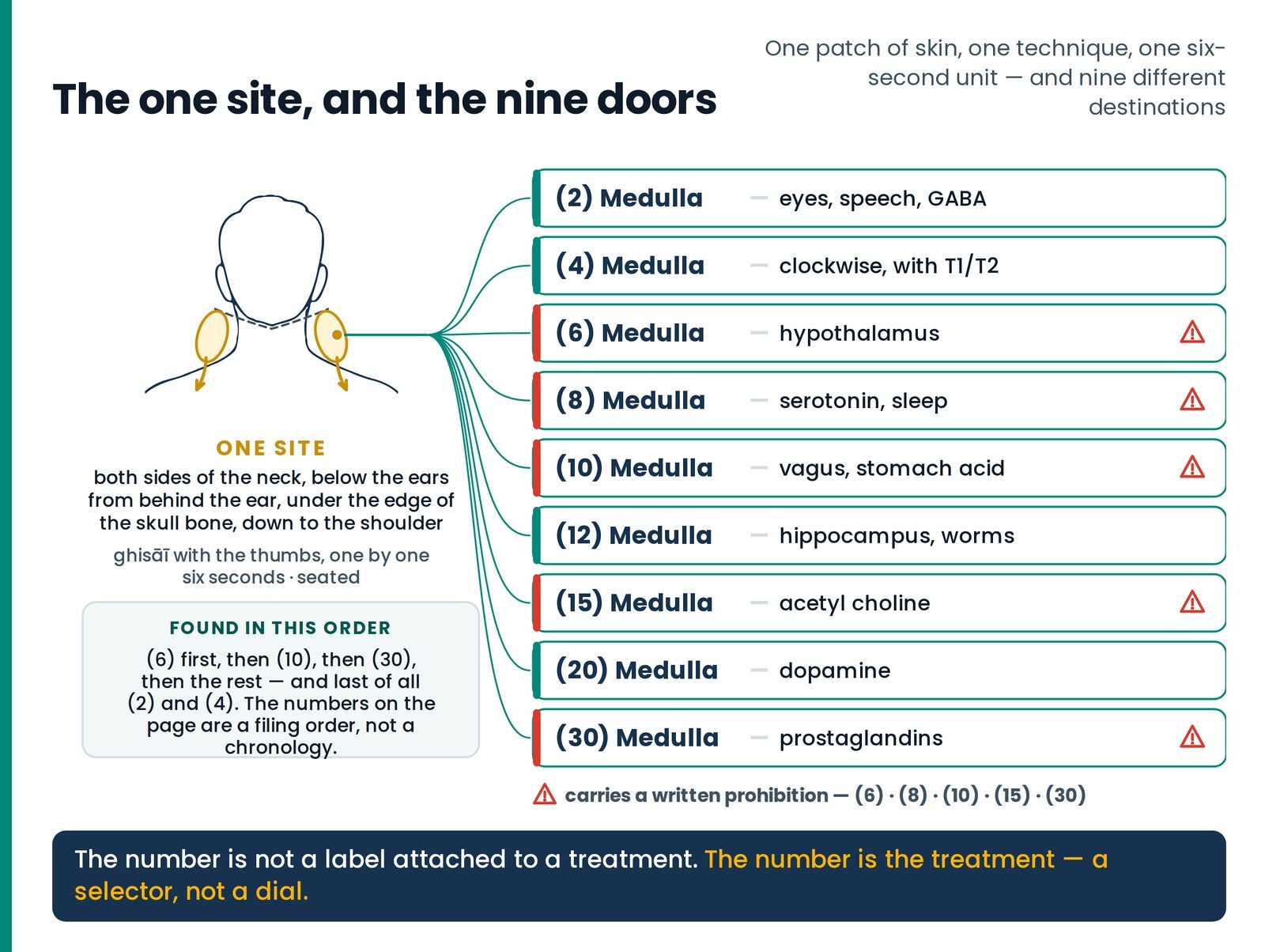
(6), then (10), then (30) — the page order is filing, not chronology
They did not arrive in numerical order, and it helps enormously to know that.
First the functions of (6) Medulla were discovered. Then came (10) Medulla, then (30) Medulla, and so on. Slowly, by research and practice, it came to be known that many organs of the brain can be stimulated by these treatments. Now many different treatments have been obtained which stimulate the various parts inside the brain and the various cranial nerves — which is ordinarily beyond belief. Apart from calling these treatments a gift of nature, or the grace of Hari, there is no other way in which their effect can be described.
Then, after all of those, the two smallest — (2) Medulla and (4) Medulla — were discovered, and they are given at the end of the family's order for that reason, not because they are least.
So the family grew (6) → (10) → (30) → the rest → (2) and (4), and the numbers here are a filing order, not a chronology. Nothing here was designed. Everything was noticed. (Figure 31.2)
Table 1 — The nine members of the Medulla family
| Formula | Applications | In one line, what it is for |
|---|---|---|
| (2) Medulla | 2 | The 2nd cranial nerve — eyes and speech; GABA; ataxia and Parkinson's |
| (4) Medulla | 4 | Given clockwise with T1/T2 — cervical C1–C4 and C5–C8 troubles, chest, mitral valve, spleen, upper diaphragm and the whole upper limb |
| (6) Medulla | 6 | The hypothalamus — temperature, hunger and thirst; meningitis and the cerebral aqueduct; epilepsy; paralysis; the releasing hormones for the anterior pituitary |
| (8) Medulla | 8 | Serotonin — deep sleep, mental depression; the raphe; vascular permeability; smooth muscle and intestinal secretion |
| (10) Medulla | 10 | The vagus, the tenth cranial nerve — all the glands of the abdomen; the acid of the stomach increases three times |
| (12) Medulla | 12 | The hippocampus — fits at night or while lying asleep; and small worms in the stools of children |
| (15) Medulla | 15 | Acetyl choline — the respiratory centre and difficulties of breathing; voluntary muscles; MND, GBS, myasthenia gravis, MS |
| (20) Medulla | 20 | Dopamine — Parkinson's disease, raised prolactin, fits; with (8) Medulla, for height |
| (30) Medulla | 30 | Prostaglandins — inflammation, side effects of medicines, PMS, asthma, systolic BP, paralysis from high BP |
Read that last column downward and the point of the article is already visible. Serotonin, the vagus, the hippocampus, acetyl choline, dopamine, prostaglandins. Six different chemicals and structures, six different clinical worlds — and the hand does not move an inch between them.
Also explained in
- (12) Medulla — the hippocampus treatment, and the worms The Medulla Family
In the brain there is a part called the hippocampus, which plays an important role in controlling fits — so the inference is that by this treatment an improvement can be brought about in the working of the hippocampus Se