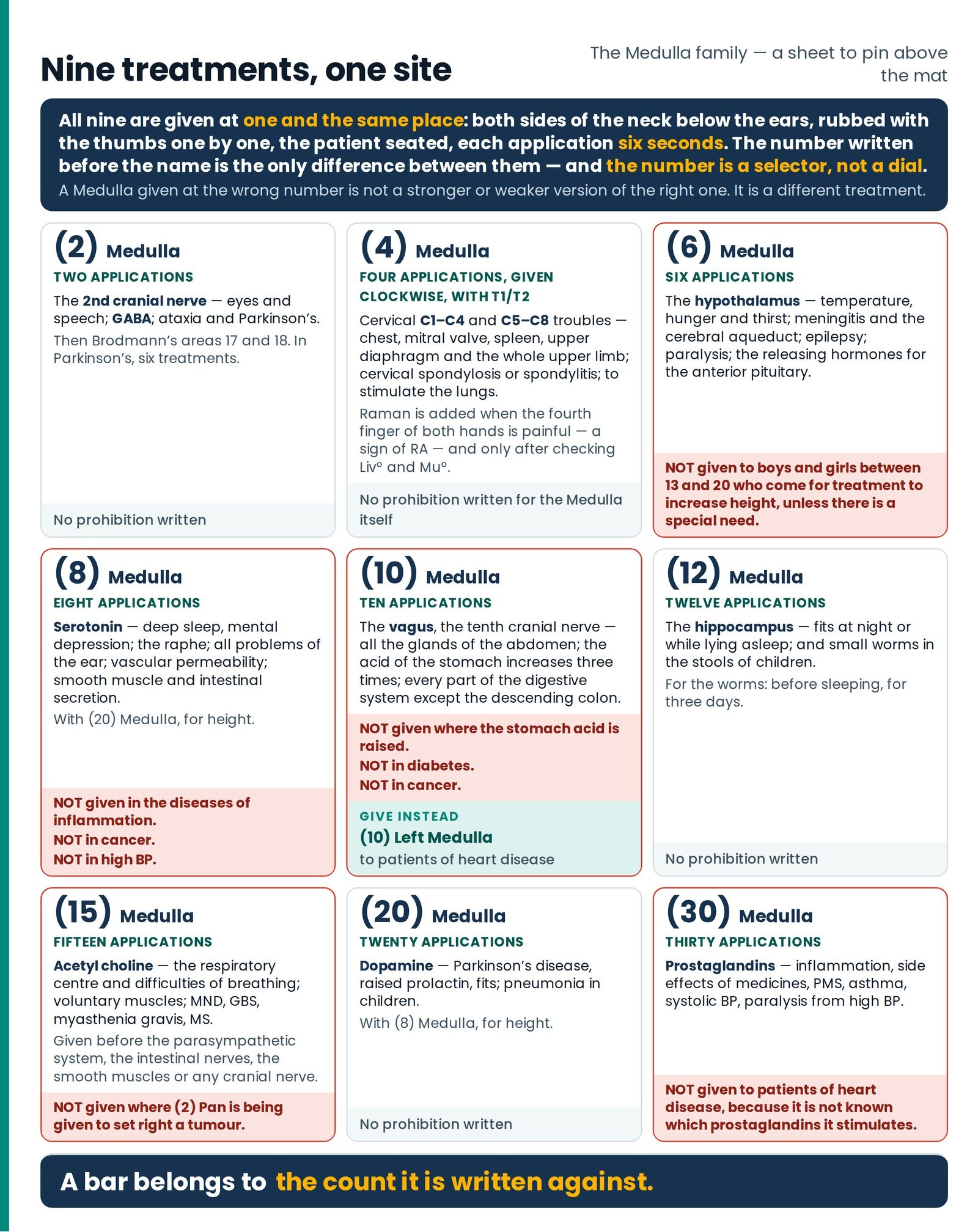
Nine treatments here; the cranial-nerve index belongs to Chapter 37
The family you have just learned is nine treatments that grew up in their own right. Beside it stands something else: a complete index of Medulla treatments, running (1) through (12) — with (11) split into (11) Left and (11) Right — each entry claiming the work of the cranial nerve of that number; and then a short second table for (15), (20) and (30), headed by the note that apart from the cranial nerves, these Medulla treatments provoke the actions of other chemicals.
That index, and the twelve cranial nerves one by one, and the polarity rule that decides side, belong to Cranial Nerve and Brain Formulas, "The Twelve Messengers", which teaches them whole. They are not taught twice. What belongs here is the boundary — and the parts of the index that add something to the nine members of this family. Those additions have been carried into the cards above, and they are collected once more below so that nothing is lost between the two articles.
Table 17 — What the index adds to the members of this family
To increase hunger, thirst and body temperature and to reduce the pains of the body. It provokes the hypothalamus, from which releasing hormones will come out and will provoke the anterior pituitary to make its own hormones — by which we can stimulate the thyroid gland, the ovaries or testes, prolactin, growth hormone and the adrenal cortex. It perhaps controls the muscles of the eyes by means of the 6th cranial nerve. It can also correct some kinds of double vision
For all problems of the ear, and for serotonin, necessary for bringing sleep and for correcting extreme sadness. By this we can correct every disease of the raphe region between the medulla and the pons
This, by means of the vagus nerve, stimulates every part of the digestive system except the descending colon. It contracts the lungs. It reduces the fast rate of the heart. To patients of heart disease, give only (10) Left Medulla ▲ Take care
It provokes the hippocampus. To correct fits that come during sleep or immediately after rising from sleep. It immediately kills worms or germs in the stomach or the intestines
Prostaglandins — inflammation, side effects of medicines, ulcer in the stomach, asthma or breathing troubles and so on. Do not give to heart patients ▲ Take care
The counts absent from that list — (1), (3), (5), (7), (9), (11) Left and (11) Right — are the cranial-nerve treatments proper, and they are Cranial Nerve and Brain Formulas's, entire. Between smell and the shoulder there is a great deal to learn, and it is taught there in one place rather than scattered here. Complete and detailed information about the functions of the cranial nerves has been given at the end. (Figure 31.6)
One further thing belongs to the boundary and to nowhere else, so learn it here. The rest between the rounds of a Medulla line is one and a half minutes, and the instruction establishing it is written of the cranial-nerve Medulla treatments: all the Medulla treatments of those tables are to be given three times at an interval of one and a half minutes. When you meet × 3 trts. on a Medulla line, that is the interval it is asking for. Table 8, How a Formula Is Built.
Key teaching
Reading the last three rungs
Up to (12) the number is claimed to index a structure — the cranial nerve of that number, doing that nerve's work. Above it, the number is simply the count that was found to produce an effect on a chemical: acetyl choline at fifteen, dopamine at twenty, prostaglandins at thirty.
The therapy marks that change itself, with a line of its own between the two tables: apart from the cranial nerves, the following Medulla treatments provoke the actions of other chemicals. It does not blur the two, and neither should the student. When you are asked what a Medulla number means, the honest answer has two halves, and you give the half that matches the number on the card.
Nine treatments, one site. The wall sheet: the shared instruction in a band across the top, nine cards of equal size three to a row with the count in the largest type, a red foot strip printing each prohibition in full, a teal give-instead strip for (10) Left Medulla, and one closing line.
(12) Gas 'I' works like (20) Medulla
Two points, two families, one errand — dopamine
The last thing this article owes you is a promise made back in the atlas, and it turns out to be the neatest illustration in of what a formula family actually is.
Gas 'I' is not a Medulla. It is a point on the calves, in the digestive group, with a dose ladder of its own — (3), (6), (9), (12) — and the reasoning that built that ladder, beginning with a Parkinson's patient whose tenderness was at Gas 'I' and whose trembling eased when it was given, is taught in full in Correcting the Two Kingdoms, "Correcting the Two Kingdoms". It is not repeated here.
What is taught here is the sentence that joins the two families.
Two points. Two families. Two positions — one supine at the calves, one seated at the nape. One errand: dopamine.
And the reason there can be two is the reason this therapy keeps giving: in our intestines there are enteric neurons, and those neurons make, in smaller quantity, the very same chemicals that are made in larger quantity in the brain. So a chemical the therapy wants can sometimes be asked for at the head and sometimes at the gut, and the two requests are for the same thing.
Parkinson's disease; raised prolactin; fits; pneumonia in children; with (8) Medulla, height
Parkinson's disease — to produce dopamine
Held to act on
Dopamine, by way of the substantia nigra
Dopamine, by way of the enteric neurons of the intestine
The relation
—
It works like (20) Medulla
Its own bar
(see the card above)
Gas 'I' increases small intestinal motility, so it is not given if there are loose motions — and that bar governs the whole Gas 'I' family, not this count alone ▲ Take care
Its own warning about the clock
The count is the treatment — Table 2
Six seconds only at every point. If nine seconds is given at every place, (6) Gas 'I' can become (9) Gas 'I' — the ladder's own warning, Correcting the Two Kingdoms 6 sec
Why this matters in practice, and not only as a curiosity. A bar on one of the two does not bar the other. A Parkinson's patient with loose motions cannot have (12) Gas 'I'; he can have (20) Medulla. A Parkinson's patient who cannot be seated — too weak, too unsteady — can have the Medulla work lying down, which is expressly allowed, or can have the calf work instead. Knowing that two roads reach one place is what lets a therapist keep treating when one road closes.
Key teaching
Two numbers that look alike on two cards are not a rule
A student who has read Correcting the Two Kingdoms carefully meets a second set of paired numbers there — 8 against 20, and 4 against 10 — in the balance between Ch. Only and the Round arrow, and sooner or later concludes that (8) Medulla and (20) Medulla must balance one another too, or that (4) and (10) are a matched pair.
They are not. Those proportions belong to a different pair of points entirely, with a different logic, and that pair is one of the four inseparable pairs established in How a Formula Is Built — (8) Ch. Only with (20) ↑|↓. The formula they belong to, and the acid-and-alkali balance they strike, are Water and Salt's, whole.
In the Medulla family, (8) and (20) are given together — for height, because dopamine and serotonin both increase the secretion rate of growth hormone. That is a partnership, not a balance, and it has nothing to do with the other pair beyond a coincidence of arithmetic. Two numbers that look alike on two different cards are not a rule.
Two more from the mat
A teacher's tremor, and a mason's shoulder older than his shoulder
At a glance
Two figures, one wall poster and one plate — what to study before the test
Ready to begin?
Send COURSE for course details, or your name, age and health issue for a consultation.