- Category
- Heart, blood pressure and circulation · Blood
- What is given
- P. Heparin
- What is barred
- No heparin while a wound is open, nor while a menstrual flow is heavy
- Explained in
- The River — Heparin
Watch


From The River — Heparin
How a clot that has already formed is dissolved
Plasminogen waits inside the clot; tPA takes about 24 hours
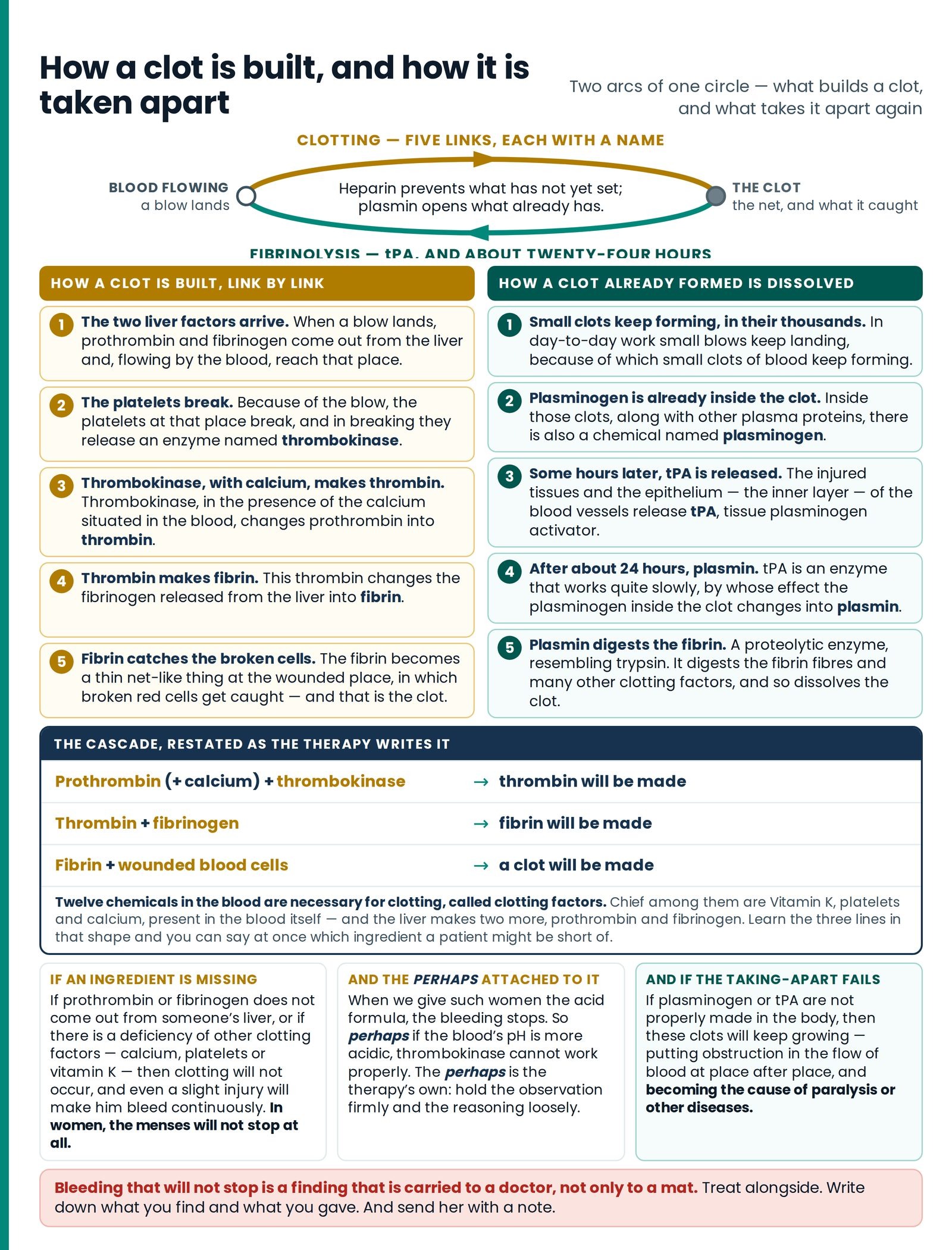
Everything above is about prevention — being saved from clots forming in future. The other half of the article's work is opening what has already closed, and that runs through a different set of chemicals. (Figure 33.2)
In our body, in day-to-day work, small blows and so on keep landing, because of which small clots of blood keep forming in their thousands.
Inside those clots, along with other plasma proteins, there is also a chemical named plasminogen.
Some hours after a blow lands, the injured tissues and the epithelium — that is, the inner layer — of the blood vessels release a chemical named tPA (tissue plasminogen activator).
This tPA is an enzyme that works quite slowly, by whose effect the plasminogen inside the clot changes, after about 24 hours, into a chemical named plasmin.
This plasmin is a proteolytic enzyme — that is, an enzyme that digests protein — and it resembles trypsin. It is able to digest not only the fibrin fibres of the clot but also many other clotting factors. In this way it is able to dissolve the clot.
The fibrinolytic system
When clots form inside the small blood vessels in the body, it is by this same process that those clots are opened.
Fibrinolysis, and what happens when it fails
The work of finishing or digesting fibrin is called fibrinolysis.
But if plasminogen or tPA are not properly made in the body, then these clots will keep growing — which will put obstruction in the flow of blood at place after place, and become the cause of paralysis or other diseases.
That sentence is the bridge from a article about blood to a article about people who cannot lift an arm. A clot that does not get dissolved does not stay the size it was. It grows, in one place and then in another, and the thing a patient finally arrives with — a weak side, a hand that has gone numb, a heart that gets breathless on the stairs — is downstream of a process that began years earlier with a housekeeping failure.
Also explained in
- The main diseases in which P. Heparin gives benefit The River — Heparin
Heparin Children of dull intellect — MR child Hypothyroidism Paralysis — that is lakwa, adhrang Atherosclerosis, or angina Diseases of the kidney and the heart Thrombosis — that is, the process of clot formation Clots an
- Layer one — is this a Heparin patient? The River — Heparin
A named finding from the lists — clots in the menses, thrombosis, a clot anywhere, AVN, raised diastolic pressure, carpal or tarsal tunnel, thrombocytosis, and the rest of Table 3.
- Layer three — the selection table The River — Heparin
Clots anywhere; raised diastolic BP; paralysis; heart; kidney; diabetes; AVN; carpal and tarsal tunnel; thrombosis; thrombocytosis; MR child; hypothyroidism; menstrual clots and pain No Heparin at all while a wound is op