Watch


Why blood must keep moving
Two opposite catastrophes, and a body that must stand between them
Begin with the danger, because the whole family is an answer to it.
The two opposite catastrophes
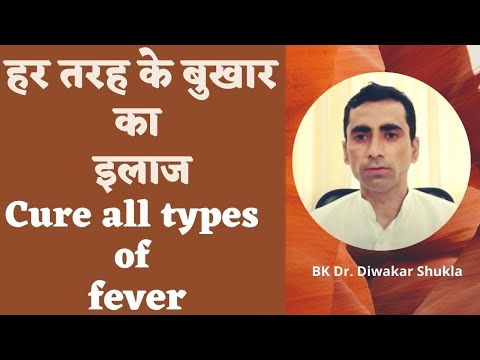
It is a property of blood that as long as it keeps moving fast there is no danger. But if it stops anywhere, or its speed becomes very slow, it will begin to set — which is called clotting.
This is a law of nature made for our protection. Were it not so, then on receiving a blow blood would keep flowing from the wound, and death could occur from excessive loss.
Exactly the opposite is also true. If clotting occurs unwanted, inside the vessels, that too is fatal.
So for this too nature has made an arrangement. In our body there are special cells which make a chemical named heparin, whose work is not to let clots form in the blood.
Two dangers, pointing in opposite directions, and the body has to stand between them every second of its life. A therapist who holds only one of them in mind will sooner or later do harm with the other.
Think of a canal running past a village. While the water moves, the channel stays open and the silt travels with it. Let the flow drop — a gate half-shut, a bend, a season of little rain — and the silt drops out of the water and begins to build a bar across the bed. Nobody put the bar there. It formed because the water slowed, and once it has formed it slows the water further, and the thing feeds itself. That is a clot inside a vessel, and it is why this article is called what it is called.
Now the arithmetic of where the anticoagulant comes from, which decides everything about the formulas.
Of the heparin made in the body:
Where heparin is made, and in what proportions
About 85 per cent is made in cells named mast cells, of the liver and the lungs.
The remaining 15 per cent is made by every tissue — the pericapillary connective tissues — and by basophil leukocytes, a special kind of white blood cell found all over the body.
Read that as a map and the formulas are already half written. Eighty-five per cent of the supply sits in two organs a therapist can reach: the liver, and the lungs by way of the chest. The other fifteen is spread thin across the whole body and has no single address.
How a clot forms
Twelve factors, five links, three lines — and a missing ingredient
Now the other half of the balance: the machinery that makes blood set when it should.
The twelve factors, and the three the therapy names first
In the blood there are twelve chemicals necessary for clotting, called clotting factors.
Chief among them are Vitamin K, the cells named platelets, and calcium, present in the blood itself.
And two more, which is where the liver enters the story for the second time: the liver also makes two clotting factors, called prothrombin and fibrinogen.
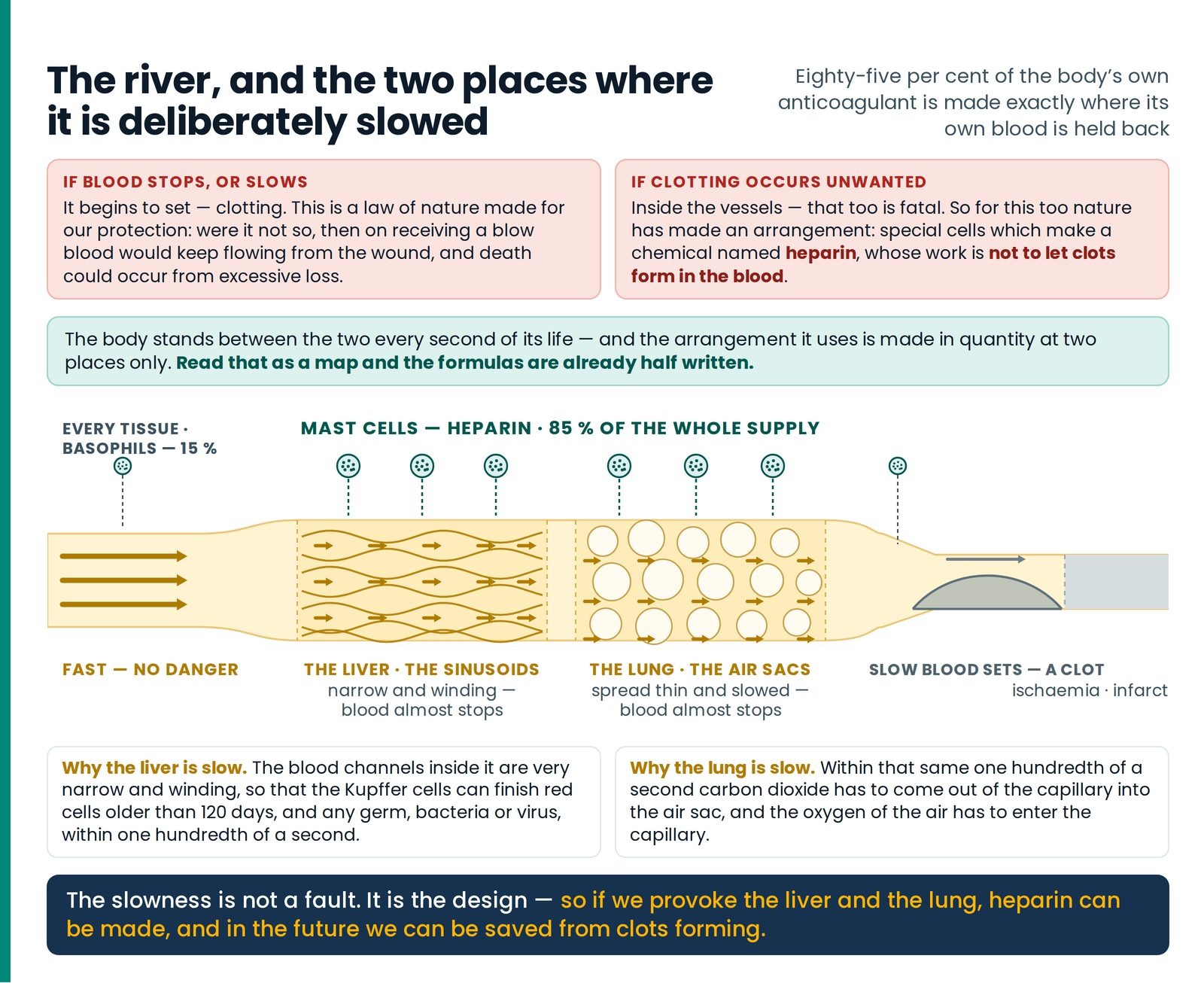
What happens when a blow lands is a chain, and each link has a name.
Table 1 — The cascade, restated as the therapy writes it
| Prothrombin (+ calcium) + thrombokinase | → thrombin will be made |
|---|---|
| Thrombin + fibrinogen | → fibrin will be made |
| Fibrin + wounded blood cells | → a clot will be made |
Three lines. Learn them in that shape and you can recite the whole of coagulation from memory, and — much more usefully — you can say at once which ingredient a particular patient might be short of.
An everyday picture for the net. Think of a hole in a mud wall during the rains. Throwing mud at it achieves nothing, because there is nothing for the mud to hold on to. Push a handful of straw into the hole first, in a loose tangle, and then the mud has something to catch on and the wall closes. Fibrin is the straw. The broken red cells are the mud. The body does not plug a wound; it first builds something for the plug to stick to.
What happens when an ingredient is missing
The thing to note
If prothrombin or fibrinogen does not come out from someone's liver, or if there is a deficiency of other clotting factors — such as calcium, platelets or vitamin K — then clotting will not occur, and even a slight injury will make him bleed continuously.
If this happens in women, their menses will not stop at all.
That last sentence deserves a moment, because it is the kind of observation a therapist meets and a laboratory often does not. A woman whose periods have never stopped properly since they began, who bruises where she cannot remember being knocked, whose small cuts weep all afternoon, is not describing a gynaecological complaint and a clumsy nature and bad luck. She is describing one thing three times. The finding is in the pattern, and the pattern is only visible to somebody who asks about all three in the same conversation.
And then the therapy's own bracketed note, which is a guess and is printed as one:
The acid formula, and the perhaps attached to it
When we give such women the acid formula, the bleeding stops.
So perhaps if the blood's pH is more acidic, thrombokinase cannot work properly.
The perhaps is the therapy's own and it stays exactly where it is. What is reported without a perhaps is the observation — the acid formula was given, the bleeding stopped. The explanation offered for it is offered as an explanation and no more. Hold the observation firmly and the reasoning loosely. That is how it was handed to you, and this wiki does not upgrade it.
Why is heparin made in such large quantity in the lungs and the liver?
Because those are the two places the body slows its own blood
This is the question on which the whole family turns, and the answer, once you have it, makes the formulas obvious.
Because these are the two places where blood is deliberately slowed
This is because these two places, or organs, are such that the flow of blood there — even if only for a very short time — is of extremely slow speed.
The liver. In the liver there are cells named Kupffer cells, whose work is that if there are red cells older than 120 days, or in the blood any germ, bacteria or virus, then to finish or destroy them within one hundredth of a second. (The remaining material obtained from the destroyed cells is stored in the liver and used again according to need.)
To do this work properly, the blood channels inside the liver — the sinusoids — are very narrow and winding, and the blood has to pass through inside them. During this the motion or speed of blood becomes so slow that there is a danger of the blood setting there. And so that clotting should not happen there, in that part of the liver the mast cells make heparin.
The lungs. The second place is the alveoli — the air sacs. In these also, within one hundredth of a second, carbon dioxide has to come out from inside the capillary and enter into the alveoli, and during that same time the oxygen of the air inside the lungs has to enter into the capillary. At this place too the speed of blood is so slow that there also there is a danger of clotting. To be saved from that, the mast cells around the alveoli make heparin.
The meaning of this is that if we provoke the liver and the lung, then heparin can be made, and in the future we can be saved from clots forming.
Read that twice. It is one of the most satisfying pieces of reasoning in the whole formulary, and it runs in a straight line from an observation to a treatment. (Figure 33.1)
Here is the picture to keep. A river runs fast and clean between its banks — and then it reaches a stretch where the channel splits into a hundred narrow, twisting side-creeks so that every drop can be inspected and every bit of rubbish pulled out. That inspection is the liver's work, and it is only possible because the water has been slowed almost to a stop. The slowness is not a fault in the design. The slowness is the design. But water that slow will silt up — so at exactly that stretch, and nowhere else along the river, something must be added to the water to stop it silting. That is the mast cell, and that is heparin.
The lungs are the same bargain struck for a different reason. A red cell has to give up its carbon dioxide and take on oxygen in a hundredth of a second, and a cell travelling fast cannot do it. So the blood is spread thin and slowed to a crawl across the air sacs — and there too, something has to be added to stop it setting.
Two places where the body deliberately slows its own blood. Two places where it therefore has to make its own anticoagulant. Two places a pair of hands can reach. The parent formula in this article is those two organs, and one more.
How a clot that has already formed is dissolved
Plasminogen waits inside the clot; tPA takes about 24 hours
Everything above is about prevention — being saved from clots forming in future. The other half of the article's work is opening what has already closed, and that runs through a different set of chemicals. (Figure 33.2)
In our body, in day-to-day work, small blows and so on keep landing, because of which small clots of blood keep forming in their thousands.
Inside those clots, along with other plasma proteins, there is also a chemical named plasminogen.
Some hours after a blow lands, the injured tissues and the epithelium — that is, the inner layer — of the blood vessels release a chemical named tPA (tissue plasminogen activator).
This tPA is an enzyme that works quite slowly, by whose effect the plasminogen inside the clot changes, after about 24 hours, into a chemical named plasmin.
This plasmin is a proteolytic enzyme — that is, an enzyme that digests protein — and it resembles trypsin. It is able to digest not only the fibrin fibres of the clot but also many other clotting factors. In this way it is able to dissolve the clot.
The fibrinolytic system
When clots form inside the small blood vessels in the body, it is by this same process that those clots are opened.
Fibrinolysis, and what happens when it fails
The work of finishing or digesting fibrin is called fibrinolysis.
But if plasminogen or tPA are not properly made in the body, then these clots will keep growing — which will put obstruction in the flow of blood at place after place, and become the cause of paralysis or other diseases.
That sentence is the bridge from a article about blood to a article about people who cannot lift an arm. A clot that does not get dissolved does not stay the size it was. It grows, in one place and then in another, and the thing a patient finally arrives with — a weak side, a hand that has gone numb, a heart that gets breathless on the stairs — is downstream of a process that began years earlier with a housekeeping failure.
In what manner is this fact used in Neurotherapy?
Pancreas, liver, lung — and the hold that now opens every formula
Everything above is physiology. Here is the sentence that turns it into a treatment.
The reasoning that built the parent formula
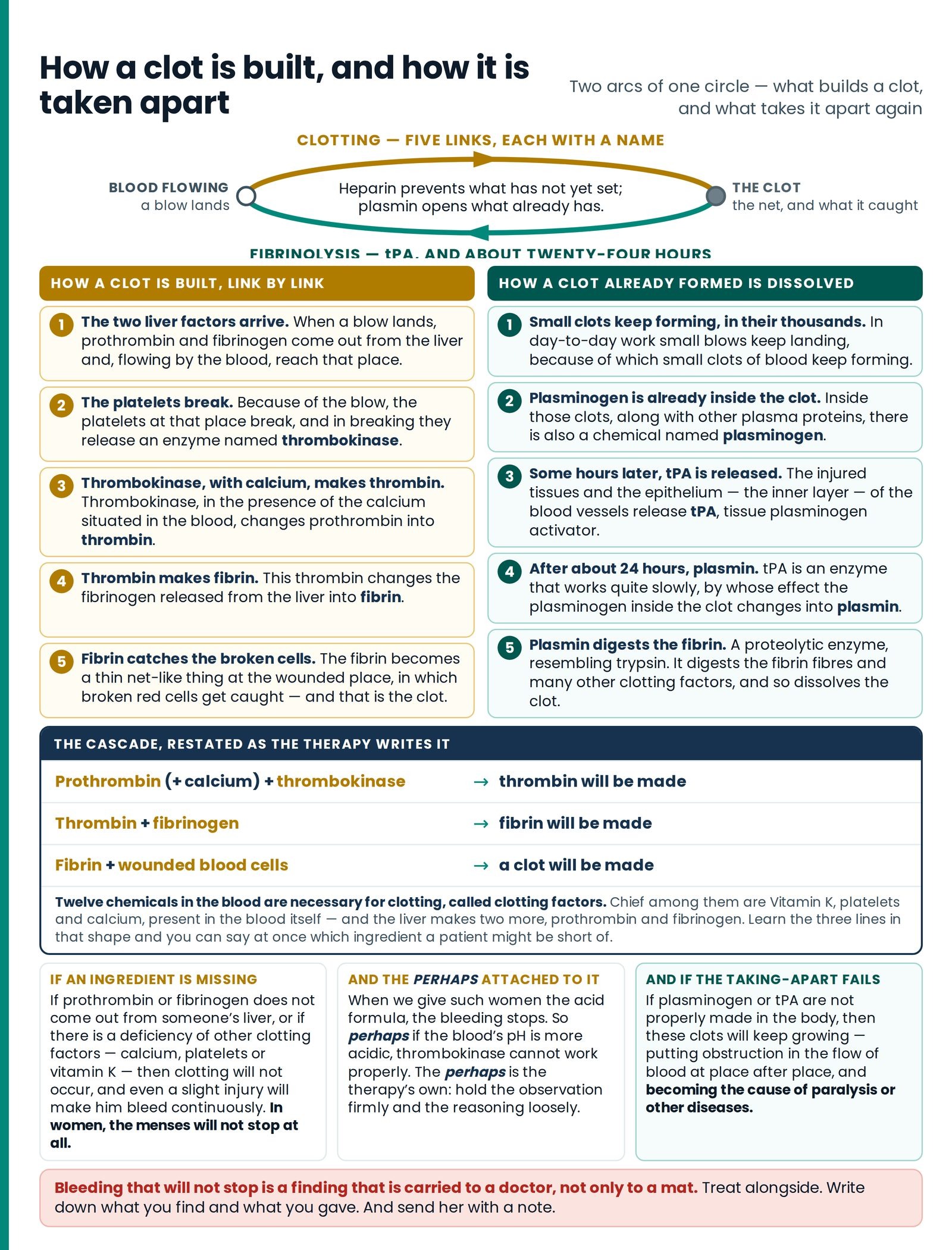
From the above fact we come to understand that if a clot is occurring in some unwanted place in a person, then heparin is not being properly made in that person's body.
Since heparin is being made in larger quantity in the liver and lungs, then by provoking those two organs heparin will be made.
Along with it, in order to digest the protein named fibrin of the old clot, the pancreas is to be provoked.
With this thinking Guruji made the following treatment, in which the pancreas, liver and lungs are provoked in that order →
Three points. Pancreas, liver, lungs. And each of them is doing a named job: the pancreas is there to digest the fibrin of an old clot, the liver and the lungs to make heparin so that no new clot forms. One formula, two errands — opening what is shut, and preventing what has not yet shut. Hold on to that, because when you meet F. Heparin and Anti-F. Heparin at the end of the article, the whole difference between them will lie in how hard the first of those three points is pressed. (Figure 33.3)
What is the secret of provoking the pancreas?
The liver and the lungs explain themselves. The pancreas does not, and the therapy sets out its reasoning openly rather than leaving the step to be taken on trust.
The two boys on the road
If, while passing along the road, we were to see two boys who looked similar to one another, could we not say that perhaps they ought to be the children of the same mother and father?
It has been written that plasmin is a fibrinolytic enzyme which resembles trypsin. Trypsin is made by the pancreas in order to digest proteins — and in the body the chief responsibility for digesting proteins is the pancreas's alone.
So is it not possible that plasmin too is being made by the pancreas?
Guruji has perhaps provoked Pan with exactly this thought. (fibrinolytic = one that breaks fibrin.)
This is the clearest window anywhere in the formulary into how a treatment in this therapy actually got made. A sentence was read in a textbook — plasmin resembles trypsin. A question was asked about the resemblance. The organ that makes the one was provoked, to see whether it would make the other. And then the patients were watched.
Notice also the two perhaps in that passage, and that neither has been taken out. Perhaps they ought to be the children of the same parents. Perhaps this is the thought with which the point was provoked. The therapy is telling you which parts of its own reasoning are inference. Keep them marked that way.
Two kinds of result seen from the formula
What was seen, and what was concluded from it
First — the clots that stop coming.
If some woman is getting clots in her menses, then after giving the above treatment once or twice, in the next menses clots do not come — and this has been proved on many women. That is, this formula works like heparin, which stops clots that are going to come. And this formula is so effective that once the clots in the menses have ended, for some years this trouble does not occur.
Second — the blockages that open. From this treatment considerable comfort reaches patients of heart disease and paralysis. Those who have blockage in the heart — if they are given P. Heparin, then first of all their breathlessness stops. And if it is given for several months, it has been seen that their ejection fraction increases — from which we draw the conclusion that the blockages are ending. This work is like plasmin.
From both of these results Guruji came to the conclusion that this formula provokes both plasmin and heparin. That is exactly why this formula has been given the name P. Heparin — that is, Plasmin Heparin.
Read the two results side by side and you can see why the name has two halves. The menstrual result is a heparin result: nothing was dissolved, something was stopped from forming. The cardiac result is a plasmin result: something that had already closed was opened. One formula was seen doing both, so the name carries both.
And note what kind of evidence each rests on. The first rests on a thing the patient reports and can count — clots, next month, present or absent. The second rests on a number somebody else measures with a machine and that nobody in the room can influence. The therapy has chosen, for once, an outcome outside its own hands, and it is worth knowing that it has.
Everything else in this article is this formula with something put in front of it, or with one of its numbers changed. Learn it properly and you have learned nine-tenths of the family. (Figure 33.6)
First, the question a careful student asks straight away — and the therapy prints it, together with an answer that does not pretend to be more than it is.
The question, and the estimate offered in reply
Question.
According to physiology, plasminogen is already present inside the clot beforehand. If it is prepared after our provoking, then after the clot has formed, how does it reach inside and open it?
Answer. The plasminogen that is inside the clot cannot change into plasmin until tPA has its effect upon it. So we make the estimate that by provoking the pancreas through LMNT, perhaps tPA is also being made, which is changing plasminogen into plasmin.
Whatever the cause may be, there is no doubt that the P. Heparin formula stops the tendency of clots to form in the future, and is also able to open old clots in paralysis and in heart diseases. (Those who have had paralysis recently — that is, only a few days ago — get relief quickly from this treatment, whereas an old disease can take a good deal of time to become well.)
The bracketed sentence at the end is a prognosis, and it is the sentence to say out loud to a family on the first day. Recent paralysis, quick relief. Old disease, a good deal of time. Not no benefit — a good deal of time. Say it before the treatment starts, and a family measuring week three against a cure will measure it against the right thing instead.
The family, and the hold that now opens all of it
The foremost formula for opening unwanted clots is P. Heparin.
Then, by joining some other points to it, various Heparin formulas have been made, which are used for correcting different symptoms.
And one change applies to the whole family at once: nowadays more benefit has been found by giving (½) Ku – 6 secs at the beginning of every Heparin formula.
The word nowadays is the therapy's own, and it means what it always means in this wiki: the older form is not an error and is not deleted. A card written before this was found, showing three steps and no Ku, is an earlier generation of the same formula. Table 13, How a Formula Is Built.
Why that hold, and not another. (½) Ku is not a count; the number after the dash is seconds, and each written timing of it is a separate treatment aimed at a separate cell. Six seconds is the one written for the mast cells, which assist in producing heparin — and the mast cells are where eighty-five per cent of the supply comes from. The hold is the family's opening move because it is aimed at the factory, before the three points that are aimed at the organs.
Table 2 — Card: P. Heparin, the parent formula Prone Supine 6 sec Both sides ▲ Take care
| Written | P. Heparin → (8) Pan (7) Liv (8) Ch. Only — with (½) Ku – 6 secs at the beginning, nowadays |
|---|---|
| What it means | P is for plasmin. Plasmin Heparin — because the formula was seen doing both jobs: stopping clots that were going to come, and opening ones that had already come |
| What it is for | This can be given to all patients. The foremost formula for opening unwanted clots; and for stopping the tendency of clots to form in the future |
| Step 0 — (½) Ku – 6 secs | One application, held exactly six seconds, then released comfortably. Prone, 1½ pillows under the chest, both heels turned to face each other, the therapist sitting between the patient's feet, the middle part of the sole on the last end of the spinal column. For the mast cells, which assist in producing heparin Prone |
| Step 1 — (8) Pan | Supine. Both soles at once, soft mid-sole in the middle of each thigh, close to the hip–waist crease. Six seconds, released, eight times — each time at the same place, weight equal on both feet. To digest the fibrin of the old clot Supine Both sides 6 sec |
| Step 2 — (7) Liv | The Liv – 3 points pass given twice — waist + elbow, mid-thigh + mid-arm, knee + wrist, six seconds at each paired station — and then once more at the middle station, the place between the hand and the thigh. Six applications, then a seventh. The liver: 85 per cent of heparin production Left Both sides |
| Step 3 — (8) Ch. Only | Supine, worked from the head end. Both soles glide from the chest up to the shoulders, so softly that the sole slips out over the cloth. Three rubs count as one, so (8) is twenty-four rubs on the left side, then twenty-four on the right. Left side first. No rub on the return stroke — count the outward journeys only. The lung |
| The position change | Step 0 is prone; steps 1 to 3 are supine. Turn the patient once, between the Ku and the Pan, and place her properly — Placing the Patient, "Placing the Patient" |
| When it must not be given | If blood is flowing, or there is a wound, then until the wound heals, do not give any Heparin treatment at all ▲ Take care |
| Points taught in | Ku — Face Down; Pan and Liv — The Front of the Body I; Ch. Only — The Front of the Body II |
Three details on that card that decide whether it is given or only approximated
(8) Pan does not travel. Every other thigh point in the wiki runs down the limb; Pan does not move at all. Eight presses at one and the same spot, on both thighs together, weight equal. A foot that creeps an inch lower with each press has given something else. The Front of the Body I.
(7) Liv is not seven presses anywhere. It is the three-station pass twice over — six applications — and then one more at station two. The entry names where the odd one goes, and it is not the therapist's to choose. The Front of the Body I.
(8) Ch. Only is a glide, not a press, and it is the only step of its kind in the formula. The foot is laid obliquely, the big toe turned a little inward relative to the heel, the heel and the outer edge of the sole kept down, and the rub travels from the chest up to the shoulders so lightly that the sole slides out over the cloth. The Front of the Body II. A therapist who leans on this step has not given a stronger lung treatment; he has given a different one, and an uncomfortable one.
Pan raises alkali — and the exception that is written for this article alone
Pan's own entry carries a prohibition that applies to the point in general, not to one count of it: giving Pan increases alkali — therefore do not give in fits, convulsions or seizures.
And then, in the same breath, the exception: but it may be given within the Heparin formula.
That clause is not an oversight and it is not a loophole. It is written into the point's own entry, it names this family by name, and it is one of only a handful of places in the whole wiki where a general prohibition is opened for one specific use. Read it whole or you will withhold the formula from the very patients — the paralysed, the fitting child — for whom it was built.
Pan's second prohibition carries no such exception and stands: giving Pan to schizophrenia patients causes them to hear voices in the ears. So do not give it to them. ▲ Take care