Watch


Layer three — the selection table
Eleven rows, and a default for the patient nothing steers you to
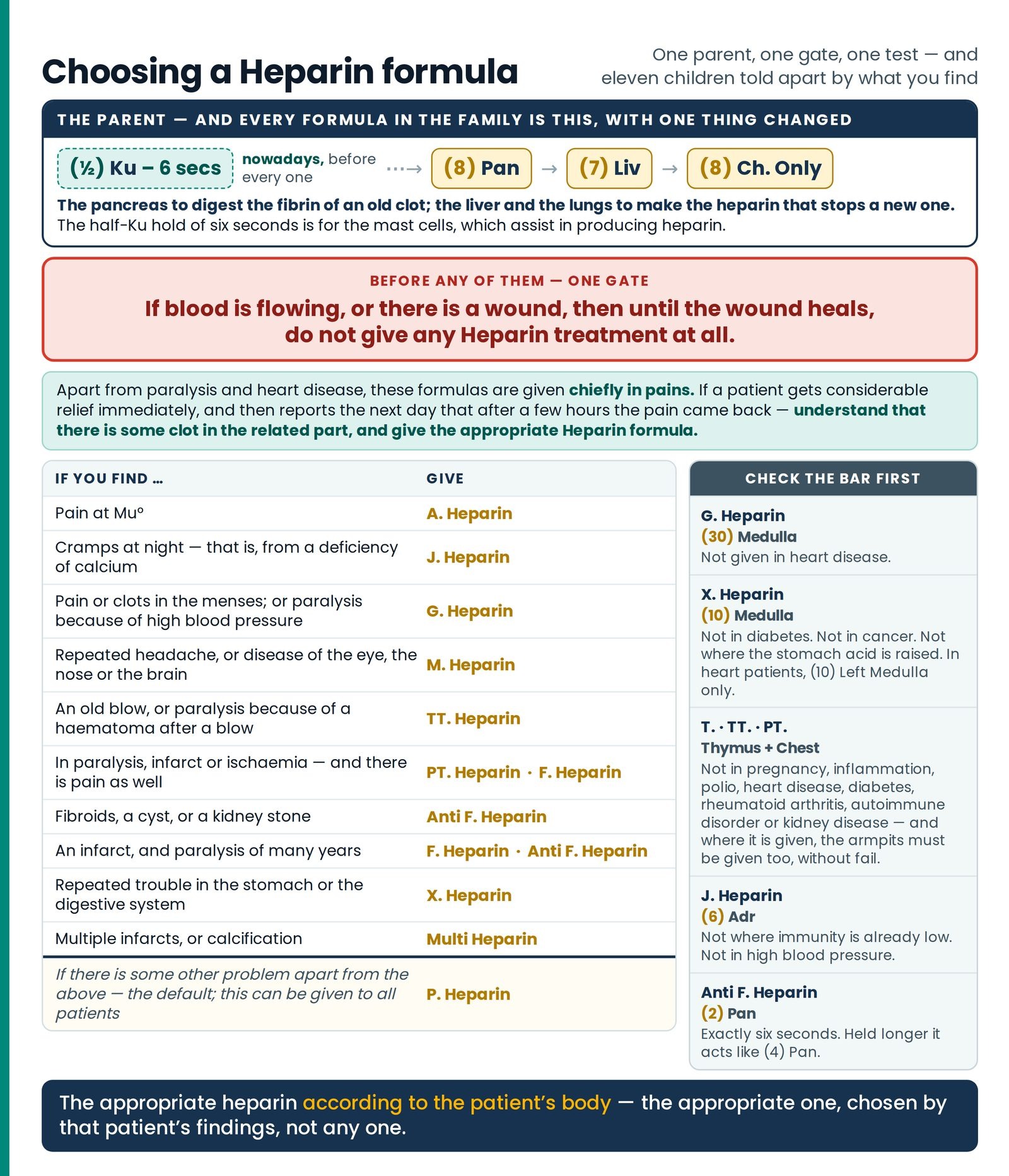
Table 14 — Choosing the appropriate Heparin formula
| If … | Give |
|---|---|
| If they have pain at Mu° | A. Heparin |
| If cramps come at night — that is, from a deficiency of calcium | J. Heparin |
| If there is pain or clots in the menses; or paralysis because of high BP | G. Heparin |
| Repeated headache, or disease of the eye, the nose or the brain | M. Heparin |
| If an old blow has been received, or paralysis because of a haematoma after a blow | TT. Heparin |
| If in paralysis there is infarct or ischaemia and there is pain as well | PT. Heparin, F. Heparin |
| If there are fibroids, a cyst, or a kidney stone | Anti F. Heparin |
| If there is an infarct and there has been paralysis for many years | F. Heparin, Anti F. Heparin |
| If there is repeated trouble in the stomach or digestive system | X. Heparin |
| If there are multiple infarcts or calcification | Multi Heparin |
| If there is some other problem apart from the above | P. Heparin |
The last row is not a shrug. Some other problem apart from the above is the instruction to give the parent formula, and the parent formula's own entry says this can be given to all patients. The family has a default, and the default is the one thing everybody may have.
Table 15 — The whole family at a glance
| Formula | Sequence | What is different | Stated target | The bar to check first |
|---|---|---|---|---|
| P. Heparin (Plasmin) | (8) Pan (7) Liv (8) Ch. Only | — the parent | All patients. Clots anywhere; raised diastolic BP; paralysis; heart; kidney; diabetes; AVN; carpal and tarsal tunnel; thrombosis; thrombocytosis; MR child; hypothyroidism; menstrual clots and pain | No Heparin at all while a wound is open |
| A. Heparin (acid) | parent + (1) acid (4) Ch. Only; ± (6) Adr | Acid point and a closing chest glide | Pain at Mu° with acidosis signs; knee; gangrene; bamboo spine; burning feet or soles; diabetes | (6) Adr — low immunity, high BP, and the diabetic who did not feel well after it |
| G. Heparin ('glandins) | (30) Medulla + parent | The highest Medulla count | Systolic high BP; paralysis from high BP; menstrual pain and clots; hot, red knee with no Mu° pain; auto immunity, such as MS | Not in heart disease |
| J. Heparin (joints) | (4) Para + parent + (6) Adr | Parathyroid prefix, adrenal suffix | Night cramps; pain all over the body with weakness — especially the diabetic patient; fatigue | (6) Adr's two bars. And no Normal or NAN the next day |
| M. Heparin (medulla) | (6) Medulla + parent; ± (6) Adr | The lowest Medulla count | Headache; face, neck, shoulder pain; brain disease; meningitis; hydrocephalus; encephalitis; eye disease; Bell's palsy; cranial nerve VI; memory; dullness of intellect | (6) Medulla — not to 13–20-year-olds treated for height. Shunt: less pressure on the neck |
| T. Heparin (thymus) | (4) Thymus+Chest + parent | Sternal prefix, single strength | The ordinary blow, after the wound has dried; after an accident or an operation | Th + Ch — pregnancy, inflammation, polio, heart, diabetes, RA, autoimmune, kidney. Armpits compulsory |
| TT. Heparin | (8) Thymus+Chest + parent | Sternal prefix, double strength | The deeper blow; the old blow; haematoma after a blow; the treatment at 10–15 days once the serum has dried | as above; and twenty-four a side must be divided 12/12, then without rest 12/12 |
| X. Heparin (cranial nerve X) | (10) Medulla + parent | The vagal prefix | Pain at Pan or Gas; repeated trouble in the stomach or digestive system; clots in the digestive system | (10) Medulla — diabetes, cancer, raised stomach acid; heart patients (10) Left Medulla only |
| PT. Heparin | (8) Pan (7) Liv (8) Thymus+Chest | The last step replaced | All kinds of paralysis; pain — given in place of P. Heparin; infarct or ischaemia with pain | Th + Ch, as for T. and TT. |
| F. Heparin (Fibrinolysin) | (18) Pan (7) Liv (8) Ch. Only | Pan raised to 18 | Old clots — breaking the fibrin that has set; infarct with paralysis of many years; all kinds of paralysis | The general Pan bars |
| Anti F. Heparin (Anti fibrin) | (2) Pan (7) Liv (8) Ch. Only | Pan lowered to 2 | Obstruction from unwanted growth; fibroids, cyst, kidney stone; infarct with long-standing paralysis; all kinds of paralysis | (2) Pan — exactly six seconds; not to children being treated for height |
| Multi Heparin | Six parts, I–VI | The full assembly | Multiple infarcts or calcification; all kinds of paralysis, infarct, clot, or years-old pain | Every bar of every part — the list above |
| (the opening hold) | (½) Ku – 6 secs | Before any of the above, nowadays | For the mast cells, which assist in producing heparin | — |
Layer four — the near-neighbours, and the one question that separates each pair
Five pairs account for almost every wrong card in this family
A table tells you what to give when you already know what you are looking at. The hard part is the moment before that — when two rows both look like your patient. Five pairs account for almost every wrong card written in this family.
Eleven names is more than anybody can hold. One formula with a key is not.
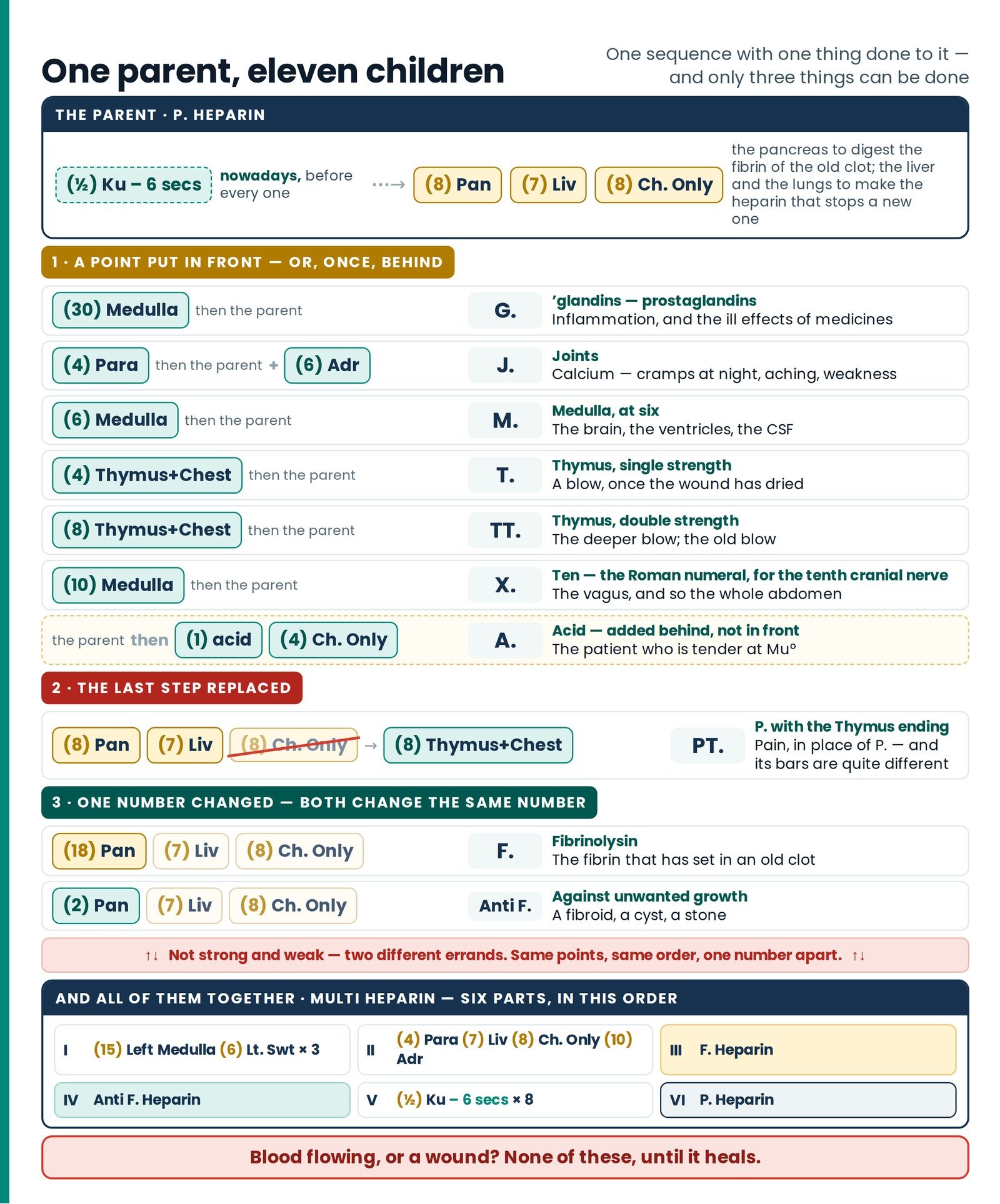
There is one parent: (8) Pan (7) Liv (8) Ch. Only — the pancreas to digest the fibrin of the old clot, the liver and the lungs to make the heparin that stops a new one. Every other formula in the article is that sequence with one thing done to it, and there are only three things that can be done:
- 1. Put a point in front of it. A. puts Acid behind it and a closing chest glide; G., J., M., T., TT. and X. all put a single step in front. The prefix names the formula, and the prefix is what the formula is for.
- 2. Replace its last step. PT. alone does this — Ch. Only out, Thymus+Chest in.
- 3. Change one of its numbers. F. and Anti F. alone do this, and both change the same number: Pan, up to eighteen or down to two.
Why the family is organised the way it is — the key that makes eleven into one
And the letters are a key you can read cold:
Letter · Stands for · Which is why the formula is aimed at
P · Plasmin · Opening clots and stopping new ones — the parent
A · Acid · The patient who is tender at Mu°
G · 'glandins — prostaglandins · Inflammation, and the ill effects of medicines
J · Joints · Calcium — cramps, aching, weakness
M · Medulla, at six · The brain, the ventricles, the CSF
T / TT · Thymus, single and double · A blow, once the wound has dried
X · Ten — the Roman numeral, for the tenth cranial nerve · The vagus, and so the whole abdomen
PT · P with the Thymus ending · Pain, in place of P.
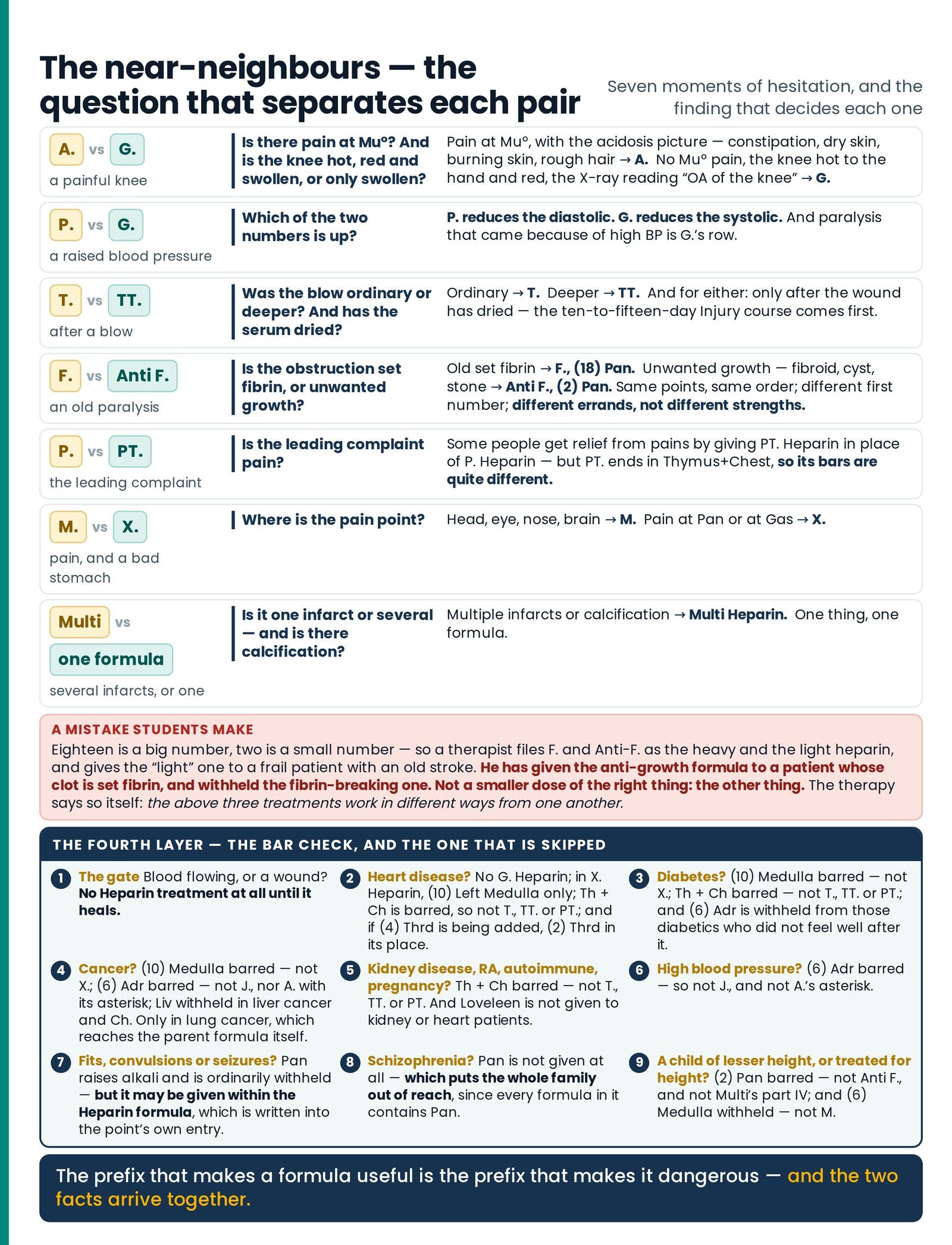
F · Fibrinolysin · The fibrin that has set in an old clot
Anti F · Against unwanted growth · A fibroid, a cyst, a stone
Multi · All of them together · Several infarcts; calcification
A student who learns that key can reconstruct any formula in this article from its name, and — much more useful at the mat — can look at a name on a card and say at once which prefix it contains and therefore which prohibitions it drags in.
One point in the whole atlas may not be given until a Heparin formula has been given first, and it is here that its instruction is completed.
Teeth point, and the line that must stand above it on the card
Teeth point is given to increase the circulation of blood in the teeth or the jaws, from which the pain in them comes to an end.
Before this, the appropriate heparin treatment according to the patient's body is to be given.
Read the qualifier and not only the noun. Not a heparin treatment. The appropriate one — according to the patient's body. That is not a form of words; it is an instruction to examine, and it is the reason this point could not be finished in Each Point in Use, "Each Point in Use", where it is the only entry in the whole physical half carrying a prerequisite. A card that reads Teeth point alone is a card missing a line.
So what does according to the patient's body actually mean at the mat? Exactly what it has meant since the a little further on wiki: Neurotherapy treats according to the condition of the body, not according to the name of the complaint. Toothache does not choose a heparin. This patient's findings choose it, and you have just spent a article learning how. Run the four layers on a patient with toothache and they answer in order:
Table 17 — The appropriate heparin according to the patient's body, worked for a toothache
| What you find on this patient | The heparin that is appropriate for this body |
|---|---|
| Pain at Mu°, with the acidosis picture — constipation, dry skin, burning skin, rough hair | A. Heparin |
| Repeated headache, or trouble of the eye, the nose or the brain, alongside the jaw pain | M. Heparin |
| Pain at Pan or Gas — repeated trouble of the stomach or digestion | X. Heparin |
| Cramps at night, aching all over, weakness | J. Heparin |
| Nothing else to steer you — no Mu°, no head, no stomach, no cramps | P. Heparin — some other problem apart from the above, and this can be given to all patients |
| A wound in the mouth, or bleeding gums that are still bleeding | None at all, until it heals — and therefore no Teeth point either, because its prerequisite cannot be met ▲ Take care |
Then, and only then, Teeth point. And note how that point is given, because it is one of the few in this wiki that the therapist does not give at all: it is taught to the patient, to do on themselves. For the upper teeth — the point above the ear, found by asking the patient to clench the teeth and feeling where the muscles move, and the point below the eyes; press where pain is felt, and do clockwise. For the lower teeth — below the chin and below the jaws, wherever pain is felt, stroked in the direction of the clock's hand. Treat on the same side as the side on which the teeth hurt. And doing it on and off through the day, rather than continuously, will bring relief sooner.
Read the two halves together and the prerequisite stops looking like a formality. The patient is sent home to press her own face several times a day. What the therapist does before that is open the blood supply to the region she will be pressing — with the formula her own body selected. One half is done by you, once, and chosen by examination. The other half is done by her, all day, and needs no choosing at all.