Watch


Foot, hand, single points, feather touch — and who goes on each rung
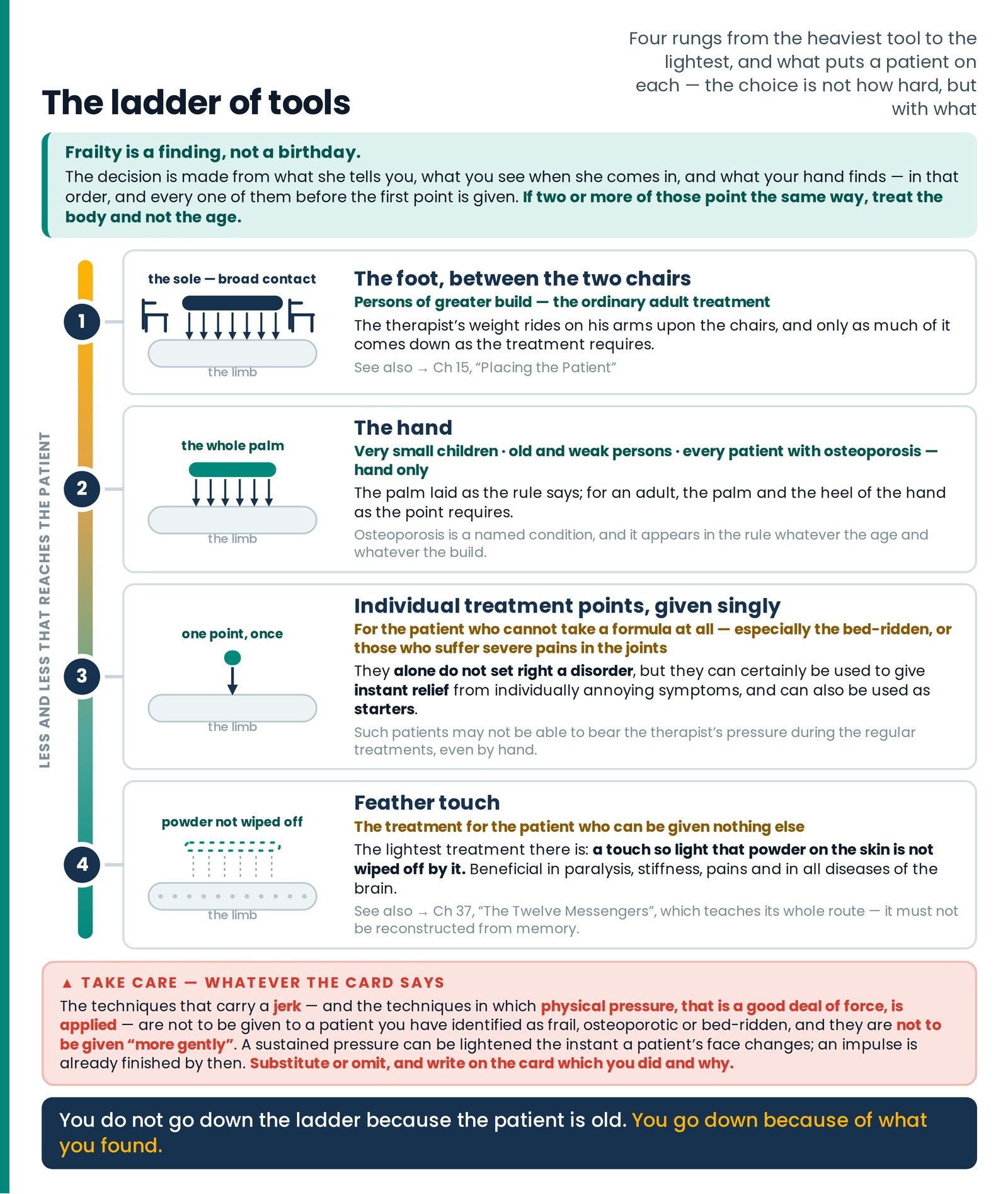
Put the whole thing in order and you have a ladder. A therapist's job is to start at the right rung, and the right rung is chosen by the body in front of them. (Figure 41.2)
Four rungs, and what puts a patient on each
1. The foot, between the two chairs.
The ordinary adult treatment. Persons of greater build. The therapist's weight rides on his arms upon the chairs and only as much of it comes down as the treatment requires.
- 2. The hand. Very small children. Old and weak persons. Every patient with osteoporosis — hand only. The palm laid as above; for an adult, the palm and the heel of the hand as the point requires.
3. Individual treatment points, given singly. For the patient who cannot take a formula at all. The statement is exact: individual treatment points alone do not set right a disorder, but they can certainly be used to give instant relief from individually annoying symptoms, and they can also be used as starters — and the footnote naming who this is for is the important half: especially in the case of patients who are bed-ridden, or who suffer from severe pains in the joints. Such patients may not be able to bear the therapist's pressure during the regular treatments, even if such pressure is applied by hand.
4. Feather touch. The lightest treatment there is: a touch so light that powder on the skin is not wiped off by it. This is the treatment for the patient who can be given nothing else — a newborn, a woman in the last weeks of pregnancy, a man whose bones break at a knock, a patient in the acute days after a stroke, somebody in too much pain to bear a palm. It is beneficial in paralysis, stiffness, pains and in all diseases of the brain.
Rung three deserves a moment, because students skip it. It is the rung for the patient whose pain is the obstacle to being treated for the pain — the bed-ridden woman with motor neuron disease, the man whose every joint hurts, the patient four days after a fracture. For them the formula is not available yet. What is available is one point, chosen for one symptom, given once, to buy the relief that makes tomorrow's session possible. The material's own words for it are instant relief and starters, and both halves are honest: it is a beginning, not a treatment, and it is not pretended to be one.
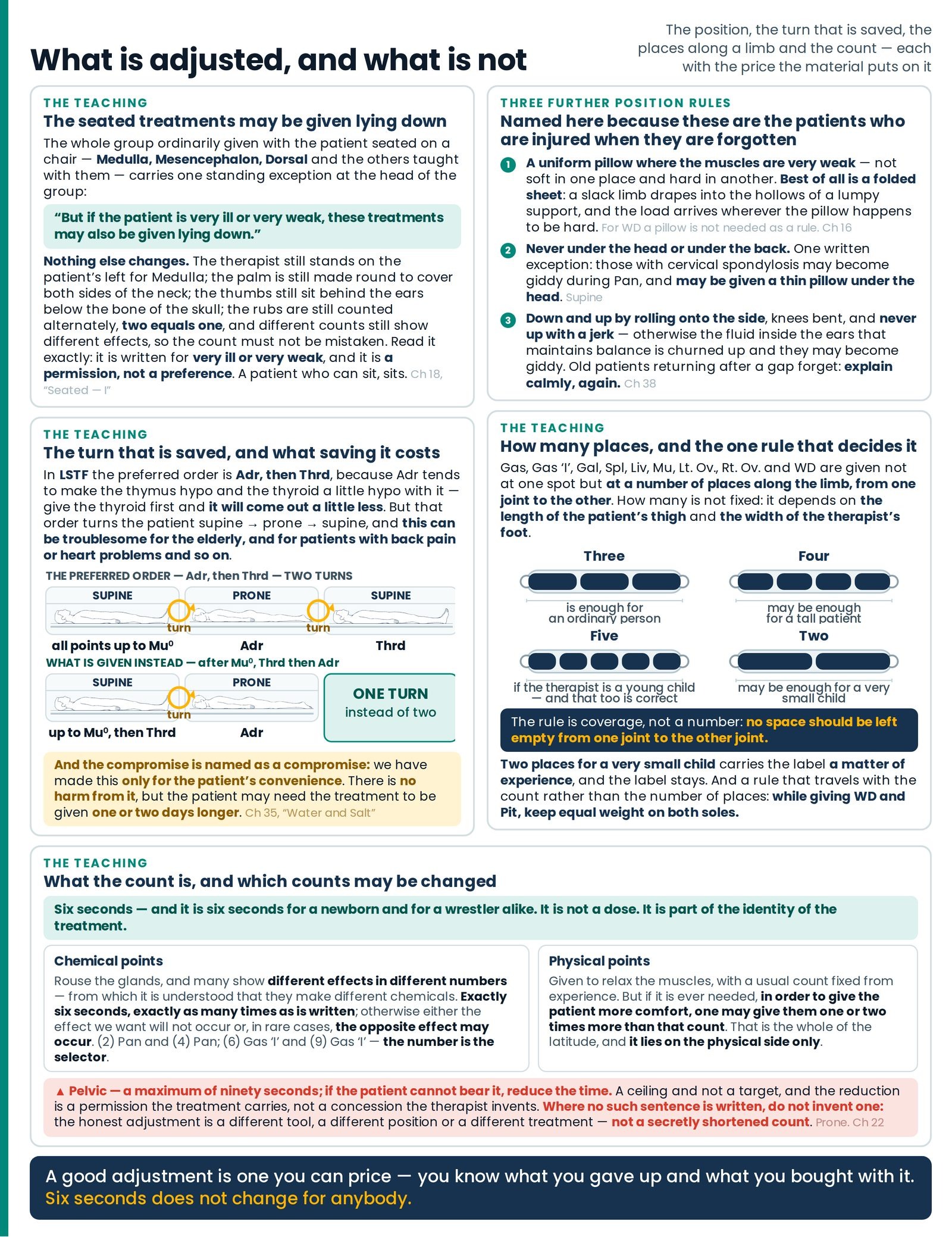
The second adjustment is where the patient's body is put. Two rules do most of the work here, and both are written. (Figure 41.3)
The whole group of treatments ordinarily given with the patient seated on a chair — Medulla, Mesencephalon, Dorsal, and the others taught with them — carries one standing exception at the head of the group:
The seated treatments may be given lying down
But if the patient is very ill or very weak, these treatments may also be given lying down.
Nothing else in those treatments changes. The therapist still stands on the patient's left for Medulla; the palm is still made round to cover both sides of the neck; the thumbs still sit behind the ears below the bone of the skull; the rubs are still counted alternately, two equals one, and different counts still show different effects, so the count must not be mistaken.
Read the exception exactly: it is written for very ill or very weak, and it is a permission, not a preference. A patient who can sit, sits. But it removes at a stroke the commonest reason a frail patient is denied the brain and neck work altogether — that she cannot hold herself upright on a chair for the length of it — and it should be known by every therapist who treats old people.
The second rule is subtler and is one of the most instructive things in this wiki, because it shows a therapist trading a known quantity of effect for a known quantity of comfort, and saying out loud what the trade cost.
In the LSTF formula, the physiologically preferred order gives Adr first and Thrd afterwards — because Adr tends to make the thymus hypo and the thyroid a little hypo with it, so that giving the thyroid first and Adr afterwards will not give a full hundred per cent result; it will come out a little less.
But in that order the patient must be turned supine → prone → supine: all the points up to Mu° are given face up, Adr requires face down, and Thrd face up again.
The turn that is saved, and what saving it costs
This can be troublesome for the elderly, and for patients with back pain or heart problems and so on.
So, in order that the patient should not have too much difficulty, after Mu° we give Thrd first and Adr afterwards — one turn instead of two.
And the compromise is named as a compromise: always remember that we have made this only for the patient's convenience. There is no harm from it, but the patient may need the treatment to be given one or two days longer.
That is the model for every adjustment in this article, and it is worth saying so explicitly. A good adjustment is one you can price. You know what you gave up, you know what you bought with it, and you can tell the patient and write it on the card. We are doing it in this order so that you only have to turn once; it may take a day or two longer. Nobody is deceived, least of all yourself.
Three further position rules bite harder on a small, old or frail body than on an ordinary one. All three are established elsewhere; they are named here because the patients in this article are the ones who are injured when they are forgotten.
The pillow that is uniform. For WD a pillow is not needed as a rule — but if someone's muscles are very weak, then the pillow must be uniform: not soft in one place and hard in another. Best of all is a folded sheet. A slack limb does not hold its own shape over a lumpy support; it drapes into the hollows, and the load arrives wherever the pillow happens to be hard. A folded sheet has no hollows.
No pillow under the head or under the back, unless it is needed. The footnote that runs along the bottom of the whole supine section — place the pillow at the proper place as needed, but never under the head or under the back — is a spine rule, and a thin old spine is where it matters most. The written exception stands: those who have cervical spondylosis may become giddy while taking the Pan treatment, and they may be given a thin pillow under the head. Supine
Lying down and getting up by rolling onto the side. Every patient is taught it; the frail patient is taught it twice and shown it. Down with the knees bent, straightening the legs afterwards; up without a jerk — otherwise the fluid inside the ears that maintains balance is churned up, and they may become giddy. And the material adds a note of manners that belongs particularly here: sometimes even old patients, returning after a gap of some days, forget. Do not ask them why they cannot remember. Explain calmly, again. What is ordinary for us is new for them, so forgetting is natural.
The third adjustment is the most easily missed, because it looks like arithmetic.
Many of the commonest points — Gas, Gas 'I', Gal, Spl, Liv, Mu, Lt. Ov., Rt. Ov. and WD — are not given at one spot. They are given at a number of places along the limb, working from one joint to the other. How many places is not a fixed number. It depends on the length of the patient's thigh and on the width of the therapist's foot, and there is exactly one rule that governs the whole thing.
How many places, and the one rule that decides it
Three places is enough for an ordinary person — but this depends on the length of the patient's thigh and the width of the therapist's foot.
The main issue is that no space should be left empty from one joint to the other joint.
For a tall patient, four places may be enough for an ordinary therapist.
But if the therapist is a young child, then even five places may be needed, and that too is correct.
If it is a very small child, then even two places may be enough. This is a matter of experience.
And a rule that travels with the count rather than with the number of places: while giving WD and Pit, keep equal weight on both soles.
Four things in that teaching are worth separating out.
The rule is coverage, not a number. No space left empty from one joint to the other is the instruction; three, four, five and two are consequences of it in four different situations. A therapist who memorises three has memorised an example.
The therapist's own size is a variable. This is the sentence that surprises students most, and it is the one that proves the rule is about coverage: a therapist who is a child has a narrow foot, so the same thigh needs five placements rather than three — and that too is correct. Nothing about the patient changed. Nothing about the treatment's effect changed. The geometry changed.
Two places for a very small child. Not because the child is delicate; because the child's thigh is short and a palm covers half of it.
And this is a matter of experience is kept exactly where it stands. It is attached to the two-places figure, and it is the wiki's standing label for a rule that rests on observation rather than on a stated mechanism. Preserve it.
Now the count — and here is the thing students expect to be adjustable and which is not.
What the count is, and which counts may be changed
Ordinarily the duration of pressure is six seconds 6 sec , and it is six seconds for a newborn and for a wrestler alike. It is not a dose. It is part of the identity of the treatment.
The wiki divides the points into two kinds, and the two kinds behave differently:
Chemical points rouse the working of the glands. Many of them show different effects when given in different numbers, from which it is understood that they make different chemicals. So while giving them, take care that the pressure is exactly six seconds and is given exactly as many times as is written; let there be no mistake in the count. Otherwise either the effect we want will not occur, or, in some rare cases, the opposite effect may occur. (2) Pan and (4) Pan; (6) Gas 'I' and (9) Gas 'I' — the number is the selector.
Physical points are given to relax the muscles. These too have a usual count, fixed from experience. But if it is ever needed, in order to give the patient more comfort, one may give them one or two times more than that count.
That is the whole of the latitude, and it lies on the physical side only. A frail patient may have a physical point one or two times more for comfort. A frail patient does not get (2) Pan for four seconds because she is frail.
There is a second, separate kind of latitude, and it is written into particular points rather than into the system. The clearest example is the Pelvic treatment, given at the edge of the head of the thigh bone with the leg taken out to the side.
Where a point carries such a sentence, use it. Where it does not, do not invent one: the honest adjustment for a patient who cannot bear a treatment is a different tool, a different position, or a different treatment — not a secretly shortened count.