Two questions, two instruments — and “RA hai”, never “RA positive”
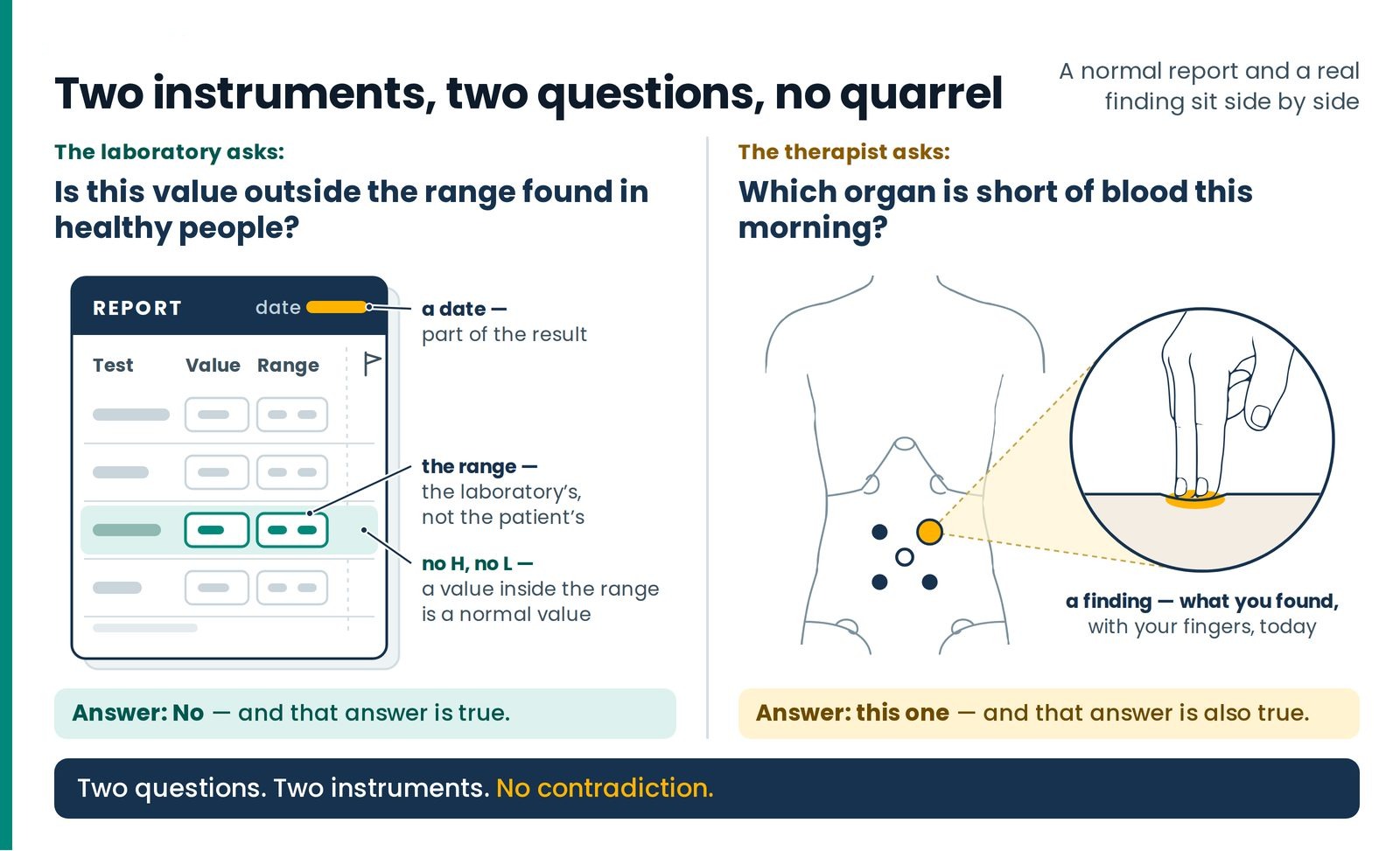
Now the rule this article exists for — the one you will be tempted to break when a patient says "but my report is normal" and you have found four tender points and know you are right. (Figure 12.3)
Key teaching
Never tell a patient that a normal report is secretly abnormal
A normal report is normal.
Not "technically normal", not "they say normal but I can see it is not".
It is untrue — the value was inside the range, and you have no instrument that measures it better. It is unkind — you are taking away the one piece of good news the patient has and replacing it with an anxiety only you can relieve.
And it is unnecessary, which is what students miss: your finding does not need the report to be wrong, because you are not reading the same thing. The laboratory asked: is this value outside the range found in healthy people? You asked: which organ is short of blood this morning? Two questions, two instruments, two answers, and no contradiction between them at all.
We call those patients RA patients in whose blood test report these words are written — RA Antigen Positive or Rheumatoid Factor – Positive. (The factor is also positive in hepatitis, syphilis, liver cirrhosis, SLE, scleroderma and in acute bacterial or viral infection — so positive does not by itself name the disease.) After seeing the report we write on our card the date of the report and, in front of it, RA positive — or ANA positive, where that is what it says.
Two instruments, two questions, no quarrel. The laboratory asks whether a value lies outside the range found in healthy people, and the answer — no — is true. The therapist asks which organ is short of blood this morning, and the answer — this one — is also true. Two questions, two instruments, no contradiction.
Now the finding that belongs to us. Take the middle joint of the ring finger of both hands between your thumb and first finger, press them at the same time, and ask in which hand the ring finger has more pain. All RA patients had a great deal of pain at that joint in both hands. Record Lt. 4ᵗʰ ⁺⁺⁺⁺ or Rt. 4ᵗʰ ⁺⁺⁺⁺, or ⁺⁺⁺/⁺⁺ for less. Left Right
Then the discovery: those who had joint pain but whose blood report was found RA negative had the very same pain in the ring finger, and the same treatment took their pain away — pain in the ring finger is an indicator that this person may perhaps get RA later on. So where a patient has joint pain and either has no report, or the report says RA negative — but we find pain in both ring fingers — we write on that patient's card: "RA hai", there is RA.
Key teaching
"RA positive" and "RA hai" — a rule about what may be written
Remember that on that patient's card, RA positive is not to be written. ▲ Take care
Whether there is a report or not, the treatment of both is one and the same.
That convention holds the ethic of the article: the therapist has a real finding, records it, treats — and does not write down a laboratory result the laboratory did not give. It is the model for what you say: not "your report is wrong", but "Your report is negative, and that is true and it is good news. What I found is a tenderness in one joint of both hands, which tells me which treatment will help you. It does not argue with your blood test."
The same shape covers the back. There are patients with pain on both sides of the waist in whose X-ray report of the back it is written NAD — No abnormality detected. They are not imagining the pain, the film is not lying, and the treatment for them — the Pure Folic Black formula — was arrived at from the pain points, not from the picture.
Read next
The Stiffening Joint The Stiffening Joint — the joint treatment, the same with or without a report
The Low Back The Low Back — waist pain with an X-ray reading NAD
Talking to the patient's doctor
The one-page letter: findings, figures, dates and one question
The patient is standing between two people who have never spoken to each other, carrying messages in both directions she does not fully understand. That is an unfair position for a sick person, and it is easily fixed.
Three things are gained. The patient stops being a messenger; decisions are made by whoever is entitled to make them — when the complaint has gone entirely she goes to her own doctor and asks, "Now I have no pain at all — must I still take the tablets in the same quantity?", and the doctor himself tells her what to do (The History That Cannot Mislead You, When the Hand Must Stop). And the repeat report comes back to you. This therapy keeps one such pair in its record: a patient whose scan reported a few ischaemic foci in both frontal lobe white matter, and whose scan a week later reads "Essentially Normal Study." What makes that worth anything is not the recovery but that somebody else wrote both reports, on dated paper.
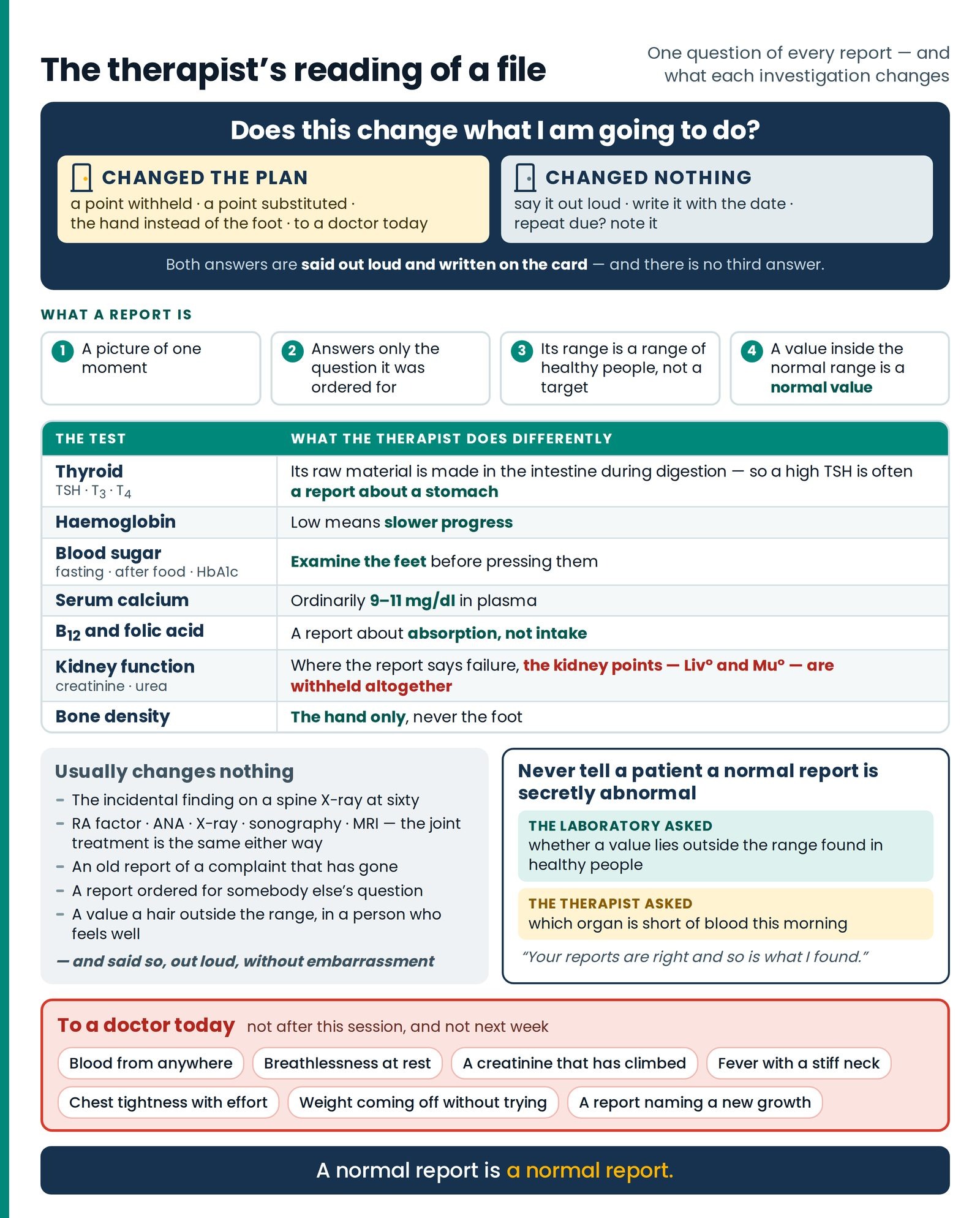
The therapist’s reading of a file. One-page summary: the question asked of every report and its two answers; what a report is; what each investigation changes; what usually changes nothing; why a normal report is never called secretly abnormal; and the findings that send a patient to a doctor today.
Ready to begin?
Send COURSE for course details, or your name, age and health issue for a consultation.